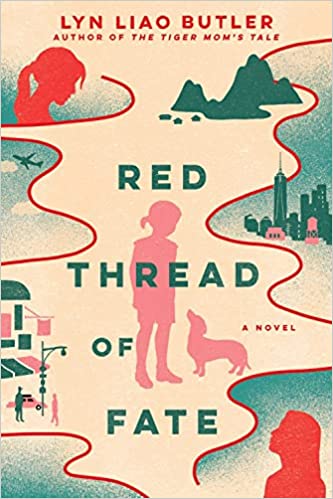
Red Thread of Fate by Lyn Liao Butler

Amid grief, betrayal and exposed secrets, a new widow learns to forge unexpected bonds.

Lyn Liao Butler (The Tiger Mom’s Tale) offers secrets, tragedy, hope and redemption in a novel centered on family and forgiveness. When Red Thread of Fate opens, Tam is on the phone with Tony, her husband. They are a bit short with each other; the marriage has been a little off, but they’re generally headed back on track and preparing to adopt a little boy from China, which both look forward to. Then there is cursing, a roaring sound–and just like that, Tam is a widow. The shocks come quickly, one after another: Tony was not in Manhattan, where he should have been, but in Flushing, Queens, and accompanied by a cousin Tam thought he’d been estranged from for years, killed by the same truck that struck Tony. Then Tam is surprised to be named guardian of the estranged cousin’s five-year-old daughter, even as her son-to-be still awaits adoption in China.

Tam, the California-born daughter of Taiwanese immigrants, and Tony, an immigrant from China, negotiated an uneasy peace with their families and their new lives in New York City, and with each other. Upon her own immigration, Tony’s cousin Mia lived with the couple for nearly two years, before unspecified events broke up the happy household. Now Tam is left to untangle the mysteries of Tony’s life, which seem to multiply the more she learns; Mia’s history is even more enigmatic, but Tam is committed to parenting her orphaned niece. She carries a guilty secret of her own, too.

By nature a shy and private woman, Tam is prompted by her new life–widowed, a single parent, grieving–to accept help, against her instincts. Slowly, she builds a family and a community: taking in her niece, moving toward adoption (which must be renegotiated now that she does not have a husband), deepening friendships and finding new ones, even beginning to mend relations with her mother. This process also involves navigating cultural nuances and divided loyalties. By the time Tony’s secrets come fully to light, Tam is a changed woman, with new strengths and allegiances, and better equipped to meet her many challenges.

Red Thread of Fate is a novel about what ties people to one another, and the nature of those bonds, the unintended consequences of choices and the possibility of a fresh start. With contemplative characters, surprising humor and a twisting plot, Butler’s thought-provoking story of nontraditional family models will appeal to readers interested in fate and identity.


This review originally ran in the December 6, 2021 issue of Shelf Awareness for the Book Trade. To subscribe, click here.


Rating: 6 wontons.

Maximum Shelf: Bewilderment by Richard Powers

Maximum Shelf is the weekly Shelf Awareness feature focusing on an upcoming title we love and believe will be a great handselling opportunity for booksellers everywhere. The features are written by our editors and reviewers and the publisher has helped support the issue.

This review was published by Shelf Awareness on August 23, 2021.


Bewilderment by Pulitzer Prize-winner Richard Powers (The Echo Maker; Orfeo; The Overstory) is a novel of great pain and empathy. Focusing on a nuclear family but also concerned with ecological collapse and the possibilities of distant space, this is a heart-wrenching story with an important message to convey.

Theo Byrne is an astrobiologist: he writes programs to explore, hypothetically, distant planets that may host life. His work is at the nexus of science, coding and imagination. But readers meet him first in a still more important role: that of single parent to Robin, who is just turning nine. Robin is a special child: artistic, caring, intelligent. “So far the votes are two Asperger’s, one probable OCD, and one possible ADHD,” but Theo resolutely resists the push to medicate him. Bewilderment begins with father and son in the Smoky Mountains on a camping trip, intended as alternative therapy following yet another outburst at school. It helps Robin immensely, but the larger world awaits. “The cars, the asphalt, the sign listing all the regulations: after a night in the woods, the trailhead parking lot felt like death. I did my best not to show Robin. He was probably protecting me, too.” Robin will not tolerate lies. But how can Theo tell the truth about just how vicious our world really is?

Theo’s wife, Robin’s mother, is absent. Aly was a tireless animal rights lawyer-activist, fierce and indomitable and loving; both man and boy are daily devastated by her loss, which readers slowly piece together: a car accident, swerving to avoid an opossum. “I didn’t know how to be a parent. Most of what I did, I remembered from what she used to do.” The novel is told in Theo’s first-person voice, in constant interaction with Robin; but Aly is ever present, too, as a voice in Theo’s head and to whom he turns for advice. On leaving the Smokies, he appeals to her: “We’re fine together, in the woods. But I’m afraid to take him home.”

Indeed, back in Madison, Wisc., Robin struggles at school and Theo, trying to care for him, falls behind at work. Planetary exploration and the sciences in general are underfunded and under attack by a government administration that blusters and crows on social media. Theo’s research partner refers to Robin as “the boy.” The school pushes harder to medicate him. Many evenings, Theo and Robin travel together in imagination to distant, dreamed-up planets that just might support life. These interludes are gorgeously rendered demonstrations of love and inventiveness. But the real world continues to rattle.

Another colleague makes an unusual offer. Decoded Neurofeedback, or DecNef, allows patients, or “trainees,” to mimic the moods of “target” subjects using real-time, AI-mediated feedback: emotional training via carefully monitored neural states. At nine, Robin is an unusually young subject, but he also has a unique opportunity. Before her death, his mother Aly allowed her own neural activity to be recorded. Now the precocious, troubled, earnest Robin has access to her mental state.

Theo and Robin share an appreciation for the Daniel Keyes story “Flowers for Algernon,” and its implications are not lost in Robin’s own unprecedented experience. Theo continues to agonize over his parenting, life on Earth and life in the beyond: “Decoded Neurofeedback was changing [Robin], as surely as Ritalin would have. But then, everything on Earth was changing him.” Robin sees enormous improvement in his ability to handle his rages and his blues, enjoying learning widely about the natural world, with a switch to home-schooling. He shows an uncanny harmony with and knowledge of his mother’s mind, enough to unnerve his father. But there will come a reckoning. Theo and Robin live in a recognizable version of the contemporary United States, beset by climate disasters, political upheaval and hate, wildfires, ignorance. Even as Robin makes his way as an increasingly well-adjusted young activist, bad news bombards their family from all sides, until disaster strikes. Bewilderment circles back to the Smoky Mountains for a gut-wrenching finish in the same place where it began. “From behind us, upstream, the future flowed over our backs into the sun-spattered past.”

Powers deserves his reputation as a consummately talented writer. His careful, lyrical prose conveys precisely the intended emotion and tone at the right time, and weaves meanings and significances in complex layers. This superlative novel invites readers to meditate on the natural world, human and animal rights, the potentialities of deep space, the role of science and technology in human societies, the challenges of modern childhood and more. “Maybe humanity was a nine-year-old, not yet grown up, not a little kid anymore. Seemingly in control, but always on the verge of rage.” Robin is a delightful character, a bright, sincere, intense child, lovable and challenging. Theo is deeply sympathetic in his dual tendencies toward far-thinking astrobiology and the care of his child (“They share a lot, astronomy and childhood”), and in his fear that he will fail his son. Powers pulls no punches: he portrays a brutal world that will damage Robin, Theo and all humanity in profound and irreparable ways. Bewilderment is a beautifully told story, but one that hurts, too.


Rating: 8 opossums.

Come back Friday for a follow-up in Powers’s own words.

This Shining Life by Harriet Kline

A family struggles to honor the loss of one of their own and a remarkable boy works to solve the puzzle of the meaning of life in this poignant, loving debut novel.

Harriet Kline’s This Shining Life opens with a brief prologue: a happy family, a joyful party at sunset. Then the tone shifts. “My dad died. He gave everyone a present before he died. He gave me a pair of binoculars. They smell of books that haven’t been read for a very long time.” This is the voice of Ollie, a boy with certain gifts (sudoku, puzzles, literal meanings) and challenges (socks, hugs, turns of phrase). As the novel considers the death of Ollie’s dad from various points of view and at different points in time, Ollie’s chapters will always begin the same way. “My dad died.”

Ollie’s dad, Rich, was spontaneous, fun-loving, kind and a great lover of cheese. He was a devoted husband to Ollie’s mom, Ruth. Ruth’s sister, Nessa, originally set them up; she and Rich had been best friends since college. Ruth suffers from depression, like their abrasive, troubled mother, Angran; Nessa believes in charging in and grasping life in a firm grip, consequences be damned. Rich’s parents, Gerald and Marjorie, are starched and proper where Angran is bohemian (Gerald says it as if it’s a dirty word) and brusque. They are a motley crew, but all devoted to Rich. In this engrossing story of grief, love and mix-ups, Ollie fixates on the puzzle he believes his father has left him, in the presents he left behind. Because of something Rich said, Ollie believes these gifts hold the secret to what it means to be alive. “I want to do that puzzle now. I want to feel happy like he did. All I have to do is get the answers right.” Time jumps around, so that Rich is dead and alive again, as Ollie attempts to track the gifts Rich has sent to his loved ones and discern their hidden meaning.

In a novel about grief and love and continuing on, these characters are heartbreakingly flawed: Nessa’s pushiness, Angran’s rudeness, Gerald’s blustering into dementia. Shifting perspectives do the essential good of enforcing empathy even in the face of quite bad behaviors. As Ollie single-mindedly pursues the solution to his father’s puzzle, the adults around him seem too caught up in their own struggles to aid him; will they rally in time?

This Shining Life is attuned to the importance of setting, including natural spaces like the waterfalls that dominate this family’s neighborhood, and the deep potential significance of objects, like those fraught gifts that Rich gives. It is a sad story, of course, but also joyful, in the style of Rich delightedly offering cheese at his final party. It proposes that grief and love are inextricable, and that there may be light even in pain.


This review originally ran in the May 27, 2021 issue of Shelf Awareness for the Book Trade. To subscribe, click here.


Rating: 8 threads.

Rabbit Cake by Annie Hartnett

Thanks to blog reader Annie Long for the excellent recommendation.

This is a sad, sweet book with an accurately written first-person child protagonist struggling with loss and grief, and with a decidedly odd view of the world, possibly reflecting neurodivergence. (Someone at school calls her ‘retarded.’) If this sounds a lot like the mad originality of The Curious Incident of the Dog in the Night-Time, I thought so too. That earlier novel was so unprecedented it blew readers’ minds; and while this one has a lot in common with that one, I don’t think that makes it a bit unoriginal. It’s still a pretty wild (and wildly unusual) model; there’s plenty of room for more surprises in this area.

“On my tenth birthday, six months before she sleepwalked into the river, Mom burned the rabbit cake.” It was one of the wonderful things about her mother Eva that she made rabbit cakes for all occasions – believed in celebrating all the small events of life. Elvis is ten-and-a-half when her mother dies, and she has questions. For one thing, how could such a good swimmer have drowned? Her mother was a frequent if not constant sleepwalker, and “she was an excellent swimmer in her sleep.” Her mother was a gifted scientist. And besides, her mother’s psychic had always been very clear that Eva would die by suicide.

Elvis is clearly a young person who craves control, and so she sets out to take care of things around the house, because her father surely isn’t; he’s taken to wearing Eva’s lipstick and her bathrobe around the house, and mostly ignoring his daughters. Elvis’s fifteen-year-old sister Lizzie has moved on from beer drinking and breaking her best friend’s jaw (in three places) to a particularly self-destructive sort of sleepwalking (although no sleepswimming). Elvis dutifully sees the counselor at school once a week during recess, until she says something especially disturbing and gets upgraded to daily sessions. Ms. Bernstein instructs her that the grieving process generally takes eighteen months, and so dutiful Elvis marks her chart counting down the days until she will not grieve her mother any more. She also works on finishing her mother’s massive book (working title: The Sleep Habits of Animals and What They Tell Us about Our Own Slumber). Elvis knows a lot about animals – enough to annoy everyone around her, until she gets a volunteer posting at the zoo. She comes across an entry in The Reference Guide to Porcupine Anatomy and Behavior in the zoo’s library that mistakenly relates the echidna to the porcupine when it is closer to the platypus. She makes a note to write to the publisher.

You get the picture: this is a child precocious in some areas and a bit hopeless in others. She indulges in magical thinking, but what child doesn’t? and for that matter, who in the throes of grief? Despite Elvis’s story being completely heartbreaking at every turn (warning, friends: this family also has an old dog. Will it never cease? Don’t ask what happens to the giraffe), it’s also frequently hilarious. There is a strong current of absurdism running through it. Lizzie the sleepwalker and breaker of jaws is institutionalized, and returns home with a pathological liar who the distant and negligent father allows to move in. Lizzie decides what she needs is to set the Guinness World Record for most number of rabbit cakes baked. Most, but not all of them, will need to be decorated. Elvis is driven mad by the delicious smell of baking cakes – which she associates with happy memories of their mother – but she is not allowed to eat any of the cakes, which Lizzie must preserve for her world record. I won’t even tell you about the troubles Elvis gets into at the zoo. Or what she discovers about her mother’s sex life.

Delightful, absurdist, ridiculous, heartbreaking; laugh-out-loud funny in the most morbid ways, if you’re into that sort of thing. (Case in point: the reason Elvis’s school counseling gets upped to daily sessions.) I was frequently quite angry at the adults in this child’s life who consistently, near-criminally fail her; I usually keep my cool with fictional characters better than this. In other words, it’s a deeply involving story, with some very wise points to make about grief in the end. That ending is surprisingly upbeat – or maybe it’s not surprising at all.

I’ll be thinking about Elvis for a long time, and about this singular, weird, troubled, endearing little family. I’m remembering Have You Seen Marie?, another gorgeous meditation on grief in fictional form. Cisneros said about that book that she did not conceive of it as being for children. And even though Rabbit Cake‘s star is a child, I don’t think this is a children’s or YA book, except to the extent that any book is right for the reader who’s ready for it. (Tin House, who does not publish children’s books, has marketed it as simply fiction. Although these labels may be worth less than we think they are.) It’s quite a deep-thinking novel, with nuances to satisfy readers of all levels of maturity, especially those who may need to laugh and cry in the same sitting.


Rating: 9 librarians aptly named Reasoner.

author interview: Natasha Trethewey

Following my review of Memorial Drive: A Daughter’s Memoir, here’s Natasha Trethewey: The Lens of That Burning Question.


Natasha Trethewey is a former two-term United States Poet Laureate and the author of five collections of poetry. She is currently the Board of Trustees Professor of English at Northwestern University. In 2007, she won the Pulitzer Prize in Poetry for her collection Native Guard. Memorial Drive is her second book of creative nonfiction.

Is this the book you thought you were writing when you began the project?
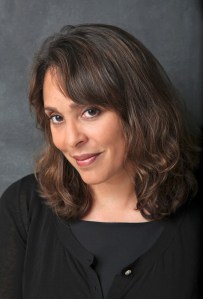
photo: Nancy Crampton

Not at all. When I first said that I needed to do it, it was after I had begun to get a lot of press about me as a writer, after the Pulitzer and after being named U.S. Poet Laureate. Because of that, there were many newspaper stories or profiles in which my mother was mentioned as sort of an afterthought, the backstory. She was basically summed up in a line as this victim to whom this terrible thing had happened, and it really bothered me. I decided that if that tragedy was going to be part of the backstory that was recorded again and again, then I wanted to be the person to write her story, so she would not be simply reduced to a murdered woman. What I wanted to do was to show how important she was, her life, my time with her, her death, and my becoming who I am and becoming a writer. I thought one of the ways to do that was to tell the story of who she was, and I imagined it as more like a sort of biography of her. I would have researched her the way I have researched historical figures I wrote about in poems.

It didn’t work out that way. Instead, I think probably the moment that I looked at Shakespeare’s Sonnet 3, those lines I used–“Thou art thy mother’s glass, and she in thee/ Calls back the lovely April of her prime”–I knew that I was the biography, in many ways. That what she was able to make in me was one of the best records of who she was, and how remarkable and resilient she was.

How did you choose this title? Not person, action, relationship, but place–with obvious allusion to memory/memorializing.

You hit the nail on the head. As a writer I think one of my enduring projects is the drive toward memory and memorialization, and contending with the contentions and overlaps between personal memory and cultural or historical memory, what gets recorded and what gets left out of the record. So I knew that that was my project, because that’s what I was trying to do in Native Guard, that’s what I was trying to do in Domestic Work, is record part of my community, where I grew up in Mississippi, that was disappearing. These old people were dying, and it took me a long time to make that connection, that my mother had literally died on Memorial Drive in the shadow of the largest monument to the Confederacy. And that symbolically had something to do with my drive to memory and memorialization, and insisting that things that often get left out and forgotten are remembered.

It must have been painful in some ways to reenter this trauma. Was it worth it?

Oh, yeah. I mean, it was really difficult, and even now I find that having to talk about her and the book in this way keeps the grief that usually is farther away right up on the surface. So I’m living with it differently now than I usually do. But one of the things that I will never forget is when I first met Dan Halpern, who is my editor, and he had read just a few paragraphs of a scene that I had written when I was proposing the book, and he said to me that he fell in love with her just from that. And I thought, if that’s what can happen then, yeah, it’s worth it. She’ll be remembered. She’ll be known by people. And at least they’ll know what she meant to me. That’s a way of knowing her, too.

When you write a book like this, or in general: Do you write with an audience in mind, or for yourself first?

That’s an interesting question that I hadn’t thought about as related to this book. I think I might answer differently if I were thinking about poetry. Or maybe not. Because I was writing in response to what I told you about at the beginning, the newspaper articles that just recorded her as victim or murdered woman, I really was always having an audience in mind. Someone that I had to say oh, no, no, no–this is who she was, too. But at the same time, I think I must have been writing to myself, because of the things that I learned in the process. I knew many different things by the time I got to the end than when I started. I began to understand more things that I had willfully erased, things that were driving me internally on a subconscious level but that I hadn’t allowed myself to think about consciously. And so in that way, I was revealing myself to myself. Which is of course why for me that other epigraph comes in: “All journeys have secret destinations of which the traveler is unaware.” I didn’t know where I was headed.

And maybe that’s the problem in the question, because how could you ever not be writing for yourself?

Right, but it’s a good question, because it makes you think about the not competing, but the multitude of motivations for writing a book project like this.

How different is the writing of prose versus poetry?

On the most basic level, the silly level, it has always been harder for me to write more. I’ve always been better at writing less. Give me an assignment in a class to write a seven-page paper–somehow I’m not going to be able to get to that. Poems are so much smaller and more compressed; that just seems my natural inclination. But I think that I write prose like that. I imagine there was so much more that could have been in this book and part of this story, but it sort of crystallizes around one or two threads. For me it felt like a very long extended poem that had to do some of the things that I want a poem to do, as it moves, as it turns to certain motifs, certain images, certain words.

Turning to poetry–does a book like Native Guard begin as a project, where there’s a book idea and then it is filled with poems? Or do you write poems and then realize you have a book?

I almost always begin with a problem, some historical question that I want to ask myself, I want to ask the nation. I want to examine and explore from many different angles. When I am focused on something like that, it’s as if I could look at anything and it will somehow be filtered through the lens of that burning question that I’ve been asking myself.

When my students are worried about what they’re going to write about or whether the poems that they’re writing will somehow hold together, I talk to them about their obsessions, the things that we can’t get away from, that have an impact on how we see the world and the things in it. If you trust that, that’s what will come through in your poems, and your poems will hang together more than simply because you’re the person that wrote them. You’re the vision behind them.

What are you working on next?

This book took a lot out of me, and so I’m in a place of trying to fill back up. There are things that I’m interested in, so I’m reading. It has a lot to do with my home state, and cross-mapping memory and memorialization, with Confederate monuments, sites of lynchings, which sort of engrave white supremacy on the landscape. I know that’s what I’m thinking about, so I know that I won’t be able to look at a tree without thinking about it.


This review originally ran in the July 28, 2020 issue of Shelf Awareness for Readers. To subscribe, click here, and you’ll receive two issues per week of book reviews and other bookish news.

reread: Mink River by Brian Doyle (audio)

My father was right to recommend this reread (re-listen) after finishing The Plover. I didn’t even necessarily remember Declan, hero of the latter novel, from Mink River. And while he was definitely present here, and a colorful character, and recognizable from his later role, I was struck by the knowledge that there were many such colorful characters, whose lives might have been pursued in a sequel. And I was struck with grief all over again that we have lost the brilliant, generous, loving, exuberant voice of Brian Doyle too soon from this world. I wanted him to write so many more books.

He was still living when I read (listened to) this book the first time. This time, I felt saddened at many turns, ironically, in appreciating the delightful high spirits and joy and wisdom in his every line. Gosh, but I’m devastated at this loss, all over again and over and over.

But the book itself: still a wonder and a joy to experience. I fell in again with the inhabitants of Neawanaka, particularly the families of Worried Man and Maplehead and Cedar, No Horses and Owen and Daniel; Declan and Grace, of course; and others: Nicholas, Michael and Sarah, and the budding romance (as I see it) between Stella and the doctor. I ached for Moses the crow and the nun, his rescuer and dear friend. I remember listening to this novel for the first time, working out at the YMCA in Bellingham, Washington. It’s funny how memory can transport us into the past. People talk about smell being such a powerful mnemonic, but for me it’s never been as strong as songs and stories, the listened-to. Hearing Worried Man and Cedar share a beer at lunch again took me back to the abductor and adductor machines and sweat, just like that.

As for writing about the book itself, I think I did a pretty good job the first time around, and will let that stand. I will say, about the audio version, it was outstanding a second time; but I wish I had the words in front of me to consult and quote from. So I’ll be finding myself a print copy as well. Consider that the highest of praise.

We miss you, Brian.


Rating: still those 8 bottles.

Late Migrations: A Natural History of Love and Loss by Margaret Renkl

This subtle, searing essay collection examines the griefs of family and of the natural world as one.

Margaret Renkl’s Late Migrations: A Natural History of Love and Loss is a quiet but stunning collection of essays merging the natural landscapes of Alabama and Tennessee with generations of family history, grief and renewal. Renkl’s voice sounds very close to the reader’s ear: intimate, confiding, candid and alert.

Renkl grew up in “lower Alabama,” the adored child of parents, grandparents and great-grandparents: in an old picture, “my people are looking at me as if I were the sun.” Her childhood was lived close to the red dirt, pine needles and blue jays of that space. As an adult, she lives in Nashville with a husband and three sons, and carefully cultivates a backyard garden with bird nests, baths and feeders. These are the backdrops to her observations of nature. “The cycle of life might as well be called the cycle of death: everything that lives will die, and everything that dies will be eaten.”

Sections are headed with simple, natural-world titles (Tomato, River, Thunderstorm) and adorned with illustrations by the author’s brother, Billy Renkl. Within these sections, the essays are brief–often just two or three pages–and can stand alone, but accrue to form a truly lovely larger picture. “Safe, Trapped” handles the duality of protective spaces: that shelter is also captivity. An echo, several chapters later: the realization that her childhood was never the sanctuary she thought it was at the time. Alongside the concern of how to keep loved ones safe, she writes about the natural cruelty of rat snakes, crows and snow.

Late Migrations studies family and loss: the deaths of great-grandparents, grandparents and parents; Renkl becoming a parent herself and worrying over her children. Spending a night in a prewar infirmary on the grounds of an orphanage, dreaming of babies in cages, Renkl goes to the window to view cardinals at a feeder and “watched until I knew I could keep them with me, until I believed I would dream that night of wings.” At about the midpoint of her book, this feels like a point of synthesis. Dreaming of babies in cages and trading them for wings, to “keep them with me,” represents a neat joining of her themes, which are of course not nearly so separate as they initially appear.

This is a book about the labors of bluebirds, red-tailed hawks and cottontails, and about grief: the loss of loved ones, the risks to her own children and the everyday struggles of backyard nests. A book of subtlety and sadness, yes, but also a tough, persistent joy in the present and the future. “Human beings are creatures made for joy,” Renkl writes. “Against all evidence, we tell ourselves that grief and loneliness and despair are tragedies…. In the fairy tale we tell ourselves, darkness holds nothing resembling a gift.” Part of her work in this book is to find and recognize the gift in the darkness, “to reveal it in its deepest hiding place.” Late Migrations is itself that gorgeous, thought-provoking gift.


This review originally ran in the June 11, 2019 issue of Shelf Awareness for the Book Trade. To subscribe, click here.


Rating: 8 bluebirds.

I sat reading, in Renkl’s chapter “Bluebird” at a state park in North Carolina, about bluebirds nesting in bluebird boxes. And I looked up to see a male bluebird, brightly feathered, ducking into a bluebird box, his anxious, drabber mate sitting on top and watching me and my little dog with concern. I couldn’t believe it: I looked down at the page, up at the bluebirds. We were a dozen feet apart. I kept reading and watching as the couple kept up their cycling through the box – she got a little more comfortable with me over time, but stayed watchful. A rare experience.

Scott Russell Sanders in recent Orion, Brian Doyle, and considering death

A synchronicity: my father sent me a recently published essay by Scott Russell Sanders that coincides with some reading and thinking I’ve been doing lately.

The essay occurred in the Autumn 2018 issue of Orion, which you can purchase here, but cannot read without purchasing – sorry. It’s called “At the Gates of Deep Darkness,” and it is about the dire cancer diagnosis of Sanders’s son, Jesse, who is 40 and has young children. In it, Sanders tries to navigate grief, and the intersection of his religious upbringing with his devotion to science, his love for this world and his sadness & anger at Jesse’s coming end.

It’s an essay I appreciate in many ways: for its language, its attention to detail, its careful plotting of divergent beliefs and feelings, and its place within Sanders’s body of work. I enjoyed his listing of “great pioneers such as Emerson, Thoreau, Muir, Leopold, and Carson, as well as accomplished contemporaries such as Barry Lopez, Terry Tempest Williams, Chet Raymo, John Elder, Kathleen Dean Moore, Pattiann Rogers, and David James Duncan” – what a list! – with whom he has some things in common. I really do recommend it.

But, separately, what is interesting about this as synchronicity is my recent reading of Brian Doyle’s short essay “Joyous Voladoras,” which you can read here. It was assigned by Matt Ferrence* for his seminar, and when Matt and I got a chance to talk more later, he told me it’s an excerpt (?) or vastly shortened version (?) of Doyle’s book The Wet Engine, which I have not read but of course want to. It’s about the heart – the hummingbird heart, and Doyle’s own. The book makes it clear, though, that this interest in the heart was inspired by his very young son’s need for open heart surgery.

His son survived, and is now an adult, and Doyle has since died (in 2017). When my father sent me the Sanders essay, he said it “presents us, like Doyle does, with a thoughtful writer wrestling with faith in real time in public.” Pops means Doyle wrestling with his own mortality, as he did while dying very quickly of brain cancer. But fresh off “Joyous Voladoras,” I thought of the even closer parallel, of worrying for one’s child.

Grief, obviously, is one of those universal topics. Sanders acknowledges, “In sharing this personal story, I do not mean to impose my grief on readers, for we all have more than enough griefs to bear, both public and private.” Even grief for a child is common enough. But for artists such as Sanders or Doyle, there is still something to offer. Sanders continues, “I tell of Jesse’s cancer because it has made clear to me the persistence of those questions, intuitions, fears, and longings that inspired my early devotion to church-going and Bible-reading. I still puzzle over the sources of suffering; I still experience wonder and terror and awe; I still yearn for a sense of meaning; I still seek to understand the all-encompassing wholeness to which I belong.” And onward. This is why we read, and this is why we write.

Among the lines that I marked in Sanders’s essay:

My calling of Jesse’s name is timed to the rhythm of my footsteps, my breath, my heartbeat. A mother’s heartbeat is the first sound we hear. Once outside the womb, we respond to that rhythm in the beating of drums, in the bass notes of music, in the iambic pentameter of poetry.

The heartbeat, again, took me back to Doyle and the hummingbird heart, which comes to be everyone’s heart. The unique and the universal.

Do go read Doyle – it will take only minutes, and you’ll feel so much. And consider that issue of Orion, which I imagine contains other gems than this one. Consider too the full-length Doyle book, which I’ve added to my to-do list (Dog help me). Thanks for following me on this winding path today and always.


*Matt Ferrence was a guest faculty member at this most recent residency at my MFA program, at West Virginia Wesleyan College. We really hit it off and had several good conversations; I’m glad to know him and although I haven’t read it yet, I’m confident that I can recommend his book Appalachia North, forthcoming on February 1! (There will be a review here, eventually.)

The Shades by Evgenia Citkowitz


Note: I am away for my residency period at school for two weeks or so. This is a previously scheduled post. I will respond to comments, but not as quickly as usual. Thanks for your patience, and thanks as always for stopping by.


In this atmospheric story, a grieving family splits, each suffering more or less alone, until a stranger comes to visit their mysterious old house and throws them off-balance even more.

Evgenia Citkowitz’s first novel (following a short story debut, Ether) is a captivating, mysterious story of family, love and grief. The Shades centers on Catherine and Michael, a year after their teenaged daughter, Rachel, died in a car wreck. Their son, Rowan, insisted on going away to boarding school immediately after losing his sister.

Catherine has withdrawn to the country, to the apartment in a subdivided manor where she and Michael had hoped to retire. She lets the mail pile up, doesn’t answer the phone and neglects her previously successful London art gallery. Meanwhile, Michael continues to work and live in the city, where he fails to find comfort in architecture–his passion–and tries to reconcile himself to his troubled marriage: “their lives ran parallel but never together or intersecting.”

The estate where Catherine has retreated is a focal point–this historic house whose design elements enchant her husband, but whose empty rooms, with both children gone, haunt her. When a young woman shows up at the door saying she used to live there, Catherine grasps at her like a drowning woman. In this potential for new friendship, she clearly sees a lifeline. But this visitor, whom Catherine calls simply “the girl,” may not be what she seems.

Catherine’s career as a tastemaker in the fine arts, and Michael’s in architecture and real estate, provide just a few of the many threads that combine for this story’s rich tapestry. The history of Catherine’s family (her father’s art, her mother’s instability); Rachel’s burgeoning romance, revealed only after her death; Michael’s courtship of the ever-aloof Catherine; Rowan’s attempts to carve out an identity for himself apart from his family: these are significant supports to Citkowitz’s plot. Strangely, that plot, involving the mystery girl and a flash-forward opening to the book that is not resolved until the final pages, is less sharply executed, less beguiling than the details that render this family so realistically. The meticulous portrayal of characters, the flaws and struggles in their relationships and a gloomy, atmospheric tone are the greatest accomplishments of The Shades.

A subtle plot element involves the myth of Orpheus and Eurydice, in which Orpheus tries to bring his beloved wife back across the River Styx following her death, but fails because he does not follow Hades’ instructions. Foreshadowed briefly by an opera at which Michael and Catherine’s romance began to bloom, this myth offers a lens for interpreting their grief, and the damage it will wreak on their family. Readers with a careful eye or a familiarity with mythology will recognize this thread; the rest will be none the poorer for having missed it in a novel rich with pathos and agony, but also simple humanity: love, loss, grief, hope and deceit.


This review originally ran in the June 8, 2018 issue of Shelf Awareness for the Book Trade. To subscribe, click here.


Rating: 7 lilting rhomboids.

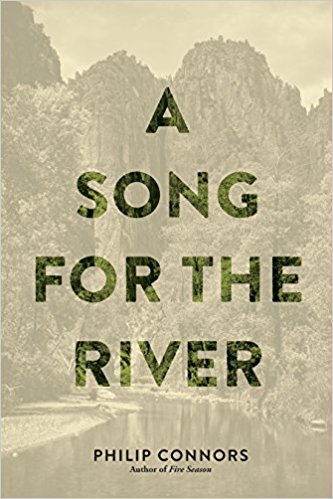
A Song for the River by Philip Connors

Philip Connors’s first book, Fire Season, changed my life and the way I thought a book could work. I’m still reeling. I need to find time to reread it someday.

His second, All the Wrong Places, worked on me differently but still impressed.

Along the way I got to meet the author and consider him a friend, although not one I’ve kept in touch with closely in the last few years. His new publisher’s email about a third book actually caught me by surprise–very, very happy surprise. I was of course thrilled to get an advanced reader’s copy, in exchange for my honest review (although I can’t at this point claim I’m unbiased about Phil’s work).

A Song for the River is a sort of sequel to Fire Season. In one sense, it’s a third memoir, and therefore refers to the events of the first two books, because all three track the life of an individual. But they do more work than that, too.

Fire Season was about the narrator’s work as a fire lookout in the Gila National Forest. It’s a personal story, a memoir, yes; but it’s also about the history of fire management in the United States, the flora and fauna of one mountain in one forest, about solitude and philosophy and the ways we deal with grief, and so much more. It’s nature writing, political writing, personal writing. All the Wrong Places concentrates more, on a particular loss: a brother’s suicide, and the narrator’s search for answers, and his self-destructive behaviors along the way. A Song for the River returns to Connors’s mountain and forest, and to some of the larger themes and breadth of Fire Season.

Since the timeline of that first book, the narrator has been through a divorce; suffered severe medical issues; lost several people he loved deeply; and seen epic wildfires tear through the wilderness he’s come to feel a part of. Amid loss and pain, he writes, “I found I wanted nothing so much as to be near moving water.” In ways that feel familiar to fans of Fire Season, Connors tracks a number of themes and challenges–pain, grief, personal inquiries–through the physical space of the Gila, with detailed attention to its trees, mosses, grasses, flowers, insects, birds, fish, and mammals. Where in his first book he devoted space to fire management policies and their effect on the natural world, here he adds a new concern: attempts to dam the Gila River, the last wild river in New Mexico and one of a small and shrinking number nationally. Among the people he mourns in this book are a dear friend and fellow fire lookout, “a forest guardian while he lived,” and a young woman he calls an inspiration, “a river guardian while she lived.” He undertakes to help protect the wild river in their honor, and to be closer to them, “gone before me in ash down the river.”

As he visits and revisits a river and travels through this wide range of topics, Connors profiles a number of people: the two in particular that he mourns, as well as other fire lookouts and sundry characters. He studies griefs, and physical pains and ailments, and questions what does and does not belong in nature writing (not, he feels sure, a discussion of his prostate troubles, and yet here they are). He explores themes of empathy and humility, ponders Catholicism, and investigates the nature of friendship and the unavoidable blank and blurred spaces in any attempt to write about a life.

There are refrains.

I reviewed my life and it was also a river, Herman Hesse wrote, in the voice of Siddhartha, a line that stayed with me through the years. Whenever I recalled it, I felt an impulse to revise it for my own purposes and replace the word river with the word fire: I reviewed my life and it was also a fire.

More than a hundred pages later,

On one quiet stretch of water I looked up at the tiered mesas above us and felt it might be true that my life was both a fire and a river, depending on the moment and the vantage from which it was viewed–and never more like a river than in moments like this.

To me, this pair of lines brings together so much of all three of Connors’s books: fire, river, duality and commonality, the connectedness of all things, human and nonhuman, from the obvious and literal fire in book one to river in book three and through the figurative fires of book two, ending in a synthesis: fire and river being one in the way that watershed and ash are part of a unified cycle. Late in the book, Connors references Puebloan beliefs: water moving from sky to earth to soil to plant to animal to death to sky again as a cycle. “The ebb and flow of drought and flood are like the pulse in a human body,” water as blood and nutrients moving through arterial systems in body and on earth. As a writer and a student of writing, the way this book closes these circles is deeply admirable to me. This kind of work can be done too neatly, but Phil allows the world to stay complicated.

I remember feeling this way when I tried to review Fire Season: I am not up to this task, putting into words why these words are so powerful. A Song for the River is deeply sad but deeply beautiful, full of love and truth. I expect it’s something like what Phil felt, trying to properly eulogize, honor, and remember his friends, and feeling less than able to do the job they deserved. This book is essential. I hope you love it, too.


Rating: 10 firm and well-placed fingers.