Teaser Tuesdays: Mary McGrory: The First Queen of Journalism by John Norris

Teaser Tuesdays is a weekly bookish meme, hosted by MizB of Should Be Reading.

mary mcgrory

I am reading a delightful biography of a groundbreaking newspaperwoman, who wrote book reviews (ahem!) before her political coverage began; she would cover 12 political campaigns (and everything in between) in her lengthy and influential career. I am reminded somewhat of Newspaper Titan. But John Norris can tell it better than I can, of course.

In many ways, Mary was as much an anolmaly at the end of her career as she was at its beginning. When she broke through, during the Army-McCarthy hearings, she was the lone female reporter in the room. On the campaign trail, she was one woman surrounded by a hundred men. By the end of her career, she was working in an environment where there were more and more women, most female reporters were married, and employers like the Post provided maternity leave and benefits. To this new generation of women, Mary was a throwback: the woman who took on McCarthy and Nixon; the pioneer who was forced to decide between career and love; a beloved relic from an earlier era who drank with the Kennedys and crafted handwritten thank-you notes. Mary had gone an entire career without ever being the norm.

Stay tuned for my review of the book, followed by my interview with the author.

This quotation comes from an uncorrected advance proof and is subject to change.

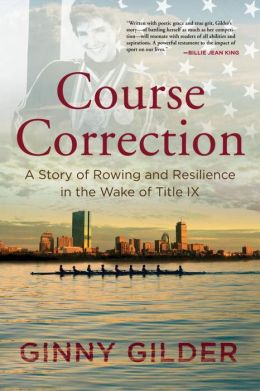
Course Correction: A Story of Rowing and Resilience in the Wake of Title IX by Ginny Gilder

The exertions of rowing crew under Title IX, as a means to overcoming one woman’s demons.

course

Ginny Gilder made her way from a privileged Upper East Side life in New York City to Yale University in 1975, in the early years of Title IX, which legislated equal educational opportunities for both men and women in all areas, including athletics. Ginny had never been an athlete; her family instead emphasized business success and keeping up appearances. But she was drawn to the grace, beauty and seeming effortlessness of rowing, and against the coach’s instincts, joined the Yale crew. The story she tells in Course Correction of collegiate competition, gender discrimination, the long road to the Olympics and personal growth, also yields Ginny’s eventual healing from the emotional traumas of a well-concealed family history.

In four sections titled Catch, Drive, Release and Recovery–the four parts of a well-executed rowing stroke–Gilder details the corresponding segments of her life. Rowing captures her passion; she drives herself through injuries and health problems to an eventual Olympic medal; she learns to let go; she forms a successful family of her own, despite a damaged past.

Gilder’s prose is earnest, heartfelt, expressive and clearly strongly felt. Her narrative will appeal to sports fans and readers dedicated to memoirs of pain and redemption. Course Correction touches on the injustices that Title IX was designed to correct (including a memorable scene involving a nude protest), and portrays a painful, affecting and impressive athletic career. But it is centrally a story of one woman’s lengthy and hard-won coming-of-age and coming home.


This review originally ran in the April 24, 2015 issue of Shelf Awareness for Readers. To subscribe, click here, and you’ll receive two issues per week of book reviews and other bookish fun!


Rating: 7 ankle bracelets.

book beginnings on Friday: Course Correction: A Story of Rowing and Resilience in the Wake of Title IX by Ginny Gilder

Thanks to Rose City Reader for hosting this meme. To participate, share the first line or two of the book you are currently reading and, if you feel so moved, let us know what your first impressions were based on that first line.

course

I’ve only just begun this one, but it’s good from the get-go. How about this opening paragraph:

A well-rowed shell is art in motion. It moves smoothly. Stroke after stroke, oars drop in the water and come out together. The rowers’ bodies swing back and forth in sync, performing the same motion of legs, backs, arms at the same instant; no extraneous shrug of shoulders, flick of the wrist, turn of the head, shift of the seat. The result – perfectly spaced swirls of water trailing the shell’s wake – offers the only visual cue of the speed these on-water dancers live to create.

I’m a sucker for poetic praise of athleticism, and it looks like this story has a few other points in its favor, too. Stay tuned.

This quotation comes from an uncorrected advance proof and is subject to change.

Maximum Shelf: Spinster: Making a Life of One’s Own by Kate Bolick

Maximum Shelf is the weekly Shelf Awareness feature focusing on an upcoming title we love and believe will be a great handselling opportunity for booksellers everywhere. The features are written by our editors and reviewers and the publisher has helped support the issue.

This review was published by Shelf Awareness on March 4, 2015.


spinster

“Whom to marry, and when will it happen–these two questions define every woman’s existence, regardless of where she was raised or what religion she does or doesn’t practice… even if the answers are nobody and never.” Kate Bolick explores her own answer to the classic questions, arduously and over the years of her own life; she examines their place in society, and the way other women she admires have answered them, mining the lives of female writers who have affected her. The resulting book, Spinster: Making a Life of One’s Own, is less a polemic than one might expect, and more a thoughtful, generous consideration of our world, and a woman’s best options to honor herself.

Bolick begins with her family background, her loving parents and brother, and her home in Newburyport, Mass. In a personal and family tradition of talking, reading, discussing and writing, Bolick naturally gravitates toward literary models for the life she hopes to build. After her mother’s death, she seeks to re-create the conversations they used to share, “not with other, real, live women… but real, dead women, whom I could sidle up to shyly and get to know slowly, through the works they left behind and those written about them.” In the opening pages, she introduces her five “awakeners,” women of the written word who have offered her lessons about how to live as a woman, married or not. These awakeners are an essayist, a columnist, a poet, a novelist and a social visionary (although each, of course, crosses over and between those categories).

Maeve Brennan (1917-1993), essayist at the New Yorker, offers a loving picture of single city life and an admirable sense of style. She will also come to provide a frightening negative version of the stereotypical single woman’s final days. Neith Boyce (1872-1951), columnist at Vogue and representative of the Bachelor Girl, supplies a glimpse into the life of working women, a novel possibility in her time; although as Bolick points out, the chance of sex or sexiness in the workplace presents a “negotiation [that] continues today.” Edna St. Vincent Millay (1892-1950), poet and legendary lover, brings revelations. “Her legacy wasn’t recklessness, but a fierce individualism that even now evades our grasp.”

Edith Wharton (1862-1937), novelist and grand dame (“society’s favorite version of the single woman”), built herself a house, the Mount, with two rooms of her own, a public “boudoir” for entertaining and a spare bedroom in which to do her writing. She represents a model for the prioritization of one’s work, and also for the work Bolick reluctantly takes on in editing a luxury decorating magazine: rather than mere frivolity, this focus offers another opportunity to get to know herself. Charlotte Perkins Gilman (1860-1935), social visionary and prolific writer (of The Yellow Wallpaper, for example), inspires self-improvement and a different way to go about making a home.

Bolick tells her own story chronologically. As she discovers each of her five awakeners (a term borrowed from Wharton) and the lessons she finds with them, she changes jobs, moves from Newburyport to Boston to New York City, and dates and cohabitates with different men (referred to only by the first letter of their first names). She started using the word “spinster” in her journals in her early 20s, and always considered it a positive appellation, one posing possibility. Her evolving interest in spinsterhood is tracked by all of these layered journeys, the lives and writings of the awakeners interspersed with her own. Along the way, she also makes brief calls on Virginia Woolf, Mary McCarthy, Anne Sexton, Annie Dillard and others. Bolick acknowledges that the subjects of her investigations are all like her: straight white women of New England; diversity is not her focus.

Spinster‘s tone is charming, by turns confessional, collegial and academic. Bolick’s erudition is leavened by a playful, casual tone, even as she references Shakespeare and the Lernaean hydra in a single page. Not only a memoir, Spinster employs research into the lives of the five profiled writers, as well as into history and sexual politics. As the narrator of this voyage, Bolick is amiable, credible and fun to know.

Interestingly, all five of the awakeners eventually married, in some cases more than once. While it thoughtfully contemplates the possibilities for and arguments in favor of women remaining unmarried, Spinster is not a mandate. Bolick does not insist upon spinsterhood for her readers. Rather, she offers assistance in “holding on to that in you which is independent and self-sufficient,” whether single, happily or unhappily coupled. The word “spinster,” and all it entails–and Bolick makes great strides toward the proud and pleased application of this embattled historical term–is thus a tool for our individual contentedness.

Entertaining, wise and compassionate, Spinster is the result of Bolick’s lifetime of meditations, ruminations, angst and joy; of research, reading and appreciation of five intriguing lives; of dating, moving in with someone and time spent alone. While allowing that the coupled lifestyle is fine for some, Bolick’s message for readers is a celebration of the delights, challenges, and opportunities of remaining single.


Rating: 8 women.

Come back tomorrow for my interview with Bolick.

Teaser Tuesdays: Spinster: Making a Life of One’s Own by Kate Bolick

Teaser Tuesdays is a weekly bookish meme, hosted by MizB of Should Be Reading.

spinster

There is a lot to love about this book, in which a fun, intelligent woman discusses singledom and the arguments in favor, while exploring the lives & writing of those who’ve gone before her. A Maximum Shelf is coming. For now, I wanted to share these charming lines.

Because I’d started contributing to magazines and newspapers as a graduate student, the transition was seamless enough, save for the fact that reviewing books makes it very easy to never go outside.

I certainly identify, Kate. Here’s to continuing to make an effort to go outside (& also loving what we do).

This quotation comes from an uncorrected advance proof and is subject to change.

movie: She’s Beautiful When She’s Angry (2014)


I’m really pleased to have gone to see this movie locally with my dad. It was so good that I went back a few days later to see it again with my mom, so now it’s a family affair (as these things should be). She’s Beautiful When She’s Angry is a recently produced history of the women’s movement of the 1960’s and 70’s. It was nice to see it with my parents, who were there, and involved.

The movie includes historical footage of protests, speeches, news media, and interviews; contemporary interviews of activists who were involved in that history; the odd performances by actors; and reenactments. So many things struck me, and I’d like to point out that while I was often shocked by the horror, and the bravery, I was not surprised. Does that make sense? For example, the divisiveness of the movements – civil rights, women’s rights, peace – is unsurprising but will shock and dismay me every time. When a woman leader got up to speak in front of a crowd of “New Left” men, and they booed and catcalled her, I was (sadly) unsurprised, but astounded nonetheless. When the women’s movement ostracized its lesbian members, likewise.

"Lavender Menace," photo credit: Diana Davies, accessed here

“Lavender Menace,” photo credit: Diana Davies, accessed here

I enjoyed learning for the first time about the “Lavender Menace” action at the Second Congress to Unite Women in New York City on May 1, 1970. The need was unfortunate, but the demonstration was great fun, gave me joy. For that matter, another of the revelations of this film, for me, was the sense of fun associated with certain direct actions throughout the movement: that’s a part of the story that I hadn’t heard before, I don’t think. I also didn’t know how close we had gotten to having legislation passed supporting universal child care (thank you Nixon for this among other criminal shortcomings).

The first night I saw the movie, it was followed by a panel discussion with faculty members from local Western Washington University. These women were younger than I’d expected, in their thirties and forties, and the theatre was sold out – all good signs. We touched on the movie’s title: a criticism of the patronizing statement that we’re cute when we’re mad? or a sincere celebration of every woman’s beauty as she pursues right? (I think it’s both.)

I’m glad to have been reminded of that slogan of the women’s movement, that “the personal is political.” I’ve used some variation on this myself, because it makes so much sense: when politicians talk about forcing ultrasounds, we are quite literally talking about the inside of my reproductive organs; what could possibly be more personal? And I’m sure I knew on some level that I was citing my parents and their fellows, but I’m glad to have been reminded.

I cried when the movie got to present-day Texas, all those women in the capital protesting Senate Bill 5. I’m sorry I wasn’t there; I should have been there. Other interesting or affecting points in the film: the portrayal of our rage as a good thing (when emotion has come to be something we’re supposed to be ashamed of); and the excellent statement that the United States doesn’t like to credit radical movements with positive change in our history. Of course this only makes sense: it doesn’t behoove the powers to acknowledge that protest and civil disobedience do good. But revision of our history is a vile and insidious weapon being used all around us, and it bears noting (over and over again). Another statement of the film – I forget who made it – is that merely speaking truth aloud is a revolutionary and powerful act. Let’s not forget it.

"8-26-1970 March," photo credit: Diana Davies, accessed here

“8-26-1970 March,” photo credit: Diana Davies, accessed here


Thanks, ladies. I owe you.


Rating: 9 consciousness-raising groups.

Older, Faster, Stronger: What Women Runners Can Teach Us All About Living Younger, Longer by Margaret Webb

An amiable and instructive memoir about achieving and maintaining competitive fitness at any age.

older

Margaret Webb (Apples to Oysters) was a successful young athlete and an active adult, but never suspected she might be a marathoner. Staring down her 50th birthday, she became curious about what she could accomplish. She knew there were competitive women runners several decades her senior; could she join their ranks? Older, Faster, Stronger covers what Webb calls her “super-fit year.” And as her subtitle states, the lessons she shares are valuable for men and women of all ages, in any sport.

With the luxury of being able to devote her time and energy primarily to training, Webb engages expert nutritionists, personal trainers, coaches, sports psychologists, aging specialists, physiologists and laboratory researchers. She has her maximal oxygen consumption tested (twice); adds cross-training, gym time and track workouts to her running schedule; travels; and brunches with world champion septua-, octo- and nonagenarian women. She sets goals: to qualify for the Boston Marathon under the fastest women’s standard (the qualifying time for 18-to-34-year-old women) and to be competitive in the half-marathon at the World Masters Games.

Webb is meticulous in applying her results stringently to her own life and documenting them for her readers. Her research appears thorough, although the more fastidious reader may be frustrated by the absence of citations. Older, Faster, Stronger is packed with statistics and studies, but is well explained, so the reader will find the science easily digestible. Athletes of any sex, age and discipline can benefit from–and be entertained by–Webb’s approachable investigation of becoming faster and stronger into advance age.


This review originally ran in the October 10, 2014 issue of Shelf Awareness for Readers. To subscribe, click here, and you’ll receive two issues per week of book reviews and other bookish fun!


Rating: 8 minutes.

How to Build a Girl by Caitlin Moran

The self-made girl of Caitlin Moran’s debut novel is irreverent, painfully self-conscious, triumphant and very funny.

moran
The wise and hilarious Caitlin Moran (How to Be a Woman; Moranthology) makes her first foray into fiction with How to Build a Girl, and this novel is everything her fans will expect it to be.

It is the early 1990s. Johanna Morrigan is 14 years old and lives in Wolverhampton, England, with her parents and four siblings: an older brother, a younger brother and two babies without names (known long-term as the Unexpected Twins). They are all on government assistance, or benefits. Her mother is depressed and her father is still distributing the demo tapes of his youth, sure that one day he’ll be a rock star. Johanna is desperate to leave behind Wolverhampton, benefits and her virginity.

Her big chance comes when she scores a television appearance during which she will read aloud her prize-winning poem on the theme of “Friendship.” However, she fails to make her family proud, instead surprising even herself with a shameful impromptu Scooby-Doo impression. Deciding that being Johanna Morrigan is a losing proposition, she sets about methodically building the girl she wants to be: she christens herself Dolly Wilde (after Oscar’s niece), and decides to become a music critic. With no money to acquire the latest albums, however, she is resigned to ordering them through the local library.

Dolly Wilde is constructed on the music of Hole, Bikini Kill, David Bowie and Kate Bush; the writing of Dorothy Parker, Orwell and Kerouac; and a blind ambition to reach London. She sends in one album review per day for 27 days until, amazingly, she is hired to review albums and performances for Disc and Music Echo. From Dolly’s very first encounter with live music, this gig ushers in an era of drink, sex and eventually drugs; she happily pursues the lifestyle of the rock stars she admires, but is challenged to reconcile this new life with her household of seven back at home in Wolverhampton.

In order to fall in love with the clumsily charming and often heartbreaking Johanna, readers will want to check their inhibitions regarding four-letter words and copious masturbation. Puzzles as stale as the difference between love and a casual hookup become fresh in this young woman’s vigorous, enthusiastic and ever-misguided perspective. Moran is cheeky, intelligent, thought-provoking and laugh-out-loud funny, and reminds us that we are always learning and rebuilding, no matter our origins.


This review originally ran in the September 9, 2014 issue of Shelf Awareness for the Book Trade. To subscribe, click here.


Rating: 9 cigarettes.

book beginnings on Friday: Older, Faster, Stronger by Margaret Webb

Thanks to Rose City Reader for hosting this meme. To participate, share the first line or two of the book you are currently reading and, if you feel so moved, let us know what your first impressions were based on that first line.

older

I am well pleased with this current read, and want to share.

A year ago, at age 50, I set out on a journey to run my way into a younger self. Just as Henry David Thoreau set off for the wilds of Walden Pond to enter a solitary relationship with nature and understand how to live well, I wanted to enter a deeper relationship with my body and understand how to train it well.

These first two lines tell you what the book is about. This lucky woman spends a year studying on how to be the best marathon runner she can be, with all sorts of science & experts to back her up, and shares with her reader what she has learned. Stay tuned; I like it.

This quotation comes from an uncorrected advance proof and is subject to change.

Lisette’s List by Susan Vreeland

Like Vreeland’s previous novels about women in history and art, Lisette’s List is heartfelt, loving and lovely, and asks difficult questions beautifully.

lisette

In Lisette’s List, Susan Vreeland (Clara and Mr. Tiffany; Girl in Hyacinth Blue) lovingly portrays Impressionist, Post-Impressionist and Modernist French art by way of a modest fictional character in Provence.

In 1937, newlyweds Andre and Lisette Roux move from France’s vibrant capital to the pastoral southeastern town of Roussillon to care for his grandfather, Pascal, who has written that he is dying. A passionate Parisian, Lisette is at first miserable in the backwater town, and infuriated when Pascal turns out to be healthier than he let on: he simply wanted their company, and to share what he remembers about the famous French artists he has known.

But Lisette is as fervent about art as she is about Paris, and Andre has trained in his grandfather’s trade of carving fine frames for fine paintings. She is captivated by Pascal’s collection of seven paintings: by Cézanne and Pissarro, and one possibly by Picasso. As a miner in the nearby ochre mines and later a pigment salesman, Pascal made the most of his access to these men, and now shares his recollections with the rapt Lisette–as well as his wisdom about life and love.

By the time Pascal eventually dies, Lisette has made a home of sorts in Roussillon; her love for the paintings further compels her to stay in Provence when Andre hides them (for fear of their destruction or seizure by German troops), not telling even Lisette where they’re stowed. Andre then enlists to fight for France, and Lisette is left alone, waiting for both the safe return of her husband and a reunion with the artwork.

Over the next decade and more, Lisette keeps a list of “Lisette’s Hungers and Vows.” Inspired by Pascal and his paintings, Andre’s love and the quiet strength and beauty of the Provençal surroundings, she pledges to “learn what makes a painting great,” “learn how to be self-sufficient” and “love without reservation.” She meets Marc Chagall and his wife, Bella, who are hiding in a nearby town. Upon receiving a gift painted specially for her by Chagall, she begins her own art collection and narrative. But war necessarily brings tragedy as well as new beginnings. Lisette will experience love and loss, joy and deep pain; learn animal husbandry as well as art history; and parse the moral questions raised under Vichy French rule, as the years go by. She finds new friends, undertakes small favors and large sacrifices, all in times of war and recovery, amid the paintings she loves so. Readers will likely rush through the lovely Lisette’s List, only to be bereaved when the final stroke is painted and the portrait is complete.


This review originally ran in the August 4, 2014 issue of Shelf Awareness for the Book Trade. To subscribe, click here.


Rating: 8 pieces of marzipan.