Teaser Tuesdays: The Silent Woman: Sylvia Plath and Ted Hughes by Janet Malcolm

Teaser Tuesdays is a weekly bookish meme, hosted by MizB of Should Be Reading.
silent

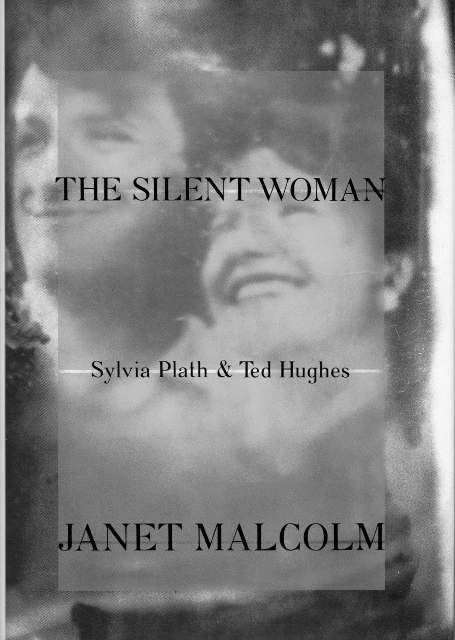
Having been impressed by Janet Malcolm’s Iphigenia in Forest Hills, I knew I wanted to read what I thought was her biography of Sylvia Plath (and, secondarily, husband Ted Hughes). I am not a great scholar of Plath, but I’ve read The Bell Jar twice, and some of her poetry, and I thought the combination of subject and biographer sounded very promising.

I was wrong, though; this isn’t a biography of Plath, but rather an examination (even an exposé) of biography as a genre, using Plath as an example. How interesting! I was still on board, having been interested in some of the problems of biography (and autobiography, and especially, memoir) for some time. Also, I just finished Alison Bechdel’s Are You My Mother?, as you know, and she muses (and her mother muses) on some of the problems of memoir, too. So this is all welcome.

I’ll just share an example from Malcolm’s opening pages that struck me, and that helps to define her understanding of the problem.

The transgressive nature of biography is rarely acknowledged, but it is the only explanation for biography’s status as a popular genre. The reader’s amazing tolerance (which he would extend to no novel written half as badly as most biographies) makes sense only when seen as a kind of collusion between him and the biographer in an excitingly forbidden undertaking: tiptoeing down the corridor together, to stand in front of the bedroom door and try to peep through the keyhole.

Putting aside Malcolm’s use of the male pronoun (shame on you!)…

Part of me, of course, wants to protest on behalf of the Truly Good Biographies out there; but I know exactly what she means. So on the one hand: we read history for some lofty purposes, don’t we? And history includes biographying certain history characters, doesn’t it? Need we be voyeuristic to want to learn about Susan B. Anthony or Major Taylor? I say, no. But oh, then there was my reading of Jaycee Dugard’s book, which made me feel just dirty. And I get the point with someone like Plath, too: she is a literary figure, but admittedly, a certain part (probably a large part) of her fame relates to the lurid details of her failed marriage and her suicide. We’re fascinated with these things. And, as Malcolm will go on to outline, another defining aspect of Plath’s case – and what makes her different from Susan B. Anthony or Major Taylor (and like Jaycee Dugard) – is that the other players in her story are still alive (or were when this book was published). They are still vulnerable to injury from the conclusions a biographer might draw, about Who To Blame; and naturally conclusions of this sort will be drawn, in such a tale of suicide and woe. Point taken, then.

Stay tuned for what looks like a stimulating read.

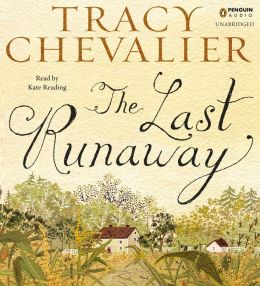
The Last Runaway by Tracy Chevalier (audio)

runawayFrom the author of Girl with a Pearl Earring (which I read pre-blog, and loved), another historical novel of women’s lives. I recently tried reading Chevalier’s The Lady and the Unicorn, but I found I couldn’t appreciate it. No such problem with The Last Runaway.

Honor Bright is a small-town British Quaker in 1850, a young woman recently abandoned by her fiance, her future uncertain. Her sister Grace will soon be departing for the New World to marry; Honor decides, somewhat impetuously, to accompany her and find a different life. She can always come back home, right? But the sea voyage – heralded as the shortest and easiest passage possible – nearly kills her, she is so seasick. When she finally sets foot in America, she knows that, no, she can never go home.

On the overland trip to Ohio (by coach – their plan to take riverboats being prevented by Honor’s seasickness), where Grace’s fiance awaits, Grace falls sick and dies. Honor will arrive alone, and ahead of the letter announcing her coming, so that the fiance, Adam, expects one sister but finds another. His brother has likewise died, leaving him now with a widowed sister-in-law as well as this almost-sister-in-law. Honor’s place is decidedly uncertain, and uncomfortable. The new Ohio Quaker community of Faithwell does not look approvingly upon Adam’s strange household. The pressure is on, therefore, for Honor to find herself a husband; but she is without even a friend in her new hometown.

She does have a friend a day trip away, however, in Wellington: Belle Mills, of Mills Millinery, who nursed Honor through an illness and sheltered her, and gave her work. Honor is a gifted seamstress and quilter, and her skills were appreciated in Belle’s shop. Quakers can’t wear colorful or decorative hats, but Honor enjoyed making them for others; and Honor got along with Belle, although the non-Quaker’s coarse speech and whiskey drinking were new to Honor. (Honor’s sewing and quilting are a strong framing element throughout the story: quilts in the English and the new American styles are described, and provide examples of Honor’s homesickness, and her new community’s intolerance of her English traditions. I thought of my mother, the quilter, who I think would appreciate these details.) Also simultaneously fascinating and disturbing is Belle’s brother, Donovan, a slave-hunter; and this is where the conflict of the novel begins.

As a Quaker and as a moral being, Honor is naturally repelled by slavery; but it is easier to abhor the peculiar institution from England, where it is distant and (forgive the phrase) black-and-white. In Ohio, Honor sees black people for almost the first time, and encounters runaway slaves who she is naturally inclined to help; she also sees Donovan working to re-enslave them. When she does marry local dairy farmer Jack Haymaker, Honor finds not a soulmate or even companion; but she does find a nasty mother-in-law and sister-in-law. When they discover that Honor has been offering minor assistance to runaways – food, water, directions to the next stop on the Underground Railroad, in Oberlin – they forbid her to help further.

The issue, then, is between obedience to her new (if unlikeable) family, versus her feelings about slavery. Honor will grow as she has to form new relationships, and not always easy ones: alliances with a black woman in Oberlin named Mrs. Reed, and with the colorful Belle Mills; and she has to find a way to relate to her new husband and in-laws that will work for each of them.

I noticed I was approaching the end of this audiobook and things felt so up in the air I couldn’t believe they’d be wrapped up in time. And indeed, the reader would appreciate a sequel to find out what finally becomes of Honor’s new family; but they are sent on their way in good time, with no loose ends, at least. Honor’s character sees a satisfactory arc: she grows, expands, speaks up for herself, considers different positions and stakes her own. And her new life is indeed established in the end.

I thought the Underground Railroad was ably portrayed, if only simplistically; the runaway slaves have some personality, and Belle Mills is a great hit. The quilting element, as I said, was an added appeal as well. But it’s Honor herself who stars, rightfully. I think Tracy Chevalier still has it here, and would recommend this novel. It’s somewhat lightweight in the issues it addresses, perhaps, but it makes its points, and is more accessible than novels on this subject sometimes are, so it will appeal to the popular reader.

The audio performance by Kate Reading (great name, that!) is fine as well. I liked the different accents she used; they provided real color and personality. I would happily recommend this format.


Rating: 7 tin cups.

The Falling Sky by Pippa Goldschmidt

My father also reviewed this book here.


An astronomer’s professional and personal journey, both eased and challenged by her scientific mind.

falling sky

Pippa Goldschmidt’s The Falling Sky revolves around Jeanette, a young astronomer deeply dedicated to her work but uninspired by the competitive bureaucracy of postdoctoral research. The stars and galaxies make sense to her in a way that people do not; she is a talented and intelligent scientist whose rational lens often fails her in navigating the world of human relationships. In a Chilean observatory, she makes a discovery that could turn the scientific world on its head; what she will do with this new and disruptive evidence will similarly upend her personal life. Amid the commotion, a new love affair with an old friend and the disorder of her professional ambitions combine to reawaken a childhood trauma, a tragedy from which her family has never recovered.

The Falling Sky incorporates hard science (Goldschmidt is an astronomer as well as an accomplished writer) with the story of a young woman struggling to find and establish her own place in the world. Artists, romantics, philosophers, mystics, feminists, photographers and scientists will all identify with aspects of Jeanette’s journey. Those familiar with the Edinburgh setting will be pleased by its evocation. But perhaps the most remarkable and unusual element of Goldschmidt’s striking debut novel is Jeanette’s perspective: the reader sees her world as she does, with an emphasis on objectivity, data points, the relativity of time and space, and the search for connections between distant galaxies. As Jeanette sighs, “the lack of information is appalling,” but her story comes around to a satisfying conclusion nonetheless.


This review originally ran in the May 20, 2014 issue of Shelf Awareness for Readers. To subscribe, click here, and you’ll receive two issues per week of book reviews and other bookish fun!


Rating: 6 connections.

Illuminations: A Novel of Hildegard von Bingen by Mary Sharratt (audio)

illuminationsHildegard von Bingen was a real-life woman; a brief glance at the Wikipedia page under her name indicates that this novel is faithful to the general shape of the historical figure’s life. (Consulting Wikipedia is not a high standard, but it’s all I felt necessary to my review of this book. And really, we can’t ask for much accuracy when dealing with a mystic from the 1000’s, can we we?)

First question: what led me to a book about a religious figurehead? I’m not entirely sure. I don’t have a great deal of patience for Christian subjects of books in general; but this woman was a writer and something of a rebel, and I decided to give it a try. I could always put it down. My whim was rewarded: I enjoyed Hildegard’s story.

The book is narrated by Hildegard herself (and to reduce confusion, I’ll also say that this audio edition was narrated by Tavia Gilbert, on whom more in a moment), beginning in her old age and then quickly flashing back to her childhood. We spend the vast majority in this lengthy flashback, and thus see her life chronologically.

Hildegard was very young when she began seeing the visions she would be famous for; she saw a lady of light that she came to believe was god, or the church, and her mother disapproved. Partly for this reason, and partly because there were so many children to provide for, her mother gave her to the church – or specifically, to a wealthy young woman from a good family who devoted her own life to god and needed an attendant. Hildegard was only eight when she and Jutta were bricked into the monastery at Disibodenberg to serve as anchorites; and this is the first, but not the last, time I exclaimed at the cruelty of the church.

Hildegard spends a number of years bricked in with Jutta, who is strict, joyless and loveless. She does make a friend in a monk named Volmar, however, who speaks with the women through a little window, and brings gifts of potted plants and books. Eventually the walls will be torn down so that two more young girls can be bricked in, as well, enlarging their tiny convent somewhat; the newcomers are Adelheid and Guda, the latter of whom is even younger than Hildegard was when she was imprisoned. Hildegard had been planning an escape when the two children were brought; but she can’t leave them to her fate, and she stays.

When Jutta dies (after starving herself), years later, Hildegard and her two younger proteges make a plea to be allowed to live in the monastery in relative freedom – they will retain their rooms as before but not be bricked back in. Due to Hildegard’s political maneuverings and performance before important visitors, this request is granted, but grudgingly. She has continued to cause trouble. She still has her visions, although she has learned to keep them to herself; but she is less obedient and more questioning than the monks appreciate. She has also, however, come to serve as a mother or leader to the younger women, who are now joined by a newcomer named Richardis, daughter of Hildegard’s powerful sometimes-ally. Richardis will become Hildegard’s special friend. Such a relationship is actually forbidden by the Benedictine order, but the two women can’t help loving each other. (To be clear, there is no sexual relationship here, and only the slimmest of hints about sexual attraction.)

The novel follows Hildegard’s growth, and her continuing efforts to live beyond the monastery. Her flock of “daughters” grows, and she will finally petition the Archbishop of Mainz, and successfully establish her own monastery at Rupertsberg, accompanied by her nuns and her old friend, Volmar. One of her greatest controversies is her writing: it takes ten years, but she will write a book of her visions, illustrated (or “illuminated”) by Richardis and transcribed by Volmar; the Pope himself confirms that her visions are holy rather than evil, although the abbot at Disibodenberg will never be entirely satisfied on that point. She also composes music, grows herbs and mixes remedies (and writes medical texts), and studies plants in the natural world; she is in fact a Renaissance woman, in an age when women were supposed to be silent nuns or wives. Again, the particulars of her life represented in this fictionalization may not be perfectly accurate. But the broader strokes are true: Hildegard was an author, an abbess, a composer, an outspoken leader.

In other words, Hildegard von Bingen was bigger than her world normally allowed women to be; and this after being buried alive in childhood as an anchorite. This novel of her life tells that story beautifully. It goes pretty light on the parts about god and religion, which was a major plus for this reader; those more interested in the religious side of her life might be disappointed, but I enjoyed being able to read about her accomplishments, her struggles, and her personality without being subjected to too much preaching. The Hildegard in this book loved people, and wanted the best for her daughters; god was almost incidental to her, and that worked well for me. Although it is her visions of that that made her famous in the first place, the god she sees in them is both notably female, and a god of love and freedom rather than rules.

Her story is compelling, and I appreciated her frustrations and enjoyed her personality. The narration by Tavia Gilbert felt right; I liked the old woman’s voice she uses at the very end, but her characterization was mostly invisible, just felt like Hildegard herself were speaking, and that is as it should be.

For a historical story of women’s rights in the church and in society in the 1000’s and 1100’s, I do recommend Illuminations.


Rating: 7 beautiful women.

Maximum Shelf: Euphoria by Lily King

Maximum Shelf is the weekly Shelf Awareness feature focusing on an upcoming title we love and believe will be a great handselling opportunity for booksellers everywhere. The features are written by our editors and reviewers and the publisher has helped support the issue.

This review was published by Shelf Awareness on April 23, 2014.

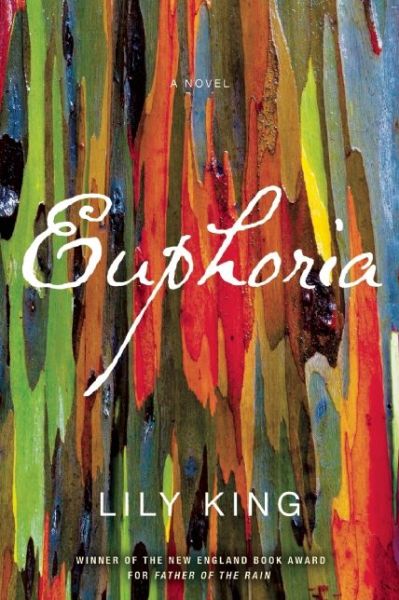
euphoriaLily King (Father of the Rain) renders three young anthropologists in 1930s’ New Guinea with nuance, tenderness and charming ambiguity in Euphoria. King draws on the life of Margaret Mead and her relationships with her second and third husbands (Reo Fortune and Gregory Bateson, respectively), but the novel is only loosely based on their lives and work.

Nell Stone is an American, and has recently written a book that is receiving much attention for its controversial subject matter: the sex lives of children in the Solomon Islands. She is an up-and-coming young anthropologist being talked about around the world; when we meet her, she is just emerging from a year and a half in the field in New Guinea, alongside her husband, Fen. Fen is Australian, overbearing and decidedly threatened by Nell’s success, as fame and glory as an anthropologist have so far eluded him.

When Nell and Fen come out of the field, at a party they meet fellow anthropologist Andrew Bankson. He is fresh off a failed suicide attempt, haunted by the deaths of his two brothers and unable to find himself in either his native England or the tribal communities he studies. Bankson is lonely and attracted to the couple, and suggests that he establish them with unstudied “natives” nearby his own fieldwork; he wants to keep them as his friends and neighbors.

The three form an unlikely triangle of mixed alliances. Nell and Fen, for all their disharmony, share a history and an intimacy the loner Bankson can’t pierce. But Nell and Bankson achieve a singular connection of the minds: they inspire each other, each stimulating the other’s best work. With Fen’s sensitivity over and resentment of Nell’s talents, this is a dangerous but intoxicating symbiosis, a cerebral union that is sensual and nearly sexual. Bankson is, in fact, rather in love with both Nell and Fen. The two men establish their own bonds as well, when Fen nurses Bankson through a malarial fever. It is a love triangle, but also an intellectual one, and shadows the perceptions of each anthropologist about the tribes they live amongst. They already have very different approaches: Nell has loved, ever since she was a small child, exploring other worlds so that she can come back and tell her family, friends and now colleagues about her adventures; for her, the joy is in the description and the homecoming, but she also has a knack for integrating herself into a new culture. Fen, it seems, would rather become a tribesman than study or write about the tribes. Bankson struggles to participate, but is more inclined to observation–his background is in the natural sciences. As he writes, “I was raised on Science as other people are raised on God, or gods, or the crocodile.”

Lily King makes an interesting decision in choosing Bankson as her narrator, as he is the most isolated of the three, spending much of his energy in observing not only the tribal peoples he is meant to study, but also Nell and Fen. That the story of these three characters is told from the perspective of his outsider status means that the reader, too, is forever peeking in and around corners, hoping for more information. Nell’s voice is heard through journal entries eventually sent to Bankson by another old friend and possible love interest of Nell’s, but she remains tantalizingly difficult to access. The tension of this desire to know Nell better is central to Euphoria, for Bankson and for the reader.

King raises broader questions as well, as each anthropologist’s individual approach to his or her work is troubling in its own way. The tribal communities of the fictional Kiona, Mumbanyo, and Tam peoples invite consideration about the fields and methods of anthropology and ethnology. The Tam women, who do the trading and the artistry in their community, inspire Nell’s growing ideas about traditional gender roles, a stance that (predictably) does not sit well with the irritable Fen. Margaret Mead is known not only for her writings and work in anthropology, but also as a feminist thinker; in King’s hands, the Tam culture inspires the beginning of Nell’s own feminist development. As Bankson gravitates toward Nell’s empathetic and involved relationship with the Tam, Fen is planning a serious cultural crime, which will precipitate the final denouement. (The life stories of Nell, Fen and Bankson are quite different from their historical counterparts Mead, Fortune and Bateson, so there are no spoilers for readers familiar with that history.)

Euphoria is a masterpiece of dreamy, lyrical, sensuous writing and evocation of a sometimes frighteningly exotic New Guinea. Readers can expect to be enchanted by the setting, inspired by the free-spirited Nell, challenged by the question of respectful participant observation, angered by certain of the characters’ actions and teased by the sexual tension. As a bonus, the beautiful cover of Euphoria features the striking rainbow gum tree that figures in the plot of this remarkable novel.


Rating: 8 books.

Come back tomorrow for my interview with King!

book beginnings on Friday: The Falling Sky by Pippa Goldschmidt

Thanks to Rose City Reader for hosting this meme. To participate, share the first line or two of the book you are currently reading and, if you feel so moved, let us know what your first impressions were based on that first line.

falling sky

You will recall that my father also reviewed this book, here. What fun that I get a shot at it now, too. I have two beginnings to share with you; the first is part of the novel but comes before the first chapter; a preview or dream, perhaps.

Nothing is as certain as death.

And from the more concrete world of “Now”:

Jeanette may as well be invisible. She’s standing on the stage in the auditorium in front of about two hundred other astronomers, presenting the results of her PhD work at the annual British conference. But she can tell no one’s listening.

More pedestrian; but it quickly becomes an involving story, nevertheless. Stay tuned.

The Empathy Exams by Leslie Jamison

An essay collection that earnestly examines feelings–the author’s and the world’s.

empathy

Leslie Jamison follows her debut novel, The Gin Closet, with an essay collection that has earned her the Graywolf Press Nonfiction Prize. The Empathy Exams opens with Jamison’s experience as a medical actor. In this role, she is given a character, complete with props and not only symptoms, but behaviors: body language, failure to make eye contact, dishonesty. In portraying deception, or a pretended lack of self-knowledge, Jamison contemplates what it is to feel, how we communicate what we feel and what we do with these communications.

While all her essays are linked by the topic of empathy, their subjects range widely. One essay about incarceration deals with a man serving time for mortgage fraud who continues to declare his innocence; another covers the case of the West Memphis Three and the documentaries about them that so moved Jamison as a young woman. “Morphology of the Hit” studies Vladimir Propp’s Morphology of the Folktale, which Jamison calls “a map for storytelling,” and she uses that map to construct a narrative of the random act of violence she experienced in Nicaragua.

Within the context of pain, both injury and chronic illness receive repeated treatment. The Barkley Marathon, a grueling, almost unfinishable race through Frozen Head State Park in Tennessee, is presented both as a subcultural phenomenon and a subtext for pain. Jamison attends a conference for Morgellons patients–who believe they are infested with fibers and foreign matter crawling out of their skin–and the few doctors who will take them seriously; she finds herself responding with such empathy that she is in danger of catching the disease herself. She also leads readers on two “Pain Tours,” closing with the specter of female pain, and female guilt over pain–making the studied choice to apologize for neither.

Throughout these varied topics, Jamison makes references to many thinkers and influences, from Lucy Grealy (Autobiography of a Face), Susan Sontag and Frida Kahlo to her own friends. Her essays often dwell in the theoretical and the academic; she is interested in philosophies, and admits to difficulty experiencing, recognizing and sharing her own emotions–a difficulty that occasionally manifests in pedagogy. However, readers will finish with no doubt she is sincere in her quest to own, identify and comprehend empathy.


This review originally ran in the April 3, 2014 issue of Shelf Awareness for the Book Trade. To subscribe, click here.


Rating: 4 itchy patches.

Not a great rating, right? Reminder: when I write reviews for the Shelf I work to (mostly objectively) state what is of high quality about a book, and who might like it and why; if applicable, I mention who might want to steer clear. When I rate the books here, I am stating my personal reaction. I think Jamison did good research & does some good writing; but the academic & theoretical nature of these essays didn’t appeal to me. I was hoping for a more emotional reaction to the world; and specifically I was interested in the medical acting concept, which received relatively little play time. I wonder if *I* have an essay to write about empathy, based on my experiences working in a cancer hospital. I don’t know that I’m ready to write it right now; but if/when I do, it will be more emotional and less cerebral than these essays here. Not better or worse; but this is how my personal reaction – the personal appeal this book had for me – rates The Empathy Exams.

The Rebellion of Miss Lucy Ann Lobdell by William Klaber

rebellion lucy annI am absolutely charmed by Lucy Ann Lobdell.

The backstory to this novel is an attractive little plot in itself. Journalist moves into an old farmhouse in upstate New York. Years later, he sits down with a local historian and hears the story of Lucy Ann Lobdell, who inhabited the area and is even linked to journalist’s own farmhouse. The aging local historian has searched and searched for Lucy’s memoir but never found it; he is now too tired to pursue her story further, but hands over his significant research to the younger journalist to follow. Journalist is likewise unable to find the memoir; but sensing the power in Lucy’s story, he writes it in novel form instead. And here it is.

Backtrack a little over 100 years. Lucy Ann Lobdell has had a difficult youth, and is entirely frustrated by the lack of options for women in the mid-1800’s, especially a young woman like herself with a daughter and whose no-good husband has run off on her. She runs away from home, leaving her daughter behind with her disapproving family, to put on men’s clothing and seek work as a man. Lucy works as a man can work (earning what a man can earn – and this references a problem that is somewhat ameliorated, but not solved, today) and lives independently – choosing her own company, holding her own hours, answering to no one. And thus she learns how much she has gained, and vows not to return to womanhood, where she will be manhandled, abused, underpaid, and never allowed to make her own choices. She dreams of having her daughter join her own day in her new life, but worries over what form that might take. What might she, as Joseph Lobdell (a name borrowed from her grandfather), be to the young Helen? Not a father; an uncle, perhaps?

Klaber’s novel, told in Joseph’s own first person voice, follows him as he works different jobs in different towns, moving around, facing various challenges. He’ll repeatedly be found out. He will eventually marry a woman named Marie – not the first with whom he’s had a romantic connection, but the first who has known his secret. Marie will accompany him through some of his roughest times, when he suffers from some form of mental illness. Of course, his conservative contemporaries will ascribe this to his sexuality, sexual preference, sexual identity – none of which terms were available to Joseph in the late 1800’s.

Here you see that I have switched pronouns; I’d like to note the brief statement that author Klaber makes, that “just which of the modern labels of sexual orientation or gender should be applied to the historic Lucy is something I will leave for others.” He notes that he honors Lucy/Joseph’s person journey. This strikes me as an appropriate stance for him to take. Such labels are fluid, and as none were open to “the historic Lucy,” I think we should take her as she presents herself. Of course, Klaber’s presentation of her or him are not her or his own; but we take what we have.

It’s easy to see what a an easy character Lucy can be to commiserate with. She is high-spirited, refuses to accept society’s limitations on her sex, and instead demands more. Her struggles are very sympathetic; not that it’s easy today, to figure out one’s sexual identity or sexuality, but how much more difficult in her time, with no role models or examples of what she might be. (Klaber cites one historian who claims the first use of “lesbian” in its current meaning was in reference to Lucy.) A theme running through her life, as told here, is the question of the extent to which she is a woman, or a man; only late in life she will come across the writings of Margaret Fuller, who proposes that we are all on a continuum between the two. Naturally Lucy/Joseph appreciates this concept.

We would like to know a little more accurately what happened to the historic Lucy/Joseph. Lacking that option, I’m glad Klaber chose to share with us as he could. He does invent dialogue, and it’s not clear to me how much of this might have come from the historical record. So as always with historical fiction, take a grain of salt. But her story is told feelingly. And as you know, I always have a weakness for women in history fighting uphill battles; her obscurity makes her rather more interesting still.

I’m glad I accepted this copy for review.


Rating: 7 wolves.

Full disclosure: I received my copy of this book from a publicist in exchange for my honest review.

guest review: The Falling Sky by Pippa Goldschmidt, from Pops

This review bears on some recent discussions: scientific fiction and scientific nonfiction.


Thanks to Kirk Smith at his blog, Fiction About Science, for both passing on a copy of this book to my Pops, and for publishing his review there. I am reposting it here, as originally published by Kirk Smith.

falling sky

The Falling Sky is about a “realistic scientist doing realistic science.” That is the hook that brought me to this special first novel written by a PhD astronomer, now a recognized writer in Edinburgh, Scotland. But it is so much more than that.

One could say this is the insightful story of a young woman finding her way from adolescence into a life of her own; or her personal contemporary tale of sexual awakening and relationships with other women; or a striking and remarkable exploration of how a scientist’s unique perspective can literally saturate the way she perceives and interacts with everything around her; or an emotionally wrenching journey with a family trying to make sense of a pointless and tragic death. It is really all of that.

That may seem to be quite a burden to place on an easy-reading first novel of only 264 pages; but Goldschmidt succeeds gracefully and does not overreach. Her story of Jeanette comfortably weaves modest measures of these elements together – and tempts the reader to fold closed the pages, finger inserted, while looking off into space to savor the author’s words and Jeanette’s thoughts. In that sense, this is not a “quick read.”

There is fuel here for artists, romantics, philosophers, mystics, feminists, photographers and scientists alike. Those familiar with Edinburgh are teased with pleasing glimpses.

But for one so inclined to the feast, it is possible to see the scientific perspective virtually everywhere in this story; in its language, metaphors, analogies, repetition of certain words and its oblique references to black holes, cosmology, time scales, anti-matter, entropy. Some may see excess or stridency in this; for those it should be accepted as essential immersion in Jeanette’s world, as setting and mood, and not as cause for anxiety or fear of missing something. There is more to savor.

Storytelling here is not linear, but not distracting: chapters alternate between “Now” and “Then” as the 3rd person narrative traces Jeanette’s young life as an astronomer while we gradually learn more of her adolescent past. She is smart & ambitious, yet confused. She is a talented and intelligent scientist whose rational lens often fails her in navigating the human world of relationships. She is an emotional creature like all of us, and it wrenches her life. The reader is drawn in as she searches.

For my money, this is a beautifully composed review, as well as describing what sounds like a quite attractive read. The book is in my hands now, so eventually you can expect me to weigh in. Thanks, Pops.

Eating Dirt: Deep Forests, Big Timber, and Life with the Tree-Planting Tribe by Charlotte Gill

eating dirtDoubly recommended by the authors of Fire Season and Dirt Work, this one moved to the top of the list.

Eating Dirt is the memoir of a tree planter. Charlotte Gill works seasonally planting trees in the Canadian west. She is employed by a company of tree planters, who contract in turn with big business – mostly logging – to replant sections of clear-cut land, usually. The daily job is to travel out to the plot in question (via beat-up truck, or boat, or by foot), load up one’s bags – a belted & suspendered piece involving two side saddle-bags and one at the rear, at hip height – with seedlings, stomp around on varying surfaces, and use a shovel and one’s hands to repeatedly insert seedlings in soil (clay, gravel, duff). It involves much bending, and the loss of fingernails. They encounter cougars, bears, muck, dirt, rain, bugs, rocks, and unspeakably sore muscles.

Gill has quite a bit in common with Christine Byl of Dirt Work: the dirty, male-dominated outdoor environment, the satisfaction of a job well done in a world populated by trees, twigs, green and brown and wild things. Not to overemphasize these two books’ similarities – because each is unique and lovely on its own and neither is derivative – but they both caused the same combined reaction in me, of yearning jealousy and thankfulness that I don’t do that for a living. What can I say. I love to be outside and wish I spent more days and nights there, but I also fret enough over my bad knees with my office job, and I like taking a shower and feeling clean after being dirty. In fact, the question at the front of my mind as I’ve finished this book is: what did clean mean in those years that make up the majority of human history, in which we didn’t have seemingly endless showers at our command?

Dirtiness aside, Gill writes with humor and wisdom and the kind of occasionally zoomed-out perspective that I like in a nature-based memoir. A little research into the history of earth, trees, and people – and the relationships between them – brings her perspective, that of just one person, into focus within a larger picture. And as a bonus, she’s based in the same general region that my parents recently moved to. We have all been learning about the Pacific Northwest – including the trees of the area – and this book offered some welcome insights to that end.

One of the more surprising subjects of Eating Dirt, for me, was the ambiguous or controversial nature of the work. I read “tree-planting tribe” and expected that it would be all green-ness and good; but as I said in my opening synopsis, Gill’s employers are most often logging companies, banking on the profitability of trees, not their inherent worth as trees themselves.

And we got paid… by the very same business that cut the trees down, which canceled the altruism right out of the equation.

Any good they provide, then, is already offset by those who paid for their planting. It’s not as simple as it seems at first glance, and Gill wastes no time in making that point.

Her voice is gritty, and her perspective not so much unapologetic in general as clear-eyed about its dual nature. She’s funny and clearly likeable – like Byl, someone I’d like to know, although I’d be intimidated by both women’s toughness. I enjoyed what I learned about the world from Gill, but also very much value what she’s encouraged me to think about.

Nature has done its big job. Like a ball thrown up in the air, all has risen, crested, and begun its arc back down into earth. After many years spent outside we come to see this – the parabola – as the contour of life itself. It’s the path the sun takes across the sky. The shape of a story. Ours included. Beginning, middle, and end.

Right up there with some of my favorites of the past few years. Recommended.


Rating: 7 red tree voles.