The Mighty Franks by Michael Frank

This memoir of family wounds and favoritism charts dark territory as the author searches for understanding.

the-mighty-franks

“‘My feeling for Mike is something out of the ordinary,’ I overhear my aunt say to my mother one day when I am eight years old… ‘I wish he were mine.'”

Michael Frank comes from an especially close-knit family: his mother’s brother married his father’s sister. He is devoted to his doubly related Aunt Hankie and Uncle Irving. The elder couple is childless, and so they “share” the younger couple’s three sons, of whom Mike is the eldest. The two households are neighbors in Laurel Canyon, in the Hollywood Hills. Both grandmothers live together at the foot of the canyon. It is all very cozy: Aunt Hankie calls them “the larky sevensome,” or “the Mighty Franks.”

And Mike is the luckiest, larkiest one of all, because he is Aunt Hank’s pet. They spend their free time together. She takes him antiquing, and sets out to teach him everything she knows. Hank (a nickname for Harriet) and Irving are successful Hollywood screenwriters, and they have the finest taste in architecture, art, literature, movies, music (nothing after Brahms) and manners. Hank has an overwhelming personality and strong opinions, and when she says that Mike has the eye, the artistic eye for the creative pursuits she prizes above all, he is naturally proud–and motivated.

The Mighty Franks is Michael Frank’s memoir of the relationship he shared with his forceful aunt. While he is favored, his two younger brothers are mostly ignored (Hank sniffs that one has the makings of a scientist, the other, an athlete). He is the modelling clay she plays with, until he begins to awaken to a world larger than Aunt Hank, and forms his own opinions and tastes. She sees this as rebellion, ingratitude or worse. As Mike grows up, Hank seems to break down and the Mighty Franks begin to fissure.

Frank moves between the child’s perspective of events as they unfold and a place of reflection. In writing this story, he seeks a better understanding of his aunt, the imperfect workings of his extended family and his own relationships within and outside it. Hank is firm about hierarchies: the Renaissance over the Middle Ages, Faulkner over Hemingway, Fred over Ginger, early Fellini over late. Similarly: Hank over her younger brother, both of them over their spouses, Mike over his brothers. And always Hank first.

The Mighty Franks is an immediate, gut-wrenching account of events that are often painful for young Mike. While not an easy story to take in, Frank’s ruminations offer some necessary distance. His tone is serious and his prose occasionally verbose, but the saga of this flawed family is deeply involving. Any hint of sensationalism is more than balanced by the psychological insights Frank eventually achieves.


This review originally ran in the April 11, 2017 issue of Shelf Awareness for the Book Trade. To subscribe, click here.


Rating: 6 period pieces.

The Chronology of Water by Lidia Yuknavitch

I gulped down The Chronology of Water like I was drunk on it.

This extraordinary memoir, fragmented and unchronological, charts the life of a former competitive swimmer who experienced many traumas: addiction, abuse, loss of a child, failed relationships, deaths. Water is the overarching metaphor, and references to water, swimming, drowning, and wetness are everywhere. Other recurring images or themes include twins/twinning, fire, hair, death, and sexuality. (Much sex.)

While Yuknavitch’s story is filled with headline-level events and excitements, her prose is every bit as compelling: poetic, rich with imagery and metaphor, but also often swinging back to a very conversational tone. Although the events of her story are terribly tragic, she offers hope, without ending with trite redemption. And she keeps her reader rapt.

As a student, I found this work interesting for both sentence-level prose style and overall organization. I made careful note of where the water/wet references and language sprang up: in fact, I highlighted all such words and phrases, making this the first book I’ve marked up since somebody last made me, in high school. Very few pages went without highlighting, and it was interesting to see where the page really lit up, and where it didn’t. I was also interested in how she uses neologisms, anthimeria and repetition to express a sense of wonder, discovery, and otherworldliness. These moods suit her subjects, for example, drug-induced states, sexual discovery, and extreme grief.

I don’t want to say too much. This is a startling work, and you should dip into it yourself.


Rating: 9 less than merry pranksters.

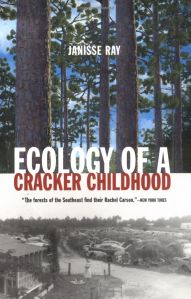
Ecology of a Cracker Childhood by Janisse Ray

Early in my reading, I was ambivalent about this book, although I cannot now remember why. Did her writing get stronger as the book progressed? Did her vision & thesis take shape and grow on me? Was I just in a mood? By the end, I felt friendly towards the narrator and the book.

Janisse Ray grew up on a junkyard in south Georgia, one of four children. Her family was strictly religious, rural, somewhat isolated, and their lives were simply furnished for both religious and financial reasons, although they were not painfully poor: “We never ever lacked food, but we had few treats.” This book is an essay collection that is two things at once: a memoir; and a naturalist’s description of a nearly-vanished landscape–an elegy. The chapter/essays alternate between Ray’s personal and family story, and the ecological side. In reading this was a little less obvious to me, because I would argue that the ecology bits include some personal, and vice versa; but the table of contents makes this structure clear and intentional: the naturalist chapter titles are italicized, like Latin names of species would be. This is what the title is telling us, that it is both ecology and cracker childhood, and also the ecology of that childhood, and of the cracker people (one of the ecology essays is titled “Crackers,” as they are themselves one of the species at work in the system).

Ray’s homeland was once a longleaf pine forest, and that diverse ecosystem (and the pine savanna that wanders through it) is endangered and precious to her, now, but her upbringing did not emphasize it. The discovery of her homeland as a natural ecosystem, and its loss almost before she knew it, came later. As interesting as her childhood is, and the ecological part too, that young-adult awakening was perhaps the most compelling part of this story for me; maybe that’s part of why it became most appealing to me late in the book, when the awakening is told.

I learned a lot about a place and an ecosystem, and I enjoyed the personal memoir. I was especially fascinated by the strict religion that did not allow girls to wear pants, jewelry or makeup; had them cover their hair to pray; forbade holidays, ball games, parties, television, newspapers, dating, sports, on and on. This stuff is so far from my personal experience as to feel exotic, or weird, so I read it with that added curiosity we feel when we encounter the foreign. And it made Ray’s experience at college so compelling: alcohol, rappelling, skydiving, and simply swimming (something her family’s dress code never allowed), oh my! The parallel discovery, as I’ve said, is of nature as a subject for study, admiration or even just notice. She observes that she had a grandfather who loved the woods, but that her father couldn’t take the time; and a culture of people working to just get by didn’t have the energy to hug trees. It’s a sad story.

Ray does some lovely writing. I love the parallel of restoring a junkyard to a natural ecosystem, and restoring a ’58 Studebaker (with parts, presumably, to be found in the junkyard). I love this grandmother: “Her skin was soft and loose, and her face wrinkled in a beautiful way that showed she had always liked to smile. Her eyes, behind silver glasses that matched the soft halo of her hair, had life in them.” There are several noteworthy characteristics to this book. Its subjects were new to me, at least: that is, the place, the ecosystem, and the upbringing or culture. Its structure is interesting. I’m not sure why it grew on me so slowly, but grow on me it did.


Rating: 7 gopher tortoises.

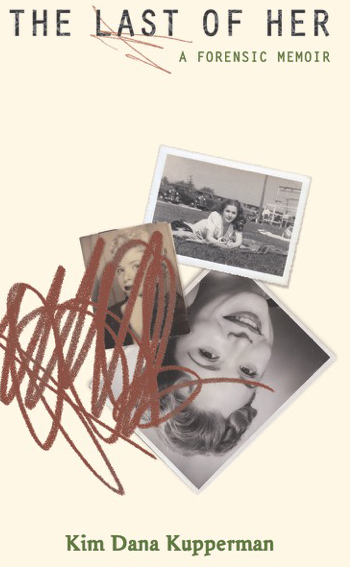
The Last of Her: A Forensic Memoir by Kim Dana Kupperman

Disclosure: Kim is a visiting faculty member in my MFA program, and one I’m looking forward to working with.


“Have a good life,” my mother wrote in March 1989, at the bottom of page four of her nineteen-page suicide letter.

This is a really good beginning, in that it certainly grabs my attention.

the-last-of-herThe Last of Her is Kim Dana Kupperman’s investigation into her mother: who she was, who she wasn’t, why she went.

This mother, Dolores, was a serial liar. She told many, many stories of her own personal history, leaving a real challenge for her only daughter in tracking that history. Kim was 29 when her mother killed herself, apparently to escape being busted for insurance fraud. It took some decades before she was ready to do the work that this book communicates: the research, the travel and the reconsidering of past crimes. Those are literal/legal crimes (Dolores was a junkie, a con artist, an identity thief, and apparently guilty though never convicted of assaulting a [pregnant] romantic rival with a hammer) as well as psychic ones, including mistreating and manipulating her daughter. The adult Kim eventually finds sympathy for this flawed and damaged woman, but it is quite an (understandable) journey to get there.

As a piece of creative nonfiction, The Last of Her is intriguing. The Preface deals heavily in birds, as Kim sketches the trauma of her mother’s suicide and then describes visiting the gravesites of family members she never knew. A few more birds season the rest of the story, although they do not end up playing as large a role as I expected. This lent a feeling, for me, of something larger and less knowable than human nature; not supernatural, but something of the mystery of the natural world, which is often absent (or mere scenery) in human stories.

This is also very much a memoir, not of Kim’s life or Dolores’s, or Kim’s memories of Dolores (although there is some of each), but of Kim’s study of her mother years after her death. In other words, this is the story of her research, including her reading of her father’s giant “Secret File” about Dolores and the custody battle she lost. I am drawn to this kind of story: the story of finding the story, that transparency. Kim’s tone keeps some distance, almost austerely observing the 20-something daughter to which this thing happened. It’s a remarkable piece of writing, on the sentence level (of course). I will also say that the chapter headings (quotations from a wide range of literature) quite baffle me; I need a guide to those.

This is a memoir about a sensational event that never approaches sensationalism, expertly crafted like a long poem, with precise emotional tone. A good study. Keep your eyes open as well for Kim’s (earlier) essay collection, I Just Lately Started Buying Wings, and the work of Welcome Table Press, where she is founding editor.


Rating: 7 phones hung up.

reread: She Got Up Off the Couch by Havel Kimmel

You’ll recall that I really loved this book when I read it in 2013. (First review here.) I reread it recently as part of my first semester reading list (see new tag here, many entries to come!). Students’ reading lists are individual, created by the student and faculty advisor together, so Katie Fallon and I came up with my list as a team.

couchI loved this book again. Havel Kimmel’s mother is far from perfect; she struggles to hold herself together and care for her children and family in a way that her society deems correct; she appears ill-kempt. But in the course of this book, in Kimmel’s youth, she also learns how to drive a car (and buys herself one), enrolls in college and goes on to graduate school, gets a job as a teacher, and goes through a divorce. She struggles, but she keeps it together, accomplishes these large goals, and as this book’s existence shows, her youngest daughter loves her very much through it all. In other words, she’s our favorite kind of hero: challenged, imperfect, but eventually victorious against long odds.

So, a great story. But more than a great story, because Kimmel also presents it cleverly, with enormous humor (even when terrible things happen, like fifth-grade Kimmel’s double compound fracture with shattered bone extruding through the skin) and the kind of detail that makes the whole thing alive to her readers without ever feeling overloaded with descriptions. How does she do it? This is what I’m here to learn on this read. Because my stories are only as great as they are – I can’t control that part – but I can control how I tell them.

I’m still learning this kind of reading, how to read for the craft, to take it apart and see how it works. But here are some things I see:

  • Kimmel’s book is about her mother. The title and Preface make that clear. But many chapters hardly mention her, or don’t mention her at all. Much of Kimmel’s story characterizes mom Delonda without even touching on her. Who she married, what her children and family do when she’s not around, where she isn’t – all these things serve the development of Delonda, which I think is really cool.
  • Kimmel is hilarious. (Here, I don’t have much hope for myself; I’m afraid I’m missing that funny bone…) In the incident I mentioned above, the double compound fracture etc., she uses a totally hilarious doctor to add much of the humor in that scene. Was her doctor really that hilarious? I don’t know. Maybe she was gifted a comic doctor; or maybe she knew how to write his dialog to play that up.
  • Her POV rarely departs from that of the child she was in each scene. She stays in the past tense, but her conclusions, what she sees and what it means to her, stay in character. This often yields humor, because her audience knows more than her narrator does. It can yield poignancy in a way that is just honest without being precious. And it plays up the few moments when adult Kimmel comments on her past: these are rare enough that we pay extra attention.
  • A few chapters take unusual formats. There are lists; a transcript of an audio recording; rules of a game she plays with her friends. This kind of formal play (that is, playing with form) can be dangerous – it can distract, or call attention to itself, as in ‘look how clever I am’ – but I think it serves her well here. For one thing, it’s used sparingly. For another, the formats really do feel like they contribute to the narrative she wants to tell. I think a transcript of an audio recording is a great idea, because it’s in the moment. It’s real.
  • I spent some time focusing on the short chapter “Brother” that biographies her much older, and therefore mostly absent brother Dan. It’s a little bit of a departure from the rest of the book, in tone as well as subject, and I found it a charming encapsulated profile.

This is just the beginning of what I have to learn from Kimmel. Exciting, right? If you haven’t read her work yet, you obviously have my recommendation. I love everything she’s written, in fact, as you can see here.

Stay tuned for more reading-list musings to come.


Rating: still 9 lines to be close-read.

A Woman on the Edge of Time: A Son Investigates His Trailblazing Mother’s Young Suicide by Jeremy Gavron

The legacy of a mother and her suicide reveals the story of both a woman and a social movement.

woman on the edge

Jeremy Gavron grew up with the faintest of impressions of his mother, who died when he was four years old, in 1965. He didn’t know that her death was a suicide until he was 16, and only decades later did he embark upon an exploration of her life and reasons for ending it. A Woman on the Edge of Time is a record of his examination and tentative conclusions.

Gavron’s mother, Hannah, is a tantalizing character. A talented, magnetic youth, she excelled in acting, equestrian sports and poetry; had an affair with the headmaster of her boarding school; married at 18; earned a doctorate in sociology while raising two young sons; and wrote a feminist text that would be published shortly after her death. In an echo of Sylvia Plath’s suicide two years earlier, she gassed herself in a flat just one street over from Plath’s. And, like Ted Hughes, Gavron’s father all but erased her presence from the lives of her two children.

In chasing this shadowy figure, Gavron corresponds and visits with Hannah’s friends, colleagues and family, and studies letters, diaries and photographs left behind. Along the way, the reader is exposed to English cultural history, particularly in Gavron’s investigations of Hannah’s book The Captive Wife, a qualitative study of young homebound mothers. As he concludes, there can be no thorough comprehension of a suicide or of a mother he doesn’t remember. A Woman on the Edge of Time ends with Gavron’s attempted “narrative verdict,” which though incomplete does offer him some closure.


This review originally ran in the September 23, 2016 issue of Shelf Awareness for Readers. To subscribe, click here, and you’ll receive two issues per week of book reviews and other bookish news.


Rating: 7 gurns.

Origins of the Universe and What It All Means by Carole Firstman

This reflective memoir examines an odd and estranged father through the lens of his scientific expertise.

origins of the universe

Carole Firstman’s ruminative memoir tracks a strained relationship with her eccentric but gifted father. The ambitious title, Origins of the Universe and What It All Means, is entirely appropriate: it is a direct and repeated quotation from her father, a research biologist obsessed with finding meaning in an enormous and confounding world.

Firstman suspects her father is on the autism spectrum, which might explain some of the social awkwardness, emotional detachment and unrepentant self-centeredness that characterizes Bruce and his parenting strategies–like moving his 19-year-old bride and their newborn daughter, Carole, into a tent in the backyard, because the baby’s crying disturbed his work. Despite such shocking details, Firstman gives a nuanced portrayal of an intelligent, lonely man capable of rare displays of concern. Weaving evolutionary theory, hard science and metaphysical origin stories with personal memoir, Firstman takes a contemplative tone. She is concerned with questions of linked causality (think the butterfly effect–except with scorpions, Bruce’s area of specialty) and what exactly she may have inherited from him. For example, she puts the same obsessive language in her own mouth that she does in Bruce’s, hinting that the Asperger-like symptoms she ascribes to him may tease at her, too. Firstman’s mother appears almost parenthetically, but at its heart this memoir is about what is inherited from and owed to one’s parents.

Origins contains unusual elements, including diagrams, mock lesson plans and footnotes, alongside Firstman’s self-questioning narrative. Despite its broad scope, this essentially human story handles “a conundrum of attachment and detachment” with sensitivity and rigor.


This review originally ran in the August 12, 2016 issue of Shelf Awareness for Readers. To subscribe, click here, and you’ll receive two issues per week of book reviews and other bookish news.


Rating: 7 ounces of formaldehyde.

movie: Being Flynn (2012)

being flynnI’m super glad I got to watch this movie version of a book I recently admired, Another Bullshit Night in Suck City. First of all, let me say that Being Flynn captured the book better than most adaptations do. Not perfect, of course, and not exactly the same, but they never are because books aren’t movies.

This one was an interesting experiment, though, because the book involved so much theatre – meaning scenes that were constructed like scenes from a play or movie. Being Flynn took perhaps less advantage of that feature of the book than might be expected. But then again, what works as theatre-on-the-page doesn’t necessarily translate to Hollywood movie-making. Let’s see if I can explain myself…

Another Bullshit Night in Suck City (a title the New York Times finds “too pungent and profane” to print, whew!) is made up of a collage of different forms. One chapter is a list; one chapter is a long, stream-of-consciousness prose poem; another is a stageplay. Some are “straight” prose but with attention paid to setting and framing, and the drama of performance. Certainly, in the life of Jonathan Flynn, performance is a central question: he doesn’t want his audience to perceive him as homeless, as a loser; he is always reminding whoever will listen that he’s a great writer, and it seems he believes it, himself. The formal play of the book does not translate well to the screen, in part because moviegoers aren’t interested in playfulness in print. The differences between the two media are often at the heart of why books don’t adapt well into movies, or why book lovers resent the film’s adaptation.

Here, the movie wisely relinquishes some of the book’s form, and goes instead for story and feeling. Roger Ebert and the Times review linked above agree that the film ends with ambivalence, fails to commit to an outcome; but they seem to find this a negative, where I found it simply faithfulness to the true story that the book and film are both based on. Jonathan Flynn’s life was ambivalence and ambiguity, and that life wasn’t yet over when the film was produced. As Nick Flynn writes at the back of my copy of the book, “My father’s not dead yet, so there’s always still the chance the Nobel committee will call.” If the movie fails to wrap up, I say, that’s life. Til it wraps.

Robert De Niro as Jonathan Flynn worked out really well; I thought De Niro made a remarkably convincing crazy-or-genius homeless man. Paul Dano as Nick Flynn worked, for me, equally well. Ebert finds Dano “distant and mystifying,” but again, this feels true to the character as I came to know him through my reading. I wonder if it’s relevant that Ebert does not seem to have read the book (“by all accounts, the memoir is a powerful piece of work”). Maybe I just have a soft spot for Dano because I liked him so much in Little Miss Sunshine, and he looks so much like my good buddy Jerko.

I really enjoyed that the movie snuck in a scrap of that prose-poem chapter “same again” that I loved so much. I thought the spirit of the story and the noncommital, troubled, on-again-off-again nature of the father-son relationship was well portrayed. The question of whether the son is the father was perhaps a little heavy-handed in this version (as De Niro repeatedly yells “you are me!”), but it is one of the questions at the heart of the book. In short, this was a more faithful movie-based-on-book than I’d hoped for. I enjoyed it, but maybe my recent guided reading of the book helped me along.


Rating: 8 ice creams.

Another Bullshit Night in Suck City by Nick Flynn

another bullshitI read Another Bullshit Night in Suck City for class, and I’m glad: glad I read it, and glad I had a class to guide me through it. I think I got more out of it this way. It would have been a little opaque to me on my own.

Nick Flynn’s father Jonathan was mostly absent in his son’s youth, although sort of a towering absence. Nick met the father he scarcely knew when Nick was working at a homeless shelter in Boston, where Jonathan became a client. This is Nick’s memoir of his father’s troubled, mysterious life and ugly effects on those around him – his wives and children – and Nick’s search for answers. (If this sounds familiar to you, you may have seen the movie made from this story, Being Flynn, which starred Robert De Niro but didn’t do terribly well.)

As illuminated by my professor, Another Bullshit Night in Suck City pulls heavily from the themes and style of absurdist theatre and theatre generally. Nearly every chapter involves some form of stage setting, awareness of audience, or other element of performance. King Lear and Beckett’s Endgame are particularly present. I know almost nothing about absurdist theatre, and would certainly have missed this subtext without help; and it really did help me to see some of what Flynn was up to.

It is an unusually, but very carefully composed book. Chapters vary in format. Some are written as short plays; some take different hermit crab forms. One of my favorites is a list of “thirteen random facts.” An illustration or two and one very important diagram come in. Despite the differences in form, there is a fairly straightforward narrative at work: the life of a father as seen (therefore, in pieces) by his son, and the life of the son, at first as it applies to the father’s story but in bursts beyond as well. This narrative is not strictly chronological, but any disjoints in its telling only reflect the way it was lived, the way information about Jonathan came to Nick, in dribs and drabs and jolts.

Readers new to the varied forms Flynn uses may find them a little distracting, but I don’t think they’ll pose a real challenge. The scrapbook-feel echoes the subject matter, echoes real life. And despite looking at a glance like it was thrown together – indeed, like real life – there is extraordinary artistry and intention at play here. Look for recurrent images throughout, like the donut, and the life raft, which sometimes takes the donut-echoing shape of a lifesaver. Look for theatricality, framed stages, costumes and sets. And the question of caring about appearances, or designing appearances.

Obviously, Nick Flynn tells painful and personal stories in this book, raising some of the classic questions of the memoir genre: how much to share, how much is too much, and what reader response is appropriate. Flynn struggles with these questions, especially in the final section called “aftermath (one year later): questions often asked, and some possible answers.” I was reminded of a Bernard Cooper essay I read – I believe it is titled “Marketing Memory,” from The Business of Memory, a collection edited by Charles Baxter. It dealt with Cooper’s surprise at reader reactions, and his inability to control what those readers take away from his work, and what they are curious about. It might seem like some of these issues are obvious ones, but there’s no accounting for people, always and in all directions, and the possibilities fascinate me.

I found this a brave, complex and moving book, and I recommend it. For a little taste, here is the obituary written for Jonathan Flynn, nearly ten years after the book’s publication. As Brevity notes, it is unattributed but presumably written by Nick.

I look forward to finding time for a reread, for further study.


Rating: 9 circles.

The Song Poet: A Memoir of My Father by Kao Kalia Yang

In celebrating a father’s traditional Hmong song poetry, this memoir records the painful history of a loving family and a people.

song poet

In The Latehomecomer: A Hmong Family Memoir, Kao Kalia Yang related her family’s immigrant experience. With The Song Poet: A Memoir of My Father, she focuses on the life and art of Bee Yang: “my father raps, jazzes, and sings the blues when he dwells in the landscape of tradition Hmong song poetry.” The storytelling and emotional communication of that art form was a defining element of Bee’s contribution to his family and his culture, from their home in Laos to a refugee camp in Thailand and, finally, in the United States. When his mother died, Bee stopped singing, and Yang considers the significance of that silence as well.

As its title suggests, The Song Poet is lyrical and beautifully composed, with themes of loss and love, realistic and raw, but enriched by gentle metaphor. It is divided into “Side A” and “Side B,” the first told in Bee’s first-person perspective and the second in Yang’s. These points of view offer immersion in a Hmong culture that values family, and shares a complex system of spiritual celebrations and a way of life centered on the day-to-day necessity of growing and harvesting food. War and violence drive the family to Minnesota, where Bee and his wife do hard, dangerous labor, and are poorly equipped culturally to battle racism and exploitation. But they retain their reverence of family and tradition. The Song Poet is a message of love and thanks to a father who sacrificed for his children’s future, and a memorial to his art.


This review originally ran in the May 17, 2016 issue of Shelf Awareness for Readers. To subscribe, click here, and you’ll receive two issues per week of book reviews and other bookish news.


Rating: 8 flip-flops.