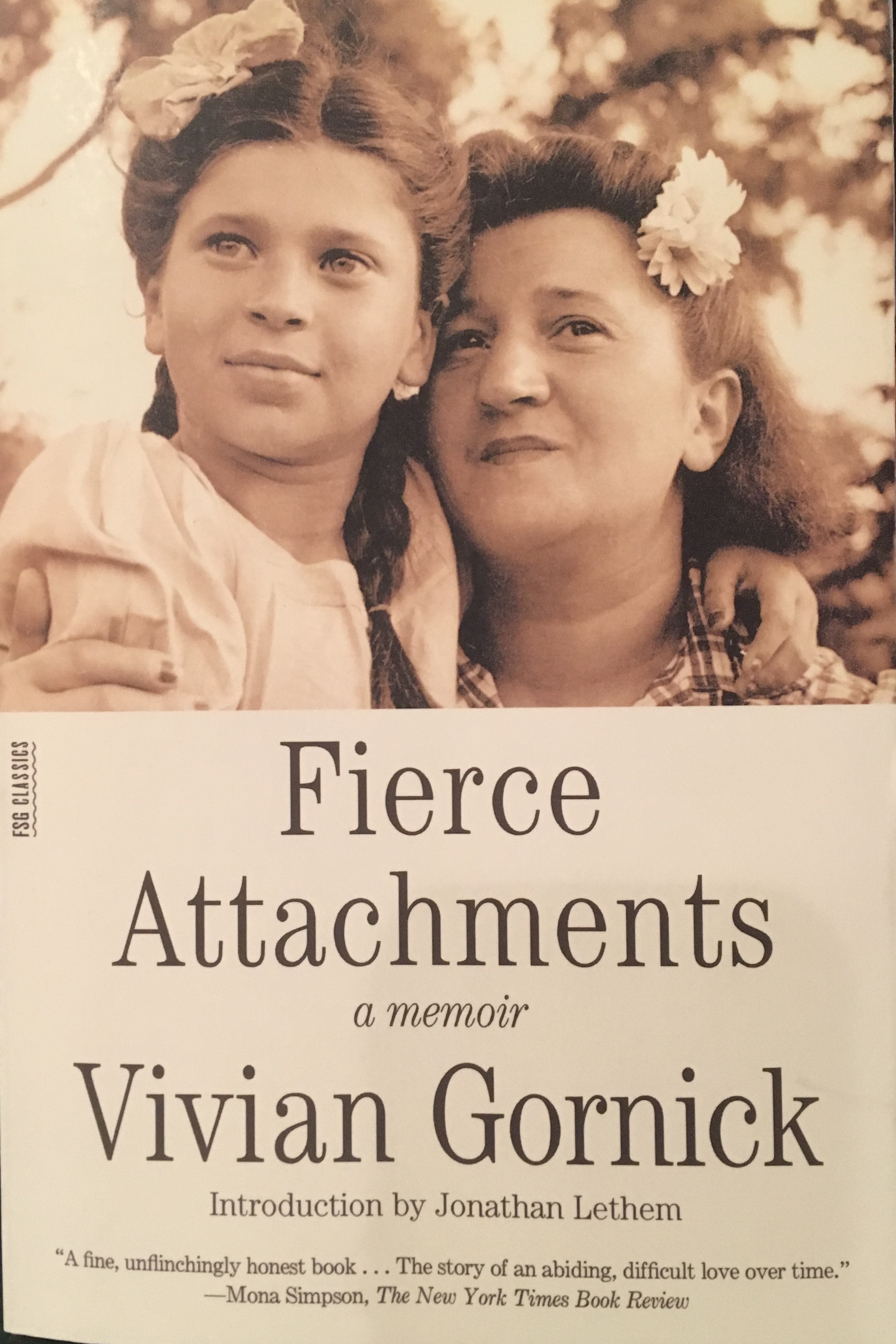
book beginnings on Friday: Fierce Attachments by Vivian Gornick

Thanks to Rose City Reader for hosting this meme. Participants share the first line or two of the book we are currently reading and comment on any first impressions inspired by that first line.

It has been a long, long time since I’ve featured a book beginning here (over a year), but I wanted to share these opening lines because I find them a fine example.

First: I knew before I even got to Gornick’s text that I had misjudged her. I think I’d been cool on this book because I did not enjoy Gornick’s craft book, The Situation and the Story. But as I opened Fierce Attachments to Jonathan Lethem’s glowing introduction, I knew this was different, and I felt I’d been wrong to wait so long.

Gornick’s opening lines are,

I’m eight years old. My mother and I come out of our apartment onto the second-floor landing. Mrs. Drucker is standing in the open doorway of the apartment next door, smoking a cigarette.

I love the immediacy of this scene, the way Gornick places us there in the very moment, in present tense. Even that first sentence, “I’m eight years old,” is such a choice on the part of the writer. It does what we are sometimes afraid to do: just comes out and gives up a piece of setting-information (age, in this case) outright. It’s simple, but that present tense makes it snappy somehow. That sentence says scene, bam. And I’m on board.

Thanks for stopping by for a book beginning. I’ll be back to reviews next week.

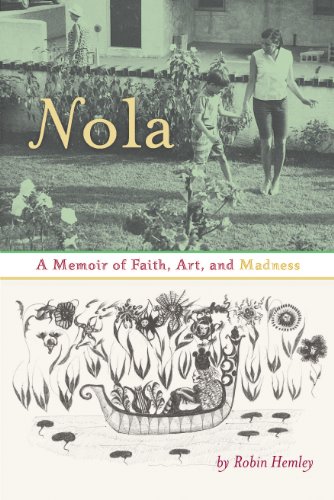
Nola: A Memoir of Faith, Art, and Madness by Robin Hemley

I appreciated Robin Hemley’s A Field Guide for Immersion Writing, and so I was interested when I learned he’d written a memoir of a difficult-to-write-about family member.

The first paragraph of Hemley’s prologue introduces five characters in a nuclear family. Father Cecil, who died when Robin (the youngest child) was seven. Brother Jonny, who “used to be good at everything, from languages to sports to the sciences,” but as an adult specializes in Orthodox Judaism (he and Robin are not close). The eldest, sister Nola, who “was good at everything, too, art and language, but especially things of the spirit.” Mother Elaine, writer and teacher, who is good at surviving. And here Robin introduces himself, as larcenous. Throughout this book, he is tormented by the thought of the stories, secrets, feelings and anguishes he’s stealing from his family members, particularly Elaine and Nola. Brilliant, spiritual, disturbed Nola, who always heard voices and saw fairies and angels and communicated with God, was treated for the last several years of her life for schizophrenia, in and out of mental institutions until she died when she was twenty-five years old, and Robin was fifteen.

This is a memoir filled with documents. The Hemleys are a writing family, and Robin mines Nola’s unpublished autobiography, her drawings, his own and his mother’s short stories, letters sent among the family, court documents, and more. Nola’s writing in particular appears peppered with struck-through text and additions, mostly the work of their mother as editor. These edits are not redacted; the reader gets both versions at once, often unsure of whether a change is Nola’s or Elaine’s. It is disconcerting, and entirely appropriate.

Nola: A Memoir of Faith, Art, and Madness is well-named. It is not an easy read. Just over 300 pages feels longer, as Hemley navigates the pain and distress of layers of family trauma–his father’s death and the deaths of several school-age friends; moves to ill-suited towns; a permissive, struggling mother; everyday sibling discord, and Nola’s increasing difficulties with a world she characterizes as “a strange and unbearable monster.” This is Nola’s book, but it follows side-threads, too, as when eleven-year-old Robin goes to live for part of a school year with elderly relatives in Florida (“By any yardstick other than a conventional one, I was essentially an elderly person… I really liked being old”). Later, he finds middle school frightening and chooses instead to attend day school at the psychiatric hospital where Nola is an inpatient. The Children’s Ward is a comfortable enough home for Robin, until he finds out they might not let him out again. Years after Nola’s death, when Robin is a graduate student, he has a girlfriend who suffers a psychotic break echoing his sister’s. Obviously, these threads are part of Nola’s story, her mystery, as well.

Not an easy read at all, as the book’s progress follows Nola’s descent into a misery she will not escape from. I do not recommend staying up late into the night to finish reading this as a winter storm rolls in. I found it quite upsetting, in fact. There’s no question that Hemley achieves emotional engagement, a representation of some of the agony his family has experienced. It’s a complicated achievement, all these layers of family trauma–often still with hope strung through them, at least while Nola retains it–and the writerly impulses of a family committed to communication and the written word, to education, and to some version of truth, however complicated. [Elaine’s technique is to write the family stories as fiction. Hemley’s essay “Truths We Could Live With,” appearing in Joy Castro’s (ed.) Family Troubles, and assigned by Jeremy Jones for my recent residency, discusses the difficulties he’s had with this practice. You can read an excerpt here.] A major thread of Nola follows the back-and-forth communications of mother and son, as Robin researches his family history for this book, and Elaine both helps (consulting, remembering, mailing him copious documents) and worries over the pain this will cause her, and Robin worries in turn.

So, a rich and complicated story. And cerebral: the Hemleys are a heavily educated, intellectual and mystic family, as well. (Cecil was co-founder of Noonday Press, and with Elaine translated and edited I.B. Singer’s work.) Almost every page is dense with philosophy (Nola’s grad-school discipline), religion, theory: faith, art, and madness indeed. I was having trouble getting through it, until I decided to let Nola’s concepts in particular sort of wash over me, and stop trying to understand them. (Much easier this way.) This book is an accomplishment worthy of study, but it will cost you something in the reading, so I recommend it with that qualification. Maybe stick to the daylight, too.


Rating: 7 Blakean drawings.

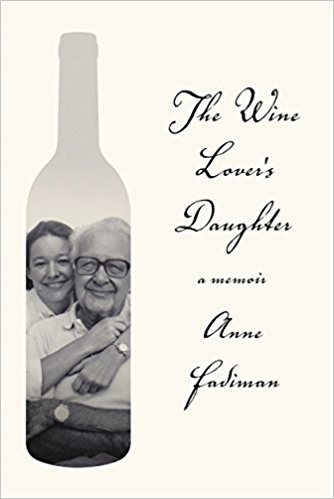
The Wine Lover’s Daughter by Anne Fadiman

A loving daughter’s memoir of her father portrays the literary mind of Clifton Fadiman through his passionate oenophilia.

Before Anne Fadiman was known for The Spirit Catches You and You Fall Down and At Large and At Small, she was an “oakling,” withering (according to an adage she quotes) in the shadow of an oak. Her father, Clifton Fadiman, enjoyed a long, successful career as a reader, book reviewer and wordsmith. He worked for Simon & Schuster, the New Yorker and the radio quiz show Information Please, and produced numerous collections of essays, criticism and anecdotes, children’s literature, translations and anthologies. Most of all, however, he loved wine.

Fadiman’s The Wine Lover’s Daughter is a beautifully composed memoir of her father’s life, viewed through the lens of his oenophilia. She recalls discovering his essay “Brief History of a Love Affair” at age 10, and being disappointed that it did not describe love for a woman. She should not have been surprised, as even at that age she knew the names of the Premier Cru Bordeaux and which were the Great Years (capitalized as such). Clifton’s passion for wine was prodigious, and it was his daughter’s shame and consternation that her palate never came to appreciate any of its forms. This memoir is in part the story of that struggle–her repeated attempts to love wine, and all the fine bottles wasted on her. Near the end, she embarks on a study of taste buds, supertasters and the possible scientific explanation for her (as she feels it) failure to live up to a legacy.

While she does not shrink from Clifton’s flaws–a condescending attitude toward women, profound insecurity–this portrait is deeply loving. Fadiman seeks to reveal a complex and multi-talented man, and to celebrate his contributions to literature. She also seeks contact with a father she clearly misses. Upon discovering the careful handwritten record of his wine purchases: “He liked thinking about a bottle waiting for decades in a hushed, dark place until a hand reached in, and the corkscrew did its work, and the wine came to life again, a life that had deepened while it bided its time. Opening the Cellar Book was like that.” She calls it “the most serious book he ever wrote, the most heartfelt, the most honest.” Finding him again in his Cellar Book, as well as in his copious writings, brings Fadiman great pleasure, and will edify and entertain readers. Along the way, she touches upon a century of U.S. cultural history, to which her father contributed.

Fadiman’s prose is clear and precise, and while not overtly poetic, perfectly composed as to rhythm and sound. As in her past work, she writes with equal skill of her own memories, family history, science and the finer points of wine appreciation (which she knows by heart and inheritance, if not by personal experience). The Wine Lover’s Daughter is a beautiful remembrance and a loving and well-deserved tribute to a literary figure–and to the joy of imbibing.


This review originally ran in the October 26, 2017 issue of Shelf Awareness for the Book Trade. To subscribe, click here.


Rating: 8 papillae.

Bonus:

I had a moment of joyful recognition when I discovered on page 5 that Anne’s father Clifton Fadiman was the author of the children’s book Wally the Wordworm which I remember enjoying as a child.

My review of Anne Fadiman’s The Spirit Catches You and You Fall Down was one of three brief pieces I sent in to Shelf Awareness when I applied to write for them. The beloved editor who hired me there has retired, but she is still reading and reviewing, and she changed my life in wonderful ways, as did Anne Fadiman’s writings.

Circles and synchronicity, friends.


Love and Fury by Richard Hoffman

Hoffman writes of struggling to know his father, or the challenge of the two fathers: “the one who made me, and the one I’ve made of him.” This is a memoir mostly of Hoffman’s adult life; it also handles race and class and family (the title refers to his theory of familial relationships). Hoffman is particularly concerned with questions of the racism, sexism, misogyny and abuse, the toxic masculinity, the blue-collar working class Pennsylvania of the coal mines with which he was brought up. In the course of the book, he becomes a grandfather and his father dies: these are the occasions for his reflection. And he is calm as well as reflective, introspective; he tries to be hard on himself and look the truth in the eye. This is the classic, universal question I am interested in: the mystery of one’s own parent(s).

I enjoyed Love and Fury. I felt immersed in Hoffman’s reckonings, and I very much identified with the struggle to know the father figure. I liked how he anticipated concerns about his memory, as when he prefaces an early childhood memory with questions about early memories generally, or where he admonished himself to say it (a difficult truth). It felt considered, as a book, if that makes sense–thought out. In fact it is more a memoir-in-essays, with lots of thinking on the page, than a strictly narrative story. A memoir for those interested in social justice as well as family.


Rating: 7 recliners.

The Glass Eye by Jeannie Vanasco

A devoted, tormented daughter eulogizes a beloved father in this thought-provoking and experimental memoir.

Jeannie Vanasco’s The Glass Eye is an intense and unforgettable memoir, as fascinating for its artistry as for its subject matter.

Jeannie was 18 when her father died. Though her mother is beloved and sympathetically portrayed, it was her father who had been her hero, her perfect person. On his deathbed, Jeannie promised him she would write about him. Although there is no sign that he heard, let alone held her to it, this promise would haunt the increasingly troubled young woman for years to come.

Her father had lost his left eye and wore a prosthetic one, which was in fact plastic, “but sometimes I call it glass. Glass implies the ability to be broken.” He lost his left vocal cord, too, and her mother loses hearing in her left ear. “What will be left of me if I lose her?” Jeannie’s father had a daughter before her, from an earlier marriage, who died in a car accident. That daughter was Jeanne; the daughter who promised to write this book is Jeannie, pronounced the same but with an added i. She fills her book with meditations on glass and left.

The Glass Eye is not what the 18-year-old intended to write. In the years after her father dies, Jeannie appears to function at high levels: she receives several degrees and works for prestigious publications. However, she is hospitalized repeatedly, battling mental illness and devastating grief. Everything is about her father–“Of course I hallucinated my eyes had fallen out.” A symptom of bipolar disorder (one of several diagnoses Jeannie receives) is a preoccupation with ” ‘clang associations,’ connections between words dictated by sound rather than meaning,” although for Jeannie, eye and i and I are also connected by meaning.

Vanasco pays compulsive attention to metaphors, and to the project of writing this memoir, which becomes a meta-exercise observing itself. She wonders, “What’s my hindsight perspective? Is this my narrative present?” and plays with plot. She asks the professor in her memoir course, “What if it’s about the promise to write the book?” The Glass Eye is indeed about Vanasco’s promise, as it’s about her father, grief, loss, her dead half-sister and reckoning with her own mental illness. And it’s about itself: both memoir and writing-about-writing.

Lyric, haunted, smart and tortured, this is an obsessive love letter to a dead father as well as a singular work of literature. The Glass Eye will attract memoir fans and readers concerned with mental illness and bereavement, as well as writers concerned with craft.


This review originally ran in the September 15, 2017 issue of Shelf Awareness for the Book Trade. To subscribe, click here.


Rating: 9 dollhouses.

The Woman Warrior: Memoirs of a Girlhood Among Ghosts by Maxine Hong Kingston

Kingston’s is a memoir in five longish essays, each of which could, I think, stand alone. A child of Chinese immigrants growing up in Hawaii in a Chinese immigrant community, she blends memoir (meaning personal or family recollections) with Chinese folktales, and ends up commenting on culture at least as much as her own personal experiences. This blend pushes the boundaries of memoir in the direction of imagination, and pushed my personal comfort level somewhat as a reader: I tend to prefer clear lines between fact and fiction, and while I am intellectually open to blurrings, I do notice my discomfort when it happens. I am most interested in the final essay, “A Song for a Barbarian Reed Pipe,” which expands metaphorically on the concept of literal voice. I’m also interested in the structure of this collection of five essays: their number, their varying lengths, their order, and the choice to offer a memoir in parts like this. Obviously the most unusual element, though, is that blending of folktale, imagination–even fantasy–with traditional memoir reporting.

Kingston has a vivid storytelling style, and voice. It is easy to get lost in the story at hand, and there is a dreaminess (in some sections more than in others) that I don’t often see in memoir. The flip side is that it can be harder to mentally pull these parts together into the story-of-a-life that I expect from memoir. But there’s no question that this is an absorbing and entertaining book–not to say that there isn’t emotionally difficult content, of course.

General readers of fiction as well as memoir will find much to enjoy. Students with rather more literal minds may be challenged.


Rating: 7 white tigers.

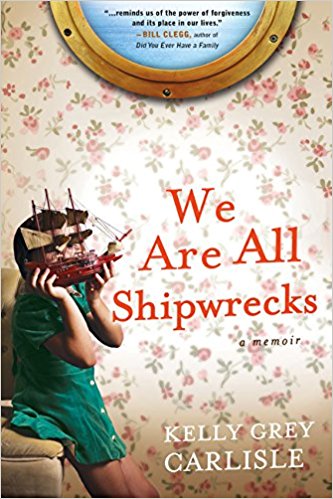
We Are All Shipwrecks by Kelly Grey Carlisle

An unstable childhood on the harbor in Los Angeles yields a wise, contemplative, forgiving memoir by a likable narrator.

A young mother tucked her three-week-old daughter into a drawer in a Hollywood motel room before leaving for the night. A police detective would lift the baby out again, after the mother was murdered. In the opening scene of Kelly Grey Carlisle’s memoir, We Are All Shipwrecks, an eight-year-old Kelly meets that detective for the first time, having just learned how her mother died. It sounds like a sensational beginning, but Carlisle’s measured, wondering tone allows the reader, like the author’s child self, to meet each disorienting new situation with curiosity rather than a sense of spectacle.

Kelly was raised by her maternal grandfather and his much-younger wife, whom she calls Daddy and Mommy. He likes to be called Sir Richard and boasts of a wild and heroic–increasingly incredible–past; her name is Marilyn, and she carries wounds that Kelly will gradually understand. They own a pornography shop near the Los Angeles airport, and for many of Kelly’s formative years, they live on a boat in a marina. Their neighbors are unglamorous down-and-outs, and Kelly is wracked by how normal her childhood isn’t. But in her reflections on the page, she realizes that the adults who surrounded her in her youth played various parts in her unconventional upbringing; many of them were loving, positive figures. We Are All Shipwrecks is a memoir about being adrift and lost on a boat, but also about discovering that we’re all more or less adrift, that yearning is a universal condition.

As she matures and learns more about her grandfather and Marilyn–the nearest to parents that she’ll ever know–Kelly persists in wondering about the mother she lost. Naturally, then, the book follows her progress: from tracking a bewildering childhood to seeking answers about where she’s come from. By the time Kelly becomes a mother, and for some time thereafter, her understanding of her roots continues to evolve. She explores the roles of trauma, love, resilience and forgiveness in shaping a life. “By now, I’ve realized that my grandfather was wrong when he told me, ‘Where you come from is important; it’s who you are,’ because it was only partly true. ‘Who you are’ also happens after you leave home. You are turning into ‘who you are’ your whole life.”

We Are All Shipwrecks is a personal history, a commentary on the experiences of childhood (uncertainty, pain, possible acceptance) and an investigation into what creates us. Readers who appreciate thoughtful memoirs will be charmed by Carlisle’s generosity and easy, open reflections.


This review originally ran in the August 7, 2017 issue of Shelf Awareness for the Book Trade. To subscribe, click here.


Rating: 8 cats on a boat.

reread: The Liars’ Club by Mary Karr

Shortened version: it was excellent and moving, again. (Original review here.)

I will repeat myself (from Wednesday’s review of The Art of Memoir) that one of Mary Karr’s greatest strengths is her voice. Her personality sings or laughs or screams off the page, vernacular and colorful, wise and confused, approachable and authentic and believable. Her story is wild. If it weren’t told in such convincing fashion and with such human wonder by its narrator–in other words, if I tried to tell you here about some of the things that happened to young Mary, less artfully–you wouldn’t believe it. But in this memoir, you do.

Karr grew up in a little east Texas coastal refinery town (here under a fictional name), with a short spell spent in Colorado. Her family was troubled, and gave the neighbors some entertainment (or opportunity for self-righteous head-shaking). But this is not a simple story of hardship and woe. The Karrs are also fiercely loving and loyal, with a capacity for humor. Karr’s narrative voice seeks answers and knows how to criticize, but she loves her flawed people; she’s not out to get them. (This is one of the key tips of The Art of Memoir: write out of love, not hate. Additionally, though this sounds even harder, “as Hubert Selby told Jerry Stahl, ‘If you’re writing about somebody you hate, do it with great love.'”)

From a craft perspective, I suppose I will start by examining the rich inner world Karr relates here, as for example on pages 148-157. In this eventful chapter, Karr’s mother creates a massive bonfire of most of her children’s–that is, Mary and her sister’s–belongings, before threatening their lives with a butcher knife. This scene is described in great detail, meticulously, so that it takes pages for moments to pass. Alongside the scene we get little Mary’s coping mechanism: her imagination supplying parallel events to explain or counter those she is witnessing. There is a backwards-looking perspective provided by the adult Mary writing these lines, but also much of young Mary’s real-time daydreaming. There are flashbacks. It’s an extraordinary sequence, and she uses a similar strategy elsewhere, in other such horrifying, dramatic, traumatic scenes. I know one reader who finds the lengthy, meticulous description of trauma difficult; but I think it’s actually a remarkable way to put us in the scene, as well as paint the child’s surreal experience. (Also, it’s difficult. But there is no way to read about rape that is not difficult. It should be difficult.)

My remarks here just scratch the surface of what The Liars’ Club has to offer. I’m a little confounded by the reviewers who didn’t love this memoir. The “best” criticism I saw was by a reader who believes that memoirs should teach a high moral lesson or reveal an important, famous person’s life. This book perhaps does neither, but I disagree with the premise; and so, thankfully, does Mary Karr.


Rating: 8 electric can openers.

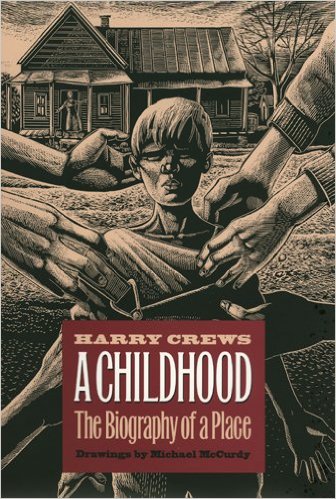
A Childhood: The Biography of a Place by Harry Crews

I’ve been hearing about this one for years, I think first in South Toward Home. While it was already on my semester reading list, I was prompted to put it next in line when I read in Mary Karr’s The Art of Memoir: “[A Childhood] is underrated–virtually unknown–except among the aficionados of the form.” So there. (My reading of The Art of Memoir was interrupted, so its review will follow this one. Preview: I like it.)

This is a memoir of a very short period, when the author is five and six years old, with just a few oblique references to his later life. During these two years, the child Crews becomes aware of himself in the world; he suffers serious injury and illness; his mother leaves his ‘father’ with her two sons, and after a few reunions, splits from him forever; and Crews learns that this was not his biological father, but the brother of that man, who is dead. In his reflections, what motivates the writing of this book is that Crews is haunted by the absence of his late biological father, and by a lack of ties to his home place of rural Georgia.

Both story and prose are tough, muscular, macho, unadorned, laden with violence and hardship; there are lovely lines concealed within, but Crews is most concerned with chronicling his scars. It is a raw and affecting book, and attempting a ‘biography of a place’ through a memoir of just two years is an intriguing strategy. I am fascinated by this idea, that two years of a child’s life can serve to profile a place.

I really appreciate Crews’s voice. This element (combined, obviously, with place and class) reminded me again and again of Rick Bragg. Bragg’s The Prince of Frogtown is on my reading list this semester as well; I hope I get to it in time. Of course I was also drawn (as with Sanders) to Crews’s preoccupation with place, where he’s from and what that means. Another kindred in this way, although his style (and the story he has to tell) differs greatly from my own. Crews is another author that plays with a fluid ‘truth’, which Mary Karr commented on as well: she forgives this favorite memoir because the more imaginative sections are obvious enough to pick out. Those are some of the sensational bits. But really, Crews lets his story stand for itself. His childhood will read as shocking to some of us; but it also reads as very real.


Rating: 8 slisures of grapefruit.

The Mighty Franks by Michael Frank

This memoir of family wounds and favoritism charts dark territory as the author searches for understanding.

the-mighty-franks

“‘My feeling for Mike is something out of the ordinary,’ I overhear my aunt say to my mother one day when I am eight years old… ‘I wish he were mine.'”

Michael Frank comes from an especially close-knit family: his mother’s brother married his father’s sister. He is devoted to his doubly related Aunt Hankie and Uncle Irving. The elder couple is childless, and so they “share” the younger couple’s three sons, of whom Mike is the eldest. The two households are neighbors in Laurel Canyon, in the Hollywood Hills. Both grandmothers live together at the foot of the canyon. It is all very cozy: Aunt Hankie calls them “the larky sevensome,” or “the Mighty Franks.”

And Mike is the luckiest, larkiest one of all, because he is Aunt Hank’s pet. They spend their free time together. She takes him antiquing, and sets out to teach him everything she knows. Hank (a nickname for Harriet) and Irving are successful Hollywood screenwriters, and they have the finest taste in architecture, art, literature, movies, music (nothing after Brahms) and manners. Hank has an overwhelming personality and strong opinions, and when she says that Mike has the eye, the artistic eye for the creative pursuits she prizes above all, he is naturally proud–and motivated.

The Mighty Franks is Michael Frank’s memoir of the relationship he shared with his forceful aunt. While he is favored, his two younger brothers are mostly ignored (Hank sniffs that one has the makings of a scientist, the other, an athlete). He is the modelling clay she plays with, until he begins to awaken to a world larger than Aunt Hank, and forms his own opinions and tastes. She sees this as rebellion, ingratitude or worse. As Mike grows up, Hank seems to break down and the Mighty Franks begin to fissure.

Frank moves between the child’s perspective of events as they unfold and a place of reflection. In writing this story, he seeks a better understanding of his aunt, the imperfect workings of his extended family and his own relationships within and outside it. Hank is firm about hierarchies: the Renaissance over the Middle Ages, Faulkner over Hemingway, Fred over Ginger, early Fellini over late. Similarly: Hank over her younger brother, both of them over their spouses, Mike over his brothers. And always Hank first.

The Mighty Franks is an immediate, gut-wrenching account of events that are often painful for young Mike. While not an easy story to take in, Frank’s ruminations offer some necessary distance. His tone is serious and his prose occasionally verbose, but the saga of this flawed family is deeply involving. Any hint of sensationalism is more than balanced by the psychological insights Frank eventually achieves.


This review originally ran in the April 11, 2017 issue of Shelf Awareness for the Book Trade. To subscribe, click here.


Rating: 6 period pieces.