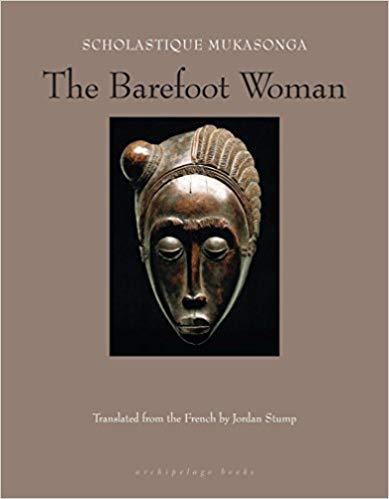
The Barefoot Woman by Scholastique Mukasonga, trans. by Jordan Stump

A shadow of tragedy hangs over this lovely, lyric memoir of Tutsi childhood in Rwanda, but the author’s love for her strong mother remains central.

The Barefoot Woman by Scholastique Mukasonga (Our Lady of the Nile; Cockroaches) is a loving tribute to a strong mother and a striking work of memoir.

Mukasonga and her family lived as exiles in Rwanda in the years leading up to the genocide of the Tutsi. This time in her life, when they were all together and alive, was short, but Mukasonga has vivid memories, especially of her mother, Stefania, a leader in the makeshift village where they were regularly terrorized by Hutu soldiers. In an earlier memoir, Cockroaches, Mukasonga depicted the horrific end of her family. Here, she focuses on her mother: Stefania is a hard worker, always with her hoe in hand; a healer with a medicinal garden of grasses, tubers, roots and tree leaves; a “highly respected matchmaker”; and a dedicated, ever-vigilant protector of her children. Saving them was her “one single project day in and day out, one sole reason to go on surviving.” She is not a hero with a single dimension, though. In Mukasonga’s warm telling, Stefania has personality, a sense of humor and a deep love for her family.

The book opens and closes with dreamlike sequences. At the beginning, in the narrator’s memory, Stefania reminds her children of their duty to their mother upon her death. At the end, Mukasonga describes a dream about her mother’s uncared-for dead body and those of so many Tutsi. This sets the tone for the rest of the memoir, which often feels dreamy as it turns to childhood memories. Extraordinarily, this story is at times horrifying in its content and at other times playful; lyric in its style and tender in its handling of the central character. While the reader’s knowledge of the genocide to come hangs over the narrative, the everyday events often retain a quotidian feeling; Stefania and her neighbors worry over their children but also laugh and celebrate and arrange marriages. As a literary work, this establishes a rare balance. Jordan Stump’s translation from the French beautifully conveys this sense of both tragedy and day-to-day joy.

The Barefoot Woman is also an essential record of traditions and a way of life that are in danger of disappearing. It describes the inzu Stefania builds, with great effort, in exile: a traditional straw-dome house “that was as vital to her as water to a fish.” The importance of keeping a fire going, and why a mother would borrow fire from a neighbor rather than use a match. The significance of sorghum, “a true Rwandan” crop, and why Stefania insisted on a cow, the traditional gift for her son’s marriage pact, even in the inhospitable new place where cows were no longer a part of their everyday lives.

This is an adoring, gorgeously rendered memorial to a mother and testimony to a people.


This review originally ran in the November 19, 2018 issue of Shelf Awareness for the Book Trade. To subscribe, click here.


Rating: 8 little loaves of bread.

guest review: Earth Works by Scott Russell Sanders, from Pops

I originally reviewed Scott Russell Sanders’s Earth Works in two parts. I also sent a copy to my Pops, because I felt he needed it. I’m glad to have heard back from him now.

Thanks for the book! A few weeks ago I finally dabbled my way through the whole thing. At first I expected to read only those essays that were new to me; but I found the continuous approach irresistible.

As did I, on both counts, actually. A well-organized collection, then!

I blame summer rather than Sanders for taking this long, but Sanders deserves some credit for all the time I took in contemplation and consideration. This collection is indeed challenging in its range and subject matter, but mostly for Sanders’ unguarded candor and intimacy. He is quite simply baring his soul; whether we choose to appreciate what he has to say is up to us. In other words, I had to remember ‘how’ to read him, accepting the variety of both subject matter, and the responses he may arouse for the reader. The wide range of those things is central to the attraction, I think. He is boldly and humbly naked in his writing.

Which is why I wanted to respond to your ‘part one’ blog comments here, because I got as far as “The Men we Carry…” and wish to rise, not to defend him, but explain my reading of it.

Actually, there is no defending, and you did an excellent job of explicating that. And we still don’t know if he has reconsidered his words here. But as I read the essay, his Preface words were fresh in my mind; you quoted those briefly, but here a bit more complete, with my emphasis: “I have refrained from making significant revisions, allowing the essays to remain, for better or worse, essentially as they were when they appeared in print.”

As I suggested earlier, this candor, with all its risk and embarrassment so well exposed, is part of the masala, the potpourri – and the challenge – of reading Sanders essays. In some others earlier, he has already disappointed, frustrated and angered me; I am now unsurprised. I have resolved to consider time and place and context, accept it as material helping me understand this complicated and flawed person (as are we all), whose thoughts I am now invested in.

It’s the difference, if you will, between reading to examine what’s inside an author’s head, versus critique or enjoyment of content only. Increasingly, as my reading has become more intentional, it seems to lean towards the former, while I still enjoy the latter.

Mostly, I appreciate how such dissonance inspires me to better understand my own thoughts and values – for better or worse. Your own thoughtful response to his mansplaining is perhaps an example, with your values now in print with such clarity.

Pleasantly, with Sanders his best are still very rewarding.

FYI: By the numbers:
There are 30 essays here, covering 3 decades;
21 were published in other collections, the others only in periodicals;
I marked 12 favorites out of the lot, including 7 that I had already read elsewhere (including 3 of the 4 from Staying Put.)
But I read every single one, for a complete journey. Favorites tended to be most personal about family and father; nature and its human impacts; existential questioning. Interestingly, the ‘others’ tended to be similar ground but pursued in excess, taking me a bit over the edge, and often simply too personal and intimate – or dissonant.

I love a good numbers round-up, so thanks for that last section!

Glad that my comments made sense to you (I’m not the least bit surprised). From a distance now of nine or ten months, I remember this collection as a whole and as a reading experience, rather than in its particulars, and that overall impression is positive: I would say I like Sanders very much. But I do remember the essay that upset me, too.

The point you make in quoting the Preface is well taken, and I’m glad he made that statement. But I guess the distress and anger I felt in reading that essay was strong enough that I think it should have warranted a response from him – maybe let the essay stand as originally published but write an addendum, letting us know how wrong he got it and how much he’s grown and learned. If Sanders were reading this, that would be my request of him: republish; but now respond to your own writing, too. Well, I won’t hold my breath, but as you said, I’m glad I have gotten my own response out there, however small my platform.

I think there is an ongoing question of how to handle writings that seem wise in many ways but require of us that we make allowances for attitudes like racism, sexism, colonialism, classism, etc. and on and on. To what extent do we accept that something is “dated” and still find a way to enjoy it or to find value? I keep reminding myself that in every era somebody has been enlightened enough to see past the values of the time. It’s something I’m still doing battle with, myself. (Stay tuned, one of these days, for my troubles with Wendell Berry.)

Thanks for yet another thoughtful guest review, Pops.

follow-up to The Twenty-Seventh Letter of the Alphabet by Kim Adrian

This Wednesday I posted my review of Kim Adrian’s new memoir; but I have more to say.

The Twenty-Seventh Letter of the Alphabet came to me as one of a series of happy accidents, or coincidences – or synchronicity. At this point, I’m not sure I can call it coincidence; this is more like the result of a cultivated reading life, for which I’m grateful. Recall how I loved and raved about Adrian’s Sock. That review posted just as I headed off to residency, and I heard almost immediately from her publicist, offering me this memoir for review. Well, I say no to these offers 99% of the time, plus I was at residency (spread extra thin), and entering thesis semester. But I was intrigued. I looked up the book. I knew I liked the author; it was the right length. I pitched the review to Shelf Awareness, who accepted, making it worth my time in that (monetary) sense. So I said yes, send me that book.

And it was not only a wonderful book, as I’ve written, but turned out to be uncannily well-suited to my studies this semester – in other words, it serves all these functions for me: a review for the blog (as requested by a pleasant, not pushy, publicist), a review for the Shelf, and a nice tie into my schoolwork.

Adrian’s memoir features photographs – described, not included – which is also something I’m doing in my thesis. (My dear friend Delaney used photographs in her thesis last semester – included them, as in Dorothy Allison’s Two or Three Things I Know For Sure – and taught on “art and artifacts” for her graduate seminar.) She studies a difficult-to-pin-down mother figure, which was the original plan for my thesis – I’ve given up on that for now, but it’s still in the back of my head. Finally and best of all, she uses that strange but quite successful structure, the glossary, an alphabetically organized series of fragments. These entries rarely strike me as “narrative” on their own, but they definitely combine to tell the story, and in chronological order. My lightbulb realization, which seems so obvious in hindsight: these entries were not titled and then sorted; they were titled for their place, to serve the alphabetical structure.

I found this fruitful reading in several senses – and not least, it was gripping. I stayed up until 1am to finish it, which is something I’ve not done, I think, in several years. So it merited this second post and my firm endorsement.

Thank you, Kim Adrian, and thanks to her fine publicist, Carrie Adams, for doing the work of connecting the right reader with the right book.

The Twenty-Seventh Letter of the Alphabet by Kim Adrian

A remarkable memoir, organized as a glossary of terms, that is part detective story, investigating a mother’s mental illness.


The Twenty-Seventh Letter of the Alphabet is a memoir with an unusual structure to match its ever-shifting reality. “I’ve wanted to tell this story for as long as I can remember wanting anything at all,” writes Kim Adrian (Sock): the story of her mentally ill mother, how she got this way and what Adrian can or should do about it.

Linda, Adrian’s mother, has been diagnosed with a long list of ailments: borderline and narcissistic personality disorders, bipolar, psychosis, paranoia and more. Adrian’s father is an alcoholic; his memories, his assertions that Linda wasn’t always this crazy, “not like she is now,” can’t be trusted, because “he’d been drunk the whole time.” Adrian’s sister has few memories from their childhood. In constructing this narrative, then, she relies entirely on her own memory. But the trouble with remembering the truth of what happened is that Linda’s lies, manipulations and her own troubles with reality created a wildly shifting experience for her oldest daughter. If Linda retold a story, the very truth of it changed for Adrian. Reconstructing the past now is therefore a fraught undertaking.

This troubled and troubling attempt to reorganize a life is organized alphabetically, beginning with an anecdote titled “Abecedarian” about an unexplained event in grade school, and ending not with “Zigzag” (Linda weaving down a city sidewalk), but with the entries under “&.” “Until the mid-nineteenth century, the ampersand was considered the twenty-seventh letter of the alphabet,” and for Adrian it offers inclusivity, “a verbal umbrella” under which she is both mother and daughter, both happy and sad.

This structure, the glossary, would feel contrived or awkward in less capable hands. The narrative of Adrian’s childhood through her own motherhood and healthy, loving family life is told more-or-less chronologically, but in fragments, whose alphabetized titles emphasize the narrator’s reliance on words, on the power of storytelling to restructure her experiences, perhaps to fix something. The glossary’s entries are anecdotes, descriptions of family photographs or simple definitions. “Domesticity: A kind of faith, in my experience.” Deceptively simple fragments add up to more than the sum of their parts.

Adrian’s story is often horrifying. Both of her parents were violent; her mother’s emotional and verbal abuse is ongoing and perhaps more shocking still. The older woman’s circumstances, bouts of homelessness and hospitalization, and the younger woman’s inability to extricate herself from the cycle of abuse, can be difficult to read. But, see “Hope: The ‘only way of knowing a person,’ said Walter Benjamin, is to love them without it.”

The Twenty-Seventh Letter of the Alphabet is a feat on many levels. Adrian tells a harrowing story, surprisingly redeemed by her own sweet family, but in many ways also continuing. She gives it meaning without having answers to all the questions she still asks herself. Her work as glossator is astonishing and inventive. Her glossary is strangely gripping, with a momentum pulling the reader in and through. The result is whimsical, even darkly funny at times, brimming with compassion, terribly sad and deeply loving. Memoir readers should not miss this singular offering.


This review originally ran in the September 7, 2018 issue of Shelf Awareness for the Book Trade. To subscribe, click here.


Rating: 8 nutcrackers.

Cutty, One Rock: Low Characters and Strange Places, Gently Explained by August Kleinzahler

I bought this book nearly two years ago, on the recommendation of my friend Doug.

Cutty, One Rock has four parts in this edition (three in the original). Generally, the book deals with Kleinzahler’s background–family, hometown and neighborhood–in a Mob-rough New Jersey; it deals with place, relationships with people, and eventually with art. His parents live a middle-to-upper-middle class life, concerned somewhat with appearances; his mother is devoted to Shakespeare. The back of the book calls them “both cultivated and deranged,” which I think is apt. Early in the book, these parents figure as central influences, central characters in the child’s upbringing, but stay tuned for another important family member to come later in the book.

The adult Kleinzahler is an expatriate Jerseyite living in California’s Bay Area, and the differences between these two places, the baggage he carries between them, is another central feature. Here he is describing the “swagger, a bluff air of menace that many of the males wear”:

Once, after leaving a restaurant in North Beach, here in San Francisco, I gave a panhandler a dollar, a middle-aged black guy with some amusing riff or other.

“Thanks, Jersey,” he said, to the great amusement of my companions.

“How did you know I was from Jersey?” I asked.

“Are you kidding?” he said.

The narrator does substantial traveling beyond these two points, east and west, and these other locations and the nature of travel itself offer another recurring thread. The essay “East/West Variations” opens:

There’s a window, thirty-six hours or so, not even, when traveling by air between places, places where you’ve lived for a long time. After you’ve landed and into the next day, perhaps the evening–then you begin to lose it. It goes very quickly, decaying like a tone in the air. But for a while, inside that window, you’re hyperawake.

He goes on to describe this “window,” which I couldn’t help but conflate with the window you look out of when traveling by air–which I was doing, as it happens, while reading this book. He concludes on the next page that “places are conditions of mind.” By the end of this wide-ranging essay (which catalogs several romantic interests and his hard-nosed mother’s reactions to these women), we deal directly with a parent’s mortality. It’s a hell of an undertaking, and I’m not sure I followed him everywhere he tried to take me, but I appreciate the ambitious handling of place and people, and their intersection.

Part three tackles the subject of poetry, and poets. Kleinzahler is a poet; but he’s a rough-and-tumble Jersey poet, with no patience for poetry readings or academia. He writes a particularly scathing send-up of Garrison Keillor’s Good Poems; a profile of Allen Ginsberg (reminding me, not for the first time, of Joseph Mitchell); and a lovely elegy of Thom Gunn. The Keillor criticism, “No Antonin Artaud with the Flapjacks, Please,” is clever, and the Ginsberg profile is incisive; but I love Kleinzahler’s voice best when he writes with love, as he does of Gunn.

Kleinzahler is derisive toward intellectuals,

particularly university intellectuals, [who] indulge in pissing contests over how much they’ve read, quoting at length by heart and so on. No wonder they have no friend off-campus. Thom could more than hold his own if sucked into one or another of these contests, but it wasn’t his sport.

And it’s not Kleinzahler’s sport, either, but I do want to point out that he had me noting (and in some cases looking up) terms like diabase, tibouchina, carillon, cloaca, tatterdemalion (great fun, that one), superannuated, and–very happily–sprezzatura, which I remember from John McPhee’s Draft No. 4, in which McPhee expresses a sense of total consternation at this untranslatable and mysterious term. So there, Kleinzahler.

While there are many fine essays here–like “The Bus,” about public transportation, class in cities, and the invisible weirdness of strip centers–this book held two exceptional highlights for me. One was the essay, in part two, “The Zam Zam Room.” It offers a profile of a bar, a dark and smoky bar with a characterful bartender/owner who professionally throws people out.

When David Letterman came to town to do a week of shows, his advance people phoned Bruno to see if he would throw Letterman out of the bar on the show. “No, I’m sorry, thank you,” Bruno said over the phone. “Who’s David Letterman?” he asked us. “I don’t know this person. Why do these people bother me? He must be some New York person.”

Perfect descriptions of place, local culture, and especially a singular personality, make for an essay I love–but if it’s also set in a bar, I’m really sold.

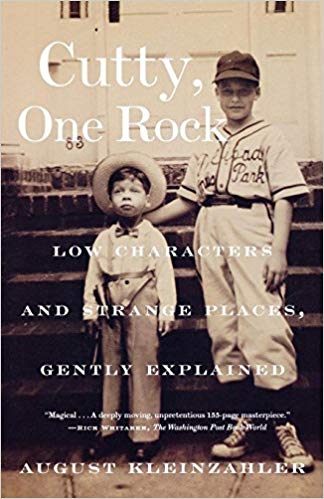
The finest thing in these pages, though, is part four. Where the first three parts contain three to four essays apiece, this is a single essay, which shares the book’s title, “Cutty, One Rock.” That’s what Kleinzahler’s older brother always ordered when he went out, which he did, just about all night and every night until he died young and tragic. I heard echoes and rhymes of Norman Maclean’s “A River Runs Through It” loud and clear throughout. This deeply loving study of a loved brother, its close attention and reluctant acknowledgement of flaws, its worship–because the narrator was the much younger brother, always looking up–is so good it hurts. That’s them on the front cover.

This book is worth reading from cover to cover, but that final section really blew me apart. Booze; sense of place; difficult families and unbeautiful homes. Also, memoirs by poets. Good stuff. Thanks, Doug.


Rating: 8 dry martinis.

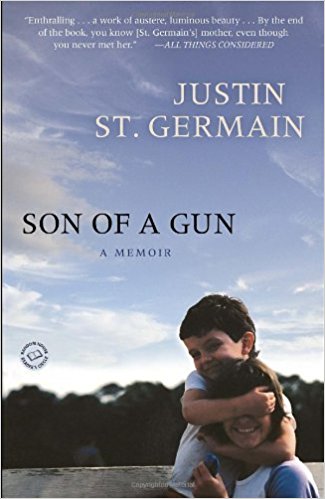
Son of a Gun by Justin St. Germain

Justin St. Germain’s Son of a Gun is a compelling, heart-breaking piece of personal narrative, and it is told beautifully, with restraint and with artistry and structure. The first observation is one any reader might make; the second is the more subtle observation of a reader looking for writing tricks. This is a book that works beautifully on both levels.

The narrator was raised by a complicated woman named Debbie. She was a soldier, a strong woman who made impulsive decisions and charged ahead, took care of herself and her two sons through all kinds of hardship; she had poor judgment in choosing romantic partners, was married five times with many relationships in between, for which she was harshly judged in turn. When Justin was 20, she was murdered by her most recent husband, Ray, a former cop with the requisite mustache and mirrored sunglasses. Until then, Justin had thought Ray the most harmless one of the bunch.

This memoir is the story of Justin’s mother’s death: his shock and grief, his anger, the violent end of Debbie and, later, of Ray. It ranges between these individual instances of gun violence and others, personal and societal, as Justin visits with Debbie’s former partners, goes shopping at a gun show, and cycles back over and over again to Tombstone. Oh, did I leave that part out? Justin and his brother Josh were raised in Tombstone, Arizona, a town whose very existence depends on the legends of Wild West shoot-outs.

I appreciate St. Germain’s title, because it reinvents an old and meaningless saying in a fresh new way: making the point that he is indeed a son of a gun, of a gun culture that engineered his mother’s demise. I also appreciate the way he handled his own character, the narrator, in a spare way that acknowledges (for example) the problematic way in which the 20-year-old reacts to his mother’s murder. He does not always behave well, but who would?

It’s a hell of a sad story, one that recalls my recent read Love and Death in the Sunshine State by Cutter Wood (review to come), and A Woman on the Edge of Time. It’s a hell of a story, in the first place, and at the same time, tragically, nothing out of the ordinary: a 2017 CDC report concluded that nearly half of female homicide victims are killed by a current or former intimate partner. St. Germain does deal with this larger context, although his primary concern (understandably) remains personal.

A hell of a story, but also artfully told. I often think that creative writing, the kind I’m studying, has two parts: an interesting story, and the artful telling of it. A book can become successful, can please or entertain and sell, with either one or the other of those elements, but the best books have both a good story and a good telling. One of the key features of this book, I think, is the narrative restraint. Anytime a writer handles a story this close to home and this fraught–emotional, violent, graphic–it’s difficult to keep a calm perspective, and yet not be cold and distant. St. Germain walks that line. Another strength is the weaving in of the external, if you will, theme material: the history of Wyatt Earp and the shootout at the O.K. Corral (which St. Germain informs us actually took place “in a vacant lot to the north, between a back alley and what is now the highway. But try putting that on a T-shirt”). This is a classic gift to the writer from the universe: that he was brought up in Tombstone, that Tombstone and Wyatt Earp and the O.K. offer such a backdrop for his story and his reflections on it. This braided-in information is almost too perfect for his story; but this is why we say fact is stranger than fiction. It allows a very neat context for the narrator to think about not only his personal tragedy, but the larger cultural implications.

I was riveted as I read this book, all the way through in a day, because this story has momentum, suspense and crafted pacing. I was heartbroken for the characters, and struck by St. Germain’s gestures at the larger world. It’s a very fine book.


Rating: 8 arcane alphanumerics.

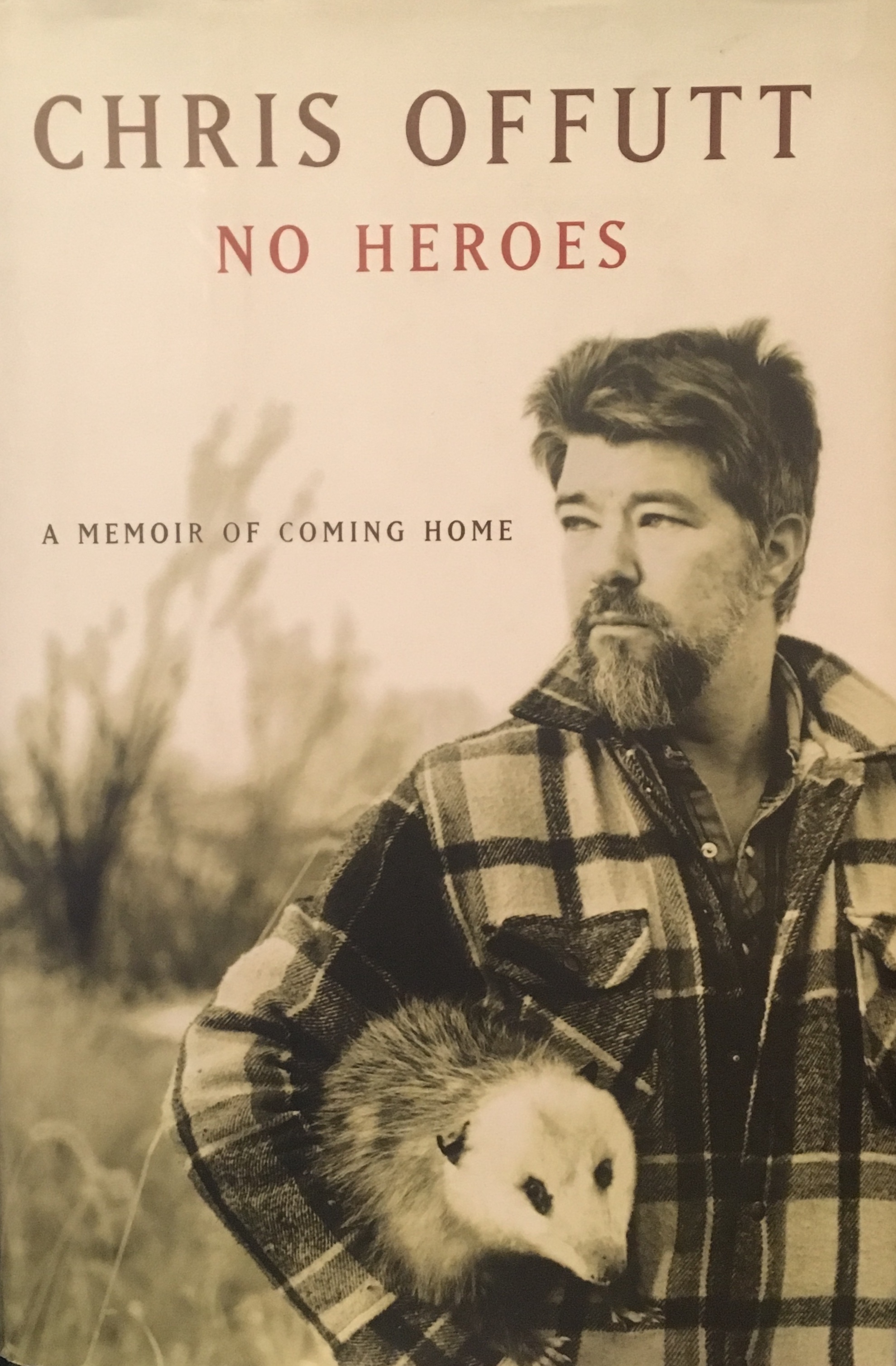
No Heroes by Chris Offutt

No matter how you leave the hills–the army, prison, marriage, a job–when you move back after twenty years, the whole county is carefully watching. They want to see the changes that the outside world put on you. They are curious to know if you’ve lost your laughter. They are worried that perhaps you’ve gotten above your raisings.

This is beginning of No Heroes. Only the prologue retains this second-person perspective, which I think would have gotten difficult for the length of the book, but it’s a perfect intro: it brings immediacy, in that you are the one facing these challenges; and it offers a dreamy, literary take on Chris Offutt’s rough-edged subject and setting. This prologue takes the form of an instruction manual (“to do this, do this”): how to return home, if home is this specific place. It concludes:

You are no longer from somewhere. Here is where you are. This is home. This dirt is yours.

It’s a perfect beginning.

This book is a close cousin to Jeremy Jones’s Bearwallow, which comes as no surprise because Jeremy recommended it to me.

It’s a fine book. In blurbs on the back, Offutt’s style is compared to that of Hemingway and Raymond Carver: strong words, but I can see the comparison. Offutt tends toward short, declarative sentences, except when he doesn’t (like Hemingway, a man perfectly comfortable with long, convoluted sentences and full-blooming metaphor when he feels like it, despite a reputation to the contrary). That is, the prose is mostly simply put together, undemonstrative, but he also knows how to turn a surprising or beautiful phrase at the moment we least expect it; the rarity of such lines adds to their impact.

Offutt’s story, like Jones’s, is of going away and coming back. Both men are from Appalachia. Offutt is from the hills of northeast Kentucky, where he went to elementary school, high school and college within ten miles, and only realized later how unusual this was. As a troubled twenty-year-old, he’d left the hills. He returns as a forty-year-old, having collected an education, written books, married and had two boys, lived and experienced lots of places. He’s back to teach at his alma mater, a humble school where he had worked maintenance while a student, a paradoxical foot-in-two-worlds experience that his cohorts on both ends–work and school–had struggled to accept. “It was more of a high school with ashtrays than a genuine college,” Offutt writes, but that criticism sounds less nuanced in isolation than it does on the page, in the midst of his obviously tortured love for this place.

In the course of No Heroes, he navigates his return to this place, whose dirt and leaves and birds he passionately loves. His parents still live here, but his love for them is less easy. His wife, Rita, and their two sons have some trouble adjusting to a place that is not theirs. Offutt came home hoping to be a hero to students like the one he was: talented but without role models, ready to slip into crime more easily than into art. The title foreshadows the end of that plot line, of course.

But there is another plot line! And it’s a doozy, complicating the story of the homesick Appalachian who has made good and therefore alienated himself. Offutt’s in-laws are finally ready to let him tell their stories. Both are Polish Jews and survivors of a string of Hitler’s concentration camps. You think you’re homesick? The narratives of Arthur and Irene humble us all. The flashback parts are different from the whole of the book: Arthur and Irene’s chapters are told in their own voices (Offutt recorded their interviews), and his own chapters told in his own voice; occasional scenes give dialog representing the interviews themselves. While a bit jarring at times (watch those chapter titles and they will guide you; I have trouble focusing on titles, for no good reason), even this effect–the jarring in and out of a painful past–suits the subject matter. It is Arthur’s admonishment about telling the complicated story, that even victims have flaws, that titles the book: “Remember, Sonny, no heroes.”

I really enjoyed this book. It’s very rooted in a beloved place, and contains two stories equally well-told. For parents, for Appalachians, for anyone facing the tension of succeeding out of the bounds of their upbringing, for the homesick, this is an engaging memoir.


Rating: 8 “crimson maple leaves with green veins that pulsed in mourning for the branch they’d left.”

part two of two-part review: Earth Works by Scott Russell Sanders

Following up on part one.


Thanks for bearing with my lengthy review. I’m picking back up with a brief (!) list of a few of my favorite essays, in order of appearance in this collection.

  • “Doing Time in the Thirteenth Chair,” about being an alternate juror in a small-time drug-dealing case starring a confidential informer
  • “The Inheritance of Tools,” previously mentioned, about his late father’s legacy in the form of tools, literal and figurative
  • “Staying Put,” about attaching oneself to place, weathering the storm
  • “Letter to a Reader,” a life history, as man and as writer
  • “Buckeye,” my longtime favorite of his, more father’s legacy in objects
  • “The Common Life,” about what is basic and good in life, like making bread with loved ones
  • “Mountain Music,” about a fight with his teenage son that opens his eyes to a mistake he’s made (and inspires an essay collection)
  • “Silence,” an interesting one to appeal to me because it references faith and religion, topics that usually make me twitchy; about the Quakers’ silent worship
  • “A Private History of Awe,” about the things he finds moving in the world
  • “Buffalo Eddy,” a visit to a sacred place that inspires related musings, in a structure I appreciate: linking of concepts reminiscent of Eula Biss
  • “Mind in the Forest,” similar contemplation based in place.

There were other essays that gave me trouble, too. “The Uses of Muscle” makes some efforts (“I have a much greater appreciation now for the bodily strength of women”) but ultimately returns repeatedly to ideas of men using their muscles, or not, and the societal concerns with each possibility: “Fortunately for the peace of society, many boys play sports…” “How might boys and young men–or, for that matter, men of any age–use their muscles for something besides recreation or mischief?” You know this made me grumble. “Honoring the Ordinary” responded to certain critiques of the memoir genre in a manner I found a little broad and simplistic, but I should forgive this because Sanders’s audience for such writing was presumably a mainstream less tuned in than I am to this topic. But then the notes say that it was composed for a conference on the art of the memoir, so, hm. (On the other hand, both the early “The Singular First Person” and the later “Letter to a Reader” do a better job with this subject, in my opinion.)

If I nitpick, it is only because this essay collection engaged me so. The overall impression is excellent; if there are essays here I need to interrogate, it’s only because the whole is so impressive that I hold Sanders to a high standard. From another writer, “The Men We Carry In Our Minds” would have turned me away entirely, and I wouldn’t have finished the book.

Do I still have your attention? May I share a few favorite lines, for final good measure?

From “The Inheritance of Tools”:

I look at my claw hammer, the distillation of a hundred generations of carpenters, and consider that it holds up well beside those other classics–Greek vases, Gregorian chants, Don Quixote, barbed fish hooks, candles, spoons.

I ardently love a list, and Sanders is good at them. He chooses his items for alliteration, juxtaposition, sounds, and themes, with both poetry and meaning-making in few syllables. This concept of classics is one of the finest lists in this collection.

From “Staying Put”:

How can you value other places if you do not have one of your own? If you are not yourself placed, then you wander the world like a sightseer, a collector of sensations, with no gauge for measuring what you see. Local knowledge is the grounding for global knowledge.

From “Wayland”:

There is more to be seen at any crossroads than one can see in a lifetime of looking.

This for me recalls Annie Dillard, or Terry Tempest Williams, down on hands and knees, really looking into the grass where a casual looker would say there was nothing.

My encounters in Wayland shaped me first as I lived through them, then again as I recalled them during my visit, and now as I write them down.

In “Honoring the Ordinary,” I was struck by a concept which matches one from Still Life With Oysters and Lemon. Referencing his own earlier book, A Private History of Awe, Sanders writes,

I wished to honor ordinary experience, not by making it seem exotic, but by peeling away the rind of familiarity that keeps us from seeing the true power and beauty and wonder and terror of it.

Doty writes:

These [still life] paintings reside in domestic, physical, fleshly space… it is so startling… that everything in this up-close, bodily space is delineated with such clarity. We’re accustomed to not seeing what is so near to us; we do not need to look at things that are at hand, because they are at hand every day. That is what makes home so safe and so appealing, that we do not need to look at it. Novelty recedes, in the face of the daily, and we’re free to relax, to drift, to focus inward. But in still life the familiar is limned with an almost hallucinatory clarity, nothing glanced over or elided, nothing subordinate to the impression of the whole.

(Bold emphasis is mine, italics are his.) When I come across the corresponding line in Sanders, then, I’m struck not only by the sentiment, such a neat parallel to Doty’s, but also by the turn of phrase, the rind of familiarity, so evocative of Doty’s beloved lemons and their luxuriant, sensual peels.

From “Buffalo Eddy”:

We cannot know what moved those vanished artists to carve their language into stone, but I imagine it is akin to the impulse that will move Bill to write a poem about our visit to Buffalo Eddy and will prompt me to write this essay. Such writing is like breathing, an exhaling that follows inhaling, as natural as that.

That is as lovely and natural an ending as any for my thoughts here. Forgive my quibbles. Sanders is on the whole an essayist to admire and emulate. I appreciate his subject matter and the frank, humble, wondering nature of his prose: a man after E.B. White, even, with perhaps more gravity and less humorous witticism. I’m a fan.


Rating: 7 crows.

part one of two-part review: Earth Works by Scott Russell Sanders

For other Sanders work, see Pops’s review of Staying Put and my review of Writing From the Center.


At this point in my semester, I’m beginning to work on a first draft of the third semester project in my MFA program: a critical essay, or longform investigation of the strategies of writers I admire that might inform my own work. (For more about the critical essay, you can take a look at pages 42-44 of the student handbook here, and follow this tag.) My essay topic is the use of stuff, things, or material objects (new tag!) as a way in to a subject or a character. With this topic in mind, I approached this most recent (2012) collection of Scott Russell Sanders’s work especially interested in a few essays in particular. I’d intended to only sample from the rest; but I couldn’t put it down.


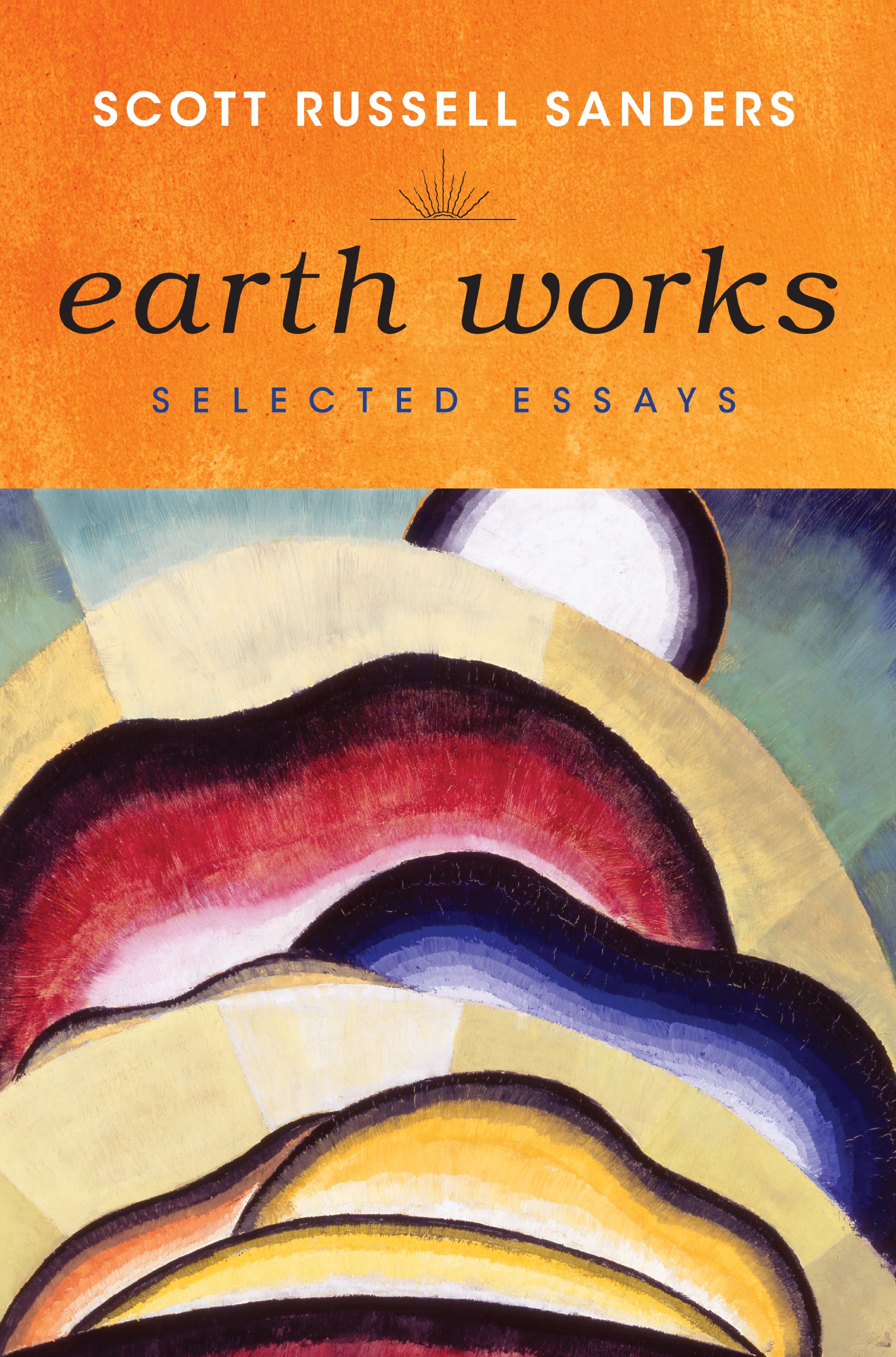
Earth Works is a must-have collection for the Sanders fan. He carefully selected the 30 essays here, including nine that have never before been collected. I’ve read some of these before, but remained mesmerized by both content and style regardless of my familiarity. Sort of like with that Beard essay I so revere, “Buckeye” remains a feat to appreciate on every reading, even six or eight readings in.

A brief preface places these essays in some context in Sanders’s life and aims, and then they unfurl, in mostly chronological order by date of composition (some exceptions for the sake of juxtaposing topics), and with few revisions to their original published form (“for better or worse”). I really appreciate that the first essay, composed in 1987, is “The Singular First Person”: it lays out Sanders’s perspective about the personal essay, its form and purposes. It’s a smart way to start, because it offers some idea of what he thinks he’s up to, and therefore some promise of what is to come. A humble man speculates on what he finds in the world, in the hopes of asking big questions: “Who am I? What sense can I make of this inner tumult? How should I live? Does the universe have a purpose? Do we? What finally and deeply matters? What is true, and how can we know?” (From a later essay, “Letter to a Reader.”) Sanders is concerned with nature and the natural world, but resists the term “nature writer” (as did Edward Abbey), because he is most concerned with interconnectedness: human beings with one another, with the natural world of which we are mere part. He wonders about spirituality, about our place in the cosmos, about the sadness of consumerism and war, the destruction of the Earth; but he has a great love for the world, too, and allows that to shine through.

This reading, my deepest exploration of his work, confirms for me that Sanders is one of my favorite essayists. He marries content that is meaningful and sympathetic to me with style that is both lovely to read, and nearly invisible. As I’ve said before, the best writing often doesn’t even feel crafted, but that’s when you know it was hardest to craft. These essays are good examples of that idea.

I came for three essays in particular, as I said. “The Inheritance of Tools” uses stuff or things to get at a character: Sanders recalls his father through the tools that father passed on to him, along with the knowledge of how to use them; this essay is a way of processing his grief on his father’s death. “Under the Influence” is about the same father, but in this essay, the father is an alcoholic, who causes his family great pain. The two fit interestingly together because they’re about the same man from two very different perspectives. Finally, “Buckeye” continues the grieving for the beloved father, through a series of objects, beginning with the title buckeyes but traveling through other material things. Because all three attempt to profile a parent, and deal with the relationship between writer and parent, and because two of them do so through objects, they offer a number of things to me. For the purpose of the critical essay, I’ve also got my hands on a talk Sanders gave in 1990 at the University of Iowa, about the crafting of “The Inheritance of Tools” and “Under the Influence.”

As I said, these were not the only standout essays for me, and I kept reading for the pleasure of it beyond the three essays I’d intended to study. It wasn’t all good times, either, though. An early (1984) essay, “The Men We Carry In Our Minds,” made me angry. Sanders means well, and he is good to the women in his life (wife and daughter) in many ways. He considers himself a feminist. This essay means well, too, but it makes some major blunders, when he concludes that his own upbringing in relatively impoverished, working-class conditions make the challenges he’s faced the same as those faced by women. I am taken back to an excellent article I read years ago, titled “Explaining White Privilege to a Broke White Person.” The idea here is that you can be really poor and still enjoy privilege as a white person, because at least your race isn’t contributing to the limitations or constraints you face. The same principle could be applied to Sanders’s arguments. You might have been poor, you might have been limited, but you didn’t face the glass ceiling, the sexual harassment, the wage gap, the rape culture, or the insidious, invisible assumptions of incompetence that women did and do face. Concluding that you thoroughly understand the predicament of women when you don’t is arguably more problematic than not attempting to understand in the first place; congratulating oneself and turning away is troubling, because it makes you something of a false ally. His blindness to this problem gave me a lot of trouble. The HuffPost article was published in 2014, and Sanders’s essay, again, in 1984. But since he’s reprinted it in 2012 without feeling a need for further comment, I think he still needs to go read the HuffPost piece.

I won’t forget the blind spots exposed in this essay. But it’s to the great credit of the rest of this book that I still love it. Because there is indeed much to love here, not least the previously uncollected work near the end–I really enjoyed seeing Sanders articulate his appreciation for Emerson, Thoreau, and Wendell Berry, among others. I had already sent a copy of this book to my father before I got to these essays, but they made me glad again that I’d sent it to him.

Come back to me next Wednesday and I’ll do more raving, and slightly more quibbling, with this long and rich book.

Fierce Attachments by Vivian Gornick

Just a week ago I gave you this book’s beginning and told you I was excited about it. It turned out to be everything I’d hoped.

Fierce Attachments is about Vivian Gornick’s mother and their relationship. It is told in two threads: the narrator’s memory of the events of her childhood in a tenement in the Bronx, and the narrative present, in which she and her mother walk together in Manhattan (where the latter lives) and throughout the city. The second thread features a daughter in her fifties and a mother in her seventies, finally eighty years old. The two threads eventually meet, as the remembered events follow a young Vivian growing up: from child to teenager, to college student, through marriage and divorce, into middle age and the walks in Manhattan. It is a very natural-feeling structure and one that makes great sense. It allows the reader to follow the heart of this book: neither the events of past or present, nor the story of one woman or the other, but rather, the story of their evolving relationship over decades, all its pain and small healings. It is also therefore about memory. The walks, which are also talks, allow Vivian and her mother to remember together, to create these stories.

In last week’s book beginning, I observed that the opening scene–a single paragraph–was given in present tense. All the narrative present events (walking in the city) are also given in present tense; but an event from the past doesn’t take the present tense again until page 91, nearly halfway through this book (at 204 pages an oddly quick read, for one so deep). It does not happen again until the past stories catch up with, merge with the present, when the mother turns eighty in the final pages and the two women find a small space in which to ease their combativeness. I had to flip back through the book to make these observations; I didn’t take notes as I went through, and in fact would have told you that more of the book took the present tense than I’ve found when I checked. I guess that makes the point that the past, rendered with lots of feeling and details, can feel pretty immediate.

There is much to admire here. I loved getting a feeling for Gornick’s inner life, as one lover calls it, her development as a writer, and the sad, conflicting story of going to City College and moving away–figuratively–from her mother, when she starts using complicated sentences and words the older woman does not understand. I appreciated the string of men she allies with, and her efforts to understand them, their places in her life and what they’ve had in common. Whatever her mother may think, Gornick uses beautiful sentences. And there is no arguing with the richness of her material: that tenement upbringing, the colorful women and sensory texture and exciting events. But for me what is most crystalline here is the relationship that is her main focus. The rendering of its difficulties.

And I see I’m writing this review prematurely, that I have not yet grasped what makes that rendering so clear. I think it has something to do with dialogue, and more to do with voice: that Vivian and her mother both get such clear voices, and not only them but many other, lesser characters as well. And perspective, the blending of what Sue William Silverman and Suzanne Paola call the “voice of innocence” and the “voice of experience”: the young Vivian, living in the past as it happened, and the writer Vivian walking with her mother and writing this book, and the way the two brush up against one another and eventually merge. The clear search for meaning, the honest, present wondering on the page: the classic assay.

I have a lot more to learn here; I’ll be back to Fierce Attachments soon, I expect. For now, please discover it for yourself, if you have any interest at all in the love and anguish of parent-child relationships, or admire creative nonfiction.


Rating: 8 corners.