Maximum Shelf: Olga Dies Dreaming by Xochitl Gonzalez

Maximum Shelf is the weekly Shelf Awareness feature focusing on an upcoming title we love and believe will be a great handselling opportunity for booksellers everywhere. The features are written by our editors and reviewers and the publisher has helped support the issue.

This review was published by Shelf Awareness on September 15, 2021.


Xochitl Gonzalez’s Olga Dies Dreaming is a scintillating, eye-opening story of family, legacies, and political and individual struggles, set in contemporary New York City and Puerto Rico. Readers will be entirely captured by Olga and her family, friends and associates as this spellbinding narrative twists, turns and unfolds over the years and miles. Gonzalez’s stunning first novel feels far more expansive than its not-quite-400 pages.

Olga Isabel Acevedo, Brooklyn-born child of Puerto Rican parents, is an ambitious, status-conscious wedding planner to New York City’s upper echelon. “Using a traditional American metric for measuring success,” she is winning: she left the family home for a fancy New England college, has her own business and enjoys a certain amount of fame via glossy magazine and television appearances. She has a large, close-knit family still based in Brooklyn’s Sunset Park, but with several holes in it: her loving and beloved father, once a proud political activist and member of the Young Lords, now dead from drug addiction and AIDS; her late grandmother who raised her; and most troublingly, Olga’s mother, Blanca, a militant radical who left the family when Olga was not quite 13. “Achieving liberation will require sacrifice,” Blanca wrote to her young daughter. Olga’s involuntary sacrifice in service of Puerto Rican liberation was to give up her mother to the cause.

Crucially, Olga still has her older brother, Prieto, with whom she is very close. If Olga is a star as wedding planner to Manhattan’s upper crust, Prieto is a supernova, the handsome, popular young congressman representing their neighborhood in Washington: “He wasn’t quite code-switching so much as he managed, miraculously, to speak several languages simultaneously, creating a linguistic creole of hip-hop, academia, contemporary slang and high-level policy points that made Olga marvel…. Olga herself had never learned this linguistic mezcla that her brother had perfected; this ability to be all facets of herself at once. She always had to choose which Olga she would be in any given situation, in any given moment.”

However well her career is going, Olga feels a void. Blanca writes to her frequently (via go-betweens, from an undisclosed location) to excoriate Olga for pursuing the meaningless, superficial goals of white society rather than working toward liberation for la raza. Prieto, apparently fighting the good fight (if only, their mother writes to him in turn, from inside a broken system), has his own demons and secrets as well.

The plot of Olga Dies Dreaming sees several delicate balances begin to upset. Olga’s surface-level achievements show cracks as she questions what she’s actually working toward. She meets a man she may truly like, which exposes a weakness: her people skills, so polished at work, don’t hold up to a situation with real stakes. Prieto’s carefully maintained façade falters, one of his secret insecurities threatened. When Puerto Rico is gutted by the one-two punch of Hurricanes Irma and then Maria, Olga takes a few hits herself. Can she navigate a romantic relationship? Will her brother withstand the latest storm in his private life–and is their bond up to the challenge? Perhaps most significantly: what does Olga have to gain–or lose–if her long-absent mother chooses these turbulent times to make a reappearance?

The masterful Olga Dies Dreaming roams far and wide, encompassing the most obnoxiously petty, overindulged weddings of the 1% and the dire straits of rural Puerto Ricans lacking clean drinking water, food or electricity. Such range could get unwieldy in less capable hands, but Gonzalez has a firm grasp of her plot threads. With lively, clever prose and adept political commentary, this novel asks questions about race and assimilation, about government corruption and capitalism, about gentrification and family duty. Olga, Prieto, their aunts and uncles and cousins, Olga’s work associates, casual sexual partners and her new bae: likeable, appalling and everything in between, these characters sparkle with authentic detail. While this is Olga’s story, the point of view does sometimes shift to offer Prieto’s perspective and a few others. Readers (uncomfortably) get inside the head of a deeply unpleasant man of great privilege, for example–aptly named Dick–as well as that of our heroine. Gonzalez is also expert with setting, as her novel travels from the peculiarly organized hoarder apartment of Olga’s love interest to an impressively high-tech rebel compound in the Puerto Rican jungle, an opulent Easthampton beach house and more.

From Blanca’s mysterious and blistering missives come political and ideological rhetoric and intellectual challenges. Olga was named for Olga Garriga, activist for Puerto Rican nationalism, but also hanging over her is the story of Olga from poet Pedro Pietri’s “Puerto Rican Obituary,” who “died waiting dreaming and hating.” These are the extreme options she’s been offered: Blanca’s rigid revolutionary ideal or the unattainable, swank American dream. Instead, in the end, Olga must chart her own path to a third option, one where she might finally find peace.

This novel positively glitters with truth, wit, humor, pathos, trauma, love and pain. Gonzalez’s narrative operates with consummate skill on the level of the individual, the family and the political system. There is much to learn and ponder here about colonialism, corruption and policy. And on a more personal level, Olga casts a spell that will linger with readers long after these pages are closed. Olga Dies Dreaming is simply unforgettable.


Rating: 10 songs.

Come back Monday for my interview with Gonzalez.

Maximum Shelf: Bewilderment by Richard Powers

Maximum Shelf is the weekly Shelf Awareness feature focusing on an upcoming title we love and believe will be a great handselling opportunity for booksellers everywhere. The features are written by our editors and reviewers and the publisher has helped support the issue.

This review was published by Shelf Awareness on August 23, 2021.


Bewilderment by Pulitzer Prize-winner Richard Powers (The Echo Maker; Orfeo; The Overstory) is a novel of great pain and empathy. Focusing on a nuclear family but also concerned with ecological collapse and the possibilities of distant space, this is a heart-wrenching story with an important message to convey.

Theo Byrne is an astrobiologist: he writes programs to explore, hypothetically, distant planets that may host life. His work is at the nexus of science, coding and imagination. But readers meet him first in a still more important role: that of single parent to Robin, who is just turning nine. Robin is a special child: artistic, caring, intelligent. “So far the votes are two Asperger’s, one probable OCD, and one possible ADHD,” but Theo resolutely resists the push to medicate him. Bewilderment begins with father and son in the Smoky Mountains on a camping trip, intended as alternative therapy following yet another outburst at school. It helps Robin immensely, but the larger world awaits. “The cars, the asphalt, the sign listing all the regulations: after a night in the woods, the trailhead parking lot felt like death. I did my best not to show Robin. He was probably protecting me, too.” Robin will not tolerate lies. But how can Theo tell the truth about just how vicious our world really is?

Theo’s wife, Robin’s mother, is absent. Aly was a tireless animal rights lawyer-activist, fierce and indomitable and loving; both man and boy are daily devastated by her loss, which readers slowly piece together: a car accident, swerving to avoid an opossum. “I didn’t know how to be a parent. Most of what I did, I remembered from what she used to do.” The novel is told in Theo’s first-person voice, in constant interaction with Robin; but Aly is ever present, too, as a voice in Theo’s head and to whom he turns for advice. On leaving the Smokies, he appeals to her: “We’re fine together, in the woods. But I’m afraid to take him home.”

Indeed, back in Madison, Wisc., Robin struggles at school and Theo, trying to care for him, falls behind at work. Planetary exploration and the sciences in general are underfunded and under attack by a government administration that blusters and crows on social media. Theo’s research partner refers to Robin as “the boy.” The school pushes harder to medicate him. Many evenings, Theo and Robin travel together in imagination to distant, dreamed-up planets that just might support life. These interludes are gorgeously rendered demonstrations of love and inventiveness. But the real world continues to rattle.

Another colleague makes an unusual offer. Decoded Neurofeedback, or DecNef, allows patients, or “trainees,” to mimic the moods of “target” subjects using real-time, AI-mediated feedback: emotional training via carefully monitored neural states. At nine, Robin is an unusually young subject, but he also has a unique opportunity. Before her death, his mother Aly allowed her own neural activity to be recorded. Now the precocious, troubled, earnest Robin has access to her mental state.

Theo and Robin share an appreciation for the Daniel Keyes story “Flowers for Algernon,” and its implications are not lost in Robin’s own unprecedented experience. Theo continues to agonize over his parenting, life on Earth and life in the beyond: “Decoded Neurofeedback was changing [Robin], as surely as Ritalin would have. But then, everything on Earth was changing him.” Robin sees enormous improvement in his ability to handle his rages and his blues, enjoying learning widely about the natural world, with a switch to home-schooling. He shows an uncanny harmony with and knowledge of his mother’s mind, enough to unnerve his father. But there will come a reckoning. Theo and Robin live in a recognizable version of the contemporary United States, beset by climate disasters, political upheaval and hate, wildfires, ignorance. Even as Robin makes his way as an increasingly well-adjusted young activist, bad news bombards their family from all sides, until disaster strikes. Bewilderment circles back to the Smoky Mountains for a gut-wrenching finish in the same place where it began. “From behind us, upstream, the future flowed over our backs into the sun-spattered past.”

Powers deserves his reputation as a consummately talented writer. His careful, lyrical prose conveys precisely the intended emotion and tone at the right time, and weaves meanings and significances in complex layers. This superlative novel invites readers to meditate on the natural world, human and animal rights, the potentialities of deep space, the role of science and technology in human societies, the challenges of modern childhood and more. “Maybe humanity was a nine-year-old, not yet grown up, not a little kid anymore. Seemingly in control, but always on the verge of rage.” Robin is a delightful character, a bright, sincere, intense child, lovable and challenging. Theo is deeply sympathetic in his dual tendencies toward far-thinking astrobiology and the care of his child (“They share a lot, astronomy and childhood”), and in his fear that he will fail his son. Powers pulls no punches: he portrays a brutal world that will damage Robin, Theo and all humanity in profound and irreparable ways. Bewilderment is a beautifully told story, but one that hurts, too.


Rating: 8 opossums.

Come back Friday for a follow-up in Powers’s own words.

Snowflake by Louise Nealon

Coming of age from an oddball Irish country family in the chaos and snobbery of Dublin’s Trinity College has never been so sweet, funny, moody and real.

Louise Nealon’s Snowflake is a novel that keeps readers guessing, a madcap family drama and coming-of-age saga for Debbie, who has grown up on a dairy farm outside Dublin in an eccentric household. “My uncle Billy lives in a caravan in a field at the back of my house,” it begins. Billy is a bit of a drunk with an unusual interest in constellations and Greek mythology; he keeps the farm running and is devoted to his niece. His sister, Maeve, Debbie’s mother, is less stable. She considers herself a writer and a prophet, fanatically recording and interpreting her dreams. Maeve’s much younger lover, James, “was stitched into his John Deere overalls when he came out of the womb and was born into a family without any land.”

Debbie is now off to Trinity College as a commuter student to study English, but she is deeply self-conscious and without city skills; she spends “half the day scoping out toilets to squat in and take a break” and cry. Her first friend on campus is Xanthe, a young woman of greater experience and privilege but, to Debbie’s surprise, with problems of her own as well. The idea that everyone is suffering something, even unseen, is not a new one, but it is refreshingly presented by this cast of wonky, wonderful, traumatized characters in a chaotic, beautiful, flawed world.

Debbie’s first-person narrative is self-deprecating and endearingly messy. Her life is constantly off-kilter, one wrench thrown after another, and this quality could be too much, but Nealon’s earnestly wacky protagonist pulls it off. Sometimes life is too much, but Billy will have another pint and Maeve will take to her bed and Debbie will muddle through–at least until tragedy strikes. An Irish country farm (with side trips to Dublin and to a dubious beach house) provides backdrop to an unlikely list of themes: mental illness, social awkwardness, art, class, guilt and different kinds of love.

The title offers layers of meaning: a little fun at the expense of millennials like Debbie? A fascinating shape worthy of study and analogous to the stars Billy so loves? Something precious, unique, ephemeral? Snowflake is that sort of novel: twisty-turning, multifaceted, smart, funny even when it is at its most serious. Nealon’s debut shows an expert eye for detail and pitch, and an appreciation for the absurd, the profound and the ridiculous–especially when they converge.


This review originally ran in the August 20, 2021 issue of Shelf Awareness for the Book Trade. To subscribe, click here.


Rating: 7 pink dressing gowns.

The Mothers by Brit Bennett

It was such a treat to return to the revelatory writing of Brit Bennett with this one – I read The Vanishing Half first but this one was earlier, her debut. The two novels definitely feel like they come from the same hand; The Vanishing Half spanned generations, while this one covers only two decades or so, but still feels expansive, because of the narrative voice (more on that in a minute), and both zoom out to accommodate cross-country travels, so that their scope is large. Both deal with a defined but largish cast of characters and decidedly big issues. In under 300 pages, The Mothers gives the impression of being about capital-L Life in a way that is powerful and well done.

The narrative perspective in this novel is unusual. For good chunks of the text it feels like close third-person, meaning the pronouns are ‘she’ and ‘he’ but the reader has intimate knowledge of the thoughts and feelings of the character highlighted at any given time. But occasionally we get a first person plural perspective: the pronoun ‘we,’ which is rare in fiction. Much is said of the rarity of the second person (‘you’), but I think we see more of that than we do ‘we.’ It made me think immediately of “Appalachian Swan Song,” the opening short story in Jon Corcoran’s collection The Rope Swing, which I love and have taught twice now. In Corcoran’s story, the ‘we’ is not quite defined; my students and I discuss it and feel that it’s the townspeople, or the town itself, the community, in some way. It’s a story very much about place, and the town or some representative(s) of it get to speak. In The Mothers, the ‘we’ gets better defined, although not right at first. ‘We’ are the Mothers of the Upper Room Chapel in Oceanside, California, where the story is most solidly set. These Mothers are the church’s elder women, and they offer nosiness, wisdom, and a long view; they are a Greek chorus of sorts. I really appreciate the effect.

I love the different ways the title works, too. These Mothers who tell the story are an obvious reference point; the book is about motherhood in many other ways, too. Our chief protagonist is Nadia Turner, who we meet at 17, when her mother has just killed herself in rather spectacular fashion (gunshot to the head). She has gotten pregnant with the help of the pastor’s son Luke (that’s the pastor of Upper Room), and had an abortion just before going off to college in Michigan. The couple’s relationship, such as it was, did not survive the abortion, but each remains caught up in the other without knowing it’s mutual. That same fateful summer, Nadia becomes friends with a girl her age named Aubrey. Aubrey is also motherless but by different means: she lives with her older sister, because their mother was guilty of some severe mistreatment (trying to avoid spoilers here). The girls understand early that motherlessness is part of their bond. “Aubrey wondered if they were the only ones who felt they didn’t know their mothers. Maybe mothers were inherently vast and unknowable.” Nadia’s choice not to become a mother at 17 will affect her life, and Luke’s, and Aubrey’s, for years to come. Nadia wonders about her mother’s choice to keep her own accidental teenaged pregnancy. Imagining a world in which she, Nadia, hadn’t been born, and her mother hadn’t turned to suicide: “Where her life ended, her mother’s life began.” You see the layers of significance around “the mothers.”

The novel mostly follows Nadia, but we get to spend time with Aubrey and Luke as well. The community that surrounds them, in Oceanside and at Upper Room, are of secondary importance. It’s a story about family ties and secrets (“After a secret’s been told, everyone becomes a prophet”) and obviously motherhood but much more besides. Race is a background issue – these characters are Black but that’s a simple fact and not The Point of the book. The quietly reset default in that is one I value and I’m trying to mix a little more of it into my reading.

This is a writer I’ll follow anywhere. I hope there are many more to come.


Rating: 9 crab bites.

L.A. Weather by María Amparo Escandón

In a novel alternating between fun and heartbreak, a prosperous, big-hearted, messy family struggles to weather literal and metaphoric disaster in 2016 Los Angeles.

L.A. Weather is a lovely, compelling and occasionally brutal novel by María Amparo Escandón (Esperanza’s Box of Saints) about a family on the brink of disaster, in a city similarly on edge. Captivating, sympathetic, funny characters and never-ending surprises (that even those involved compare to a telenovela) form a world for readers to get lost in.

Patriarch Oscar Alvarado has become a shell of his formerly assertive self; his wife, Keila, a sculptor, is losing patience. Their daughters are Claudia, an author and television chef; Olivia, an architect and mother of twin girls; and social-media maven Patricia. The Alvarados are a close-knit family of successful, high-powered professionals, bridging Oscar’s Catholicism, Keila’s Judaism and their shared Mexican-American heritage in Los Angeles, a vibrant city beautifully evoked by Escandón’s loving descriptions of food, traffic and culture.

In L.A. Weather‘s opening pages, a horrifying accident befalls Olivia’s daughters (parents beware), prompting various responses to trauma and launching the story directly into the Alvarados’ family dynamic and cascading failures. Oscar’s obsession with drought and wildfire may at first seem random, if not nonsensical, but it reflects a secret he’s been keeping from his family, and serves as symbol for their shared concerns. When Keila announces she wants to divorce him, their daughters protest vehemently, although it is soon their own respective marriages that threaten to catch fire. The city crackles with heat as one crisis or shenanigan after another ensues.

“[The] family’s stories were never neatly wrapped up at the end of the year. They just went on, and it felt good, this continuum.” The novel is defined by time, however: Escandón chronicles events from January through December of 2016. Her story is a feat of both plot and character. Each member of the extended Alvarado clan is intriguing and flawed but deserving of empathy; even when they make questionable decisions, they are both convincing and entertaining. Climate change serves as a clever way to monitor the metaphoric fire risk to a family that loves fiercely but stumbles in the execution of that love. L.A. is richly portrayed: “the wildland-urban interface, that zone where nature and city cohabited (or collided?), where your surveillance camera could spot a mountain lion roaming in your backyard while you slept…. [Oscar] could not stop thinking that it was this unashamed human encroachment into nature that was causing so much destruction.” This is a story of people, place and connection. Absorbing, moving, comic and tragic, L.A. Weather will capture readers and never let them go.


This review originally ran in the August 9, 2021 issue of Shelf Awareness for the Book Trade. To subscribe, click here.


Rating: 7 squash-flower mini tamales.

Songbirds by Christy Lefteri

Set in the old capital city of Cyprus, this is a beautiful, sad novel about human relationships and hard choices, who is seen and unseen.

With Songbirds, Christy Lefteri (The Beekeeper of Aleppo) shines a light on social issues through the story of one woman’s disappearance. The central character is absent from the beginning and remains a mystery until the novel’s final pages.

“One day, Nisha vanished and turned to gold.” Nisha is a Sri Lankan immigrant to Cyprus, where she works in the capital city of Nicosia as maid to Petra, a widow, and her nine-year-old daughter, Aliki. Petra’s upstairs tenant Yiannis is Nisha’s secret lover (maids are not permitted lovers). This absorbing novel opens after Nisha has gone missing, and is told in chapters that alternate between Petra’s and Yiannis’s points of view as they mourn and search for Nisha.

Nisha is representative of numerous migrant worker women in Cyprus, largely from Vietnam, Nepal, the Philippines and Sri Lanka. Petra observes, “The maids here did everything–they were hired and paid (lower than the minimum wage) to clean the house, but ended up being child-carers, shop assistants, waitresses.” Also: “I had started to see the rhythm of these women with new eyes–how the whole neighborhood pulsed with their activity. They had been invisible to me before Nisha had gone missing.”

Although her neighbors are quick to write off the disappearance as abandonment, with the assumptions of casual racism, Petra knows this is out of character. Nisha is devoted to Aliki, and besides she’s left behind her passport and most precious possessions, relics of her late husband and her own daughter in Sri Lanka. The police won’t help. Petra mounts her own investigation, eventually teaming up with a distraught Yiannis, who is facing challenges of his own. He feels trapped by his involvement in the criminal poaching of songbirds, and especially conflicted because he’d grown up feeling so close to nature.

Lefteri deftly weaves Yiannis’s pain at his illegal work and the loss of his love with Petra’s growing realizations about her own culture and Aliki’s attachment to her missing caretaker. Nisha, “a dark and beautiful shadow, who rattled around in old sandals and with fire in her eyes,” is the center of this story, but an absence; the two speaking characters triangulate the third, and readers don’t hear Nisha’s own voice until the very end. Moving human characters and careful depiction of natural spaces contribute to a contemplative tone. Songbirds is quietly urgent in its treatment of Nicosia’s maids, lyrical in its descriptions, and thoughtful, compassionate and important.


This review originally ran in the July 12, 2021 issue of Shelf Awareness for the Book Trade. To subscribe, click here.


Rating: 7 makeshift oars.

The Reading List by Sara Nisha Adams

A shared reading list improves the lives of two lonely individuals in this charming novel about the power of a good book.

In Sara Nisha Adams’s sweet, pleasing debut, The Reading List, two lonely characters in contemporary London–and a host of friends and family–learn just how much books, and other people, have to offer.

Mukesh is grieving after his wife’s death: “Now here he was, alone, still without any clue as to what he should do now she was gone, left in a lifeless, soulless, bookless house that had once been their home.” He wishes he were as close to his granddaughter, Priya, as she was to her grandmother, but he does not share their love of reading. Then he finds an unreturned library book his late wife loved and gives it a chance.

Aleisha, 17, works at the library, but begrudgingly. Her older brother is the reader in the family. Both are slowly being crushed by their mother’s oppressive depression; they’ve lost touch with their friends and even each other, leaving Aleisha alone in the world, traveling between work and home until even the boring local library begins to feel like a sanctuary. In a returned book, she finds a handwritten note that begins, “Just in case you need it,” with a list of book titles. Not knowing why, she tucks it away.

Following a prologue introducing the titular reading list, sections of the novel are named for books (The Time Traveler’s Wife, Rebecca and more); most chapters follow either Aleisha or Mukesh. In interstitial chapters labeled “The Reading List,” other characters interact with the same mysterious document in their own ways–a crime thriller fan grieving a break-up; a lonely divorcé; a young woman who collects lists.

Out of guilt and boredom, Aleisha begins reading the books on the found list and recommending them to the elderly Hindu man who has tentatively begun to visit her library. Together, Mukesh and his teenaged librarian share what they read. Both are unpracticed, but each has much to gain from the developing friendship and the fictional worlds that transport them away from their daily struggles. When tragedy strikes, the friendship and the reading list may help them get through: “‘Aleisha,’ Mukesh said softly. ‘Please try to remember that books aren’t always an escape; sometimes books teach us things. They show us the world; they don’t hide it.'”

The Reading List is a tender novel about human connection and community and the healing power of reading, about the support and compassion that all people need at one time or another. This book is a soothing salve.


This review originally ran in the July 8, 2021 issue of Shelf Awareness for the Book Trade. To subscribe, click here.


Rating: 8 cups of chai.

This Shining Life by Harriet Kline

A family struggles to honor the loss of one of their own and a remarkable boy works to solve the puzzle of the meaning of life in this poignant, loving debut novel.

Harriet Kline’s This Shining Life opens with a brief prologue: a happy family, a joyful party at sunset. Then the tone shifts. “My dad died. He gave everyone a present before he died. He gave me a pair of binoculars. They smell of books that haven’t been read for a very long time.” This is the voice of Ollie, a boy with certain gifts (sudoku, puzzles, literal meanings) and challenges (socks, hugs, turns of phrase). As the novel considers the death of Ollie’s dad from various points of view and at different points in time, Ollie’s chapters will always begin the same way. “My dad died.”

Ollie’s dad, Rich, was spontaneous, fun-loving, kind and a great lover of cheese. He was a devoted husband to Ollie’s mom, Ruth. Ruth’s sister, Nessa, originally set them up; she and Rich had been best friends since college. Ruth suffers from depression, like their abrasive, troubled mother, Angran; Nessa believes in charging in and grasping life in a firm grip, consequences be damned. Rich’s parents, Gerald and Marjorie, are starched and proper where Angran is bohemian (Gerald says it as if it’s a dirty word) and brusque. They are a motley crew, but all devoted to Rich. In this engrossing story of grief, love and mix-ups, Ollie fixates on the puzzle he believes his father has left him, in the presents he left behind. Because of something Rich said, Ollie believes these gifts hold the secret to what it means to be alive. “I want to do that puzzle now. I want to feel happy like he did. All I have to do is get the answers right.” Time jumps around, so that Rich is dead and alive again, as Ollie attempts to track the gifts Rich has sent to his loved ones and discern their hidden meaning.

In a novel about grief and love and continuing on, these characters are heartbreakingly flawed: Nessa’s pushiness, Angran’s rudeness, Gerald’s blustering into dementia. Shifting perspectives do the essential good of enforcing empathy even in the face of quite bad behaviors. As Ollie single-mindedly pursues the solution to his father’s puzzle, the adults around him seem too caught up in their own struggles to aid him; will they rally in time?

This Shining Life is attuned to the importance of setting, including natural spaces like the waterfalls that dominate this family’s neighborhood, and the deep potential significance of objects, like those fraught gifts that Rich gives. It is a sad story, of course, but also joyful, in the style of Rich delightedly offering cheese at his final party. It proposes that grief and love are inextricable, and that there may be light even in pain.


This review originally ran in the May 27, 2021 issue of Shelf Awareness for the Book Trade. To subscribe, click here.


Rating: 8 threads.

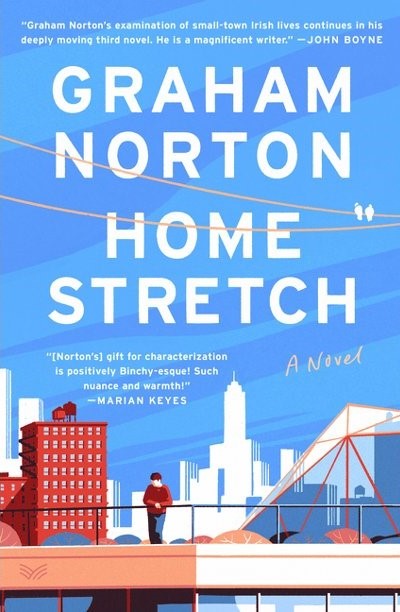
Home Stretch by Graham Norton

This novel of strong bonds, secrets and small-town Irish life is both sweet and horrifying, and completely absorbing.

Home Stretch by Graham Norton (Holding; A Keeper) wends its way from small town to big city, from Ireland to England and the U.S., and back again, tracking family and community. This aching saga begins in 1987, in a small village in Cork, when six young people are in a car wreck on the way home from the beach. Three are killed, one lies comatose and two walk away unscathed–physically, at least. But their lives, and those of everyone in the village of Mullinmore, are changed forever.

The novel follows these characters over the ensuing decades, most centrally Connor Hayes, the social outcast who was inexplicably driving the car when it overturned, and his younger sister, Ellen. Turned out of town by shame, blame and guilt after the tragedy, Connor lives and works in Liverpool, London and New York City, wrestling with his past and self-loathing. “The task of untangling the mess of secrets that he had created seemed so impossible.” Ellen stays in Mullinmore. A chance encounter in a Manhattan gay bar will eventually reconnect Connor to his distant past and see the next generation get another shot at correcting certain mistakes.

Norton rotates the novel’s point of view so that readers see the impact of the car wreck from many angles. The Hayes family suffers Connor’s survival alongside the grief of the families of the dead, two of whom were on the eve of their wedding. But it is that tangled mess of secrets that will most haunt these characters, and readers, as Norton doles them out teasingly into the final pages.

Home Stretch is by turns charming and harrowing as it accesses some of humanity’s darkest moments and impulses, as well as some of the best. That expert balance of comfort and pain is perhaps the most memorable feature of a novel with complex plotting, twists and turns and characters who do not fit easily into likable and unlikable categories. This is a story of the many kinds of love and betrayal that can hold and haunt people, of filial and community ties and the meaning of home. “This is what homecoming meant. Arriving in a place to discover you’re fluent in a language you’d forgotten you ever knew.” Home Stretch is a riveting narrative, a character study, a love letter to a place and a culture, and a moving coming-of-age story.


This review originally ran in the May 21, 2021 issue of Shelf Awareness for the Book Trade. To subscribe, click here.


Rating: 8 pints.

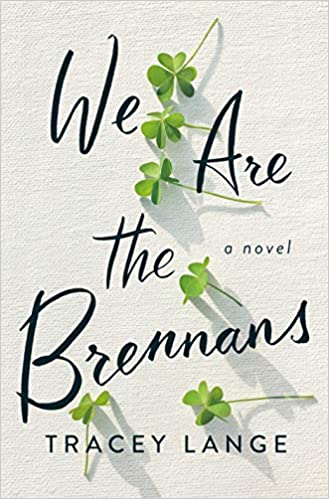
Maximum Shelf: We Are the Brennans by Tracey Lange

Maximum Shelf is the weekly Shelf Awareness feature focusing on an upcoming title we love and believe will be a great handselling opportunity for booksellers everywhere. The features are written by our editors and reviewers and the publisher has helped support the issue.

This review was published by Shelf Awareness on May 12, 2021.


Tracey Lange’s We Are the Brennans is an utterly riveting debut novel of family ties, secrets and the depths of love. Beware the unintended single-sitting read: this magnetic story has the power to draw its reader from cover to cover in one gulp.

The Brennans are an extremely tight-knit Irish American family living in West Manor, N.Y., just north of Manhattan and “leaning upper middle class.” Mickey Brennan is now widowed, but the memory of his wife, Maura, casts a shadow. They have four children. The eldest, Denny, has a large frame and a large personality. He is half owner of a pub called Brennan’s (or Ó’Braonáin’s, in the Gaelic), begun on a loan from Mickey and Maura and very much the family business. Next in age is Sunday, the only child to have left the neighborhood, much to the family’s chagrin. Jackie is her Irish twin, at just 14 months younger: recently in trouble with the law, he’s moved back home to save money and help out. Shane is the youngest, genial and developmentally disabled, around whom all the Brennans rally. And then there is Kale: Denny’s business partner, a neighbor since childhood, an honorary Brennan–and Sunday’s former fiancé. Aunts and cousins cycle through as well; the charismatic Brennans have a large, comfortable household with a strong center of gravity.

As exceptionally close as they are, the Brennans also specialize in secrets. Denny has not been honest with his wife or Kale about the pub’s poor financial situation. Jackie is the only one who knows why Sunday really left town.

Chapters alternate perspective among these characters, chiefly the four siblings but also the other Brennans and Brennan-adjacents. There is an argument to be made for Sunday as main character; she was the glue that held this clan together, and it is her homecoming that sets the novel’s events in motion. But the book’s title points toward the family unit as central; their inextricability is compelling, unique and apparently infallible. Each chapter ends with a line of dialogue that also opens the next chapter, but from a different point of view, which contributes to the momentum that will keep you up all night to finish this book in one go. The effect is nearly cinematic, as if the camera shifts to show the same scene from another angle. This technique also highlights the impact of a deeply bonded family insisting on keeping secrets.

The Brennans are captivating, even hypnotic, for readers as well as for those who enter their orbit in the world of West Manor. In her debut novel, Lange shows a sure hand with characters both flawed and complex: Jackie loves bartending and is a talented painter, although only Sunday supports his art. Kale’s devotion is complete, even when he’s had to navigate the relationship of his best friend (Denny) and his childhood sweetheart (Sunday). Kale’s wife is challenging, but nuanced. Denny’s daughter Molly is sweet and spirited: she embraces her new Aunt Sunday wholly (after sitting her down for a serious talk about the preexisting plan for her to inherit Sunday’s room when Molly turns five). These damaged, fierce, loyal Brennans and their intricate problems will capture readers’ hearts entirely and not let go. Their story has everything: intrigue, crime, heartbreak, therapeutic awakenings and a romance that feels both impossible and inevitable.


Rating: 9 broken glasses.

Come back Wednesday for my interview with Lange.