An Odyssey: A Father, A Son, and an Epic by Daniel Mendelsohn

What is Odysseus, in the end – the hero whose final act of vengeful violence is compared, by means of another memorable simile, to a bard stringing his lyre – but the poet of his own life?

This is the first book I read in 2022, and I feel sure it will make the year’s best-of list, so that’s an excellent start. Another happy synchronicity: I bought this book based off a review I read, but find that Mendelsohn is also the author of a book I’ve had on my shelf for a few years, from a grad school reading list I never got to: The Lost: A Search for Six of Six Million. After this read, that one just moved up the list.

An Odyssey is a memoir focusing on a father/son relationship and a journey, both a literal one and the figurative path to greater understanding facilitated by a yet more famous Odyssey. Daniel Mendelsohn’s father Jay is eighty-one years old the spring he asks his son Dan if he can sit in on his undergraduate seminar course on Homer’s Odyssey. Dan says yes, and together with a small group of college freshmen, father and son explore a work of classic literature and, as Dan sees it, their own relationship. Just after the course ends, they go together on a Mediterranean cruise that follows Odysseus’s presumed route home from the Trojan War. A year later, Jay would be dead.

I bought this book because I read a lovely review of it (which I now cannot find. I thought it was Shelf Awareness but apparently not), but then it sat on my shelf for some time, I think because the concept sounded a little precious, a little pat. And it could have been, in the wrong hands, but Daniel Mendelsohn was the right writer for this story, and I’m so glad. For one, he has a deep expertise in Homer and indeed in the classics – as I briefly (in high school) aspired to do, he learned Greek and Latin sufficient to read Homer, Ovid and Virgil (etc.) in their original forms, just for a start. He is the kind of thoughtful, introspective student of relationships and families that I most appreciate as a writer. He has the nuance to handle such a premise – father and son study the Odyssey and take a trip together – with the subtlety it needs. Talk about a book matched to its reader: Homer, parent/child relationships, contemplative memoir… and a focus on teaching. The result is a beautiful book that I’ll be thinking about for a long time.

Here are a few lines that made me pause.

I was going to read Greek, the Iliad and the Odyssey, the elaborately unspooling Histories of Herodotus, the tragedies constructed as beautifully as clocks, as implacably as traps…

How lovely – and makes me think of Amy Leach’s “Pea Madness.”

And so ring composition, which might at first glance appear to be a digression, reveals itself as an efficient means for a story to embrace the past and the present and sometimes even the future – since some ‘rings’ can loop forward, anticipating events that place after the conclusion of the main story. In this way a single narrative, even a single moment, can contain a character’s entire biography.

A single moment containing a character’s entire biography feels like why I read and write.

About competing literary interpretations,

Whatever else it may mean, the fact that both of these hostile camps could make use of the same examples to prove diametrically opposed interpretations suggests a truth about how all of us read and interpret literary texts – one that is, possibly, rooted in the mysteries of human nature itself. Where some people see chaos and incoherence, others will find sense and symmetry and wholeness.

Following a half-page discussion of the etymology of a certain word that I care about,

In time, this wistful word nostos, rooted so deeply in the Odyssey‘s themes, was eventually combined with another word in Greek’s vast vocabulary of pain, algos, to give us an elegantly simply way to talk about the bittersweet feeling we sometimes have for a special kind of troubling longing. Literally this word means ‘the pain associated with longing for home,’ but as we know, ‘home,’ particularly as we get older, can be a time as well as a place. The word is ‘nostalgia.’

This takes me immediately to a Jason Isbell song (forgive the whiplash), “Something to Love,” and the line “don’t quite recognize the world that you call home.” Naturally, this is a song about art and creativity, and it is sung in the voice of a parent speaking to his child. The idea that two people a generation apart – parent and child – necessarily come from different worlds, because of the way the world changes over time, has been a powerful one for me in the last decade or so.

Here’s another passage that gets to the heart of some of (again) my own thinking about parents.

If only they knew the real him, I thought. Glancing around at the others as they listened to Daddy, at the charmed smiles on Brendan’s and Ksenia’s faces, and then back at his face, relaxed and open, mellow with reminiscence, a face so different from the one he so often presented, at least to his family, I wondered suddenly whether there might be people, strangers he had met on business trips, say, bellhops or stewardesses or conference attendees, to whom he showed only this kindly face, and who, therefore, would be as astonished by the expression of contempt that we knew so well as we were by the rare glimpses of the other, softer side. How many sides did my father actually have, I asked myself, and which was the ‘real’ one? Perhaps this expansive and charming person, so different from the crabbed and coiled man whom only a month or two earlier, I ruefully thought, my Odyssey students had come to know, this song-singing old gentleman who could be so affable and entertaining with total strangers on a ship in the middle of the sea, was the person my father had always been meant to be. Or, perhaps, had always been, although only with those others, the bellhops and stewardesses. Children always imagine that their parents’ truest selves are as parents; but why? ‘Who really knows his own begetting?’ Telemachus bitterly asks early in the Odyssey. Who indeed. Our parents are mysterious to us in ways that we can never quite be mysteries to them.

On teaching:

It was from Fred that I understood that beauty and pleasure are at the center of teaching. For the best teacher is one who wants you to find meaning in the things that have given him pleasure, too, so that the appreciation of their beauty will outlive him. In this way – because it arises from an acceptance of the inevitability of death – good teaching is like good parenting.

This feels like a revelation but also something I recognize because I already understood it. It gets at why passion and excitement make for good teaching. And there’s a profundity to the idea that teaching is about what lives on beyond us. Although shortly after, he’ll make the point that teachers never know who they will reach with which lesson, because these things take years to reveal themselves; just as our own teachers rarely know who they have reached. I think again of Mrs. Smith, who introduced me in high school to Homer and Hemingway.

These moments go on and on. I love a book that offers both lovely lines and thought-provoking ideas.

The only critique I’d make of this exquisite work is some minimizing or simplification of women, especially by contrast to another recent read, Natalie Haynes’s excellent Pandora’s Jar, which was one of the best books I read in 2021, and helped inspire this read. (I regret that my weird reading-and-review schedule has reversed the order in which they appear here.) Haynes set out to address the roles and reputations of women in the Greek myths, and Mendelsohn concerns himself with fathers and sons, so, fair enough. But there were a few moments where I felt Mendelsohn missed a chance to see certain issues of gender, such that it felt like an oversight to me. It’s up for debate, of course, what agency Odysseus gets for his affairs with Calypso and Circe and his flirtations with Nausicaa and others (as opposed to the-gods-made-him-do-it), but to credit his “allegiance to his wife… withstand[ing] the seductive attentions of various goddesses and nymphs” seems a bit rich. I missed a more nuanced treatment of gender relations, both in Homer and in Mendelsohn’s own life. But perhaps this is unfair, considering his stated focus on male relationships.

I’ll be thinking about An Odyssey for a while.


Rating: 9 doors.

The Stone World by Joel Agee

Immediately following World War II, an intuitive boy from the U.S. in Mexico carefully observes his changing world in this scintillating work of literary fiction.

Following his memoirs (Twelve Years; In the House of My Fear) and translations, Joel Agee’s first novel, The Stone World, is a dreamy, haunting immersion in the mind of a child in a gravely serious adult world. The story spans mere months in the life of six-and-a-half-year-old Peter, who prefers to go by Pira, as his Mexican friends pronounce his name. (Pira wishes he was Mexican; he has learned that gringo is not a compliment.) This is a quietly profound study of boyhood, in some ways almost humdrum: Pira writes a poem, borrows a significant item from a parent and breaks it (and lies about it), falls out with a friend, learns about the world. But the backdrop is late-1940s Mexico, where Pira lives with his American mother and German communist “second father” (his biological father lives in New York), and they rub shoulders with a range of characters: American, Hungarian, Mexican, rich, poor, activists and organizers and artists, including Frida Kahlo.

Pira is prone to involved imaginings, including dreams but also waking visions, as when he lies on the cold stone floors of the family’s small patio and feels himself sinking into another world. There is a literal fever dream as well (brought on by a serious allergic reaction), but even the half-sleep of the afternoon siesta can transport the boy–a very serious thinker–into realms of fantasy, where he decides that a nearby decaying bull’s carcass is the famous bull that has just killed a beloved Spanish bullfighter. Through the eyes of this curious, philosophical, sensitive child, the whole world is fresh and new, colorful, beautiful and dangerous.

Joel Agee is the son of celebrated novelist James Agee, and Pira’s life resembles his creator’s, who likewise lived in Mexico with his mother and German stepfather in the late 1940s. The Stone World is concerned with relationships, interpersonal and political: Pira is friends with boys his own age, as well as his pet dog and parrot and the family’s cherished maid, Zita. The politics of his parents and their friends (with their talk of parties–but not in the usual sense) are initially boring to young Pira, but real-life risks and even arrests bring the issues home to him: “He didn’t understand, but there was an explanation.”

In the hands of such a skilled and nuanced writer, this material glistens and tilts with both beauty and menace. Pira is captivating, and The Stone World is completely absorbing. Readers should clear their calendars until the final page has been turned, and then leave time for the contemplation this novel deserves.


This review originally ran in the December 21, 2021 issue of Shelf Awareness for the Book Trade. To subscribe, click here.


Rating: 7 marbles.

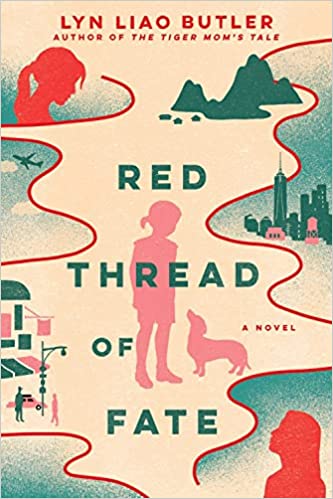
Red Thread of Fate by Lyn Liao Butler

Amid grief, betrayal and exposed secrets, a new widow learns to forge unexpected bonds.

Lyn Liao Butler (The Tiger Mom’s Tale) offers secrets, tragedy, hope and redemption in a novel centered on family and forgiveness. When Red Thread of Fate opens, Tam is on the phone with Tony, her husband. They are a bit short with each other; the marriage has been a little off, but they’re generally headed back on track and preparing to adopt a little boy from China, which both look forward to. Then there is cursing, a roaring sound–and just like that, Tam is a widow. The shocks come quickly, one after another: Tony was not in Manhattan, where he should have been, but in Flushing, Queens, and accompanied by a cousin Tam thought he’d been estranged from for years, killed by the same truck that struck Tony. Then Tam is surprised to be named guardian of the estranged cousin’s five-year-old daughter, even as her son-to-be still awaits adoption in China.

Tam, the California-born daughter of Taiwanese immigrants, and Tony, an immigrant from China, negotiated an uneasy peace with their families and their new lives in New York City, and with each other. Upon her own immigration, Tony’s cousin Mia lived with the couple for nearly two years, before unspecified events broke up the happy household. Now Tam is left to untangle the mysteries of Tony’s life, which seem to multiply the more she learns; Mia’s history is even more enigmatic, but Tam is committed to parenting her orphaned niece. She carries a guilty secret of her own, too.

By nature a shy and private woman, Tam is prompted by her new life–widowed, a single parent, grieving–to accept help, against her instincts. Slowly, she builds a family and a community: taking in her niece, moving toward adoption (which must be renegotiated now that she does not have a husband), deepening friendships and finding new ones, even beginning to mend relations with her mother. This process also involves navigating cultural nuances and divided loyalties. By the time Tony’s secrets come fully to light, Tam is a changed woman, with new strengths and allegiances, and better equipped to meet her many challenges.

Red Thread of Fate is a novel about what ties people to one another, and the nature of those bonds, the unintended consequences of choices and the possibility of a fresh start. With contemplative characters, surprising humor and a twisting plot, Butler’s thought-provoking story of nontraditional family models will appeal to readers interested in fate and identity.


This review originally ran in the December 6, 2021 issue of Shelf Awareness for the Book Trade. To subscribe, click here.


Rating: 6 wontons.

The Turner House by Angela Flournoy

Humans haunt more houses than ghosts do. Men and women assign value to brick and mortar, link their identities to mortgages paid on time. On frigid winter nights, young mothers walk their fussy babies from room to room, learning where the rooms catch drafts and where the floorboards creak. In the warm damp of summer, fathers sit on porches, sometimes worried and often tired but comforted by the fact that a roof is up there providing shelter. Children smudge up walls with dirty handprints, find nooks to hide their particular treasure, or hide themselves if need be. We live and die in houses, dream of getting back to houses, take great care in considering who will inherit the houses when we’re gone.

Family, home, and sense of place. Pathos and humor. What’s not to love? This is a Great American Novel, telling the story of one prodigious family over generations, and in it the story of a city and more: the Turners’ Detroit is the story of the Great Migration, of racism and striving. Francis Turner came up from Alabama to Detroit in 1944, to be later joined by his wife Viola and first son, Charles or Cha-Cha. From there, from one rental house to another, the family grew, purchasing the house on Yarrow Street in 1951, where they would raise thirteen children, whose ages span 23 years. Readers meet these character briefly in 1958 and then spend much of the book’s space in 2008, as a widowed Viola weakens in Cha-Cha’s home and the old house on Yarrow falls into decay (and, if you remember 2008, there will be financial repercussions). The timeline jumps around: The Turner House is most concerned with 2008 and the final disposition of the title house (and its matriarch), but to tell that story, we have to flash back. Not all thirteen of the siblings get equal time, of course; the eldest, Cha-Cha, and the youngest, Lelah, play large roles, as do patriarch and matriarch, and a few others along the way, including partners.

There is a bit of a mystery at this story’s heart, too: Cha-Cha saw a haint in the Turner house when he was just a boy, and in his 60s he sees it again, while driving an 18-wheeler for work, which ends his career. His efforts to resolve this haint – its reality or unreality, its meaning – drives much of the book’s plot, serving as the main conflict in the 2008 timeline, although readers gradually become aware of how tenuous the family’s very existence was in the 1944 timeline as well. And Lelah is fighting demons of her own – as are all thirteen siblings, presumably, as are all of us. It’s an expansive story like that.

One man’s haunting is another man’s hallowed guest.

There is humor as well as pain, and many truths about families and homes, especially large families. One sideplot, which is both heartwrenching and funny, involves a minor character whose curiosity about big families causes her to make some spectacular missteps. As an outsider to large families myself, I sympathize, and I enjoyed this glimpse into a big, warm, loving, dysfunctional, unwieldy example.

He felt like a hostage in his own house. He saw now that these parties were larger than him and Tina, and even Viola. That his family could go on party prepping in Cha-Cha’s house when his home life was an obvious wreck indicated of a lack of respect. This was what happened when an open-door policy–something Cha and Tina had prided themselves on–ran amok. When mi casa es su casa was taken literally. His house had become an extension of the Brotherly Banquet Hall of their youths, except his siblings slept here too, and paid no security deposit for damage. In exchange, Turners thought their presence was expression of love enough; that they’d booked flights and crossed state lines to invade Cha-Cha’s space was supposed to be some sort of gift to him. It felt more like an ambush.

You know I have a special weakness for literature that tackles our relationships to places. Detroit is not a city I know well, but this version certainly felt fully formed to me; I didn’t look up street names but these are real places as far as I’m concerned, and that’s good enough. The importance of home, of connection to place and (sometimes) to the walls of one place in particular is very much a part of my worldview.

This book is about families and relationships, about connections to the past, about mysticism, about race and housing discrimination and Detroit and the Great Migration and the United States, about the significance of place and home. It is beautifully written and entirely absorbing; none of these characters is without flaws, but the narrative oozes with empathy through it all. It’s a masterpiece.


Rating: 8 hot links.

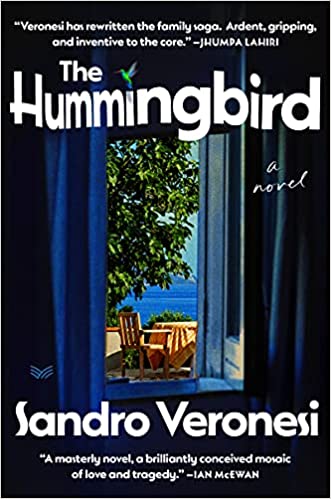
The Hummingbird by Sandro Veronesi, transl. by Elena Pala

This family saga set in Italy, with one life at its center, is moving, literary, philosophical and multi-layered.

The Hummingbird by Sandro Veronesi (Quiet Chaos; The Force of the Past), translated from the Italian by Elena Pala, is a shape-shifting, multigenerational novel of family, love, loss, joy, change and pain.

When readers meet Marco Carrera, the year is 1999 and he is a 40-year-old ophthalmologist in Rome, about to meet destiny in the form of a psychoanalyst breaking his confidentiality oath. From here, chapters jump back and forth in time from 1960 to 2030. Readers meet the great love of Marco’s life, visit his childhood, witness his marriage and divorce. When he is just a boy, Marco stops growing, remaining small and childlike well into his teenage years: his mother nicknames him “the hummingbird” for his stature, a moniker that will echo into his adulthood. He becomes a father and eventually a grandfather, so that four generations of his family flash kaleidoscopically across these pages; Marco is ever at the novel’s center, however, even as he is accused of holding still through life’s storms. “You can keep still as time flows around you, you can stop it flowing, sometimes you can turn back time, even–just like a hummingbird, you can fly backwards and retrieve lost time.” The novel mimics this movement with its nearly stop-action chronology.

Some chapters take a straight narrative form, others are transcribed conversations, letters, postcards or e-mails. Elena Pala’s translation from the Italian feels perfectly suited to this twisting, many-faceted form, as different voices take the lead. The pieced-together story moves between Rome and a Tuscan coastal town where the Carreras have a vacation home; its characters travel much farther (Spain, Germany, the United States), but Marco’s orbit is limited. Rather, as he keeps still, his family and friends revolve around him.

In these various forms, across time and space, Veronesi refers to numerous other literary voices (a Samuel Beckett epigraph sets the tone) and concepts from ophthalmology, psychotherapy, architecture and design, among other disparate fields. The Hummingbird is clearly an intellectual exercise, but can also be read more simply as a story about a single, deceptively ordinary life: Marco might appear unremarkable at first glance, but he has lived remarkable tragedies and triumphs, which will define him. He is affected by his experiences as if by ocean waves, his life a series of natural forces, or natural disaster. Packed with pathos, humor and tragedy, the novel’s finish is both a quiet goodbye and a crescendo, the only fitting end to such an unobtrusive but resounding life.


This review originally ran in the December 2, 2021 issue of Shelf Awareness for the Book Trade. To subscribe, click here.


Rating: 7 appointments.

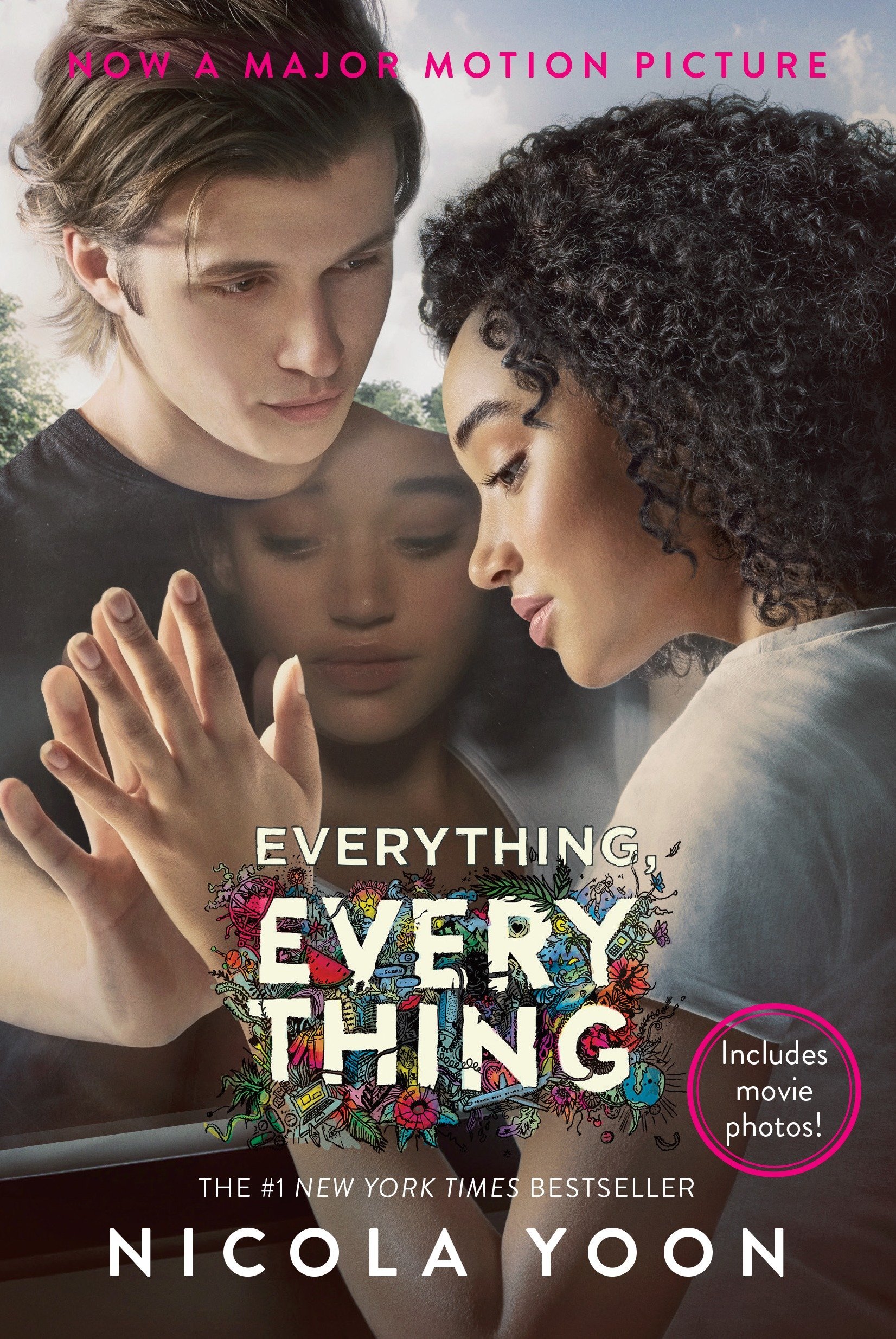
movie: Everything, Everything (2017)

I loved the book so much that I thought I’d love the movie, but I was wrong. I found it more gooey and less substantial, leaning too heavily on the staring into one another’s eyes and the admittedly compelling romantic trope of the view between two windows. (Also the beauty of both starring actors – and they are beautiful! but not what makes the story work.) The mother character is less warm here, and therefore less sympathetic; the mother-daughter relationship has none of the sweetness that makes it work in the book. It’s all less developed, as is always the case with book-to-movie adaptations. If the novel rose above the potentially juvenile nature of the “young adult” designation, the movie did not.

On the other hand, there was this bookstore shot with an out-of-focus copy of Paul Kingsnorth’s The Wake in the foreground as an Easter egg, so that’s worth some points.

I’m sure this movie is for somebody – perhaps it’s perfect for the young adult audience; it got good audience reviews. I found it too simple and saccharine. I watched the trailer for the movie version of The Sun Is Also a Star and decided to save my money. Oh well.


Rating: 4 books.

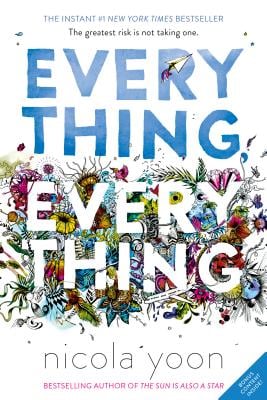
Everything, Everything by Nicola Yoon

After The Sun Is Also a Star I was sold on anything Nicola Yoon. Everything, Everything is her first novel, also a YA romance of star-crossed lovers, heavy on metaphor. I will buy whatever she writes next.

Madeline Whittier is just turning eighteen when we meet her. She lives in an immaculate home, in an entirely white room where “book spines provide the only color” and her best view of the outside world; she hasn’t left the house in seventeen years. She has SCID, or Severe Combined Immunodeficiency, or “bubble baby disease.” Luckily, her mother is a doctor, so she has the best care. She loves her books and goes to school via video calls and the occasional, exhaustively decontaminated visit from her architecture teacher. She has a great relationship with her nurse, Carla, and with her mom; she’s really not unhappy with this life, until a new family moves in next door. Through pantomimes from their windows, and emails, and IMs, Madeline and Olly fall in love.

SCID (a real disease) literalizes several truths about the more universal coming-of-age story. Madeline’s mother wants to protect her, while Madeline begins to chafe at the limitations of that protection. Falling in love involves risk, and necessitates keeping secrets. Throughout this book runs the question of whether love can really kill us or not; for Madeline, perhaps, it literally can. But for Madeline, as for all of us, it is also true that for her to grow into adulthood, she’s going to have to take some risks, and her mother will have to release her grasp a little bit.

The teenaged romance is as enchanted, magical, and absolute as these things really are. Olly is a delightful character, and like the male love interest in The Sun Is Also a Star, he has his own interests and personality to complement Madeline’s. Madeline lives through her books, especially The Little Prince, until her world suddenly grows exponentially larger. Olly is building a fanciful model of the universe on his roof, to escape the trauma of his own home life. They are very sweet with each other, and the whole story is best read in a breathless rush, the way young love happens. Yoon writes lovely, fresh, sparkling prose about universal experiences made specific, detailed, and gorgeous. Her characters are multifaceted and loveable. I feel like I get to disappear into these stories, and I can’t wait for her to write another one.


Rating: 8 rewards.

Yolk by Mary H.K. Choi 

This review from Shelf Awareness prompted me to buy and read this book, and it delivered. I felt fully involved and invested in the lives of Jayne and June Baek, Korean-American sisters born in Seoul and raised in San Antonio, Texas, now living as young adults in New York City. They haven’t been close for years, and now Jayne (our first-person narrator) avoids her sister’s phone calls as she does their mother’s, until June tracks her down on a disastrous third-wheel date and demands they meet. June is very sick. Outwardly, Jayne is the sister with more obvious problems – self-loathing, squalor, harmful sexual practices, generally low functioning as an adult (and some more serious issues that are only gradually revealed). Now that they are sharing increasing challenges, the estranged sisters might just come together again.

As an only child, I have always been fascinated by siblings, whose various dynamics I can only watch from outside, generally with jealousy. One of my favorite things about this novel is its intimate, insider look at the sisters’ relationship, which is troubled (but aren’t they all), love and dislike intertwined with violence and yearning. One of Yolk‘s great strengths overall is immediacy and intimacy, how close we feel to Jayne, in all her messes and flaws. I also really appreciated the writing about place. New York feels right to me, but what do I know; brief sojourns home to San Antonio I am in a better position to judge, and I think Choi (who shares geographical background with her characters) gets it just right. The humid night air and the big skies make me a little homesick, too. The tone of young twenty-somethings dealing with all the madness of life feels pitch-perfect.

Choi includes a brief note at the book’s beginning about some difficult subject matter, acknowledging that she shares some of Jayne’s difficulties and that “for those struggling with body image and food, this story might be emotionally expensive for you.” I had to pause at that phrase, emotionally expensive: I like it. “Sensitivity is a superpower,” Choi instructs us. It is not a novel with an overt message, but I appreciated this one.

I also need to note the loveliness of this hardback book as a physical object: I love the design, the dust jacket, what’s under the dust jacket, and the print on the edges of the pages that continues the image on both dust cover and hardcover. It’s a beautiful piece that feels good in the hand and I’m glad to own it.

Sensitive, funny, raw and often painful – I worried a little early on that I’d taken on something sadder than I needed at this time. But Yolk is a beautiful book about love and hope, too, and with a thread of unlikely romance to it as well. I found it delightful and do recommend.


Rating: 8 glasses of water.

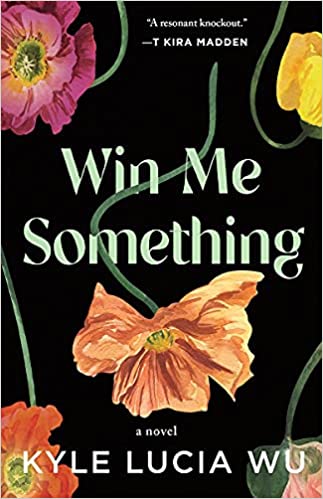
Win Me Something by Kyle Lucia Wu

A young woman must chart her own way, even while quietly craving belonging and home, in this subtle, wise debut.

Kyle Lucia Wu’s first novel, Win Me Something, is a wrenching evocation of yearning in a slim, artful package. The story of Willa Chen, a young woman unmoored in New York City, is defined by liminal spaces and a wish to belong.

In the opening pages, Willa interviews to become a nanny to a wealthy family in Tribeca, even though she can’t quite conceive of what a nanny does. “Maybe I couldn’t imagine these moments because when someone asked about my childhood, my mind clenched and closed like two fists in a pool–fingers squeezing for something to come up with when everything around them was a different kind of matter.”

Willa’s father is a Chinese American immigrant whom she barely knows, her mother a blonde-haired white woman, detached and depressed, who can’t comprehend the microaggressions her daughter faces. Since their divorce when Willa was very young, each has begun a new family, and she feels she belongs to neither. Thus adrift, she enters the Adriens’ household, where she cares for the charming, innocently privileged, nine-year-old Bijou, who studies Mandarin and the violin and cooks coq au vin. Willa feels as unbelonging as ever, but also entranced by the family’s ease, their wealth, their things. “When I looked around their apartment, my veins filled with rushes of want, as if I could see the price tags on everything, as if they would increase my own value.” It’s not that Willa is materialistic, but that she is drawn to the idea of worth suggested by those around her: “I often found myself in friendships with people like this, self-absorbed and sparkling.”

Readers will be engrossed by Willa’s troubled desire to please and her pervasive unease, as she seeks and then deflects the slightest attempt at connection. As she begins to meld into the Adriens’ household, she reconsiders her own childhood and family homes in a series of flashbacks. The subtle racism she encounters is but one thread of Willa’s distress; her estrangement from both of her half-families, and her half-hearted attempts to join the Adriens’, presents a greater challenge on its face, but also stands in for the larger estrangement she feels everywhere she goes, as the in-between spaces of family and race in culture echo each other.

With an eye for just the right detail, Wu offers an understated protagonist, self-defeating but still searching. Win Me Something is a nuanced story of longing, of the paired desires to belong and to strike one’s own path. Willa is a quiet heroine, but unforgettable.


This review originally ran in the September 28, 2021 issue of Shelf Awareness for the Book Trade. To subscribe, click here.


Rating: 7 dresses.

The Birds of Opulence by Crystal Wilkinson

I know Crystal Wilkinson mostly by reputation; I’ve read a few of the stories from her well-regarded collection Blackberries, Blackberries, and listened to her reading her lovely essay “Praise Song for the Kitchen Ghosts,” here. The Birds of Opulence is her second novel, set in the fictional small town of Opulence, Kentucky. It focuses on a handful of women (and the odd man or two), over a few generations: mostly the Goode and Brown family, and their adjacents.

It opens with these lines:

Imagine a tree, a bird in the tree, the hills, the creek, a possum, the dog chasing the possum. Imagine yourself a woman who gathers stories in her apron.

Isn’t that brilliant? In this chapter, a baby is delivered in a squash field, and the story is told by that baby.

The birds of the title are sprinkled throughout as a throughline, something to watch for; sometimes they are women or girls themselves, sometimes just bystanders or witnesses. They also offer something to the titles of chapters: “The Known Bird,” “Wild Birds on Easter Sunday.” Sometimes these chapter titles are like short prose poems unto themselves: “Warming of Old Bones. New Ways. That Hurting Place.” Wilkinson is a decidedly lyric writer with a gift for resonant lines:

A feeling seeped into Mama Minnie’s bones, a feeling like the return of everything lost. Old-time people from across the waters gathered all around her. She put her bony hand on her hip. Every yesterday converged.

The clamor of her own house grows as faint as secrets while she lets her mind ride the night.

Her mind follows the worn path back to the beginning, and she’s only a little surprised that at this moment she can only think in small disconnected spurts, like an old movie reel spinning: a blue sweater, the smell of pine, a large bird’s nest.

Come to think of it, I think I see myself again attracted to lists, as in that last example.

Chapters also refer to the character(s) whose perspective will be featured, so we move from Mama Minnie (a matriarch and rather a seer) through the generations and to neighbors as well… One or two chapters feel more town-focused than character-focused. “Dinner on the Grounds” in particular reminds me of that story I’ve written about before, “Appalachian Swan Song” by Jon Corcoran, for its unusual first-person-plural point of view. This chapter doesn’t actually take the ‘we’ voice, but has the same feeling of a communal gaze. (I wonder if I sense something common between Wilkinson and Corcoran that is Appalachian in nature.) Finally, chapters are also headed under years: the book moves from 1962 to 1995.

Lovely, lyrical writing and evocation of place and culture are the biggest wins here, but the characters and their interlocking relationships, the trouble in those relationships, feel like they will stay with me for some time. Wilkinson is channeling something that feels a little otherworldly here.


Rating: 8 little black bugs flying at the corners of her eyes.