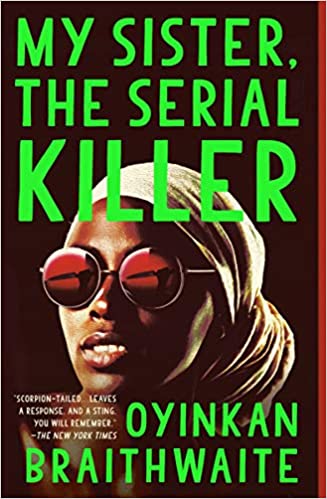
My Sister, the Serial Killer by Oyinkan Braithwaite

Readers of this blog might by now know that I am capable of calling a book about a serial killer light-hearted. Here it is. This is a fun romp about a serial killer.

First-person narrator Korede is a competent nurse at a hospital, where she has a serious crush on a doctor named Tade. He considers her a friend, but nothing more. She is also the responsible sister, and good thing, because her younger sister Ayoola needs one. Their mother is a bit flighty and detached; Korede’s one ally at home is the house girl, otherwise unnamed, another competent but invisible type. Korede and Ayoola’s abusive father, thank goodness, is dead.

Ayoola is a very different sort: stunningly beautiful, she attracts attention everywhere she goes. Men court her and buy her things; women want to be her. She is utterly spoiled, possibly a sociopath, and she has a bad habit of stabbing her boyfriends to death. Thank goodness for Korede’s (perhaps unhealthy) obsession with cleaning products. She knows just how to get the blood out, cover up smells, and where to dispose of the bodies. Her conscience is beginning to nag, however, and so she does what any invisible hospital worker would do: she confides at great length to a kindly-seeming man deep in a coma. You might guess how that winds up.

The delicate arrangement Korede and Ayoola have established to deal with Ayoola’s violent habit is beginning to fray for several reasons, but one event that pushes it to a head is when Tade, Korede’s beloved doctor, asks for Ayoola’s number. The long-overlooked elder sister is forced to decide: is she really willing to protect Ayoola in all scenarios? At all costs?

Chapters are very short, at most a few pages, which is part of what contributes to My Sister, the Serial Killer‘s sense of momentum. I had to force myself to put this one down and get to bed on a school night; it rather demands a single-sitting read. As the present-tense story of Tade’s infatuation with Ayoola unfolds, we also get flashbacks, in chapters titled “Father,” to the story of that patriarch. Braithwaite in no way answers all the reader’s curiosities about this dysfunctional family, but there are surprises along the way, nonetheless.

This novel is set in Lagos, with some Yoruba language sprinkled in, and the family’s foods were often foreign (and interesting) to me. The Lagos police are woefully corrupt and/or incompetent, but other than these details for flavor, if you will, the setting didn’t have an enormous effect on the story.

Despite Ayoola’s murderous tendencies (and generally annoying personality), there is, again, a sense of fun about Korede’s situation: the antics of the women she works with, and Ayoola’s completely ridiculous nonchalance. I felt like the story could keep going, and I would definitely read another installment about Korede’s hapless existence.


Rating: 7 shoes.

The Care and Feeding of Ravenously Hungry Girls by Anissa Gray

Once there was a family. The mother died when her children were young; the father, a traveling preacher, remained mostly absent. The eldest sister, Althea, raised her younger siblings. They are Viola, Joe, and the baby, Lillian. A generation later, Althea and her husband Proctor have twin girls, Kim and Baby Viola. Until recently, they also had a successful restaurant in a struggling Michigan town following a devastating flood (locally called the Great Flood). The couple was trusted in town; they ran fundraisers and charity events for those who lost everything. But then it came out that they’d been skimming off the charity donations. Now, Althea and Proctor are facing a trial and possibly serious time for this transgression. The townspeople have turned against them (Althea’s lawyer says, “the community probably wants to see a public hanging”). Lillian has care of the disgruntled teenaged girls; Viola is en route home from Chicago to lend a hand, although she is beset by problems of her own. And Joe turns up, which is not necessarily a good thing.

Althea refuses to let her daughters visit her. Lillian is losing control, particularly of Kim, the difficult child to Baby Vi’s obedient one. Viola is breaking down mid-road-trip. Joe’s past sins remain unresolved. The legacies of their parents do not rest easy. They come together in the family home, which Lillian has renovated to remove some – but not all – its painful stains; she’s also moved in her former-grandmother-in-law, just to enliven this mess of relationships.

The Care and Feeding of Ravenously Hungry Girls is an emphatically character-driven novel, and these characters are wonderfully formed: a mess in all the best ways. Viola is a practicing therapist plagued by her own eating disorder and her failing marriage to a rather saintly, patient woman whom the reader really wants to see her with. Lillian’s childhood trauma has left her obsessive-compulsive and guilt-ridden – it is in part this guilt that causes her to care for the elderly Chinese woman with broken English whose grandson she’s wronged, but the friendship that results is in fact a gift. Althea’s mood is foul enough to keep her somewhat opaque, but she is also the heart of this family; just because she was the responsible eldest does not mean she’s escaped her own wounds. The novel follows the three sisters most closely, with chapters moving among their points of view. The title refers to Viola’s eating disorder, to the various literal and figurative hungers of the sisters, and beyond.

Proctor, whom we see less of – in flashbacks to the time before the arrests; in emails to his wife as they are both incarcerated – is still a lovely character, whose love of music has been a gift to his daughters, and who sends punny musical hints to Althea as a game they used to play. He at one point quotes the lyrics of Jason Isbell (whom he leaves unnamed, but I am the reader for this moment, y’all, so you know that gave me a thrill). There are other still more minor characters who make a real impact on the world Anissa Gray builds here, including Viola’s and Lillian’s respective childhood friends, Kim’s goofy stoner boyfriend, and the women Althea serves times with.

There are a few plot-level details that never especially coalesced for me. The Great Flood this small town has experienced feels like a looming matter of importance that never quite comes to life, although the long-dead mother had some comments to make about women, water, and rivers that should have connected a bit more strongly there. The crimes Althea and Proctor committed – fleecing their neighbors – are sort of neither here nor there; the plot needed them incarcerated, but it never matters much what they did. I spent some time considering this: Gray had to define their crime, of course, couldn’t just leave it unnamed; but this feels like an odd choice. It’s ethically quite off-putting, while in the grand scheme of things (murder, for example) also relatively minor (embezzlement?), and we’re left with a vague sense of the agency with which the crime was committed. It felt a little bit like Chekhov’s gun never went off. These are minor concerns, and it’s not unusual that a novel so gorgeously and richly character-driven might have some plot weaknesses, but I noticed.

The timeline of Care and Feeding is pretty tight, mostly contained within a few weeks as Althea and Proctor’s trial approaches, their sentences are set, and the immediate fallout occurs. There are flashbacks to earlier times (all the way back to the four siblings’ youth), and a final epilogue-style section set after the dust has settled. But chiefly, this novel is concerned with the quasi-locked-room situation when Lillian and Viola come together to sort out family histories and unhealed wounds. It’s about relationships, the pull of the past, the question of cycles broken or continued, and love.

I found it absorbing; I enjoyed sinking in to the lives of these women and girls, getting to know them, accompanying them. I cared, and they felt very real and immediate. If I cocked my head at the odd and somewhat unresolved crimes Althea and Proctor have committed, so be it; life is sometimes confusing in this way. As a story of regular, imperfect, but good people dealing with life’s confusions, The Care and Feeding of Ravenously Hungry Girls was more than satisfying. Gray’s brief “Beyond the Book” essay at the back of my paperback edition tells us that Viola was a fictional character who just wouldn’t go away, who demanded her story be told. And that makes perfect sense to me; I too would follow Viola wherever she wants to take me, narratively speaking. I would read more.


Rating: 7 1/2 Snickers bars.

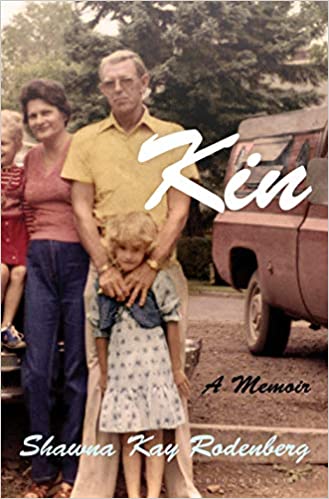
Maximum Shelf: Kin by Shawna Kay Rodenberg

Maximum Shelf is the weekly Shelf Awareness feature focusing on an upcoming title we love and believe will be a great handselling opportunity for booksellers everywhere. The features are written by our editors and reviewers and the publisher has helped support the issue.

This review was published by Shelf Awareness on February 17, 2021.


Shawna Kay Rodenberg’s harrowing memoir Kin leads the reader backward and forward in time and across an American landscape of trauma and healing. With a persistent focus on family and home, Rodenberg documents a process of learning and personal growth that is both unique and universal.

Kin opens in 2017, as the author guides CBS reporters though her native eastern Kentucky. They seek to crack open what they see as Trump country, and Rodenberg hopes to complicate that story. The backdrop is “my family’s mountain, the mountain where my grandfather mined coal, where my father was reared with great love and brutality, where I picked my grandmother’s strawberries and my grandfather’s roses… the mountain on which my family sought refuge after leaving The Body, an end-times wilderness community, cloistered in the woods of northern Minnesota, that my father joined when he was red-eyed and mad with fear, following his tour of duty in Vietnam.” The narrative then moves back in time to Rodenberg’s childhood in Grand Marais, Minn., and the purposeful deprivations of The Body.

Rodenberg’s upbringing in this strict religious sect gives her a cultural background that will make it hard for her to fit in later, and she suffers more than one form of abuse within The Body, including her father’s recurrent rages. “Instead of following in alcoholic, workaholic footsteps, he made religion his primary vice, religion that was unconventional, ecstatic, even perhaps rebellious–and virtually militaristic, which must have felt familiar.” The family eventually moves back to the secular world, to Ohio, to Kentucky and finally to the mountain of family origin. The austere, often angry influences of The Body will follow them.

This memoir recounts family stories, some from Rodenberg’s memories, some passed down. She writes of each of her parents’ childhoods, and of her aunts, uncles, cousins, grandparents and neighbors. She recounts the history of her hometown, Seco, Ky., a former coal-mining camp. Kin begins well before the traumatic story of Shawna’s birth, “bruised-ass-backward into a world of chaos.” The chronology is disjointed, jumping back and forth, shifting timelines as well as locations, which can be disorienting for the reader, but that effect feels true to the narrator’s experience: Kentucky exerts a strong pull even in Minnesota, and pains felt by generations past are ever present.

At each stage, Rodenberg struggles with the meaning and shape of love and caring, and the confusing truth that those who love us most can hurt us most. Religion will continue to play a large role in her life, complicated by her father’s movements to and away from a strict adherence to The Body’s teachings. She will continue to wrestle with sex and the aftermath of childhood sexual abuse, through her troubled first attempt at college and beyond. Kin closes with Rodenberg on the cusp of pregnancy and marriage, but hints at what is to come: “I wish I could tell [that earlier version of myself] she had come to the beginning, not the end.”

Rodenberg’s prose is graceful and effortless, vulnerable and raw, beautifully descriptive without drawing attention to itself. She emphasizes character of place, from coal country where women “kept the food covered and draped cribs with quilts to keep the dust off their babies” to “town-sized time capsules, stoppered and sealed…. Barns sank beneath fields of kudzu and the roofs of old houses bowed in the middle like the backs of the ancient, singular mares that waited outside to be fed and put away.”

While Kin is first and centrally a memoir of family, it is also about Appalachia, about histories more complicated than the opening scene’s reporters care to see. It is ultimately about forgiveness, understanding and love. Rodenberg seeks an emotional reconciliation with her parents, especially the father she has butted heads with all her life. Of that battle, “even now, writing about it fills me with worry that I might be inadvertently reengaging, and that is why talking about it, why telling was and still is the hardest thing…. This is what it means to come from people who have been broken and exploited, they see the world in sides, theirs and the other, and disloyalty is the gravest offense, the blasphemy of the mountains.” In a world of just two sides, it might be an act of rebellion to both love someone and hold them responsible.

As narrator, Rodenberg is intelligent and insightful. As character, she is resourceful, scrappy, defiant, brave and exposed. Her memoir is heart-rending and hard-won. “I didn’t know when I started writing this book that it would become my own book of Revelations, rife with warning and promise, an account of my own and other apocalypses that created me, end times that predated me but shaped me as surely as if I’d lived through them myself.” That sense of regional and filial legacy defines Kin, a work of nuance that complicates received narratives in all the best ways.


Rating: 7 skirts.

Come back Monday for my interview with Rodenberg.

Red at the Bone by Jacqueline Woodson

At just under 200 pages, Red at the Bone is a brief novel, but rich. I read most of it in a single day and finished it the following, but that doesn’t mean it’s not full of feeling. In fact, it has the kind of multigenerational sweep that we usually find in big, fat novels of 500+ pages, the kind that require lots of time and rest to take in. I appreciated the compressed depth.

Each chapter takes a close third-person perspective (sometimes first person) of a different person in the family, beginning with sixteen-year-old Melody, on the night of her presentation to society in a formal ceremony in her grandparents’ Brooklyn brownstone. The first word of this novel is ‘but,’ which you don’t see very often: “But that afternoon there was an orchestra playing.” They’re playing Prince’s “Darling Nikki,” but without the lyrics, naturally.

In other words, the novel begins in media res. Gradually we move through the perspectives of Melody’s mother Iris and father Aubrey, and Iris’s parents Sabe and Po-Boy; in their memories, especially Sabe’s, we learn of earlier generations. This family has come from all over – Aubrey from cities up and down the Gulf Coast, his mother from Santa Cruz and Berkeley; Sabe’s family stretches back to Tulsa and, crucially, the massacre of 1921. When Iris gets pregnant as a teenager, Aubrey is all in, but she wants to get out, and eventually goes away to college at Oberlin where her world widens while Aubrey and baby Melody make a family with Sabe and Po-Boy in the brownstone of the opening scene. The “fire and gold” remembered from Tulsa reaches forward in time to 9/11, and beyond.

This is a story about family and legacy, about what does and doesn’t carry from one generation to the next, about love and changing cultures and also about class. It has tragedy and comedy and love and heartbreak and love – again, that large and sweeping scope, but in a compact form, easy to take in practically in a single sitting. This is some very fine storytelling, especially because each chapter inhabits a different voice. And I appreciate all the markers of culture and time, like music, literature and fashion. In other words, Red at the Bone checks a lot of fine-fiction boxes in a really accessible package (no small feat). Woodson makes it look effortless. I enjoyed Another Brooklyn, but I think this one is better still. I’ll look for more from this author.


Rating: 8 drops of milk.

The Boy in the Field by Margot Livesey

A single discovery touches three siblings’ lives in surprising ways in this poignant, gleaming story.

The Boy in the Field is a stunning novel of tenderness, interconnectedness, cause and effect by Margot Livesey (The Flight of Gemma Hardy; Mercury). Matthew, Zoe and Duncan are walking home from school one day when they find him, in a field with cows, swallows, bluebottles: a beautiful young man, really just a boy, bloodied and unconscious. He speaks one word: “Cowrie,” Zoe reports to the police. “Cowslip,” says Duncan. “Coward,” says Matthew. With their discovery, they save his life.

The teenaged siblings are close, loving and very different from one another. Matthew, the eldest, is thoughtful. He hopes to become a detective one day, and becomes obsessed with solving the mystery of who hurt the boy in the field, and why. He puzzles over motivations. Zoe has “a gift for finding things: birds’ nests, their mother’s calculator, a missing book, a secret.” She worries over her parents’ relationship and explores her own first sexual experiences; she is drawn to the ways in which people come together and apart. Duncan, the youngest, is observant, almost preternaturally sensitive and a gifted painter. Finding the boy will start him toward a discovery about his own life that might be destructive.

The novel unfolds through alternating chapters from the perspectives of Matthew, Zoe and Duncan. Their parents, Betsy and Hal, are compelling characters as well, less known than the children but multi-faceted, imperfect and endearing. Livesey’s deceptively simple prose renders each sibling as both sweet and complicated. Their shared experience, finding the injured young man, begins for each of them a different kind of acceleration: into adulthood, out of innocence, into reconfigured connections. Matthew gets to know the police detective assigned to the case; his relationships with his girlfriend and his best friends irrevocably change; he notices for the first time that he’s drawing away from his younger siblings. Zoe has out-of-body experiences, breaks up with her boyfriend and meets a young philosopher, and it is Zoe who discovers the chink in their parents’ marriage. Duncan sinks into the paintings of Morandi, gets a new dog and launches an investigation of his own. By book’s end, the three will grow both closer and apart through this shared experience.

The Boy in the Field is a coming-of-age story, a mystery, a sharp-eyed examination of individual lives and relationships. Despite the violent crime related to its title and the insecurities that arise for various characters along the way, this brilliant novel offers a sense of beauty and safety in its quiet ruminations.


This review originally ran in the July 21, 2020 issue of Shelf Awareness for the Book Trade. To subscribe, click here.


Rating: 8 brushstrokes.

Maximum Shelf: Good Boy: My Life in Seven Dogs by Jennifer Finney Boylan

Maximum Shelf is the weekly Shelf Awareness feature focusing on an upcoming title we love and believe will be a great handselling opportunity for booksellers everywhere. The features are written by our editors and reviewers and the publisher has helped support the issue.

This review was published by Shelf Awareness on January 22, 2020.


Jennifer Finney Boylan tells her life story with both sweetness and fierceness in Good Boy: My Life in Seven Dogs. A coming-of-age story, a tale of finding and owning of self, and an elegy to a series of delightful and frustrating mutts, this is an occasionally heartbreaking but ultimately feel-good memoir about life and love.

Boylan’s 2003 memoir, She’s Not There, about her trans experience, was the first bestselling book by a transgender American author. Good Boy differs in several particulars: for one, there are dogs. “This is a book about dogs: the love we have for them, and the way that love helps us understand the people we have been.” It follows the path of Boylan’s life, from a confused and troubled boyhood through various teen and young adult phases, to dating and marriage, and finally to the decision to transition and the recent happy years as wife and mother to two young adults. Through these years and epochs, seven dogs in particular helped Boylan mark time and observe change, and learn to love.

First came Playboy, “a resentful hoodlum who loved no one except my father.” He chases and attacks motorcycles and is happy to raise a leg or squat indoors. “My father thought this was kind of funny, but then he was never the person who had to clean it up.” (That person was Boylan’s mother, and she would continue the unenviable task of cleaning up for several dog lifetimes to come.)

Then there was Penny, aka Sausage. What eventually turned out to be a thyroid problem caused this Dalmatian puppy to grow enormously fat, but the young Boylan (at this point known as Jimmy) carries her around “like an unusually heavy rag doll.” Boylan loves her, despite the dog’s indifference. “I figured, if I kept being sweet to Penny all the time, eventually her heart would open, and she would love me as I loved her. No one told me this is never how it works.”

Matt the Mutt humps everything and everyone, human and non, and knocks people down as they enter the house. Despite being neutered, Matt has lots of sex with Sausage, while James–now in college–mostly avoids it, even though he has opportunities with female classmates.

Next comes Brown, whose perfectly plain (if descriptive) name the Boylans hoped would match a personality boringly normal and sane, as none of their dogs had been to date. But all Brown wants to do is eat her own paws, and so she must spend her days in the Cone of Shame, meant to protect her from herself. “Was Brown not so unlike me, driven to the ends of the earth simply because she could not quite do the thing that she was destined to do?”

Alongside the lives of these dogs, young Boylan wrestles with deeply hidden anxieties–about how well he belongs in “his” body, in an all-boys school, in the world he’s been assigned. James’s mother is a martyr to dog poop, and his father battles cancer. On his deathbed, Boylan Sr. tells his son, “Be the man.” That, of course, is the task James most struggles with.

Boylan describes herself as a gender immigrant, as having a life divided into more or less equal thirds: boyhood, manhood, womanhood. (Boylan makes clear that while some trans people would not use such terms, she does see the earlier parts of her life as belonging to a person others perceived as a boy and, later, a man.) Good Boy is in part a contemplation of these themes: What does it mean to be a man? Is it tied to one’s ability to change the oil in the car, build things, woo women?

In adulthood, Boylan meets the woman she will marry, and they receive from their best man and childhood friend a dog that he can no longer care for. Alex is Boylan’s “guardian angel” and a “unique scholar,” apparently the first well-behaved dog to belong to a Boylan, but one who never gets over the loss of his first owner.

Happily married James adopts a “golden retriever” puppy that turns out to be anything but. This vaguely yellow mutt, Lucy, serves as witness to the beginnings of Boylan’s transition, finding herself and becoming Jenny. Initially distressed by the sight of her owner in dress, heels and wig, Lucy eventually counsels Jenny (in imagined dialogue) that, rather than losing everything, “Some things you will keep.”

Finally, Ranger is the dog of Boylan’s happy, settled life, a loyal black lab with a troublesome inability to avoid porcupines. In these later years, the author reflects on how well her conservative mother had handled her coming out, and Boylan herself must consider how to be the best mother she can be when one of her own children has news to share. Happily, well-adjusted Ranger is there to counsel the whole family as Boylan’s children grow up.

The mature woman who has penned Good Boy has much to reflect upon and lessons to share, many of them couched in the lives of good (and troubled) dogs. “There’d been this puppy I’d loved when I was eleven, but in time I’d turned my back on her, thrown my dog out of bed because her gelatinous sadness was a merciless chain tying me to the person I no longer wished to be.” Boylan’s dogs have taught her about love, and how its unconditional nature flows between humans and dogs. Good Boy is a story, first and foremost, about love, its many forms and the many directions in which we point it and receive it, and about how certain details, like gender, really matter very little in the end. If you have a family–and a dog–that love you, that’s the vital thing.


Rating: 6 cello suites.

Come back Wednesday for my interview with Jennifer Boylan.

The Magical Language of Others by E. J. Koh

Letters from mother to daughter shed glimmering light on reunions, reconciliation, immigration, heritage and familial love.

Poet and translator E.J. Koh grew up in California’s Bay Area, the daughter of Korean immigrants. Her parents moved back to Korea when she was 15, leaving her to live with her angry, taciturn 19-year-old brother. By the time her parents returned to the United States, Koh was off to graduate school in New York City. During those years of separation, a flurry of letters from mother to daughter sketched a yearning over distance.

The Magical Language of Others revolves around these letters, translated from occasionally English-spattered Korean. Koh read them as arrived, but it wasn’t until much later, in their rediscovery, that she came to understand what they offered. In a small box she has kept for years, Koh finds exactly 49 letters: “In Buddhist tradition, forty-nine is the number of days a soul wanders the earth for answers before the afterlife.”

As Koh studies Korean and Japanese, and eventually adds a graduate degree in Korean translation to her graduate poetry studies, she works as well to translate the love, longing and abandonment of generations of women. Her paternal grandmother’s memories of Jeju Island are first idyllic and then filled with trauma from the massacre in 1948. Koh’s privileged but heartbroken maternal grandmother, after several suicide attempts, left her cheating husband in Daejeon and took an apartment in Seoul. She loved it there, but eventually relented and moved back home to a family that begged for her return. “Coming to one home, she had abandoned another.”

Meanwhile, in Koh’s own lifetime, she deals with young adulthood with her antagonistic brother. She makes frequent trips to see their parents in Korea, where she shops and visits the bathhouse with her mother, formally studies languages and informally studies people. “He waved not a hand but a blank page, and I knew it was gestures like this one that meant nothing.” Such luminous prose is evidence of an unusual mind.

This slim book is a memoir–of the years Koh spent quasi-orphaned in California; her visits to Korea; finally sharing a continent and eventually a home with her parents again in adulthood. It is also a study of generations of women before her. Koh considers how people make poetry out of imperfect lives, and how they interpret and generate love. In startling, lyrical, imaginative prose, Koh wrestles with the meanings of devotion and duty, and with the challenges of language and translation. Her final lines are as heartbreakingly beautiful as the entire book deserves. The Magical Language of Others is a masterpiece, a love letter to mothers and daughters everywhere.


This review originally ran in the November 25, 2019 issue of Shelf Awareness for the Book Trade. To subscribe, click here.


Rating: 7 parentheses.

Between the World and Me by Ta-Nehisi Coates

between the worldFinal review of the year, and the book is a great one. Pops reviewed it first, and I knew it was one I needed, but it just took me a while to get to it. The reason I finally prioritized it now is because I suspected a student needed it – actually, that was Pops’s suggestion, too – and so I needed to read it first, to know, and to be able to recommend it to her. So I have that student to thank for my own education, which is often how it works.

Coates speaks painful truths about our society and the legacy of slavery and ongoing racism in this country. He speaks with specificity and detail of his upbringing in a Baltimore that was worlds away from what he saw on TV growing up, the world where “there were little white boys with complete collections of football cards, and their only want was a popular girlfriend and their only worry was poison oak.” I think of his narrative as accomplishing three things: a review of the evils of racism in this country since its founding and continuing today; a memoir of the experiences of one man, his coming-of-age and coming to realize the above, and of growing up in Baltimore; and a review of the writings and philosophies of Black American thinking and activism. Coates has an inquisitive mind from a young age. In this book, he actively investigates the nature of education, and who gets to define the value of a civilization. I loved the part where we learn that his mother used to have him, as a child, write essays about his own mistakes. This taught him to question, and that the question itself, not any purportive answer, is the point. This lesson has got to be the most important lesson anyone can offer a young person. This is the concept behind the classic liberal arts education, right: critical thinking?

Coates assigns his son the same essays in response to his own transgressions.

I gave [these assignments] to you not because I thought they would curb your havior–they certainly did not curb mine–but because these were the earliest acts of iterrogation, of drawing myself into consciousness. Your grandmother was not teaching me how to behave in class. She was teaching me how to ruthlessly interrogate the subject that elicited the most sympathy and rationalizing–myself.

Oh, that I could teach one or two of my own students the same.

I have tried to write more about this book and what it accomplishes, both artistically/stylistically and in its content, but I keep observing that my dad did it better. (I especially like his work with what he calls metaphorical coding, and the Richard Wright poem that gives this book its title and a refrain.) His book review says everything I’d like to say about this book, and says it beautifully, so let me again try to send you back to it. Thanks, Pops.


Rating: 9 open, easy smiles.

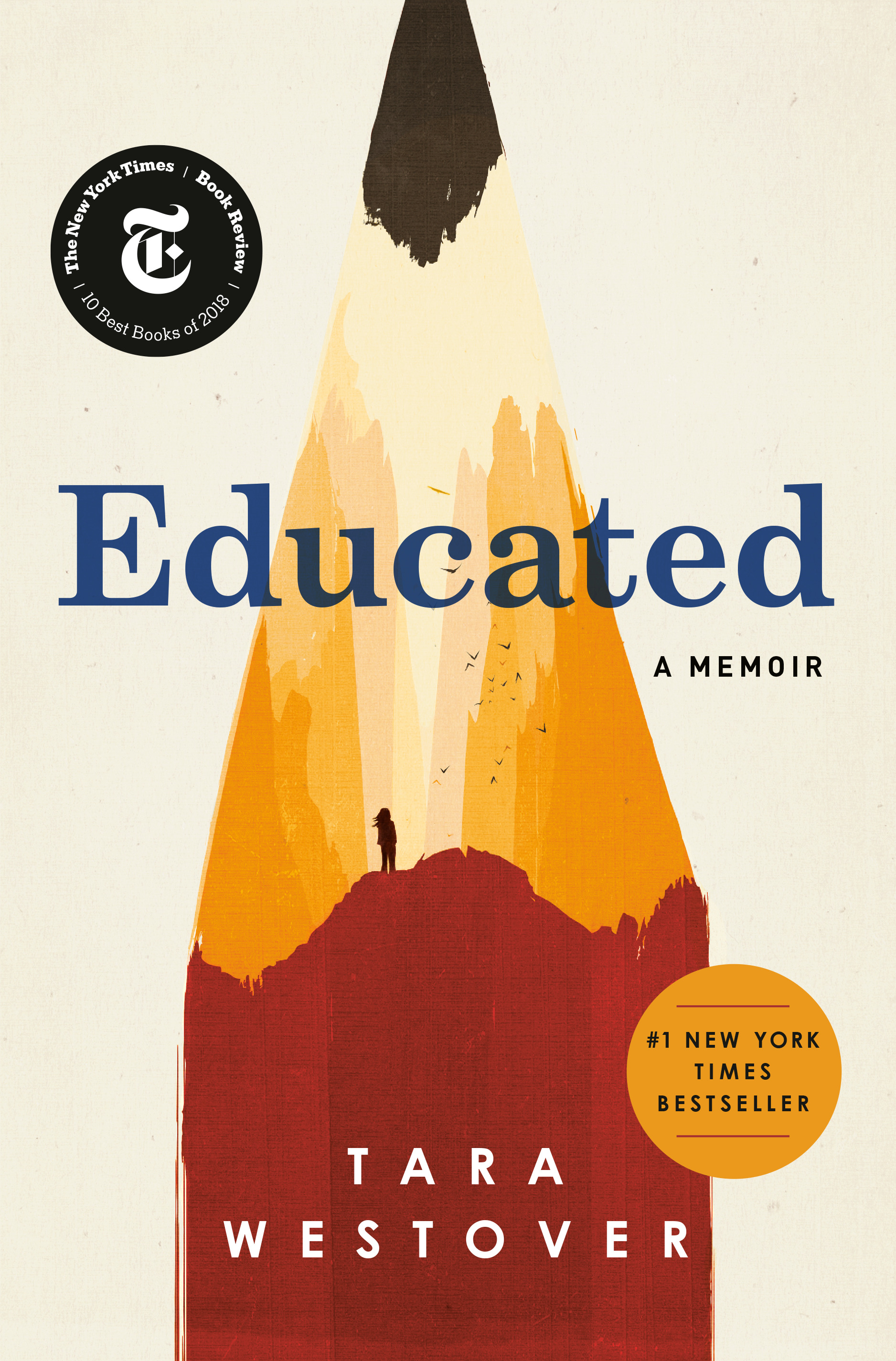
Educated by Tara Westover

We are all more complicated than the roles we are assigned in stories.

Last Friday, I briefly reviewed Tara Westover’s talk at West Virginia University. Now here’s her book.

It’s a hell of a book. I’ve written about this before: every book has the two layers, the content itself – the story it tells – and the telling of it. Sometimes one or the other clearly dominates. I read a lot of books in which the telling, the lovely lyric or literary or weirdly styled telling of it, trumps the story itself (man comes of age, meets woman, ho hum). And I read some that are very much about the story, where the telling is just serviceable. I sometimes remark when they both align to a remarkable level. This one is noteworthy because the story is so outrageous: truly, it would stand alone as a sensational tale (which is not altogether a good or a bad thing, although rather maligned in memoir). But it doesn’t rely on the shock value of its story to carry it; the telling is also elegant, and Westover makes some wise observations along the way.

As I wrote the other day, Westover was raised by some pretty extreme isolationist Mormons. She was not allowed to go to school or to a doctor. Her father seems a little nuts; he is a religious zealot, insists upon total control in the household, is prone to wild mood swings, and late in the story, becomes something of a cult leader. He makes his living by scrapping metal from his junkyard(s) and doing odd building jobs. His seven children are expected to work as part of the family business – with him, or with their mother, a midwife and homeopathic healer. This latter was not her idea, but his, so that the family would not need doctors, and as a way to serve God. She is a reluctant student but eventually finds her stride and gets serious about faith healing (which involves something she calls muscle testing, clicking her fingers and whatnot). It’s all pretty far out for me. Because Dad is crazed about the junkyard/scrapping work, and because he lives in a bit of a fantasy where nothing bad happens to the righteous, he is opposed to safety measures, actively forbidding gloves and protective eyewear (etc.) and using ludicrously dangerous equipment. So the family suffers quite a few serious injuries. They do enter the hospital a time or two, but also treat third degree burns over a large percentage of the body, and head wounds involving exposed brains, at home. So, the first sensationalist point of this story is the extreme isolation, zealotry, and risk-taking the Westover family lives.

The second is abuse. Young Tara is absolutely placed in mortal danger by her family, repeatedly and constantly, and this is a form of abuse. But the greater issue is with one of her older brothers, who beats and tortures her as a matter of daily life when she is a teenager. He inflicts sprains and I think one broken bone. “I found myself cleaning the toilet every morning, knowing my head might be inside it before lunch.” He laughs at her, taunts her, calls her whore until she knows deep within herself that it is so, and he gaslights her into feeling that she’s imagined all of the above. I can’t do the trauma justice here. Talk about shock value.

The abuse extends from here. She and a sister try to confront the family about the brother’s abuse (which apparently extends to several of his siblings), but this results in a range of lies and false fronts, and no change. Eventually, it results in each whistleblower being invited to recant and be received back into the fold, or be disowned, which is Tara’s fate. At the time of the book’s writing, she is not in touch with her parents or most of her siblings.

But again, her book does not rely on these events for its impact – or at least, not entirely. It’s hard to think about her life without concentrating on these stories (as I have here in this review). But meanwhile, Tara gets an undergraduate degree from Salt Lake City’s Brigham Young University; travels to Cambridge on a Gates scholarship; receives an MPhil from Trinity at Cambridge; studies at Harvard; and gets her PhD back at Cambridge. This would be a remarkable academic journey for the most privileged among us, but especially so for someone who never set foot in a classroom until Brigham Young, who had no support at home for her education, and who battled mental illness and extraordinary obstacles and gaslighting from her family at every step along the way. For dog’s sake, she takes school breaks at home where she is gaslit and physical abused, then returns to the school grind. It’s quite bizarre and almost unbelievable.

So, let’s mention the whiff of controversy. The Westover family is divided: some of Tara’s siblings back up her story, while others (and of course her parents) deny what she has written. I’m not especially concerned. If they are the people we’ve read about in these pages, we expect them to react in these ways. It’s hard to confirm such a story, but she does seem careful to consult the memories of others (those siblings she’s in touch with), and why would they support her if indeed this were fiction? I tend to believe her at this point.

I don’t think Tara’s done growing and learning – she’s just in her early 30s now, and I appreciated her comments at WVU last month, that she doesn’t know what’s next for her. (Nothing more arrogant than thinking we know what’s coming next! Or maybe that’s just the van-dweller in me.) I don’t think she’s done integrating the lessons of her spectacularly weird upbringing; we probably all still have a lot to learn, from her and from ourselves. But I think her telling of this story is careful, thoughtful, and compelling. She throws no one under the bus; even the abusive brother, even her enabling, turncoat mother, even her possibly mad father, get compassion, second-guessing, the ambivalence of a narrator who knows she doesn’t know everything. I found her someone I’d be glad to be friends with. She has a curious mind, and is still investigating what’s happened to her (although she’s come a long way in protecting herself).

There are other elements here to appreciate as well. For example, Tara’s attachment to her family is also inextricable from her attachment to place, the mountain where she’s grown up exerting a hold on her (and you know I like a sense of place). She meditates on the value of education, and its different definitions – the value of open-mindedness, and of knowing there is a larger world out there than your own particular mountain.

I am left quite impressed – by what Tara has lived through and overcome, by her journey and her accomplishments, and by her thoughtful, precise, contemplative, considered, literary telling of it. And I am curious about what she’ll take on next. I’m very glad I read this book. (And very sorry to miss the second book club meeting on it, but that’s another story.)


Rating: 7 tinctures.

Appalachia North by Matthew Ferrence, in Still: The Journal

Following my earlier review, I am so deeply pleased to shared with you today this review in the Fall 2019 issue of Still: The Journal.

Matthew Ferrence’s Appalachia North is both memoir and outward-looking examination of place: what it means to be from somewhere, how our relationship to home can change, and the complicated and too-often negative role Appalachia plays in the national imagination, and in its own.

Ferrence was forty when he received a life-changing diagnosis…

Please click over to read the full review. Look for my interview with Matt on Friday. And many thanks again to the Editors at Still for considering and accepting my work.