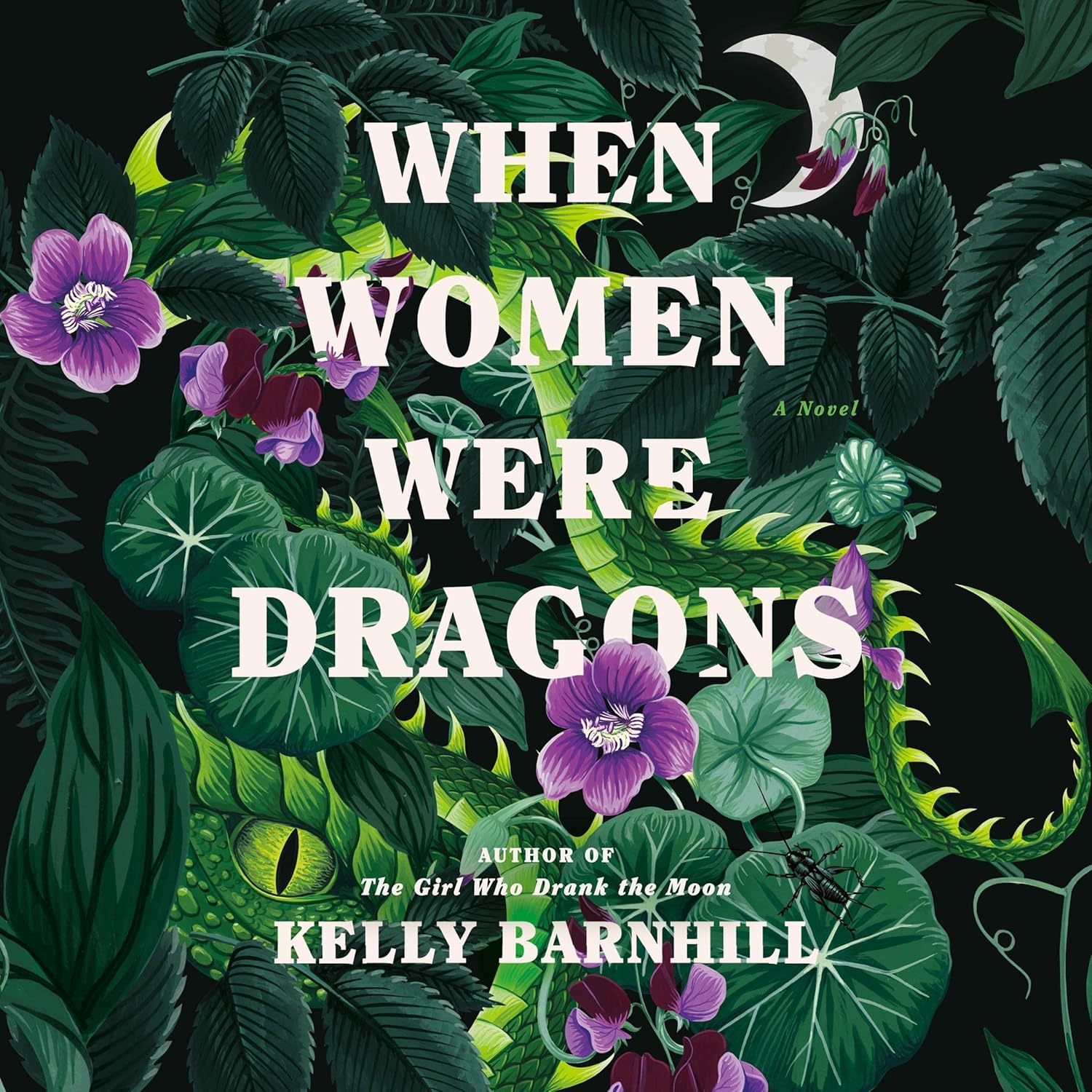
When Women Were Dragons by Kelly Barnhill (audio)

I don’t recall where I got this title from, but I loved this book, and am grateful to whatever review or list sent it my way. Also to my lovely partner who gifted it to me for the long drive from Texas to West Virginia.

When Women Were Dragons: Being the Truthful Accounting of the Life of Alex Green–Physicist, Professor, Activist. Still Human. A memoir, of sorts is a living, breathing tale, ever expanding, filled with metaphor that reshapes itself with the reader’s interpretation. It opens with a strange letter from a Nebraska housewife in 1898 to her mother, shortly before the woman spontaneously dragoned. Next we have an excerpt from the opening statement given by Dr. Henry Gantz to the House Committee on Un-American Activities in 1957. Then we get into the first-person narration of Alex Green, who will tell most of this story, with brief insertions mostly from Dr. Gantz’s work – bit of an epistolary format. (The audiobook is narrated by Kimberly Farr, as Alex Green, and Mark Bramhall, as Dr. Gantz, which I thought was a great choice.) “I was four years old when I first met a dragon. I didn’t tell my mother. I didn’t think she’d understand.”

I think this must be right around 1950. Alex grows up in small-town Wisconsin, in a pretty 1950s world: there are many things we just don’t talk about, including cancer, menstruation and most aspects of girlhood and womanhood, what to expect on one’s wedding night, diversity in sexual orientation and gender expression, our feelings, and dragons. When Alex is a little girl, her mother goes away for some time – months – and no one explains or even acknowledges the change; likewise when her mother returns, gaunt, weak, different (she doesn’t even smell right). The reader understands better than little-girl Alex when her mother’s chest is glimpsed, missing breasts, two scars like smiles. This world is recognizably our own except for the dragons. Women in this world can dragon (that’s a verb), or become dragons, at which point they sometimes eat their husbands (this seems to happen frequently with very unlikeable, not to say abusive, husbands) before flying away. Dragoning is a poorly understood phenomenon because, as with much that is female or feminine, society judges it too shameful to examine, and science mostly averts its gaze. Dr. Gantz is a rare exception: he believes in the scientific mandate to learn, whatever truths are revealed. Biology should never be shameful. His research articles and responses to an oppressive world are useful seasonings to this story, and he is himself a delightful character, alongside the heroic librarian Mrs. Gyzinska.

And oh, Alex’s auntie Marla, a wonderful woman who comes and cares for her while her mother is away in cancer treatment, a big powerful woman who flies airplanes during the war and works as a car mechanic and wears men’s clothes and takes very little shit, and who we lose to the Mass Dragoning of 1955. When Marla dragons, she leaves behind an infant daughter, Alex’s cousin Beatrice, who from here on is raised as Alex’s sister. Such is the gaslighting of Alex’s family and world that she learns to really believe – almost – that she has no aunt, that Beatrice has always been her sister. (Echoes of 1984. We have always been at war with Eastasia.) And boy, the time Alex has raising her younger sister, Beatrice, a delightful dragon of a child if there ever was one.

Despite all I’ve just thrown at you, I’ve barely scraped the surface of this remarkable novel. It contains many stories and many layers, much that is very recognizable from our ‘real’ world, and lots of potential metaphors to ponder. I wondered at different times if dragoning were a metaphor for menstruation; for puberty; for “un-american activities” (certainly, HUAC seems to conflate them); for simply being independent, self-determining, and female (except that those who dragon are overwhelmingly but not universally girls and women). This story tackles the way we handle difference, and especially gender, sexuality, and gender expression. It contains such maddening (if entirely realistic) renderings of sexism that it was sometimes hard to listen to. It contains transcendent moments of personal discovery, joyful academic inquiry, love and coming-of-age, and some lovely iterations of family and built family, which I always appreciate. “Sometimes,” confides Alex at an advanced age, “the expansive nature of family takes my breath away.” There is such good fun; I especially liked the line “If that dragon was hoping for sympathy, she was crying in front of the wrong teenager,” which I got to share with my favorite dragon-loving teenager. It considers the looping of time and relationships. It’s got science and wonder, a bit like A Tale for the Time Being, but I liked this better. I’m a bit over the moon about it, and am giving it a perfect score. Also, I loved the audio format, with the one caveat that I wish I could pull more quotations that I loved.

Do give it a go, and let me know what you think.


Rating: 10 military-issued boots.

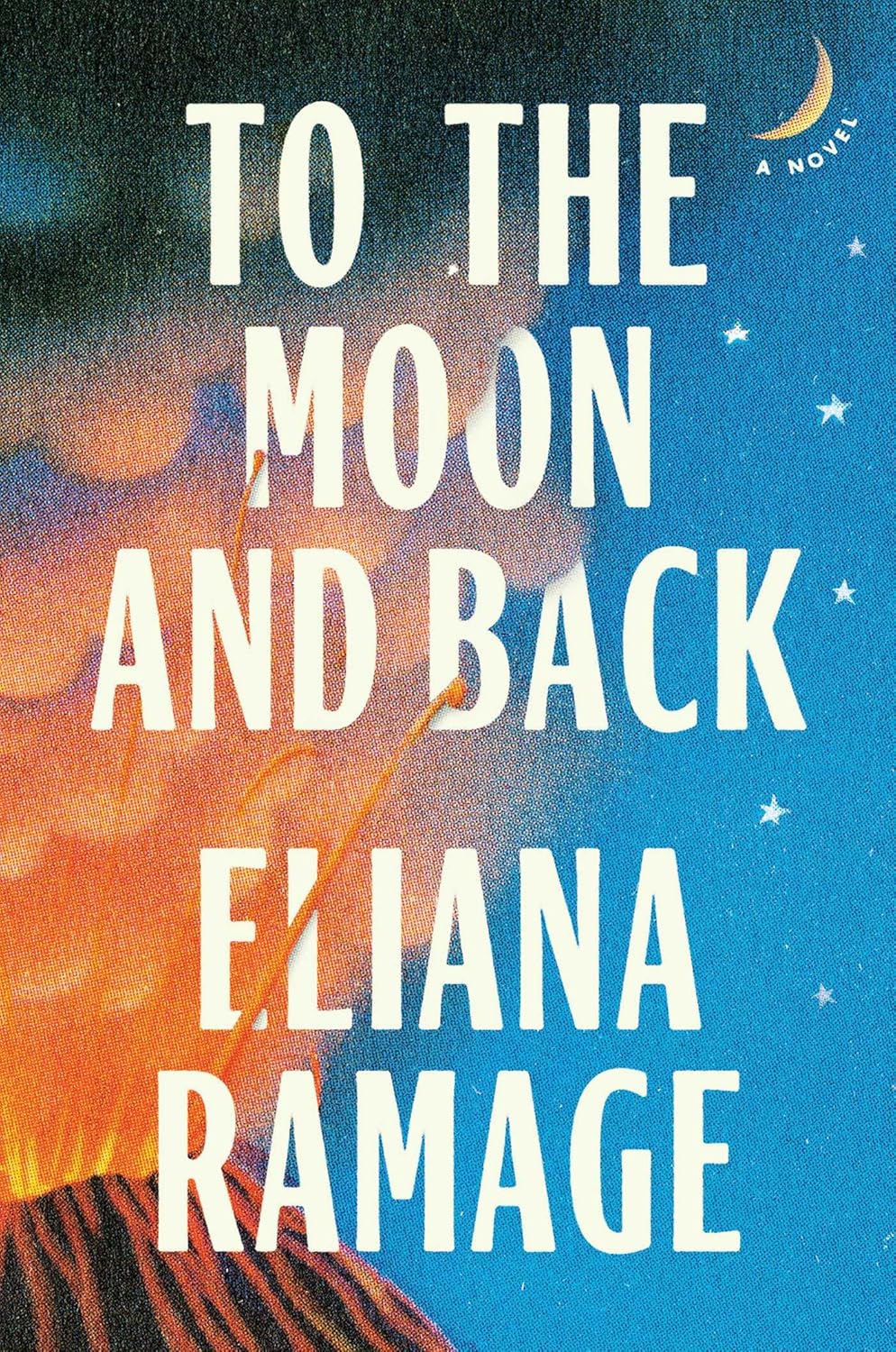
Maximum Shelf: To the Moon and Back by Eliana Ramage

Maximum Shelf is the weekly Shelf Awareness feature focusing on an upcoming title we love and believe will be a great handselling opportunity for booksellers everywhere. The features are written by our editors and reviewers and the publisher has helped support the issue.

This review was published by Shelf Awareness on March 25, 2025.


Eliana Ramage’s debut, To the Moon and Back, is a far-reaching, ever-surprising, intricate novel about identity, family, ambitions, career, romance and, yes, astronomy.

When readers meet Steph Harper, she is almost six years old. “I imagine her terrified. Our mother. Two children in the backseat. She drove like a woman followed, even after we left him at the foot of that tall hill. There was blood there, back in Texas, and tiny shards of glass still covered my sister.” Their mother, Hannah, is in flight from a vague threat–abuse, trauma–with her two little girls in tow. Precocious Steph is already developing her obsession with astronomy. Kayla is just a baby, sparkling in broken glass but unscathed by what haunts the others: “Our mother would never have Kayla’s confidence because Kayla had no memory of another self. Of another place. Of what was possible, here on earth. Maybe what was wrong with our mother was also wrong with me.”

From Texas, the fragile family resettles in the Cherokee Nation, in Tahlequah, where Hannah hopes to recover community and reclaim her heritage. Steph and Kayla learn to speak Cherokee. Steph watches the sky and fine-tunes her plans to become an astronaut: when readers meet her for the second time, she is 13 and concerned only with getting into Exeter Academy, which she hopes will put her on course for Harvard and then NASA. She studies the biographies of astronauts and the hard science she will need, with the help of a telescope gifted to her by her mother’s new boyfriend, Brett. “It had been my goal to understand the origins of earth, the universe, and everything in it by my fourteenth birthday. I was behind schedule.” This dream is what gives Steph’s life focus; she needs this to live. “I’d picture an astronaut watching me back. Some astronaut would call his daughter through mission control and she’d say tell me what you see and he’d say oh, the Northern Hemisphere, North America, and that would be true, but also true was Oklahoma, a field, a tree. A girl alone, looking up.” It is also true that the dream, which in some ways saves her, may be what keeps her from finding happiness in relationships on Earth: with her mother, her sister, or the love of her life.

Distracting her along the way are her feelings for girls, which she suspects will not be appreciated in Tahlequah: “If I could figure out the money and the applications and the getting myself to college, I decided I would be gay. Or bi, maybe? At schools like Harvard, they let you figure that out.”

As Steph moves from Tahlequah to Hollis College in rural Connecticut, a parallel character is introduced. She was named Della Owens at birth, when she was adopted by a Mormon couple in Provo, Utah. But as the center of a legal case resting upon the Indian Child Welfare Act, she became known as Baby D. Many Native Americans believe she belongs with her people. Della’s path intersects Steph’s when they find themselves at Hollis together, and they will intertwine from there, coming of age in parallel and navigating romance, Native heritage, and ambition.

For a portion of the book, Della’s first-person voice alternates chapter-by-chapter with Steph’s, which otherwise dominates. Later, these perspectives are joined by various epistolary elements: e-mails, social media posts, text messages. To the Moon and Back excels in surprise; these points of view are only one area in which Ramage takes her reader in unexpected directions, geographically and otherwise. The novel is gloriously expansive, epic, and sweeping. It covers just a couple of decades, from 1995 to 2017, although the history of previous generations certainly comes to bear on the present timeline. But like Steph herself, the story keeps reaching beyond its expected limits. It is not only a coming-of-age story, but also about a variety of Native American experiences, and about queer experiences and those intersections. It’s about lofty goals, astronomy, and yearning. Just when readers grasp the enormity of Steph’s single-minded focus on becoming an astronaut, she reaches further, to becoming a better human being. The events of Steph’s life are often sensational, but always, in Ramage’s expert storytelling, believable.

So many threads would be too much for a less skilled writer to wrangle, but these characters are developed with such steady pacing, depth, and perfect detail that they always feel natural. A plot summary with spoilers would sound, perhaps, absurd. But To the Moon and Back is anything but. It is a complex, absorbing, thought-provoking novel, compulsively readable. Steph is exceptionally eccentric, and her story is also universal, all-encompassing. Her impressive character arc comes, eventually, to wisdom and an unlikely peace: “I want to love the universe, even if I don’t know what it is. I do not have to know what it is.” Readers will be enriched for having shared these pages with her.


Rating: 9 M&Ms.

Come back Monday for my interview with Ramage.

North Woods by Daniel Mason

A gift from a dear friend, this novel is different. It could be categorized as a collection of linked shorts, in various formats (formally playful, you might say), including epistolary. The stories that make up North Woods are connected across history by place: together, they track a single location, a small valley in what will become western Massachusetts, from early colonial America until the more-or-less present and into the future. We are used to novels and stories being connected by character or plot. We are familiar with stories that center place heavily – I’m thinking of Rebecca, Housekeeping, The City We Became, The Rope Swing. This one felt a bit more… kaleidoscopic.

They had come to the spot in the freshness of June, chased from the village by its people, following deer path through the forest, the valleys, the fern groves, and the quaking bogs.

Fast they ran!

So opens the novel, and it takes several paragraphs until the reference to ‘harquebuses‘ (I had to look it up) gives us a clue as to setting in time. I loved how the fens and meadows, bramble and thickets, bear caves and tree hollows could have been anywhen. The couple who run remain nameless, and we learn very little of their story in their four-page chapter, but we see them stop in a valley: “a clearing, beaver stumps and pale-green seedlings rising from the rich black ash.” “Here,” says the man, and there they stop with their chicken and their squash and corn seeds and fragments of potato. And scene.

Subsequent residents – most of them human – find the log and stone hut built by this original couple, experience joys and hardships there, and add to that structure. A veteran of the American Revolution establishes an apple orchard. His twin daughters, after his death, grow old preserving his legacy and bickering with each other, unto a shocking end. A mountain lion briefly occupies the abandoned dwelling, hoarding her kills. A slave catcher hunts other prey in the area, eventually homing in on the house in the overgrown orchard, but will not find what he seeks. A painter finds a haven there, in a gorgeous valley where he can observe nature and work on landscapes and studies of birds nests, fungus, and trees; he pursues a forbidden love. In his old age, a nurse comes to assist him, and finds a love of her own that will fare no better. (It begins to feel like the home in the valley, at this point with many additions and “improvements,” might be a site of bad luck.) A mystic plies her trade, claiming to drive out a haunting, but has bitten off a bigger haunting than she’s realized. The chestnut blight settles in. A mother struggles to care for her disturbed son, who is schizophrenic, or haunted, or maybe both (?). The son wrestles with his delusions, or, his heightened knowledge of reality; his sister, an academic on the west coast, grapples with her brother’s life’s work. A newlywed couple lives out a fantasy, and a bark beetle expresses its lusts in parallel, in one of the weirder sections of this novel (and that’s saying something). (The chapters that feature nonhuman characters – spores, beetles, panthers – are delightfully immersive, but also somehow inherently creepy, in a way that feels anthropomorphic.) A lonely old woman narrowly avoids a dangerous con artist, a crime writer discovers an ancient grave, a metal detectorist goes seeking evidence, and a graduate student searches for spring ephemerals but encounters a ghost. The world turns.

It was a fascinating experience to sink into this place. There were not many characters or episodes to like or even especially enjoy; there was often a sense of watching something disquieting take place. I definitely loved the consideration of place over time, the natural world, and the different ways we interact with it. I loved the orchardist, the painter, and the graduate student most of all. I do love a zoom in on a procreative beetle. It was a disjointed experience, one I’ll not soon forget, but also don’t feel a firm grasp of. Maybe I need more time out of this book to figure out what it did for me. Maybe this is an instance of the author demonstrated prowess for its own sake. (As ever, your mileage may vary.) If you get into it, please do let me know what you think.


Rating: 7 antlers, turtle shells, and bird eggs.

Maximum Shelf: Creation Lake by Rachel Kushner

Maximum Shelf is the weekly Shelf Awareness feature focusing on an upcoming title we love and believe will be a great handselling opportunity for booksellers everywhere. The features are written by our editors and reviewers and the publisher has helped support the issue.

This review was published by Shelf Awareness on May 8, 2024.


Rachel Kushner (The Flamethrowers, The Mars Room) envelops her readers in an absorbing tale of espionage, philosophy, intrigue, and chaos with her noir fourth novel, Creation Lake.

An unnamed narrator opens these pages with extended quotations from the e-mails of a man named Bruno Lacombe, which she is reading without his knowledge. Bruno’s ideas will form an important thread throughout the novel, although he never appears in the flesh; the epistolary sections offer a perspective on events, a worldview, in juxtaposition to the narrator’s. She begins by reading his e-mails as part of her job, but their meaning will shift. And Bruno’s corporeal absence allows for some question as to his true form.

This narrator, presently using the alias Sadie Smith, is an American woman living in France. A former FBI spy, she was fired after a case she worked as an undercover agent did not bring the trial result the agency desired. Now she performs similar work for shadowy private interests: she takes on a character and infiltrates a group, instigating as well as observing its actions. In the Guyenne region of France, she is to penetrate an organization of anarchist environmental and anti-civilization activists called Le Moulin and learn of their involvement in a recent act of sabotage. The assignment to observe and investigate becomes an assignment to provoke further action, and she may yet be asked for more.

Creation Lake has layers. It is partly a spy novel. “Sadie” gains entry to the Moulinards through her fiancé, Lucien, a wealthy, privileged young man she easily seduced and moved in with following a carefully planned “cold bump” that Lucien thinks was an accidental encounter. She moves through the community she’s been assigned to, playing one character off the other, with readers privy to her inner commentary about both the assigned mission and the personalities of her new acquaintances. Along with her sexual relationship with Lucien (enacted with carefully concealed distaste), she carries on another affair that is more pleasurable but no more honest. She can be funny, cutting, and disarmingly self-critical. Despite holding all the cards–at least in her own view–“Sadie” is not precisely a highly organized personality.

Creation Lake is also in part an exploration of philosophies, as Bruno preaches the virtues and qualities of the Neanderthal and other early relatives and forebears of Homo sapiens. An enigmatic figure, he lives in a cave and extols the virtues of primitivism by e-mail. Kushner’s not-necessarily-reliable narrator brings a certain amount of mystery herself: amoral, even nihilistic, she seemingly cares not a bit about the principles at question in her work, but only about her paycheck and a few simple pleasures. Unmoored by the FBI, she has no leader or cause to follow, barely pausing at collateral violence. Importantly, her role with the Moulinards is that of a sympathetic outsider hired to translate their writings. Rather than a true convert, she is able to ask questions, showing curiosity and a friendly skepticism. This allows her to fully explore the Moulinards’ beliefs, although she is unimpressed by their devotion to principle.

None of these characters is heroic or even especially virtuous; the narrator points out the hypocrisy and self-serving nature of the activists. “Charisma does not originate inside the person called ‘charismatic.’ It comes from the need of others to believe that special people exist.” On the other hand, she may find herself more susceptible to the philosophies of the unseen Bruno than she was equipped for. Bruno apparently writes these e-mails for one audience–the Moulinards–but they will perhaps have their greatest effect on the audience he is apparently unaware of.

With punchy short chapters and bursts of action, the plot builds tension to a boiling point while resisting any convention or formula of the spy novel genre, which it reinvents as much as it inhabits. Kushner’s pacing is inexorable, ratcheting up tensions to propel readers to a surprising ending. Spare, even stark, Creation Lake considers the past and the future of humankind without sentiment, letting the narrator’s unblinking observations stand alone. She is hardworking and apathetic, drinking a bit too much and going through the motions of a job that she has no particularly strong feelings about.

If Kushner’s expansive plot considers no less than the very origin and fate of humanity, “Sadie” considers only her next destination. As focused as she can be on the job at hand, her approach to life is profoundly blurred. Gritty and hard-edged, this is a novel of both cynicism and belief, with a mysterious narrator at its center, adrift but anchoring its plot. There is something dark at work throughout, but Kushner keeps a sense of fun, pleasure, and unexpected humor as well. “Deep down, even if they lack the courage to admit it, inside each person, they know that the world is lawless and chaotic and random.” Taut and propulsive, Creation Lake leaves its readers with plenty to think about once its pages close.


Rating: 7 cans of warm beer.

Come back Friday for my interview with Kushner.

Maximum Shelf: Swift River by Essie Chambers

Maximum Shelf is the weekly Shelf Awareness feature focusing on an upcoming title we love and believe will be a great handselling opportunity for booksellers everywhere. The features are written by our editors and reviewers and the publisher has helped support the issue.

This review was published by Shelf Awareness on January 24, 2024.


Swift River tackles an impressively broad range of issues, including race, class, and body image, within the coming-of-age of Diamond Newberry. Essie Chambers’s first novel, building upon her work in film and television (Descendant, 2022), is set in the decaying New England mill town of Swift River, with meditations on place and the effect of a hometown upon generations of lives. Sixteen-year-old Diamond narrates: “This isn’t a mystery or a legend. It’s a story about leaving. It starts with my body. My body is a map of the world.” Her voice is strong, clear, and confident, interspersed with flashbacks to Diamond’s life at age nine, when her father disappeared. These two timelines are eventually joined by letters from a previously unknown aunt and great-aunt, so that the voices of three women over decades triangulate a story of longing, family connections, and growing into oneself.

“Picture my Pop’s sneakers: worn out and mud-caked from gardening, neatly positioned on the riverbank where the grass meets the sand.” This indelible image, published in the newspaper, haunts Diamond as she mourns her lost father. He was the lone man of color in Swift River. “Pop is the only other brown I know. No one else in town has dark skin like ours, not even Ma, which is what makes our family different.”

Years after the sneakers on the riverbank, in the summer of 1987, Diamond’s Ma, of “pure Irish stock,” is unemployed and dependent on pain pills after a traumatic car accident. Mother and daughter live in extreme poverty, and Diamond has dealt with her grief by eating. Diamond and Ma, like many mothers and daughters, have a complex, push-and-pull relationship, mutually dependent and melding love and disdain. By class, by race, by Diamond’s weight–their household is defined by difference. Ma has a plan to finally get a death certificate for the missing Pop (now that the requisite seven years have passed) and collect his insurance. Diamond, at 16, has forged Ma’s signature and signed herself up for driver’s education classes. She seeks escape. Out of the blue, a letter from an Aunt Lena in Woodville, Georgia, disrupts Diamond’s sense of herself and her heritage, and establishes her first link to any family since her beloved Pop disappeared.

As Diamond and Lena exchange letters, a new version of Swift River unfolds. Diamond learns about the past: “Time is folded in half. Black people live here, they call this town home. They are millworkers and cobblers, carpenters and servants. A ‘Negro’ church sits next to a ‘Negro’ schoolhouse; the mill bell carves up their days… clotheslines stretch across yards like flags marking a Black land… In one night, they’re gone. Those were my people.” Aunt Lena also sends Diamond older, preserved letters from Lena’s Aunt Clara, so that three versions of Swift River emerge through the years. Race is at the heart of their stories, an issue Diamond has had little context for until now. As she grows into herself, and rebels against Ma–including learning to drive, a literalization of her need for movement and self-determination–she finds new family and a new version of the world she thought she knew.

Swift River is an ambitious novel. Diamond and Ma struggle with small-town ostracization and class. The history of Swift River, with its firm racial lines and exodus on the night the Black former residents called “The Leaving,” as well as Pop and Diamond’s personal experiences, offers access to a larger history of race in America. Diamond’s choices about her own body, including food, track her sense of agency and self. The gravity of the novel’s themes is leavened by Diamond’s strengths: she is smart, sings beautifully, and takes initiative in her own life against all odds. At driver’s ed, she makes a new friend, Shelly, a hard-edged girl with problems and hopes of her own. Between the many hardships, Chambers imbues the story with warm compassion, gentle humor, and a care and respect for relationships between women: Diamond and Ma, Diamond and Aunt Lena, Clara and her sister Sweetie. “Who is a person without their people?” Other than the significant absence of one man, this is a story about women.

Chambers’s choice of the epistolary format is inspired, as Lena’s and Clara’s voices emphasize the importance of relationships and connection. Their perspectives on Swift River strengthen the significance of place and displacement. Lena writes to Diamond, “Your hometown makes you and breaks you and makes you again. Daddy said that to me. I wonder if that’s how you’ll feel about Swift River if you ever leave it?” The question of whether to stay or to go is at Swift River‘s heart, as Diamond told readers early on: “It’s a story about leaving.”

Featuring strong characters and a strong sense of place, amid numerous social issues and personal challenges, Chambers’s first novel will appeal to a wide audience and stick with its readers long past its stirring final pages.


Rating: 7 newspapers.

Come back Friday for my interview with Chambers.

Murder Your Employer: The McMasters Guide to Homicide by Rupert Holmes

So you’ve decided to commit a murder.

Congratulations.

Murder Your Employer is a genre mash-up, and great fun. It purports to be a how-to manual on how to commit a murder (the Conservatory prefers “deletion”) without getting caught – in this case, specifically the deletion of one’s employer, with future volumes promised. (Other popular deletions include work rivals, financial advisors and spouses.) The book’s narrator is Dean Harbinger Harrow – Dean being not a first name but a title, as he serves as Dean of the McMasters Conservatory for the Applied Arts, a top-secret institution that trains would-be deletists to remain successful and forever unknown. It contains narratives within, however: short on actual training-manual-style directives, instead the bulk is made up of examples in the form of the stories of three McMasters students, all majoring in employer deletions.

The central protagonist is Cliff Iverson, who botched his first attempt to murder the toxic, womanizing, belligerent boss at his aircraft manufacturing job. Instead of criminal charges, he faces involuntary admission to McMasters (for very mysterious reasons). We are treated to his journal throughout, as well as the Dean’s notes on the progress of Cliff and two fellow students: Gemma Lindley, who needs to get rid of her blackmailing boss, and a woman known at the school as Dulcie Mown, although everyone finds her dimly familiar (the reader knows why).

So we have a how-to-manual, framing an epistolary novel (journal entries and other documents), in an idyllic boarding school milieu, on the absurdist subject of ‘an education in murder,’ filled with wordplay, puns and humor, with a certain amount of suspense as our three students aim to successfully complete their theses (intended deletions), wrapped up in a mystery (who is responsible for Cliff’s enrollment at McMasters in the first place?). Oh and the setting is historical, in the 1950s, so bookies and bad guys have a certain style and type. It is a mad, beautiful mess of genres, and I found it enormous fun (despite a rather crabby review from Kirkus, who does not think it cute). Yes: it does require a fair amount of suspension of disbelief; I would think that would be obvious, since it’s a slightly unhinged promotion of the murderous arts. (Somewhat in their defense, McMasters does have some moral standards. Make sure your target is deserving and all other options have been exhausted; no innocent bystanders; certainly no serial killings or mass murders; etc.) It’s ridiculous and it knows it (think The Princess Bride).

The pacing is not snappy, but I thought it was nice to linger with each of our characters – Harrow rather silly, Cliff earnest and serious, Gemma haunted, Dulcie driven – and in the slightly cartoonish historical setting. The McMasters world itself is a sort of madcap Opposite Day, and the ‘real’ world features caricatures. Dean Harrow is a bit of a buffoon (and yes, pun-obsessed). It was fun and, I admit, relaxing. The whole conceit is ludicrous enough that it let me let go. I don’t think real life murders are cute, but this book surely is.


Rating: 7 MacArthur-style sunglasses.

Maximum Shelf: The Chilbury Ladies’ Choir by Jennifer Ryan

Maximum Shelf is the weekly Shelf Awareness feature focusing on an upcoming title we love and believe will be a great handselling opportunity for booksellers everywhere. The features are written by our editors and reviewers and the publisher has helped support the issue.

This review was published by Shelf Awareness on January 10, 2017.


chilbury-ladies-choir

Jennifer Ryan’s first novel, The Chilbury Ladies’ Choir, takes on a wide range of the human experience through the lives and voices of the women of the village of Chilbury, in the south of England, at the beginning of World War II.

The immersion in small-town life opens with Mrs. Tilling’s journal entry of Tuesday, 26th March, 1940. Mrs. Tilling is a timid, good-hearted, churchgoing lady, a widow whose only son is about to be sent to France to fight. The occasion of this journal entry is the funeral for young Commander Edmund Winthrop. This funeral is to be the last appearance of the village choir, as, according to the Vicar, “all our male voices have gone to war.”

In addition to Mrs. Tilling, the reader is introduced to a cast of characters in turn, each of whom speak in the form of letters and diary entries. Miss Edwina Paltry is the town’s sly midwife, who in letters to her sister reveals herself to be secretly pursuing a fortune by any means: “I’ve been offered the most unscrupulous deal you’ll ever believe!” Kitty Winthrop is the 13-year-old sister to the lost Commander. Between her violently abusive father and distracted, pregnant mother, Kitty is left to her own devices to worry about boys, war and her hoped-for career as a professional singer, all of which she records in her diary. Her older sister Venetia, at 18, is a wildly boy-crazy beauty, and in letters to her friend Angela in London, recounts her difficulties in seducing the handsome new artist in town, Mr. Slater.

In these personal documents we learn that a new music teacher has arrived from London. “Her name is Miss Primrose Trent, but she told us to call her Prim, which is funny as she’s not prim at all but frightfully unkempt.” The lovably misnamed Prim doesn’t see why a choir needs male voices, and promptly calls practices again. The Chilbury Ladies’ Choir meets some resistance, some grumblings about tradition, but as the war proceeds, the women learn to lean on one another. Eventually the choir becomes a central institution in the town, providing material as well as moral support, and a theatre for personal growth.

After Mrs. Tilling’s son leaves to fight, she takes in a boarder, Colonel Mallard, who is working from a nearby base. Living with a stranger is a great challenge for her, but one of several she rises to as war comes to England. Venetia wins Mr. Slater, but experiences a life-changing accident. Kitty takes a position of leadership in the choir and suffers a massive disappointment. Miss Paltry’s plans go awry, and the town sees several new births, but also tragedy. The Germans bomb the English shore. The novel concludes in September, but these are an eventful few months.

Occasional other voices join in to complete the picture, including the rare diary entry from Silvie, a 10-year-old Czech Jewish refugee billeted with the chaotic Winthrop household, and a few letters from Colonel Mallard to his sister. But it is the perspectives of Mrs. Tilling, Venetia, Kitty and Edwina Paltry that define the novel’s path. Encompassed in these experiences is all of life: love, hope, despair, loss, petty disagreements and great sacrifices. The Chilbury ladies learn to expand their horizons and their abilities, build new relationships and stand up for themselves.

The various first-person voices vary subtly, but distinctly. Mrs. Tilling has a deep commitment to propriety and loyalty; Miss Paltry is unafraid to crow over her rivals; Venetia’s boy troubles are apt to take over her world. Kitty’s 13-year-old diary is perfectly wrought: she peppers it with lists (“why everyone’s getting married in a hurry”; “things I know for sure”), and persistently subscribes to patent fantasies, but also soberly reports the news of her larger world. On her list titled “what will happen if we get taken over by the Nazis,” this obstinate teen notes, “they’ll imprison or shoot anyone who doesn’t do what they say.”

The epistolary form works nicely to establish intimacy, giving the reader a behind-the-scenes perspective and a feeling of being deeply engaged with Chilbury. The overlapping points of view offer the opportunity to make up one’s own mind who to believe, and to piece together a fuller picture of events when the characters try to keep secrets. Poignancy is abundant, with Silvie fully aware of her precarious status, and Mrs. Tilling desperately worrying over the life of her son. There are moments of humor, too: life cannot help but go on, even as the Germans fly overhead.

The Chilbury Ladies’ Choir offers a world of emotions, experiences and characters in a tiny village, over a few months in 1940. Anxious Mrs. Tilling, devious Miss Paltry and the ever-evolving sisters Venetia and Kitty represent a wealth of possible reactions to an event bigger than themselves. In their variously sweet, mischievous, aggrieved and hopeful letters and journals, these ladies bring home the impact of world war. And in a village deprived of its men, they show that women can pull together and do anything that needs doing. The Chilbury Ladies’ Choir is an inspirational, sometimes sad, tale, and Jennifer Ryan puts it together with style.


Rating: 6 envelopes.

Come back next week for my interview with Jennifer Ryan.

The Delicacy and Strength of Lace, letters between Leslie Marmon Silko & James Wright, ed. by Anne Wright

the delicacy and strength of laceAs I wrote in my beginning, I enjoyed this book more than I expected to. I struggle with poetry, and the snippets included here out of context (it seemed to me) challenged me. I was not familiar with the protagonists. But quickly their voices and personalities revealed themselves; and the story of James Wright’s death, and the introduction to this book by his wife, add a poignancy. There’s something about knowing the sad ending to a story before you read it.

I found many lovely lines (naturally) and scraps of wisdom here. My instinct is to just begin sharing those with you.

I enjoyed Wright’s lines,

I hope you don’t mind post cards. They are a way of sharing something, some place or other delight, and they can also, when written and sent truly, offer small wavelets, so to speak, to the rhythm of a correspondence.

and perhaps even more, that he wrote so instructively, so consciously of this – that he felt the need, and the meta-quality of explaining one’s correspondence. They were still kind of new to each other, you see.

From Silko,

I always resented Shakespeare’s use of the delayed messenger in Romeo and Juliet, maybe because such things are so ordinary and so possible, and so much can be lost for two people that way.

which is both amusing, and profound, and a little confusing – why resent the use of something ordinary and enormous, and isn’t that what we do as writers? Hm.

And then,

I believe more than ever that it is in sharing the stories of our grief that we somehow can make sense out – no, not make sense out of these things… But through stories from each other we can feel that we are not alone, that we are not the first and the last to confront losses such as these.

and I think of the impulse we all seem to share to tell our stories in response to one another. This can be selfish. One person shares something personal and painful, and the response is “well I…” or “my…” as if to turn it back to the speaker every time. But Silko has a point, that there is a function to this return-to-me, and that in the right setting & relationship it’s how we perform empathy. I think about this in conversation sometimes, the effort to not always “me” everything. But it can be well done.

And very pertinently to nonfiction writers in particular, Silko again –

Memory is tricky – memory for certain facts or details is probably more imaginative than anything, but the important this is to keep the feeling the story has. I never forget that: the feeling one has of the story is what you must strive to bring forth faithfully.

This is the trick, or the puzzle, and the much-discussed central problem, with creative nonfiction or with memoir: the tension between strict “fact” (which is what, exactly?) and the richness of imaginative memory. See also Sejal H. Patel’s “Think Different” in issue 58 of Creative Nonfiction (I reviewed here), where she and other memoirists explore the use of technologies to aid memory.

Finally, and perhaps most centrally to the question of correspondence in general and especially between writers:

With you to write to, I go through the day with a certain attention I might not always have. I look for things you might want to see for yourself, but I can’t seem to get them into a letter.


I enjoyed reading this slim epistolary collection, and I think I got a lot out of it. But what was I supposed to get out of it? Despite a few classes taken early this year, I feel rusty at reading literature with a class in mind, and I am so curious about what the seminar that assigned this book will hold. Most of all, I’m excited. So thank you, school and world, for that.


Rating: 8 roosters.

Love from Boy: Roald Dahl’s Letters to His Mother ed. by Donald Sturrock

Forty years of letters from a beloved children’s author to his mother offer an intriguing, entertaining perspective on both the man and the world.

love from boy

Roald Dahl, renowned for both children’s classics and eerie adult short stories, wrote his first letter home from boarding school in 1925, when he was nine years old; Donald Sturrock (Storyteller: The Authorized Biography of Roald Dahl) edits this collection of previously unpublished letters from Dahl to his mother. In Love from Boy, Sturrock’s minimal narrative appears alongside the epistolary bulk of the text, accompanied by a small selection of Dahl’s photographs and drawings.

Organized in seven chapters by phases of Dahl’s life, the correspondence tracks the growth of a beloved imagination and literary career. Over 40 years, Dahl evolves from funny prankster to crafty storyteller to a more serious and cynical mind, particularly following World War II. Dahl had a thoroughly interesting life even before he began writing in earnest: from English boarding schools to travel and corporate work in colonial Africa, hours logged as a Royal Air Force pilot, diplomatic work in the United States and collaboration with Walt Disney in Hollywood. But Love from Boy also provides a personal perspective on his eye for detail and the absurd, his predilection for pranks, his knack for characterization–“He’s a short man with a face like a field elderberry, and a moustache which closely resembles the African jungle. A voice like a frog…”–and his quirky preoccupation with personal hygiene, especially dental care. Love from Boy is both an endearing glimpse of a much-loved author and a sober view of mid-20th-century world events.


This review originally ran in the September 6, 2016 issue of Shelf Awareness for Readers. To subscribe, click here, and you’ll receive two issues per week of book reviews and other bookish news.


Rating: 7 tubes of Euthymol.

The World of Raymond Chandler: In His Own Words, edited by Barry Day

This collection of Raymond Chandler’s reflections and witticisms, edited into themed chapters, will equally satisfy his fans and readers unfamiliar with the noir master.

chandler

Though born in Chicago in 1888, Raymond Chandler was raised in England, so when he returned to the United States at age 24 he felt rather foreign. He had to study and learn what he called the “American” language, but conquered it in writing The Big Sleep, Farewell, My Lovely, The Long Goodbye and many short stories in the noir style–a style he helped perfect. He created the famous Philip Marlowe (an archetypal hard-boiled private investigator who has trouble with the ladies) and wrote screenplays for Double Indemnity, The Blue Dahlia and Strangers on a Train. When he died in 1959, he left a variety of written works behind, and many are respected as classics today. In The World of Raymond Chandler, editor Barry Day (The Noël Coward Reader) compiles Chandler’s published and epistolary writing to form a picture of the man behind Marlowe.

The voice of this book is as much Day’s as his subject’s. Rather than a memoir by Chandler or, as the subtitle might suggest, a narrative told in his words, this is a collection of quotations. Beginning with an excellent brief introduction, Day sketches the major events and publications in Chandler’s life, largely avoiding a standard biography. Selecting from letters and articles, but more often from Chandler’s fiction, Day patches these fragments together with commentary into chapters on themes or common topics of Chandler’s work: cops, dames, Los Angeles, Hollywood. We see Chandler invent the strong sense of place that helps define such writers as Michael Connelly and James Lee Burke today. Day makes the argument fairly successfully that Marlowe’s voice represents Chandler’s, particularly in their later years, as both softened (but not, Chandler insists, mellowed) until Marlowe in The Long Goodbye was “as hollow as the spaces between the stars.”

Chandler fans will be tickled by a great many pithy aphorisms that both describe and exemplify his distinctive style. “To justify… certain experiments in dramatic dialogue… I have to have plot and situation; but fundamentally I care almost nothing about either.” About his preference for small casts, he wrote, “If more than two people were on scene I couldn’t keep one of them alive. A crowded canvas just bewilders me.” And what Day calls the master’s “ground rules” (Chandler labeled them “Casual Notes on the Mystery Novel”) are treasures, including “The mystery must elude a reasonably intelligent reader” and (sadly) “The perfect mystery cannot be written.” At the end of this admiring collection, Day’s reader is left wondering if Chandler came closest.


This review originally ran in the December 2, 2014 issue of Shelf Awareness for the Book Trade. To subscribe, click here.


Rating: 5 disconnected quotations.