guest review: The Warmth of Other Suns by Isabel Wilkerson, from Pops

More than three years ago, I listened to the audio version of this book, and reviewed it here. At that time, Pops commented:

You make a most important point – that this is essential American history, of which most white Americans are sadly unaware. Jim Crow discouraged personal initiative and disrupted families & communities – a loss for the South. The challenge for black Americans to recreate their lives in “foreign” parts of the country, and the consequences for those regions, is an important part of our collective & continuing history.

He has now gotten around to reading The Warmth of Other Suns himself, and posted a longer comment to that original review. I thought it deserved its own post here so that more readers would have a chance at his thoughts.
warmth

I finally picked this one up, overcame the weighty intimidation of 600 pages and fully appreciated what Wilkerson created. I will simply add to your good observations.

Like you, I enjoyed her written voice and how she allows herself to be part of the story. Her own family story, and its part in her motivation for writing, is important and contributes to the warmth of her people stories. She writes with open sympathy, if not empathy, for the migrants, and full appreciation for the courage & fortitude revealed in their experiences; and I found that appropriate. Just one example, from her earliest pages describing the magnitude of the migrants’ decisions: “it was the first big step the nation’s servant class ever took without asking.”

I am struck by the breadth of her story, much attributable to how she weaves in anecdote & nuance in the course of her narrative. Whole books can be written of the wide ranging cultural contributions in literature, music, sports (maybe even “root doctors” in medicine?) – from the early stages of slavery forward, but released in a torrent once the migration began escaping Jim Crow. She mentions this in passing, but we learn more as she accumulates anecdotes & chapter heading quotes.

The racism implicit in mainstream history & sociology accounts is due full treatment elsewhere, but she obliquely makes the point well with examples of contemporary “professional” accounts, including some that are uncomfortably recent.

And I’m glad she also observes the way the migrants changed the cities, not just the reverse; this is not a Black History Month episode – it’s an essential part of American history that has been ignored and misunderstood at our loss. Her treatment of the Jim Crow regime is a good example, as she describes the deliberate way it was constructed, one little ordinance or ambiguous social convention at a time, enforced by law but often also arbitrarily, in the shadows, hidden under literal cloaks as well as cloaks of darkness. The not-knowing was part of the terror; her analogy to the spread of Nazism is worthy. She describes the terrible impact on individuals, both physical & mental; but also the deep & insidious cultural impacts, including the scars on a white culture so pitifully dependent on the master/slave mentality.

Hers is a wonderful contribution to our history, and will no doubt guide my further reading as it has yours.

Thoughtful as ever. Thanks, Pops. For those that missed it, this is an exhortation to go get Wilkerson’s excellent book today! (My final editorial addition: I really do recommend the audio version.)

Merry Christmas, y’all.

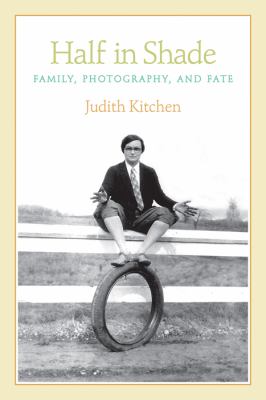
Half in Shade: Family, Photography and Fate by Judith Kitchen

This is a complex one. Judith Kitchen has inherited dusty boxes of old photographs, belonging to her family and stretching back over generations. Some of the black-and-white figures she finds there are labeled, or recognizable to her; but many are strangers. In a series of short pieces – meditations, essays, ramblings, experimental forms – she wonders over these photographs. Sometimes she uses her imagination to tell their stories; sometimes she uses research.

She is also being treated for cancer, and the narrative of surgery, chemotherapy, and radiation responds to the history she researches and creates. She plays with concepts. Every photograph has an unseen character, the one behind the camera; who was he or she, what did he or she see? In looking back into time, she can see both more and less than the characters in these pictures. They know one another, they know where they are, and oftentimes Kitchen does not. But she knows what Paris in 1939 has looming over it. She knows what will come.

My reactions to these pieces varied. Kitchen is a poet, and she wanders into a sort of free-form poetry that reminds me of abstract art: I understand that the people around me see and interpret a great deal that is hidden from me. I wonder if I’m not smart enough for the appreciation of this art. I like Kitchen best when she says what she means, playing with language a little along the way. The more abstract she gets, the less I comprehend. I don’t think my mind works the same way hers does.

But I like what she did with the idea of photography, the examination of light and exposure, the questions about how certain confounding photos (like the young woman surrounded by handled objects before a snowy lake) were posed, arranged, intended, carried out. I like what she did with history, and family history, and the uncertainties we have to accept. I love the artistry of this sentence:

The clapboard’s horizontal plane cuts through the outlines of their lives as they stand facing us across the intervening years, chance encounter that will fuse her rough pinked hem, his knot at ease, our own unbridled mysteries.

The homonym of knot, the rhyme of ease and mysteries.

Half in Shade is a complicated thing and contains many different opportunities to delve in. I’m not sure I’m up to it, at least not on my own. I think this is a class someone could teach for a whole semester. Recommended for people who understand and like Faulkner.


Rating: 7 second looks.

reread: Pieces of White Shell by Terry Tempest Williams

pieces of white shellThis memory from my childhood was every bit as good this time around. Terry Tempest Williams is a curator at the Utah Museum of Natural History in the early 1980’s, and in encountering Navajo people and their stories, she begins to learn her own natural history, her own and her (Mormon) culture’s connections to the earth, and how to find and tell stories herself. The tone is fanciful, but also grounded in the literal ground of her local environment in the Utah desert. In her first chapter, she shakes a small leather pouch out onto her desk and finds a sprig of sage; rocks, sand, and seeds; turquoise, obsidian, coral; pieces of white shell; yucca; a bouquet of feathers bound by yarn; coyote fur; a bone from Black Mountain; deerskin; wool; a potshard and some corn pollen; and the Storyteller, a clay figurine from Jemez. These objects, collected during her communion with people and place, form the chapters of her book. I’m not sure whether to call these stories or essays; they are both. There is an element of dreaminess: she is sure she heard the drums of the Anasazi, and tells of transforming into Flea to hide out and listen to the stories the animals tell on Black Mountain. These are not literal truths in the scientific world as we understand it. Does that make these stories fiction? Allegory? Spiritual journeys? I’ll leave it to you. I am not a spiritual person by any standard definition, but Terry Tempest Williams holds me in thrall. This book is still the one of hers that touches me most deeply.

I don’t know how many times I read this book as a child, but it clearly made a deep impression on me. Several lines echoed like I just read them yesterday, or like I’d copied them into countless margins and scrawled them in notebooks over the years. “How could I tell him the mind creates those things that exist. I couldn’t, and so I concentrated on birdlife to avoid a confrontation.” “No one culture has dominion over birdsong. We all share the same sky.” “If we all live, and continue to increase as we have done, the earth will soon be too small to hold us, and there will be no room for the cornfields” (says Coyote in one of the Navajo stories). And new lines jumped out at me on this reading. Because I’m working on processing my relationship with place: “Sometimes you have to disclaim your country and inhabit another before you can return to your own.” “Each of us harbors a homeland. The stories that are rooted there push themselves up like native grasses and crack the sidewalks.” Like all the best books, then, I’m continuing to discover it.

The stories Williams tells in each chapter of this book are from her life, living and working at the very four corners of the four corners states. A Utah Mormon, she gets to know the Navajo and their stories, and sees certain similarities between these two cultures which share a place. She explores Navajo stories and the storytelling tradition, the animals and plants and places they interact with, and uses these to map her own life; she explores story as tool for communication, history-building, and wise and respectful relationships with our earth, and its human and nonhuman inhabitants. In reading these stories, as a child, I was enchanted by the stories of animals like Coyote, Bear, and Badger, and characters like Monster Slayer and Child-of-the-Waters, who were twin sons born to Sun and Changing Woman. I learned about the flora and fauna of New Mexico and Utah deserts (quite exotic to me then, and now). In rereading the same stories as an adult, I get more of Williams’s search for answers about the world, about her family, her homeland, its significance, and her spiritual and cross-cultural questions. It is a rich experience.

My mother asks if this is a children’s book. I did first find it as a child and loved it then, in elementary school. Its origins in my family are unknown; I feel like it just appeared on a bookshelf. Someone must have bought it – for me specifically, it seems likely. I am an only child. But we don’t know. Neither of my parents remembers it. As it turns out, Pieces of White Shell is not marketed as a children’s book. But Williams worked with children (as well as adults) when she wrote it, and in the stories she tells. It is certainly accessible to a child, in its tone of wonderment and simple joy and careful observation.

This was published in 1984, and Refuge in 1991, and I can see some of the evolution. In Pieces of White Shell, Williams is still getting to know her world; in the later work, she more confidently moves in it and speaks of it, although she has retained her capacity for wonder (still alive and well in her recent retelling, The Story of My Heart). Refuge is also necessarily much sadder, as it studies personal loss while Pieces of White Shell takes pleasure in discovery.

Terry Tempest Williams was and is a remarkable, completely singular voice. “You always hear wings,” her family tells her in an anecdote in her prologue. I marvel, and I continue to learn from this deceptively simple grouping of stories. She is better known for other works but this is still my gold standard.


Rating: 9 coyotes.

Thunder & Lightning: Weather Past, Present, Future by Lauren Redniss

Superb illustrations accompany fascinating tidbits about weather and the world in this lovely, distinctive book.

thunder lightning

Lauren Redniss (Radioactive) offers a gorgeously rendered and singular piece of work with Thunder & Lightning: Weather Past, Present, Future. Her original artwork is stunning, dreamy and evocative, the perfect complement to facts about weather and carefully selected interview excerpts and quotations.

Redniss’s “Note on the Art” describes her media: copper plate photogravure etchings and photopolymer process prints, hand-colored, and a few drawings in oil pastel. She comments on the artistic tradition that inspired her: artist/scientists whose devotion to precision and accuracy have historically paired with “a sensation of strangeness, wonder, terror.” Her work is certainly worthy of that tradition; drawings of wildfires recall Picasso’s Guernica, and the chapter entitled “Sky” contains only striking illustrations and no text. These drawings are both otherworldly and very much of our world.

Redniss’s text, based on scientific research and cultural traditions, riffs on weather phenomena rather than offering a comprehensive study. Her chapters cover conditions (cold, rain, heat, fog) as well as concepts (dominion, war, profit), and span the planet and various peoples throughout history. She considers weather that has been blamed on witches or credited to gods; the use of cloud seeding as a weapon by the United States against Vietnam; and weather derivatives and insurance. Redniss’s subjects are quirky and entertaining; her chapter “Forecast” is as concerned with the Old Farmer’s Almanac as with the National Oceanic and Atmospheric Administration. That tone of marvel and whimsy, plus exquisite illustrations, make Thunder & Lightning both remarkably beautiful and pleasingly informative.


This review originally ran in the November 10, 2015 issue of Shelf Awareness for Readers. To subscribe, click here, and you’ll receive two issues per week of book reviews and other bookish fun!


Rating: 8 gorgeous interpretive hand-colored prints.

Wild by Cheryl Strayed (audio)

wildI took my time getting around to this, because I wasn’t convinced it was really worth my time. But I’m glad I did get around to it.

Then I took my time listening to it, because (as I’ve been saying for several audiobooks now), my listening time is much diminished these days by my lack of commute. In fact, after this one, I’ve decided to lay off audiobooks for a while except for long road trips.

Happily, though, Wild worked just fine with my slow pace and long breaks. The story Cheryl Strayed has to tell is that of her solo hike over much of the Pacific Crest Trail (PCT), at age 26, following a series of self-destructive behaviors and personal tragedies beginning with her mother’s death and including a divorce and a heroin habit. The chronology jumps around: we first see her late in her hike, when she loses her hiking boots; we then flash back to learn much of her history: her childhood, close relationship with her mother, her mother’s death and her struggles afterward. In part because of its episodic nature, it was okay to move into and out of this story over time. If I’d lost track of her momentary situation, I knew she was hiking the PCT and struggling somewhat; and in just a few seconds, I’d placed her again. Credit for this ease is also due, of course, to the engaging and memorable story she has to tell. Her mother is a sympathetic, interesting and engaging character; her brother, sister, stepfather and ex-husband are less developed but still present as individuals. Cheryl’s own voice is clearly portrayed, and while she frustrated me at times (only natural, I promise), she was ultimately absolutely a compelling, likeable and very real person.

Where Bill Bryon’s A Walk in the Woods was a little exasperating in its silliness, Wild achieves the right blend of humor and real struggle. She is definitely hapless; she has definitely made some serious blunders in getting out there on her own, with a wildly heavy pack, and no preparation. But she persists. She won my respect – I am tempted to say my grudging respect; call it semi-grudging – but better than that, she wins her own.

The writing is expressive, occasionally a little overwrought but only (I believe) as Cheryl was herself overwrought in those moments; it is descriptive and plain. I began to write that the writing is not the achievement of this book, that it is rather Cheryl’s distinctive story that carries it; but that’s not actually true or fair. The structure of this book, the pacing and order in which she reveals herself to us, are intelligently put together. The disordered chronology was carefully considered. The writing is not a straightforward narrative but includes metaphors and images that help bring the story to life. It’s more that the writing fades away and the reader experiences the story starkly: I forget I’m listening to a book and just see the journey unfold before me. This is indeed an accomplishment of writing, but it is an accomplishment of invisible writing rather than the decorative sort employed by Amy Leach, Brian Doyle or Terry Tempest Williams, which I also enjoy and which is easier to see.

I’m sorry for my earlier hesitation: pop sensation it may be, but Wild is also an example of fine writing, well-designed structure, and a hell of a story. I’m glad I studied it. Oh, and Bernadette Dunne’s reading on this audio edition felt like it captured the right voice, for me, of a young Cheryl Strayed. I happily recommend this format as well as this book.


Rating: 7 cold glass bottles of lemonade.

Refuge: An Unnatural History of Family and Place by Terry Tempest Williams

I am slowly, painfully discovering that my refuge is not found in my mother, my grandmother, or even the birds of Bear River. My refuge exists in my capacity to love. If I can learn to love death then I can begin to find refuge in change.

refugeWhen I read this book, I was continually reminded of the first Terry Tempest Williams book that I loved, as a child: Pieces of White Shell. I knew immediately that I would need to follow this book with a reread of that one. For me, Refuge is the more personal, more intimate, more grown-up and more exacting version of the kinds of things I found in Pieces of White Shell. I think I found this one more difficult, more thought-provoking and challenging; the other was both sparer, and offered clearer, more accessible comforts. Refuge is stripped, exposed pain. If there are balms for its wounds, they are more complex. Pieces of White Shell is metaphorical, symbolic, spiritual, seeking wisdom and humbly finding some of it; Refuge is bared emotions and loss. It is many birds. Each chapter is headed by the name of a bird – burrowing owls, killdeer, sanderlings, avocets and stilts, on and on – and by a level of Great Salt Lake.

Over the years in which the story of Refuge takes place, Great Salt Lake rises beyond its usual depths and boundaries. I learned in this reading that this Lake is shallow and covers a great area; therefore a few feet of rise can cover miles, and cause great destruction. Terry Tempest Williams saw her mother die of cancer as she saw her beloved Bear River Migratory Bird Refuge overtaken by saltwater, the birds displaced and many of them lost. In Refuge, she meditates on both losses and the relationship between them, how the Refuge offers refuge to her and to her mother, how they are linked – birds and women (clearly presaging her later When Women Were Birds), people and place (Terry’s Mormon family with the Great Basin and Utah), the cancer that runs in her family (“the clan of one-breasted women”) and their home (neighboring nuclear test sites).

Refuge involves nature, of course, and Terry educates us with precision about the birds she loves. It involves people, and society, and our interactions. It is beautifully written, with poetry, and with liberal gaps in which the reader may draw her own connections. Terry has an imaginative and generously interpretive mind, more so than mine.

The cancer process is not unlike the creative process. Ideas emerge slowly, quietly, invisibly at first. They are most often abnormal thoughts, thoughts that disrupt the quotidian, the accustomed. They divide and multiply, become invasive. With time, they congeal, consolidate, and make themselves conscious. An ideas surfaces and demands total attention. I take it from my body and give it away.

She finds wisdom in the world, as her mother and grandmother did; and of course, centrally, she finds refuge, which is not quite to say recovery or redemption, although those arguments can be made.

Terry Tempest Williams is a lovely writer. The story of her mother’s life and death, their relationship, and the difficulties and beauty of letting go, are all well accompanied by the pain and beauty of the migratory birds of the Great Basin that Terry knows well.


Rating: 7 phalaropes.

Things That Are by Amy Leach

Warning: raving follows. This is the best book.

THINGS THAT ARE by Amy Leach.Amy Leach’s Things That Are is a collection of essays that address creatures and natural phenomena, philosophy and the stars; they are as fanciful and wondrous and wondering as anything I’ve ever read, delightfully imaginative and fun to read, and illuminating. I learned facts and was made to consider concepts, and the package was unbelievably beautiful.

Amy Leach introduces her reader to beavers that “affably yield not”; music that sweeps you “juggled into its furious torrents, jostled into into its foamy jokes, assuming its sparklyblue or greenweedy or brownmuddy tinges”; peas that grow too tall to support themselves and must “grow madly wending tendrils, to sweep the air for lattices – just as teetery marionettes will grow marionette cords to sweep the air for marionetteers.” I marked many such quotations to share with you for their whimsy, their unique perspective, or their lingual tricks. Sometimes I failed and just noted that the whole essay should be studied and loved, as with “Talent” and “Warbler Delight” and “The Safari” and oh, the essay called “Pea Madness”…

Leach describes peas, which are self-contained until they grow tall enough that they must reach for external support. At this point she describes their tendrils, their reaching: your yearning, she writes, “can horse or unhorse you.” If you yearn for lattice and find one, you have won; if you reach not at all, you will lose; if you reach and find nothing, “your looking apparatus topples you over.” And some of us may have a lattice standing nearby, “installed with you in mind,” that we never find, although we come within an inch. The pathos! She writes that the yearning of peas is extrasensory: they do not know for what they reach; and

lattices are not the only things that are extrasensory. When you cast your small, questioning arms into the opaque universe, you may find a trellis to tether yourself to; or you may find a tree sticky with birdlime; or a snuffling piglet; or a trapeze artist swinging by who takes you for an aerialist and collects you – then alas, unless you have excellent timing and a leotard, you will be a lost cause.

This writing is funny and approaches our known world from a wholly unique angle; and its message is so powerful that I am nearly immobilized.

In “Silly Lilies,” Leach teaches us about gravitropic mutants, who send their shoots into the ground and their roots into the air, “like a demented boat that insists on sailing upside down, draggling underwater its silky sail.” (Yes, she wrote ‘draggling.’ Also ‘circumgallop,’ and ‘vasty,’ which she defines in her Glossary: “Has approximately the same meaning as ‘biggy,’ ‘hugey,’ and ‘giganticky.’ Do not let anyone tell you these words are not words; all words are words.” I think this is part of why she is compared to Lewis Carroll.) To describe lotuses in a windstorm, she evokes an image of slam-dancing hula girls. This is outrageous stuff. “Bluebirds defect, like bubbles and luck.” “Stars, like thoughts, are not inevitable.” I could go on. In “Twinkle Twinkle,” an essay from the section on “Things of Heaven,” she writes: “The incandescent cauliflower-ballerina is made of dust plus deep light; take away either ingredient and you have no celestial vegetables tripping the light fantastic in a laser tutu.” And I promise, in the context of the whole essay, this sentence makes perfect sense. It would take such a long quotation to illuminate to you that I would fear copyright violations; you should just go get a copy of this book yourself, and learn.

With all these playful poetics, I hope I haven’t given you the impression that Leach is only a whacky fun manipulator of language – because she is that, but she is much more than that. These essays examine and interrogate concepts larger than the ones we meet in everyday life. She forces her reader to question, and I have marked several of her passages to come back and continue to reflect upon.

I am smitten, you see. I found both the writing and the content perfectly formed and singular. Oh, and there are illustrations. I enjoyed the illustrator’s story of The Evolution of the Cover, and then, of course, this interview with Leach herself. And as my final bid to make you buy this book, listen to this lovely piece of work, in which Leach reads her essay “God” to a bluegrass accompaniment.

Best book of 2015, obviously.


Rating: 10 fireflakes.

“Where the Heart Was” at You Are Here Stories

Back to You Are Here Stories today for another short piece of my creative nonfiction writing. Thanks for checking it out! If you have comments, please consider leaving them there instead of (or in addition to) here. Many thanks.

Teaser Tuesdays: Refuge by Terry Tempest Williams

Teaser Tuesdays is a weekly bookish meme, hosted by MizB of Should Be Reading.

I am pleased to have found the time, finally, to pick up more work by Terry Tempest Williams. Refuge is her well-regarded memoir of her mother’s life and death within the region of Great Salt Lake, in Utah.
refuge

Today I chose a few lines that not only tell succinctly what this book is about, but speak to me personally as I work through my own relationship to place.

Most of the women in my family are dead. Cancer. At thirty-four, I became the matriarch of my family. The losses I encountered at the Bear River Migratory Bird Refuge as Great Salt Lake was rising helped me to face the losses within my family. When most people had given up on the Refuge, saying the birds were gone, I was drawn further into its essence. In the same way that when someone is dying many retreat, I chose to stay.

I am, of course, very excited about this book, as Terry Tempest Williams consistently impresses me. I am also already planning to reread one I loved as a kid: Pieces of White Shell. So look out for that one to come.

book beginnings on Friday: Things That Are by Amy Leach

Thanks to Rose City Reader for hosting this meme. To participate, share the first line or two of the book you are currently reading and, if you feel so moved, let us know what your first impressions were based on that first line.

I am fairly certain that it was Hali Felt, author of the outstanding Soundings, that recommended this book. I’ve had it on my shelf for years, and am so glad now that I have finally gotten around to reading it.

THINGS THAT ARE by Amy Leach.Things That Are is already sort of blowing my mind, and feels right up my alley: fanciful, dreamy, but also very rooted in the real world; whimsically lovely writing. I’ve only just begun, so stay tuned for the review: we’ll see if it sticks. But for now, wow. It begins with a chapter called Donkey Derby:

Usually all we have to do when we go a-conquering is build a boat, find a benefactress, recruit a ribald crew, and wear radiant glinting helmets. With these four easy steps my kind has conquered far-away lands, and seas and moons and molecules.

And I have the impression she will mine all those fields, that is, far-away lands, seas, moons and molecules (and maybe some of the implications of going a-conquering, too). Let us hope.