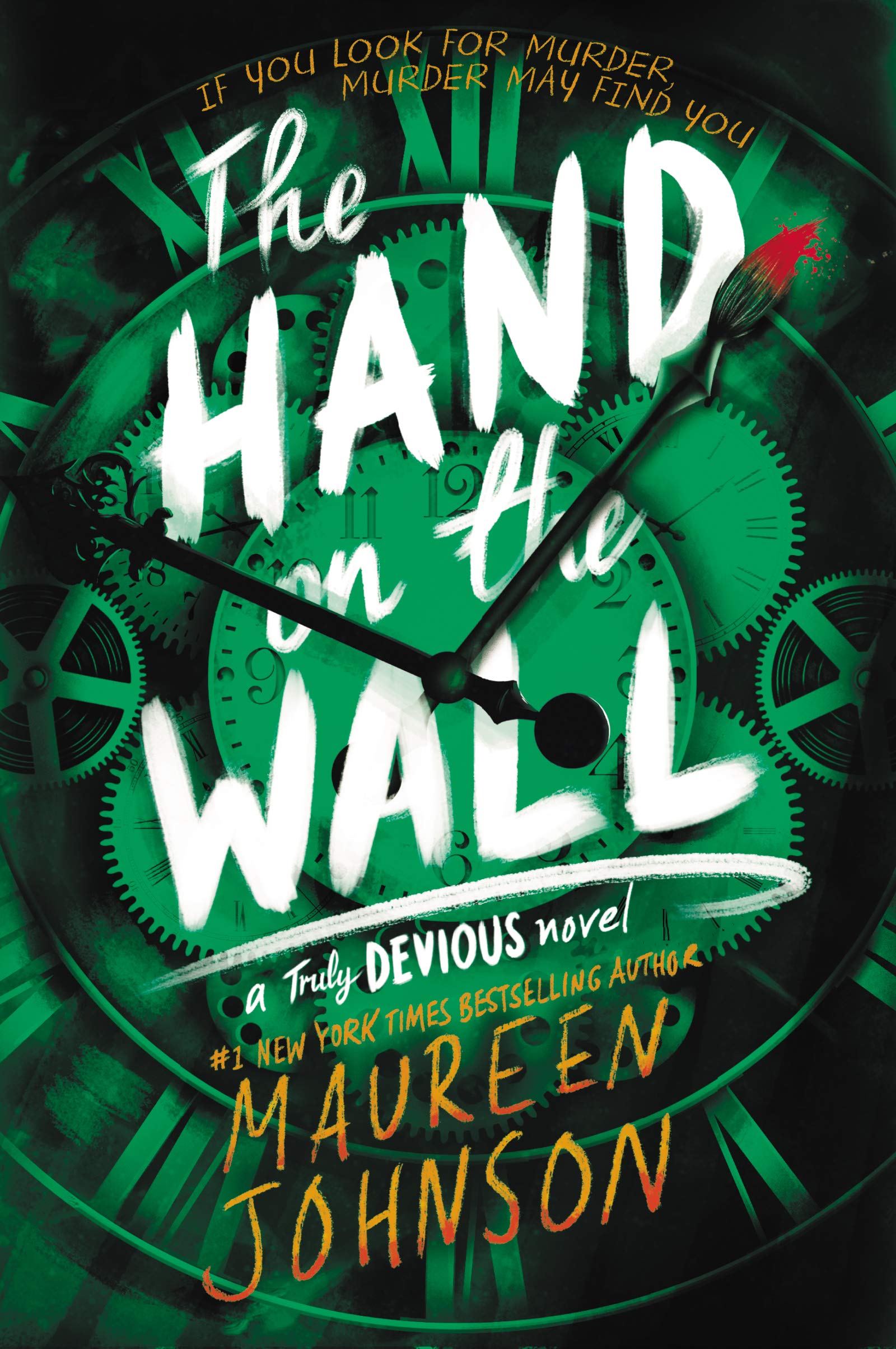
The Hand on the Wall by Maureen Johnson

On a day that I claimed to be overwhelmed with the student papers I had to grade, I also managed to wake up and immediately begin this book… and then stay up til midnight finishing its nearly 400 pages in the same day. I loved Truly Devious and was even more entranced by The Vanishing Stair, which annoyed me with a cliffhanger the night before and sent me directly into this one, book three. My main goal today is not to read a whole book by accident when I’m supposed to be working.

The Hand on the Wall is book three of three in the Truly Devious series – but the Stevie Bell series continues for two more books, a bit confusingly. The Truly Devious murders themselves (aka the crime of the century, the murder/kidnapping at Ellingham Academy in the 1930s) are wrapped up in this book, but newly minted detective hero Stevie apparently continues on. (I haven’t read book four yet! I’m staying strong.) This installment sees the advancing of Stevie’s investigations and her modest decline in terms of personal hygiene and nutrition; the beginning of real fears for her personal safety and/or that Ellingham may indeed be cursed; the continuing friendship and alliance with Security Larry (this is a relationship I have really enjoyed in two books now); and the bumpy evolution of Stevie’s match with the troubled David. I said in my last review that getting to know him a bit better would yield more sympathies, and we do get that here. I still find him a bit obnoxious and don’t appreciate his treatment of Stevie, but they’re making progress.

Stevie grows in her relationships with others. A bit weirdly, the amazing Janelle continues to be identified as Stevie’s best friend, but our hero actually spends more time talking with and confides more in Nate, a hilariously Eeyore-like blocked writer. Janelle is a great friend, but involved in her own love match (that’s going more smoothly than Stevie’s), and it’s actually Nate who ends up fulfilling a day-to-day best-friends role. We have a new friend as well, Mudge, who is loveable if a bit of a cariaciture: he’s here to exhibit exactly how drolly eccentric Ellingham students can be.

Mudge was Stevie Bell’s lab partner–a six-foot-something death-metalhead who wore purple-colored contacts with snake pupils and a black hoodie weighed down with fifty Disney pins, including some very rare ones that he would show off and explain to Stevie as they dissected cows’ eyes and other terrible things for the purposes of education. Mudge loved Disney more than anyone Stevie had ever met and had dreams of being an animatronic Imagineer. Ellingham Academy was the kind of place where Mudges were welcomed and understood.

Security Larry, mentioned above, is a former police detective and becomes a mentor to Stevie in her own work, both cautioning and trying to enforce the rules upon her and gradually, increasingly, viewing her as a peer. He’s great. Several other faculty members develop as well. I very much related to poor Dr. Quinn trying to convince her students to do the readings before class.

I love Stevie more and more. She “would rather eat bees than share her tender inner being with anyone else–she didn’t even want to share it with herself.” She undergoes an actual epiphany (pages 108-109) when she realizes that her weird, awkward self is just a perfectly fine version of a human, and that her own unique combination of qualities is precisely what’s gotten her where she is in life; this is a passage I would like to share with everyone I know, but especially young people and especially girls just making their way and finding themselves. I would follow this protagonist anywhere.

As befits the final book in a trilogy, this one ends on a note of triumph, closure, and hope – perhaps a bit neatly tied up, in fact, but I know there’s another Stevie Bell book to follow. Again, for the sake of my sleep I’m taking a day or two off, but expect more any time now. Maureen Johnson is my new favorite. Thanks again, Liz.


Rating: 9 moose.

The Vanishing Stair by Maureen Johnson

Book two of the Truly Devious series flew by. I stayed up late to finish this one and it ended on a serious cliffhanger, so look for my review of book three to follow this one immediately.

At the close of Truly Devious (for which there are mild-to-moderate spoilers here), The Vanishing Stair opens with Stevie glumly returned home to her parents’ house and her public high school. The gamechanger comes quickly in the form of the despicable Senator Edward King, her parents’ hero and employer and (surprise) the father of her love interest from Ellingham Academy. King has arranged everything for Stevie to return to Ellingham – funding the trip, heightening security following a student’s mysterious death, and convincing her parents of her safety. He wants Stevie, in return, to keep an eye on his wayward son David, with whom Stevie’s not on particularly good terms anyway. She’s thrilled to be back at the school where she feels stimulated: with her friends Nate and Janelle again, working on her life’s greatest passion, the solving of the 1930s Ellingham murders, and yea, David. Quickly a second body is added to the modern Ellingham count. Stevie gains a new advisor, an eccentric academic from the local (Burlington, Vermont) university with a drinking problem and a very nice nephew. David’s moods and attitude toward Stevie continue to swing wildly, hot to cold to nuclear.

The best thing about these books is Stevie herself. She’s socially awkward but mostly doesn’t care; she’s occasionally bothered by her inability to fit in back in the ‘normal’ world (of which Ellingham is not part), but only when she remembers. Despite sometimes showing signs of a standard teenager’s low self-esteem, she generally carries on as herself, unbothered. I like her. She’s an extremely focused detective – perhaps to the point of mild self-neglect, but that’s part of a long tradition of detective types in fiction (a fact she’s aware of). Johnson’s prose is downright funny: after camping out overnight in the school’s yoga studio, Stevie “felt a waffle pattern of yoga blanket on the right side of her face and the faint smell of lavender and patchouli permeating her being. It was like she had been run over by a boulder made of hippies.” Our young hero can be a little bumbling and dense – just like a teenager, no matter how smart. I have a little less patience for David’s antics, perhaps in part because he’s a rich boy? but mostly, I think, because we don’t have the close third person window into his interior self that we have into Stevie’s. He’s a suffering kid, too, and I think if we got inside his head it would be just as sympathetic as hers.

The mystery plot remains compelling: this book focuses in on the riddle that Albert Ellingham left behind on his final day, which the title of this book nods to. We’re learning things, about the historic murders as well as the modern suspicious deaths, but not the big final thing we want to know. Again: this one ends on a mad cliffhanger; I was actually a little peeved, and even more relieved that I already had book three ready and waiting. I recommend you do the same.

Liz was (as ever) 100% correct about this one. I’m pretty sure she said she ripped through the whole series, as I am clearly going to do as well.

These books are recognizably YA in a few ways: teenaged protagonists, a gentle handling of gore, violence, and sexual content, and humor. But the plotting is not too simplified for adult readers to enjoy, and a strong female lead who is still in her teens appeals to this reader at any age. I’m a fan.


Rating: 8 cats.

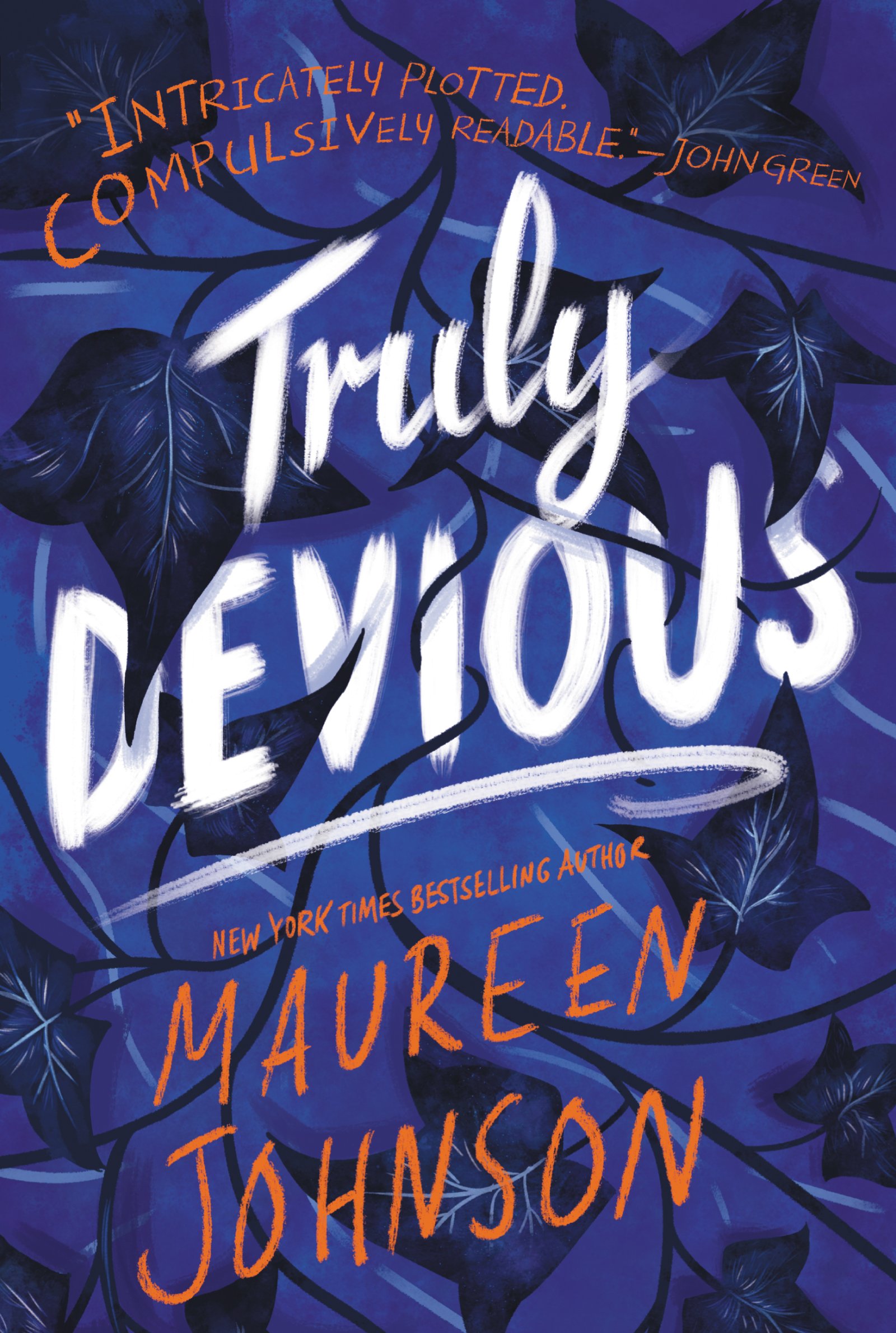
Truly Devious by Maureen Johnson

Yet another gem from Liz, Truly Devious is a positively delightful piece of fun (that also involves murder). It’s for young adults, but easily well-written enough, and sufficiently funny and clever on a few levels, to please adults (like Liz & me).

There are two timelines, although we spend the bulk of the book in one of them. First, in 1935, a teenaged genius is lucky enough to be plucked out of her New York City public school to attend a special new educational experiment in the mountains of Vermont: Albert Ellingham, major mogul, has established the Ellingham Academy to let kids like Dottie pursue the joys of learning in their own ways. Unluckily, a year later, Dottie is murdered at the idyllic Academy, apparently a bystander in a plot to kidnap for ransom Albert Ellingham’s wife and daughter. Readers get a glimpse of Dottie’s final moments, but her assailant is unnamed, undescribed, and genderless.

Much later, more or less in contemporary times (I didn’t notice a year for this timeline?), another teenaged girl is also delighted to be admitted to Ellingham, not despite but because of its murderous history. Stevie Bell, of Pittsburgh, is crime-obsessed: she hopes to become a detective, ideally for the FBI, and the Ellingham Academy murders are her dearest project. The remains of Iris Ellingham (Albert’s wife) were found as well as Dottie’s, but the body of young Alice Ellingham, aged four at the time of her disappearance, has never been found; technically Alice is Stevie’s host and educational benefactor in absentia. Socially awkward Stevie arrives at Ellingham determined to distance herself from her parents (who love her but do come off rather obnoxious, especially with their unfortunate political leanings), begin a new chapter in her life, maybe finally make some friends, and – most importantly – solve the biggest best crime she knows. Each of these goals will turn out to be ambitious, but Stevie is both smart and scrappy. She easily pairs up with Janelle (who hails from Chicago and excels at building machines and gadgets) and establishes a harder-won friendship with even more socially awkward Nate (a published and thoroughly writer’s-blocked novelist). Their dormmate Ellie is a free-wheeling artist who both impresses Stevie and makes her nervous; there is also a famous and spectacularly handsome filmmaker/actor (who however seems not very smart), and a mysterious boy named David who both attracts and repels Stevie.

While we check back in with 1936 (investigation, trial of an apparent straw man, Ellingham’s grief), the modern timeline dominates. Stevie is both a fine amateur detective (in a long literary tradition) and a teenaged girl, grappling with hormones, friendships, school, the sandpaper grip of her parents, and other challenges that will be familiar to all readers, not just those with true crime obsessions and unusual educational settings. By nature of having a female lead, Truly Devious involves some girl-empowerment messaging, but like its handling of nonbinary genders and queer characters, this messaging is simply built into the story, not A Point To Be Made.

Was this was pretty was?
Who knew. This was what a Stevie was, anyway.

Stevie and her friends are lovable above all; also smart, bumbling, funny, painfully awkward, and pleasingly eccentric. There is everything to enjoy.

I finished this book having just ordered book two but it wasn’t here yet and I felt a real sense of loss. I expect to burn right through books two through five, so look out for more Stevie Bell.


Rating: 8 poles.

Brutes by Dizz Tate

A group of 13-year-old girls tries to deal with another teenager’s disappearance alongside their own coming-of-age in an unattractive Florida town beset by increasingly adult threats.

Dizz Tate’s first novel, Brutes, is set in Falls Landing, Fla., a small town formed of theme parks, mall food courts, gated communities and swampland. At its center is the mystery of a missing teenage girl, and the group of younger girls who adored her: the narrative voice is the unusual first-person plural “we,” which perfectly suits a girlhood of conformity and togetherness. The 13-year-old narrators yearn for individual recognition but also fear separation. Their collective voice slips into the singular only when the girls speak from their adult perspectives, looking back. This narrative “we” contributes greatly to the haunting atmosphere of a story about loss, secrets and the costs of growing up.

“Where is she?” the girls imagine Sammy’s parents asking the morning after her disappearance, and this question will echo. They worshipped, followed and watched Sammy on the nights when she climbed over the wall of her exclusive community to meet her boyfriend, Eddie; they share her love for Eddie and, after she’s gone, shift to attach themselves to Sammy’s best friend and rival, Mia. “We wanted to be like them, to become ever louder and brighter, but we could feel their futures slipping through our fingers, because we were not stupid.” Sammy and Mia had both been affiliated with Star Search, the local talent agency, and everyone in town wants to be selected, to be seen as special, to be given a business card or a plane ticket to L.A. “We squashed our faces against the glass of our own lives. Is this it? we asked. Are we having fun like they have fun? Are we in love like they are in love? We filled up our days following them, watching them, waiting to be invited in.” The girls come from the apartment towers of Falls Landing, not the desirable neighborhood behind the white walls that they watch obsessively. Their mothers are harshly portrayed with both love and derision by the daughters they call “brutes” for their childish cruelties.

Brutes offers stark and unlovely characterizations, but with moments of striking beauty. The girls (and their mothers) are grasping, even desperate, but capable of compassion. Tate’s Florida is steamy and thickly rank, with blinding sunlight and shadowy depths, not least in the lake that many residents believe houses a monster–maybe the monster that took Sammy, although the human monsters in this community are plenty sinister. This is a dark coming-of-age tale and meditation on childhood and the cusp of adolescence: authentic, often grim, but with glimmers of hope.


This review originally ran in the December 16, 2022 issue of Shelf Awareness for the Book Trade. To subscribe, click here.


Rating: 6 fire ants.

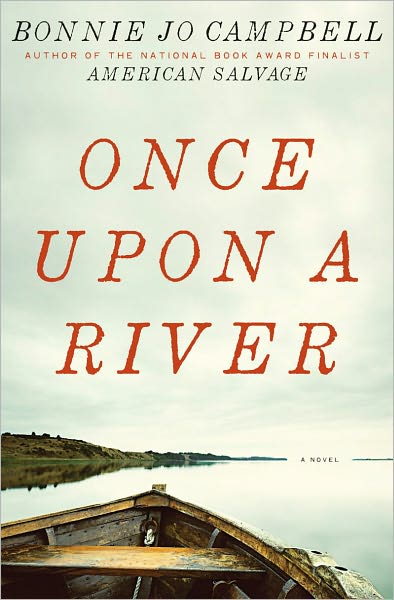
rerun: Once Upon a River by Bonnie Jo Campbell

Pulled from the depths of October 2011, please enjoy this rerun review.

Once Upon a River is a beautiful book. The story is not joyful, let me say that right off. But it’s beautifully wrought, and in fact, when I finished it and stepped back and viewed it as a whole, I decided that the story has a certain beauty, too. A sad beauty, but a beauty that’s true to life.

This is the story of Margo. She grows up in a little town on the Stark River in Michigan, hunting, fishing, and living and breathing the river. She is close to her grandfather, and lives in the outdoors; school and social situations are difficult for her. She’s a very skilled outdoorswoman, and an especially good shot; Annie Oakley is her hero. Bad things happen. Margo’s mother leaves, and as her situation further deteriorates, she takes off upstream in the boat her grandfather gave her to look for her mother. Margo lives off the land and the river, mostly. She makes a few alliances but they all fall apart. People and relationships are not as reliable as the river and the outdoor world in which she feels safe and comfortable. More bad things happen. She grows up some, learns about people, and learns more about the natural world. She moves upstream and downstream, learns how to survive with her hands, a few tools, and her skills, along the lines again of Annie Oakley (she will eventually own two biographies, among her few prized possessions).

This story is painful in more than a few spots. Plenty of bad things happen, including several rapes and quite a bit of death. There’s no shortage of young people having sex, to which your reactions may vary. (Consensual? In itself a “bad thing”?) You will cringe. But like many books that are both sad and realistic, the cringing might be worth it. Margo’s story actually looks skyward, hopefully, at the end. She finds and makes some good things, too.

Campbell has full grasp of metaphor. The river flows on, and Margo learns its rhythms, and how to assert herself while following its current. She finds the river to be a more constant (if not predictable) force than human nature. Campbell has full grasp of language, too; she writes beautifully, lyrically, symbolically. In the end it’s a gorgeous book and I recommend it wholeheartedly. So, to recap: bad things happen, but beautifully. It’s a book about life.

I shan’t attempt a retrospective rating at this distance of more than eleven years, but I still remember this one fondly.

Factory Girls by Michelle Gallen

Amid the Troubles in Northern Ireland, a scrappy young woman comes of age in this inspiring, humorous and moving novel.

With Factory Girls, Michelle Gallen (Big Girl, Small Town) delivers a heartrending, funny, blistering and beautiful novel of foreboding and hope. In the summer of 1994, Maeve Murray and her two best friends are on the cusp of escaping their small Northern Irish town for bigger, better and safer things. Maeve is a child of the Troubles: “neighbours shooting neighbours was just the way things had always been for her.” She comes from a poor Catholic family and has been taught to expect little, but she has hopes that her exam results will move her beyond the background that, in her world, defines her. “Nobody as poor as Maeve could afford to have notions about herself. Which was why she treasured them.” Maeve and her friends Caroline and Aoife find summer jobs at a shirt factory in town, hoping to save a bit before going away to college. Exam results loom all summer, in this novel organized by a countdown beginning “74 days until results.”

Caroline has a loving family, and Aoife is downright privileged compared to Maeve’s rather stark upbringing, not only in poverty but with the death of her sister (unexplained for much of the novel) shadowing all her family’s interactions. “Maeve sometimes wondered if [her sister]’d still be alive if she’d failed and stayed in the town.” Factory work is a bit of a miracle in this depressed town, but it comes with unforeseen challenges, like working alongside Protestants, while outside the gates a never-ending war of retaliation is played out by paramilitary groups on both sides. Maeve worries about losing her kneecaps or her life before she ever makes it to London. “The news reports had said the children were ‘lucky,’ for despite being packed together in the parish hall, they’d received only minor injuries…. She didn’t feel lucky when she felt the slap of the explosion.” Alongside wrestling with grueling work making shirts that nobody she knows can afford and fending off her slimy English boss, Maeve will find still greater challenges spring from the factory floor. “It was the factory workers–both Prods and Taigs–who were at the bottom of a very long and merciless food chain.”

Factory Girls takes on class, corruption and the Catholic/Protestant and English/Irish divides; gender and labor rights; female friendships; family disappointments; the specter of opportunity and the puzzle of how to transcend one’s roots without leaving part of oneself behind. This may sound like a heavy, ambitious group of subjects, but Gallen draws delightful, richly rendered characters and imbues her narrative with a vernacular voice that will charm readers and keep them firmly rooted in time and place. This novel is as hilarious as it is heartbreaking: not to be missed.


This review originally ran in the October 25, 2022 issue of Shelf Awareness for the Book Trade. To subscribe, click here.


Rating: 8 crisp sandwiches.

Yolk by Mary H. K. Choi 

This review from Shelf Awareness prompted me to buy and read this book, and it delivered. I felt fully involved and invested in the lives of Jayne and June Baek, Korean-American sisters born in Seoul and raised in San Antonio, Texas, now living as young adults in New York City. They haven’t been close for years, and now Jayne (our first-person narrator) avoids her sister’s phone calls as she does their mother’s, until June tracks her down on a disastrous third-wheel date and demands they meet. June is very sick. Outwardly, Jayne is the sister with more obvious problems – self-loathing, squalor, harmful sexual practices, generally low functioning as an adult (and some more serious issues that are only gradually revealed). Now that they are sharing increasing challenges, the estranged sisters might just come together again.

As an only child, I have always been fascinated by siblings, whose various dynamics I can only watch from outside, generally with jealousy. One of my favorite things about this novel is its intimate, insider look at the sisters’ relationship, which is troubled (but aren’t they all), love and dislike intertwined with violence and yearning. One of Yolk‘s great strengths overall is immediacy and intimacy, how close we feel to Jayne, in all her messes and flaws. I also really appreciated the writing about place. New York feels right to me, but what do I know; brief sojourns home to San Antonio I am in a better position to judge, and I think Choi (who shares geographical background with her characters) gets it just right. The humid night air and the big skies make me a little homesick, too. The tone of young twenty-somethings dealing with all the madness of life feels pitch-perfect.

Choi includes a brief note at the book’s beginning about some difficult subject matter, acknowledging that she shares some of Jayne’s difficulties and that “for those struggling with body image and food, this story might be emotionally expensive for you.” I had to pause at that phrase, emotionally expensive: I like it. “Sensitivity is a superpower,” Choi instructs us. It is not a novel with an overt message, but I appreciated this one.

I also need to note the loveliness of this hardback book as a physical object: I love the design, the dust jacket, what’s under the dust jacket, and the print on the edges of the pages that continues the image on both dust cover and hardcover. It’s a beautiful piece that feels good in the hand and I’m glad to own it.

Sensitive, funny, raw and often painful – I worried a little early on that I’d taken on something sadder than I needed at this time. But Yolk is a beautiful book about love and hope, too, and with a thread of unlikely romance to it as well. I found it delightful and do recommend.


Rating: 8 glasses of water.

Gone to the Woods: Surviving a Lost Childhood by Gary Paulsen

I had not thought of Gary Paulsen in years, until I saw the Shelf Awareness review of this new book. (Hat tip to my colleague Jen Forbus for that review.) Paulsen might have been the first author I really fixated on; I remember setting out to own all his books, and while I didn’t get very far (maybe six or eight of them), I’m pretty sure I wrote “Julie’s Gary Paulsen library” or some such inside the cover of each one, and had them set up on their own little shelf. Early signs of something, there. My favorite was Hatchet, of course, and its sequel; and I vividly remember a scene from the beginning of another book where the narrator watches a… chipmunk? eating another creature, blood down its front… what book was that?

Anyway – when I saw that he’s returned with a memoir of his own childhood, I was sold. And let me tell you. This book had me entranced from the opening lines. I wept.

Gone to the Woods has an innocence and a simplicity built into its writing style and the value system, I think, of its narrator. This makes it accessible to younger readers, but not at all to them alone. I think this is a memoir for everyone. Paulsen tells his story in the third person, calling his protagonist only ‘the boy,’ although the name ‘Gary’ is used once or twice by other characters. This helps to give the boy an elemental quality, like he’s sort of an archetypal boy, although his story is very specific. When the book opens, he is five years old, living in Chicago with his mother in 1944. She has a factory job, and coming from a small farm in northern Minnesota, is “not even remotely prepared to resist the temptations of the big city.” She lives in the bars and does not parent her small son, who she’s trained to perform for the men who try to win her favor. Grandmother hears of this lifestyle and is “critical, then concerned, and finally… past horrified and well into scandalized.” Her solution colors the boy’s method of problem-solving for life: “If it doesn’t work Here, go over There.”

The first adventure of the book, then, is the five-year-old boy’s solo journey by train from Chicago to International Falls, Minnesota. This takes several days and involves a train absolutely jam-packed with severely injured soldiers, smelling of and oozing pain and death, so that the boy is physically ill from it all – because didn’t I say, his father, who he’s never met, is a soldier off in the war. The boy becomes stuck in a train toilet, among other things, and observes out the train window the woods that will become his sanctuary. By the time he arrives at his aunt and uncle’s farm he is wrung out with exhaustion, trauma, and confusion. But the farm will be a perfect place for him, the first place he feels he belongs, is valued, is taught. He’s given his own room and bed. It’s lovely. Then it’s taken away from him.

I’ll stop summarizing here. The boy’s upbringing is one trauma after another, including a few years on the streets of American-occupied Manila, and a continuing absence of parental concern. I appreciate that the narrator is slow to judge his parents, and I think it would have been easy (narratively speaking) to be ugly about the mother’s drinking and many boyfriends, for example, but neither the young boy nor the adult man who writes these lines takes that easy road. (At least until the teenager’s perspective, at which point he thinks of both parents as vipers. But this is about the damage they do to him, rather than some puritanical judgment of mom’s moral choices.) He is an unjudgmental creature in general. Paulsen is wonderfully good at the innocent child’s perspective, elements of which are present in the teenager too.

Trauma after trauma, but with a few bright points, like the aunt and uncle in the Minnesota woods, and a saintly librarian when he is thirteen years old who makes him a gift of notebook and pencil, for whom this book might be considered a gift in return. And the woods and rivers and streams, which are always a bright point. From age five, the boy learns that the woods will allow him to take care of himself, even when he lives in a city again, keeping to the alleys and nights to avoid bullies, and escaping to the stream where he can fish for food or shoot squirrels and rabbits when his parents fail to provide for him. Even in Manila, a city of a certain sort of trauma (truly, the violence and death this child witnesses by his sixth birthday is unfathomable), he finds beauty and human kindness.

At times the events were hard for me to take in, and I wondered if younger readers were really the right audience for this. But on reflection, I think Paulsen offers just enough. I think children might take away what they need from this book – I’m no proponent of censoring life’s pains from kids – and it’s the adult mind and perspective that makes it even harder to read, if that makes sense.

The story is harrowing but also lovely, always riveting, and an important testimonial from a generation that we will eventually lose access to. It is excruciatingly beautiful in how it’s told. The immediacy of traveling with the boy is heart-rending and direct. I can’t imagine how this book could be improved upon.


Rating: 10 willow branches.

How to Order the Universe by María José Ferrada, trans. by Elizabeth Bryer

Through a child’s clever but innocent point of view, this inventive debut novel considers family, hope and the harsher realities of 1980s Chile.

María José Ferrada’s How to Order the Universe offers an imaginative view of Pinochet-era Chile through a child’s eyes, as she assists her father in his work as a traveling salesman of Kramp brand hardware items. The world appears complex, fascinating and a little magical to M, the narrator. Elizabeth Bryer’s whimsical translation from the Spanish feels appropriate to M’s exceptional perspective.

Ferrada’s playful, poignant novel opens with the story of a young man named D, whose “first sales attempt happened the same day a man took a step on the moon.” He meets a beautiful woman. They marry and have a child, M, and so the narrator enters her own story. She begins accompanying D on his sales calls when she is seven. M’s school attendance is sporadic; her work as D’s assistant is important to both of them, and M’s mother is a bit detached. Father and daughter are close, in their dreamy interactions with each other and with a small community of salesmen and shopkeepers. She is treated as a small adult: “in recognition, I think, of the fact that I had grasped the complexities of human beings at such a young age, D showed me how to blow smoke rings. Small rings that crossed the city, expanding and dissolving in the distance.”

M’s narrative voice is solemn, serious. She is a little obsessed with categories and classification. D’s understanding of the world, and therefore M’s as well, involves hammer, nails, the moon and stars. “Every person tries to explain the inner workings of things with whatever is at hand. I, at seven years of age, had reached out my hand, and had grasped a Kramp catalogue.” She studies the organization of items for sale in shops: “I thought that discovering the sequence would bring me a little closer to comprehending the classifications used by the Great Carpenter to order the universe.” M is a precocious philosopher, but also a child, for whom certain realities eventually come as a surprise. When the family circumstances unexpectedly change, “There were two possibilities: A. Precariousness had always been with us, and I’d never noticed. B. Something had changed. Whichever it was, my childhood memories fractured: crack.”

How to Order the Universe is fanciful, sweet and moving, as M gradually registers and questions the changing world she inhabits, wrestling with violence, absence, the ability to make one’s own luck “with well-shined shoes and the right outfit.” Much of this evolution is filtered through her irrevocably changed relationship with D. “We had been deeply united by a catalogue of hardware store products: nails, hammers, door viewers, screws. But that catalogue no longer existed.” This is a beautifully translated, thought-provoking novel of profound themes and childlike wonder.


This review originally ran in the February 8, 2021 issue of Shelf Awareness for the Book Trade. To subscribe, click here.


Rating: 7 door viewers.

We Run the Tides by Vendela Vida

An uncertain adolescent girl narrates a heart-aching tale of coming of age in a city in transition.

We Run the Tides by Vendela Vida (The Diver’s Clothes Lie Empty) is a dreamy, tricky tale of girlhood, secrets and the shifting sands of truth set in mid-1980s San Francisco. This captivating coming-of-age novel asks readers to consider friendship, cruelty, deception and consequences.

Narrator Eulabee begins her story with the first-person plural point of view. “When I say ‘we,’ I sometimes mean the four of us Sea Cliff girls who are in the eighth grade at the Spragg School for Girls. But when I say ‘we,’ I always mean Maria Fabiola and me.” The foursome is close, but it is beautiful Maria Fabiola who enraptures Eulabee and, apparently, everyone else–children as well as adults–in their rarified world. Theirs is a neighborhood of au pairs, chauffeurs and views of the Golden Gate Bridge. “Sea Cliff is for solitude, for when you want to protect yourself from people.” Bad things still happen here, but the community handles them in whispers, while looking away.

Earnest, awkward, devoted Eulabee is perhaps less polished than her friends, or perhaps it only seems so because readers are privy to her insecurities. The trouble begins when she and Maria Fabiola fail to see a minor event in the same way, literally. Did Eulabee miss a small, important detail? Or did Maria Fabiola make it up? The truth almost doesn’t matter; what matters is that the girls are equally firm in their divergent truths. An insignificant moment snowballs until Eulabee’s world is shattered. Lives may be endangered; the foursome disintegrates; nothing will ever be the same again. “I stand there, on the cusp of the ocean and listen to its loud inhale. And then it recedes and takes everything from my childhood with it–the porcelain dolls, the tap-dancing shoes, the concert ticket stubs, the tiny trophies, and the long, long swing.”

We Run the Tides is an enchanting, literary novel, realistic but a little unreal. Vida gives a tender, incisive portrayal of adolescence. The girls’ cruelties are visceral and impermanent, the stressors of Sea Cliff somehow both superficial and profound. Decades later, the events of 1984-85 remain “part of the lore. The newspapers called what happened the Sea Cliff Seizures,” and in adulthood, Eulabee both has and has not outgrown them. Her friends and classmates have moved on; San Francisco has changed. “Symphonies of tiny violins play themselves to shreds.” And Vida’s readers will be changed, too, by this cleverly woven story about honesty, betrayal, charm and illusion, about what matters in youth and what matters always.


This review originally ran in the January 26, 2021 issue of Shelf Awareness for the Book Trade. To subscribe, click here.


Rating: 8 text messages.