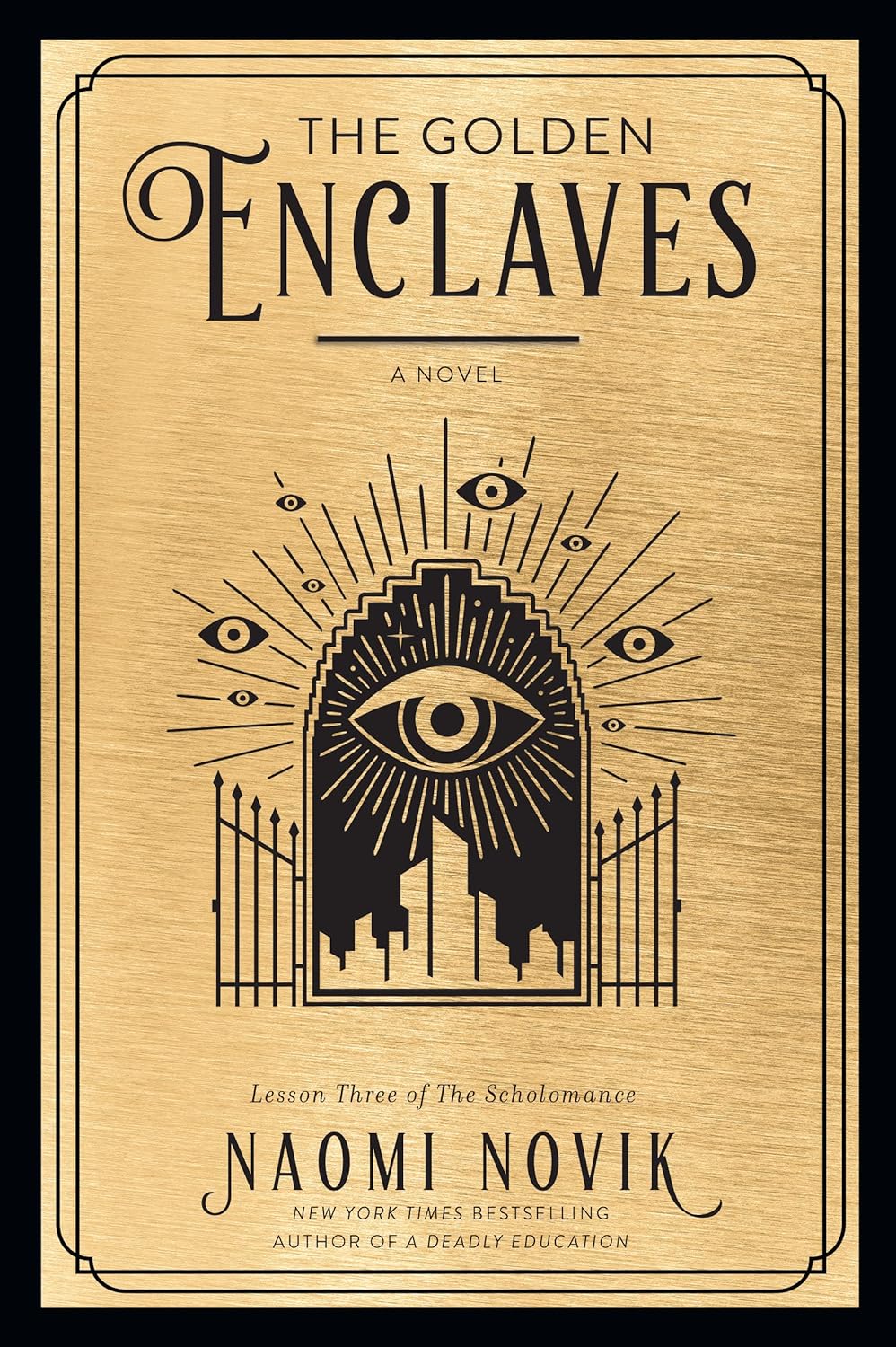
The Golden Enclaves by Naomi Novik

**Spoiler-Free!**

Following A Deadly Education and The Last Graduate, The Golden Enclaves wraps up the Scholomance series. I am very pleased with this conclusion and the whole series. For spoilers’ sake, this review includes practically no plot summary.

As a series finale, The Golden Enclaves takes on a lot, and involves a ton of action, ranging very widely in the ‘true’ geographic world as well as in the void and the magical spaces that populate Novik’s imagined world. A number of characters take great steps; this is indeed a coming-of-age for El, who has graduated from the Scholomance and achieved some real victories, but only to step out into a larger world where the monsters are decided not all neatly taken care of. She’s suffering some losses, not least in realizing the limits of her powers: she is one of the most powerful wizards ever, but there are still limits. We see her take less advantage of the friendships and alliances we’ve seen her form up til now, but also find news ones and/or revive some that have lain dormant.

I love about this whole series that it offers commentary on class divisions and the ethics of who gets to be safe and cared for in the world. Those themes are strengthened here, and complicated. There is a very pointed conflict of interests that she calls a trolley problem, of the highest order; El must face that she cannot (so to speak) save them all, that every choice has a cost. In the face of this frustration, she wavers, considers giving up. We have learned that El is incredibly strong and strong-willed; she doesn’t give up easily. But we have also never seen her tested like this.

I love the characters, including one or two who are still ‘rising’, coming to center stage. I love El herself so dearly; she struggles so hard with this book, even after having accepted help and friendship, and her struggles often yield some good snarky humor and fun amid the pathos. Novik has enormous world-building power, which was evidenced at the series’ start but is still at play here, because our understanding of the world (and El’s understanding of it!) must expand considerably in this book. I’d recommend her to anyone.


Rating: 8 bricks.

The Other Valley by Scott Alexander Howard

Alongside her coming-of-age, a teenaged girl must wrestle with when it is appropriate to influence the past and the future in this remarkably imaginative debut.

Scott Alexander Howard’s first novel, The Other Valley, is a lyrical, thought-provoking coming-of-age story that probes the question of self-determination.

“That fall I was sixteen and the course of my life was ready to be determined. My class had reached the apprenticeship level,” at which young people choose a professional path. Odile’s mother has always intended that she try for a conseiller’s post, which is ambitious for a kid from the village’s north end, let alone one as socially outcast as Odile, but she dutifully tries.

Odile lives in a village in a valley bookended by villages in valleys identical to hers, with an important difference: to the east lies her village 20 years in the future. To the west, 20 years in the past. The Conseil governs the rare and tightly controlled visits from one valley to another. Coinciding with her bid for a conseiller position, Odile witnesses a visitor from the east. From what she has seen, she understands what is to come, and has the opportunity to influence events–but the Conseil teaches that she must not. Intervention, it is well understood, leads to catastrophe. “A person… interferes, and then new time rolls over him like a wave, leaving nothing behind. It’s as simple and ruthless as that.”

At the same time, Odile suddenly finds herself part of a group of friends for the first time: a fivesome of boys and girls her age, all struggling with choices about their future lives, including budding romance. She develops concurrent loyalties to the Conseil and to her friends, and these quickly clash. The nature of the valleys implies preordination, but her actions are her own. What if she could save a life? What if she had to sacrifice her own?

Howard’s style is quietly lovely, drawing attention to the starkness of a harsh landscape, a culture with little tolerance for difference, Odile’s loneliness, and her emotional range. “What I felt was a kind of thrilling sadness, something I have since experienced when looking out over other open spaces and lonely boundaries: an emotion that lives on the desolate edge of the known.” Indeed, landscape vistas offer rich commentary on the themes at play in The Other Valley: what may be seen and what is obscured, who is allowed to look. “All I saw were future griefs.” The novel’s tone is somber, but there is hope in the way Odile’s story pushes against the concept of predestination in favor of free will.

The premise is strikingly unusual and provocative; the climax, after a long, subtle build, is electrifying. With beautiful prose, a compelling protagonist, and serious fodder for thought, The Other Valley is a remarkable debut.


This review originally ran in the December 8, 2023 issue of Shelf Awareness for the Book Trade. To subscribe, click here.


Rating: 7 peach trees.

Maximum Shelf: Fruit of the Dead by Rachel Lyon

Maximum Shelf is the weekly Shelf Awareness feature focusing on an upcoming title we love and believe will be a great handselling opportunity for booksellers everywhere. The features are written by our editors and reviewers and the publisher has helped support the issue.

This review was published by Shelf Awareness on November 28, 2023.


Rachel Lyon’s second novel, Fruit of the Dead, is a lushly detailed, mesmerizing retelling of the ancient Greek myth of Demeter and Persephone, set in modern times. This version retains original themes and subject matter, including power struggles, sexual assault, and cycles of growth and decay, while adding fresh commentary on addiction, class dynamics, and late-stage capitalism. Readers absolutely do not need familiarity with the myth to enjoy the novel, but such familiarity will be amply rewarded by Lyon’s subtle, clever references. The result is smart, disturbing, rich with opulent detail, and harrowing (there are several scenes of sexual assault).

The figure of Demeter, goddess of the harvest, appears as Emer Ansel, who runs an agricultural NGO. “We design, provide the seeds, outsource growth to farmers, and export to the hungry in Yemen, Syria, South Sudan, etcetera.” She is a woman of lofty principles but has sunk perhaps too comfortably into her professional role; a colleague accuses her of wearing “white savior drag.” Demeter had a beautiful daughter named Persephone, fathered by Zeus (god of the sky, king of the gods); Emer is single mother to Cory, who’s just turned 18, a wayward teen who has been accepted to zero colleges. Mother and daughter are at serious odds.

To escape the Manhattan apartment they share and forestall an uncertain future, Cory takes a job at her long-beloved summer camp, River Rocks. At a vulnerable moment (among other things, she is high), while caring for Spenser Picazo, a sensitive boy she’s befriended who’s also the summer’s youngest camper, she first encounters Spenser’s father. Rolo Picazo–the reimagined character of Hades, god of the underworld–is a self-made, superstar executive of a Fortune 500 pharmaceutical company. He has made his significant fortune on painkillers and now faces congressional hearings for his role in a pattern of destructive addictions.

Cory finds Rolo compelling, intimidating, by turns magnetic and repulsive. He is a massive man with a forceful personality. “His gaze is hard and hungry. It could consume her, she thinks, if she let it.” She finds herself spirited away in “a licorice melt of a Cabriolet,” accompanied by seven-year-old Spenser and his younger sister, Fern, figuring, “what killer would bring his kids along for the ride?” Rolo has her sign an NDA and transports her to a private island with no cell or wifi service, to serve as new nanny to his two young children. Cory is isolated, insecure. Rolo offers a lavish, seductive lifestyle, and literal intoxication. Emer descends into a wild panic over the disappearance of her barely-of-legal-age daughter, as Cory descends into the pleasurable fuzz of the ruby-colored pills Rolo provides.

Among Fruit of the Dead‘s themes is the specter of hazards faced by women and girls. Banishing frightening thoughts, Cory reminds herself dismissively, “occasional visits by violence are part of the cost of growing up female.” Rolo acts as if anything he desires is his for the taking: by charisma, by money, by force. His threat is looming and omnipresent, beyond its embodiment in one character. While these power struggles are central, Lyon excels at creating complex characters: Spenser and Fern are especially charming, well-rounded children.

In one of Lyon’s inspired storytelling choices, chapters alternate between the perspectives of Cory (in close third person) and Emer (first person), so that readers see Cory receive a text from her mother that she interprets as malicious, and later watch Emer send it with hopes of loving inspiration. These quietly tragic misunderstandings abound. Cory has moments of clarity, with misgivings about her disappearance into Rolo’s empire of painkillers and dissipation, but she loves her young charges. She mostly thinks her mom is a jerk, and what did Cory have going on, anyway? Emer quickly spirals, beset by calamities at work even as she searches for Cory. “How long have I spent hunting her down, daughter of evasion, daughter of evaporation, daughter of god help me.” The “daughter of” refrains lend this retelling an appropriately mythic tone. “Daughter of goofing, daughter of grief,…” “daughter of splendor, daughter of heartbreak, daughter of elusion,…” “daughter of warmth, daughter of sweetness, daughter of mine.” And “daughter of unwelcome surprises.”

Lyon (Self-Portrait with Boy) expertly leads readers to sympathize with both mother and daughter, even as their perspectives differ. This push/pull echoes the Greek myth’s focus on seasonal cycles: Persephone’s return to Demeter heralds springtime, her inevitable return to the underworld forcing growth to start over again. The best efforts of the protective mother can only delay the child’s foray into danger; every reawakening continues the struggle. Fruit of the Dead offers hope, but always with a seed of foreboding.

This compulsively enthralling novel recasts an ancient myth in familiar times to great effect. Disquieting, propulsive, wise, and frightening, Lyon’s imaginative second novel is hard to put down and harder to forget.


Rating: 8 succulents.

Come back Monday for my interview with Lyon.

The Second Sight of Zachary Cloudesley by Sean Lusk

An exceptional boy in a loving, if odd, family, surrounded by automatons, must adventure into historical Constantinople to save his father in this debut novel of love and whimsy.

Sean Lusk’s debut novel, The Second Sight of Zachary Cloudesley, is a strange, spellbinding, imaginative work of magical realism set in 1700s London and Constantinople, exploring Pinocchio-esque questions about what is real, and the many forms of love. It contains no shortage of tragedy, but always retains a charming sense of wonder.

In London in 1754, Abel Cloudesley anxiously paces outside the birthing chamber where his beloved wife, Alice, labors. Zachary Cloudesley’s life begins with his mother’s death; Abel will be a loving father, but at first the experience is clouded by grief.

Abel is a clockmaker, but clocks are only the beginning of his artistry: he creates clockwork creatures, automatons that move and communicate like the real-life animals and humans they mimic. In Abel’s workshop, Zachary suffers a life-changing injury, resulting in the treasured son being sent away to be raised in the safety of his eccentric great-aunt Frances’s home in the country. Zachary’s no-nonsense nurse, Mrs. Morley, and the staunchly feminist Frances round out an unusual family for a very unusual boy. Zachary is a genius, precocious in everything, a great reader and nature lover. He also knows things–the past, the future–that he should not be able to know. When Abel is sent away to distant Constantinople on an odd and dangerous mission, seven-year-old Zachary says, “You should not go, Papa. You know that, don’t you?” Abel knows, but sail he does.

Years later, a teenaged Zachary will set out to rescue his father–believed to be long dead–from imprisonment in the Ottoman court. Zachary is still a deeply intelligent young man, but his studies have been conducted from the English countryside, and these travels will be eye-opening. Readers will delight in following the devoted son as he learns about a broader world, encounters romance, and seeks family. Through these pages are woven the clockwork wonders that have gotten Abel into this mess, and may yet get him out.

The Second Sight of Zachary Cloudesley is enchanting. Abel and Zachary are sensitive, compelling characters; Mrs. Morley and Aunt Franny are stalwart and impressive female heroes in two very different styles; Mrs. Morley’s daughter (raised alongside Zachary nearly as a sister) offers her own development and young romance; and Abel’s gifted employee Tom, an indispensable friend to the family, is not quite what he appears.

Lusk’s engrossing novel wraps a coming-of-age narrative in a historical setting, with lovable characters and dreamlike twists. Don’t miss Lusk’s memorable, sweet, original debut.


This review originally ran in the October 12, 2023 issue of Shelf Awareness for the Book Trade. To subscribe, click here.


Rating: 8 peacock feathers.

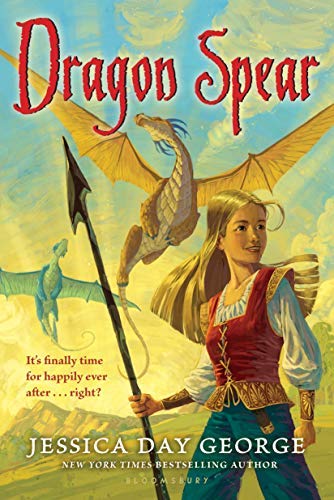
Dragon Spear by Jessica Day George

Dragon Spear is the final volume in the Dragon Slippers trilogy, and I remain glad I was handed that first book by a young friend. These have been entirely fun, with positive messaging and enough grit and humor to keep me engaged. The dragon characters are as sweet and diverse as the human ones, and the women and girls, and female dragons, tend to be both clever and strong. It’s very appealing material for this age group, and I found it perfect, easy reading while on a recent trip to see family.

In this episode, once again, we think the dragons are safe until they aren’t. This time something’s different: the threat comes from other dragons, under their own power and not that of malicious humans. In fact, these dragons enslave humans. And there are some young ones at stake–as well as Creel’s wedding dress, as her union with the younger prince approaches. We lose track of Marta, which is a shame, but get a new human buddy: Creel’s brother Hagen has shown up. He’s an interesting new feature. Dragon friends, and the prince Luka, remain steadfast.

It seems like faint praise to say that this one offers nothing especially new. But I truly feel comforted by knowing what to expect, especially at this reading level. This one is faithful to the series in pleasing ways.

A final strong recommendation. And I’m a little bit considering looking into George’s other works.


Rating: 7 holes.

Girls with a Voice and Girls with Courage by Ann Turnbull and Adèle Geras

Another loan from my favorite 11-year-old, this is a pair of historical novels linked by location. Girls with a Voice, by Ann Turnbull, is about a 12-year-old girl named Mary Ann who travels from London to a boarding school in the nearby village of Chelsea in 1764. She is excited to study singing and the harpsichord there, because she wants to perform as an opera singer onstage (an ambition her family is not especially supportive of). She makes good friends, not only with her fellow pupils, but with a maid in the large house where the school is located. The maid, Jenny, also has a fine singing voice, but because of her class, cannot have the same training as Mary Ann. Jenny sings ballads in the streets for money, however, which Mary Ann finds extraordinary. When circumstances change for Mary Ann’s family, she has to get creative in problem-solving to continue following her dream.

In Girls with Courage, set in 1857, Adèle Geras tells us about Lizzie, also 12, who is on a journey from her home in the country into London, to stay with family in their large, impressive home on Chelsea Walk. This is the same home that housed Mary Ann’s boarding school nearly 100 years earlier; what was then an outlying village is now part of the city, and Lizzie, a country mouse, is awed by the bustle. Lizzie’s father died when she was young, and her beloved mother Cecily is now remarried to a dour man who has suggested Lizzie go away for a spell, as Cecily is pregnant. Lizzie will stay with her father’s brother’s family: uncle, aunt, three cousins including a boy her own age, another uncle who has been injured in the Crimean War, and a grandmother, as well as several servants. Compared to her spare country upbringing, this life strikes Lizzie as grand and luxurious, although also limiting: she enjoyed learning about plants and trees from a local orchardist, and now is forced to do needlework that she finds very tedious. Cut off from her late father’s books by the mean stepfather, she now yearns to learn the math and science that her cousin Hugh gets to study. She misses her mother terribly–and when something seems to have gone amiss back home, Lizzie will have to be brave to help.

As you can tell from these summaries, both stories are a bit sweet and instructive. While I like these protagonists, they are earnest and simple and good-hearted in a way that leaves off the grit and snark and fun I like in all my reading, children’s and young adult of course included. Compared to the Dragon Slippers trilogy this same young friend introduced me to, Girls is less delightful. That said, I passed a pleasant enough day-and-a-half here, and have no argument with the messaging about girls following their passions – whether in music or botany – and standing up for themselves (and their mothers). This messaging is not exactly radical, but still solid. And I’m glad my young friend is interested in history. I look forward to hearing what she loved about the book, and will continue reading anything she brings me.


Rating: 6 walnuts.

Dragon Flight by Jessica Day George

Book two in the trilogy that began with Dragon Slippers is at least as good – my young friend who recommended them to me prefers the first book but I think this one might be better. Creel, in her late teens, is now an entrepreneur, running a dress shop in King’s Seat along with her best (human) friend and business partner, Marta. Marta is engaged to marry Tobin, former bodyguard to the younger prince, Luka; Creel is less secure in her relationship, but the reader can see that Luka himself is smitten with her, commoner or no. Because this is the Dragon Slipper series, trouble quickly arises: a distant country is poised to invade with an army of soldiers riding dragons. We know that dragons are not hostile by nature, so something funny (probably of the alchemical variety, as in book one) must be afoot.

One thing I love about Creel is her genuine devotion to her dragon friends. Her first friend, really, was a dragon, while she definitely has some good human ones. She is adamant in her defense of the misunderstood dragons, anxious both to protect their reputations and keep them safe. The humans also need dragons to keep them safe, and Creel is the liaison between the two groups.

I love the friendships among and between humans and dragons. I love Creel’s (and Marta’s) innovations and puzzling through problems, and their bravery. The romances are sweet, but what I love most about the pairings is that Creel and Marta are outright heroes while their respective beaus just follow along, supportive but a little bumbling, good-natured about their partners’ impressive accomplishments. (I considered sharing this observation with the 11-year-old who recommended these books to me, then realized I’d actually rather she live in a world where this was unremarkable.)

Charming, daring, whimsical, loveable, endearing. I’m in for book three.


Rating: 7 scales.

Dragon Slippers by Jessica Day George

My favorite 11-year-old saved this book especially to loan to me, and I was so excited to be given the assignment. And I quite enjoyed it! Rated for grades 5-6, Dragon Slippers has engaging action, humor, sweet friendships, a hint of romance, and snappy pacing. It’s also got some good messaging, which I approve of. It’s the first in a series and I thought I’d walk away after just one, but the surprise ending (and the sample chapters of book two!) got me.

In poverty and desperation, with a hint of a Hansel & Gretel dynamic, Creel’s aunt decides she should be abandoned to the rumored local dragon, in hopes that a noble knight will rescue her and uplift the whole family. (“Why should anyone be rewarded for defeating a dragon by being saddled with a dowryless, freckled wife and well over a dozen daft and impoverished in-laws?” Creel wonders, but nobody asked her.) This device gets Creel in the company of a dragon that no human has seen in generations, and she quickly learns that their hoards of gold and treasure are a false rumor – this one prefers shoes – and that they’re not terribly motivated to kill humans. She makes a friend, gains a beautiful pair of blue slippers that fit just right, and heads off to the city of King’s Seat hoping to make her own living rather than return to an aunt who tried to feed her to a dragon. Creel is a talented maker of what her late mother called fancywork: embroidery, weaving, and (if necessary) sewing. In the city, she is repeated called a country bumpkin. Events move quickly: she falls afoul of a visiting princess; meets a friendly prince (no relation); gets a job in a dressmaker’s shop; and finds herself embroiled in a few messes. One, working for a boss involves the kind of exploitation anyone in our present, real capitalist system will recognize. Two, her coworkers range from friend material to backstabber. Three, the prince’s attentions and the princess’s hostility somehow manage to entangle Creel in political intrigue and matters of state that also – surprise – turn out to involve her dragon friends.

(Following an early whiff of Hansel & Gretel, the slippers and the prince definitely recall Cinderella. Just echoes.)

I asked my favorite 11-year-old what she liked about the book, and she started with the initial meeting with the first dragon. (Dragons are one of her two favorite animals.) She also mentioned Creel: she likes her strength and her unwillingness to take any crap. She identifies with that. We talked about the friendships in the book, and the pacing. She said she wanted me to read it because she thought I would like Creel, and she was right.

If Creel’s interest in pretty gowns, sashes, and slippers is a bit prissy for me, she is on the other hand a highly practical feminist entrepreneur, with a dangerous habit of speaking her mind even to royalty, and a strong sense of her own powers. I love the urge to make her own way in the world. She’s brave. And she’s a good friend to a handful of dragons as well as humans, and might just turn out to be a hero. I appreciate the positive messaging, and the imaginative world of dragons. There were a few very minor plot holes that I think would likely be tolerated (or missed) by many adult readers, and certainly by younger ones. And as I said, I was hooked by a surprise finish. All in all, my young friend gave a good recommendation.


Rating: 7 collars.

The Last Graduate by Naomi Novik

Book two of the Scholomance series was every bit as thrilling and engaging as book one. I love our grumpy, standoffish teddy bear of a protagonist.

El had good character development in A Deadly Education; now she’s continuing to develop as a person, both because she’s a teenager (coming of age) and because she’s made friends for the first time in her life. She’s reluctant to believe in this, because she’s endured a lifetime of trauma at the hands of almost everyone she’s ever known. Her new friends and allies do have something to gain from working with her at graduation, now that her power as a wizard is becoming more widely known, so she’s not entirely wrong to consider that this may motivate their friendship; but the reader can see better than she can that their friendship is real, too. It’s poignant to see such a sweet but enormously curmudgeonly, damaged, dear kid struggle to accept that people might actually care about her.

The privileges of class and nationality at work here, the power structures that are most invisible to those in power, and the injustice of it all, are more overtly at the center of this book. I think there are some good magical parallels to our real world here that can be instructive but also entertaining and fit neatly into the fantastical wizard-y world of Novik’s imagination, which is prodigious, by the way; this is expert-level worldbuilding. Late in the book the focus begins to move beyond the Scholomance to consider the whole world, which is clearly where book three will take us; this one ends on another final-line cliffhanger (!), so I’ll be getting there fairly quickly.

Perhaps because they were both Liz recommendations, I am reminded of the Murderbot series here, which also featured an outsider first-person narrator who is actually a loveable marshmallow on the inside but puts forward a hard, aggressively antisocial exterior. Despite being mostly rejected by their respective societies, both are driven to right the big wrongs. I do love this set-up, and I love El for being a hard-nosed, sarcastic badass.

In this installment, I actually questioned the YA label. The series does star teenagers, and deal with coming-of-age problems (therefore YA). On the other hand, it also deals with some very dark themes, heavy enough that some readers move it out of the YA category; but after some consideration, I don’t think that’s necessarily a disqualifier. It’s definitely for older kids, not least because there’s some (non-graphic) sex in this one. Maybe the line between YA and adult is blurred; certainly it depends on the reader. There’s no question that these are books for adults (hi), but I think they’re also books for young adults who are up for serious thinking on dark subjects, and some really good writing. This is a step adultward from Hunger Games, which are however very fine books in their own right. Who’s to say what kids should read, anyway? My parents didn’t seem to me to monitor my reading much, and I definitely read some stuff beyond my comprehension at a young age, and all that seems to have done is whet my fire. As ever, your mileage may vary.


Rating: 8 glaciers.

Clap When You Land by Elizabeth Acevedo

Clap When You Land is a novel in verse, in two alternating perspectives. Camino lives in a village in the Dominican Republic with her Tía, who has raised her since her mother died some years ago. Her father lives in New York, and comes to stay each summer for several months. Camino loves her father, and feels loved in return; he supports her and her Tía better than they could afford to do on their own, with the small funds raised by Tía’s doctoring duties. She’s a healer and midwife, skilled with herbs and prayer, and Camino wants to follow in her footsteps, but take it a step further: her dream is to study medicine at Columbia University. Meanwhile, Yahaira lives in New York City with her parents. She’s a former chess champion, but she’s given it up, which has put a rift between her and her father. The two girls are just two months apart in age, approaching 17. They have the same father, but they don’t know it until after he is killed in a plane crash, traveling from his home with Yahaira to spend the summer in the DR, as he does every year.

In their alternating chapters, we see two teenaged girls wrestle, first, with their futures: Camino is concerned about where to go with her life if her father doesn’t help her get to the States. Her options in the DR are few, and there is a predatory young man after her. Yahaira is upset because she’s discovered that her father had a secret – although it’s not the big one she’s about to learn, that she has a sister. Each girl has a best friend: Camino’s is about to give birth, and Yahaira’s is also her partner. We see them both struck by the loss of a father that each loved and admired. And then we see them hit by another shock: they’ve lost a father, but each has gained a sister. What will they do with that knowledge?

I like the questions raised by the twinning of the two girls, what each might have been under different circumstances, what is conveyed by certain advantages. (Camino’s household is better off than most in her village, but still much poorer than Yahaira’s unremarkable middle-class home in Morningside Heights.) At its heart, this is a story about family love, grief, and forgiveness. It’s lovely told in simple verse: easy to read but also contemplatively paced, dealing as much with emotions as events. As a YA novel, I think it would be well suited to thinking about loss for young people, or for any of us.

Papi’s two families, and his keeping the girls in the dark about each other’s very existence, isn’t much dealt with: the character is dead before we meet him, so we only see him in their memories, and he never gets to justify his choices. That’s rather more complicated.

Another thread involves the crashed airplane, which is based on the real American Airlines flight 587. Both the fictional and the real flights left New York headed for the DR filled with Dominican-Americans; the Dominican community in New York was badly shaken by its loss, and that’s a large part of what inspired Acevedo to write this novel (as described in her Author’s Note). That community-wide impact is well described here, which I think is a service.

Sad, thought-provoking, but also a beautiful honoring of a community.


Rating: 7 bachata songs.