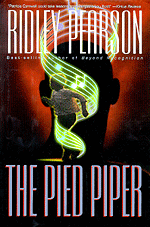
book beginnings on Friday: The Pied Piper by Ridley Pearson

Thanks to Katy at A Few More Pages for hosting this meme. To participate: Share the first line (or two) of the book you are currently reading on your blog or in the comments. Include the title and the author so we know what you’re reading. Then, if you feel so moved, let us know what your first impressions were based on that first line, and let us know if you liked or did not like the sentence. (You might also consider visiting the original post where you can link to your own book beginning.)

Today, we are on the road! Heading for the Ouachita National Forest in Arkansas. I’m equipped with audiobooks! For starters, let’s sample Ridley Pearson’s The Pied Piper:

The train left the station headed for nowhere, its destination also its point of embarkation, its purpose not to transport its passengers, but to feed them.

By early March, western Washington neared the end of the rinse cycle, a nearly perpetual curtain of ocean rain that blanketed the region for the winter months, unleashing in its wake a promise of summer. Dark, saturated clouds hung low on the eastern horizon. Well to the west, where the sun retreated in a violent display, a glimpse of blue cracked the marbled gray, as welcome to the residents of Seattle as any sight alive.

I like a well-evoked location, especially one I’m familiar with. I’ve spent some time in Seattle – have family there – and we can all recognize the reference to rain, can’t we! I really picked this book out just to expand my familiarity with popular authors in the mystery/thriller genre, but particularly this one, because I can remember someone recommending it at some point. Don’t remember who, or what was said, but it was enough to go on. 🙂 I’ll let you know!

The Postcard Killers, by James Patterson (audio)


Well, my feelings on this one are mixed.

First let me speak to the format: I listened to this book on audio cd, in the car while commuting, and also brought it in to the house two nights to listen some more. I don’t listen to audio books very often at all. The Husband and I enjoyed some together on our last long road trip, and I think that’s an excellent application. But mostly I find that I enjoy reading actual, physical books. One of my main concerns is that I like to go back and reread a sentence or a paragraph that strikes me or that I want to understand better, and rewinding a cd is just not the same. The voices of the characters or the inflections aren’t always what I would imagine in my reading experience. Sometimes this bothers me. On the other hand, I’ve just “read” another book in the last week that I wouldn’t have gotten to read otherwise; I have a good hour a day spent driving that I can spend listening to audiobooks. Despite my complaints and concerns, I think it’s likely that I’ll be picking up another audiobook next week. 🙂 I guess that’s a net win for the format. But I most definitely prefer reading.

Now, on to the book in question. As I said earlier this week, I picked up this James Patterson novel – my first (I know!) – just to expand my horizons as a reader and (more importantly) librarian and readers’ adviser. I came in with some bias: I have an understanding that Patterson writes “fluffy” novels, that he really cranks ’em out (or rather, puts his name alongside numerous co-authors to crank ’em out), that maybe his mysteries are less intellectual than some. All of this is very snobby of me and I’m not proud of it, but I’m trying to address this bias honestly here.

After finishing The Postcard Killers, I remain conflicted. I had a number of real problems with this book. The plot was somewhat simplistic; there weren’t layers of meaning or action; there were no real surprises. (Of course, there was no mystery for the reader to solve, just some loose ends left to curiosity til the end of the book. We met the killers in chapter 1 and knew them all along; it was just the detectives that didn’t.) The sex was foreshadowed from the first moment; some tension was allowed to build up, but once the dam burst, so to speak, a formerly strong woman just followed the man around like a puppy dog, which I found a bit silly. The police detectives in Stockholm were incompetent beyond comedy to the point of my great frustration. I thought it was totally unrealistic. These are police officers! The characters didn’t have hobbies, interests, or personality characteristics. They were flat. It was rather a flat book in general, in many ways. Michael Connelly may be “fluffy” too, in a way (light, entertaining, pleasurable reading for the beach), but his Harry Bosch is a many-layered complex character, and he meets interesting, complex people and solves complicated cases. I’m afraid I was unimpressed by the Patterson & Marklund team in many ways.

However! I was engrossed! I knew from the start who the killers were, but couldn’t figure out how they had accomplished things. The question of motive was left open, too, although I found the solution unsatisfactory. I was anxious to get back in the car to hear what was going to happen next. And however tired and predictable the sexual tension and eventual release was for Jacob & Desi, I waited anxiously for them to get around to it. So I guess what this says is, for all my criticisms, Patterson’s predictable, flat suspense still got me interested and page-turning (so to speak). I’m not impressed, but I was entertained in the short term. I would probably even grab another one of his novels again – that is, if there were nothing better lying around, at the beach; or if the Husband and I needed an audiobook for a road trip. At any rate, I’m very glad to have exposed myself to this author and know his style. (At least in combination with one of his co-authors. There’s probably a lot I still don’t know, thus the need to pick up some more.)

As it happens, we’re hitting the road this weekend, for a drive to Arkansas and back. I’ve picked out four audiobooks, but no Patterson this time. I have:

Extreme Measures, by Vince Flynn

Gone Tomorrow, by Lee Child

Shoot Him If He Runs, by Stuart Woods

The Pied Piper, by Ridley Pearson

The Husband and I are both fans of Lee Child and his bad-ass character Jack Reacher. The other three are in further pursuit of my well-roundedness in the mystery/suspense genre, and in the hopes of discovering more authors the Husband can appreciate. (He likes Connelly but I’ve read all of his novels and didn’t want to do repeats on this trip.)

So, I give the audio format a “meh” with strong likelihood of repeat use. I give The Postcard Killers a “meh” with medium likelihood of repeat use. I’m open to compromise. 🙂

Dethroning the King: the hostile takeover of Anheuser-Busch, an American icon, by Julie Macintosh


Wow. Where to begin? I found this book riveting, cover to cover. I took my time, and I took breaks, and I read other books – all this is true. But my interest in this one never waned. I have been raving a bit manically to anyone who will listen ever since I finished it last Friday night. I’ve taken my time writing about it here because I was trying to be less hysterical in my praise.

I’ll give you a quick synopsis if the subject area is unfamiliar to you:

Anheuser-Busch was the last U.S.-owned big beer company in 2008, and was also still family-controlled, by the Busches. (Coors was already part of Canadian-owned Molson-Coors, and Miller was part of South-African-owned SAB-Miller.) A few Brazilian bankers had started, years earlier, by buying out Brazilian Brahma beer, but they quickly grew into a large brewing concern known as AmBev who then joined with Belgian brewers Interbrew to become InBev, which ended up Belgian-based, but mostly Brazilian-controlled. In 2008, AB was suffering, and InBev made their play by offering an impressive bid. AB made a rather half-hearted effort to defend itself by merging with Mexican brewing powerhouse Modelo, but ended up selling to InBev to create Anheuser-Busch InBev (ABI).

Macintosh is the journalist who covered the takeover of Anheuser-Busch by InBev, for the Financial Times. She had me right from the start, when she described (in the Author’s Note) her experience as a woman – and a visibly pregnant one, at that – in the doubly male-dominated worlds of finance and beer. This resonated with me, as I’ve worked in beer and in bicycles in the past and am also familiar with the concept of male-dominated industries. This personal relationship to her work foreshadowed to me that she was going to handle her subject from a human perspective, and she did. I like my nonfiction full of narrative and personalities – human characters. This was a fascinating treatment of a story I was already prepared to be interested in. My ties to beer, and the beer industry, originally drew me to this book. But I stayed for the human element.

This story is full of characters. (Forgive me for broadly generalizing, but people in Big Beer and finance are wealthy, and wealthy people tend to be eccentric, yes?) Macintosh kindly includes a “Cast of Characters” (and I also referred to the index to flip back to the earliest mention of a character here and there) to help us keep them straight; but really I had minimal trouble. They’re all so quirky and real (notice I didn’t necessarily say likeable! but interesting, yes). Like I said, the beer got me in the door; but the people and the plot twists kept me in my seat.

The world of finance is thoroughly new and mysterious to me. (I have been harassing my finance-friends to help me understand certain concepts. They have been mostly helpful; or, unavailable. Probably on purpose. That’s you Will.) But it speaks to my engagement in this book, that I am now hyper-motivated to learn all about mergers & acquisitions (independent v. dependent board members… fiduciary duty… private equity firms…) JUST so I can better follow the action in this plot. For me to have found a book of finance this unputdownable seems rather a feat. I can’t recommend it enough.

The more I try and explain my appreciation, the more I think this story wears several hats. It’s actually suspenseful and full of intrigue, like a lot of the novels I enjoy – like a murder/mystery/international intrigue. It also has certain elements of classic tragedy – ambition and hubris being (among) the tragic flaws of the Busch players. And the fate of Anheuser, in mid- and late-2008, is also an allegory for what the United States went through simultaneously. Our national hubris and feeling of this-can’t-happen-to-us led to a shocking (to varying degrees I suppose) downfall. Of course I’m just paraphrasing Macintosh in this; she says on page 22,

Anheuser’s hubris and naivete had led to its fall from grace, and it provided an apt comparison to the broader state of American at the time.

Or again, page 341, in the words of an (unnamed) advisor to AB,

The way this played out was Shakespearean in nature. I haven’t decided which play. The dynamic between father and son was just Shakespearean and tragic.

(The father and son referred to here are August Busch III and IV.)

My notes at the end of reading this book say, “I ❤ gray areas." It's always easy to love and hate characters in books when they're all good or all bad; but isn't it more satisfying to feel conflict? Aren’t they more human and thereby more evocative of complex emotions, when they have redeeming characteristics, or confuse us a little bit? These are, of course, real humans; but it’s Macintosh’s journalistic thoroughness that rounds them out. I didn’t find it easy, in the end, to see any of these characters in black and white. Instead, the complexities and gray areas make it echo for me.

If you’re interested in big business, or finance, or the beer industry, or the consolidation of the world market into very few giant conglomerates, or U.S. businesses’ place in an international world, or if you enjoy readable nonfiction… I really can’t overestimate my recommendation of this book.

Teaser Tuesdays: The Postcard Killers by James Patterson


Teaser Tuesdays is a weekly bookish meme, hosted by MizB of Should Be Reading. Anyone can play along! Just do the following:

* Grab your current read
* Open to a random page
* Share two (2) “teaser” sentences from somewhere on that page
* BE CAREFUL NOT TO INCLUDE SPOILERS! (make sure that what you share doesn’t give too much away! You don’t want to ruin the book for others!)
* Share the title & author, too, so that other TT participants can add the book to their TBR Lists if they like your teasers!

I’m listening to this one on audio right now, mostly just in the car as I commute. It’s an experiment; you know I’ve mentioned before that I’m not sure if the audio format is really for me.

My teaser comes from page 19 (I did get my hands on a book for this):

The view from the hotel room consisted of a scarred brick wall and three rubbish bins. It was probably still daylight somewhere up above the alley, because Jacob Kanon could make out a fat German rat having itself a good time in the bin farthest to the left.

I have mixed feelings about this book (aside from the audio format). This is my first James Patterson, and I picked him up so as to broaden my knowledge of the mystery genre – I had some impressions to indicate that maybe he wouldn’t be my favorite, but for my job here in the library it’s ideal that my reading be broad. The jury is decidedly conflicted, but I’ll let you know this week or next how it all ended up for me (and for Jacob Kanon and the others).

Thanks for the Teaser Tuesday!

Among the Mad by Jacqueline Winspear

It’s that time again! The sixth Maisie Dobbs book is entitled Among the Mad, and takes place within London (and surrounding environs, of course). Maisie is conscripted formally into the machine that is New Scotland Yard when she’s mentioned by name in a threatening letter aimed at the government. As is usual, this case involves the aftermath of WWI and its veterans, in the context of the depression in England. Also as usual, there is a personal embodiment in Maisie’s own life: Billy Beale’s wife is still struggling to process the death of their young daughter. The general issue is shell-shock, or what we would now call post-traumatic stress. Maisie is touched by the plight of veterans who are still suffering less obvious wounds, like psychological, mental, or emotional ones, and who are unable to find work or meaning in a changing world.

This was, for me, perhaps a lackluster episode in Maisie’s story. It had all the familiar elements: themes of social and economic injustice and the sobering reality of depressed post-war England; Maisie’s search for belonging in between social classes (although she’s more and more integrated into the middle class; more on that in a minute) and with few real friends; the immorality and futility of war, with foreshadowing of the next world war to come. Maisie does continue to grow. She displays a work of art in her home, a tapestry we can assume she made in the weaving class she was attending in the last book. At the end of the book, she buys a camera, which I interpret as both another artistic/creative outlet, and a connection to other humans. She displays photographs as a means of reminding herself of her relationships. She also starts seeing more of Priscilla, and seems to open up more; but I’m bothered by her acting as Psychologist & Investigator (and therapist) in their friendship. It may not be sufficiently different from her day job, if that makes sense. But these are all positive developments. And then there’s the big one, at the end of the book, when she declares (to herself at least) that she has regained her soul. The healing suggested by Simon’s death seems to have begun.

About Maisie’s social standing: did anyone notice that Catherine Jones accused Maisie of not knowing want, and Maisie didn’t correct her? And later, in considering the possibility that a foundling could have become a successful scientist, she concludes that such social/economic climbing would be impossible – “unless, of course, he was something of a chameleon. Like herself.” It sounds to me like Maisie’s made a pretty successful climb, but it’s left her as isolated as ever.

She does see some developments in her romantic life. It seems that Stratton continues to be interested, but frankly, I never saw him as a serious option. I know some of my fellow readers-along liked him as a candidate for love in Maisie’s life, but I felt he was a bit one-dimensional from the start, and a bit patronizing of Maisie as female detective. He’s come a long way in respecting her professionally, I’ll give him that. But still, aside from being a single parent, I don’t think we know anything interesting about him. I liked Dr. Dene, for his sense of humor and personal connection via Maurice; but that didn’t take. It was too early for Maisie. Our new friend MacFarlane, though, is more of a firecracker. He has more personality. I like him as an option for Maisie very much. I like his style, and I like that she fed him dinner in her apartment (!) and they shared really a very intimate evening. I hope to see more of him.

The mystery was engaging, too, and Winspear continues to twist her readers’ heartstrings with the criminal-as-victim and really very sad national situation that breeds situations like this one. It’s very poignant, powerful stuff. Still, I guess it’s beginning to be a bit patterned for my liking. I hope she’ll mix things up a bit in the next installment, The Mapping of Love and Death, which we shall discuss in another two weeks.

We saw less of Maurice in this book – really hardly saw him at all. There is discussion of he, and Maisie’s father Frankie, aging. She has precious few close friends, and I notice she’s not very forthcoming or honest with her father about her life. It really bothered me that she didn’t tell him about her injury at the start of the book. I know she likes to be a tough guy, and independent, but really. A single woman with a father who loves her should let him take care of her when she’s hurt at Christmas! At any rate, I’m glad she’s drawing closer to Priscilla, but hope she continues to expand her little circle, especially with the hinting at Maurice & Frankie’s mortality.

I still adore Billy, and find his family’s situation one of the stronger points of every book, actually. They feel very real to me, and perhaps because we follow them for the whole series (as opposed to the characters in each case, who come and go), they feel like Winspear’s best representation of the national malady. I think I am most anxious for them between books. The Beales, and Maisie’s love life, are my greatest concerns going into the next installment. I do like the mysteries, but I would like to see a little variety in the structure & subject of the next one.

Let’s discuss covers, briefly. For those of you also reading the series: the first image, above, is the standard hardcover design. It matches the rest of the series (at least the copies I’ve picked up), and I like the continuity; it’s recognizable. I like her cloche, too. 🙂 (remember, I got my own in Maisie’s honor!) But this time I accidentally picked a large print edition (that was weird; had to turn pages much faster), whose cover you also see above. Although it’s not visually recognizable as belonging to the series, I think it expresses the subject matter (at least of the mystery part of the book) better. I guess the usual series covers are more about Maisie; the large print cover is more about post-war madness. What do you think?

Despite some gentle criticisms, I still like Maisie and can’t wait to see her through! We have just two books left – the last having been released just last week. I’m so glad I’m involved with this series, and am so glad to have a group of people to share her with. Don’t forget to check in with Book Club Girl, where this book is being discussed. And we’ll meet again in two weeks for The Mapping of Love and Death.

the daily post’s prompt

Briefly, because I couldn’t resist….

This site offers a daily prompt for those bloggers who want to blog every day unfailingly but may lack for topics. I could not let today’s prompt pass me by as the answer is so obvious!

What non-exercise activity do you wish would keep you fit?

Duh! READING! So many hours spent on my back on the couch with a little dog on my belly… ah how flat that belly would be…

book beginnings on Friday: options

Thanks to Katy at A Few More Pages for hosting this meme. To participate: Share the first line (or two) of the book you are currently reading on your blog or in the comments. Include the title and the author so we know what you’re reading. Then, if you feel so moved, let us know what your first impressions were based on that first line, and let us know if you liked or did not like the sentence. (You might also consider visiting the original post where you can link to your own book beginning.)

I’m breaking the rules again. I’m not sure what I’m going to read next. I will hopefully finish both Main Street and Dethroning the King this weekend (and will likely not post at all over the weekend, which is my usual habit). But I did want to share a few books that have recently been published that I’m interested in reading. Perhaps you can help me choose!

First of all, Heather Gudenkauf’s These Things Hidden begins:

I stand when I see Devin Kineally walking toward me, dressed as usual in her lawyer-gray suit, her high heels clicking against the tiled floor. I take a big breath and pick up my small bag filled with my few possessions.

To me, this indicates that the narrator has seen this Kineally woman before, knows her “usual” suit color, and is not feeling so hot about the action to come. I have read the blurbs (and a review or two) of this book and am excited about what sounds like a thrilling and intriguing, um, thriller.

And then there’s Lisa Gardner’s Love You More. From the Prologue:

Who do you love? It’s a question anyone should be able to answer. A question that defines a life, creates a future, guides most minutes of one’s days. Simple, elegant, encompassing.

This is a bit general and philosophical for my tastes, and not such a grabber, for me at least, but chapter one does me better:

Sergeant Detective D.D. Warren prided herself on her excellent investigative skills. Having served over a dozen years with the Boston PD, she believed working a homicide scene wasn’t simply a matter of walking the walk or talking the talk, but rather of total sensory immersion.

Now that will grab me. I like a good detective and a good crime scene; this is my favorite kind of light reading. I’ve read some about this book, too – I’ve never read Lisa Gardner before, but this one sounds wonderful, and I can’t wait to get into it. Although again I’m noticing a sort of emotional theme of maternity, parenting, mother-child bonding, family, etc. I’ve mentioned this before and it bothers me somewhat. I wonder if this is a recent theme in publishing? Or just the ones I’m stumbling across? Any thoughts?

Anywho, sorry, got distracted. Either of these books appeal to me for a next read – or it could always be something off my TBR bookcase at home. 🙂 Do you have a vote? What shall I tackle next? (Perhaps the next one of these two to be returned to my library, hmm…)

Main Street by Sinclair Lewis: a study of covers

I’m not finished reading this book yet – I’m still splitting my time between Dethroning the King and Main Street. They’re both delightful! And a bit long, but mostly I’m just very busy right now. (School is ramping up for the end of the semester, and my big race is in a week and a half…) So, thanks for your patience. Anyway – I haven’t finished Main Street, and I haven’t written much about it here; I’m waiting to finish and write up all my thoughts at once. (I have lots of thoughts.) But in the meantime, I went looking for different covers.

There have been many editions of this book, and many different covers. I’ve got a collection of them here for you. This won’t mean much to you if you haven’t read the book yet, but I wonder about your thoughts. Some of these cover designs seem to emphasis the titular Main Street, and I guess that’s a nice picture, and plays into the title. But I feel that the real Questions (capital Q) of the book deal with the People who color the street, if you will. The cover of the edition I’m reading is the very last one pictured here, and I actually think I like it the best. (It’s a charming little paperback that requests to be sold for 75 cents!) It concentrates on the people, leaving Main Street out altogether, and the fact that the two people (overlapping, and presumably “together”) are turned away from each other, and each seeming to hail someone else, seems especially appropriate to me. The book indicates that the inhabitants of Gopher Prairie, Minnesota are overly concerned with the opinions of others. It all fits, to me.

With no further ado, lots of Main Street covers for you! Do you have any thoughts? Any favorites? Or have you not read this book and I’m boring you completely? (My full write-up will come eventually. I promise.)


my Signet Classic edition

movie: The Lincoln Lawyer (2011)

I didn’t let being sick stop me! I made the Husband take me to a movie Friday night! So I saw the first Michael-Connelly-book-made-into-a-movie on opening night! This is especially momentous because the Husband does not Do Movies. This is the second movie we have seen together in a theatre. (He has a slightly higher tolerance at home on the couch. Like maybe 10 movies, ever.)

It was pretty great! I was excited, because it’s Connelly, and it’s a great story, and I thought McConaughey had some potential as Mickey Haller. (I hadn’t thought of Haller as being quite that pretty, myself, when I read the book, but I was open.) But I was also concerned, just as in reading The Paris Wife (which I loved! did you notice?), because I love Connelly and the movie is never as good as the book, and there was a high risk of disappointment.

cute Maggie McFierce

But I liked it! Yay! (The Husband did too. Remember he’s a part-time Connelly fan.) Of course, being a two-hour Hollywood movie, it cut significantly from the book. I was tolerant. It stayed with the feel of the plot; Haller was a baller, and his being pretty worked, and I thought Marisa Tomei was the CUTEST Maggie McFierce. It was enjoyable. Was it a Connelly novel? Heck no, but it followed his atmosphere, and I enjoyed it. And then I went to bed.

McConaughey with Connelly

I wonder if maybe he sold that book for a movie, first, to see how it would go, rather than any of the Bosch series. I figure once he releases Bosch to the big screen, he will have committed, and will have to let them keeping making Bosch, for better or worse. Which led to a question: who do we like to play Bosch? Anybody? The Husband had an idea, but I didn’t know the actor so it hasn’t stuck in my head. I have no ideas because I’m not very good at Hollywood. :-/ Please share! Who is Bosch? I see him as being stout and muscled, not terribly tall, with dark hair, and weathered by violence and stress, but still a touch ruggedly handsome while NOT being pretty. Who is this?

Teaser Tuesdays: Main Street by Sinclair Lewis


Teaser Tuesdays is a weekly bookish meme, hosted by MizB of Should Be Reading. Anyone can play along! Just do the following:

* Grab your current read
* Open to a random page
* Share two (2) “teaser” sentences from somewhere on that page
* BE CAREFUL NOT TO INCLUDE SPOILERS! (make sure that what you share doesn’t give too much away! You don’t want to ruin the book for others!)
* Share the title & author, too, so that other TT participants can add the book to their TBR Lists if they like your teasers!

I am going to revolt and share a slightly longer passage because it’s just too funny (from page 194):

They had gone to the “movies.” The movies were almost as vital to Kennicott and the other solid citizens of Gopher Prairie as land-speculation and guns and automobiles.

The feature film portrayed a brave young Yankee who conquered a South American republic. He turned the natives from their barbarous habits of singing and laughing to the vigorous sanity, the Pep and Punch and Go, of the North; he taught them to work in factories, to wear Klassy Kollege Klothes, and to shout, “Oh, you baby doll, watch me gather in the mazuma.” He changed nature itself. A mountain which had borne nothing but lilies and cedars and loafing clouds was by his Hustle so inspirited that it broke out in long wooden sheds, and piles of iron ore to be converted into steamers to carry iron ore to be converted into steamers to carry iron ore.

If that’s not clever and funny and insightful I don’t know what is.

And in case you need help (like I did) with mazuma, Answers.com tells me it is slang for money or cash.

I’m enjoying Dethroning the King simultaneous with Main Street. Aren’t I a lucky girl!