I don’t regret the books I’ve read, but those I did not read

I work in a library that focuses mostly on fiction, mostly on bestsellers, and mostly on recent releases. Recently released bestselling fiction is the big hit, although we certainly carry exceptions to each category, too. I get asked a lot about books. I get asked for advice on what a patron should read – this is the most common and the most natural and appropriate; I’ve taken courses and read books about “reader’s advisory” service, which means advising what books a person might enjoy, based on what they’ve enjoyed (or not) in the past. (I still consider myself woefully inadequate, mostly because we can’t read them all! But I try – and I’m familiar with what’s expected, with what reader’s advisory entails, even when I can’t perform.) Almost as frequently, I get asked about what I am reading, what I like to read, what I’ve read recently. This can be a tricky one. It should be easy – I should be able to answer honestly, and that should often lead to a fun, stimulating conversation, even if our reading tastes differ. (Which is fine! I like to say, how boring would it be if we all liked the same things? And how long the lines would be, too!) But sometimes I get some strange questions or strange responses. Today, when asked what the last book I read was, I answered truthfully: The Taming of the Shrew. I was rewarded with deep, uncontrollable belly laughter as the patron stumbled out wiping his eyes. I don’t entirely understand. Carry on, sir.

I also get asked difficult questions, like, “which Christian fiction author do you like to read?” The truthful answer is none; the diplomatic answer is “Jan Karon and Karen Kingsbury are very popular. What are you looking for? Who have you enjoyed in the past?” It always makes me smile bemusedly when people ask me, “do you read?” (I’m sure there is a librarian out there who doesn’t, but really.) Or another favorite, when a big batch of hot-off-the-presses, brand-new books arrive: “have you read all of these?” To which I reply, “no. I put them out for you all, first.” But sometimes I can’t resist grabbing a brand new one, I confess. The Reversal and The Paris Wife both came straight home with me, for example. And sometimes I get to read a gally before publication, as I did with Chevy Stevens’ Never Knowing (review yet to come, via Shelf Awareness). But mostly, my access to our library’s new books is limited in the same way my patrons’ access is: by availability. Also, I’m very busy, have lots of reading to do, and try to prioritize their access more highly than my own.

I do get excited about a lot of the books that I buy for the library. And I do get to read a lot of them, but I miss more than I hit. By how many? Well, I got curious. Out of 2011 book orders to date, I have read (in no particular order):

**Some of these were among the best I’ve read this year, too.

But on the other hand, I wanted to read:

  • Turn of Mind, Alice LaPlante
  • Once Upon a River, Bonnie Jo Campbell
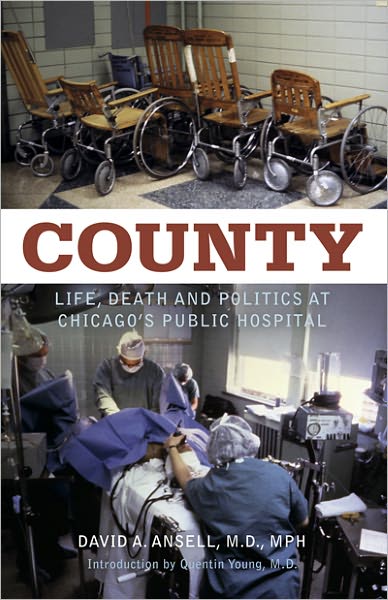
  • County: Life, Death and Politics at Chicago’s Public Hospital, David Ansell
  • Tolstoy and the Purple Chair: My Year of Magical Reading, Nina Sankovitch
  • The Invisible Line: Three American Families and the Secret Journey from Black to White, Daniel J. Sharfstein
  • The Clamorgans: One Family’s History of Race in America, Julie Winch
  • The Story of Beautiful Girl, Rachel Simon
  • The Reading Promise: My Father and the Books We Shared, Alice Ozma
  • Ruby Red, Kerstin Gier
  • The Butterfly’s Daughter, Mary Alice Monroe
  • Claire DeWitt and the City of the Dead, Sara Gran
  • I’ll Never Get Out of This World Alive, Steve Earle
  • Mightier Than the Sword: Uncle Tom’s Cabin and the Battle for America, David S. Reynolds
  • Georgia Bottoms, Mark Childress
  • One of Our Thursdays is Missing, Jasper Fforde
  • Mr. Chartwell, Rebecca Hunt
  • Oracle of Stamboul, Michael David Lukas
  • Cleaning Nabokov’s House, Leslie Daniels
  • Crime: Stories, Ferdinand von Schirach

…that’s a lot of books. I may still make it to several of these – I have my heart set on County, for example. (I want to continue my reading of history and historical fiction in Chicago and the northeast, as in The Devil in the White City, Newspaper Titan, Around the World on Two Wheels and Clara and Mr. Tiffany.) But others will just fall off my wish list gradually for lack of attention – or move up it, if someone else raves. This is the joyful problem of the avid reader and professional librarian: so many options, so little time.

I know I’m not alone! What has passed you by this year that you’re still hoping to find time for? Or, what DID you find time for that turned out really, really well? Best of 2011? (We’re talking published in 2011 here for now. My best of 2011 [published in] are those asterisked, above.) Anything really terrible? (I found Gone with a Handsomer Man very disappointing.) Please do share. Tell me I’m not alone. πŸ™‚

The Accident by Linwood Barclay

A relentlessly paced thriller in which a man has to turn detective to protect his little girl and determine the truth behind his wife’s death.

When Glen Garber’s wife, Sheila, is killed in a drunk driving accident, he’s shocked and disbelieving when he learns that she was the drunk driver. Suddenly a single father, he struggles to reconcile Sheila’s final act with what he knew of her, but things just keep getting stranger. One of Sheila’s best friends is killed in another bizarre accident right after yelling at Glen’s eight-year-old daughter, Kelly, for overhearing a phone call.

The intrigue mounts. Glen receives threats and inexplicable instructions from Sheila’s friends; someone shoots out Kelly’s window; and a sinister figure with ties to organized crime pays a visit to the Garber household. Glen’s contracting business, already in financial trouble, may be on its way to becoming another victim. The background and setting are ΓΌber-current, with small-town families struggling to survive a recession, tricky sub-prime mortgages and home foreclosures. Unsure of the local police department, Glen is forced to undertake his own investigations. Is someone trying to destroy his business? What questionable sideline dealing was Sheila involved in? And who or what, exactly, killed her?

Glen, a competent builder but a decidedly amateur investigator, is most importantly a loving father. After all the dust settles, this heart-pounding thriller is surprising family-oriented. Barclay’s (Never Look Away) fast-paced, twisting plot keeps the reader guessing at who the good guys and the bad guys are. Allegiances shift. Glen isn’t sure who can be trusted; and while we stay a step ahead of him, the ending still comes with a shocking crash.


This review originally ran in the August 9, 2011 issue of Shelf Awareness for Readers. To subscribe, click here, and you’ll receive two issues per week of book reviews and other bookish fun!

Teaser Tuesdays: A Bitter Truth by Charles Todd

Teaser Tuesdays is a weekly bookish meme, hosted by MizB of Should Be Reading. Anyone can play along! Just open your current read to a random page and share a few sentences. Be careful not to include spoilers!

A Bitter Truth is the third Bess Crawford mystery from mother/son writing team “Charles Todd.” I am finding it a) enjoyable and b) decidedly like Jacqueline Winspear’s Maisie Dobbs series. (See them ALL reviewed by me here.) That is – Maisie is a British interwar detective and former nurse; Bess Crawford is a British nurse during WWI who, while on leave, gets involved in a murder mystery of her own. Both women are apt to sympathize with people in trouble, in this case, a young women who shows up on Bess’s doorstep with a big bruise on her cheek.

Your teaser comes from page 223:

She smiled at me in that way that some children have when meeting a stranger, and now I could see what George Hughes had seen, a likeness perhaps not as strong as he had wished to believe it was, but so pronounced that this child and Juliana could have been sisters. I wanted very much to speak to her, to hear her voice, to hold her on my lap and watch the play of emotions on her face.

This quotation comes from an uncorrected advance proof and is subject to change.

two-wheeled thoughts: London Judy

two-wheeled thoughts

away on the road where the dusty clouds whirl
away with a spirit ecstatic
goes the cool-as-an-icicle, bicycle girl
bestriding the latest pneumatic;
she heeds not the scoffers who scorn,
though knickers her kickers adorn,
the cool-as-an-icicle, bicycle, tricycle maiden by no means forlorn.
–London Judy, Buffalo Illustrated Express, July 29, 1894, as quoted in Around the World on Two Wheels

Don Quixote by Cervantes, trans. by J.M. Cohen: The First Part

Thank goodness Cervantes gives us a “First Part” division right at the halfway mark of this big book, because I need it. I have a huge number of galleys to read for review, and the Gone with the Wind readalong going on as well. So Don Quixote is getting a break. But, I am enjoying it and will be picking it back up! So, eventually, expect a Second Part.

For a chunkster, this is surprisingly easy reading. Don Quixote and sidekick Sancho are just goofily traversing the Spanish countryside, having haphazard and silly adventures which they view in different terms. At the beginning, Sancho’s perspective is that of reality, more or less, with an ongoing desire to please his master and see things his master’s way, and Don Quixote’s perspective is entirely fantastical, based on the novels of chivalry he has read until his brain became mush. (The perils of novel-reading, children!) As they continue their adventures, though, Sancho buys into the fantasy – mostly. He retains a more cynical view that his master, who is completely off his rocker where errantry is concerned.

I was definitely intimidated by its bulk, but these 900+ pages of story are split into little episodes only 2-3 pages long in some cases. What I’m saying is, if you’re intimidated by the bulk of Don Quixote, don’t be! It’s remarkably easy, and entertaining, reading.

Don Quixote is a gentleman of leisure living in the countryside of La Mancha. (This is Spain in, erm, the 1600’s or 1500’s? Published in early 1600’s. I’m not too clear on the precise setting in time, 16th vs. 17th century Spain, and the niceties thereof, not being a strong point in my education to date.) He becomes so obsessed with his novels of chivalry and the knights errant and their lady loves and great deeds, etc., that his mind becomes confused. He outfits himself in a comical assortment of bits and pieces and substitute parts, thinking he is an elegant knight. He roams the countryside on his tired old horse, with a squire named Sancho on a mule, imagining that he achieves feats of gallant and courageous battle and strength, when in fact he (famously) does battle with windmills, releases dangerous criminals from the King’s custody, gets himself and Sancho beaten repeatedly, makes promises he clearly will not be able to keep, and generally makes a fool of himself.

The book, which was originally published in two volumes (thus, two parts!), follows a meandering story line; it is more a series of small adventures, the kind that might be published serially. Some of these adventures leave Don Quixote and Sancho sidelined while we meet other temporary protagonists. These are a welcome respite when Don Quixote’s ridiculous behavior becomes tiresome. I get most excited and engrossed in his adventures when there are plenty of other characters milling about; just Don Quixote and Sancho together can get a little bit repetitive. It is easy to get annoyed with Don Quixote because he is exasperating; but this is intended. He is a ridiculous character.

I am surprised at what an easy and quick read this is turning out to be, and at how often I giggled aloud. Don’t fear the chunky Classic of Literature, friends. Although setting the book aside for now, I look forward to returning to it. Part the Second to come.

One for the Money by Janet Evanovich

Perhaps you noticed how badly my last Evanovich experiment turned out. Perhaps you are shocked (as am I, rather) that I tried again. Well, for one, I was still trying to figure out what people like so much about Evanovich; I hope to be the kind of librarian who at least knows something about all the different genres and tastes. Also, I spoke with a friendly regular patron after my failed attempt with one of her little-known romance novels (above), and decided I was misguided in judging her based on that. I was advised to try again with the Stephanie Plum series, and so I picked up the very first. [For the record, yes, duh, I should have started here in the first place. I did know these were her bigtime contributions. But I guess I was trying to knock out a pure-romance-genre read – again for the sake of breadth in my reading – at the same time. Failure. Note: Always read what the author is famous for.]

For those that don’t know, Stephanie Plum is reluctantly and accidentally employed as a bounty hunter in New Jersey. This first book is her intro to the business. She’s an unlikely candidate, but she needs the money – Plum is kind of a mess, but a cute one. Her first job is to hunt down Joe Morelli, to whom she lost her virginity behind an eclair case in high school. Her feelings for him are mixed, but she barely has time to even try to work them out as the corpses mount up around her, she’s stalked by a sadistic serial rapist, and somebody else is trying to kill her.

I know, just from cover blurbs and general awareness, that Plum has a ping-pong-style love triangle with Morelli and fellow bounty hunter Ranger. This love triangle and sexual tension, as I understand it, is going strong – and still unresolved – after the recent publication of Smokin’ Seventeen, the 17th (yes, true) in her by-the-numbers Plum series. On top of these there are a number of between-the-numbers Stephanie Plum novels, so that for over 20 books, Evanovich’s fans have been eagerly awaiting resolution. Or have they? Maybe they enjoy this ongoing tension and drama, but I have read a few reviews myself indicating that her readers do desire decision. I confess, this is something that would get old for me. Indecisiveness, especially of the multiple-lovers variety, is a bit of a peeve of mine.

Another mild complaint: I’m not offended by sex or violence. I literally haven’t found my boundaries yet; I can handle whatever an author throws. But! I am offended, stylistically, by gratuitousness. And I found some of the sexual references gratuitous. Again, I’m not much of a reader of romance novels; I suspect this is a staple of the steamier of that genre that its readers expect and cherish. But the random appearance of genitalia for its own sake throws me off and yes, offends me – not because it’s sex, but because it’s random. [Seekers of “clean” books, look elsewhere.]

I was conflicted during most of my reading of this book. Stephanie Plum is feisty, hectic, and cute; she has attitude; her narrative voice is funny. Funny things happen to her: awkward moments and moments of conflicted sexual tension. There is some real humor here. But I was annoyed, too. I realize that the outlandish, unrealistic, pure silliness of these story lines are part of their appeal – Evanovich’s fans appreciate this – but I don’t think it’s for me. I’m too easily exasperated with Plum and her indecision (did I say that already?) and her clumsiness and poor decision-making. These books may not be my cup – but of course that’s a subjective judgment, and that doesn’t mean others can’t enjoy them.

I was repeatedly tempted to put this book down, but I hung in there. Just as I got annoyed by Plum (I promise you, if we were friends, I would constantly be rolling my eyes, sighing, and giving her unsolicited advice. Maybe we wouldn’t be friends very long), she’d make me giggle and I’d decide to keep going. Plus, I already quit on Evanovich once, and I was determined to see this one through.

After finishing the book, I remain ambivalent. This book did make me laugh, and it did keep me turning the pages, so Evanovich accomplished several goals: suspense and humor. But I finished with the same exasperation and frustration I’d felt for the whole book. I don’t entirely respect Plum. I’ve had my share of male-female interactions, and I don’t think people behave like this in the real world. It reads like a romance novel, not like life. I’m bothered by the scene, prevalent in romance novels, wherein a man can seduce a woman by being aggressive, rough, rude, even violent. I think this is a dangerous concept to propagate. But perhaps my overarching complaint is, this book is silly. And pointing to this as a criticism rather than a selling point is a matter of my personal taste, not of the objective value of Evanovich’s work.

As a final aside, it was cute to see how dated some of the details were. Cassette tapes, and the impressive tape deck in Morelli’s tricked-out Jeep, made me flip to the front for the publication date: 1994. Rather a fun little blast from the past. As you may have noticed, I’m not too concerned with reading series in order, but I’m glad I started at the beginning of this one. I’m willing to give Evanovich credit – sight unseen – that her characters & style develop as the series progresses. I’m happy to have started off at the beginning.

Final verdict? My options would have to be pretty slim to pick up another one of these books, but at least I now understand what Evanovich fans are looking for. She’s not to my personal taste. But I can see the appeal.

book beginnings on Friday: On Bicycles: 50 Ways the New Bike Culture Can Change Your Life by Amy Walker (ed.)

Thanks to Katy at A Few More Pages for hosting this meme. To participate, share the first line or two of the book you are currently reading and, if you feel so moved, let us know what your first impressions were based on that first line.

On Bicycles is sort of a book of advice, not necessarily to be read cover to cover. But I’m finding myself doing just that, which should be taken as a compliment, especially as, in all humility, I don’t need this kind of advice, being rather an experienced cyclist.

Amy Walker edits, and writes a number of chapters, but by no means the majority of the book. Her chapter one, entitled “Bicycling is Contagious,” begins:

Warning! Cycling can be addictive. Before you grab onto those handlebars, before you throw a leg over the saddle and start pumping away at those pedals, be aware: once you start, you may never want to stop.

Well, she’s off to a good start for me! I couldn’t agree more.

This quotation comes from an uncorrected advance proof and is subject to change.

What are YOU reading?

miscellany: what writers eat

Thanks to the New York Times for this cute little piece of writerly trivia: Favorite Snacks of the Great Writers. I especially like Truman Capote’s drinking schedule.

Which one do you like the best?

Right Ho, Jeeves by P.G. Wodehouse

Oh, Bertie Wooster. You are so silly and so deadpan. The dialogue is killer. The abbreviations are droll. The voice of Bertie is priceless. (I did get a voice – literally – for Bertie in my head in my first Wodehouse encounter via audio, which if anything has increased my enjoyment. Luckily the narrator was great and I now hear him in my head as I read this.) Wodehouse is a comic genius. These Jeeves-and-Wooster books are light, easy, even fluffy, but also pure gold: so easy to consume and so very pleasurable.

The story is this. Our narrator, Bertie Wooster, is a man of leisure in the London scene, light on the brains, perhaps, but blissfully unaware of it. He doesn’t have real problems, but rather those of a Shakespearean comedy plot. In my limited (two book) experience, they are the problems of confused lovers. Think A Midsummer Night’s Dream. Luckily, Bertie, and his surrounding community, are served by the genius valet Jeeves – so quintessentially useful, wise, clever, and discreet that his name has become an eponym. Jeeves solves all the problems, in the end, with aplomb, good taste, and tact. He even lets Bertie think he’s clever too – sometimes. I should also point out that Wodehouse has a genius for names. Bertie Wooster, Reginald Jeeves, and “the Bassett” are tamely named in comparison to Gussie Fink-Nottle, Tuppy Glossop, and the Market Snodsbury School. (Husband’s favorite is still Whatwhatley, or however you might spell it, from Thank You, Jeeves.)

In this book, Bertie is called to Aunt Dahlia’s country home to help out a pair of troubled lovers: cousin Angela and her fiance Tuppy. They are quickly joined by Madeline Bassett and her admirer, Bertie’s old friend Gussie, who has a debilitating fascination with newts, to the exclusion of everything else until Madeline came along. Gussy is having trouble wooing Madeline; Angela has throw Tuppy over. Bertie finagles Gussy into speaking at the Market Snodsbury grammar school in his stead. Bertie decides the answer to teetotaler Gussy’s problems is to get him drunk just before his speech. This results in a switcheroo (as my mother would say), and Angela ends up engaged to Gussy. Bertie’s machinations not seeming to do the trick, as usual, Jeeves steps in and saves the day. Right ho, Jeeves.

I love these little books and think I need to keep one on the nightstand always. They are laugh-out-loud silly job. If you can find audiobooks read by Jonathon Cecil, I recommend them as well.

10 books you really should have read in high school

I’m a sucker for a list like this.

MSN gives us a list of 10 books you really should have read in high school.

  • Frankenstein by Mary Shelley
  • The Scarlet Letter by Nathaniel Nawthorne
  • The Catcher in the Rye by J.D. Salinger
  • The Great Gatsby by F. Scott Fitzgerald
  • Pride and Prejudice by Jane Austen
  • Siddhartha by Herman Hesse
  • Lord of the Flies by William Golding
  • The Adventures of Huckleberry Finn by Mark Twain
  • To Kill a Mockingbird by Harper Lee
  • The Fountainhead by Ayn Rand

My stats on this list are pretty good: 8 out of 10. Here’s your list again with my comments.

  • Frankenstein by Mary Shelley: I found this moving and interesting; I think I read it twice in high school, and only once was required. Thumbs up.
  • The Scarlet Letter by Nathaniel Nawthorne: I’m pretty sure I didn’t read this book until I was back in college after my BA, taking post-bacc courses. It was required reading, then. I did find it to address some important concepts, and I think it would do well in high school, too. Thumbs up.
  • The Catcher in the Rye by J.D. Salinger: I did read this in high school, although I feel fairly sure it wasn’t for school. Although there is no end of discussion of and raving about this book, it didn’t grab me. Perhaps there’s something specifically male about the perspective. I found it dull. Because I know it’s spoken of as being important, I’ll generously give it a meh.
  • The Great Gatsby by F. Scott Fitzgerald: Wonderful book. Was required reading for me in high school and I think it should be. Thumbs decidedly up.
  • Pride and Prejudice by Jane Austen: Nobody made me read this in high school, but it’s one of the best books I’ve ever read. Funny, and relevant in any age, witty, clever, and important. Thumbs up!
  • Siddhartha by Herman Hesse: Have never read. You tell me, what am I missing?
  • Lord of the Flies by William Golding: Loved it. Read for school in high school. I think this is an important book. Thumbs up, absolutely.
  • The Adventures of Huckleberry Finn by Mark Twain: If I had to choose just one that every high school kid should read, this would be it.
  • To Kill a Mockingbird by Harper Lee: Another no-brainer in my book.
  • The Fountainhead by Ayn Rand: And here’s the other I’ve never read. I have heard that Ayn Rand is a) difficult and b) not, politically, for everyone. What are your thoughts? This is certainly the first I’ve heard of her as a high school required reading selection.

Please share, what are your reactions? How many have you read?