Very Bad Men by Harry Dolan

A clever, complex thriller in which a killer hunts the perpetrators of a decades-old crime.

Anthony Lark has three names written down in his notebook, and he’s hunting them down one by one as part of his mission to avenge a 17-year-old crime. David Loogan (introduced in Bad Things Happen) is content with his life in Ann Arbor, with girlfriend Elizabeth Waishkey (who’s a police detective) and her daughter Sarah, and with his job as editor of a mystery magazine. Lucy Navarro is a tabloid reporter trying to dig up a story linking the old crime with a current political campaign. But David is drawn into the murky waters of Lark’s crusade, and Elizabeth is assigned to the investigation, so David feels compelled to help Lucy in her inquiries–especially after she disappears suddenly.

This fast-paced and intelligent thriller is told in David’s voice, but offers insight into Lark’s troubled psyche as well, as he battles the demons that make the words in his notebook breathe and tremble. Readers of the mystery genre will have a little extra fun with David’s work editing mystery stories; we even learn which authors Lark follows. Teenaged Sarah is a spunky addition to the diverse mix of characters trying to solve the crime: amateur David, tagging along with Elizabeth, the experienced professional; and indomitable Lucy, whose past holds a secret or two. Then there are the political players: an aging senator about to retire and his up-and-coming daughter-in-law, who may be tied to an old bank robbery. Complex and well-developed characters, a mind-bending plot and a wry tone make this novel impossible to put down.


This review originally ran in the July 8, 2011 issue of Shelf Awareness for Readers. To subscribe, click here, and you’ll receive two issues per week of book reviews and other bookish fun!

book beginnings on Friday: The Fifth Witness by Michael Connelly

Thanks to Katy at A Few More Pages for hosting this meme. To participate, share the first line or two of the book you are currently reading and, if you feel so moved, let us know what your first impressions were based on that first line.

My current audiobook (for the daily commute) is the latest from Connelly, also the fourth of his books featuring Mickey Haller. Here we go!

Mrs. Pena looked across the seat at me and held her hands up in a beseeching manner. She spoke in a heavy accent, choosing English to make her final pitch directly to me.

“Please, you help me, Mr. Mickey?”

I’ve got to say this narrator may not be my cup of tea; but it’s early days yet and I’m certainly glad to be back in Connelly’s competent hands.

Thanks for stopping by. What are YOU reading this weekend?

Two for Texas by James Lee Burke

Another good one from James Lee Burke; and such a quick read, too.

Son Holland and Hugh Allison escape together from a prison in Louisiana in an opportunistic and unplanned series of events that includes killing a prison guard. With Son struggling to recover from a gunshot wound, they flee into Texas, where the Mexican army is skirmishing with General Sam Houston’s troops, and various Indian tribes make up a plurality of fighting factions. It’s a lawless land, whose chaos does help Son and Hugh stay lost, but the brother of the murdered prison guard is on their trail. The older, more experienced Hugh (a friend of James Bowie) acts as a big-brother figure to the younger Son, who’s had his share of violence and hard times but retains some innocence and some righteous virtue, both for better and for worse. The two pick up an Indian woman, Sana, along the way, who will turn out to be an ally.

Son and Hugh decide to join Houston’s army as a defense against being recaptured and thrown in prison. Even if the tortures of their earlier incarceration weren’t unbearable enough, a return would mean certain slow, painful death. They catch up with Houston and spend several fateful months in the General’s camp, and are there during the battle at the Alamo, as well as Houston’s final defeat of Santa Ana’s Mexican army at San Jacinto.

My little paperback copy of this novel does not include any notes from Burke to tell me how much of this story is fiction. I surmise that Son and Hugh are entirely fictional characters. Certainly, the battles at the Alamo and San Jacinto are a part of history, as are the many big names Burke drops: Houston, Austin, Fannin, Milam, Bowie, Crockett, and more. But I think the story of these two men is Burke’s creation.

I enjoyed this quick read. At only 148 pages, it took me about a day in my free moments. It offers Burke’s usual fine descriptive writing, and I thought both of the main characters were well drawn: they had personality; they felt real; I was invested in their personal outcomes. The battle scenes and the rough edges on the soldiers, Houston’s ragtag troops, and the outlaw character of Texas at the time were all visceral and (in my embarrassingly limited knowledge) true to history.

An easy read with poignant characters and a good, readable (if cursory) history of the Texas Revolution, in Burke’s usual fine writing style.

[If you’re concerned: there is some blood-and-guts in the battle scenes, to be sure (how could there not be?) but it’s fairly conservative.]

hemingWay of the Day: author insults

Thanks to Shelf Awareness for this interesting item today.

Recently, Flavorwire gave us The 30 Harshest Author-on-Author Insults in History. It might be worth your time to go check them all out, but I had to share with you a few of my favorites.

Numbers 15 and 14 are a back-and-forth:

15. William Faulkner on Ernest Hemingway:
“He has never been known to use a word that might send a reader to the dictionary.”

14. Ernest Hemingway on William Faulkner:
“Poor Faulkner. Does he really think big emotions come from big words?”

…to which I give an lol. My meager attempt to appreciate Faulkner was pathetic, but I blame him entirely – or maybe my choice to try The Sound and the Fury first, I don’t know. I *may* give him another try someday. If I do, it will definitely be a different title. It should go without saying that I side with Hemingway on this one, in terms of the end-result-value of their work – although it is also true, I have never used a dictionary in my readings of Hem. (I do use a dictionary when I read sometimes, though.)

I also liked this one:

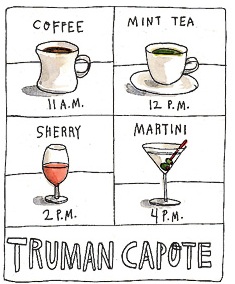
9. Truman Capote on Jack Kerouac:
“That’s not writing, that’s typing.”

I think this is in the same spirit as #15, above. And again, I loved On the Road and so disagree; but the witty jab makes me smile, all the same.

There are some other clever ones there, too. I encourage you to go poke around and tell me, which ones made you smile? Or get angry? Or feel justified?

Teaser Tuesdays: Miss Peregrine’s Home for Peculiar Children by Ransom Riggs


Teaser Tuesdays is a weekly bookish meme, hosted by MizB of Should Be Reading. Anyone can play along! Just open your current read to a random page and share a few sentences. Be careful not to include spoilers!

This book is great fun so far. My teaser comes from page 142:

We walked through the house, past more curious eyes peeping through door cracks and from behind sofas, and into a sunny sitting room, where on an elaborate Persian rug, in a high-backed chair, a distinguished-looking lady sat knitting. She was dressed head to toe in black, her hair pinned in a perfectly round knot atop her head, with lace gloves and a high-collared blouse fastened tightly at her throat – as fastidiously neat as the house itself. I could’ve guessed who she was even if I hadn’t remembered her picture from those I’d found in the smashed trunk.

ALL the Lee Child books! or, reading series in order. or, who’s your favorite?

I’m not going to call it a “challenge” or anything, it’s just something I’m going to do, someday. Having finally caught up and read ALL the Michael Connelly books – for years my favorite genre author – I immediately fell off again, when he published The Fifth Witness. I have yet to read it. I’m content knowing it’s out there, and I’ll get around to it. For that matter, it will be out in paperback soon, all the better. I have a new genre man, and his name is Lee Child.

photo credit: his website

I’ve read 9 of his books in the last 8 months or so, and I’ve been raving about him, as I’m sure you’ve noticed. So I’ve decided that clearly he’s my next conquest: I’m going to read them all. I even got on his very nice, helpful website and found a nice checklist – isn’t he clever? (Or perhaps, his marketing team?) So now I know what I’m looking for, and even in what order.

Which brings up another point. Do you read series in order? I have a number of patrons who are paralyzed by the need to read series in order. If a certain book is checked out or unavailable, it halts their reading. I’ve never been one of those people. I read all the Connelly novels, and there’s a good chance, nary a one in the order intended. And that was fine with me. I haven’t been paying any attention to order with the Lee Child books, either, although I’m happy to know and all things being equal, will aim for chronological correctness. I just don’t feel strongly enough to go well out of my way, though. I find the character development over a series to be equally fascinating when viewed out of sequence. That way, I’m viewing the author’s artistry, as well as the fictional character’s growth. As a point of interest, you might notice that Child recommends that his books be read in the sequence in which they were written, which actually puts their timeline out of order. In other words, the 8th book he wrote in the Jack Reacher series is set well before the first. Interesting.

I’m in no hurry, I’m setting no timeline, and I’m not firm on the sequence; but I do know I want to read ALL these books. (It doesn’t hurt that the Husband enjoys these books, too!) Maybe next year it will be someone different – maybe a nonfiction author like Janet Malcolm or Erik Larson. Who knows? There are so many good authors out there, and we don’t always get around to reading a whole lot or all of their work as we might mean to when we first discover their talents. Sort of like Amy’s comment about taking Agatha Christie for granted. I know you can sympathize with me here! Who have you always wanted to read more of?

And what Lee Child will cross my desk next??

vocabulary lessons: The Devil in the White City

It’s time for more vocabulary lessons! The Devil in the White City offered a wealth of learning opportunities for me.

A shot tower is “a tower designed for the production of shot balls by freefall of molten lead, which is then caught in a water basin.” It’s used in a list of miscellaneous structures in a discussion of the design of the fairgrounds.

Virga is “an observable streak or shaft of precipitation that falls from a cloud but evaporates before reaching the ground,” as in “strong gusts of wind buffeted the train, and ghostly virga of ice followed it through the night” (page 78).

Grip-cars are defined in the book itself: they get their name “for the way their operators attached them to an ever-running cable under the street” (page 13). How interesting; I didn’t know about this kind of streetcar, and I looked for a picture:

(thanks to these guys for the photo.)

According to context clues (it’s used several times), I concluded that an alienist must be a period term for psychologist, and it looks like I was right.

And here’s one I really like: a sirocco is “a Mediterranean wind that comes from the Sahara and reaches hurricane speeds in North Africa and Southern Europe.” It’s used on page 113: “In the hearth at the north wall a large fire cracked and lisped, flushing the room with a dry sirocco that caused frozen skin to tingle.” What a neat word for such a specific concept.

Some of these felt vaguely like a review; but I still had to look up calumny: “a misrepresentation intended to harm another’s reputation” and meretricious: “tawdrily and falsely attractive.”

Mucid was entirely new to me, but creepily appropriate, almost an onomatopoeia. It means “Musty; moldy; slimy; mucous.”

In addition, I looked up a number of names, of celebrities of the times. Some I knew and needed to know better; some were unknown to me.

This book was rich with vocabulary-learning opportunities. Have you learned anything new from your reading lately?

please share an opinion: deckled edges

I’ll begin with some educational resources in case we’re not all up to speed.

According to Merriam-Webster Online, a deckled edge is “the rough untrimmed edge of paper left by a deckle or produced artificially.” Way to use the word in its own definition, Merriam-Webster. There was a time in printing when a book would be printed on a long roll of paper which was then folded over and bound, leaving some pages folded closed, thusly:

The reader would then use a paper knife to cut the pages to read the book, leaving the pages rough and jagged-like.

Today, we mostly don’t make books like this any more. (I say “mostly” because surely there’s an obscure little press somewhere… who knows.) But many books, especially when they’re trying to be arty, are being machine-made with “deckled edges.” This mimics a historic printing method, presumably making the reader feel she’s been transported to another era.

Now, there are plenty of discussions of this method and its virtue as art or its flaw as pretension. I don’t have a horse in that race. I’m not impressed by the art or offended by the pretension. Well, I guess if you pressed me, I’d say new things made to look old are a little silly in many cases. But that’s not my gripe.

My gripe is with utility. I’m a booklover, but I love them for what’s inside them, not so much for the container. I mean, I DO love books – books themselves – I’m not going to be an e-reader convert anytime soon! But to me a book is a book: mainly a vehicle to get those words inside my head. And the deckled edges make it difficult to turn pages and difficult to turn back to a specific page I have in my notes. This is getting between my head and those words! I am frustrated! Please, no more deckled edges!

(This rant has been fermenting inside my head for I don’t know how long, but this post was finally stirred up by the two paperback copies of Zora Neale Hurston’s Their Eyes Were Watching God I had to choose between. One had underlining and margin notes. The other had deckled edges [and was otherwise beautiful]. What to do? What to do? What would YOU have done?)

Does anybody else have a frustration with this? Or, do I blaspheme? Please emote. (And vote in my poll.)

book beginnings on Friday: Two for Texas by James Lee Burke

Thanks to Katy at A Few More Pages for hosting this meme. To participate, share the first line or two of the book you are currently reading and, if you feel so moved, let us know what your first impressions were based on that first line.

I couldn’t resist a historical novel – NOT mystery – by James Lee Burke.

According to the back-of-the-book blurb, this very short little book (under 150 pages) involves two convicts escaped from a Louisiana prison who play a role in the Texas Revolution. It begins:

The first day that Son Holland arrived in the penal camp, manacled inside a mule-drawn wagon with seven other convicts, he knew that he would eventually escape, that he would die before he would spend ten years in a steaming swamp under the guns and horse quirts of malarial Frenchmen with Negro blood in their veins and a degenerate corruption in their hearts. But he was just barely nineteen then, still sufficiently naive to believe that his will alone was enough to win his freedom. He didn’t know that almost two years would pass before his escape would come almost by accident, and that he would have to help murder a man to accomplish it.

Yes, I’m from Texas, and yes, I had to look up quirt: “a riding whip with a short handle and a rawhide lash.”

I feel hooked already! I love James Lee Burke, and a slim little book like this just begs me to devour.

What are you reading?

The Devil in the White City by Erik Larson

THIS is how I like my nonfiction! See, Castaneda? Like this! I can’t exactly explain the difference. There’s just something very narrative, conversational, interesting about this. Similarly, Dethroning the King, Janet Malcolm, Annie Londonderry, etc. It’s not sensationalist; it’s just exciting. Written like a thriller or like a work of fiction, but no less serious a work of nonfiction for it. How to explain? Let me quote a very average paragraph for you, from page 27:

Each man recognized and respected the other’s skills. The resultant harmony was reflected in the operation of their office, which, according to one historian, functioned with the mechanical precision of a “slaughterhouse,” an apt allusion, given Burnham’s close professional and personal association with the stockyards. But Burham also created an office culture that anticipated that of businesses that would not appear for another century. He installed a gym. During lunch hour employees played handball. Burnham gave fencing lessons. Root played impromptu recitals on a rented piano. “The office was full of a rush of work,” Starrett said, “but the spirit of the place was delightfully free and easy and human in comparison with other offices I had worked in.”

See, that second sentence is long and convoluted and uses biggish words, but it flows and communicates; it doesn’t impede communication, and what it certainly doesn’t do is brag.

All right, rant aside, this is an excellent book! I started it Friday night and finished it Sunday afternoon. Not to repeat the back-of-the-book blurbs, but this work of nonfiction absolutely reads like a thriller; it’s difficult to put down. Very enjoyable. After years (literally) on my TBR shelves, I picked it up because I had such a groove going, after Annie Londonderry and Clara and Mr. Tiffany, two books set in the same era with overlapping locations – Annie in New York, Boston, and Chicago as well as all around the world, and Clara in New York, with the Chicago World Fair playing a role as well. I enjoyed both of these books so much, and especially the extra immersion in time-and-place I got by reading them back-to-back, that I wanted to go straight into The Devil and the White City next. And I’m so glad I did.

The story is this: Daniel H. Burnham, along with a huge cast of other talents and characters and against all odds, pulled together the World’s Columbian Exposition of 1893, better known to us as the Chicago World Fair. Concurrently, a man named Herman Webster Mudgett but known by his most-used alias, Dr. H.H. Holmes, murdered an unknown number of people, at least 27 but estimated as high as 200, in Chicago on the very edge of the fair grounds. Larson tells the story of the fair, of the serial murders, and of a larger time-and-place from the points of view of these two men, mostly, with side journeys into several other lives.

The World’s Fair is a character unto itself, as is the city of Chicago. Larson gives us the styles and morals of the time, and helps us to understand how it was that dozens of people, mostly young women experiencing a freedom unknown to their parents’ generation, could disappear into Holmes’ grasp. We see the wonder and beauty and ambition and angst of those who worked to produce the landmark event that was the White City, as the fair was known. We see the everyday struggles that allowed Holmes to methodically go about his evil pleasures.

Larson walks a fine line in trying to enter the heads of historical figures, especially the elusive Holmes, and still call his book nonfiction; but he’s got me convinced. He points out that everything in quotation marks is attributable, and defends the two murder scenes he chooses to portray with the evidence available to him in his research. In fact, as an aside, I enjoyed his “Notes and Sources,” and the brief story of his research there. He even mentions, in some cases, in which library or rare book room he found a particular elusive source. Further, also from Notes and Sources, page 395-6:

I do not employ researchers, nor did I conduct any primary research using the Internet. I need physical contact with my sources, and there’s only one way to get it. To me every trip to a library or archive is like a small detective story.

I know all of us booklovers (and librarians) enjoy that.

This is an engaging, riveting read. The historical value is vast. I’m always amazed by how the pieces of our history fit together. Am I the only one? I feel like there are so many names, personalities, and events in our history, but we learn them as individual bits; it’s always a little thrill when they come together in ways I don’t expect. For example, reading that Elias Disney worked as a carpenter and furniture-maker in the building of the fair, and went home to tell his sons, including little Walt, stories of the “magical realm beside the lake.” Isn’t that a charming little anecdote? Several of these connections are left in suspense, too; if your history is a bit weak in the right places, as mine was, you get these happy little surprises. I like that.

I found this book captivating, and I recommend it as a pleasurable read that may sneak some learning in on you. I invite readers of thrillers and evocative nonfiction to enter this fantastic, glittering, magical, and deadly – and true – world.