fiction as politics

No, I’m not going to talk about the fiction of Bill O’Reilly or Glenn Beck.

Shelf Awareness reports:

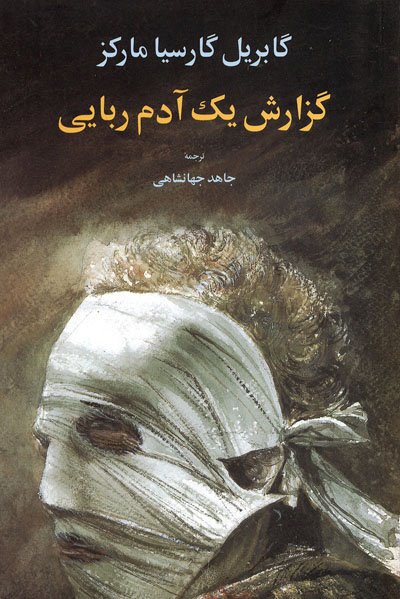
García Márquez Novel a Bestseller in Iran

Copies of Gabriel García Márquez’s 1996 novel News of a Kidnapping have sold out in Tehran’s bookshops this week “after detained opposition leader Mir Hossein Mousavi said the book’s description of Colombian kidnappings offers an accurate reflection of his life under house arrest,” the Guardian reported. Mousavi and opposition leader Mehdi Karroubi have been under house arrest since calling for mass protests last February in solidarity with other pro-democracy movements in the Arab world.

Last week, Mousavi was permitted to meet briefly with his daughters, and told them: “If you want to know about my situation in captivity, read Gabriel García Márquez’s News of a Kidnapping.” Word spread quickly online, “prompting hundreds of opposition supporters to seek out the book. Queues formed in some bookshops, and copies of the book sold out within days,” the Guardian wrote.

The news was also shared on García Márquez’s Facebook page, which linked to a Radio Free Europe blog post reporting that Mousavi’s supporters had launched their own Facebook page, “News of a Kidnapping, the status of a president in captivity,” and that “a number of Iranian websites and blogs have made an electronic version of the book in Persian available for download.”

I find this very exciting and interesting in so many ways. Marquez wrote a work of fiction in 1996 that has become incredibly relevant and interesting to a demographic he may have never originally specifically intended; it’s speaking to modern events that he couldn’t have foreseen (again, at least not specifically). Let this be an rebuttal to those that argue that fiction has no real-life important purpose! Commercially speaking, it can’t be a bad thing from Marquez’s perspective that he’s selling more books; but I’d wager he is more pleased that his work is speaking to current events and, hopefully, helping the cause of democracy.

Another interesting aspect of this short news piece, as reported by Shelf Awareness, is in the rapid-fire social networking/media communication of Mousavi’s recommendation, and the distribution of the Persian translation. As in the recent Egyptian protests, these relatively new media are aiding social and political causes. I think it’s interesting to see media technologies changing the way we do the business of the world. And to see these lessons tied back to BOOKS is kind of inspirational for me.

I’m no expert in Iranian politics and don’t claim to be. But the power of the media, communications and social networking, and most especially, 15-year-old works of fiction on today’s political turmoils is worth noting.

Does this catch your imagination as it does mine?

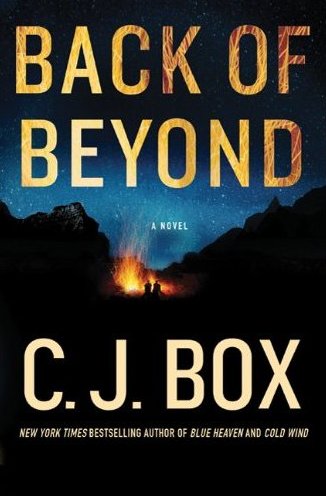
Back of Beyond by C.J. Box

A fast-paced, twisty thriller set in the backwoods of Yellowstone in which an alcoholic cop tracks a killer, hopefully in time to save his son.

Cody Hoyt’s job as a policeman in Helena, Montana teeters delicately in balance with his self-destructive behaviors. He has nearly two months sober when he’s called to the scene of his AA sponsor’s death: Hank Winters and his cabin are burned nearly beyond recognition. Cody spins off into a drunken relapse, mistakenly shoots the county coroner, and heads out of town in search of Hank’s killer–against orders, since the local authorities see no signs of foul play. But Hank’s death is just the beginning. It seems that a brutal killer has joined a backcountry horseback-riding trip into the depths of Yellowstone–along with Cody’s son, Justin. Reeling with the DTs and enraged by Hank’s murder and the threat to Justin’s safety, Cody sets out into the wilderness to bring down a killer and bring his son back safe, even as the bodies pile up around them.

Sympathetic secondary characters include Cody’s long-suffering partner Larry, a still-hardy retired wilderness outfitter who agrees to take Cody into the backcountry, and a precocious young girl on the pack trip. Yellowstone’s natural beauty is partly overshadowed by the very real dangers, both natural and manmade, that the motley crew of near-strangers encounters in this adrenaline-charged setting. Far from civilization, there is no lack of suspects, and everyone wonders who can be trusted. While Cody searches for a killer, multiple plots intertwine and complicate beyond what he’s imagined, and he’ll have to follow Justin to the very precipice to save him.


I wrote this review for Shelf Awareness for Readers. To subscribe, click here, and you’ll receive two issues per week of book reviews and other bookish fun!

On Bicycles ed. by Amy Walker

An exhaustive how-to manual and impassioned plea on behalf of riding bicycles for transportation and as a way of life.

Editor Amy Walker is joined by some 30 authors–policy-makers, researchers, business owners, activists, parents and/or cyclists–in this instructive manual. On Bicycles is not concerned with colorful Spandex, racing bikes or speed. Rather, this is a handbook for North Americans who want to use bicycles for commuting, transportation and fun.

The book covers a range of subjects and possible needs. First, why we ride: for better health, for the environment, for a better connection with our communities. Next, chapters cover what gear is needed, how to ride safely in various conditions, how to make the transition away from the car; how to transport kids by bike and how to get them on bikes themselves; how to use a bicycle for cargo needs; different kinds of bicycles; community services and connections including and beyond the retail bike shop; and redesigning our infrastructure and culture to allow for more and better biking. Your experienced-cyclist-and-book-reviewer learned new things; the novice rider will be thoroughly equipped with information and empowered by the enthusiasm pouring off these pages.

Walker’s examples come largely from that exemplary bike town, Portland, Ore., and some of her discussion feels a bit removed for cyclists in, say, Houston–but her arguments and advice are more, rather than less, relevant for cities (and riders) with further to go before reaching cycling nirvana. The only caveat: if you are in the camp that occasionally resents Portland’s reputed smugness, you may find a touch of that here. But it might be worth the stellar and scrupulous advice.


This review originally ran in the September 20, 2011 issue of Shelf Awareness for Readers. To subscribe, click here, and you’ll receive two issues per week of book reviews and other bookish fun!

Teaser Tuesdays: Tripwire by Lee Child (audio)

Teaser Tuesdays is a weekly bookish meme, hosted by MizB of Should Be Reading. Anyone can play along! Just open your current read to a random page and share a few sentences. Be careful not to include spoilers!

Love my Lee Child on audio, y’all. It was especially fun to find this one starting off in Key West, since we (thought we) were headed there on vacation a few weeks ago. Not that Reacher sticks around in Key West for long, though; this one mostly finds us in New York, so far.

Here’s your teaser:

An hour later Reacher was drifting down Duval Street, thinking about new banking arrangements, choosing a place to eat an early dinner, and wondering why he had lied to Costello. His first conclusion was that he would cash up and use a roll of bills in his pants pocket.

Stop back by and I’ll have a review for you shortly! What are you reading this week?

fiction vs. non

I’ve talked a few times recently here at pagesofjulia about fiction and nonfiction. (See for example my discussion of the value of fiction.) Most recently, in my review of In Cold Blood, I ponder the fine line between the two. Sometimes it’s difficult to tell. How do we draw the line? Here at the library, for cataloging purposes, I use OCLC’s bibliographic record; but there is often room for debate. Ernest Hemingway (obviously) is my go-to example of an author of fiction which is so highly autobiographical as to raise eyebrows; and for that matter, he was also an author of nonfiction that may have fudged here and there (i.e. his journalism in times of war in which he claimed a heroic or brave role for himself). And then there are the James Freys and Greg Mortensons of the world, who claimed to be writing nonfiction and later were accused of either smudging their facts or wholly making things up. So, my point is, the line between fiction and nonfiction (a) can be fuzzy and (b) is an important line to be aware of – even when we can’t draw it firmly.

I came across a short article the other day that I want to share it with you here. Robert Gray’s column at Shelf Awareness, is called “Deeper Understanding.” He recently wrote Conquering Our National Fear of Fiction, in which he notes that President Obama has been criticized for reading fiction. He then makes arguments – and quotes studies – in favor of reading fiction for education, and for improving ourselves. His message is one I definitely get behind (again, see my discussion of the value of fiction).

I love reading nonfiction. I think I love it more every year. There’s so much in the history of our world – and in what’s happening in our world today – that’s fascinating and that we should be aware of. Of course, I’m not doing an exceptional job of keeping up on everything. There’s too much to know. But I do enjoy nonfiction. In fact, I feel like I’ve read an awful lot of it this year – but when I look back at my Books Read log, I see that fiction still massively outnumbers nonfiction. Maybe I had a misconception because so much of the fiction I read is very short, and some of nonfiction is quite long, so the time spent on each might be closer to equal… maybe I’m making excuses. My point is, I have nothing against nonfiction, and should read more than I do. But! Fiction! Not an ugly stepchild at all!

So, for discussion here if you please: Do you read mostly fiction, or non? What is the value of each? In other words, is fiction frivolous and nonfiction valuable, or does fiction have a great deal to offer us as people, as a society? Why? What authors have you come across who smudge the line between the two? How strongly do you feel about defining the line, and how do you go about it? For example, is In Cold Blood fiction or non? Or some strange hybrid?


For your reference, I’ve linked here to a few of my favorite nonfiction reads of the last year or two…
Around the World on Two Wheels: Annie Londonderry’s Extraordinary Ride, Peter Zheutlin
Dethroning the King, Julie Macintosh
The Devil in the White City, Erik Larson
Fire Season, Philip Connors
Heroine’s Bookshelf, Erin Blakemore
Iphigenia in Forest Hills, Janet Malcolm
Mr. Playboy, Steven Watts
Hemingway’s Boat, Paul Hendrickson
Newspaper Titan by Amanda Smith

two-wheeled thoughts: Anonymous

two-wheeled thoughts

Good health to all, good pleasure, good speed,
A favoring breeze – but not too high
For the homeward spin! Who rides may read
The open secret of earth and sky.
–Anonymous, Scribner’s Magazine, June 1895, as quoted in Around the World on Two Wheels

And today I must add: my knee is getting better. I’m out of PT and back on the bike, on shorter road rides (yesterday I got up to 3 hours, although it was depressingly challenging). Today is a happy day: I am off to Huntsville State Park for my first mountain biking in almost 3 months! Cross your fingers for my knee and my fitness level. 🙂 If I’m not too unhappy with my performance I’d love to race the Dave Boyd Memorial Huntsville race in a few weeks…

Those are my two-wheeled thoughts for the day.

Some Tame Gazelle by Barbara Pym

I have finished reading one of the two books that Thomas of My Porch sent me. You done good, Thomas, I found it charming and funny. Pym is not entirely different from another Barbara I recently discovered, through Stuck in a Book: Barbara Comyns, whose Who Was Changed and Who Was Dead I really enjoyed. Simon, Thomas, anyone, if you can help me come up with a better genre tag for these ladies than “misc fiction,” I’d be obliged. Do these count as “domestic fiction” or whatever they call Jane Austen? Sorry, I’ll get on with it…

Some Tame Gazelle is the story of two spinster sisters, Belinda and Harriet, in a little English village in the 1950’s or thereabouts. We get the story from Belinda’s perspective primarily. She’s the dowdier and more humble of the two sisters, and her day-to-day life revolves, perhaps more than she realizes, around the local Archdeacon, who she knows and still loves as Henry from their school days. Henry is married, of course, and she resignedly sighs and gently envies his difficult wife Agatha, with whom he does not seem entirely happy, and alternately resolves to be a friend to her. Harriet, on the other hand, is still regularly refusing marriage proposals (mostly from the same man, Ricardo, an Italian count who Belinda rather wishes she would marry). Harriet is a bit sillier and prouder than her sister, but they depend on each other and are very much settled in their life together.

We read about this little village, where the sisters have tea, buy groceries, attend church, and help out with church functions. Where Belinda is devoted to the Archdeacon and worries over what garments she can appropriately knit for him, Harriet attaches herself to one curate after another and teases Ricardo and criticizes Belinda’s beloved Henry. Day follows day.

Sort of like what I said about the Comyns novel, this is a quiet book; there aren’t loud noises; you don’t jump in your seat. But my, is it ever quietly funny. Pym is compared to Austen, which I guess makes sense, but they’re not so similar you’d confuse them or anything. Part of this I suppose is the subject matter, that is, spinster ladies vs young women chasing marriageable men of independent wealth. (And I haven’t done my Pym research so don’t know if this is her standard subject material.) But I suppose the tone is comparable to Austen: people are so confined by custom and what the neighbors might think that they do silly things, and worry about silly things, and certain gentlemen do even sillier things that the women make excuses for. It’s a humor of quiet, respectable absurdity.

It also has in common with Austen, a female preoccupation with marriage. I don’t want to give anything away, but there are marriage proposals and there are weddings (okay, only one is onscreen), and there is much agonizing over marriage. There is also some rather blasphemous talk of spouse-switching – all completely theoretical and private, of course.

This book is set firmly in religion; most of the main characters are clergy, or obsessed with a member of the clergy, and all are church workers. This was a little foreign for me, someone with no church or religion in her life (don’t pity me, I’m very happy this way, and I don’t like being judged either, thanks) but I think I followed along okay. It’s not “Christian fiction” in any way; the church is just the backdrop. If anything, the church is an object of some merriment too, since the clergy tend to behave at least as ridiculously as anyone else.

Without getting too spoilery, I’m going to stop here in discussion of plot, but I want to note the title. The book opens with a Thomas Haynes Bayly quotation:

Some tame gazelle, or some gentle dove:
Something to love, oh, something to love!

Which perhaps tells us what this book is “about” better than anything.

If you are okay with the spoilers and/or have read this book, highlight the white text below.

One of my favorite things about this book is that it came full circle and we ended up right exactly back where we started. I was worried along with Belinda that one (or the other!) of the sisters was going to accept a marriage proposal, but I was much happier ending with Harriet preparing to dote on a new curate, and back again to the first line. So this is another book in which not much happens – but it’s surprising how satisfying that can be.

Thomas! You are wonderful! Thanks so much. Can’t wait to get into The Home-Maker.

book beginnings on Friday: Into the Silence by Wade Davis


Thanks to Katy at A Few More Pages for hosting this meme. To participate, share the first line or two of the book you are currently reading and, if you feel so moved, let us know what your first impressions were based on that first line.

Into the Silence: The Great War, Mallory, and the Conquest of Everest appears to be a largeish, well-researched, exhaustive coverage of its three overlapping subjects. I’m just a bit into it but am finding it to be gripping, and painful in its discussions of the tragedy that was WWI. You know, I feel like we say this about just about all the wars (and rightfully), but what an awful thing it was…

I am going to give you a double beginning today. The prologue:

On the morning of June 6, 1924, at a camp perched at 23,000 feet on an ice ledge high above the East Rongbuk Glacier and just below the lip of Everest’s North Col, expedition leader Lieutenant Colonel Edward Norton said farewell to two men about the make a final desperate attempt for the summit. At thirty-seven, George Leigh Mallory was Britain’s most illustrious climber.

And chapter one:

On the very day that George Mallory and Sandy Irvine disappeared on Everest, another party of British climbers slowly made their way to the summit of a quite different mountain and in very different circumstances. At 2,949 feet, Great Gable was not a serious or difficult climb, but it was said to be “the most completely beautiful of English mountains.”

So you can see the juxtaposition set up. I find this to be an effective way of linking his topics (see the subtitle) right from the start.

A word on nonfiction book beginnings: Unlike in fiction, where I feel the first lines should always grab or surprise the reader and interest her, I think nonfiction can take one of two routes. I do like to be grabbed in the first lines, of course, and extra points are given for this. But it’s extra credit, not required work. Sometimes nonfiction begins quietly, stating a date, a place, arranging a background, and this I find effective, too. Somehow, with nonfiction, I’m comfortable settling into things with this understated approach, which I think the above falls into.

What are your thoughts? And what are you reading this weekend?

These quotations come from an uncorrected advance proof and are subject to change.

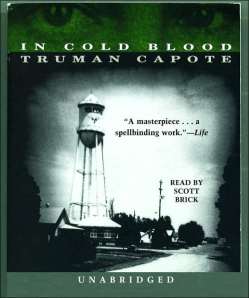
In Cold Blood by Truman Capote (audio)

Truman Capote captured my undivided attention with this medium-largeish* book in remarkable fashion. My first issue for this review: is this fiction, or non? It is most commonly referred to as a “nonfiction novel,” a term I have a lot of trouble with. The story is either based very closely on, or is, the true story of the quadruple murder of the Clutter family in small-town Kansas, and the investigation, arrest, and eventual execution of the two perpetrators. (My library’s OCLC listing calls it “postmodern fiction.”) Capote himself said, “I wanted to produce a journalistic novel, something on a large scale that would have the credibility of fact, the immediacy of film, the depth and freedom of prose, and the precision of poetry.” So, fiction or non? I’m going with fiction, but clearly this is one of those areas where the line blurs. More on that in a bit.**

I came across this book recently in several blogs, which is curious because it’s not new; it was first published serially in Life magazine in 1965, and in book form in 1966. I already had the book on my radar, but these fine fellow bloggers definitely solidified my interest. In telling you about the story, and the book constructed about the story, I’m going to be fairly spoilery, because this is history. If you want to read it yourself and be surprised, I’m not your top-choice review.

So. The subtitle reads, “A True Account of a Multiple Murder.” On the night of November 15, 1959, the Clutter family was bedding down on their farm in Kansas, just outside the small town of Holcomb, itself a suburb of Garden City. Herbert Clutter, the patriarch, was a respected member of the community and devout Methodist; his wife Bonnie had been suffering from depression and had been in and out of hospital, but at this time was home. Sixteen-year-old Nancy, the belle of local society, sweet, talented, generous, and universally beloved, had just sent her boyfriend Bobby home and was getting ready for bed. Fifteen-year-old Kenyon was slightly socially awkward but friendly and respected as a member of a well-liked and important family. The two older Clutter daughters were living on their own outside the home – one married, one about to be.

Meanwhile, two paroled convicts of the Kansas state prison system were on the road. Perry Edward Smith and Richard Eugene “Dick” Hickock had been cellmates and although very different in temperament, had teamed up for an endeavor that Dick described as being the perfect crime. As you’ve already guessed (or already knew), these six characters converge when Dick and Perry kill the Clutters in the night and make off almost as perfectly as Dick imagined. They spend months traveling, living briefly in Mexico where Perry hoped to become a successful treasure hunter, and then roaming the US again until they were apprehended in Las Vegas. They were tried in Kansas, convicted, and finally hanged in April of 1965.

Capote follows both groups of characters – the Clutters, and Perry & Dick – alternately in the days leading up to the night of the murder. Then he follows Perry and Dick in their roaming, and then through their imprisonment and trial, and right up to the hangings. His voice is omnipotent third person, and he quotes extensively from letters, documents, and trial proceedings, as well as from his interviews with various players and especially Dick and Perry themselves. Capote was on the case (so to speak) well before they became suspects, and published after they were killed, so his perspective and the timeline of his coverage is pretty extensive.

But, perhaps not entirely objective. The Clutters are painted in admirable detail, in lovely little vignettes. But their role is minor and short-lived (ouch, pun not intended). And of the two killers, Perry Smith is treated far more sympathetically and examined more deeply. I was pondering this as I listened to the book, wondering if this was all Capote’s apparent subjectivity, or if Perry was inherently more sympathetic; in other words, would I have found him so if I had been researching this case myself? There are a few fairly easy markers for this, at least for me: for one, Dick liked to rape little girls. Perry apparently stopped him from raping Nancy (by both their accounts). Dick ran over stray dogs with his car for fun, which Perry found revolting (as do I, obviously). Perry’s childhood was patently rough, while Dick’s is characterized as fairly normal. Perry seems to more clearly have a mental illness or defect that “causes” his criminal and violent tendencies. But, I’m not sure we get all of Dick’s story; Capote looks much more closely into Perry’s past. So what I’m trying to say is, I think there may be a bias in favor of poor Perry the murderer, having been manipulated by evil Dick. Apparently, it was alleged that Capote in fact had a sexual relationship with Perry while he was imprisoned, although obviously I can’t speak to that. This is not a criticism. I just want to point out that perhaps Capote is not entirely impartial with regards to his two main characters.

I found this book incredibly powerful. Capote has a fine sense of drama and of timing. Scenes and people are sketched artfully, sometimes quickly and with broad strokes that paint a pretty complete picture just briefly, and sometimes in painstaking detail. The stories of the Clutters’ deaths and Dick and Perry’s adventure and executions are fascinating and engrossing, yes. But it’s Capote’s rendering that makes this book, more than his subject matter. (I guess this is always the case.) I was blown away by the emotional effect of this story. I couldn’t get enough; I wanted more of the inside of Perry’s head, of Dick’s (ew, how creepy), of the small-town life of Holcomb and Garden City. This is my first experience with Truman Capote, and I’m a fan.


Also, as Marie said at The Boston Bibliophile, Scott Brick’s narration is excellent. I recommend this book on audio if you’re so inclined. (I also picked up a paperback, though, to have on hand. I never did reference it while listening but I think I’d like to have it for future use.)


*My audio version is 12 cd and 14.5 hours; my paperback edition is just under 400 pages.

**Back to the fact vs. fiction question. It does seem that Capote behaved like a journalist in putting this book together: gathering facts, interviewing key players, confirming dates. It could pass as “true crime,” a genre which itself may have trouble with fact vs. fiction. The biggest place where Capote appears to leave the realm of nonfiction behind is in dialogue; he has recreated a great many pieces of dialogue, mostly between Perry and Dick, that were unrecorded. He has relied upon Perry and Dick themselves in this recreation, I think, but memory being what it is, some creativity definitely come into play. I did note that on the night of the Clutters’ deaths, Capote has not tried to recreate their experience or any dialogue, except in the accounts shared by Perry and Dick in their confessions. This seems to show a reluctance to just “make things up,” and a respect for the question that (I think) still remains: did Perry kill the two male Clutters and Dick the two women, as Perry originally claimed? Or did he Perry kill all four, as he amended his story to say, and as Dick claimed all along? Capote doesn’t answer this question for us – presumably because he respects the fact that he can’t answer it authoritatively. (I do wonder what he thought, though, considering that he apparently was very close to Perry in particular.)

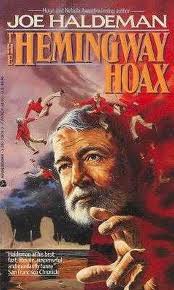
The Hemingway Hoax by Joe Haldeman

This was a delightful short read. The Hemingway Hoax was loaned to me by my friend Amy, librarian (newly, my coworker librarian! yay!), science fiction enthusiast, and science fiction author to boot. (I wrote briefly about one of her short stories here.) After my recent raving about Hemingway’s Boat (my review to come at Shelf Awareness), she lent me her signed, personalized copy, ooooh. It’s an easy read at 150ish pages; I ran right through it at one sitting.

David Baird is a college professor and Hemingway scholar. He and his (much younger, former student) wife are summering in Key West, where they meet a con man with a scheme to “find” the manuscripts of Hemingway’s early short stories, and a partial novel, that H’s first wife Hadley lost on a train in their Paris days. Baird, with his expertise, should be able to successfully forge them. In so doing, however, he gets wrapped up… transported through times… to parallel universes… meets the Hemingways of various eras… or does he? I won’t ruin the whole surprise, but there is time travel and questions about What Is Real. Some bad things happen. Or do they?

I enjoyed the Hoax. It had suspense, interesting characters, intrigue. It had Hemingway! And the Hemingway parts were well done; Haldeman knows his Papa well enough to pull this off without offending the armchair Hemingway scholar. (I didn’t pick it apart or check references or anything but it held together.) And that would have been a deal-breaker for me, of course. Not for the first time, I say: this is sci fi? I thought I didn’t like sci fi! Well done, Amy. You may keep lending me books. Thank you!