We Make Beer: Inside the Spirit and Artistry of America’s Craft Brewers by Sean Lewis

Anecdotes and observations of American craft brewing that will make readers thirsty.

beer

Sean Lewis was working as a sportswriter in 2010 when he got his first writing assignment from Beer Advocate–a profile of the infant Blue Hills Brewery in Canton, Mass. He worked there as an unpaid intern, learning the brewing ropes, and admired what he calls “the Tao of the brewmaster.” Many brewery tours and interviews later, in We Make Beer, he relates the “spirit and artistry” of craft brewers from coast to coast, from garages and barns to the largest brewhouses in the nation.

Lewis visits with major players (Boston Beer Company, Sierra Nevada, Stone), younger, smaller efforts (Nebraska, Jackalope), brewpubs and production breweries, and explores various approaches to the concept of growth. For example, Sheepscot Valley Brewing Company has chosen to stay local to Whitefield, Maine, and the community has repaid that effort, while West Coasters Sierra Nevada and Lagunitas have recently opened East Coast locations to serve their expanding markets. In language that will make readers thirst for a well-crafted pint, and with graceful transitions between topics, Lewis undertakes what is clearly a labor of love–much like the businesses he writes about. His celebration of the women and men of craft brewing is both accessible to the novice (see his one-page appendix on the brewing process, and explanation of the pronunciation of “wort”) and thoroughly rewarding for the beer aficionado. A comment about a collaboration between three breweries is equally applicable to the larger concept of Lewis’s book: “It just seemed like a fun thing to do.”


This review originally ran in the September 26, 2014 issue of Shelf Awareness for Readers. To subscribe, click here, and you’ll receive two issues per week of book reviews and other bookish fun!


Rating: 8 pints, naturally.

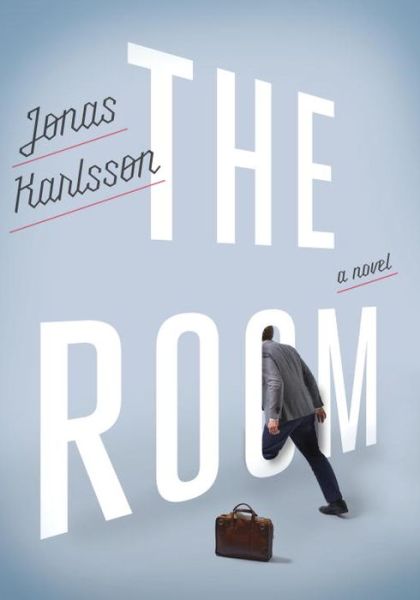
book beginnings on Friday: The Room by Jonas Karlsson

Thanks to Rose City Reader for hosting this meme. To participate, share the first line or two of the book you are currently reading and, if you feel so moved, let us know what your first impressions were based on that first line.

room

The opening lines of The Room read:

The first time I walked into the room I turned back almost at once. I was actually trying to find the toilet but got the wrong door. A musty smell hit me when I opened the door, but I don’t remember thinking much about it. I hadn’t actually noticed there was anything at all along this corridor leading to the lifts, apart from the toilets. Oh, I thought. A room.

I opened the door, then shut it. No more than that.

And I think I’ll leave it at that for you. Stay tuned.

This quotation comes from an uncorrected advance proof and is subject to change.

Planet of the Bugs: Evolution and the Rise of Insects by Scott Richard Shaw

An impassioned view of insect evolution and the awesome implications of bugs for all life on earth.

bugs

Scott Richard Shaw has been collecting bugs since he was four. Now a professor of entomology at the University of Wyoming, he shares his passion for these creatures and their cosmological significance in Planet of the Bugs.

The scope of this work is immense. Shaw begins with the Cambrian period, more than half a billion years ago, by examining the sea-dwelling arthropods that first developed body armor and mobility, and then follows them through prehistory and into the modern day. He argues for the predominance of insects, as they are Earth’s most diverse and adaptive animals and thus the best survivors over time. The dinosaurs were impressive, and we like to emphasize the importance of our own human species in earth’s history–he criticizes this human-centrism throughout–but Shaw makes an excellent case that insects “literally rule the planet.”

Planet of the Bugs is packed with intriguing trivia. Parasitic flies feed in turn on the blood of vampire bats; caddisflies are “nature’s most adept architect,” building portable, protective cases for themselves using the natural materials around them; the griffinflies of the Carboniferous period (which looked something like huge versions of the modern dragonfly) had wingspans of two to three feet; female sawflies and wasps choose the sex of their offspring.

Shaw boggles the reader with his enthusiasm and expertise, and reveals a playful side. Among his many encyclopedic turns, he waxes philosophical and indulges in metaphor and even humor, resulting in a surprisingly accessible and entertaining read. A love of bugs is not required.


This review originally ran in the September 23, 2014 issue of Shelf Awareness for Readers. To subscribe, click here, and you’ll receive two issues per week of book reviews and other bookish fun!


Rating: 7 old wings.

My Grandfather’s Gallery by Anne Sinclair

Investigations by an art dealer’s granddaughter into paintings stolen in World War II France.

grandfather

Paul Rosenberg was a successful art dealer in Paris in the 1930s, a friend to and advocate for Pablo Picasso, Georges Braque and Henri Matisse. A Jewish man, he fled his home in Vichy France in 1940, fearing for his family, his livelihood and his collection of modern masterpieces. From his new home and gallery in New York City, he campaigned for the rest of his life to recover the many valuable paintings and sculptures he lost during the war, looted by Nazis and French collaborators.

Journalist Anne Sinclair didn’t pay much attention to her maternal grandfather’s life and work as an art dealer until he was long dead. In examining old papers, however, she discovered a story that moved her and that represents the experience of many French artists and art professionals, whose collections were stolen and never returned. In My Grandfather’s Gallery, Sinclair writes that she “wanted to create an homage to my grandfather, a series of impressionist strokes to evoke a man who was a stranger to me yesterday, yet who today seems quite familiar.”

Many unidentified paintings continue to lie in museum basements throughout France even now, “awaiting the return of those who will not come back.” Sinclair, like her grandfather, acknowledges that lost lives trump lost art; but the spoliation of priceless paintings constitutes an important piece of her family history, as recorded in this deeply felt memoir. Despite an occasionally awkward translation to English, My Grandfather’s Gallery is a powerful history made personal.


This review originally ran in the September 19, 2014 issue of Shelf Awareness for Readers. To subscribe, click here, and you’ll receive two issues per week of book reviews and other bookish fun!


Rating: 5 letters.

Teaser Tuesdays: The Brewer’s Tale by William Bostwick

Teaser Tuesdays is a weekly bookish meme, hosted by MizB of Should Be Reading.

brewers tale

“A history of the world according to beer”! Who’s surprised that I needed to read this?

There is no great shortage of written words regarding beer’s important place in history: that it is part of what brought European settlers to New England; that it helped us preserve grain & feed ourselves, and take in liquid when water was unsafe to drink; that it drove us to establish settled civilizations (& agriculture). But just as I learn something new from every brewery tour I take, even into the dozens, I haven’t yet reached the point of satiation on beer-in-history. Here’s something I hadn’t quite considered in these terms before:

…if beer’s essence can be distilled to one idea, it’s this: beer is made. Our first recorded recipes were for beer because beer was the first thing we made that required a recipe, our first engineered food. Wine, for example, just happens – a grape’s sugars will ferment on their own, without a human touch; even elephants and butterflies seek out rotting fruit. But grain needs a modern hand to coax out its sugars and ferment them into alcohol.

And these lines come from the introduction! (Libraries show up on page 2.) You have my attention…

This quotation comes from an uncorrected advance proof and is subject to change.

on picking up another book by Marilyn Johnson

overdueThree people simultaneously bought me Marilyn Johnson’s previous book, This Book Is Overdue!, as I graduated from library school. (Possibly they are reading this now – sorry! I don’t even remember who they were.) I didn’t make it even halfway through. Was it uninspiring, or was it I who was uninspired? worn out from study? It’s a fine question about the intersection of book, reader, time and place; a good reading experience requires a happy meeting of all four. Maybe I would love the book now.

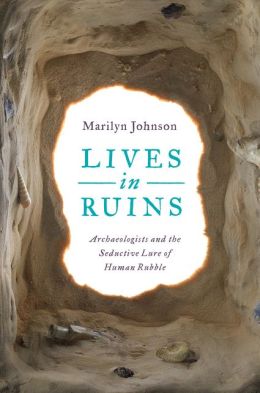
livesI’m rather encouraged to try again. The first pages of Johnson’s latest work, Lives in Ruins, reference librarians immediately – and beer too, twice in three pages; a funny story about the apocalypse is credited to a graduate student, and during an economic depression, “Dublin was running, as far as I could tell, on what spilled out of the pockets of Brits during their bachelor parties.” Johnson is self-deprecating and irreverent, and also serious and passionate about her subject (in this case, archaeologists). What’s not to love?

May have to try This Book Is Overdue! again. Perhaps three well-meaning graduation present givers were right after all.

book beginnings on Friday: Severed: A History of Heads Lost and Heads Found by Frances Larson

Thanks to Rose City Reader for hosting this meme. To participate, share the first line or two of the book you are currently reading and, if you feel so moved, let us know what your first impressions were based on that first line.

severed

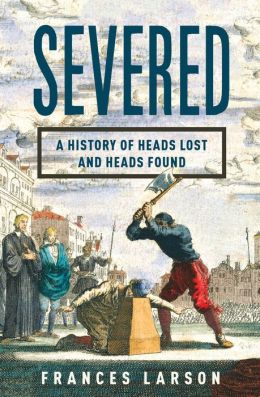
This one is eye-catching, no? The first few lines follow suit:

Josiah Wilkinson liked to take Oliver Cromwell’s head to breakfast parties. The broken metal spike which had been thrust through Cromwell’s skull at Tyburn, 160 years earlier, provided a convenient handle for guests to use while examining the leathery relic over their devilled kidneys.

It gets a little more gruesome from here, as you might expect, but gratuitous gore it isn’t. It looks (early on) to be a thoughtful examination of the heads in our history, from an anthropological standpoint. And assuming you’re up for, you know, severed heads – I think it will be quite good.

This quotation comes from an uncorrected advance proof and is subject to change.

Tortilla Flat by John Steinbeck (audio)

tortillaTortilla Flat is set in the neighborhood by that name in post-WWI Monterey, California, and involves a group of paisano friends. Perhaps I am just being lazy, but I do think that Steinbeck himself can tell you best what the book undertakes. I give you the first paragraph of his Preface:

This is the story of Danny and of Danny’s friends and of Danny’s house. It is a story of how these three became one thing, so that in Tortilla Flat if you speak of Danny’s house you do not mean a structure of wood flaked with old whitewash, overgrown with an ancient untrimmed rose of Castile. No, when you speak of Danny’s house you are understood to mean a unit of which the parts are men, from which came sweetness and joy, philanthropy and, in the end, a mystic sorrow. For Danny’s house was not unlike the Round Table, and Danny’s friends were not unlike the knights of it. And this is the story of how that group came into being, of how it flourished and grew to be an organization beautiful and wise. This story deals with the adventuring of Danny’s friends, with the good they did, with their thoughts and endeavors. In the end, this story tells how the talisman was lost and how the group disintegrated.

And that is, very much, what the book is about.

Danny inherits two houses from his grumpy grandfather upon returning from the war. He is astonished by his good fortune and newfound riches, but also dismayed at the great responsibility of owning property. He takes in friends, one by one by one, and they become a strange, disordered household. It is true that critical readings of this book treat it as an interpretation of the knights of King Arthur’s Round Table; but I think it’s worth pointing out that these men are a rather dirty, devious, and intermittently disloyal version thereof. They steal from each other on occasion; and their main purpose in life is to obtain wine, and drink it. Not necessarily a bad thing. Steinbeck writes as impressively as ever about the wine:

Two gallons is a great deal of wine, even for two paisanos. Spiritually the jugs maybe graduated thus: Just below the shoulder of the first bottle, serious and concentrated conversation. Two inches farther down, sweetly sad memory. Three inches more, thoughts of old and satisfactory loves. An inch, thoughts of bitter loves. Bottom of the first jug, general and undirected sadness. Shoulder of the second jug, black, unholy despondency. Two fingers down, a song of death or longing. A thumb, every other song each one knows. The graduations stop here, for the trail splits and there is no certainty. From this point anything can happen.

You might also call it a picaresque, being full of minor adventures that often run to humor and pathos by turns.

My audio version is narrated by John McDonough, and I like his interpretation very much. The Spanish-in-translation word order and sentence structure gives an accurate paisano feel, and McDonough reflects that in the lilt and rhythm of his speech. (Note that I did not say he puts on an accent.) I enjoyed hearing this story told. I did not always like the players, but that’s not a requirement for liking a book.

I won’t rate this one above the best of the Steinbeck I have read, Cannery Row and Of Mice and Men. But it is recognizably Steinbeck, and worth the time.


Rating: 7 jugs of wine, naturally.

How to Build a Girl by Caitlin Moran

The self-made girl of Caitlin Moran’s debut novel is irreverent, painfully self-conscious, triumphant and very funny.

moran
The wise and hilarious Caitlin Moran (How to Be a Woman; Moranthology) makes her first foray into fiction with How to Build a Girl, and this novel is everything her fans will expect it to be.

It is the early 1990s. Johanna Morrigan is 14 years old and lives in Wolverhampton, England, with her parents and four siblings: an older brother, a younger brother and two babies without names (known long-term as the Unexpected Twins). They are all on government assistance, or benefits. Her mother is depressed and her father is still distributing the demo tapes of his youth, sure that one day he’ll be a rock star. Johanna is desperate to leave behind Wolverhampton, benefits and her virginity.

Her big chance comes when she scores a television appearance during which she will read aloud her prize-winning poem on the theme of “Friendship.” However, she fails to make her family proud, instead surprising even herself with a shameful impromptu Scooby-Doo impression. Deciding that being Johanna Morrigan is a losing proposition, she sets about methodically building the girl she wants to be: she christens herself Dolly Wilde (after Oscar’s niece), and decides to become a music critic. With no money to acquire the latest albums, however, she is resigned to ordering them through the local library.

Dolly Wilde is constructed on the music of Hole, Bikini Kill, David Bowie and Kate Bush; the writing of Dorothy Parker, Orwell and Kerouac; and a blind ambition to reach London. She sends in one album review per day for 27 days until, amazingly, she is hired to review albums and performances for Disc and Music Echo. From Dolly’s very first encounter with live music, this gig ushers in an era of drink, sex and eventually drugs; she happily pursues the lifestyle of the rock stars she admires, but is challenged to reconcile this new life with her household of seven back at home in Wolverhampton.

In order to fall in love with the clumsily charming and often heartbreaking Johanna, readers will want to check their inhibitions regarding four-letter words and copious masturbation. Puzzles as stale as the difference between love and a casual hookup become fresh in this young woman’s vigorous, enthusiastic and ever-misguided perspective. Moran is cheeky, intelligent, thought-provoking and laugh-out-loud funny, and reminds us that we are always learning and rebuilding, no matter our origins.


This review originally ran in the September 9, 2014 issue of Shelf Awareness for the Book Trade. To subscribe, click here.


Rating: 9 cigarettes.

Teaser Tuesdays: Gretel and the Dark by Eliza Granville

Teaser Tuesdays is a weekly bookish meme, hosted by MizB of Should Be Reading.

gretel

This is a delightful blend of dark, gloomy fairy tale, historical fiction, and horror. I don’t want to say anything more about it at this point, but I think I’ve found a real winner.

For now, enjoy these lines, which are a fine example of the emphasis placed on the importance of storytelling.

“When I make up stories I’ll write them down so they won’t disappear or be changed.”

Greet shrugs. “Then they won’t be proper stories, will they?”

Also, who doesn’t love a little girl who thinks this:

When I grow up I shall be a famous author like Carol Lewis or Elle Franken Baum, but the girls in my books will be explorers, they’ll fly planes and fight battles, not play down holes with white rabbits or dance along brick roads with a silly scarecrow and a man made out of metal.

Stay tuned. Gretel and the Dark looks like a star.

This quotation comes from an uncorrected advance proof and is subject to change.