art and dirt

[I recently read Theo Pauline Nestor’s Writing Is My Drink, but my review won’t be published at Shelf Awareness for another week or two.]

I remember from Natalie Goldberg this thing that I also recognize in Theo Pauline Nestor: an aversion to the outdoors, a lack of appreciation for nature. It is apparently something to be avoided, cleaned off your shoes if you accidentally step in it, and this is every bit as disturbing to me as the people who react to the idea of exercise by saying that they “don’t like to sweat.” What!! What a bizarre concept, to not like to sweat. Sweat is not the first or primary goal of exercise, I want to tell them, any more than getting dirty is the primary goal of going outside; but both results (and they cross over quite a bit) feel good because they are of the nature of their parent: exercise, and the outdoors.

Nestor writes, of camping: “life’s hard enough; why turn it into a three-ring circus by trying to rub sticks together just so you can boil water for morning coffee?” And then later, in praise of her medium: “writing comes from the wild place, from the home of the undomesticated, the untamed, the feral.” As if that is a good thing. How can the undomesticated, the untamed, the feral, the wild place, be a good thing if camping is a bad thing? And oh how simplistic (and ill-informed) her picture of camping: that it involves rubbing sticks together, for chrissakes, to make coffee!

Why the disconnect? Why does art have to take place in clean and civilized environs? Don’t get me wrong, I like a good coffeeshop too; but I worry that there’s something missing from a person who appreciates art and beauty and yet thinks camping is an unnecessary complication. Some of us feel that camping is a necessary reduction in complications, in fact: think on that for a moment. You can even forgo the coffee and use trees and sky as your stimulant! I want to be clear that I very much enjoyed Goldberg’s Writing Down the Bones and Nestor’s Writing Is My Drink, and I found both useful. But I think I’m bound to identify better with Philip Connors and Christine Byl, artists unafraid to get dirty.

guest post: Mom’s recent reading adventures

Mom says…

Just thought I would share some recent reading adventures.

I just started Rules of Civility which immediately captivated me.

Just finished Leonard Rosen’s The Tenth Witness, part of his Henri Poincare series (book two). I loved the previous one more, but was swept along by this one, even with some flaws. He explores the soul and the tendency among some to be cruel and unconcerned about humans, as well as the incomprehensible ability – of others – to be full of love and compassion. The recent one took on the Nazis and WWII. All Cry Chaos (book one) was so good that I bought it in audio, although I haven’t gone there yet. The protagonist is a descendent of Poincare the mathematician, and that plays a bit part. More importantly, he’s a Frenchman who travels as part of his work, and sees a lot of places that I at least know. Amsterdam has a roll in the first, and in the 2nd, the Wadden Sea and the island of Terschelling. There he takes on the mud walking on the flats that is so popular with the Dutch, and makes a case for its attraction.

Mom is not only a world traveler but a mathematician, herself.

And before that I read in succession Wolves Eat Dogs, by Martin Cruz Smith, and The Sky Unwashed by Irene Zabytko, both of which have a focus on the Chernobyl nuclear disaster which killed a few hundred thousand at least. There’s also Georgi Vladimov’s Faithful Ruslan, a dog’s story (told by the dog) as parable: we cannot get beyond our training, even to save ourselves. It was circulated by hand as samizdat for years. Those three along with the Penguin books (Death and the Penguin, Penguin Lost) are all set in the Soviet sphere or Soviet Union – or Russia – and they all take on the attitude toward life that that history gave people. A bleak hopelessness combined with determination made survival possible for some, but they carried the black memory of their lost families and co-strivers. The Sky Unwashed is set completely in the Ukraine during the catastrophe of 1986, with some of the people living like peasants of an earlier century, and many returning to the forbidden sites to continue to live that way, gardening and tending a cow or pig, even as there are whole pine forests of standing trees killed by radiation. Smith has been here before (Gorky Park, etc), and knows the territory. His treatment may be even more devastating, love and desperation and ambition mixed so completely, with the hopelessness of the system still a palpable part of people’s psyche. These books are set in a society where being drunk and incompetent at work was not out of the ordinary, and there is no sense of duty to the public: police and social worker are driven by bribes and ambition or a perverse sense of cynicism (is that a contradiction?).

Contradiction? No. Redundant? Perhaps; but no, I think I’m with you here. Perversely cynical.

Enough of that! I started out to tell you about Collapse. I always enjoy stories about other cultures, so anthropology with some lessons makes for a good read, even without considering the lessons for today. Jared Diamond tells at the end about his conversations with students about this material, as he taught a course with the plan to write this book. The students couldn’t imagine how these people could have cut down the last tree that also doomed them – how could they knowingly do that? He even cites an academic who sees this as impossible (speaking about some collapsed ancient society) because cultures are more purposeful and self-aware, self-preserving. There are too many counterexamples for this to be valid of course, and where does that leave us? His conclusions leave some hopeful possibilities, as well as the not-so-hopeful outcomes.

Diamond tells a striking story set in an airport. We see the ID checking, the security machinery, the computer screens with the little piece of paper that tell who you are and where your seat is. It is clearly a lesson in pervasive technology, but wait! His point is that he is in an airport in New Guinea, where we have been talking about a society that was only found in the last century, and all the faces are very like those of the ‘primitive’ people we see in photos from the ’30s. His point is that we are much more connected that in the past, when some societies were able to collapse separate and unknown to the rest of the world. (One of the principles of collapse is connection to neighboring societies, whether as trading partners who fill a need, or as competitors or simply antagonists that further the collapse.) So globalization is both positive and negative in the social equations of collapse and survival.

Many more thoughts about this book, but no definitive answers – did I expect that?

Aside from Rules of Civility which of course I bothered her to read, much of this was new to me! I did read and enjoy Jared Diamond’s The World Until Yesterday, and I recognize him from her brief description here. In fact, I could swear I’d read that airport scene before; or maybe Mom had already told me about it? Funny. At any rate, Mom, I enjoyed this glimpse into your reading life – as diverse as any – maybe that’s where I got it?? A fine legacy! I was just reminiscing the other day over the authors my mother has introduced me to – James Lee Burke, Michael Connelly, Elizabeth George (who is becoming less appreciated, sadly), and Lee Child who I’ve brought to her attention. But better than any of these genre authors is having inherited eclectic reading interests. Thanks, Mom.

from the New Republic: on books

Thanks, again, to Liz for sending this along. The New Republic‘s issue of October 21, 2013 featured a cover focus on books and publishing, with five articles included. They range from a one-page infographic to 3 pages long; no serious time commitment here, although you will have to find them. I accessed these stories through a database (Ebsco, if you’re curious) through my employer; you may have similar access through your local public library, for example. I know that on Houston Public Library’s page you can go to “research databases” and search for the publication you want (New Republic), and then you’ll need to put in your library card number to see the articles. Contact your local librarian if you want to get in and you need some help; she or he will be happy to assist. Or, there’s always the print edition, if you subscribe or know of a decent newsstand!

I found these articles interesting (obviously) and wanted to share just a few thoughts. In the order I read them (I have no idea how this relates to the print magazine):

  • “Books Don’t Want to Be Free: how publishing has escaped the cruel fate of the other culture industries” by Evan Hughes examines the fact that books have avoided the way music and movies have become open to pirating and price drops. Those industries are struggling, Hughes writes, in ways that the book publishing industry isn’t. (And don’t even get started on print magazines and newspapers…) This article is optimistic and thus refreshing. It touches on the recent price-fixing court case between a group of major publishers, and Amazon. It also speaks to pricing differences between e-books and traditional print, which is addressed in the next item:
  • “The Words Business, In Numbers,” an infographic (sort of) identifying trends in revenue (e-books vs. print), reader trends, and foreign readership. In a word, “e-books are growing the pie.”
  • “The Dastardly Defender of Letters” by Laura Bennett is an article about and interview with Andrew Wylie, “who still makes millions off highbrow.” He is an infamous agent for clients including – I shamelessly reproduce those listed in the article – Amis, Nabokov, Bellow, Rushdie, Roth, and more in that vein. He is delightfully curmudgeonly, snobbish about the lowbrow, and defending books as they should be made (says he, and I largely agree). This was the most fun piece to read. His apparent serene calm regarding the future of traditional books was heartening.
  • “I Hope They Read Books in Hell” by Norene Malone, on the other hand, touches on the opposite end of the spectrum. Malone visits with the editor, Ruby-Strauss, and agent, Leavell, of Tucker Max, author of I Hope They Serve Beer in Hell.” Max’s cache, if you didn’t know, is being 1) internet-born and 2) offensive as all get-out. Ruby-Strauss and Leavell work with others in the same vein: Snooki from Jersey Shore, that University of Maryland student who wrote that bitchy email, Shit My Dad Says (whose twittering I like, btw). It was interesting to consider that counterpoint, the lowbrow, which (it is argued) helps finance the highbrow.
  • Finally, “The Rancid Smell of Success” was written by Lionel Shriver, author of a good number of novels, most famously We Need to Talk About Kevin, which became a major motion picture. She laments the changed life of a successful novelist: from the scary, financially insecure obscurity of an undiscovered writer to the publicity-exhausted successful author – who is still financially insecure and has to immediately begin work on the next book, but can’t because of all the promotional demands of the current one. It’s a beautifully written article, and she acknowledges the problem with her complaints about the literary festival she has to attend in Bali; but she justifies her complaints, too. It’s a thoughtful piece.

On the subject of e-books versus print – and the question of the future of the traditional book (“is it dead?!” they ask hysterically) – others have said it better before me, but I’ll briefly file my position. The birth or the rise of the e-book does not signal the death of the book, any more than the birth or the rise of television sounded a death knoll for radio. Radio has changed over the decades, but we still have a recognizable semblance of what it was when the television was born. There’s room for both e- and print books in this world, and both have their uses, their pros and cons, their seasons if you will; and both have their fans. Those of us who prefer print (even if we occasionally read electronically!) will continue to buy and borrow real books. Everybody calm down, is my concise message. And please, read books – any kinda way.

movie: The Great Gatsby (2013)

Well, we finally got around to it! Sadly, my friend Justin and I missed this one in theaters; I think it would have been oustanding on the big screen, but Justin has a large-ish screen at home too, so we did okay.

My first comment on this movie is that it is wildly visually pleasing, and impressive, and extravagant – much like the Roaring 20’s.

photo credit (click to enlarge)

photo credit
(click to enlarge)


The spirit of Gatsby’s parties, the lavish lifestyle, is well evoked. Actually, I am impressed with the faithfulness to the book in story, too; it’s been years since I’ve read it, so I may be missing the minor details, but the feel was right. Perfectly rendered are the beautiful women in outrageous costumes, with a tendency to turn their heads just so to catch their lovely profiles; Gatsby’s larger-than-life personality and biography, and his arresting discomfort in the shadow of Daisy’s presence; and Nick’s own retiring persona. There is a framing element added to the movie that was not present in the book; it’s a little unsettling for us book-purists, but minimally so, and I think I can understand how it felt necessary, to explain Nick’s narration.

And oh, did I mention the visual appeal? The women, the clothing, and the outrageous parties – not to mention Leonardo DiCaprio himself as Gatsby – are positively eye candy. Leo is at his best, exhibiting the boyish, almost childlike charm we knew him for in earlier years (singularly in the scene involving the shirts – “they’re such beautiful shirts”), an older man’s brooding, and all the rest of his handsome faces. It was easy to get lost in some of the scenes and scenery. The film is clearly color-enhanced; I’m no expert and can’t explain this, but the color is clearly doctored. This adds to a fairy-tale-like feeling throughout, which is not faithful to the book, but somehow works. In this different medium, the larger-than-life effect feels like the proper analogy to Fitzgerald’s book. Towards the sad ending, the movie transitions to the disaffected tone of the book with perhaps some abruptness. But really, it’s a damn fine job – and gorgeous.


Rating: 8 beads.

vocabulary lessons: Pilgrim at Tinker Creek

Annie Dillard had me quite active with my note-taking for later looking up. I have included only the highlights here for you.

anchorite: “An anchorite’s hermitage is called an anchor-hold; some anchor-holds were simple sheds clamped to the side of a church like a barnacle to a rock. I think of this house clamped to the side of Tinker Creek as an anchor-hold.”

discalced: “[The effort to] gag the commentator, to hush the voice of useless interior babble that keeps me from seeing… marks the literature of saints and monks of every order East and West, under every rule and no rule, discalced and shod.”

spate: “I live for… the moment when the mountains open and a new light roars in spate through the crack, and the mountains slam.”

oriflamme: “The flight [of a flock of starlings] extended like a fluttering banner, an unfurled oriflamme…”

sonant and surd: “The wind shrieks and hisses down the valley, sonant and surd…”

scry: “…I had better be scrying the signs.”

eidetic: “…we have feelings, a memory for information and an eidetic memory for the imagery of our own pasts.”

obelisk: “We run around under these obelisk-creatures, teetering on our soft, small feet.” (She’s referring to trees.) and, 20 pages later: “A tree stands… mute and rigid as an obelisk.”

pavane: “An even frailer, dimmer movement, a pavane, is being performed deep under me now.”

neutrinos: “I imagine neutrinos passing through [a bird’s] feathers and into its heart and lungs…”

racemes: “Long racemes of white flowers hung from the locust trees.”

a two-for-one, etiolated and lambent: “The leaf was so thin and etiolated it was translucent, but at the same time it was lambent, minutely, with a kind of pale and sufficient light.”

eutrophic: “The duck pond is a small eutrophic pond on cleared land…”

phylactery: “…the microscope at my forehead is a kind of phylactery, a constant reminder of the facts of creation that I would just as soon forget.”

cofferdam: “…pouring wet plaster into the cofferdam…”

stet: “If the creature makes it, it gets a ‘stet’.”

shmoo: “Generally, whenever he was out of water he assumed the shape of a shmoo…” (referring to a muskrat).

enow: “The Lucas place is paradise enow.”

lorn: “A bobwhite who is still calling in summer is lorn…”


See other “vocabulary lessons” posts here.

movie: Pedal-Driven: A Bikeumentary (2011)

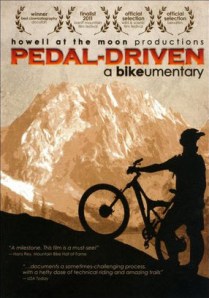
pedaldrivenI can’t remember who told me I needed to see this film. Thank you, whoever you are.

Pedal-Driven is a documentary about the relationship between mountain bikers and the US Forest Service, regarding the former’s right or privilege to recreate on public lands. The conflict is fairly well summed up early on: public lands are our lands, so we want access to do what we like on them; but on the other hand, we (mountain bikers or mtbers) are not the only user group in “the public,” and even beyond present-day users, the USFS (Parks services, etc.) feel a responsibility to a future public as well. Therefore the needs/wants of today’s users (mtbers and others) are balanced against a need for conservation and preservation.

The USFS doesn’t want to be entirely anti-mtber, but they can’t condone the practice of building trails on public land without permission; this is illegal. But what is a mtber to do? To go through the proper channels is a 5, 10, or even 15 year process; at some point, we’re building trails for our kids to ride, which is nice for them, but who knows if we will get to ride those trails at all. Then again, builders of illegal trails risk having their work torn down at any moment.

While I’m not particularly on the side of illegal activities – and illegal building of anything on public land rubs me the wrong way – I sympathize with the mtbers, obviously, as I am one myself and understand the desire for trail to ride. Without trail, we can’t be mountain bikers. As I summarized them in my first paragraph, all those user groups indeed deserve their rights and their voices being heard. It’s a sad quandary. This film was in danger of just depressing me, early on, with the stalemates portrayed (centrally in Leavenworth, Washington, not far from where my parents have recently settled; also in the loss of trail systems in Montana). But it does circle back around to success stories like those in Oregon; hope is not lost.

I will say that, for me, one weakness in this film is in its specificity to freeriders. Freeride is mountain biking that involves jumps, tricks and stunts; it generally requires what we call “structures” (bridges, dirt jumps, big constructed berms, skinnies, teeter-totters), and structures are a good part of the USFS’s problem with illegal builders. Don’t get me wrong; they wouldn’t let you build natural-surface trail, either, but I think it would be less offensive than the construction in question. To give you some idea:

freeride(photo credit)

freeride, from the film (photo credit)


bridge work (photo credit)

bridge work (photo credit)


wooden berm (photo credit)

wooden berm (photo credit)


Talking about building freeride-style trail with structures, then, is a certain kind of conversation. And it has left out the even larger group of cross-country (XC) mountain bikers: this activity is performed generally on natural-surface trails (bridges thrown in for function – to cross a stream or gulley – rather than for the chance to catch air), and keeps the rider mostly on the ground or close to it. XC riders look different from free-riders: no full-face helmets, different bikes, even sometimes brightly-colored spandex. These are generalizations, and there are exceptions, and there’s crossover between the two groups; but the point I’m trying to make is that as an XC rider, myself, I felt a little left out of the story that this film tells. And that’s a shame; because really, we face the same challenges in using public land, in trail construction and access and our relationship to the public and the government. I would have appreciated a little more inclusive story being told here. On the other hand, maybe there isn’t such a story about XC riders – maybe our conflicts haven’t been played out so dramatically or on such a scale, or such a stage. I’m honestly not sure. And I haven’t been deeply involved in advocacy battles as of yet (except on a local scale where I’ve done some volunteer trail work), so I want to be clear, I’m not criticizing the fine folks portrayed in this movie. Their work can only benefit my kind of rider, too. And you never know, I may find myself in a full-face helmet high up in the air one of these days too! Who knows what the future holds?

As a film, I found Pedal-Driven to be very well put together and visually impressive. I had a few minor gripes with the soundtrack (some of it was great!), but you can’t please them all in that respect! I enjoyed seeing the riding, and I ended up on the hopeful side regarding access and advocacy issues. Most of all, I’m super glad that these issues are being discussed. So thank you, Howell at the Moon, for this movie! It makes me want to ride my bike!


Rating: 7 feet of air, of course.

movie: A River Runs Through It (1992)

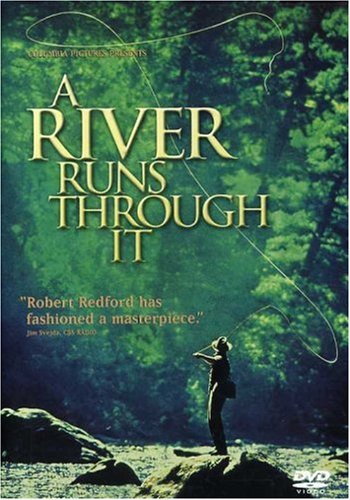
rivermovieI was pleased when Husband found this movie for me the other night. I enjoyed the book by Maclean so much, and I had heard good things about the movie. Robert Redford’s involvement speaks well, too.

First of all, this film is very visually pleasing; the scenery is lovely (IMDB says it was shot in Montana and Wyoming – not onsite in Missoula, but convincingly nearby), the fishing scenes are appropriately peaceful, and the actors are attractive. Thank you, Hollywood, for a typical, unrealistic portrayal! Although Paul Maclean in particular was supposed to be a very good-looking young man; and whatever your feelings about Brad Pitt, I don’t think you can argue that his role as Paul is less than gorgeous. (See below.) Also pleasing are the glimpses of 1920’s flapperdom, particularly in the character of Jessie Burns (later Maclean’s wife), who is charmingly represented.

young Brad Pitt

young Brad Pitt

The film opens and closes with Norman Maclean as an old man, fly-fishing, accompanied by a voiceover (by Robert Redford) quoting from the book. This is appropriate, and effective. Otherwise, the film’s connection to the book comes and goes. The Maclean family onscreen is quite faithful to the Maclean family of the novella (although I found the Reverend a little friendlier in the book than in the movie), but the action diverges often. I missed the couple that happen upon Paul’s masterful fishing in the book, but at least the scene is represented in the film. I was perhaps most thrown by the scene in which the Maclean brothers take a daring whitewater trip in a “borrowed” boat; I could feel how disconnected this section was from Maclean’s own writing, and indeed, it felt out of character with the brothers as I knew them from the page. Coming early in the movie as it did, it was even more disjointed for me. When the fishing trips (two of them) with Jessie’s brother take place in the book, Norman and Jessie are already married; in the movie, they’ve just begun dating, and there’s only one scene. It is, however, well represented with both humor and outrage.

As of course is standard in book-to-movie adaptations, we get less in the film than we did on the page. Naturally I missed the parts we lost, because I loved the book so. This is to be expected. Part of what I missed was the immersion (no pun intended) in the world of fly-fishing that Maclean brings so fully to life, in such an interesting manner even to those of us who don’t care much for fishing. The depth of all the characters also naturally loses some development in a 2-hour movie. All things considered, this was an enjoyable movie – for its natural landscapes, peaceful yet tortured tone, and familiarity with the Maclean family of whom I cannot get enough. It doesn’t do the book justice, but no movie could, so I won’t hold much of a grudge for that.


Rating: 6 trout.

movie: United 93 (2006)

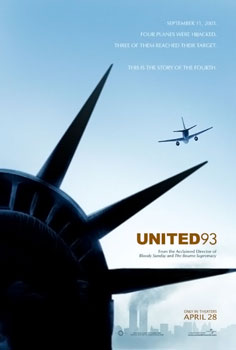
I hesitated to contemplate before writing this movie review. 9/11 remains a charged, sensitive, and controversial subject in the United States; I believe the same is true worldwide, although presumably in a different sense and perhaps to a lesser degree. I can only speak for myself and, less so, for the country where I live; less still for the rest of the world. I’ll do my best here.

United 93 was released in 2006 and tells the story of United flight 93, the 4th hijacked airplane on 9/11, which was taken down by the passengers in a field in Pennsylvania. It shows the first three planes go down, and then follows UA93 in real time up to the finish. As Rotten Tomatoes notes, it’s “even more gut-wrenching because the outcome is already known.” If nothing else, a far less impressive movie than this one would be emotionally harrowing for anyone who can remember that day, I think, regardless of your politics or complicated reactions to the unfolding and varied understandings of what’s happening in our world and why; I believe a basic human reaction is horror.

I’ll say in a nutshell: I think the movie is well done. There are qualifications coming, but to start, it is a moving experience, the acting is convincing, and the drama is fully wrought.

My greatest concern while watching this movie – about which I knew nothing; I wasn’t even aware it existed until Husband put it on – was the level of respect given to surviving families, and the faithfulness to the real people involved. My brief research after viewing* indicates that director Paul Greengrass (great name) put in some effort to authenticate his characters, working out clothing and reading material and giving actors opportunities to study their characters’ lives and habits. This is good; this is what I was looking for. It won’t be perfect, of course. This being Hollywood, all the people are more or less beautiful (they don’t seem to produce a great many ugly actors), which I doubt (with all respect) was true of the real passengers on that plane. And Wikipedia states that ” there are some notable exceptions” to the victims’ families’ cooperation with the film; however, the source cited for that line of text says that “filmmakers said ‘Flight 93’ had the cooperation of all the families of the passengers who died on the flight.” So, I’m confused. Who cooperated and who didn’t? I don’t know and I’m not trying to make this into a research project; I’m simply pointing out some ambiguity. Further, there’s the controversy over the German passenger’s portrayal: read about it here.

Another chief concern is the commercialism: this movie was made to turn a profit, right? IMDB notes in its trivia section that “the filmmakers donated a percentage of the opening weekend proceeds to the Flight 93 memorial near Shanksville, Pennsylvania. The actual amount donated turned out to be $1.15 million.” However, I would bet that somebody still made a buck; and that obviously leads us to some concern. On the other hand, what’s more American than making a profit from every last thing that happens to us or anybody else?

What I’m getting at is this: to make a movie about 9/11 is a wildly challenging, potentially dangerous undertaking, bound for controversy. I find it a curious phenomenon. A number of movies have been made; this is the only one I’ve seen. (I’m going to read Extremely Loud and Incredibly Close one of these days, though.) I’d like to go back to my nutshell statement that this is a moving and well-done movie, not without some concerns, and owing much of its moving nature to its subject; but it earns the “well-done” part itself. I would recommend it with some reservations to someone interested in watching a movie about 9/11, but not everyone will be. I am about as removed from this tragedy as an American can be – I didn’t lose anyone I knew; I don’t even think anyone I know lost anyone – and I still found it pretty painful. So, exercise caution.

Finally, and I think this is obvious, this movie assumes that Americans are good and the passengers that wrestled the plane to the ground were heroes. The second assumption is pretty firmly rooted; the first offers room for debate. Within the United States, we’re so numb to these assumptions that we hardly notice them; but the comments on IMDB, for example, make clear that different parts of the world quite naturally react differently to 9/11 and to this movie. Noted. The world is a complicated place and very few things are cut’n’day or black’n’white. You can take it from there, I think.


Rating: 7 audio transmissions.

*Rotten Tomatoes, IMDB, Wikipedia, The New York Times, Atlantic Review

a compilation of lists

Whew! You all might know that I’m a sucker for book lists. It can get a little exhausting with everyone publishing their own “100 greatest books” etc. (you know I did!), and this is a highly subjective matter. But I’m still attracted.

But then I saw this list (through Shelf Awareness, naturally). It’s a chart compiled from all the books on 11 lists of 100 books. [One list says “American novels”, where the others seem to be international. Eight of the 11 say either “novels” or “literature,” and a glancing survey does seem to confirm that this is a fiction list. These rules are not entirely made clear.] There aren’t 1100 books, because there’s overlap: that’s the point of this chart. And what fun: statistical analysis! Three books make 10 of the 11 lists: Catch-22, Lolita, and The Great Gatsby. Four books make 9 lists; 4 make 8; and so on from there. I found it fascinating to see the semi-democratic selections between these lists. Of course, each of those 11 lists is just another subjective view; but it’s nice to the the intersections. The lists, if you’re curious, come from sources like bookriot.com; TIME magazine; Entertainment Weekly; Modern Library; Goodreads; and Reddit.

Naturally what I want to do now is show which ones I’ve read, plan to read, or don’t plan to read (hello, Faulkner and Ulysses). Let’s say bold are those I’ve read, italics are those I want to read, and underlined for those I’ve picked up and put back down or don’t intend to.

Please excuse my laziness in listing only titles and not authors. You will fairly easily figure it out yourself or find the author via The Google. A few of these titles, for the record, didn’t ring a bell to me at all. Some authors are available at the original link; others are not. I’m guessing this was a copy/paste in from the 11 lists themselves…

Made 10 lists:
Catch-22
*Lolita
*The Great Gatsby

Made 9 lists:
Invisible Man (Ralph Ellison, not H.G. Wells. I have read the one by Wells, actually.)
Slaughterhouse-5
The Catcher in the Rye
The Sound and the Fury

Made 8 lists:
*1984
Beloved
The Grapes of Wrath
To Kill a Mockingbird

Made 7 lists:
The Sun Also Rises

Made 6 lists:
An American Tragedy
Atlas Shrugged
Brave New World
Gone With the Wind
Midnight’s Children
My Antonia
*On the Road
* The Adventures of Huckleberry Finn
The Heart is a Lonely Hunter
The Hitchhiker’s Guide to the Galaxy
The Tropic of Cancer
Their Eyes Were Watching God
To the Lighthouse
Ulysses

Made 5 lists:
A Clockwork Orange
A Passage to India
All the King’s Men
Animal Farm
Brideshead Revisited
Crime & Punishment
Fahrenheit 451
Go Tell It On the Mountain
Heart of Darkness
Infinite Jest
Light in August
Lord of the Flies
Moby-Dick
Mrs. Dalloway
Native Son
One Hundred Years of Solitude
*Pride and Prejudice
The Age of Innocence
The Call of the Wild
* The Lord of the Rings
* The Old Man and the Sea
The Stand
The World According to Garp
Things Fall Apart
* Wuthering Heights

Made 4 lists:
*A Confederacy of Dunces
A House for Mr. Biswas
A Portrait of the Artist as a Young Man
Anna Karenina
Blood Meridian
Charlotte’s Web
Death Comes for the Archbishop
Don Quixote
Ender’s Game
Howards End
I, Claudius
Naked Lunch
Neuromancer
One Flew Over the Cuckoo’s Nest
Rabbit, Run
Ragtime
Sons and Lovers
Sophie’s Choice
The Adventures of Augie March
The Brothers Karamazov
The Color Purple
The Fountainhead
The Golden Bowl
The Handmaid’s Tale
*The Hobbit
The Maltese Falcon
The Moviegoer
The Sheltering Sky
Under the Volcano
War and Peace

And on.

I have added *asterisks* for the 11 that overlapped with MY list of 100: that was interesting to note. In such subjective measurements, I think that’s not a bad statistic. And some of the ones on this list that I’ve been looking forward to reading may well end up on my own list.

What are your reactions?

the hermit thrush

My parents have recently moved from Houston to northern Washington state, a scant 20 miles from Canada. Pops wrote me an email the other day which I will share in part, with some locations redacted…

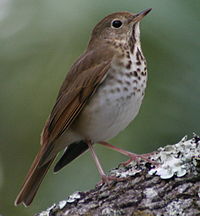
First, I’ll remind you the ringtone I assigned your number on my phone is the Hermit Thrush.

Today I rode a big loop out —- and back along the shore of —-; as I rode a quiet back road bordered by forest, I was climbing a moderate hill at a steady pace, but slow enough on a low-wind morning to enjoy near silence, hearing & seeing detail in the woods as I passed; it was then that the Hermit Thrush sang out as your text came in; and I swear I heard a thrush answer in the forest!

That’s happened before, back in Texas, with the Tufted Titmouse assigned to your mother – but there are no Thrushes in Texas; I haven’t yet determined if the thrush we hear around town here is the Hermit or one of the others. The book makes it hard to tell the difference; but somebody out there liked it today!

I commented that that must be a very high-quality ringtone!

from here

from here

The ringtone is an actual recording of a bird; the small speaker of a phone is naturally more effective with high pitched sounds, like bird songs, so it really is natural sounding and projects well from my jersey pocket.

One way researchers “search” for rare birds is to play recordings of their songs & calls and listening for a response, so we shouldn’t be surprised this works.

Indeed – and that makes sense; but still, who’d have thought? And by the way, according to this range map, the hermit thrush is in fact quite likely to be in my dad’s new neighborhood.

So why I am sharing this on my book blog? Well, I continue to be struck by the episodes of coincidence (if you like) or of synchronicity that inhabit my life, my world, and my reading (and cross over from my reading into my “real” world). The final page of the book I reviewed yesterday, Susan Vreeland’s The Forest Lover, made me think of my father, because it made reference to the song of the hermit thrush:

A hermit thrush spilled one long crystalline note, stilling all the earth to listen, and then poured out an ethereal flute song, over too soon. She closed her eyes, waited. Again, that purest of tones, long-held, chillingly beautiful, and then the cascade of melody like a tumbling stream. A spirit song. For her.

If she could sing like that thrush, what would she sing?

[You can listen to its song here, thanks to the Macaulay Library at the Cornell Lab of Ornithology.]

The next paragraph references, among other trees, the Douglas fir, another species belonging to my parents’ new habitat and appreciated by them. It just goes to show that life really does imitate art, and/or the reverse, and that that’s as it should be.