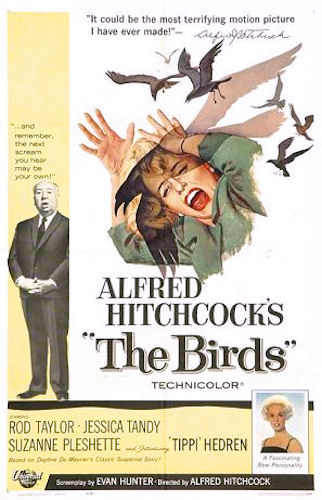
movie: The Birds (1963)

I am continuing my studies of Hitchcock with The Birds, after reading the short story just the other day. As I anticipated, it changed a great deal in adapting for the screen: in fact, only the concept of the birds attacking carried over; none of the characters or the setting were the same. (It was still set on a shore, but in California, not England.)

the birdsAnd I must admit, this was a sillier movie than Psycho. For one thing, The Birds necessitated special effects, and 1963 special effects do not play well in 2015. The attacking birds were a low point in the action, for their unrealism. (I suspect the sound effects of rioting birds were provided by screeching cats.) For that matter, the threat the birds posed read well on the page, but did not ring true onscreen: much flailing, of people and of birds, but not much evidence of real danger. As in Psycho, drivers persisted in getting into their cars via the passenger door. Also, they walk into one another’s homes – even strangers’ homes – right through the (unlocked) front door, sometimes without knocking. This I find most strange (and it happened in Psycho, too). Was this a 1960’s reality??

The early storyline begins in the bird shop and involves two people engaged in a bit of a feud; this quickly and strangely progresses into gift-giving and making out, which progression was not entirely transparent to me. I was interested in the friendship developing between Melanie and Annie, though. More so than in Psycho, I found a few of these characters to be fairly interesting people, and I liked that most of the key characters were women, Mitch being defined by relationships with mother, sister, ex-girlfriend and new girlfriend. But then our female lead, who had been a fairly strong woman, became a big heap of limp weakness, which was thoroughly disappointing. (Although perhaps unsurprising, considering 1963.) There was one visual, of a moonlit car on beach with birds, that I found striking. Other than that, this one gets a general ‘meh,’ and does not satisfy in the way that Psycho did. I’m happy to believe it did better than this in its own time, but it translates poorly to the modern one.

For me, not Hitchcock’s best.


Rating: 5 crows.

movie: Psycho (1960)

How about a horror movie for Friday the 13th, hmmmm?

I enjoyed this Hitchcock classic. I don’t care what Husband says.

He says he can’t believe people were frightened by this. But I think that 1960 was a different time. Susanne Antonetta writes in Body Toxic, “Nobody was supposed to talk about Psycho. My parents came home unable to sleep.” I can believe that this movie was scarier then; I thought it was scary now, although I certainly noted the ways in which it’s dated: slower paced, longer pauses, far less graphic (on which more in a moment). The psychological question is every bit as chilling as ever. The bones of this movie are still scary; the production is of another era, is all.

Some of the elements for which Hitchcock is known – creative camera angles (downright innovative at the time), stark, simple shots and sets, psychological drama, and in this case, low budget black-and-white – were plainly evident. For that matter, it was graphically violent for its time, I’m told. (We noted that there was strangely little blood in that one scene, but maybe it was a lot by comparison.) It’s a little hard to see these things in context, as I was neither alive nor a movie-goer in 1960 when this film was released. But even from the vantage point of 2015 – when new releases are frantically fast-paced and horror movies flow with blood – I can see the artistry here. It’s a different viewing experience now than it would have been then. Now, it looks vintage, dated, but still charming, and still chilling. Janet Leigh’s pin-up-style beauty is classic; all those shots of her dramatic mascara in black-and-white are arty in a way you don’t really see any more. The one really famous scene was striking, again, whatever Husband may think. I also noted the MacGuffin (a term I learned just the other day while looking up Hitchcock). Actually, the item that bothered me was not a shortage of frightfulness, but a hole in logic: it didn’t make sense to me that Lila and Sam would be so confident in the existence of Mother when they have just talked to two people who saw her buried. (Spoiler in white text – highlight or select to view.)

If you notice I’m being cagey about the plot, it’s because I hold out hope that there may still be someone out there like me, who has never seen this movie and really doesn’t know much going in; and for that person, should I reach her or him, I am avoiding all plot description. Go see it blind, Hypothetical Reader.

I’m on board for the classic thriller/suspense/horror genre, and I like a good psychological twist. More Hitchcock to come.


Rating: 7 sandwiches.

Final note: Husband was deeply frustrated by the consistent habit of drivers, traveling alone, to get in and out of their cars via the passenger-side door, sliding across the bench seat. I have offered that the hoods on these old cars are so long that maybe this really does provide a short cut?

iDiOM Theater presents Clown Bar

I had a romping and hilarious good time seeing the iDiOM Theater’s production of Clown Bar with my Husband and parents. This was my first time at the iDiOM Theater, a tiny, intimate place with just three rows of seats in my section, which allows or necessitates that the players use the audience as part of their stage: awesome.

photo from the Herald

photo from the Herald: click to enlarge

Clown Bar is a work of clown noir, in which a man named Happy – who retired from the funny business to go straight and become a cop – is forced to go back down into the seedy clown underworld to search for his brother’s killer. The play takes place in Clown Bar, a business run by the sinister BoBo. Other literally colorful characters include Petunia (who sidelines as a sex worker), Shotgun (whose name references two meanings of the word), helpful Twinkles, straight-faced Giggles, the terrifying Popo, and of course the unforgettable Blinky Fatale. Also the unfortunately unfunny character Timmy (actually very funny as played), the murdered brother, who we meet in flashback scenes. This is not a play for the whole family: drugs, violence, sexual content including a thoroughly effective burlesque scene (wow!) make for adult entertainment, thank you very much.

I thought this was wonderful stuff. The story is engaging, and I love how it was played: the characters mostly face the audience, making eye contact and interacting with us in lively fashion even as they address one another. They really used the intimate setting. The clown frame was explored not just in fun costumes – although absolutely those – but with mannerisms and theme music. (The music was central, and because this is a small town, we recognized our electrician’s assistant playing the bass.) I jumped off my seat a few times in alarm during this dark and murderous show; but more often I laughed out loud at the antics. Husband and I discussed our favorite characters: I listed pretty much all of them, though, so that is unhelpful.

I commented to Grammy just the other week, when we saw In Your Arms in San Diego, that living in a smaller town means seeing events that are often less polished, less professional Broadway-level work than you see in Houston (or San Diego). And I confess that it was impressive to see In Your Arms, one of those top-level professionally produced plays. But the fact is I really enjoy community-level theatre a great deal, too. Even without the tiny theatre that lets you actually touch the actors, it feels more intimate to see your talented neighbors engaged in a passion that is so entertaining to watch. And I want to be clear: this was not messy amateur work; this was absolutely talented acting, in every role in this play. The fact that it was born closer to home just made it all the more enjoyable to me.

iDiOM Theater has got the goods. I’ll be back. And Clown Bar is worth the time if you can track it down.


Rating: 8 mixed drinks.

musings on “A River Runs Through It” by Norman Maclean, from Tassava

In reading and rereading some pieces by and about Maclean recently, I was struck by the certainty that my buddy Tassava would love him. He told me he’d read none, so I set out to remedy that. Unsurprisingly, A River Runs Through It and Other Stories was a big hit.

Rivers Run through It

At my friend Julia’s recommendation, I read Norman Maclean’s “A River Runs through It” today – a gorgeously warm fall day that seemed perfectly suited to the action of that incredible, indelible, devastating story.

He follows with some photos that reflect his personal connection to Maclean’s writing.

Henry's Fork in Island Park, ID (March 2014), photo by Tassava

Henry’s Fork in Island Park, ID (March 2014), photo by Tassava

Read the rest here.


Thanks, Tassava. I hope you love Young Men and Fire as much as I did, too!

The Old Globe presents In Your Arms

I was so lucky last week to get to accompany my Grammy to this outstanding theatre production, which is a little hard to describe, but of course I’ll try.

photo by Buck Lewis, courtesy of New York Stage and Film & Vassar's Powerhouse Theater

photo by Buck Lewis, courtesy of New York Stage and Film & Vassar’s Powerhouse Theater

In Your Arms is a dance-musical production with very little dialog. It is a series of shorts, mostly unconnected, but with a theme of romantic relationships. These vignettes range through time and geography, sometimes implied and sometimes explicit, as with “The Lover’s Jacket,” in which dates and locations (Spain in 1939 and Argentina in, I’m pretty sure, 1940) are projected against the wall. This is one of the finest and most communicative pieces of nonverbal storytelling throughout the whole, although all of them were impressively clear in their messages and emotions despite being mostly wordless. Details might be blurred, of course, but the feeling and action of each piece was perfectly plain.

The exception was Carrie Fisher’s contribution, “Lowdown Messy Shame,” which is voice-overed by Fisher as she is seated off to one side at a typewriter, composing the action we see played out across the stage. The players act out Fisher’s imaginings but also comment upon them, in a cute innovation. One review found this one overly wordy – and indeed it was almost the only spoken theatre of the evening – but I enjoyed it as much as any other, despite its differences. (“The Dance Contest” also uses some voiceover.)

As I said, these shorts had a shared theme, but remained distinct. I loved the survey over time, space and culture. And then they are tied together by opening and closing pieces featuring a singer expressing nostalgia for loves past. Here I agree with the Union-Tribune (link above) that less song would have been fine; but I think these scenes served well nonetheless to emphasize the loose links between all the pieces. Overall, this nearly-wordless hour-and-forty-five-minutes of music, dance and theatre was profoundly emotional and moving, over a wide range of topics but centered around affairs of the heart. I was deeply impressed; it’s the best thing I’ve seen in a long time.

I was further pleased by stage settings and costume. No set stands out in my memory as being particularly complex or elaborate, but each was distinct and evocative, and the transitions were smooth and easy; I love seeing a change of just one or two elements transform a stage and introduce a new setting with perfect clarity. I think that kind of subtle-but-clear set design is more impressive than elaborately complete stage dressings. A unique element here, too, was the use of shadow and projection throughout; the time-and-place cues in “The Lover’s Jacket” were projected on the screen, and shadows were a major feature in “A Wedding Dance,” while projected home movies were central to “Life Long Love.” The costumes were great fun, too, and well designed for showcasing the dance as well as helping to tell the story. I liked the protagonist’s costume in “Life Long Love” for what it emphasized and revealed, while also looking demure at the appropriate moments.

I do want to say briefly that I wasn’t sure about the racial tones in “A Wedding Dance”, which tells the story of an African couple’s immigration or… kidnapping? I don’t have enough information to be certain whether this was a well-told realistic story, or an ugly appropriation of stereotypes. Likewise “White Snake,” which tells the story of a white businessman who reads comic books and fantasizes about his Asian assistant. It was a great piece of theatre and movement, combining dance and martial arts and a lovely representation of the blurry line between fantasy and reality. But I wasn’t sure how much fun we should be having with certain stereotypes there, as well. I haven’t worked out what’s okay here, in part because of the lack of details in wordless theatre. Just something I wanted to note. On the other hand, the same-sex couple in “Artists and Models, 1929” was represented with sensitivity and realism and I found them delightful. I want to say that this was one of my favorite pieces, but gosh, I want to say that about nearly all of them.

Finally, I must note that this event took me back to San Diego’s Old Globe theatre, where I saw what I’m pretty sure was my first Shakespeare production, in 1992, when I was 10 years old. The theatre and surrounding park still felt familiar, and it was such a treat to be there again with my Grammy, thoroughly aside from the quality of the show.

If you have a chance, definitely make a point to see In Your Arms. It was a rare treat for me. There are rumors it might be Broadway-bound, so maybe a larger audience will get an opportunity at it.

Thanks, Grammy, this was so special.


Rating: 9 memories.

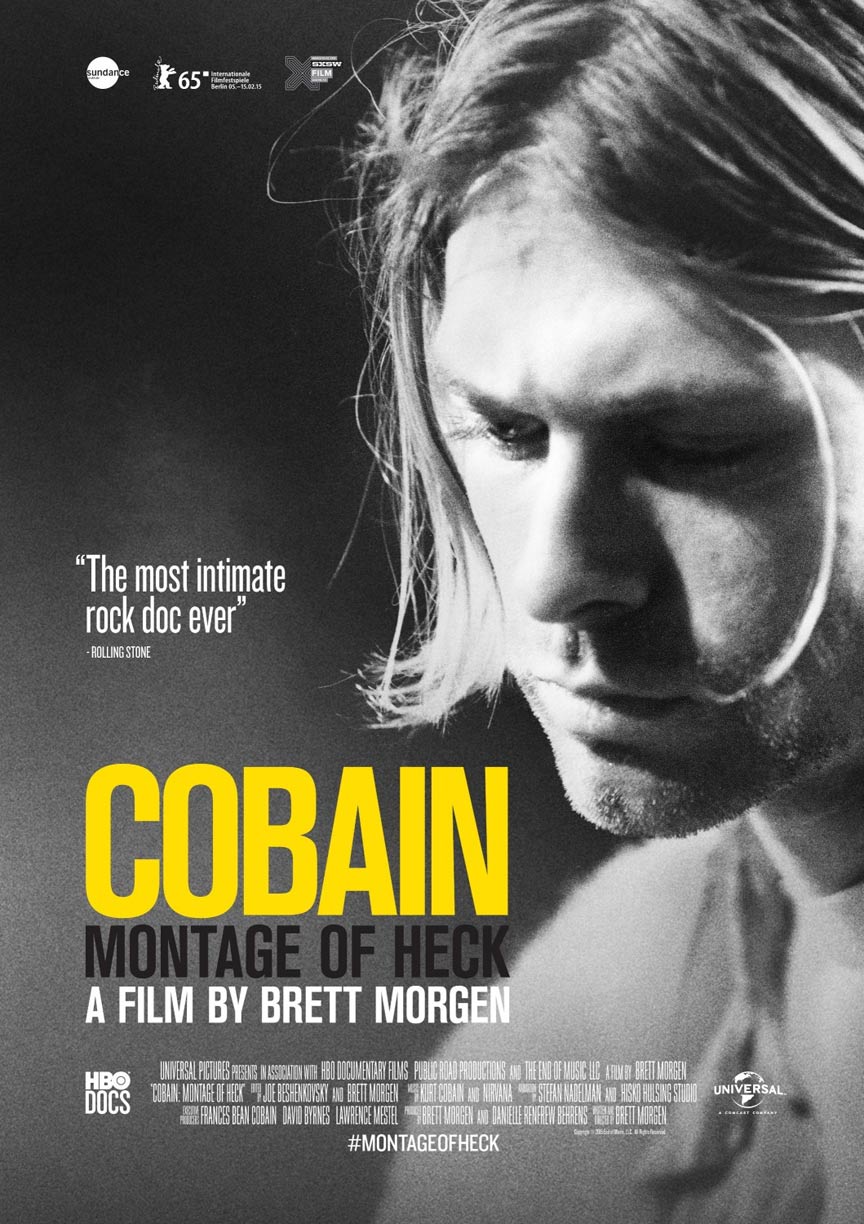
movie: Montage of Heck (2015)

Montage of Heck is the recently released documentary about Kurt Cobain’s life, and we got to see it in the theatre during Pickford’s Doctober. In a word, it was an unsurprisingly depressing, but compelling glimpse into an interior life that I did not know a whole lot about. It was well put together and enjoyable (in a depressing way) to watch. It was also fairly interpretive, on which more in a minute.

montage of heckAs a piece of art in its own right, I found this to be a fine film. I like the collage effect, of old home videos, recent video (of interviews with Kurt’s parents, Courtney Love, and Nirvana bassist Krist Novoselic, among others), concert footage, stills and animations from Kurt’s journals and sketchbooks, and animations of Kurt’s life. It was dynamic and expressive, like him. I learned a lot about him (I like Nirvana but am no super-fan, and no expert on his life), like that all-too-familiar combination of genius creativity, hyperactivity, and disturbance. I didn’t know about his stomach problems or the ex-girlfriend Tracy. It’s an enthralling story, and this movie made it immediate, and moving.

On the other hand, I am troubled by my lack of understanding of how real any of this is. I said earlier that the film is quite interpretive. The soundtrack includes synthesized and orchestral renditions of Nirvana songs: what would Kurt think about that? And the animations of his journals and sketches assume chronology and intention; who knows for sure? Contemporary footage of Kurt’s father and step-mother leaves the former looking nearly catatonic; I can’t believe there isn’t an editorial angle on that. Kurt’s daughter Frances is a co-executive producer. She’s family; she has as much business here as anyone. But she never knew him, as she was not yet two when he died. Even with the best of intentions, who knows how much she got right? Not to assume she had total control over the content…

Any time an artist dies, their work will be interpreted and presented to the public by someone else. And all artists die, although not all so young as Kurt Cobain. This is not a new concern. But this film did more interpretive work than it necessarily needed to do, and that just got me a little curious, and a little anxious. I like knowing where the line is drawn, and here I don’t know. If I knew more about his life beforehand I’d be better equipped to make judgments, but of course that would come with preconceptions and bias, too. And then there’s this guy who says it’s all a load of sh*t, and who do we believe?

As Husband pointed out, the footage of Kurt and Courtney in their apartment with baby Frances was hard to watch. Some of their home life goofing off was sweet, in a messy way – it really looked like they had fun together – but once there was a baby around it got more straightforwardly disturbing. What did we expect, though?

While I’m exploring expectations: the movie does not deal with his suicide at all, other than stating it in plain white text on a black screen. I’m sure some of us came for the sensationalism of learning more about his death, and those folks will be disappointed. But I can’t argue with the dignity – or maybe just the shying away from pain – involved in turning away. At what point should we expect his family or anyone who loved him to turn his death into movie theatre entertainment? What do we want, crime scene photos of splattered brain matter? I’m okay with this treatment.

This was a pretty great movie, unto itself. But it left me with more questions than answers, and feeling a little unsettled about the idea of Truth. Maybe that’s not the point. Beware Montage of Heck as an authoritative source on the life of Kurt Cobain; but for visual imagery and a moving experience, please enjoy.


Rating: a conflicted 7 unwashed locks.

guest review: movie: Run Free, from Pops (2015)

Pops has been to see the documentary film Run Free, which handles the subject matter of Born to Run which he’s earlier reviewed for us. His review is below.

In follow-up to the Micah True, Caballo Blanco story introduced in McDougall’s book, I saw the just-released doc film by Seattle director Sterling Noren: Run Free. Noren began working on the general idea of a film after a chance meeting with True in Mexico in 2009. After Born to Run was published, True heard Hollywood was planning a film so he requested that Noren help tell the “real story” with his own film.

Noren’s film is wonderful; his work benefits from True’s cooperation and many interviews with central characters including McDougall, runner Scott Jurek and Luis Escobar, who also contributes great still photos taken over the years. It features the beautiful & magical Copper Canyon in Mexico, the special native towns there and of course the Tarahumara themselves – and True’s special relationship with the place & its people.

Filming includes the 2012 version of Caballo Blanco’s Copper Canyon ultra race; and then Noren’s crew was on hand for the immediate aftermath when True goes missing in the Gila Wilderness (as I related in my earlier book review.) McDougall’s fun & mythical tale as told in the book becomes starkly real in the film – both in the simplicity of Tarahumara subsistence culture, and the sad poetry of True’s final, fatal run.

The film’s narrative effectively invites us into the eccentric world of its main character & the close network of ultra runners, which makes their role in the wilderness search & subsequent memorial events all the more poignant. It’s a powerful story for those who can connect, from a number of perspectives. For this runner, four decades in, it was that and more.

Thanks, Pops. I’m glad – but not surprised – that you found it so powerful.

more on Rick Bragg

I am struggling to respond to the book I just finished, so I wrote a letter instead.


Mr. Rick Bragg,

I make a very small living as a book reviewer these days, but reading your books I am no kind of book reviewer, because I don’t know how to write about what you do when you write about your life.

Of course I believe that the best books for us find us at the right times, and yours have found me at the time when they can hit me the hardest. I am having a crisis of identity and place, having moved from my hometown of 32 1/2 years in Texas to a small town on the Canadian border of Washington state, which I have found largely unworkable. Your writing about places I have never lived and know only a little or not at all – Miami, New Orleans, rural Alabama – makes me feel homesick. Your writing about being a displaced Southerner at Harvard, or in New York City, resonates with me, although I am not the same as you. I’m from a big city – the fourth largest in the country – and have moved to a small one; but your displacements feels familiar all the same.

You are, of course, one of the finest writers about food that I’ve encountered. At the risk of offending, I will say I don’t eat pork, because I don’t like pork; but your descriptions of cracklin’s (etc.) still make me wish I were there and not here.

I am not one of those “who went to speech school to get rid of their accents,” in part because I don’t have much of an accent, being from a city, but what I have I will keep – although I was at one point one of those, as you observe, who fear “they sound slow, or at least unsophisticated, to outsiders.” When I interviewed for a big-time academic job in the North, I worried about saying y’all. I shouldn’t have. I don’t apologize, any more.

Houston is many things, big and diverse, containing multitudes, and that is my single favorite thing about the place; this also means that Houston can be a bit schizophrenic, even self-loathing. You write that Atlanta “tears down its history with wrecking balls, and builds something bland and homogenized in its place.” Houston has done too much of that, although it’s done lots of other things with its history, as well.

This wasn’t supposed to be about me, but that’s the work your writing does. I see a lot of myself and my own experience, even where I see all sorts of adventures that are unknown to me. That’s a piece of work, in itself.

You’ve made a big difference to me. Keep up the good work. I wish you and yours all the best; you feel like friends to me now.

Thank you.

Julia


Tomorrow I’ll try again to write a book review.

movie: Capote (2005)

I was so pleased when Husband expressed an interest in watching Capote with me the other night. It’s rare that we agree so easily! And I have some Capote readings coming up – The Early Stories of Truman Capote for a Shelf Awareness review, and Breakfast at Tiffany’s for a beer-drinking book club; and I do like a little immersion when I get to know a writer. I recall being deeply impressed by In Cold Blood, but I hardly remember Other Voices, Other Rooms at all, so there’s that.

capoteCapote‘s storyline is concerned with the writing of In Cold Blood, with no examination of Capote outside that timeline. Opportunities are missed there, of course, as the man had a fascinating life in general; but as a fan of In Cold Blood I can’t complain. Any work of art, literature, or film has to choose its scope. In this case we are glad to get to meet Nelle Harper Lee (played by Catherine Keener), as she assisted Capote with his research in Kansas: I read somewhere recently that she was an ideal helper there as her soft, Southern femaleness alarmed the Kansans a little less than Capote’s flamboyant New Yorkness (of Southern roots, yes, but still). The late Philip Seymour Hoffman stars as Capote and does as outstanding a job as I had heard (for which he won an Academy Award for Best Actor, among others).

The Clutter family has just been killed in rural Kansas. Capote reads about it in the New York Times, and immediately feels that this is a story he needs to write; he takes a train down to Kansas from New York with Nelle, his childhood friend. In their distinct styles – Capote pushier, Nelle more quietly sympathetic – they interview the locals and get the feel for things. Then two suspects are arrested, Dick Hickox and Perry Smith. When Capote first lays eyes on Perry, he changes his plans from an article to a full-length book. “There’s just something about him, he’s so lonely” (I paraphrase wildly). The film emphasizes the connection between Capote and Smith, which reads here, on screen, as somewhere between a strong psychological bond and infatuation. Husband struggled with Capote’s character as he transitions from apparently having a crush on Perry, and getting him a new lawyer to help him out in an appeal (and, as he later acknowledges, help himself out in terms of having a book to research)… to exploiting Perry for his story and being sorry that the man won’t die quickly enough. This makes Capote a less sympathetic character: absolutely true. But is it an accurate depiction of the man? I think quite possibly yes, so don’t hold it against the filmmakers. Finding the protagonist likable is not, I think, a requisite for art.

I was particularly intrigued by and suspicious of the implication that the epigraph for Capote’s final, unfinished work Answered Prayers was a comment on his experience with Perry Smith and In Cold Blood. It was a convenient epilogue to this film, certainly, but I think it’s a bit complex an idea to just throw out with the finishing credits. I’d enjoy exploring Capote’s life and work with this idea in mind, though. Whatever else you might say about him, I think we have to agree that he’s an intriguing guy. My favorite biographical subjects are always those that raise complicated reactions in us, and Capote fits that bill.

Capote is an arty, well-produced and interesting film that mostly follows the true and also interesting story of Truman Capote and In Cold Blood. Hoffman’s acting is very fine: his expression of Capote’s voice, mannerisms and prima donna behaviors are often a little grating but I think that was true of the original, and he does a good job with the character switching Capote used for different scenarios. I enjoyed Capote and Capote both very much.


Rating: 7 cigarettes.

on Rick Bragg

Sometimes it happens this way. I decide I need to read a book – not put it on the TBR shelf to grow musty for two to five years to never, but really read it – and (as in this case) I put myself on the local library’s hold list for it. It comes my turn, and I go to the library and pick it up off a special shelf where it’s been filed under my name. I take it home, and I go back to reading the books I’ve been assigned, for work, for a living. I read another 6, 8, 10 books; some of them are really good, and I get involved and distracted. I interview a few authors, which is often, not always, engrossing. I go online to renew this book that I haven’t made time for yet, and find that – of course – someone else is on the hold list, behind me in line. I have to turn it in in four days. If you have forgotten this about me, I am a librarian. I’m no longer employed as such, but that blood pumps through me still.

So I put down the book I had just begun reading, for work, with a deadline. That book, by the way, offered an epigraph by the author of this book. And I pick up All Over But the Shoutin’, by Rick Bragg.

Bragg blew my mind with My Southern Journey (which will publish in two weeks or so; look out for my review then), and although I’d heard his name before, I never knew that he would be a writer to reach into me in such a way, to pull on me and make me nostalgic for a place that is not my home: foreign language words like fernweh, sehnsucht, saudade seem to touch on it. Bragg’s travels capture me; how will I ever go back to that other book, let alone my life, when this is done?