NBC’s The Wiz Live! (2015)

I missed round one, but got to see NBC’s encore showing of the remake of The Wiz, a 1974 retelling in turn of The Wonderful Wizard of Oz, set in an urban and African-American cultural context. It has been much talked about and enjoyed, and I’d heard a little bit about Shanice Williams, who plays Dorothy: she’s just 19 and has never been involved in anything this big before, which is its own underdog story. And who doesn’t love that story?

wiz

First, let me admit that I am unfamiliar with the 1974 show (though pretty familiar with the 1900 original), so I can make no comparisons there. I approached this as a happily enjoyable, entertaining remake on a well-loved classic, with a twist, and with a young new star. It was all of those things. There were some changes made for the stage – like, Toto is only present in the opening and closing scenes, in Kansas, and doesn’t make it to Oz. I guess it was too hard to get a dog’s cooperation for the whole. The journey from the house-dropping scene in Munchkinland to the Emerald City was much compressed, and I was sorry about that. The magical slippers are returned to silver, which is how L. Frank Baum wrote them, rather than Hollywood’s red. There was a new mini-storyline, wherein Dorothy is actually from Omaha, only recently living with Aunt Em after her parents’ deaths. Thus, in her searching for home she has to parse which of these places really is home, which I thought was a nice addition for depth, and which I identified with personally, too. The original story is very much about a concept of home, but even more complexly so in this rendition. I approve. Oh, and of course: the Wiz is a woman this time around! “His” false public character is still male, but the ballooned-in accident from Omaha is female. I found this a welcome twist.

Overall it was far from a flawed performance, though. There were some rough spots: imperfect synchronization of effects, the Wiz tripping on “his” robe. Though star-studded, the acting was a little uneven. I thought the Tin Man (Ne-Yo) was genius; the Lion (David Allen Grier) was a little underplayed, a little blank. The Scarecrow (Elijah Kelley) actually became a little unlikeable to me, as a character, for the first time ever. Queen Latifah as the Wiz was a great casting idea, but fell a little short: it felt like the songs she had to sing were a little below her usual register, and she didn’t get to belt out like we know she can do so well. Once she stepped out of her Wiz costume, though, and became the woman behind the mask, she hit just the right notes – in portraying her character, that is. I did appreciate Stephanie Mills as Aunt Em – and also appreciated the nod to her role as the original Dorothy in 1974. Shanice Williams herself is beyond complaint, though. I found her engaging and heartfelt, fully committed to song, dance and acting.

As a filmed stage production, I found The Wiz thoroughly disappointing, but that’s because National Theatre Live has got me so spoiled. The work NT Live does is unparalleled excellence: I actually remember myself as being at those shows, rather than in a movie theatre. The camera angle changes: it shows the whole stage (including the front edge, so we can see it’s a stage), different parts in medium-close-up, and close-up angles on individual characters. We see all the set changes (no commercials), so we get the feeling for a real, live stage show. The Wiz clearly took a very different approach. We saw no stage settings (commercial breaks!), and the angle never cut so widely as to give a feeling for the stage itself. For that matter, NT Live shows shots of the audience before and after the show and during intermission, so that I feel like I’m with that crowd in London (or wherever). It remains unclear to me whether there was an audience present for The Wiz. And if not, what a shame for the players. Filming of a stage show is clearly not NBC’s strong suit here.

Uneven performances (but some of them were stellar!), some very fine singing and a classically loveable story make for a pleasing experience, if you didn’t expect too much coming in.


Rating: 7 winged warriors.

National Theatre Live presents Jane Eyre (2015)

Pops suggested this stage production of Jane Eyre to me, and I confess that I was at first hesitant. Jane Eyre is not among my favorite novels. Perhaps in juxtaposition to Wuthering Heights, I at some point developed some rather negative feelings about it. (Recall my discussion with Erin Blakemore, here.) But it was an intriguing concept, this adaptation to the stage; and I have been nothing but impressed with past National Theatre Live performances (Treasure Island; A View From the Bridge). So we went.

The Lincoln Theatre in Mount Vernon (a town about 30 minutes south of where I live now) is always a treat, and we found a tiny hole-in-the-wall Thai place beforehand that was worthwhile, too. And I had rearranged my mindset by the time we got there. It has been years since I read Jane Eyre. And I love the stage. This will be great, I thought. Of course it was!

JaneEyre

As we have seen at past NT Live shows, the set design was innovative and well done: so extraordinarily simple, just a few platforms and levels of planking, with lots of stairs and ladders throughout, so that the players create the impression of distance covered by sort of doing laps. And because there was no decor, any space could be anyplace at all. Same with the actors: I believe it was a crew of about six who played every character in the story, by simple costume changes and adjustments in accent and attitude; we never had trouble following along. Another less-is-more approach, which is always a clear winner with me. I think I’m done with elaborate costuming and set design. (She says, until the next beautifully elaborate production comes along.)

I was taken with the way they put together this adaptation, too. The company did it cooperatively, through improvisation: they all read the book, got up and freestyled. There’s a great clip, Devising Jane Eyre – and you get a glimpse of some of the actors there. (Then check out the trailer.) It’s a stripped-down version this way, purified if you will. This is not the Jane Eyre I remember. I remember Jane Eyre being a rational, thinking woman’s novel, almost austere, where Wuthering Heights was all passion; but this play was steeped in passion, as well as that groundbreaking feminist thought that we recall Jane for. She still makes (the same) choices of self-deprivation, but they are made with passion. I loved this woman. This company made of Bronte’s work something different – and, for me, better. (I can hear the novel’s fans gasping. They’re just personal reactions, folks.)

The acting was magnificent, and I will say that this version of Rochester was a heartthrob (also something I do not recall from the novel). But all the acting was magnificent. The woman who played Jane’s friend from boarding school, and later played the pastor Rivers who proposes, was perfect in every role; and the woman who played Jane’s mother, then the maid, then Rochester’s girlfriend, was stunning. Even Rochester’s dog, Pilot, is a joy to watch, played by a man (great fun). The communication of Jane’s inner thoughts – always a problem in adapting books to screenplays or stage plays – is solved with pure genius: a group of (I think) 4 actors gather round her, all talking at once, like a Greek chorus inside her head. She dialogues with them. Pops and I were both mesmerized by this inventive and entertaining solution.

Another unique angle we observed was gender- and race-bending (if you will). There were two black actors who fit right into the story without comment or need for explanation; we both liked that introduction, a modernization if you will, since historically Jane Eyre’s mother was decidedly not black; but we were happy to see it fit right in. And during Jane’s stay as a student at Lowood Institution, a boarding school for girls, all the same actors played her classmates – including two men, one of them bearded. But we understood: in this scene, these are all little girls. I think we were both tickled by these new angles, and happy to play along.

The cues used to switch us from Jane as newborn baby, to Jane as young girl, to teacher, to governess, to bride, etc. were simple but effective. She never left the stage, I don’t think, in the whole performance; she made tiny costume changes onstage, not hidden but as part of the action. Her Greek chorus helped her changed into her wedding dress and then back again into the costume of her lower social standing, and this was a symbolic and important part of the story. I liked this new way of signalling changes in time, place and action. Again, minimalist but effective.

The stark simplicity of stage and costuming, and even in the number of actors involved, and the distillation of the novel to its most powerful, moving, and passionate elements, was supremely successful. I regret my hesitation: I will see anything produced by National Theatre Live. And on that note, let me point out that all those fine folks in the Bristol audience paid a lot more money than I did to see this play in person; but I got close-up shots and all the right angles. The invisible element to the National Theatre Live format is cinematography. They claim, and it is true, that each of us at the Lincoln Theatre in Mount Vernon, Washington had the best seat in the house. What a deal.

And now the question of whether to reread. When I try a beer again after years, that I used to love, and I no longer like it: have my tastes changed, or my very taste buds; or have they changed the recipe on the beer? When your professionally-fit bicycle no longer feels right, has the bike changed? No, your body has aged. I wonder if I would appreciate the novel more today because of my age, maturity, life experience then I did when I was… I think I read this as a teen and again in my early twenties. Or is it just this production that worked so well for me? What do you think?

Not in question is my rating of this theatre experience. Go find yourself some NT Live: it’s worth it.


Rating: 10 fires burning brightly.

best movies of 2015

I am as surprised as anyone to see that I reviewed fifteen movies in 2015. For me, this is a lot. We are not a big movie-watching family: Husband can’t sit still that long. So I thought I’d put up a new kind of best-of post, in honor of some great films I saw this year.

I gave one movie a 10 this year, although it is sort of a mixed-media piece, if you will: the Young Vic’s A View From the Bridge, which is a live-filmed stage production. I am going to count it, because it’s done cinematically, not just with a stationary camera in the audience. As I am learning, any National Theatre Live productions are worth making time for.

I gave several ratings of 9:

And, I can’t help but mention the National Theatre Live offering of Treasure Island, which I rated an 8 at the time but still think fondly of.

Funnily, perhaps unsurprisingly, not a one of these was a Hollywood new release (although several documentaries were new).

It’s been a great year for movies for me; I feel privileged. Here’s to some quality screen time in 2016.

2015: A Year in Review

I’ve reviewed a few years now (2014; 2013; 2012; 2011), so plenty of comparisons are available to us. Maybe I’m a nerd. I like lists.

This year should be expected to be a little different than years past, because of some changes that have taken place in my life. Let’s jump right in:

Of the 150 books I read in 2015:

  • precisely 50% were nonfiction (44% last year)
  • 51% were by female authors (44% last year)
  • of the 75 novels I read, 24% were historical fiction, 19% were mysteries, and a whopping 40% I classified as “misc fiction.” I guess I need to come up with better tags for that category. Contemporary fiction? Other categories included true crime, drama, fantasy, and short stories. (Last year 33% were historical fiction, 20% were mysteries or thrillers, 24% were miscellaneous fiction, and 15% were fantasy.)
  • only 7 books out of 150, or about 5%, were audiobooks. (13% last year)
  • 12% of the books I read came from the library; 9% I owned (or purchased); 79% were for assigned reviews. I borrowed one. (Last year, 20% of the books I read came from the library, and a whopping 71% were review copies; the few remainders were either ones I already owned or were gifts.)
  • I read 150 books this year – my most ever – compared to 135 last year.

As always, for the very *best* books I’ve read this year, see New Year’s Eve’s post.

So, what’s changed? Well, this is my highest count yet – although not by a huge margin. 150 books in 52 weeks is a rate just a bare fraction less than 3 books a week, and I don’t think I can do any more. Reviewing has been the backbone of my reading & writing work this year, and I’ve quit my day job to do (this and other forms of) reading and writing. So it’s not a big surprise that I set a new record. And I don’t think I can do many more! I now turn away lots of reviews – including 99.9% of those offered without pay. Sorry, and thanks for your understanding.

That’s why my books read for review numbered the highest yet also, at 79%, and I’m a little surprised it wasn’t higher. (This is also why the audiobooks are becoming a negligible category: I don’t review those for pay. Also, as I’ve noted before, I no longer commute! so that’s listening time lost.) Frankly, I’m pleased I got to read as many books “just for me” as I did.

As far as I can tell, 2016 should be a continuation down the same sort of path; but the future is always unknown. What about you? How has 2015 stood up to your reading years in the past, or to your expectations? And what do you hope for in 2016?

best of 2015: year’s end

My year-in-review post will be up tomorrow, of course, as usual. But first, as the year ends, I always like to review the very BEST books I read in the last year. As ever, these were not necessarily published in 2015 (although many were).

Those that received a rating of 10:

Those that received a rating of 9:

There were, as always, lots of 8’s. I won’t list them all here for fear of exhausting you, although a search on this page for “Rating: 8” should take you there, if you’re that interested. I need to note just a few here, though. Honorable mention goes to Paul Kingsnorth’s strange and singular debut novel, The Wake. I can’t stop thinking about Wallace Stegner’s The Big Rock Candy Mountain. And, cheers to Rick Bragg, whose name appears twice on the lists above.

What did YOU read this year that’s blown you away?

still grasping for a definition of “classics”: a list

I get an excellent email, five days per week, from A.Word.A.Day. Occasionally there is an ad, and I think I’ve seen this one before, but was just recently interested enough to click through. “Listen to the 100 Greatest Books of All Time,” it cries! Well, you know my question: what on earth are the 100 greatest books of all time?? (I’ve wondered before.) I always have to refer back to that BBC list. I think it’s fun to look at what rates, and how it changes. Of course we shall never all agree. But listing books we love is an inherent pleasure, I think. As I’ve done before, I’ve marked up this list:

Bold = I’ve read it
Underlined = I’ve started the book, but never finished
neither = I haven’t picked it up.

The Adventures of Tom Sawyer, Mark Twain
Romeo and Juliet, William Shakespeare
The Wonderful Wizard of Oz, Frank Baum
Alice’s Adventures in Wonderland, Lewis Carroll
The Adventures of Sherlock Holmes, Arthur Conan Doyle
The Legend of Sleepy Hollow, Washington Irving
Walden, Henry David Thoreau
The War of the Worlds, H.G. Wells
The Phantom of the Opera, Gaston Leroux
The Raven, Edgar Allan Poe
A Christmas Carol, Charles Dickens
The Red Badge of Courage, Stephen Crane
Macbeth, William Shakespeare
The Odyssey, Homer
The Call of the Wild, Jack London
The Tale of Peter Rabbit, Beatrix Potter
The Tell-Tale Heart, Edgar Allan Poe
The Princess and the Pea, Hans Christian Andersen
White Fang, Jack London
The Scarlet Letter, Nathaniel Hawthorne
Oedipus Rex, Sophocles
Frankenstein, Mary Shelley
Paradise Lost, John Milton
The Time Machine, H.G. Wells
Tarzan of the Apes, Edgar Rice Burroughs
Through the Looking Glass, Lewis Carroll
Daisy Miller, Henry James
The Gift of the Magi, O. Henry
Young Goodman Brown, Nathaniel Hawthorne
Beowulf, unknown
The Tale of Benjamin Bunny, Beatrix Potter
A Portrait of the Artist as a Young Man, James Joyce
The Return of the Native, Thomas Hardy
Babbitt, Sinclair Lewis
The Prince, Niccolò Machiavelli
The Turn of the Screw, Henry James
The Art of War, Sun Tzu
The Masque of Red Death, Edgar Allan Poe
The Indiscreet Letter, Eleanor Hallowell Abbott
Adrift in New York, Horatio Alger, Jr.
Anne of Green Gables, Lucy Maud Montgomery
King Lear, William Shakespeare
The Ransom of Red Chief, O. Henry
The Inferno, Dante Alighieri
Just So Stories, Rudyard Kipling
The Pit and the Pendulum, Edgar Allan Poe
The Thirty-Nine Steps, John Buchan
The Importance of Being Earnest, Oscar Wilde
A Prisoner of Morro, Upton Sinclair
Euthyphro, Plato
Moby Dick, Herman Melville
A Tale of Two Cities, Charles Dickens
Pride and Prejudice, Jane Austen
Little Women, Louisa May Alcott
Gulliver’s Travels, Jonathan Swift
Treasure Island, Robert Louis Stevenson
Julius Caesar, William Shakespeare
Wuthering Heights, Emily Bronte
The Curious Case of Benjamin Button, F. Scott Fitzgerald
Robinson Crusoe, Daniel Defoe
A Room with a View, E.M. Forster
Rip Van Winkle, Washington Irving
Black Beauty, Anna Sewell
Peter Pan, J.M. Barrie
Around the World in 80 Days, Jules Verne
Hamlet, William Shakespeare
The Metamorphosis, Franz Kafka
The Voyages of Doctor Dolittle, Hugh Lofting
The Prince and the Pauper, Mark Twain
The Jungle Book, Rudyard Kipling
A Haunted House, Virginia Woolf
A Midsummer Night’s Dream, William Shakespeare
The Last of the Mohicans, James Fenimore Cooper
The Emperor’s New Clothes, Hans Christian Andersen
Heart of Darkness, Joseph Conrad
Beyond Good and Evil, Friedrich Nietzsche
A Modest Proposal, Jonathan Swift
The Fall of the House of Usher, Edgar Allan Poe
The Strange Case of Dr. Jekyll & Mr. Hyde, Robert Louis Stevenson
Othello, William Shakespeare
The Song of Hiawatha, Henry Wadsworth Longfellow
Common Sense, Thomas Paine
Much Ado About Nothing, William Shakespeare
The Man Who Would be King, Rudyard Kipling
The Purloined Letter, Edgar Allan Poe
Candide, Voltaire
Politics, Aristotle
In Defense of Women, H.L. Mencken
McTeague, Frank Norris
Ben-Hur: A Tale of the Christ, Lew Wallace
The Apology of Socrates, Plato
A Letter Concerning Toleration, John Locke
A Doll’s House, Henrik Ibsen
The Five White Mice, Stephen Crane
An Occurrence at Owl Creek Bridge, Ambrose Bierce
Siddhartha, Hermann Hesse
O Pioneers!, Willa Cather
The Idyl of Red Gulch, Bret Harte
Ethan Frome, Edith Wharton
Maggie: A Girl of the Streets, Stephen Crane

I’m surprised to see the blocks of books I have or haven’t read showing up together, rather than sort of equally dispersed down the list. I wonder what ordered these selections and what that means.

It quickly becomes clear that this list employs a heavy cultural bias toward the usual Dead White Guys (hat tip to an excellent blog by that name). Of 100 books, only 12 are by women (11 different women, with Beatrix Potter’s delightful anthropomorphizing children’s books represented twice). At a glance, I’m pretty sure that none of these authors are living. And overwhelmingly Western: Twain, Dickens, Shakespeare, Poe, Crane, Kipling and Stevenson all recur; Sun Tzu is the only non-Western name of the bunch. Plenty of Greeks, no Romans. Only one Fitzgerald (but no Gatsby!), and no Hemingway: and yes, you know I’m biased, but really I think few of the anointed minds who rate “great literature” – academics, professors, professional writers and reviewers – would leave Hemingway off a list of Greats. He’s not for everyone, but I think his talent and achievements are relatively inarguable. He won both a Pulitzer and a Nobel. Actually, that would be another interesting way to look at this list: to cross-check it with prizewinners. Hm.

I’m not overwhelmed by the originality or diversity of this list.

You’ll notice I took the liberty of linking to my reviews, where I’ve written them. These are relatively few, I think because I read many “classics” in school, which is to say pre-blog. There is also a large overlap between this list and the Great Illustrated Classics I remember as a kid (and yes, I gave myself credit for a few I know only from that format [very few], just as an indication of my familiarity with the story). They were my introduction to many classics: Huck Finn, Tom Sawyer, A Journey to the Center of the Earth, 1,000 Leagues Under the Sea, Around the World in 80 Days, Oliver Twist, Treasure Island, Frankenstein, The Call of the Wild, White Fang, Gulliver’s Travels, The Invisible Man (Wells, not Ellison), The Swiss Family Robinson. Some of these I would later read in their unabridged versions, but some, not. I treasured those books. I don’t know what happened to them.

I researched this series later, as a professional librarian, and was dismayed at their reputation. It left me wondering what misconceptions I have, what I missed. Of course the very definition of abridgment is missing things, but these are said to be especially extreme. Here I am with my whole experience of Oliver Twist defined by those illustrations I can still see clearly in my mind: the orphan as interpreted by Great Illustrated Classics had lovely, long eyelashes. On the other hand, I happily read many of the same stories in their full and unabridged versions later on. And I recommend doing so.

The “100 best books of all time” list appears to have been compiled with Dead White Guys in mind, and by more or less the same folks who chose the Great Illustrated Classics. These, at least, are unabridged. And, hey, they’ve got a point: at $99, this is indeed a hell of a deal for all these books pre-loaded onto a player for you. But just don’t forget to survey some women and writers of color and those born in the last 100 years or so, too. There is always my list in progress if you need some tips.

movie: American Psycho (2000)

Lots of movies around here, hm? I mean, relatively speaking. I think I will add a movie section to this year’s best-of list!

american psycho

Following Psycho, I was drawn to this later work which has only tangential relation to that Hitchcock classic. American Psycho was released in 2000 and set in the late 1980’s. Christian Bale is Patrick Bateman, a wealthy young man ostensibly employed by his father’s mergers-and-acquisitions firm on Wall Street (he doesn’t really work). He’s creepy, just like all his peers: deeply materialistic and concerned with fitting into a type, womanizing, narcissistic, spoiled; he snorts coke in the bathrooms of nightclubs and exclusive restaurants and swaps fiances with his friends. The level of detail that goes into some of the markers of this type is extraordinary, and a big part of what establishes this movie’s satirical dark humor. This was one of my favorite features, this oddly close attention. For example, Patrick compares business cards with his “friends” (colleagues he actually strongly dislikes): they all look alike, in colors like eggshell, white, and off white (Patrick’s is a color called “bone,” naturally), and yet they see distinctions in what is clearly a heated competition. Patrick uses “I have to return some video tapes” as an all-purpose excuse. Late in the movie, in yet another scene obsessing over dinner reservations, one of his “friends” says, “I’m not really hungry, I just need to have reservations somewhere.” This stuff cracked me up completely.

The first, oh, maybe close to the first half of the movie is caught up in slow-paced scenes like this that specialize in the absurd by focusing on minutia. The opening scene focuses on Patrick’s beauty regimen: quite elaborate. During these scenes, we hear a lot of Patrick’s interior monologue, intimate, low-spoken. The effect throughout this early section of the film is arty and frankly weird; I think Husband was checked out. And then the killing begins. Patrick Bateman is the movie’s titular psycho, and there is much blood (although happily no graphic gore in terms of body parts or brains, just… blood). It’s jarring, the transition from business cards and moisturizers to wild laughter and blood spatter. And of course jarring is the point.

The movie has a big reveal at the very end that leaves the question of Patrick’s crimes, and his level of psychosis, perfectly ambiguous. I will leave this spoiler-free but say that Husband and I were left with only conjectures, and no clear interpretation. This could be fascinating, or maddening, depending on your personality. I poked around the internet and found that no one else is really sure, either (link contains piles of spoilers). I am a little unsatisfied by this lack of closure, but it will also keep me thinking about this movie for some time, so that is probably a victory for its makers – who, however, according to the above link, wished they’d left things less ambiguous. Sort that one out.

A thoroughly strange and memorable film, and I’m glad I spent my time watching it, although some of my other feelings are less clear to me.


Rating: 7 business cards.

movie: The Winding Stream (2014)

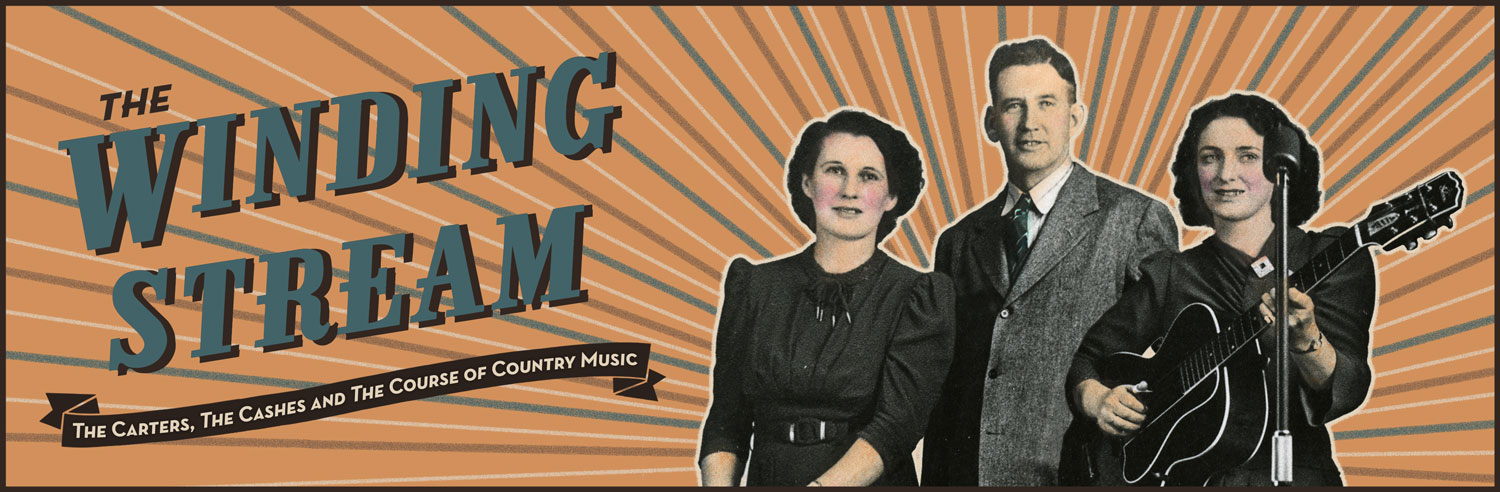
The Winding Stream is a documentary about the contributions of the Carter Family (plus Johnny Cash) to music as we know it. I was deeply impressed, and learned a lot, and was reminded here and there of another excellent music-history documentary, Muscle Shoals.

source

source (click to enlarge)

The Carter Family began with the trio of A.P. Carter, his wife Sara, and Sara’s cousin Maybelle (also a Carter by marriage to A.P.’s brother), who began playing music together in the 1920’s. The scope of the story is astounding, how many of these Carters there were and are, how many songs they recorded – the original trio left 260 recordings behind as their legacy, if I remember correctly. A.P. was an early music ethnologist, who traveled throughout his region – the Appalachian mountains of Virginia – seeking out old songs, “mountain music” as they called it (there was no “country music” yet). He noted the lyrics and the tunes and took them home, where he and Sara and Maybelle arranged them, rebuilding them somewhat, and then recorded them for the Victor Talking Machine Company. Today it occurs to us to wonder about the ethical implications of all these songs ending up being Carter songs; but as the movie points out, back then there was no concept of music being “owned” by anyone in particular. And but for A.P.’s avid, even obsessed calling to save this old music (even at the cost of his family life), many of those songs would have been lost to history in the Appalachian hills.

The trio eventually became part of a radio empire in Mexico, just across the border from Del Rio, Texas: “border radio” sprang up to avoid U.S. regulations, and used a high-powered frequency to send their programs across the States. (Stranger than fiction: the founder of the Del Rio border radio station was a doctor famous for his goat gland transplant procedure that supposedly boosted men’s sexual function and who promoted female circumcision [to make women less frigid, he claimed].) This is how a young boy named Johnny Cash first heard the Carter Family singing their old-timey songs. The group by this time involved some of the next generation, including Maybelle’s three daughters who would eventually be the Carter Sisters; one of them was little June. As Johnny Cash grew in stature, he kept Mama Maybelle close: in footage from his late life, he calls her the biggest star he ever knew.

The story goes on from there. You’ve heard of Johnny’s daughter (June’s daughter-in-law), Roseanne Cash. Their only child together, John Carter Cash, appears in the movie with his wife, an avid student of the Carter Family history who inspired him to learn more about his own legacy. These contemporary Carters still play the old music. In fact, one of the impressive details is in how many Carters there have been, and how they all seem to have had that music running in their veins: it was just a part of their lives, it appears, and they all could play. For example, Janette Carter, A.P. and Sara’s daughter, appears throughout the documentary, recalling her parents and their career. Only late in the movie do we learn that A.P. asked her on his deathbed to continue the legacy – and so she opened a dance hall and picked up her guitar and played. All of these characters – so many Carters – are rich, colorful figures in a compelling history.

As with Muscle Shoals, this film inspired a purchase: we went out immediately and bought an album by the Carolina Chocolate Drops after discovering them onscreen. One of the points made throughout is that the Carters have influenced all the music we know today. Like the (better-known) Beatles, everything that came after had a note of Carter Family in it.

Not only an extraordinary story, The Winding Stream is a well-produced and visually pleasing documentary, rich with family, detail, and emotion. I will say that in the animation of old black-and-white photographs of the original trio performing their music, the moving, blinking eyes were entirely creepy. But this was a rare treat of a movie. I learned a lot, and the music was outstanding.


Rating: 9 songs saved from extinction by A.P. Carter.

movie: Rear Window (1954)

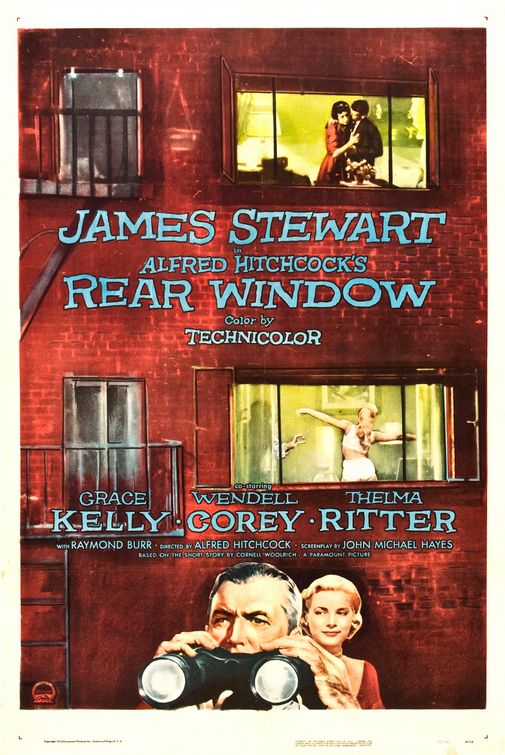
Happily, after some disappointment with The Birds the other night, I moved directly into another Hitchcock film that pleased me far more. I found Rear Window entertaining, clever, funny, and visually pleasing. Jimmy Stewart and Grace Kelly don’t hurt, of course. But fundamentally, I think murder-mystery ages better than horror, and that is what Rear Window is: not horror, but a noir murder mystery, which is one of my favorite things.

rear windowJames Stewart is L.B. Jefferies (“Jeff”), successful photographer of the adventurous sort, known for action shots, combat and the like. He is laid up with a broken leg, in a wheelchair, in his apartment, which suits him poorly, of course. Also irksome is his girlfriend and would-be fiancé, the lovely Lisa (Grace Kelly), a wealthy socialite he feels can’t possibly accept his life on the edge. Bored and bothered, he takes to spying on his neighbors out the window. The entire movie takes place from this perspective: we only ever see the inside of Jeff’s apartment, and the view he sees out its window, into a courtyard and the windows that also look upon it. There’s a middle-aged couple with a little dog; a female sculptor; a young ballerina who entertains many men; a slightly older, lonely woman; a composer struggling with his latest work; and a salesman who appears to be entirely tired of caring for his invalid wife. Jeff is visited by Lisa as well as a nurse, and a police detective friend he calls on for help when he thinks he’s witnessed a murder.

I loved the visuals: both James Stewart and Grace Kelly (particularly in tandem), and the vignette-style views of courtyard and other apartments, almost a shadowbox effect. I loved the survey of lives and loves provided by Jeff’s perspective. The lives he peeks into represent a range of experiences of life, different levels of contentment. I thought the suspense was well-done in a classic, thunder-and-lightning, guns-and-beautiful-ladies style. Even the puzzle itself – the whodunit – was engaging, if imperfect. The business with the flashbulbs struck me as quite ridiculous, but I laughed good-naturedly, because the overall effect of the story, the sets and the cast was so enjoyable. My fourth Hitchcock film is definitely my favorite. Fans of Agatha Christie will be pleased.


Rating: 9 little red pills.

art museums: Intersections, The Infinity Machine, and the Surrealists

I made my first trip to Europe with my then-boyfriend, who had an art degree. We went to Brussels and therefore to the Musées Royaux des Beaux-Arts de Belgique. We spent 8 or 9 hours there, and I have felt an aversion to art museums ever since. (I will say that the Mauritshuis in den Haag is a nice, small art museum filled with classics, including Girl With a Pearl Earring, which is easy to get through fairly quickly and is worth the time.) Despite this aversion, on a recent visit back to Houston, I went with my mother and my “other parents” (old family friends) to a few art museums on a Friday afternoon.

We started with Intersections, by Anila Quayyum Agha, at the Rice University Art Gallery. The piece is a six-and-a-half-foot cube of laser-cut wooden cube, suspended, with a bright bulb inside, so that the pattern cut out of the cube is projected onto ceiling, floor and walls. That pattern is a complex tessellating geometric design, and a short and very worthwhile video explains that Anila Quayyum Agha was inspired by the Alhambra. As a Muslim woman in Pakistan, she was not allowed into mosques (men only) and had few experiences with their interiors, but was struck by the extraordinary beauty and creative power in the Alhambra (which she was permitted to enter as a tourist.) She also spoke of the construction of this beauty by Muslims, Christians and Jews working together, and called it a “gem” of both artistry and unity between peoples. This was the inspiration for Intersections, whose tessellations echo the tile designs at the Alhambra.

Intersections, Anila Quayyum Agha (with Karen, Susan and Bob)

Intersections, by Anila Quayyum Agha. (With Karen, Susan and Bob). Click to enlarge.

It is a work of light and shadow, geometry and projection. The images on the ceiling and floor (closer to the cube) are crisper than those on the walls (which are further away), so the effect is variable. The cube itself is a work of art (although watch out for that ~600-watt bulb within), and the shadow/light-show another layer of it. People entering the room participate, because the shadows are cast on them (us) too. It was striking and meditative, and free at the University. Good stuff.

Next, after lunch, we went to the Menil campus, and walked first over to the Byzantine Fresco Chapel to see The Infinity Machine, by Janet Cardiff and George Bures Miller. This was an excellent counterpoint to Intersections: another room-sized installation playing with light and, in this case, reflection. Many mirrors are suspended on wires and rotate – around as one large constellation, and also in some cases individually. The room is very dark; a docent escorted us in with a flashlight to seat us on a bench until our eyes adjusted. A few lights lit the solar system of mirrors, and we suspect those lights dimmed and brightened or shut off completely or changed colors. It is hard to say, because the effect is disorienting. I had the odd feeling that different mirrors were present upon each rotation: clearly this is not the case, but the view was ever-changing and, I felt, never repeating. It was kind of intense. A soundtrack played, of NASA recordings of solar wind. Perhaps because we had just lunched at the Hobbit Cafe (always a treat), I said it sounded like the Eye of Sauron. I also thought of calling it “dark noise”: like white noise, but darker, spooky. At one point I thought Sauron was coming to get us on a train, with that characteristic clack-clack and growing whoosh. Where Intersections was light, crisp, patterned, and explicitly called for unity, The Infinity Machine was a little foreboding, even threatening – although I was very happy to experience it, and don’t mean that as a criticism. It was fascinating.

We finished with the Menil Collection building, about which I was most ambivalent, but there was a Dalí exhibit! I was enchanted by some of the artifacts in the Arctic Art collection, including a tiny statue of a bust (of a man?) with toddler on its shoulders; it was less than the height of one of my (cut-short) fingernails, and a fraction the width. I quickly browsed the “frottages and rubbings” exhibit. And then surrealism: lots of Victor Brauner and Max Ernest, several Joseph Cornell boxes (an exhibit of whose work first took me to the Menil, in high school), a few Picassos, and oh, Rene Magritte. I love him – although I didn’t feel he fit perfectly in this collection. His images are so crisp and hyper-real, even if they do float in the wrong places. Dalí’s Eggs on a Plate Without the Plate centered this exhibit, which was entitled “The Secret of the Hanging Egg.” But my favorite piece was The Hunted Sky by Yves Tanguy, which transfixed me. I wish I had a full-size print of that in my home to continue to consider, because I feel like I need more time. (You can look it up online but those images do no justice.)

Still, overall and by comparison, I moved through the Menil Collection quickly; I think the room-sized installations are more generally my speed than rooms filled with paintings. But this was a remarkable experience all around. I normally make it into an art museum every year or so, or less often, and generally at my mother’s side (I try to be good-natured about it, she doesn’t drag me). Today’s visit was at least as rewarding as any I can recall. If you find yourself in the neighborhood of either of these big installations, definitely check them out. Everything we saw was free, too (great job, Houston!), so take advantage!


Rating: 9 reflected or projected tones of light.