the TBR shelves: a lifestyle

Friends, I am a full-time reader-writer these days, having moved cross-country and left my day job behind. I read & review books & do author interviews for a living, and pursue my own, creative writing where I can. Let me repeat: I read books for a living.

I’ve written about this before, but I say again, I read for lots of reasons. I read for work, obviously, and am happy that what I get to read for work is mostly stuff I’m really interested in. But I also want to read all the good creative nonfiction and memoir out there, to train myself on it; I want to read all the good writing about sense of place, and people’s relationship to place; I want to catch up on everything ever written by Hemingway, Abbey, Maclean, and Dillard; I want to read more Stegner and Snyder. For fun I’d definitely spend more time with King and Burke. I want to read all the books on this and other lists. There are always more classics on my wish list – Steinbeck, Fitzgerald, Nabokov. I’m sure I’m forgetting all sorts of things, too.

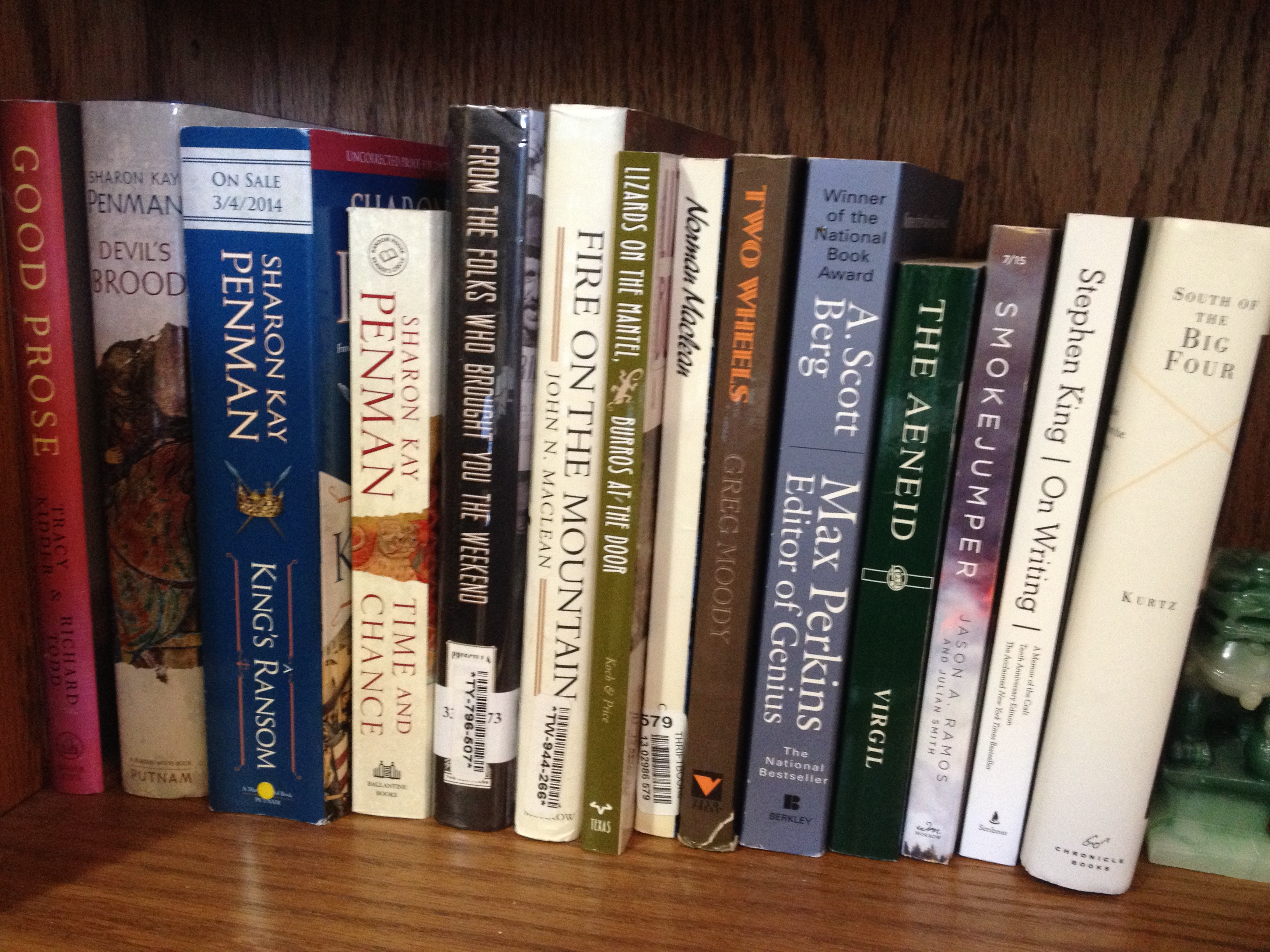
Unsurprisingly, then, I’ve also got a couple of shelves devoted to books I already own and hope to someday find time for. Sometimes I weed these. When we moved from Houston to Bellingham, I was pretty ruthless; but I still moved probably 50 or 60 “to-be-read” (or TBR) books. Where do they come from?? I was just wondering this, so here’s a blog post.

My TBR shelves, in pictures (click to enlarge):
IMG_6176
IMG_6177

IMG_6178

IMG_6179

IMG_6181
These are recommendations (and gifts – Fil) from friends, on cycling and nature and Texas and Mexico; biographies of Melvil Dewey, Howard Hughes, and Zelda Fitgerald (if there’s a theme there, it might be mental illness); nature writing, much of it recommended by other nature writers; a hefty pile of Sharon Kay Penman; and several galleys I missed the chance to review for Shelf Awareness, but still hope to read (a smokejumper’s memoir; a readalike for Gus Lee’s Honor and Duty). Books about writing, or books that showcase the kind of writing I aspire to. There’s a different edition of A Sand County Almanac, from my dad. They’ve come from the discards pile at libraries I’ve worked at, as gifts, as galleys from publishers, and more than I like to admit I’ve bought and paid for, and may never find time to read. I’ve read 80-something books this year, and 18 of them were purely my choice, unassigned. I already quit my day job. What gives?

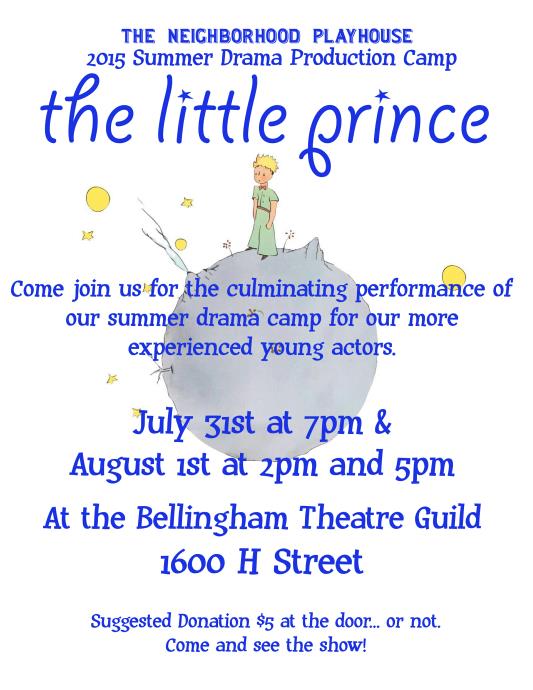
The Neighborhood Playhouse presents The Little Prince

little princeThe Little Prince is a magical tale, and I was immediately sold on the idea of a local production, performed by young people no less. The Neighborhood Playhouse Summer Drama Camp culminated in this production after less than two weeks; the ability of these teens to stand up with confidence and memorized lines after such brief prep is impressive enough, even if the play hadn’t been beautifully and feelingly done, which it was. Wow.

This was a musical production, and as I said about The Drowsy Chaperone, there were moments of less than perfect polish: these actors (whether youth or adult) are not professionals. But that’s okay! In fact, like when I go to watch college or adult-league sports, it’s part of the charm: I can see that these are “just” real people, like me, pursuing a passion. And I’m not criticizing. The level of performance here was very high – just not Broadway.

There were several very strong singers up there, especially the young lady who played the flower, but they all played their parts well. I felt the magic of St. Exupery’s original work, as these young actors communicated all the emotion of the pilot – his frustration, his regrets – and the prince, whose innocence is part of his appeal. I felt happy and lucky to be in the small audience. Thank you, Neighborhood Playhouse, and to the kids: bravo.


Rating: 7 snakebites.

best of 2015, to date

I’ve had several requests lately for recommended reads, and I always try to have those ready for my friends & readers! As you know, I’ll always do an end-of-year best-of list, but maybe it’s time for an interim selection. Not all of these will make the final 2015 list, I’m sure, but some will: my first entry is still the only 10 rating I’ve given this year. Now with a few annotations… click the links for the full review, and in the cases where it hasn’t yet posted, I’ll do my best to come back and add those links when they become available.

This is a fairly varied list, which I always feel good about: something for everyone, I hope.

Best of 2015 to date! Thanks for caring, y’all.

  • Martin Marten, Brian Doyle – fiction. A novel of two young creatures, a boy and a marten, showcasing outrageously fine writing and a unique sensitivity to the fact that we humans are not the only ones living and breathing on this planet.
  • Of Things Gone Astray, Janina Matthewson – fiction. A whimsical novel of lost things and what they mean, and the stories of the people who lose them, and sometimes find them again.
  • Travels in Vermeer, Michael White – nonfiction. A lyrical memoir of recovery and art appreciation; the best writing about the visual arts that I’ve encountered.
  • Hammer Head: The Making of a Carpenter, Nina MacLaughlin – nonfiction. Memoir of a young female carpenter, about everything entailed in that life, and the balance between the mental and the physical.
  • The Light of the World, Elizabeth Alexander – nonfiction. Memoir of loss of a beloved husband by an excellent poet; lovely glimpses of global cultures.
  • Bird by Bird, Anne Lamott – nonfiction. Writing advice and wit from a respected mind, with a fun and singular voice.
  • Mislaid, Nell Zink – fiction. Quirky novel of mixed-up relationships with a strong sense of place (set in the South).
  • Wondering Who You Are, Sonya Lea – nonfiction. Memoir of a spouse’s traumatic brain injury: sex, love, art, identity.
  • Station Eleven*, Emily St. John Mandel – fiction. Imaginative post-apocalyptic novel of a traveling symphony and Shakespeare theatre company in a changed United States. Emphasis on character and story rather than sensationalism of collapse.
  • Old Heart, Peter Ferry – fiction. Brief, sweet, feeling novel of old age and end-of-life autonomy with impulses toward romance, but not an idealized version.
  • The Elements of Style, Strunk & White – nonfiction. Still an outstanding style guide, and surprising funny, enjoyable reading.
  • The Anger Meridian, Kaylie Jones – fiction. Novel of a traumatized widow seeking direction in vividly evoked San Miguel de Allende, with a little puzzle for the reader to work out.
  • Coming of Age at the End of Days, Alice LaPlante – fiction. Somewhat distressing, compelling novel well summarized by its title.
  • The Writing Life*, Annie Dillard – nonfiction. Lovely essays about Dillard’s writing life: glimpses into places and experiences and challenges.
  • South Toward Home, Margaret Eby – nonfiction. A review of one Alabama woman’s literary icons that resonated especially with me.
  • Dakota, Kathleen Norris – nonfiction. Lovely evocations of sense of place in essay form.
  • My Southern Journey, Rick Bragg – nonfiction. Funny, moving, evocative, beautifully crafted, very short true stories from the Deep South.

(* are audiobooks.)

Honorable mention goes as well to Paul Kingsnorth’s singular debut novel, The Wake, which tells a great story, a historical post-apocalypse set in England following the Norman Invasion. Kingsnorth makes the gutsy decision to tell the story in a modified version of Old English, making it quite hard to read: I fear he will lose readers by challenging them so greatly, but really, it’s a worthwhile book if you can struggle through. It gets better after 50 pages, I promise!

If you try any of these fine books out, I’d love to hear what you think. Thanks!

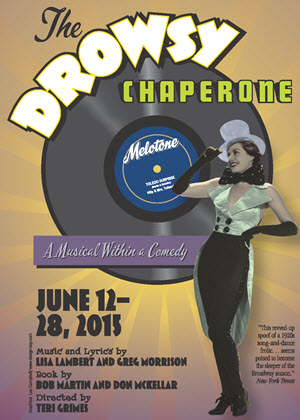
Bellingham Theatre Guild presents The Drowsy Chaperone

drowsyOn a rainy night, with a sprained ankle, I set out on my bicycle with Pops to see a local amateur production at a neighborhood theatre. In a word, the production was indeed amateur (which is to say, unpolished), but heartfelt and charming; and the play borders on too silly but was ultimately fun.

The narrator is a middle-aged, socially awkward man, sitting in the darkness of his apartment and dreaming about another world. He speaks directly to the audience about the strengths and downfalls of musical theatre, and puts on a record, the soundtrack to a musical of the 1920’s called The Drowsy Chaperone. The action comes to life in his living room, as the original cast performs the play, interrupted by our host’s interjected comments on the show.

The musical is your standard comedy of errors, involving a wedding that not everyone is supportive of, and includes mistaken identities and the beginnings of new romances. It was pretty cheesy, particularly in its song and dance (even more so than your standard musical!), although the tap dancing was a great addition. But as the story developed, I was more tuned in to the pathos of the narrator and more on board with the general silliness of the show-within-the-show. So while it started a little questionably, by the end I had let myself go into the world of the theatre, and it was rewarding. The performances were less than perfect, but again, this is local, amateur, community theatre: adjust your expectations a little, and be prepared for a good time. I left feeling uplifted by the fun, and will be looking for more Bellingham Theatre Guild performances in the future. Thanks, neighbors.


Rating: 6 gimlets.

Emily St. John Mandel

1. I am charmed and seduced by her most recent novel, Station Eleven. It is hypnotic.

2. She has five different people available for contact on her website (for representation; speaking; and publicity in the US, Canada and the UK). They are named Kelsey, Katherine, Kate, Kate, and Kate. Surely she had to have done that on purpose??

3. The title line for her short bio piece on the same website is: “St. John’s my middle name. The books go under M.” She has a sense of humor and c’mon, librarians and booksellers.


Dear Emily St. John Mandel,

I have a dear friend named Liz, and she is who recommended that I read your latest book. Liz is still batting 1000 with her recommendations to me, which is unprecedented and very impressive; nowadays her recommendations often move straight to the top of my very long list. She recommended I listen to the audiobook of Station Eleven, and so I am.

I am entranced by this world you’ve created, which is so closely related to but also so far apart from our own. I love the world within the world, of Station Eleven; I love that we meet the artist behind that world just a step behind entering it ourselves. I really appreciated the detail of the doctor calling from the emergency room near the beginning of the book. Dahlia is outstanding, and her speech got me thinking just as it did Clark. I was fascinated by Jeevan’s story at the start and, at nearly halfway through, I am anxious to know: will we go back to check in on him and find out his fate? When I checked in with Liz, I found that both she and her partner Steph had the same reaction: they wanted to hear more about Jeevan.

I haven’t even finished your book yet, but I know it has to end. And Liz says she doesn’t feel that this should be the end of the world you’ve imagined; she wants you to write more. Because I trust Liz, and because I love the first almost-half of this novel and know I will feel the same way, I want to say: please keep going. I know you have three earlier novels for me to go back and discover, but I’m not sure that’s enough.

Keep up the good work.

Thanks, and all my best,

Julia

“How to Write Like a Mother#^@%*&” by Elissa Bassist & Cheryl Strayed

I have not read Cheryl Strayed’s Wild. But I did take seriously the recommendation of this piece that I found at creativenonfiction.org, and yes, I own this mug.

9

It would take me almost as many words to summarize and praise this article as are included in the article, so I shall exercise restraint and say: go read this now; it is excellent. Thank you, Cheryl & E-Bass.

movie: Jackie Brown (1997)

jackie brown
You know I’m a Tarantino fan, but I stumbled on this one, friends.

Jackie Brown (played by Pam Grier) is a flight attendant who’s been busted smuggling cash over international borders for Samuel L. Jackson’s character, Ordell. The cops don’t want her in prison: they want her to inform on him. Ordell bails her out with the help of bail bondsman Max Cherry (Robert Forster, who feels decades more dated than the rest of the film), so he can kill her; but she thwarts him. Jackie plays the cops (chiefly an ATF agent played by Michael Keaton) against Ordell against Cherry, who falls for her; adding to the star-studded staff is Ordell’s old friend fresh out of jail, played by Robert De Niro, one of his kept women played by Bridget Fonda, and a brief role by Chris Tucker.

In Tarantino fashion, the plot is many-twisted: Jackie tells everybody a different story of herself and her plans, so watch closely for where she’s really headed and who’s really holding the bag. The script is heavy on clever monologues that are not strictly realistic but are great fun to listen to nonetheless. (These are the great strengths of Pulp Fiction, I think.) I hadn’t known that this movie was based on an Elmore Leonard novel (Rum Punch), but it makes sense now.

On the other hand, where I think the extensive use of the n-word in Django Unchained was fairly well justified and pointed, it grated here. There were many references to race that felt gratuitous rather than purposeful. I felt uncomfortable. I know this movie is supposed to reference a tradition of “blaxploitation” movies that I missed out on: maybe I’m just lacking the reference point to appreciate Tarantino’s edginess. But that’s my reaction: it was a little too unjustifiably race-conscious for me.

I did like the vintage feel to the movie. Anthony Lee Collins or somebody else with the relevant expertise will have to help me out here: I know there’s something about the cinematography, maybe the type of film used (?), that makes Jackie Brown feel older than it is. I can’t put my finger on it but Robert Forster’s character felt out of another time, even within the context of the film. And then there’s the text used in certain sections, like in the Kill Bill movies, that felt like it referenced something older, too.

So, a mixed review. I liked the plot twists, and the acting was excellent, and Tarantino’s monologues continue to crack me up. But the n-word got to me this time around.


Rating: 5 shopping bags.

Brian Doyle at Chuckanut Radio Hour

You will of course remember my glowing review of Brian Doyle’s most recent novel, Martin Marten, which remains the best book of 2015 to date (and may well make it through: I rarely award more than one *10* in a year). The same week that that review published over at Shelf Awareness (and my teaser posted here), he came to my little city to speak at a local event, the Chuckanut Radio Hour.

The Chuckanut Radio Hour is edited and aired on local radio a few times afters its live production, and it costs $5 per person (plus fees, naturally) to be part of that live audience. My parents and I went to see this edition, because Brian Doyle! I hadn’t been before (my parents had). The show describes itself as

…a radio variety show that began in January 2007. Each Chuckanut Radio Hour features a guest author and includes guest musicians, performance poet Kevin Murphy, Cascadia Weekly columnist Alan Rhodes, an episode of “The Bellingham Bean” serial radio comedy, and some groaner jokes by hosts Chuck & Dee Robinson and announcer Rich Donnelly.

(Chuck and Dee are the owners of Village Books, our local top-shelf independent bookstore.) I have wholesale stolen that quotation because it’s quite accurate, although in this edition we missed Alan Rhodes and instead took an extra musical number by guest artists 3-Oh. The band was good, and funny, with covers and originals; the spoken-word/poetry was good; “The Bellingham Bean” was quite funny (and guest-starred the versatile Brian Doyle to boot). The hosts’ jokes were, yes, groaners. But of course we were there for the author. Brian Doyle turns out to be a falling-down fine comedian in his own right, who knew? Also a very good storyteller, although that is less surprising. He didn’t really need an interviewer – just a microphone and a stage, and free rein. He monologues quite cheerfully, energetically, happily, and oh so funnily. He then continued this performance after the show was wrapped up, as we lined up to get our books signed (did I cheat by having him sign my galley?) and talk with him: the line was long because Doyle was so generous with his time and attentions, and I am grateful.

That’s two very good author-talk experiences in a row. If you get a chance to see Brian Doyle live, do! And for now, go get yourself a copy of the new Martin Marten: it’s outstanding and unique. And join me in investigating his earlier work, too, which includes two novels (The Plover and Mink River) as well as a bunch of essays. Here’s to local theatre etc.!

coffee helps me read and write

Realizing the obvious: as a creative person, I have good days and bad ones. When I get discouraged, I get very discouraged, and feel unable to do the writing & editing I know I need to do; I want to give it all up. As my friend Liz says, though, some days we just need to lie fallow (and give ourselves permission to do so).

I don’t want to dwell on that negative side today, though: I want to talk about the other days, the hyperproductive ones, when I can write 3 book reviews, do an author interview, schedule 4 blog posts and finish an essay I’d been working on. That happens sometimes, too! And you know what those productive days have in common? Coffee.

Shelf Awareness shared with me the other day an article called 12 Literary Coffee Mugs All Book Nerds Need in Their Lives. I am tickled by the concept, naturally. Go ahead, click the link, and see the bookish, readerly coffee mugs on offer there. I have made my own collection, though, and naturally think mine are a better set of choices: readerly and writerly as well.

a nod to the librarian stereotype

a nod to the librarian stereotype

a little humor - and truth

a little humor – and truth

a Sugar reference

a Sugar reference

often, but falsely, attributed to Hemingway: never mind, it sounds like him

a gift from my parents, from the Library of Congress

a gift from my parents, from the Library of Congress

What about you, dear readers? Coffee or tea? In what mug? Does it matter?

class: Foundations of Creative Nonfiction – B

I took a class from Creative Nonfiction this spring, for 10 weeks from January through March. Foundations of Creative Nonfiction is taught in two sections, A and B, and the difference is in the readings assigned, so that neither is a prereq; rather, it’s basically an opportunity to expand into 20 weeks by taking both, and get more reading-and-discussing out of it. Also, presumably, different instructors. My instructor for this section was Meghan O’Gieblyn.

Let’s see, how to begin? Like many online classes, this one involved reading 3-5 short pieces per week and commenting on them in discussion forums. Meghan posted her written lectures (3-5 pages) for each week, as well as two examples of the writing form in question, and often a few more optional readings. My classmates and I were to post a comment on the week’s readings, and reply to one another’s comments as well. Then there were writing assignments: short, optional ones, and three longer (3,500 word) pieces. These, too, the instructor as well as my classmates responded to.

Now, I got my master’s degree almost entirely through this very format. The difference here is that my classmates and I are here even more by choice: we paid for this class, and it gets us nowhere in terms of a degree or class credit; it’s purely for personal enrichment. (If any of my classmates got a pay raise or a new job out of this, I didn’t hear of it.) If anything, one might expect the discussion to be slightly elevated over my (rather disappointing) graduate school experience. And… I guess it was, a little, but the drawbacks were the same. For one thing, I think online discussions are unavoidably more stilted than live, in-person ones. There’s little chance to speak off the cuff in an online forum; there’s a chance for editing and deleting. Some classmates cited technical difficulties interrupting their comments, too. It’s always rewarding to hear from other human beings about anything you’re reading, writing, or otherwise interesting, so that benefit was present. But I remain unsold on the digital format: if real people are available, in person, in real life, I think they will always be preferable.

I did get a lot out of this class, of course. I got a lot of readings and lectures (all of which I’ve saved for future reference). I got feedback on several short and the three long writing pieces I did. I gained only a little help with the concept of getting my work properly published; but that still feels awfully remote anyway. And to be fair, if it felt closer, the opportunity was present to ask those questions.

Instructor Meghan was excellent: responsive, kind, and full of specific, detailed criticism and advice. Overall, the class may not have been utterly world-changing, but it was worth the time, although I think an in-person class would be better. And if you consider CNF for an online class like this, I’d highly recommend Meghan.