part one of two-part review: Earth Works by Scott Russell Sanders

For other Sanders work, see Pops’s review of Staying Put and my review of Writing From the Center.


At this point in my semester, I’m beginning to work on a first draft of the third semester project in my MFA program: a critical essay, or longform investigation of the strategies of writers I admire that might inform my own work. (For more about the critical essay, you can take a look at pages 42-44 of the student handbook here, and follow this tag.) My essay topic is the use of stuff, things, or material objects (new tag!) as a way in to a subject or a character. With this topic in mind, I approached this most recent (2012) collection of Scott Russell Sanders’s work especially interested in a few essays in particular. I’d intended to only sample from the rest; but I couldn’t put it down.
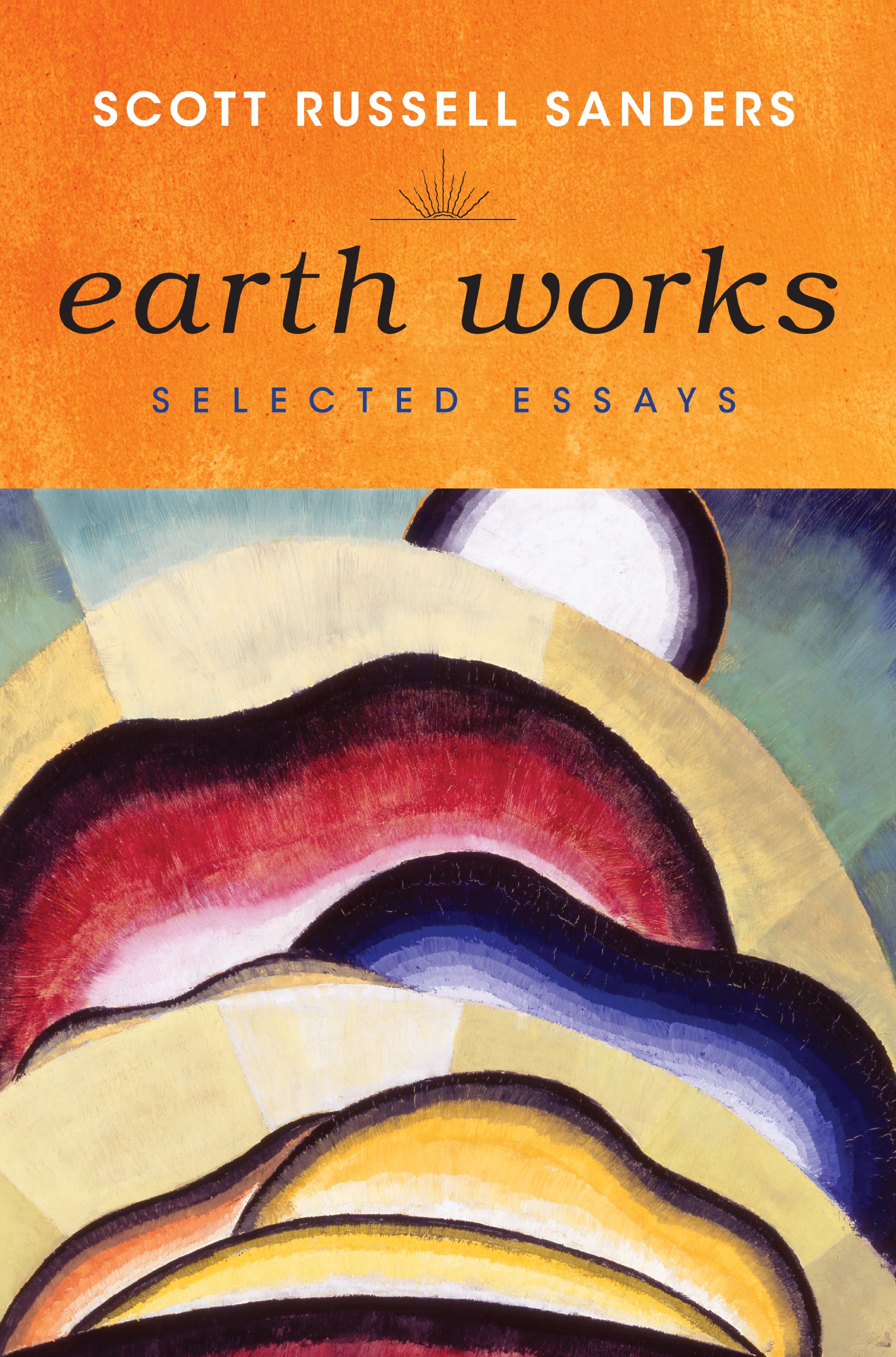

Earth Works is a must-have collection for the Sanders fan. He carefully selected the 30 essays here, including nine that have never before been collected. I’ve read some of these before, but remained mesmerized by both content and style regardless of my familiarity. Sort of like with that Beard essay I so revere, “Buckeye” remains a feat to appreciate on every reading, even six or eight readings in.

A brief preface places these essays in some context in Sanders’s life and aims, and then they unfurl, in mostly chronological order by date of composition (some exceptions for the sake of juxtaposing topics), and with few revisions to their original published form (“for better or worse”). I really appreciate that the first essay, composed in 1987, is “The Singular First Person”: it lays out Sanders’s perspective about the personal essay, its form and purposes. It’s a smart way to start, because it offers some idea of what he thinks he’s up to, and therefore some promise of what is to come. A humble man speculates on what he finds in the world, in the hopes of asking big questions: “Who am I? What sense can I make of this inner tumult? How should I live? Does the universe have a purpose? Do we? What finally and deeply matters? What is true, and how can we know?” (From a later essay, “Letter to a Reader.”) Sanders is concerned with nature and the natural world, but resists the term “nature writer” (as did Edward Abbey), because he is most concerned with interconnectedness: human beings with one another, with the natural world of which we are mere part. He wonders about spirituality, about our place in the cosmos, about the sadness of consumerism and war, the destruction of the Earth; but he has a great love for the world, too, and allows that to shine through.

This reading, my deepest exploration of his work, confirms for me that Sanders is one of my favorite essayists. He marries content that is meaningful and sympathetic to me with style that is both lovely to read, and nearly invisible. As I’ve said before, the best writing often doesn’t even feel crafted, but that’s when you know it was hardest to craft. These essays are good examples of that idea.

I came for three essays in particular, as I said. “The Inheritance of Tools” uses stuff or things to get at a character: Sanders recalls his father through the tools that father passed on to him, along with the knowledge of how to use them; this essay is a way of processing his grief on his father’s death. “Under the Influence” is about the same father, but in this essay, the father is an alcoholic, who causes his family great pain. The two fit interestingly together because they’re about the same man from two very different perspectives. Finally, “Buckeye” continues the grieving for the beloved father, through a series of objects, beginning with the title buckeyes but traveling through other material things. Because all three attempt to profile a parent, and deal with the relationship between writer and parent, and because two of them do so through objects, they offer a number of things to me. For the purpose of the critical essay, I’ve also got my hands on a talk Sanders gave in 1990 at the University of Iowa, about the crafting of “The Inheritance of Tools” and “Under the Influence.”

As I said, these were not the only standout essays for me, and I kept reading for the pleasure of it beyond the three essays I’d intended to study. It wasn’t all good times, either, though. An early (1984) essay, “The Men We Carry In Our Minds,” made me angry. Sanders means well, and he is good to the women in his life (wife and daughter) in many ways. He considers himself a feminist. This essay means well, too, but it makes some major blunders, when he concludes that his own upbringing in relatively impoverished, working-class conditions make the challenges he’s faced the same as those faced by women. I am taken back to an excellent article I read years ago, titled “Explaining White Privilege to a Broke White Person.” The idea here is that you can be really poor and still enjoy privilege as a white person, because at least your race isn’t contributing to the limitations or constraints you face. The same principle could be applied to Sanders’s arguments. You might have been poor, you might have been limited, but you didn’t face the glass ceiling, the sexual harassment, the wage gap, the rape culture, or the insidious, invisible assumptions of incompetence that women did and do face. Concluding that you thoroughly understand the predicament of women when you don’t is arguably more problematic than not attempting to understand in the first place; congratulating oneself and turning away is troubling, because it makes you something of a false ally. His blindness to this problem gave me a lot of trouble. The HuffPost article was published in 2014, and Sanders’s essay, again, in 1984. But since he’s reprinted it in 2012 without feeling a need for further comment, I think he still needs to go read the HuffPost piece.

I won’t forget the blind spots exposed in this essay. But it’s to the great credit of the rest of this book that I still love it. Because there is indeed much to love here, not least the previously uncollected work near the end–I really enjoyed seeing Sanders articulate his appreciation for Emerson, Thoreau, and Wendell Berry, among others. I had already sent a copy of this book to my father before I got to these essays, but they made me glad again that I’d sent it to him.

Come back to me next Wednesday and I’ll do more raving, and slightly more quibbling, with this long and rich book.

reread: Still Life With Oysters and Lemon by Mark Doty

This is one of a few rereads and re-reviews, as I work my way into this semester’s project: my critical essay about the use of material things in Mark Doty’s Still Life with Oysters and Lemons, Terry Tempest Williams’s Pieces of White Shell, and a handful of Scott Russell Sanders’s essays. Original review here.


I annotated this book last semester for its use of objects. This time around, I’m interested in contrasting its strategy for using things with Terry Tempest Williams’s in Pieces of White Shell.

Where PoWS is a collection of essays or stories, SLWOL is a single essay, just seventy pages. Williams offers a collection of objects and devoted a chapter to each, where each object (or grouping of objects) allows her a way in to discuss the topics she needs to discuss. Doty’s work is initially ekphrastic: he is engaged in a lengthy, unhurried meditation on a single painting, and along the way meanders through a wide variety of places, buildings, objects, and other paintings. Doty refers to the habitual attendees of auctions, a tribe in which he includes himself, as “curators of objects, some of which would outlast us” (33); Williams is employed as museum curator during the narrative present of her book. Both books are concerned with material things, and use those things as a way in to larger topics, or allow them to stand in for less concrete concepts. But they do it both in very different ways and to very different effects, in part because the two writers are pursuing very different subjects.

Williams explores a body of knowledge and mythology that is outside herself (Navajo culture and myth, and a scientific approach–geography, biology–to a specific place) in order to better understand her world, including her Mormon background and her relationship with people and nature; she works to put forward a philosophy gleaned and developed from these sources. Doty wants to develop a worldview as well, of the dualities that engage his curiosity: intimacy versus independence, home versus travel. (He writes in The Art of Description about the usefulness of polarity: “the pull of forces in opposition to one another makes writing feel alive, because it feels more like life to us than any singular focus does; reality, we understand, is a field in which more than one attraction, more than one strong tug, is always at work.”) He does this by examining the objects that draw his attention, and the nature of that attention. Thus, he’s not studying a still life painting so much as studying its effect on him, although a study of the painting is involved in a study of its effects.

In this way, Williams and Doty’s use of objects necessarily differs. Williams chooses the objects that head her chapters for their associative value. The Storyteller is a useful object because it opens the door to discuss storytellers she’s known, and the cultural value of storytelling. (The reader takes her word for it that these are also the objects actually on her desk, but whether chosen for the desk or for the book, still chosen.) Doty doesn’t choose objects so much as they choose him. He’s not using the painting, or the blue-and-white platter with antlered deer on it, or the peppermints, because of what they let him talk about. He is rather driven to use those objects because they have acted upon him, and it’s that acting-upon that he writes about in this book.

He also writes at several points about the narrative contained in objects: “I loved best the [auctions] that took place at people’s houses, for then the narrative of a life was most available” (31). The things he’s purchased “are informed for me, permanently, by the narrative of the auction, an experience of participation” (33). Obviously a nonfiction writer interested in composing a larger story through objects, perks up her ears at these mentions of narrative. However, I think perhaps Doty is even more interested in that “experience of participation.” Williams’s approach is more like narrative-through-representative-object (objects for their associative powers), where Doty’s is more the experience of interacting with objects, as the central narrative.

If there were a thesis question at the heart of this book, it might be, “Why do these things make me feel what they make me feel?” The title painting leads him into a lengthy discussion, revisited throughout the book, of how lemons represent intimacy. I’m not sure I would ever have gotten, myself, to a conclusion that lemons represent intimacy; but I’m deeply involved in Doty’s thought process. In the end, this book is not centrally about Doty’s life, any more than PoWS is about Williams’s. Rather, this book is about how Doty looks at (literal, material) things, and by extension how we all look at things.


Rating: upgraded to 9 quinces on this go-round.

reread: Pieces of White Shell by Terry Tempest Williams

This is one of a few rereads and re-reviews, as I work my way into this semester’s project: my critical essay about the use of material things in Mark Doty’s Still Life with Oysters and Lemons, Terry Tempest Williams’s Pieces of White Shell, and a handful of Scott Russell Sanders’s essays. Original review here.


The importance of this book to me can hardly be overstated, as I’ve read it many times since my childhood. It offers many possible annotation subjects: the dreamy quality of the stories Williams tells; the line between fact and fiction; the liberal use of other writers’ words to compile her own impressions; the interplay between Mormon and Navajo traditions; her study of storytelling as communication and education across generations. But here I am most interested in her use of objects as an organizing principle.

Williams’s chapters are organized by the items she keeps in a leather pouch on her desk at the Utah Museum of Natural History, where she works as museum curator. The prologue opens: “Out of my pouch falls a sprig of sage.” This prologue is different from the rest of the book in that it is set in Williams’s family home and tradition, while the rest of the book stays with the Navajo and her work life. Sage backgrounds her home. Chapter one, “Curator,” presents the pouch. Its first two paragraphs read,

I am a collector. On my desk sits a small leather pouch, weatherbeaten, full of mementos of the desert. I have carried it with me everywhere in Navajoland. It is my link with the Diné, as they call themselves. I am shy. The people are shy. The objects inside give us courage to speak.

I shake the objects out of their pouch and spread them across my desk. What stories they tell: a sprig of sage; rocks, sand, and seeds; turquoise, obsidian, coral; pieces of white shell; yucca; a bouquet of feathers bound by yarn; coyote fur; a bone from Black Mountain; deerskin; wool; a potshard and some corn pollen. Wait–something is missing. I shake the pouch four more times and from the bottom of the bag rolls out the Storyteller, a clay figurine from Jemez.

This list of objects forms the rest of the chapter titles. The prologue is subtitled “A Sprig of Sage,” and the rest following chapter 1, “Curator,” proceed: “Rocks, Sand, and Seeds,” “Turquoise, Obsidian, and Coral,” etc. down the list. “Storyteller” is followed by “Home,” and then an epilogue, acknowledgements, notes, and bibliography. With just a few exceptions, the pouch’s contents neatly form the table of contents. As a writer who has always struggled with titles, this neatness appeals to me.

Within each chapter, the object or objects offer entry into stories, folklore, natural history, and personal musings. The connections between object and story are often tenuous: they make sense to Williams, and she is content to leave them sketched. My first impression is that she follows her mind where it wanders without much explicit mapping of those wanderings for her reader. Let me look closer at how each chapter title describes its contents.

The sprig of sage is the Utah landscape that Williams and her family and her Mormon culture belong to; it leads her to family stories. The rocks, sand, and seeds are the geography of Navajoland (the Colorado Plateau), and this chapter lets her tell the story of that land both through the science of geography and through Navajo mythology. Turquoise, obsidian, and coral are colors: of the desert, and of Navajo mythology again. Pieces of white shell are vestiges of the ocean that once covered Navajoland, and this leads her to an old world and old traditions, again accessed in part through myth. Yucca is soap, tradition, and the traditional ceremony surrounding a Navajo woman’s first menses.

A bouquet of feathers bound by yarn is classic Terry Tempest Williams: her obsession with birds, and their place in the myth and culture and ecology of the region. Here she tells stories of communing with a great horned owl, and of attending a powwow. Coyote fur is also obvious, allowing a way in to Coyote/Trickster stories. A bone from Black Mountain is a storytelling opportunity: Williams picks up a bone and dreams, imagines herself shrinking to Flea and listening in on the storytelling of the animals on the mountain. The chapter ends with a lesson about the nature of storytelling.

Deerskin begins the reentry of Williams’s own family, as her father’s and brothers’ hunting traditions meet the Navajo Deerhunting Way. Wool is a connection to the Navajos’ sheepherding tradition. A potshard and some corn pollen lets Williams imagine her way into the ancient world of the Anasazi, the Navajos’ precursors in the region. The Storyteller reminds her of two women in particular that she’s known; the reader recognizes that Williams is herself a storyteller, as well, with all the ritual and roles associated. The outlier final chapter, “Home,” re-grounds Williams back in the present, in her office at the Utah Museum of Natural History.

I can see now that these objects each lead Williams into history, myth, place, and culture, associatively. In fact, it’s a more consistent, standard strategy than it immediately appeared to me–almost a formula, but with a feeling more intuitive and natural than that implies.

Within chapters there is an organization to admire, too. Many chapters both start and end with an image, or with the object itself, circular. This keeps the reader grounded in the objects and the images and associations they call up. It is part of what makes my overall impression of this book as both simple and profound: the pattern brings the reader back around, always, so that she remembers the objects that brought us here. Williams deals in concepts that ask her reader to stop and think, but she grounds them in easily grasped things. The chapter titled “A Bouquet of Feathers Bound by Yarn” begins with the word “birds” and ends with “birds burst into song”; the title phrase occurs in both the next-to-first and next-to-last sentences.

As a writer intimidated by both titles and the conclusion and tying-up of essays, this structure appeals to me very much as a strategy to make my own work easier to organize. I appreciate that the effect on me as reader was not of a formula but of an artful form. I think there may be a shortcut here for me. In my critical essay, there are several aspects of Pieces of White Shell that I hope to mine for my own work: overall organization of a collection, the theming of individual chapters or essays, and things standing in for stories or concepts, as ways in.


Rating: 9 coyotes return.

more on Silverman’s Fearless Confessions

I’ve been asked by a reader to elucidate some points in my review of Fearless Confessions. I apologize for being less than clear. Y’all keep on asking your questions so I can do the communicating I want to do, improve my practice, and not frustrate my readers!

These are the lines in question as they appeared:

I was really excited by Silverman’s concepts of highlighting, with different color highlighters, different plot elements or characters in a memoirist’s story to serve different plots. Or her idea of erasing the parts that don’t serve whichever story is being told: where a fiction writer builds plot, a nonfictionist sculpts one by erasure. These metaphors worked really well for me, and are perhaps the best expressions I have read of concepts I’ve been trying to articulate and wrap myself around.

And the question read,

Who is doing the highlighting – an aspiring writer reading an established author? For understanding the craft in that writer’s style? And is ‘erasing the parts’ advice for that aspiring writer to edit a draft down to the desired essence?

Okay, I’ll try again. The highlighting is metaphoric, not literal, although the metaphor gets a little involved when we talk about the different color highlighters. The idea is this: let’s say I’ve been a competitive cyclist; been married and divorced; and worked in several male-dominated industries, with associated challenges. Let’s say I also studied library science in graduate school. If I’m writing a memoir about my divorce, I don’t necessarily need to weigh down or confuse the reader with all the other stuff. If we imagine my life story as one big, exhaustive text (that no one wants to read), and I’m crafting a memoir from it, I’m going to highlight the stuff that meets the needs of the book I have in mind to write. I’m going to highlight all the parts about marriage and divorce, obviously. And maybe some parts of riding bikes or working around men will also get highlighted, because they are relevant to the narrative about my divorce. But I don’t necessarily need the library science. When I get around to writing a memoir about my experience as a woman in the world, I’ll use the male-dominated industries stuff, and some of the bike racing (from when I raced against men), and maybe some of the library science (a female-dominated profession, with different issues) and some of the divorce. If we imagine my full and exhaustive life story as one big text, I’m using different color highlighters to go through and select the content that belongs in different memoirs. That’s the metaphor at play.

The erasure concept is related. If my life is a big, exhaustive text, and I’m writing an artful memoir of it, I’m not going to include every pair of shoes I ever wore, every friend I made and lost from pre-K on, every meal I can remember eating, every time anyone hurt my feelings. We all know that kind of exhaustive life story is… exhausting. Nobody wants to read that, although many a late-night drunk has offered it to many a bartender. As Silverman wrote it, the fiction writer gets to build a story out of her imagination. But a memoirist has to craft one by erasure, by taking out all the unnecessary details and bullshit of a life, until she is left with a beautifully crafted story.

How’d I do?

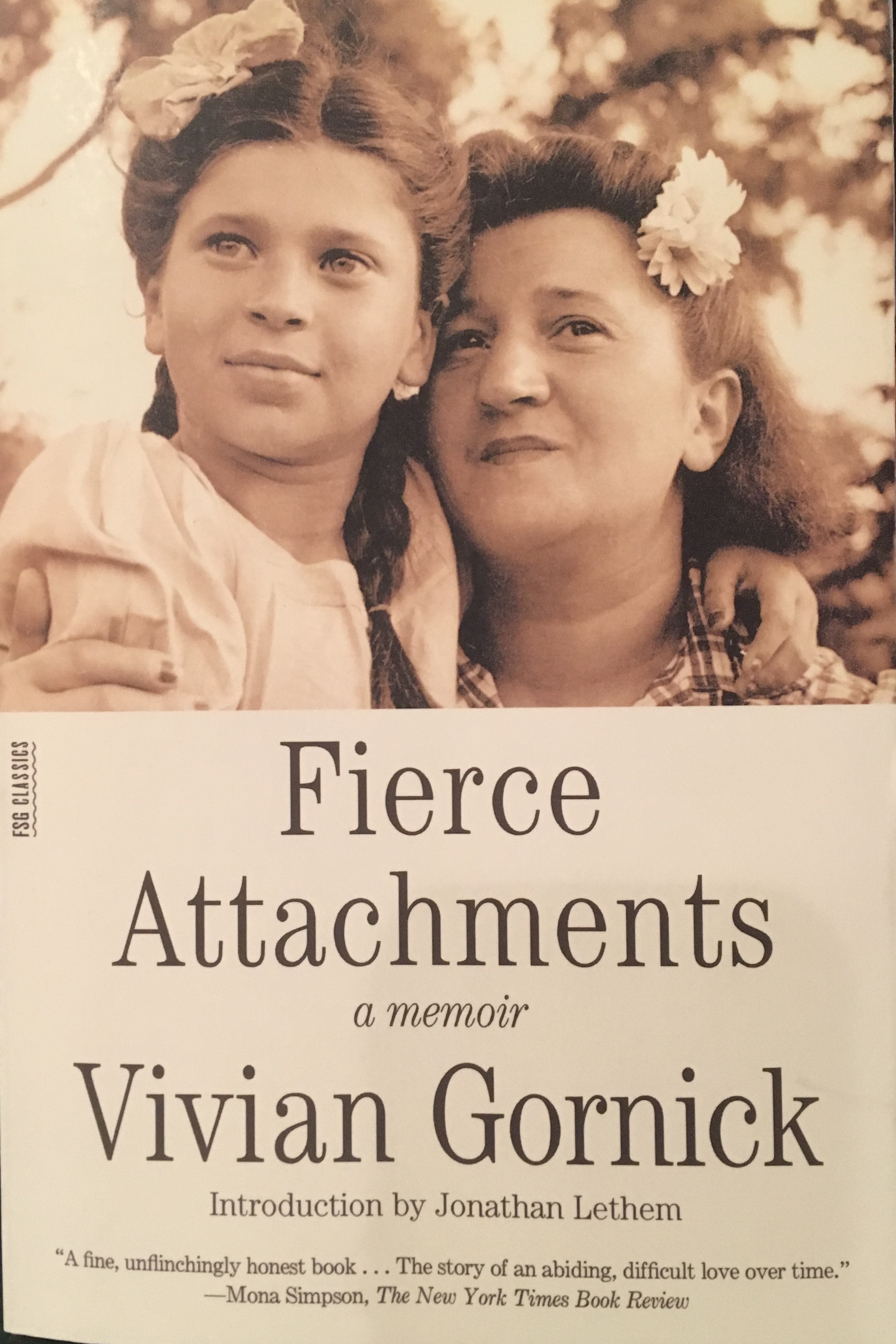
Fierce Attachments by Vivian Gornick

Just a week ago I gave you this book’s beginning and told you I was excited about it. It turned out to be everything I’d hoped.

Fierce Attachments is about Vivian Gornick’s mother and their relationship. It is told in two threads: the narrator’s memory of the events of her childhood in a tenement in the Bronx, and the narrative present, in which she and her mother walk together in Manhattan (where the latter lives) and throughout the city. The second thread features a daughter in her fifties and a mother in her seventies, finally eighty years old. The two threads eventually meet, as the remembered events follow a young Vivian growing up: from child to teenager, to college student, through marriage and divorce, into middle age and the walks in Manhattan. It is a very natural-feeling structure and one that makes great sense. It allows the reader to follow the heart of this book: neither the events of past or present, nor the story of one woman or the other, but rather, the story of their evolving relationship over decades, all its pain and small healings. It is also therefore about memory. The walks, which are also talks, allow Vivian and her mother to remember together, to create these stories.

In last week’s book beginning, I observed that the opening scene–a single paragraph–was given in present tense. All the narrative present events (walking in the city) are also given in present tense; but an event from the past doesn’t take the present tense again until page 91, nearly halfway through this book (at 204 pages an oddly quick read, for one so deep). It does not happen again until the past stories catch up with, merge with the present, when the mother turns eighty in the final pages and the two women find a small space in which to ease their combativeness. I had to flip back through the book to make these observations; I didn’t take notes as I went through, and in fact would have told you that more of the book took the present tense than I’ve found when I checked. I guess that makes the point that the past, rendered with lots of feeling and details, can feel pretty immediate.

There is much to admire here. I loved getting a feeling for Gornick’s inner life, as one lover calls it, her development as a writer, and the sad, conflicting story of going to City College and moving away–figuratively–from her mother, when she starts using complicated sentences and words the older woman does not understand. I appreciated the string of men she allies with, and her efforts to understand them, their places in her life and what they’ve had in common. Whatever her mother may think, Gornick uses beautiful sentences. And there is no arguing with the richness of her material: that tenement upbringing, the colorful women and sensory texture and exciting events. But for me what is most crystalline here is the relationship that is her main focus. The rendering of its difficulties.

And I see I’m writing this review prematurely, that I have not yet grasped what makes that rendering so clear. I think it has something to do with dialogue, and more to do with voice: that Vivian and her mother both get such clear voices, and not only them but many other, lesser characters as well. And perspective, the blending of what Sue William Silverman and Suzanne Paola call the “voice of innocence” and the “voice of experience”: the young Vivian, living in the past as it happened, and the writer Vivian walking with her mother and writing this book, and the way the two brush up against one another and eventually merge. The clear search for meaning, the honest, present wondering on the page: the classic assay.

I have a lot more to learn here; I’ll be back to Fierce Attachments soon, I expect. For now, please discover it for yourself, if you have any interest at all in the love and anguish of parent-child relationships, or admire creative nonfiction.


Rating: 8 corners.

Fearless Confessions: A Writer’s Guide to Memoir by Sue William Silverman

Edit: see follow-up post here.


Sue William Silverman is an established memoirist with Because I Remember Terror, Father, I Remember You and Love Sick: One Woman’s Journey Through Sexual Addiction (among other books, including poetry). This is the first of hers I’ve read, though.

Her title is intended as an answer to accusations that memoirs during the “memoir craze” of recent decades, and particularly those by women or other marginalized demographics that she refers to as the “other,” are confessional-in-a-bad-way, or sensational, or oversharing, or navel-gazing. With this title, Silverman reclaims the term and redefines it. Confessions are good, are therapeutic and cathartic, and lead to healing for the confessor and opportunities for fellow sufferers to begin their own healings. It’s a positive sentiment, although in this telling it occasionally carries a bit more touchy-feeliness than I might like.

I love the balance Silverman strikes between general philosophies of writing and nuts-and-bolts strategies. Each chapter concludes with a series of writing prompts or exercises. The craft books I’ve read for school (now in my third semester) have been successful reads, for me, at a lower rate than the rest of my reading. I don’t know if I’m pickier about craft books, just tend to like them less as a category, or am having trouble selecting the right ones. But my complaints often center on this balance issue: a writer holding forth about Writing (capital W) because he likes the sound of his writing, versus the practical how-to. I was pleased, early in Fearless Confessions, at the balance, which feels just right to this Goldilocks.

There is, though, a touch more cheerleading and rah-rah than I might like, just a hint of a tone that could be patronizing. Silverman has a tendency to wrap up chapters or concepts with “now go forth and do it, you’ll be great!” statements. Some of this is because there is an emphasis on trauma writing, Silverman’s own experience and (arguably) her specialty: the uncovering of a source of shame (incest, sexual abuse, sex addiction) which becomes an empowering and healing experience, and an aid to others. It makes sense to me that writers dealing with these kinds of issues deserve and need a certain amount of cheerleading. But I think Silverman has a lot to offer those of us who are doing different work, less revealing-of-trauma, and her tone came off just a touch strong for me, personally, and perhaps for other writers like me.

It also sometimes felt a bit more beginner than I needed, like in the first appendix, a discussion of the subgenres of creative nonfiction, which I found a little stark in its delineations–although a good primer it would be. Other appendices include a reading list (long, and by subject–I’ll be returning to that), and a handful of craft essays and examples of creative nonfiction essays. These were valuable inclusions that broadened the book and diluted Silverman’s peppy teacher’s tone.

I hear myself waffling as I write this review, and I guess that ambivalence is the story of my reading experience: great content, but often delivered in a way I found just slightly frustrating. And there was great content! I was really excited by Silverman’s concepts of highlighting, with different color highlighters, different plot elements or characters in a memoirist’s story to serve different plots. Or her idea of erasing the parts that don’t serve whichever story is being told: where a fiction writer builds plot, a nonfictionist sculpts one by erasure. These metaphors worked really well for me, and are perhaps the best expressions I have read of concepts I’ve been trying to articulate and wrap myself around.

I think I came to this one at a little the wrong time, and it would have suited me earlier in my studies. I’m glad I read it, but I found myself sometimes a tad impatient with the tone. I think I’ll be returning to this book, and going back to the writing prompts and exercises Silverman offers. I do recommend Fearless Confessions, just with a little patience, if indeed your tastes tend to follow mine, or if your background in creative nonfiction is already established. Or, to put it another way: an excellent introduction to writers new to memoir.


Rating: 7 pairs of red shoes.

book beginnings on Friday: Fierce Attachments by Vivian Gornick

Thanks to Rose City Reader for hosting this meme. Participants share the first line or two of the book we are currently reading and comment on any first impressions inspired by that first line.

It has been a long, long time since I’ve featured a book beginning here (over a year), but I wanted to share these opening lines because I find them a fine example.

First: I knew before I even got to Gornick’s text that I had misjudged her. I think I’d been cool on this book because I did not enjoy Gornick’s craft book, The Situation and the Story. But as I opened Fierce Attachments to Jonathan Lethem’s glowing introduction, I knew this was different, and I felt I’d been wrong to wait so long.

Gornick’s opening lines are,

I’m eight years old. My mother and I come out of our apartment onto the second-floor landing. Mrs. Drucker is standing in the open doorway of the apartment next door, smoking a cigarette.

I love the immediacy of this scene, the way Gornick places us there in the very moment, in present tense. Even that first sentence, “I’m eight years old,” is such a choice on the part of the writer. It does what we are sometimes afraid to do: just comes out and gives up a piece of setting-information (age, in this case) outright. It’s simple, but that present tense makes it snappy somehow. That sentence says scene, bam. And I’m on board.

Thanks for stopping by for a book beginning. I’ll be back to reviews next week.

The Art of Description by Mark Doty

I have had a rough time with Graywolf Press’s The Art of series, which is a shame, because I am a fan of Graywolf Press generally. (I gave Charles Baxter’s The Art of Subtext and Christopher Bram’s The Art of History 6 widgets apiece, and DNF’d [did not finish] Donald Revell’s The Art of Attention.) But I gave this one a try because it’s Doty, and I am getting to be excited about Doty. (Stick around for a reread of Still Life With Oysters and Lemons.)

Okay, enough parentheticals. The Art of Description is both an enjoyable read and a useful craft book. I appreciate its balance of quotable moments, profound concepts, and nuts-and-bolts writing advice. I also appreciate its illumination of Doty’s working style, because I plan on focusing partly on his work for my critical essay this semester. He includes as well plenty of examples from other writers’ (mostly poets’) work, with close readings, and one large section of this slim book is an alphabetical list of elements of description, which I think must have been fun to put together.

I know many writers/fellow students who love Graywolf’s The Art of books, and I know that my past failure with some of them is merely personal. But here is one that is working for me, in the way that I believe these books are meant to work: it is small, short, pocket-sized, and packed with memorable lines and nuggets. I want to just leave a few of them here, for my use as much as for yours. (All bold emphases are mine. Italics are Doty’s.)

The parts of a narrative are contiguous, each connecting to the previous instant and the next, but the lyric moment is isolate.

People who have studied drawing know that you have little idea what’s in front of you in the visual landscape until you try to represent it. To some degree, the art of description is the art of perception; what is required, in order to say what you see, is enhanced attention to that looking, and the more you look, the more information you get.

I am reminded here of his detailed study of the color of the white asparagus in a (different) still life, in Still Life With Oysters and Lemon. (Switching books on you for this next quotation.) It is blanched asparagus,

grown, that is, shallow trenches of sand, by which the body of the stalk is gradually covered, as it sprouts, so that the flesh will remain white. Though that term is far too simple for the actual color of these stalks: a pale lemony shade, tinged with a little green, shadowed on the underside, particularly where the curve of the bundle falls away, in its lower reaches, into darkness. The shade of these stalks–exactly right, as a look at a bundle of asparagus grown in this European style today confirms–is achieved through a mixture of ash, lead white, and a color called schiet geel, or shit yellow…

I think he’s practicing what he preaches in these lines: only by looking very closely with great attention at this painting could he see these colors, pick them apart; and then he takes what he’s seen back to real asparagus for comparison; and follows with research into the painting techniques of an earlier time (the shit yellow paint was made from buckthorn berries, “a laxative, thus lending the hue its tone”).

Okay, back to The Art of Description.

…the yoking of disparate elements makes more than a vivid account of perception; the best description is never merely decorative, but makes meaning in itself, building an argument about the nature of the real.

Polarity, the pull of forces in opposition to one another, makes writing feel alive, because it feels more like life to us than any singular focus does; reality, we understand, is a field in which more than one attraction, more than one strong tug, is always at work.

If I were asked to say what distinguishes an artistic temperament from any other, I’d say that it’s a fundamental sense that the project of being alive is something peculiar, little understood. I’ve always felt amazed by–a bit envious of–people who take their lives for granted, who feel that of course this (this body, this community, this set of human laws and social expectations) is the way things should be, how could it be otherwise?

And on and on, but I fear copyright infringement.

As I deepen into Doty’s work, I’m observing and understanding better this writer’s appeal to me personally, so this craft book comes at the right time.


Rating: 8 breathless sonnets.

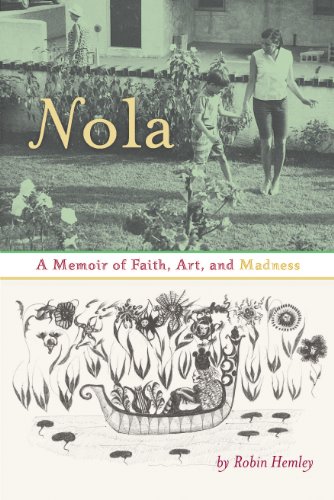
Nola: A Memoir of Faith, Art, and Madness by Robin Hemley

I appreciated Robin Hemley’s A Field Guide for Immersion Writing, and so I was interested when I learned he’d written a memoir of a difficult-to-write-about family member.

The first paragraph of Hemley’s prologue introduces five characters in a nuclear family. Father Cecil, who died when Robin (the youngest child) was seven. Brother Jonny, who “used to be good at everything, from languages to sports to the sciences,” but as an adult specializes in Orthodox Judaism (he and Robin are not close). The eldest, sister Nola, who “was good at everything, too, art and language, but especially things of the spirit.” Mother Elaine, writer and teacher, who is good at surviving. And here Robin introduces himself, as larcenous. Throughout this book, he is tormented by the thought of the stories, secrets, feelings and anguishes he’s stealing from his family members, particularly Elaine and Nola. Brilliant, spiritual, disturbed Nola, who always heard voices and saw fairies and angels and communicated with God, was treated for the last several years of her life for schizophrenia, in and out of mental institutions until she died when she was twenty-five years old, and Robin was fifteen.

This is a memoir filled with documents. The Hemleys are a writing family, and Robin mines Nola’s unpublished autobiography, her drawings, his own and his mother’s short stories, letters sent among the family, court documents, and more. Nola’s writing in particular appears peppered with struck-through text and additions, mostly the work of their mother as editor. These edits are not redacted; the reader gets both versions at once, often unsure of whether a change is Nola’s or Elaine’s. It is disconcerting, and entirely appropriate.

Nola: A Memoir of Faith, Art, and Madness is well-named. It is not an easy read. Just over 300 pages feels longer, as Hemley navigates the pain and distress of layers of family trauma–his father’s death and the deaths of several school-age friends; moves to ill-suited towns; a permissive, struggling mother; everyday sibling discord, and Nola’s increasing difficulties with a world she characterizes as “a strange and unbearable monster.” This is Nola’s book, but it follows side-threads, too, as when eleven-year-old Robin goes to live for part of a school year with elderly relatives in Florida (“By any yardstick other than a conventional one, I was essentially an elderly person… I really liked being old”). Later, he finds middle school frightening and chooses instead to attend day school at the psychiatric hospital where Nola is an inpatient. The Children’s Ward is a comfortable enough home for Robin, until he finds out they might not let him out again. Years after Nola’s death, when Robin is a graduate student, he has a girlfriend who suffers a psychotic break echoing his sister’s. Obviously, these threads are part of Nola’s story, her mystery, as well.

Not an easy read at all, as the book’s progress follows Nola’s descent into a misery she will not escape from. I do not recommend staying up late into the night to finish reading this as a winter storm rolls in. I found it quite upsetting, in fact. There’s no question that Hemley achieves emotional engagement, a representation of some of the agony his family has experienced. It’s a complicated achievement, all these layers of family trauma–often still with hope strung through them, at least while Nola retains it–and the writerly impulses of a family committed to communication and the written word, to education, and to some version of truth, however complicated. [Elaine’s technique is to write the family stories as fiction. Hemley’s essay “Truths We Could Live With,” appearing in Joy Castro’s (ed.) Family Troubles, and assigned by Jeremy Jones for my recent residency, discusses the difficulties he’s had with this practice. You can read an excerpt here.] A major thread of Nola follows the back-and-forth communications of mother and son, as Robin researches his family history for this book, and Elaine both helps (consulting, remembering, mailing him copious documents) and worries over the pain this will cause her, and Robin worries in turn.

So, a rich and complicated story. And cerebral: the Hemleys are a heavily educated, intellectual and mystic family, as well. (Cecil was co-founder of Noonday Press, and with Elaine translated and edited I.B. Singer’s work.) Almost every page is dense with philosophy (Nola’s grad-school discipline), religion, theory: faith, art, and madness indeed. I was having trouble getting through it, until I decided to let Nola’s concepts in particular sort of wash over me, and stop trying to understand them. (Much easier this way.) This book is an accomplishment worthy of study, but it will cost you something in the reading, so I recommend it with that qualification. Maybe stick to the daylight, too.


Rating: 7 Blakean drawings.

“The Fourth State of Matter” by Jo Ann Beard

At the gracious request of Uriah Pariah, here is a my response to an essay I admire greatly, and more and more every time I read it. “The Fourth State of Matter” appears in Jo Ann Beard’s collection The Boys of My Youth, and you can read it here.


NOTE: This review includes spoilers, and I feel strongly about the reader’s first experience with this essay being a blind read. If you don’t know what it’s about, please STOP now and go read it yourself first before continuing with my lesser words.


I think this post has to include the story of how I came to this essay in the first place. It was assigned reading in Suzanne Paola’s Intro to Creative Nonfiction Writing class at Western Washington University, an undergrad course I took in my early 30s a few years ago, surrounded by people not old enough to legally purchase beer (itself a weird time). Suzanne is a gift to the world and to this art form, but that’s another story. I read the essay she’d assigned without knowing anything about it. So my experience was innocent, like most of the readers (I assume) who first encountered it in The New Yorker in 1996. I have since been assigned the same essay several times, and have read it additional times for “pleasure” (though that’s not quite the right word) and study. I’ll never have that first read again, but it still gets better every time. I wish the same for you.

So, on first read, this is what presented itself to me: the narrator has an old dog, a collie, who is nearing death, in the most sympathetic, almost apologetic fashion. Jo Ann sleeps in fits and starts, between cleaning up after the collie’s incontinence. She has squirrels in her spare bedroom, and her husband has just left her. It’s a rough time. Then we go to work with Jo Ann, and meet her quite likable colleague, Chris. They are quite different–he is a space physicist, she is the managing editor of the space physics journal and vague on the science–but have a genial relationship, so comfortable that I instantly relate, even envy them a little.

This essay is a braid, and a very fine example of that form, but sort of subtle too, because the various braids (and there are several: dying dog, squirrels, estranged husband, work relationships with Chris and others) all come from the same timeline, the present tense of the essay. It’s not clear at first whether they will work as braided fibers or a single story, although I think they come out in a braid, and like the finest such essays, they are tied up together at the end, so that there is a moment of reveal: the reader’s aha, when she sees how tragically these narrative threads are all in fact one.

Because what this essay is “really” about is the 1991 shooting at the University of Iowa, when a graduate student killed five and maimed a sixth before shooting himself. Jo Ann knew the shooter and several of his victims, including her dear friend Chris.

This “real” material comes on slowly, then suddenly. There are foreshadowing moments of darkness, but when the first bullet flies the reader still feels a shock. It felt very realistic to me in this way: it felt like the faculty and students on campus might have felt that day.

Jo Ann goes home in shock. She takes care of the collie dog. She has already had an old friend take care of the squirrels in the spare bedroom. She is surrounded by friends who want to help her, although they don’t know how; her estranged ex-husband (not a sympathetic character) comes around and bumbles some more. Again, the telling feels like what she might have experienced in the living of it. The essay ends on a heartbreakingly beautiful elegiac note, and we are bereft: that this fine piece of art is over, and that lives have been lost, along with the squirrels and the not-quite-yet-dead-but-still-dying beloved dog.

One of the things that struck me most on my first reading was how much the dog affected me. Because, be clear, five people were murdered and followed by one suicide, then another; an additional victim was left paralyzed; a major university was deeply wounded. But the dog. My own old dog has been getting older and less cogent for years now–he’s still going, amazingly, but even when I first read this essay, I could feel his mortality. When we discussed “The Fourth State of Matter” in that undergraduate class, I was a little surprised to learn that nearly everyone had this story, though, about a beloved old dog, dead or dying. Of course, I quickly saw what nonsense it was to think that I had a monopoly on this. It’s a pretty universal feeling. We love our dogs.

Also, though, the essay starts with the dog. Beard’s first line reads, “The collie wakes me about three times a night, summoning me from a great distance as I row my boat through a dim, complicated dream.” My personal impression of this essay is that the collie dog–who goes unnamed, lending her even more of the universal, the ur-dog, the archetypical beloved–stands in for everything else that is lost. The youth and innocent partying of the squirrels, the broken love of the husband, the lives (Chris, who Jo Ann was close to, but also Bob, who she disliked and fought with constantly)–all of this, for me, is contained in the dog. For me, it’s a near-perfect essay, if not perfect. I haven’t even mentioned all the single lines that are crystalline, funny and perfect, as well. Go read it, again.

There have been criticisms. For one thing, Beard plays loose with the facts in characterizing the shooter, Gang Lu, attributing thoughts and feelings to him, supplying some of the content of letters he left behind explaining his actions. On first reading, I gave her the benefit of the doubt, thinking that maybe enough of those letters (for example) had been released to the public to allow her to know what she claims to know in this essay, but that is not the case. I’m so much on board with this essay that I no longer care. Funny, I’m a stickler for truth in nonfiction, until my heart has been won, and then I don’t care anymore. (See also Albert Goldbarth’s “Fuller.”)

Then there is the question of how we write about violence, about trauma, and about other people’s losses. This was the subject of Katie Fallon’s seminar at my recent residency, for which I was most recently assigned this essay, among other lovely pieces of writing. The class was divided, although “The Fourth State of Matter” was not at the center of our discussion–we mostly focused on Brian Doyle’s “Leap,” another piece I dearly love, although my peers are not all in agreement about it. We wonder, with pieces like these, about exploiting trauma, about glorifying violence, about whether to number the gunman in the death count, about when a story is “ours” to write about. We all have different reactions to these questions, and that’s not really what this blog post is meant to be about, but I will say about “The Fourth State of Matter” that I think Beard stays well on the side of writing about her own personal experience of this tragedy. She may not be all in the clear on the question of fact-in-nonfiction, but I think she’s fairly safe on exploiting violence. Again, because she makes it about a dog, some squirrels, and a dear friend. Or, as the original commenter put it when he requested this post: “it’s the fact that it was her story to tell, and a true one at that, that lends it its ultimate power.” That’s why nonfiction, my friend.

Uriah Pariah, thank you for asking me to write this. Hope it’s been helpful.

I already said it when putting together my best-of-2017 post:


Rating: 10 faces of love.