follow-up to The Twenty-Seventh Letter of the Alphabet by Kim Adrian

This Wednesday I posted my review of Kim Adrian’s new memoir; but I have more to say.

The Twenty-Seventh Letter of the Alphabet came to me as one of a series of happy accidents, or coincidences – or synchronicity. At this point, I’m not sure I can call it coincidence; this is more like the result of a cultivated reading life, for which I’m grateful. Recall how I loved and raved about Adrian’s Sock. That review posted just as I headed off to residency, and I heard almost immediately from her publicist, offering me this memoir for review. Well, I say no to these offers 99% of the time, plus I was at residency (spread extra thin), and entering thesis semester. But I was intrigued. I looked up the book. I knew I liked the author; it was the right length. I pitched the review to Shelf Awareness, who accepted, making it worth my time in that (monetary) sense. So I said yes, send me that book.

And it was not only a wonderful book, as I’ve written, but turned out to be uncannily well-suited to my studies this semester – in other words, it serves all these functions for me: a review for the blog (as requested by a pleasant, not pushy, publicist), a review for the Shelf, and a nice tie into my schoolwork.

Adrian’s memoir features photographs – described, not included – which is also something I’m doing in my thesis. (My dear friend Delaney used photographs in her thesis last semester – included them, as in Dorothy Allison’s Two or Three Things I Know For Sure – and taught on “art and artifacts” for her graduate seminar.) She studies a difficult-to-pin-down mother figure, which was the original plan for my thesis – I’ve given up on that for now, but it’s still in the back of my head. Finally and best of all, she uses that strange but quite successful structure, the glossary, an alphabetically organized series of fragments. These entries rarely strike me as “narrative” on their own, but they definitely combine to tell the story, and in chronological order. My lightbulb realization, which seems so obvious in hindsight: these entries were not titled and then sorted; they were titled for their place, to serve the alphabetical structure.

I found this fruitful reading in several senses – and not least, it was gripping. I stayed up until 1am to finish it, which is something I’ve not done, I think, in several years. So it merited this second post and my firm endorsement.

Thank you, Kim Adrian, and thanks to her fine publicist, Carrie Adams, for doing the work of connecting the right reader with the right book.

The Twenty-Seventh Letter of the Alphabet by Kim Adrian

A remarkable memoir, organized as a glossary of terms, that is part detective story, investigating a mother’s mental illness.


The Twenty-Seventh Letter of the Alphabet is a memoir with an unusual structure to match its ever-shifting reality. “I’ve wanted to tell this story for as long as I can remember wanting anything at all,” writes Kim Adrian (Sock): the story of her mentally ill mother, how she got this way and what Adrian can or should do about it.

Linda, Adrian’s mother, has been diagnosed with a long list of ailments: borderline and narcissistic personality disorders, bipolar, psychosis, paranoia and more. Adrian’s father is an alcoholic; his memories, his assertions that Linda wasn’t always this crazy, “not like she is now,” can’t be trusted, because “he’d been drunk the whole time.” Adrian’s sister has few memories from their childhood. In constructing this narrative, then, she relies entirely on her own memory. But the trouble with remembering the truth of what happened is that Linda’s lies, manipulations and her own troubles with reality created a wildly shifting experience for her oldest daughter. If Linda retold a story, the very truth of it changed for Adrian. Reconstructing the past now is therefore a fraught undertaking.

This troubled and troubling attempt to reorganize a life is organized alphabetically, beginning with an anecdote titled “Abecedarian” about an unexplained event in grade school, and ending not with “Zigzag” (Linda weaving down a city sidewalk), but with the entries under “&.” “Until the mid-nineteenth century, the ampersand was considered the twenty-seventh letter of the alphabet,” and for Adrian it offers inclusivity, “a verbal umbrella” under which she is both mother and daughter, both happy and sad.

This structure, the glossary, would feel contrived or awkward in less capable hands. The narrative of Adrian’s childhood through her own motherhood and healthy, loving family life is told more-or-less chronologically, but in fragments, whose alphabetized titles emphasize the narrator’s reliance on words, on the power of storytelling to restructure her experiences, perhaps to fix something. The glossary’s entries are anecdotes, descriptions of family photographs or simple definitions. “Domesticity: A kind of faith, in my experience.” Deceptively simple fragments add up to more than the sum of their parts.

Adrian’s story is often horrifying. Both of her parents were violent; her mother’s emotional and verbal abuse is ongoing and perhaps more shocking still. The older woman’s circumstances, bouts of homelessness and hospitalization, and the younger woman’s inability to extricate herself from the cycle of abuse, can be difficult to read. But, see “Hope: The ‘only way of knowing a person,’ said Walter Benjamin, is to love them without it.”

The Twenty-Seventh Letter of the Alphabet is a feat on many levels. Adrian tells a harrowing story, surprisingly redeemed by her own sweet family, but in many ways also continuing. She gives it meaning without having answers to all the questions she still asks herself. Her work as glossator is astonishing and inventive. Her glossary is strangely gripping, with a momentum pulling the reader in and through. The result is whimsical, even darkly funny at times, brimming with compassion, terribly sad and deeply loving. Memoir readers should not miss this singular offering.


This review originally ran in the September 7, 2018 issue of Shelf Awareness for the Book Trade. To subscribe, click here.


Rating: 8 nutcrackers.

movie: Peppermint (2018)

My date for this movie called its hero a female Jack Reacher. He’s right and he’s wrong.

The plot of Peppermint reminded me of The Brave One. That 2007 movie starred Jodie Foster as a woman recovered from a coma to find that her fiancé had been killed in the same attack that left her hospitalized. She becomes a vigilante, taking her own justice against those who wronged her as well as other wrongdoers in the community. In this one, Jennifer Garner’s husband and daughter are killed in front of her; she disappears for five years, trains to become a badass, a vigilante, and comes back to take her own justice against those who wronged her as well as other wrongdoers in the community.

On the plus side: Jennifer Garner is ripped and she is beautiful and I like her. The fight scenes and blow-em-up scenes are exciting, and I didn’t notice anybody firing forty-seven shots out of a magazine that holds twelve rounds (as is so common on my beloved show The Walking Dead). As pure adrenaline-excitement-thriller, this one satisfies.

On the minus side, quite a few things. Garner’s character is not developed. She loved her husband and child – we can easily trust this, but that’s pretty much all of her personality that we know, and it’s not much of a personality; it’s something most people with spouses and children carry, in fact. We don’t get to see any of her training to become the badass that we see onscreen. A single line of dialog by (if memory serves) an FBI agent describes her training in foreign countries, but it’s a very brief line. The actual becoming – a critical piece of growth, and that which makes this movie – takes place all off-screen. I’m thinking of Kill Bill here, and how it showed Uma Thurman’s character gaining her skills: that’s an important part of the story, movie people! To put it another way: the plot of this movie is easily summed up in the single sentence I wrote above. Jennifer Garner’s husband and daughter are killed in front of her; she disappears for five years, trains to become a badass, a vigilante, and comes back to take her own justice against those who wronged her as well as other wrongdoers in the community.

Pretty plot-weak, then. But successful as a blow-em-up thriller: for one thing, the weakly sketched plot tends to resonate with all of us (underdog wins; justice is served), and even with a sort of cheap version of feminism (Jennifer Garner has muscles and beats the men). Hollywood knows their formula. I enjoyed it, actually. My date enjoyed it even more. But a female Jack Reacher? No. Reacher’s author, Lee Child, gives his hero copious backstory. His books have plenty of plot twists. And his strategies, methods, and skills are detailed and explained. The Reacher books are told in either first-person or a close third-person-limited perspective, meaning that we get to know what Reacher thinks and feels. Any of these elements would have done Jennifer Garner’s character so much good, in terms of depth.

Still fun, though. Beautiful muscles on our heroine. Stay out of her way.


Rating: 5 shells.

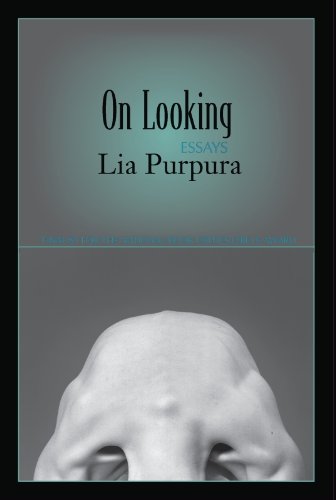
On Looking: Essays by Lia Purpura

I felt I might be tested on the things I saw.

Lia Purpura’s On Looking is an collection of essays that are unrelated, but for their preoccupation with looking and seeing. It’s an interesting look at collecting essays: some of these do not make obvious their obsession, except by proximity with the others. It’s an effect that builds. I like it.

Purpura’s language is lyric, which is often difficult to make clear meaning of – words go together that we don’t expect, which slows down this literal-minded reader. There is undeniable music and rhythm to the language, but also meaning available, if one slows down.

The opening essay, “Autopsy Report,” I’ve read before. It’s beautiful. It is absolutely about looking – a fine way to begin this collection – about really seeing when so many would turn away. (Some readers may wish to turn away. It gives the fine details of bodies literally split open.) This is definitely one of my favorites of the book, and a representative sample, although I suppose it is also clearer in its language than some that follow, and therefore a bit more accessible.

Another favorite was “Sugar Eggs: A Reverie,” which identifies itself as a list essay.

(A list, after all, is an incantation. In a list of likenesses, each element, each peculiarity gathers, leans into and flicks on the light in the room of the next one. The elements loop and knot forth like a net, band as a colony of frost or coral reaching, suggesting not so much a progression as a collective tendency toward. And taken together, the elements offer the assurance of a stance: here is a way to speak of this lightest, barely perceptible–in this case–space. From here I can count and collect that which stirs, and has always stirred me.)

A list inches one closer. Hints along.

Recognize my lists-and-things obsession here, which is of course related to a looking-and-seeing obsession. What follows is a series of spaces and things considered for whether they can count or cannot count as sugar eggs. Sugar eggs for the narrator are sacred spaces… “a space that makes a place for thought, an air considerably pure in which objects–say, sugar bushes, sugar trees–grown precise in their stilled distance.” The specialness of sugar eggs is hard to pin down: Purpura has spent a beautiful essay working on it, and I’m not sure I can sum it up. I’m not even sure I entirely understand it; but I had a lovely time following her parsing of what does and does not qualify.

Another favorite essay was “Coming to See,” which turns out to be a memorial. It’s a series of fragments, about looking through a window and wanting a better, clearer frame for the view (subjects I have played with too); only on the essay’s third page do we learn that the narrator has a friend who is dying. This friend is scarcely mentioned throughout, but it becomes clear that she is what the narrator’s anxiety of seeing is all about. Again, the memorial is something I’ve attempted, but it’s hard to get it right. This is an unusual, touching take on it. By almost entirely eliding the true subject, Purpura gets at the emotional heart without predictable sentimentality or cliché.

There is more, much more; it is so dense. From here I will give you a few favorite lines.

The epigraph, by Goethe:

Every object, well contemplated, creates an organ for its perception.

From “The Pin”:

But while we stayed, we stayed because we were protected by a curiosity so certain of its task, that things–boots, mail, pots, our bodies–offered themselves, first tentatively and then with urgency, as if for us alone, solicitous as all objects of adoration, as all objects in stories lure us, irresistible and catalytic.

All objects in stories lure us. My thesis, if you will.

And finally, from “On Looking Away: A Panoramic,”

I believe in the circle.

It’s funny the things that resonate with us. Another reader would have read this book and marked entirely different lines, I’m sure.

Perhaps this book should be read alongside Mark Doty’s Still Life with Oysters and Lemon, for its attention to attention. And in fact perhaps that comparison is useful: I had to read Doty’s book twice (and repeatedly after that) to begin to get it. These are dense, rich texts, about abstract things even while they’re about very literal, physical things as well.

Worth your time.


Rating: 8 ships in bottles.

The Art of Mystery: The Search for Questions by Maud Casey

In Chekhov’s famous letter to a friend, he wrote, “You are right to demand that an author take conscious stock of what he is doing, but you are confusing two concepts: answering the questions and formulating them correctly. Only the latter is required of an author.”

I have been looking forward to Maud Casey’s The Art of Mystery, because it sounds like it addresses something I like in the writing I admire, and something I hope to do myself. I have thought of it more as ambiguity, or subtlety, than mystery; but I think we’re talking about the same thing. As in that perfect Chekhov quotation above, it’s about posing interesting questions and exploring them, not about having all the answers. If we provide too many details, we take away the reader’s chance to use her own imagination or her own experiences to fill out the story, to make it her own. It is questions, not answers, that are a part of the universal experience, and that’s what makes really good literature so rewarding.

Casey’s focus is on fiction writing, but I didn’t find that it mattered much. She studies a number of novels and short stories (relatively few of which I’d read, but it was fine) for their mystery. She praises Paul Yoon’s Snow Hunters, for example, for its offstage gestures: the protagonist makes reference to a castle, forests, high canopies, a river, none of which are explained. “The gesture toward everything that we don’t know about [that protagonist] doesn’t frustrate; rather, it intrigues.” And I found myself asking the question, why does this work when he does it? The rest of us would be scolded for the same: references to details nowhere in our own stories. But then comes the answer: “In every case… it’s useful to ask, What is the effect of the withholding? Does it yield something generative in relation to character? Or is it an effort to drum up surface-level suspense, whose effect may be experienced as exactly that, effortful, and cosmetic, rather than as true dramatic tension?” Twenty-six pages later, again: “It’s a question of effect. Is a bizarre character, and the mystery surrounding that character, being generated for look-at-me-Ma show, or is it doing something that leads to generative mystery?” (I confess I enjoyed “look-at-me-Ma show.”) See the repeated words: we are looking for effect; our goal is generative mystery. (That last is the phrase Jessie used in recommending this book.) The bulk of The Art of Mystery is devoted to explicating these concepts with lots of good examples (that make me want to read lots of books). For this review, I’m content to have named them.

Like so many significant lightbulb moments in studying the craft of writing, this one seems obvious in hindsight. The writer must know what she’s trying to do; she must work with intention; and she must consider the effect of the choices she makes. Mystery for its own sake is at best a cute trick, liable to frustrate the reader. Generative mystery has a job to do. Know which is which.


Rating: 7 cataracts.

The Prairie in Her Eyes by Ann Daum

This is an extraordinary book, one of the most enjoyable reads of the year so far. I took it slowly, out of pure pleasure. Thanks once more to Jessie.

Ann Daum is from a farm-and-ranch in South Dakota’s White River Valley. She left to go to college, but returned every harvest season, and came back after college. She grew up as a ranch hand; her father was the farmer, but her sister and she were ‘cattlemen’ and handlers of horses. As her parents age, and circumstances work against cattle ranching, that part of the family business shrinks and crumbles; they sell off much of their four thousand acres. But Ann’s horse breeding operation does well, and she continues on the family property.

Against this backdrop, The Prairie in Her Eyes is an essay collection and something of a memoir-in-essays. It begins with Ann listening to sandhill cranes passing over her family’s homeplace, in an essay titled “The Habit of Return,” and ends with “The Last Crane,” in which she watches the last sandhill of the season worry itself along. In between, essays consider the history of South Dakota and its farming and ranching cultures; the region’s wildlife; “Silence and Spaces” and “Predators and Prey,” and more. I admire Daum’s titles, which often cue me to follow her subtle braid, as in the essay “Fences,” which deals with boundaries of different sorts, and the variety of effects of literal fences in her region of South Dakota, for good and for ill, and the evolution within her own life of how she sees fences, which is a matter of both her own growth and of changes in the place itself.

Some of this content is hard to take. An account of a difficult foaling had me in tears; the animals (not people!) who hurt and died wrenched me. There is human trauma, as well, that can be difficult to read; interestingly, the human trauma is written about with some distance, less graphically, while the animals’ is more viscerally portrayed. But it’s shown with so much love and grace, and beautiful prose. I’d recommend this book 1,000 times.

These lines open “Silence and Spaces”:

Rain never falls in the South Dakota of my childhood. Wind blows down the valley with the force of locomotives, clouds pile on the horizon, thunder growls from the west. Once, sometimes twice, a summer, lightning sparks prairie fires that crackle and spit, swallow brown summer grasses without tasting. The flames cough embers up like glowing stars and the smoke hangs in cloud. But there is no rain.

This paragraph is about the weather. Fairly dramatic weather, sure. It’s about a lack: no rain. Weather, and an absence. It does not sound like a good recipe for gripping prose. But the fires swallow brown grasses without tasting? Amazing.

Obviously the themes and subject matter of this book spoke to me. It’s about home, what it means to be attached to a place, and how complicated, multifaceted, and imperfect our connections are. I love how deeply the flora, fauna, and history (natural and otherwise) of her region have contributed to making Daum who she is. At the pinnacle of this concept is the essay “Why We Return – The Prairie in Her Eyes,” in which an old woman comes to visit the Daum family property. This woman had never lived there; she’d never seen it before; but her parents had homesteaded there, and an older sibling had been born there. Just like the cranes in “The Habit of Return” (and, obviously, Daum herself), she felt the pull of the place, even though she’d never set foot. “Gertie grew up missing a place she never knew.”

I’m enchanted. I’ll be referring back to this one.


Readalikes: Gretel Ehrlich’s The Solace of Open Spaces and Evelyn Funda’s Weeds: A Farm Daughter’s Lament.


Rating: 9 fading trails.

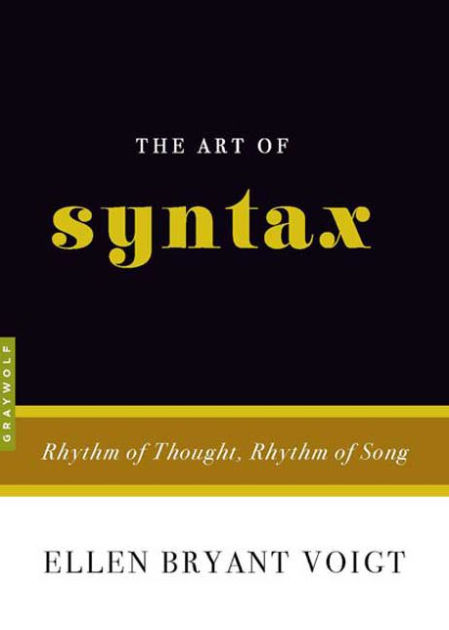
The Art of Syntax by Ellen Bryant Voigt

I continue to have mixed reactions to The Art of series from Graywolf (a publisher I love). (See History, Subtext, Description; I gave up on Donald Revell’s The Art of Attention without reviewing it.) Voigt’s The Art of Syntax was interesting, and not without its high points for me. But a very detailed focus on poetry made it, unsurprising, less accessible for this particular reader than it might have been.

Much of the book is devoted to metric feet and uses poetry terms that I am still learning. There is a glossary, to help us keep our trochees and tercets straight, our spondees and Pyrrhic feet, and I referred to it repeatedly, but I think I still need the beginner course. Voigt parses a number of specific poems (she also uses the verb ‘parse’ in a specific way I was not familiar with); and I enjoyed these: Elizabeth Bishop’s “The Moose”, Donald Justice’s “To the Hawks,” Philipi Larkin’s “Cut Grass,” and D.H. Lawrence’s “Snake,” among others. (I love the naturalist theme of those titles! although “the Hawks” are figurative ones.) But – and I suppose this betrays my interests – I wish I’d learned more about the words themselves and their meanings, and spent less time on feet and meter and syllables. My brain just doesn’t have great patience for counting these, which perhaps is why Jessie wanted me to read this book. Sigh. I don’t know that I got everything out of it that I should have. (I feel like a broken record when writing about poetry.)

I ended up being reminded of Suzanne Paola’s excellent teaching (at Western Washington University) on syntax and language (particularly Germanic vs. Latinate words – a topic Voigt touches on briefly). Suzanne was much more prose-focused, and made much more sense to me at the time. I wish I had access to some of her teaching. I do still have this link she shared with us, which I appreciate for its recognition of concepts as well as its terms naming them. A handful of these (like parataxis and hypotaxis) appeared in Voigt, like old friends.

In the end, the most useful nuts-and-bolt craft tip I distilled out of this book was: vary your sentence lengths! which, duh; but it bears reminding. Beyond that, the music in the line – rhythm and rhyme – is something I recognize and admire and want for my own work, but the minutia of it eludes me at this point. Whatever of it that I have now comes by instinct, not conscious design, and certainly not counting of feet. I shall keep on exposing myself to discussions like this and hope it sinks in. Another central idea of Voigt’s is the importance of surprise, not the surprise of content (which the reader will be aware of) but the surprise of word order or syntax, that the reader may remain unaware of as the source of that special something in a given line.

They are good lessons. Despite my continuing trouble with this series, I’m looking forward to Maud Casey’s The Art of Mystery, so stay tuned for that review.


Rating: 6 perseverations.

A Field Guide to Getting Lost by Rebecca Solnit

Another book that came to me at just the right time thanks to Jessie van Eerden. I know of Rebecca Solnit, of course, but I think this is the first of her writing that I’ve read. I really enjoyed it in several aspects: its subject matter is very much in line with that of my thesis (that I’m currently writing); its structure is of interest and also has something to offer my own; the writing is lovely; the content it approaches is wide-ranging, and (as Jessie said early in this semester as we did a manuscript review), “I like to learn stuff.”

That said, it’s not an easy book to sum up. These collected essays are connected, but far from telling a narrative. Solnit is exploring the idea of getting lost and what it has to offer us; and that is ‘getting lost’ in several senses, geographic (I got off the trail and I was lost) and metaphoric (after my mother died I was lost, or I lost several years). Also the sense in which we lose both things and people: lose your keys, lose your mother (to death), lose a boyfriend (when you break up). She sees value in getting lost – sometimes it’s how we find ourselves – and notes that we don’t get lost much anymore. Late in the book, she looks at old maps with their ‘Terra Incognita,’ and observes that we don’t have terra incognita on our maps anymore. We know it all! Right? (Of course, we’ve thought we knew it all before, and been proven wrong.)

I’m using the sense of place tag here although it’s not quite right, which is perhaps a design flaw in my tag. By ‘sense of place,’ I have tended to mean a strong attachment to a certain place; so Jesse Donaldson’s writing about Kentucky, James Lee Burke’s New Iberia, Michael Connelly’s Los Angeles, or Mary Karr’s southeast Texas. That is not what I found with Solnit, so much as a strong feeling about the importance of wandering, losing and finding oneself, in place and in other senses. Place plays an important role here. This book feels like it fits that tag, even though it doesn’t fit the tag as I originally conceived it. (This blog will be eight years old next month. Expect some scope creep.)

Structure-wise: there is a chapter-title refrain, with the heading The Blue of Distance (italicized, where the others aren’t) taking every other place between differently-titled essays. These are not the same essay over and over, but they all meditate on blue and its role in our observation of distance, beginning with the literal meaning (that is, that the sky and deep water both look blue for scientifically observable reasons) and moving through less-literal ones. Distance, it seems, is an inextricable part of one’s ability to get lost. My 600-square-foot house would be much harder to get lost in (tell that to my geriatric dog) than a 20-something room mansion would be. I really appreciated this design, the repeated title for very different essays; it was a succinct cue to the way in which they’re linked.

Another item I found interesting to note was Solnit’s references, the other thinkers she turns to. Some were perhaps unsurprising, as writers cite other writers: Fitzgerald, Nabokov, Katherine Anne Porter, Virginia Woolf, Joseph Conrad. These are joined by Johnny Cash, Patsy Cline, Bobbie Gentry, Yves Klein, Plato, Álvar Núñez Cabeza de Vaca, and Alfred Hitchcock (among many others). A huge number of minds contributed to Solnit’s own thought processes here – which are of course her own – and I was fascinated by the twists and turns. Again (and again), this is something I need in my own writing and that appeals to me. I can’t wait to tell Jessie how right-on she was with assigning me this book.

Obviously this Field Guide‘s usefulness to me is just beginning. You will like it, too, if you like far-ranging considerations of the human condition and where each of us as an individual might be or should be headed, if we’re thinking about it. I found it an engaging and curiously winding path, and I recommend it.


Rating: 8 shades of blue.

movie: Confirmation (2016)

I only found out that this movie existed thanks to my current favorite podcast, Another Round, so thanks to Heben and Tracy for that! And so timely now.

I read Anita Hill’s memoir, Speaking Truth to Power, more than five years ago. It was a powerful experience: she did a beautiful job telling her story, and it’s a hell of a story to begin with. I was nine years old when Clarence Thomas’s confirmation hearings took place. I don’t remember them as something I directly experienced; my knowledge of these events comes from hearing other people (like my parents) talk about them, and from reading her book.

This movie is an excellent follow-up as well. If you’re looking for an education about what happened, I suggest Hill’s book for its level of detail. But if you’re looking to grasp the feeling, the emotional truth of this time period, the movie does a good job. Hill, Thomas, and Joe Biden are all played by actors who come remarkably close to their roles not only in physical appearance but in movements, speech patterns, and mannerisms. The feelings (on one side) of shock and concern and ill-boding about what will come of all this, and (on the other side) of indignation and impatience and real threat unlooked for, are well captured. Again, as someone who doesn’t remember viewing the confirmation hearings when they happened, I spent some time pausing this movie to pull up old video from the real events, comparing both the wording and the delivery. It’s pretty spot on.

All of which means it was hard to watch. I guess there may be people out there who question the truth of Hill’s allegations, but I can hardly imagine who they might be. Not women, for one thing, because all of us women who have lived and worked in the world know that these things happen, and we know well why a woman might not speak up when it happens, as Hill’s critics kept harping on about. It should go without saying, but: I am horrified that we are seeing these events play out again twenty-freaking-seven years later with Brett Kavanaugh. Horrified.

You can read Anita Hill’s own words on this subject in an article for the New York Times: “How to Get the Kavanaugh Hearings Right.”

Weirdly, though, I found the movie less difficult to watch than Anita Hill’s book was to read. You’d think the movie would be more visceral because of its visual and aural elements. But Hill’s writing admirably matches her speaking: calm, measured tone, far from devoid of emotion but thoughtful and thorough. Like the lawyer she is, she is careful with fact and clear about where she speculates. She relies on the strengths of her arguments and the truth. I found this careful telling even more moving than the movie.

In a nutshell? A recommendation for this movie, and an even stronger one for Hill’s book. And a sound shame-on-you for our country still struggling to treat women with respect, like as if we were real human beings, and for punishing and not believing us when we speak up. I hope someday the cases of Anita Hill and Christine Blasey Ford will cause history students to gasp in disbelief, rather than nodding their heads in recognition of the same old story.


Rating: 8 cases.

Sylvia Center for the Arts presents Marian, or the True Tale of Robin Hood

While visiting my parents in Bellingham, we picked up this sweet, raucous outdoor play: Marian retells the Robin Hood story from a differently-gendered perspective. It was great fun. The evening was perfect, quickly cooling as the sun went down (not quite in our eyes) until we were all wearing our fleece jackets. We sat on concrete stadium-style benches in Marine Heritage Park, a downtown park with a sizable homeless/loitering population that, I think, events like this hope to reclaim in some way, or, they hope to help renovate the park’s reputation. (It was fine.) The set was simple – the troupe lugged it there, up and down a hill, by hand – but perfect. As I’ve written before, the set shouldn’t carry a play’s weight; elaborate sets and costumes can be great, but the acting and the play itself should do the heavy lifting.

The story opens in the usual spot, at an archery contest with grumpy Prince John presiding and Robin Hood in disguise. Except that Robin Hood is Maid Marian, already in disguise: that’s right, Marian is Robin Hood, yielding lots of costume/disguise changes and two-people-never-seen-in-the-same-place stuff. Marian/Robin should be our protagonist, but that role is shared by a character named Alanna, a lady-in-waiting, who does a certain amount of audience-facing narration, and (slight spoiler) ends up joining the Merry Men early in the play. Few of the Merry Men, in fact, are men at all.

Gender-bending is a theme, and while gender-bending is as old as gender conceptions (and absolutely Shakespearean), there were some modern twists here, including one of the Merry Men requesting they/them pronouns and a change to the group’s title to ‘Merry Men and Much.’ (All well-received.) Also, the script was an interesting mix of an older, more formal diction and a modern slangy one, which I think is always a good tool: once you’ve primed your audience to expect that period-style talk, the modern usages become totally hilarious in context. There was lots of physical humor as well, and no small amount of romance. We the audience were in stitches.

This production was more amateur than some: a few actors stumbled over a few lines, and the sound system (or the microphones? during costume changes?) cut in and out a bit. No problem. As I’ve written more than once, I love to see passionately produced and talented amateur theatre, even if there are a few glitches as here; and there is no question that this play was produced with passion and talent. I had a fabulous time; I was super disappointed when the play ended and wanted it to go on for hours.

Thanks, Sylvia Center folks, for romance and hilarity and poignancy. Hooray for Marian and her Merry People.


Rating: 9 arrows for joy.