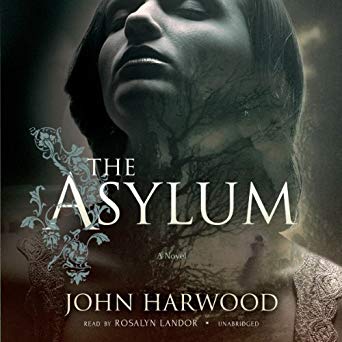
The Asylum by John Harwood (audio)

This is a Victorian gothic mystery/psych thriller, and how it ended up in my iPod is another mystery which I cannot explain. I hit ‘play’ on it on a whim, and listened to the tracks from disc 1 and then there were no more. I was involved enough that I then went and paid for the audiobook (which I never do), and now I’m left unsatisfied with my purchase.

Georgina Ferrars wakes up in an asylum (a madhouse, she surmises, although the doctor in charge demurs at the term), with no memory of the past several weeks. She’s told she checked in under the name Lucy Ashton; her L.A.-monogrammed valise supports that claim. When Dr. Straker telegrams her uncle, the reply comes immediately: Georgina Ferrars is here at home. Your patient is an imposter.

It’s an engaging enough opening, and what unfolds from here continues to intrigue. It seems Miss Ferrars has a double, a new friend (or long-lost something-or-other?) named Lucia Ardent (note the initials), and the two look just alike. The question now is which is whom? Miss Ferrars is missing her two prized possessions: a dragonfly brooch that was a gift from her father to her mother; and a writing case, with her journal inside. If that journal could only be found, we might learn what happened in the missing weeks…

Solid plot so far, then. I found it a little bit exasperating to listen to the distraught young lady who (how Victorian) is wont to become faint at every shock, but okay, it’s part of the period setting. When the diary is located, we start learning more about the Ferrars/Ardent/Ashton history; here connections and plot lines get increasingly twisted, and I’m afraid Harwood got his threads a little entangled. There is a major reveal that just did not follow for me – I didn’t see how we made the logical leap – and, because I was listening to the audiobook while driving, I wonder if it was my fault, if I just missed a crucial moment. But I did go back and re-listen to some parts. And, too, a number of other readers on Goodreads were left confused as well. I’m inclined to think that if a larger portion of your readership missed something, maybe it’s on the writer and not the readers. (I have experienced this as a writer – I put the fact in, but everybody missed it – and even though I put the fact in, if they all missed it, I didn’t do my job properly.)

At any rate, the final third or so of the book – the protracted denouement – was far less compelling, and less believable, than what came before. Our heroine is alternately the fainting Victorian weakly woman, and a surprisingly scrappy, clever one; these quick shifts back and forth and back again did not ring true. The quickly complicating plot threads got too incredible for me. The final action scene, followed by the final proposal and answer, topped out the ridiculousness; it was a major letdown. Oh, and – spoilers in white text here; highlight to read – there’s a lesbian incest thread, for good measure.

Full credit for that first disc’s worth of tracks pulling me in; and more than half the book kept me engaged. After that, I was just hanging on out of increasingly incredulous curiosity about how this silliness would wrap up. Not particularly recommended. As I learned on Goodreads, Harwood has his fans, and some of them loved this book; some would recommend others of his over this one. I won’t be trying him again, but you’re welcome to.


Rating: 6 windows.

White Flights: Race, Fiction, and the American Imaginationby Jess Row

This tough, serious essay collection considers whiteness in American fiction and culture, and the inextricableness of the two, with exhortations for change.

Jess Row (Your Face in Mine) takes on ambitious material with White Flights: Race, Fiction, and the American Imagination. He points out a societal need for reparative writing, examining the role of imagination in real lives, both in “straight” fiction (novels, stories, films, plays) and, in a larger sense, “in which our collective life is a series of overlapping fictions, fantasies, dream states.” The first kind “reflects and sustains” the second, so that novels are never “just” novels, but rather serve to uphold institutions and ways of thinking that have consistently and systematically hurt nonwhite Americans. The title refers both to the real estate pattern of movement known as “white flight,” and also to flights of fancy, such as imagining that ignoring race and racism means they’ve gone away.

In seven essays, this book argues that imagination is as much part of the problem as real-world actions and prejudice. Its main concern is whiteness, in and out of fiction; when it examines specific marginalized groups, they tend to be African Americans and Native Americans. Row undertakes close readings of Marilynne Robinson, Don DeLillo, David Foster Wallace, Cormac McCarthy, Annie Dillard, Richard Ford and more: these white writers may be among his own past literary heroes, but they nonetheless come under scrutiny for the whiteness, or sheer emptiness, of the spaces they create. On the other hand, he examines James Baldwin, Toni Morrison, Chang-rae Lee, Colson Whitehead, Amiri Baraka and Ta-Nehisi Coates for the examples they offer of more inclusive fictional spaces. Row consults music and films, as well.

In challenging ways of writing–even, for white writers, the choice to write at all–Row is careful to acknowledge that, as a white man, he can merely ask questions and grope for progress, rather than offer a solution. He also mines personal material, including his childhood in the Black Hills of South Dakota, land that by treaty belongs to the Lakota and is illegally occupied by white people (like Row’s own family).

This intelligent collection is often deeply engaged in realms of philosophy and literary theory; it approaches an academic writing style. Its subject matter may be discomfiting for white readers and writers, and readers less familiar with Wittgenstein, Derrida or Edward T. Hall’s theory of proxemics will likely find this book challenging. There is something for every reader, however, in the message that fiction not only reflects but acts upon real life, and that each of us is obliged to act for justice, in reading and writing as in life.


This review originally ran in the July 2, 2019 issue of Shelf Awareness for the Book Trade. To subscribe, click here.


Rating: 6 references.

break for a personal update: on teaching

Whew. I’ve finished my first week teaching writing composition classes to freshman (and a couple of sophomores) at a little liberal arts college in West Virginia. This is a big change for me. Aside from Hops’s ugly shock at being left home alone for hours every day!, I’ve been wrestling with lesson plans, reading and writing assignments, and managing a class full of variously bored, overanxious, and sleepy 18-year-olds. It is simultaneously maybe the hardest thing I’ve ever tried to do, and potentially one of the most rewarding.

For our second class meeting, I had all my students write me a letter of introduction, sharing as much of themselves as felt comfortable. This allowed me to judge the writing skills and grammar they entered with (not perfect, but often not terrible either), and see them as individuals with their own interests and concerns. I was touched at how much some of them did choose to share. And I learned how many of them are genuinely nervous about passing my class (with a C or better, required to move on to the next one). I’ve been trying to communicate to each of them that I’m here to help them pass – every last one of them – as long as they’re putting in the work and asking me for the help they need.

It feels kind of overwhelming, the idea of having readings, writing exercises, grammar lessons, and class discussions (etc.) ready for every class meeting between now and early December. All their faces and needy brains out there in a sea of challenge. Just learning their names! (I have my smallest class down; the next one, pretty much there; the last, still kind of a mess.) I am trying to remind myself that even though I’d like to be perfect every day, professional and polished, that’s not a realistic goal. I’ve pointed out to them that I’m not perfect, either, but I don’t want to overstress that point, lest they worry that I’m nearly as much at sea as they are!

At this point, for better or worse, I’m committed to the syllabus, schedule, and textbook I’ve set. So we’ll just venture out together, me and these 47 kids. Wish us luck.

I have scaled my book review work way, way back. But I also have a backlog of work ready for this blog into the month of November as of now. I think we’ll make it into the new year easily enough with a three-day-a-week schedule; come January, we’ll see. This work remains important to me, as I think it always will. But I obviously have some day-to-day priorities right now that take precedence.

And January sounds a long way off still. Lots of essays to shepherd and grade between now and then; lots of individual conferences and who knows what little crises to face. I’ll be out here learning as I go.

Teacher friends, if you have words of wisdom for me, I’d be grateful to take them in the comments below. Or just send me your good wishes. I’m headed back into reading my students’ words and figuring out what’s next…

reread: Still Life With Oysters and Lemon by Mark Doty

This is my third review of this book – sorry if you’re getting bored! – and I’m probably close to ten times reading it, what with it being near the center of both my critical essay and my graduate seminar. Obviously a favorite. This time, I am motivated by Jessie van Eerden’s seminar, “Valley of Dry Bones: Bringing Non-Narrative Prose to Life” (see also Monday’s post). Because I’m traveling and almost all my books are in storage, I bought a fresh copy. (As I’m graduated and attending these seminars not for credit but for fun, Jessie encouraged me to skip the reread, but really.) It was a joyous adventure to mark up a clean copy: you may recall I rarely mark up books at all, but this one is special, and I went for it. I’m pretty sure my markings are very different this time around, which is an interesting story. When I have the two side-by-side one day, I will certainly compare them, which may make for a fourth blog post! Welcome to pagesofjulia, the Still Life With Oysters and Lemon blog… (First two posts here and here.)

This is an increasingly perfect book, at least for this reader, and as is the case with books like this, every read deepens it for me. On my first reading, I definitely didn’t get the full impact; I know the second was significantly more rewarding, but each time since, I see more through-lines and subtle echoes, and I am more appreciative of the lovely language and imagery. The narrator has just given a man a ride home:

On the front porch of the unpainted wooden shotgun house, his ancient wife sat reading her Bible aloud, Praise the Lord after every passage, and as Chris led me inside, she said, Chris, don’t you go gettin’ in that liquor in there, and though he said, Why no, Esther, I won’t do that, he led me right to the big Victorian armoire that concealed his treasure: beautiful glass jars of his own plum brandy, whole fruit preserved in pickled sleep, and poured each of us a shot of the most delicious brandy I’ve ever known, before or since, dusky, fiery, perfect.

And these lines have long been a special place for me in the book, but this is the first time they made me cry. A page later,

jars of plum brandy, whole fruit turning in their sleep like infants in the womb.

Whole fruit turning.

I marked many phrases like this, just a few words that made my heart sing: “floors sloped with fun-house abandon,” “what tugs at my sleeve and my sleep,” “that’s what we are, facts,” “not the thing itself but the way of seeing,” “if bodies could flower out.” “I feel possessed by the things of the day.” “There is nothing anywhere just like this.”

I marveled more than ever at the bodily, physical, intimate nature of all of Doty’s observations. I wondered, did I really never notice this before, how the “sexual presence, physicality, bodiliness” he ascribes to still life paintings of seashells is also inherent in everything else his eyes touch? Paul’s jacket, “shiny and blue-black,” and his black shoes “gleaming with droplets; his shoulder pushes against mine.” The men in the sauna, “these beautiful physical presences, all this skin, framed here–like works of art–by the little doorways.”

I noted again the repetition of a line of Cavafy’s poetry – “They must still be around somewhere, those old things.” But perhaps for the first time I saw its echo in the scent Doty recognizes in his mother-in-law’s house: “Is it still out there, in the houses of old women somewhere?”

I recalled but never before noted how perfect this description is:

An unfinished violin, of bird’s-eye maple, in two parts–the top carved out as a single piece, complete, and the violin-shaped block of uncarved wood that would have been the fiddle’s bottom half, the two parts together purchased for a dollar, and feeling, in the hand, like music emerging out of silence, or sculpture coming out of stone. A perpetual wooden emblem: something forever coming into being.

And I appreciated anew the (I will call it) theory of art he lays out, in saying that old things that belonged to someone else (the things you buy at an estate auction), or still life paintings, are beautiful because of what’s invested in these objects – stories, emotions – even when we don’t know what those stories or emotions are. It reminds me of Hemingway’s iceberg metaphor, or the idea that a novelist must know her characters’ backstories even when those backstories never enter the story on the page; the reader will feel them.

Also, having just suffered the loss of a friend, I was comforted in some small way by these lines:

Not that grief vanishes–far from it– but that it begins in time to coexist with pleasure; sorrow sits right beside the rediscovery of what is to be cherished in experience. Just when you think you’re done.

In short, it seems I concentrated on words and sentences this time around, having gotten more or less comfortable with the larger narrative (such as it is) and philosophies presented by the book as a whole. (Recall that this book is really a longform essay at just 70 pages.) I have struggled with the latter, with those philosophies, over multiple readings. This time I just let it feel good to read words and sentences.

I am terribly excited for Jessie to teach from this book. I’ve never had an outside guide to it before, and the subject of Jessie’s seminar is so close to my heart, and she feels so simpatico with my thinking and feeling in general; this will be a real treat. Reading this book is always a real treat. Also, I’m finally going to get around to reading Doty’s other memoirs, I swear it…


Rating: for me, a perfect 10 quinces.

The Diving Bell and the Butterfly by Jean-Dominique Bauby, trans. by Jeremy Leggatt

Jean-Dominique Bauby was in his early 40s and enjoying a career as editor in chief at French Elle magazine when he suffered a stroke and woke up, post-coma, with “locked-in syndrome”: he can only move one eye, and jiggle his head around a little. He writes this memoir – short at 132 pages, but still, extraordinary – by blinking his left eye at a friend who runs through the alphabet with him for every character in this book. That, alone, is astonishing.

But it’s also quite a good book. Chapters are short, episodic; language is often lovely, and not just descriptive. Where I expect someone in Bauby’s position to be bitter and melancholic, he is often nearly joyful, waxing about how he can go anywhere, taste anything in his mind.

My diving bell becomes less oppressive, and my mind takes flight like a butterfly. There is so much to do. You can wander off in space or in time, set out for Tierra del Fuego or for King Midas’s court.

In his imagination, he interacts playfully with the Empress Eugénie (his hospital’s patroness, who died in 1920); travels to New York, Hong Kong, Saint Petersburg; eats apricot pie, Alsatian sausage, or “a simple soft-boiled egg with fingers of toast and lightly salted butter.” (He is fed through a stomach tube.) He is also often very blue, as in the chapter ‘Sunday’ about how excruciating that day can be when he has no visitors and his hospital carers are indifferent to their job. But we don’t blame him, do we.

Bauby has both a sense of humor and a sense of the sublime. He tells us that in using the alphabet process wherein a guest runs through letters (not in ABC order, but in order of their frequency of use in French), some are inclined to wait for him to conclude each word himself: “unwilling to chance the smallest error, they will never take it upon themselves to provide the ‘room’ that follows ‘mush.'” Others jump to conclusions, in a hurry for the next word. “Yet I understood the poetry of such mind games one day when, attempting to ask for my glasses (lunettes), I was asked what I wanted to do with the moon (lune).” Lovely. Or: before the stroke, Bauby had been contemplating writing a modern retelling of The Count of Monte Cristo (fine book, that); now he finds it ironic that he is living the life of the character Grandpapa Noirtier, who also had locked-in syndrome. “As a punishment, I would have preferred to be transformed into M. Danglars, Franz d’Epinay, the Abbé Faria, or, at the very least, to copy out one thousand times: ‘I must not tamper with masterpieces.'” This is a narrator I like very much.

Lest that go too far, he’s not perfect, either. His relationship with his children and their mother, now that his world has so changed, is complicated by the fact that he had recently left them for another woman when he had his stroke.

This is a memoir with a heartbreaking human story at its core. Nothing much happens during the course of these pages – what has happened has already happened when it begins, although we do get a brief flashback version of the stroke itself, just at the end. (I suspect this question of sequence and not-happening will be Cynthia’s focus, in her upcoming seminar.) But the thoughts and feelings of this locked-in man are worthy of our attention, told as they are with careful focus, humor and humility, and a concern for language. Recommended.


Rating: 7 lucky days.

residency readings

Again! I know! I’m graduated; but I’m still back. This summer I’m honored to be serving as residency assistant for the usual residency period. This gets me in to all the seminars, so I’m doing all the reading as usual. Also as usual, you can view seminar descriptions here. Note that not all seminars assign readings at all; there may be others there you find interesting even though they’re not mentioned here.

Also note that this post is written as if residency is in the future, even though it’s past by the time this publishes – such is my review backlog these days!

I thought I’d just cover what are, for me, the highlights.

Savannah Sipple, who will teach on “Right to Discover: Conventions in Queer Writing in Appalachia and Beyond,” assigned three online pieces: “To Suffer or To Disappear,” “Who Cares What Straight People Think?,” and this essay by Carter Sickels. I appreciated hearing from Sickels again (he has also served as guest faculty at Wesleyan, but before my time), and his story was moving. The other two pieces both address the great success of Hanya Yanagihara’s novel A Little Life, which I have not read but which I know is much loved by my Shelf editor Dave, who is a serious reader and writer, and a gay man; these perspectives are complicating and therefore interesting. I’m certainly interested to hear from Sipple on this topic.

For Jon Corcoran’s seminar on “The Analytical Hybrid: Using Notes, Texts, and Poetry to Push Your Narrative Toward a Deeper Truth,” I read excerpts from Rachel Hadas’s Strange Relation, Joan Didion’s The Year of Magical Thinking, Francisco Goldman’s Say Her Name, and Jenny Offill’s Dept. of Speculation. I felt warmly toward Didion, pleased to recognize something I appreciated at the time. But the Hadas memoir and Goldman novel were the real winners here: I have added both of these books to my hopeful-someday list. I was sorry when each excerpt ended.

Devon McNamara’s assigned reading for “Utterly Present,” her cross-genre generative session, included an excerpt from Virginia Woolf’s Moments of Being, which I was not particularly happy to see again (mercifully it was short). But it also included a short story called “Foster” by Claire Keegan which blew me away. Read this one immediately: here. Of the two assigned poems there was also one standout: “The Same City” by Terrance Hayes. Whew.

Cynthia McCloud is graduating this residency, and for her graduate seminar, “Ordering Your Private World: Discovering the Structure That Fits Your Project,” she began with a couple of chapters assigned from John McPhee’s Draft No. 4. I need to thank Jeremy Jones again for that recommendation; the whole book was outstanding, and I’ve so enjoyed rereading these pages (but my favorite essay in the book, one of my favorite essays of all time, is still “Frame of Reference“). It was a real treat to see both “Progression” and “Structure” again. Thanks, Cynthia! She also asked us to read Jean-Dominique Bauby’s The Diving Bell and the Butterfly, which will come in its own review on Wednesday: in a nutshell, I was moved by this minimalist (and for good reasons) memoir. Finally, Cynthia had us listen to a podcast: “The Murder Ballad of Spade Cooley” from Cocaine and Rhinestones (found here). I like dark and gritty crime stories and I like country music, so I liked this podcast – that is, aside from the goriest of details. (I thought the warnings about how bad it was were slightly exaggerated. Only slightly.) She recommended reading Fun Home, but I don’t have a copy of that with me, and decided not to bother with the reread (though it’s a very good book). I’m very interested in the topic of Cynthia’s seminar, and pleased with all her readings, so I’m looking forward to this one.

Richard Schmitt always assigns enjoyable readings. This time he’s teaching “Stereotypes: An Aspect of Characterization,” which sounds like ‘stereotypes but in a good way’ in his description. Okay. Here he’s assigned a series of short stories and novel excerpts (one of which he totally assigned us to read very recently – okay, it was two years ago, summer 2017 – don’t ask how long I just spent tracking down that fact in my hard drive). It was a good packet, but some pieces stood out more than others. “Sunday in the Park” by Bel Kaufman was memorable, even accounting for the fact that it’s the repeat from ’17. Cheever’s “The Swimmer” is sort of a favorite of mine. The rest each had some sparkle, and I can see why they were included.

And finally, best for last (this is the order they came in!), Jessie’s seminar: “Valley of Dry Bones: Bringing Non-Narrative Prose to Life.” For one thing, I think this is a topic I’m going to love. For another, she assigned two of my all-time favorite books: a chapter from Amy Leach’s Things That Are, and the entirety of Mark Doty’s Still Life With Oysters and Lemon. Swoon. Finally, she gave us a short piece by Robert Vivian called “Hearing Trains” that was lovely but, for this reader, probably overshadowed by the other two stars.

I’m so very much looking forward to this residency. For a change, I have extra mental space: no deadlines pressing down (except for the odd book review!), no workshop to attend or prep for, no pressure to “do” school at all – but rather the privilege of attending seminars as I desire. And there is some richness here. I am lucky, lucky.

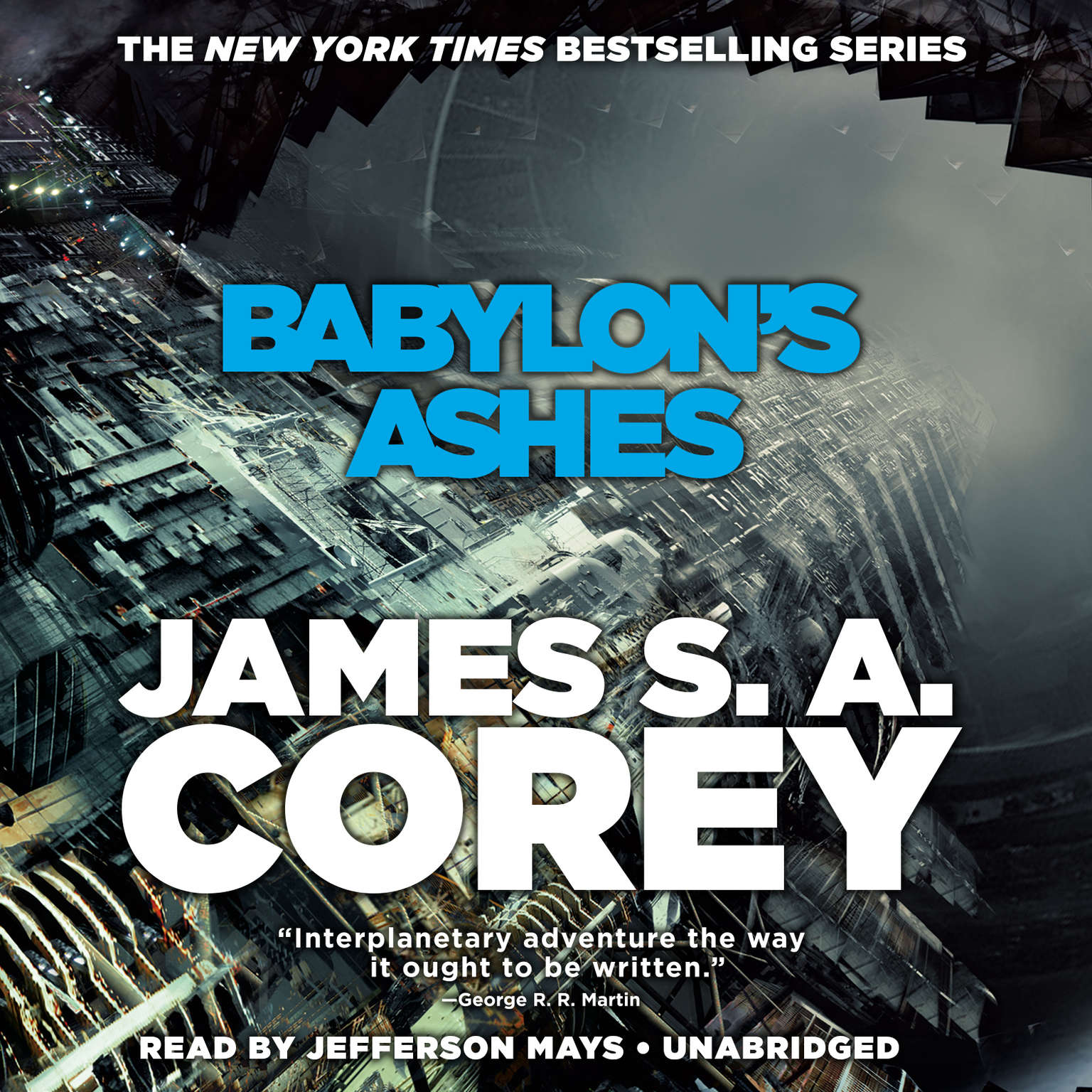
Babylon’s Ashes by James S. A. Corey (audio)

The Expanse series: Leviathan Wakes, Caliban’s War, Abaddon’s Gate, Cibola Burn, Nemesis Games, and now book six, Babylon’s Ashes.

I realize I keep going light on plot summary with these books, and I’m going to continue that trend here – you can get synopses elsewhere (as usual, Tor.com does a good job), and I feel pretty strongly that that’s not the point for me, with this series in particular. I’m here for the people. And they are delightfully developed in each episode. This book is delicious in its continuing development of everyone in turn. I feel that we’re consolidating our cast of characters, swelling the ranks of the Rocinante‘s crew to include Bobbie and Clarissa, and keeping up with Fred Johnson, Avasarala, Marco and Filip, and even (in prologue and epilogue) checking in with Anna Volovodov. Michio Pa is back with a still larger role to play; and Praxidike Meng, like Anna, plays a smallish role, but the presence of each of these returning characters would seem to indicate that they’ll have more to contribute in future books.

As the title indicates (and I have to say this is the first time I’ve found the title even glancingly related to the book’s contents!), the world is changing irrevocably; the question now is simply whether humanity will survive the coming years. Naturally, it is only thanks to the Rocinante‘s crew – well, with some help – that they have a chance at all.

I’m a little surprised it took me this long to notice a habit: all the characters in The Expanse consistently push their food away before they’ve finished it. All the foods, it seems, coagulate or degrade quickly into something pasty. (Almost all of these foods are made from a finite list of ingredients, things like mushrooms and yeast, and they tend to get gummy.) Sometimes it’s because something sad or bad happens and the character is suddenly no longer hungry. But whatever the reason, I’m not sure I’ve seen a character finish a meal yet – I typed, before getting to the epilogue, where Anna’s daughter Nami remarkably does so. Still, there’s a pattern. They’re always pushing the bowl away or putting it in the recycler. Funny what we notice. Funny the habits of a writer (or in this case, writers): the Corey team seems unable to let our folks eat to satiation.

Also, whoever it was that said that all science fiction is really set in the present (my buddy CT thinks it was Ursula Le Guin) was not wrong. This series’s new world is different in many of its details – including some pretty basic building blocks of life, like food, and travel, and the air we breathe – but all that is just so much window dressing, when it comes down to it. The essential problems in this world are the same old ones: how humans get along with each other. Power grabbing, greed, the needs of the disenfranchised to eat and breathe up against the “needs” of some selfish jerk or another to control everything. Racism now follows what part of the solar system a person comes from; ethnicity seems to be a non-issue, but really the discrimination has just shifted its focus. I deeply appreciate this new lens on an old problem: when I say that this is just the same story set in a different world, or that its details are window dressing, I don’t mean to be dismissive. I think it’s extraordinary. And sometimes we need new backdrops to recognize old problems in a fresh new way. If certain problem presidents were in a book club, maybe they could read this series; I don’t know.

Deep, complex characters, entertaining dialog (Corey is back on their stride after some hiccups), a racing plot, and the big questions about capital-H Humanity: I love this stuff as much as ever. You can expect more reviews to follow. Hooray!


Rating: 8 rocks.

PNC Broadway at Kentucky Center for the Arts presents Hamilton (2019)

You already know I love the soundtrack and concept. I felt so lucky to get to see this production in Louisville, Kentucky, with a friend of mine.

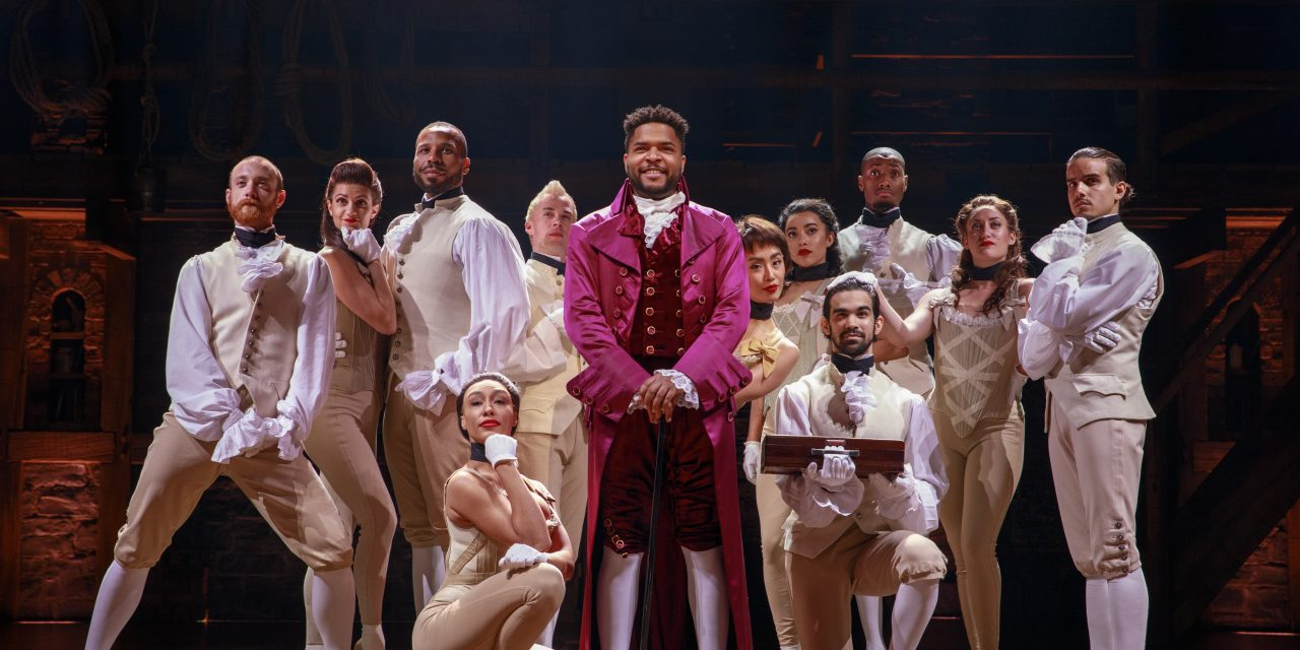
Jefferson in Hamilton (photo credit)

A few thoughts of my own here, and then I’ll respond to some observations from Pops.

I found every moment of this performance thrilling. I came in so heavily invested in and in love with the show as I knew it, from the soundtrack and from videos I’d watched online of other productions – I know this made me both harder to impress (because each actor was being held up to another actor’s interpretation) and easier (because I had already bought in). I think I had a fixed grin for several numbers; then when people started getting heartbroken and dead, I felt those things deeply, too. We had impressive vocal performances as well as acting throughout; it’s a blockbuster. I agree with Pops’s comment that some familiarity with the lyrics is helpful in appreciating their richness, depth and cleverness; don’t miss any of these lines!! but with my thorough study beforehand, I got a lot out of this. My admiration for Lin-Manuel Miranda and the whole production was confirmed, expectations satisfied. I still wish I could have seen the original cast. But this was amazing, outstanding, and something few people get to see (those ticket prices, whew $$$). I’m overjoyed.

My date (who is a novelist) and I talked some about the characters we appreciate most. Hamilton is a big one – the show is definitely built around the idea of his being a complicated, sympathetic, fascinating guy – and I find Burr a close second. He is the more tragic figure, I think, what with his final ambitious leap and disappointment, and his fatal mistake and instant regret. I enjoyed the comedy of Jefferson, and the gravitas of Washington. My date and I agreed that while Eliza was performed beautifully, Angelica is by far the more interesting and complex character, something of a tragic figure herself; that seems to be the nature of their true roles in history, though, and each actor beautifully performed her role as written.

One thing I hadn’t realized was how little script there was in addition to the soundtrack that I already knew so well – in other words, the whole story is sung; there is very little dialog. The notable exception is the news of John Laurens’s death: seeing that shared onstage, I finally understood why I’d been confused by the soundtrack on this point! No plus or minus here, just good news for fans of the soundtrack: you’re getting pretty much the whole thing. I guess I find it an interesting artistic choice on Miranda’s part. Everything in song!

A difference from the soundtrack and videos: our version of Burr (Alexander Ferguson) was a much slighter and less burly, macho man. The rest confirmed previous impressions. Mulligan and Jefferson each had their own swagger, and Jefferson onstage gets an infusion of pure silliness which was delightful to watch, and I think an important element toward the story – he was the comedic influence, and a foil in other ways as well for Hamilton. Hannah Cruz as Eliza was powerfully voiced, and I dug her haircut which was decidedly modern. And don’t let me pass up mentioning Peter Matthew Smith as a hilarious and beautifully sung King George.

The set was apparently simple, although it had a number of moving parts (not stationary as Pops reports the SF one); set changes (including furnishings coming on and going off) were part of the choreography, which was very smooth. The ensemble of backup singer-dancers made a definite contribution. Each actor filled their role nicely, although Burr was the biggest change. Funny Pops mentioned Van Jones – that man at least physically matches the original Broadway’s Burr much better than ours did.

In rereading Pops’s comments: I did not watch our audience very closely, I’m afraid. But my impression was that it was pretty white, and older than you noted yours. Also not rowdy or terribly involved; at Jefferson’s big entrance he had to ask for more applause (which he got, in moderation). SF has more pep than Louisville?

As far as Pops’s note about politics being mostly in casting rather than lyrics: this is true for the most part, and I appreciate that, sort of understated and unavoidable at the same time. (Funny story: after immersing myself in this play beforehand, I at one point found myself double-checking the appearances of some of these historical figures, wondering, were they brown? Silly question, of course – the powerful figures of American history are absolutely white – but that’s how involved I got in this play, that it let me imagine an alternative.) But! one notable exception would be repeated reference to the power and talent of immigrants. I love these lines.

Funny that Pops mentioned having seen the #2 Hamilton actor – I don’t see how I’d know such a thing, except that when I went looking for photos to accompany this review, I couldn’t find any of our Hamilton (Edred Utomi) in his role. I also can’t find any other Louisville Hamilton (which is why there is a picture of our very funny Jefferson [Bryson Bruce] at the top of this post instead). Hmm. No complaints about Utomi at all, though – I think he embodied the character perfectly. As I’ve mentioned above, Burr was the only one who didn’t feel quite right in his role; but I think that’s just because I had an impression in my head going in, and not the actor’s fault for having a different interpretation. The double-edged sword of my familiarity, is all.

Clearly I had a wonderful time. I’d do it again in a heartbeat. If I were made of money, I’d go see multiple productions of this genius play. If you can get in, do go see Hamilton wherever you have the chance.


Rating: 10 coattails.

guest review: the Orpheum Theatre presents Hamilton (2019), from Pops

Some months ago now, my parents went to see Hamilton in San Francisco (lucky them!), and I am now sharing with you Pops’s remarks – because the next post you see here will be my own response to another Hamilton production, 2300 miles away. Briefly, then, here’s Pops.

The audience was surprisingly white; guess I shouldn’t be surprised given the price and the world-class tourist destination of San Francisco.

I was impressed there were so many teens with families, young people, and couples; there is a cross-generational attraction.

It was like a rock concert: excitement building just waiting; with the first chord of music, they cheered and hooted like these were rock idols; the conductor was obviously pacing the opening song to allow for applause and cheering, so we didn’t miss too many opening lyrics.

The stage set was huge, simple, stationary and visually rich to my eye, smacking of heavy-timbered construction, shades of dark brown; it was open, no curtains, enticing the awaiting crowd; the show began with Aaron Burr simply striding out on stage and letting loose!

The talent on stage was overpowering; wonderful, top to bottom; the audio system was good, and the powerful music will move you; but the rapid fire lyrics were still sometimes lost to individual diction or presentation; good to be familiar!

It strikes me that the ‘politics’ of this production are largely in the ‘meta’ of presentation, not so much the content of lyrics: i.e. diversity of skin color, musical style, physical character portrayal, etc.

The cast presented a broad palette of skin color; very few racial or ethnic stereotypes appropriate here; it was wonderful how that quickly faded to background as each character established their identity with other features.

The acting adds so much to the songs! Characters were sometimes surprising as fleshed out by actors, with body language and expression adding so much; good seats up front paid off; so many of these ‘familiar’ historical ‘founding fathers’ were so different as portrayed, Jefferson especially (as a buffoon!); George Washington retained the most tradition I thought, with great gravitas; I thought our Aaron Burr was by far the powerful character, as portrayed by a handsome man who I thought to be a doppelganger for Van Jones, if you know him.

There is great dancing too! Again, totally missed listening to only audio; it’s fun how the ensemble women also play male or ambiguous gender roles in other scenes.

We saw the relatively inexperienced #2 Hamilton actor, and he was great; I suppose the #1 is saved for weekends – he has a much longer and showier background including a Broadway tour. One wonders about different interpretations…

Act 1 is all upbeat, high energy, uplifting; the shorter Act 2 brings the steady decline to denouement, like a Shakespearean tragedy; it’s a sad ending – no attempt to sugar-coat history.

I’ll be responding to these thoughts in my own review. It was so fun to get this email and whet my own considerable appetite for the same show…

author interview: Tim Mason

Following my review of The Darwin Affair, here’s Tim Mason: You Have to Bring the Stage to Them.


Tim Mason‘s plays have been produced in New York City and around the world. He has received the Kennedy Center Award, the Hollywood Drama-Logue Award, a fellowship from the National Endowment for the Arts and a Rockefeller Foundation grant. In addition to his dramatic plays, he wrote the book for Dr. Seuss’s How the Grinch Stole Christmas! The Musical, which ran for two seasons on Broadway and tours nationally every year. He is the author of the young adult novel The Last Synapsid (2009). The Darwin Affair, out now from Algonquin Books, is his first adult novel.

photo credit: David Kelley


What about this history captured your imagination?

It began with Dickens, really: my love of Dickens, perhaps his best novel, Bleak House, and the character, the Detective Inspector named Bucket. I always thought, wouldn’t it be fun to write something with Bucket as the lead character instead of just a member of the supporting cast? And when I found that Dickens quite likely based Inspector Bucket on a real London policeman, Charles Field, I felt at liberty to use that fellow, or my version of him, as my lead character. It began with Dickens, and with my father’s love of the works of Charles Darwin.

How important, to you, is historical accuracy in fiction?

I worked very hard to be as accurate as possible, given that it’s a work of fiction. I tried to insert my fiction in the interstices between one historical event and the next. I had some good luck: when I first began work on the notion of the novel back in 2009, I was having dinner with a friend, a British expatriate in New York. And she said, well, if you’re doing anything Victorian, you should be in touch with my friend in London, Jane Hill. I e-mailed this perfect stranger and she, within days, was looking over my first 80 pages and correcting my Victorian. She was a great help throughout. At one point she turned over her house in north London to me while she was traveling abroad, and I used that as a base for research. I had an old friend in Oxford, an archeologist, and he and his wife were able to unlock a door for me at the University Museum, where the famous Wilberforce-Huxley debate on evolution took place. It is no longer open to the public, but I got to scope it out for myself and try to duplicate it in my book.

Also, in 2012, I think that was the year, the diaries of Queen Victoria, which had been transcribed and digitized, were briefly put online and open to the public. That was just a godsend; it was incredible. I had Queen Victoria’s own day-to-day accounting of her time, and the trip with her husband, Albert, to his homeland of Coburg in Germany, including the very real, very serious carriage accident that Albert suffered where he was thrown from a carriage and injured. I saw that as a green light to my fiction. It really happened; my version of it didn’t, but I squeezed my fiction onto historical fact.

Did you enjoy the research process?

I enjoyed it very much. Discovering sources like those I’ve mentioned, and a couple of others–I had a lot of good luck. At a certain point I feel you can’t write until you shut the history book. Otherwise you’ll go on forever researching and, you know, this is not a documentary; this is a work of fiction. I have to be willing to get some things wrong. I do my best to study up on the area I’m pursuing, and then I metaphorically shut the book and don’t look at it while I’m writing. That’s my process. Otherwise I find I’m paralyzed; I couldn’t actually begin the fiction until I looked away from the history.

What do you love so much about Bucket?

For me the Charles Field that I made was attractive. Dickens’s Bucket is also very attractive. He’s probably one of the first-ever police detectives in fiction. Very adept, very sagacious. He’s able to spot character on sight and come to snap judgments that prove to be accurate. I felt he also had quite a lot of moral ambiguity. He does a terrible trick to the poor character of Tom–Tom who’s all alone, a miserable poverty-stricken street boy. So he’s very warm and engaging, and you love him, and then he’s also capable of underhanded dealing. I thought he was very human.

When I came to write my version of Inspector Field, I realized he’s only superficially like Dickens’s Bucket. He has certain patterns of speech that are like Bucket, and he’s sort of a burly middle-aged man and he loves his wife, as Dickens’s Bucket did; but he’s a nicer guy. He has a terrible temper–that’s his biggest failing. But I could embrace him wholeheartedly, even with his temper and his sense of his own limitations. I think that’s very attractive to me. He’s not the omniscient detective. He’s not anything like Hercule Poirot. He’s just groping in the dark and so frustrated because he feels he makes one mistake after another. That feels more like my life.

How was writing a novel for adults different from your past writing experience?

I began experimenting in prose fiction some years ago, around 2000, when a story occurred to me that simply couldn’t be told on the stage. A play can span time, and travel in time theatrically, but this story wanted something different. That’s how my middle school novel, The Last Synapsid, began, and that was just such a slog. I just had to write and write and overwrite. My first draft was over 450 pages long! It took me a long time. I eventually cut 100 pages before Random House bought it and published it, but it was a great education. I could do things in novel form that I can’t do on the stage.

The literature of the stage is pure economy. Action is dialogue. Action isn’t, he goes to the bar and makes a cocktail and returns to the dinner table. Action is what happens from one line of dialogue to the next between one character and another, constant shifting of the balance of power. That makes the dynamic of a play. Well, in a novel, you’ve got the reader, who isn’t looking at the stage but looking into his or her own imagination, and you have to bring the stage to them. And it’s a lot of work, a lot of wonderful work.

What are you working on next?

What I’m working on involves Inspector Field five years before the events of The Darwin Affair, and seven years after. Both a prequel and a sequel. But this one I don’t want to take four years to write!


This interview originally ran in the June 21, 2019 issue of Shelf Awareness for Readers. To subscribe, click here, and you’ll receive two issues per week of book reviews and other bookish news.