thought for the day

Briefly, I felt compelled to share this line with you from my A.Word.A.Day email.

What I like in a good author isn’t what he says, but what he whispers.

–Logan Pearsall Smith, essayist (1865-1946)

Isn’t that well said. I don’t know this Mr. Smith but I am impressed. I’m sure I’ll feel the need to refer back to this concept in a book review one of these days…

Oedipus Rex by Sophocles, trans. by Dudley Fitts and Robert Fitzgerald

oedipus“The Oedipus Cycle” is made up of three plays by Sophocles: Oedipus Rex, Oedipus at Colonus, and Antigone. I cannot remember at this moment what motivated me to read or reread these plays; something else I read, no doubt. I remember Greek tragic drama very fondly from high school, where Mrs. Smith inspired me in many of my present-day literary loves (hello, Hemingway and Homer).

This triptych concerns the mythic curse on the House of Thebes, which I will retell quickly in my own words. Ahead: spoilers. Oedipus was both to the Theban King Laius and Queen Jocasta, but upon his birth, an oracle prophesied that this baby boy would grow up to murder his father and marry his mother. Wishing to avoid this fate, Laius took the boy out in the woods, pierced his heels and pinned them together, and left him to die. Now, this is no way to avoid the fates. Oedipus was raised by a foster father and mother who claimed him as their own, until as a young man he heard this prophecy given, and not wishing to fulfill it against the parents he knew and claimed, he fled them. Along the road on his travels, he came across an older man who wouldn’t yield the road as Oedipus thought proper. They quarreled, and fought, and Oedipus killed the older man (guess who this will turn out to be). He continues on the road to Thebes, a city-state that has just lost its king to a mysterious murder; he solves the riddle of the Sphinx, marries their queen, and happily begets four children.

When Oedipus Rex (or “Oedipus the King”) opens, King Oedipus is struggling to relieve his city of a plague. He must appease the gods, and the oracle tells him the way to do this is to finally avenge the former king’s murder. He agrees that Laius deserves justice – ironically volunteering to serve as his child should: “I say I take the son’s part, just as though / I were his son…” (as translated in my edition by Dudley Fitts and Robert Fitzgerald). And Oedipus curses the murderer, or anyone who would hide his identity, with death or banishment. This will have consequences. The action of the play, the tension and emotion, resides in Oedipus’s earnest cursing of the murderer who turns out to be himself; adding incest to his unknown crimes is too much for him, as his queen (wife, mother) kills herself and Oedipus gouges out his own eyes and puts himself at the mercy of his brother-in-law, Creon. Here the play ends.

There is some ambivalence, at least for me, in identifying the fatal flaw or crime of the tragic hero in this play. (It will be much clearer in Antigone.) Oedipus is indeed guilty of murdering his father and marrying his mother – terrible crimes, to be sure – but he did both unknowingly, and to his knowledge had every right to kill (in self defense) and marry. I think his fatal flaw is at least shared by his parents: the crime was in trying to avoid the predestined fate assigned them all by the gods. This you can’t do! One wonders, if Oedipus had been raised at home, how these things would have come to pass; clearly differently, as he would have known his parents. Presumably he would have been more at fault. But at any rate, the point is made that it is futile to avoid the fate assigned you by the gods. Perhaps his limited responsibility here is what earns Oedipus a somewhat reduced sentence – of which, more in the next installment.

I enjoyed this play for its feeling. The characters are passionate, emotional, and all of this is well evoked by the somewhat dramatic (but this is drama, after all!) but very understandable language. I think Fitzgerald’s translation is excellent; I find it moving, and the atmosphere of building doom and foreboding is exquisite.

Coming up: the next two plays.


Rating: 7 places where 3 roads meet.

book beginnings on Friday: NOS4A2 by Joe Hill

Thanks to Rose City Reader for hosting this meme. To participate, share the first line or two of the book you are currently reading and, if you feel so moved, let us know what your first impressions were based on that first line.

nos4a2

Do we all know who Joe Hill is now? The secret is out, correct? I’m kidding; the secret’s been out for years. Joe Hill is Stephen King’s son. I’m a King fan, but it took this recent article to convince me to get some of Hill’s work. And I’m glad I did; this recent novel started out with a bang and had me excited right off the first page. It begins:

Nurse Thornton dropped into the long-term care ward a little before eight with a hot bag of blood for Charlie Manx.

She was coasting on autopilot, her thoughts not on her work.

Nothing crash-bang in those first two lines; but we do get our first reference to blood. And it only gets creepier from there, in the most delicious way.

art and dirt

[I recently read Theo Pauline Nestor’s Writing Is My Drink, but my review won’t be published at Shelf Awareness for another week or two.]

I remember from Natalie Goldberg this thing that I also recognize in Theo Pauline Nestor: an aversion to the outdoors, a lack of appreciation for nature. It is apparently something to be avoided, cleaned off your shoes if you accidentally step in it, and this is every bit as disturbing to me as the people who react to the idea of exercise by saying that they “don’t like to sweat.” What!! What a bizarre concept, to not like to sweat. Sweat is not the first or primary goal of exercise, I want to tell them, any more than getting dirty is the primary goal of going outside; but both results (and they cross over quite a bit) feel good because they are of the nature of their parent: exercise, and the outdoors.

Nestor writes, of camping: “life’s hard enough; why turn it into a three-ring circus by trying to rub sticks together just so you can boil water for morning coffee?” And then later, in praise of her medium: “writing comes from the wild place, from the home of the undomesticated, the untamed, the feral.” As if that is a good thing. How can the undomesticated, the untamed, the feral, the wild place, be a good thing if camping is a bad thing? And oh how simplistic (and ill-informed) her picture of camping: that it involves rubbing sticks together, for chrissakes, to make coffee!

Why the disconnect? Why does art have to take place in clean and civilized environs? Don’t get me wrong, I like a good coffeeshop too; but I worry that there’s something missing from a person who appreciates art and beauty and yet thinks camping is an unnecessary complication. Some of us feel that camping is a necessary reduction in complications, in fact: think on that for a moment. You can even forgo the coffee and use trees and sky as your stimulant! I want to be clear that I very much enjoyed Goldberg’s Writing Down the Bones and Nestor’s Writing Is My Drink, and I found both useful. But I think I’m bound to identify better with Philip Connors and Christine Byl, artists unafraid to get dirty.

guest post: Mom’s recent reading adventures

Mom says…

Just thought I would share some recent reading adventures.

I just started Rules of Civility which immediately captivated me.

Just finished Leonard Rosen’s The Tenth Witness, part of his Henri Poincare series (book two). I loved the previous one more, but was swept along by this one, even with some flaws. He explores the soul and the tendency among some to be cruel and unconcerned about humans, as well as the incomprehensible ability – of others – to be full of love and compassion. The recent one took on the Nazis and WWII. All Cry Chaos (book one) was so good that I bought it in audio, although I haven’t gone there yet. The protagonist is a descendent of Poincare the mathematician, and that plays a bit part. More importantly, he’s a Frenchman who travels as part of his work, and sees a lot of places that I at least know. Amsterdam has a roll in the first, and in the 2nd, the Wadden Sea and the island of Terschelling. There he takes on the mud walking on the flats that is so popular with the Dutch, and makes a case for its attraction.

Mom is not only a world traveler but a mathematician, herself.

And before that I read in succession Wolves Eat Dogs, by Martin Cruz Smith, and The Sky Unwashed by Irene Zabytko, both of which have a focus on the Chernobyl nuclear disaster which killed a few hundred thousand at least. There’s also Georgi Vladimov’s Faithful Ruslan, a dog’s story (told by the dog) as parable: we cannot get beyond our training, even to save ourselves. It was circulated by hand as samizdat for years. Those three along with the Penguin books (Death and the Penguin, Penguin Lost) are all set in the Soviet sphere or Soviet Union – or Russia – and they all take on the attitude toward life that that history gave people. A bleak hopelessness combined with determination made survival possible for some, but they carried the black memory of their lost families and co-strivers. The Sky Unwashed is set completely in the Ukraine during the catastrophe of 1986, with some of the people living like peasants of an earlier century, and many returning to the forbidden sites to continue to live that way, gardening and tending a cow or pig, even as there are whole pine forests of standing trees killed by radiation. Smith has been here before (Gorky Park, etc), and knows the territory. His treatment may be even more devastating, love and desperation and ambition mixed so completely, with the hopelessness of the system still a palpable part of people’s psyche. These books are set in a society where being drunk and incompetent at work was not out of the ordinary, and there is no sense of duty to the public: police and social worker are driven by bribes and ambition or a perverse sense of cynicism (is that a contradiction?).

Contradiction? No. Redundant? Perhaps; but no, I think I’m with you here. Perversely cynical.

Enough of that! I started out to tell you about Collapse. I always enjoy stories about other cultures, so anthropology with some lessons makes for a good read, even without considering the lessons for today. Jared Diamond tells at the end about his conversations with students about this material, as he taught a course with the plan to write this book. The students couldn’t imagine how these people could have cut down the last tree that also doomed them – how could they knowingly do that? He even cites an academic who sees this as impossible (speaking about some collapsed ancient society) because cultures are more purposeful and self-aware, self-preserving. There are too many counterexamples for this to be valid of course, and where does that leave us? His conclusions leave some hopeful possibilities, as well as the not-so-hopeful outcomes.

Diamond tells a striking story set in an airport. We see the ID checking, the security machinery, the computer screens with the little piece of paper that tell who you are and where your seat is. It is clearly a lesson in pervasive technology, but wait! His point is that he is in an airport in New Guinea, where we have been talking about a society that was only found in the last century, and all the faces are very like those of the ‘primitive’ people we see in photos from the ’30s. His point is that we are much more connected that in the past, when some societies were able to collapse separate and unknown to the rest of the world. (One of the principles of collapse is connection to neighboring societies, whether as trading partners who fill a need, or as competitors or simply antagonists that further the collapse.) So globalization is both positive and negative in the social equations of collapse and survival.

Many more thoughts about this book, but no definitive answers – did I expect that?

Aside from Rules of Civility which of course I bothered her to read, much of this was new to me! I did read and enjoy Jared Diamond’s The World Until Yesterday, and I recognize him from her brief description here. In fact, I could swear I’d read that airport scene before; or maybe Mom had already told me about it? Funny. At any rate, Mom, I enjoyed this glimpse into your reading life – as diverse as any – maybe that’s where I got it?? A fine legacy! I was just reminiscing the other day over the authors my mother has introduced me to – James Lee Burke, Michael Connelly, Elizabeth George (who is becoming less appreciated, sadly), and Lee Child who I’ve brought to her attention. But better than any of these genre authors is having inherited eclectic reading interests. Thanks, Mom.

Farewell, Dorothy Parker by Ellen Meister (audio)

farewellI “like” the Dorothy Parker facebook page, available here, which is run by Ellen Meister and posts Parker quotes and anecdotes regularly. This is how I became aware of Meister’s new book, a nod in novel form to the feisty one.

In wrapping up this audiobook experience I am a little conflicted. I was alternately spellbound and greatly entertained, and exasperated, with the novel’s protagonist, Violet Epps. Violet is a movie critic in present-day New York, and her verbal wit on the page is razor-sharp (as they say), in the spirit of her acknowledged hero, Dorothy Parker. But in real life, she’s petrified of everything, rarely finding the voice to ask for a seat at a restaurant; in the opening scenes (quite frustrating) she is trying to break up with a dirtbag loser boyfriend but can’t. And then she obtains a book signed by Dorothy Parker, and discovers – gasp – that she can summon the dead writer at will. This changes Violet’s life enormously.

Violet needs a helping hand in several areas of her life: dumping the boyfriend and fielding a new one; dealing with a horrible bratty new underling at work; and fighting a custody battle for her recently orphaned niece. Mrs. Parker (as she insists on being called) is a great help – or sometimes a great interferer – in these matters, giving Ms. Epps (as she insists on calling her) the backbone she needs. Sometimes this takes the form of encouragement (or even feeding her lines); but Mrs. Parker also has the ability to enter Violet and take charge of her body, which can be messy. There is always the questions of where to give credit (or blame) – how much is Violet in control of herself? She is apt to give Dorothy Parker the credit, but she’ll have to learn how to stand up for herself by herself in the end, of course. The satisfying flip side to Violet’s growth is that she has something to offer Mrs. Parker, as well.

On the one hand, Meister’s characters were well-developed and believable (with the possible exception of a rather ogre-ish grandmother), and I cared about them. Dorothy Parker was wonderful, everything you’d want her to be, realistic, heroic but humanly flawed. I was honestly desperate to get back to this audiobook when I had to shut it off. I needed to know what was going to happen next; I was excited or anxious for Violet, who I liked.

On the other hand, Violet’s behavior was often infuriating. She was so slow to learn, so allergic to speaking up for herself in even the most obvious of needs, that I wanted to shake her. We spent what felt like eons in situations where she should have just done something. Now, I’m not a person who typically struggles to speak up for herself; I don’t suffer from social anxiety except in the most exceptional of circumstances. Perhaps I should be tolerant of this portrayal because perhaps it is entirely realistic for people who truly fight these issues. [Although, the explanation for Violet’s social anxiety – a trauma involving her recently-deceased sister when they were small – I found rather trite.] But even if this was a realistic portrayal, I found it tiresome.

Similarly, perhaps I should give allowances for this part because I’m not a romance fan – but in the thread of this story that was a romance novel, there occurs that maddening trope wherein the woman wants the man but pushes him away, and it takes far too long for them to reconcile their totally obvious mutual desire. My patience was tested. But, romance fans, you should like that part.

I know I sound harsh here, but I point out again, the plot’s action had me riveted and I am going to miss Violet Epps (and Dorothy Parker!) very much now that this book is finished. I just want to communicate that I had conflicting moments throughout.

And in the end, I was silly putty in this book’s hands. I was so pleased for the happy endings and for all the characters that I forgot my earlier quibbles. Had I been I overreacting? Or did the later success of this novel simply wash away the memories of my frustration? Whatever it was, my patience with this book was rewarded and I’m won over. Three cheers for Violet and Dorothy, both.


Rating: 6 edits.

from the New Republic: on books

Thanks, again, to Liz for sending this along. The New Republic‘s issue of October 21, 2013 featured a cover focus on books and publishing, with five articles included. They range from a one-page infographic to 3 pages long; no serious time commitment here, although you will have to find them. I accessed these stories through a database (Ebsco, if you’re curious) through my employer; you may have similar access through your local public library, for example. I know that on Houston Public Library’s page you can go to “research databases” and search for the publication you want (New Republic), and then you’ll need to put in your library card number to see the articles. Contact your local librarian if you want to get in and you need some help; she or he will be happy to assist. Or, there’s always the print edition, if you subscribe or know of a decent newsstand!

I found these articles interesting (obviously) and wanted to share just a few thoughts. In the order I read them (I have no idea how this relates to the print magazine):

  • “Books Don’t Want to Be Free: how publishing has escaped the cruel fate of the other culture industries” by Evan Hughes examines the fact that books have avoided the way music and movies have become open to pirating and price drops. Those industries are struggling, Hughes writes, in ways that the book publishing industry isn’t. (And don’t even get started on print magazines and newspapers…) This article is optimistic and thus refreshing. It touches on the recent price-fixing court case between a group of major publishers, and Amazon. It also speaks to pricing differences between e-books and traditional print, which is addressed in the next item:
  • “The Words Business, In Numbers,” an infographic (sort of) identifying trends in revenue (e-books vs. print), reader trends, and foreign readership. In a word, “e-books are growing the pie.”
  • “The Dastardly Defender of Letters” by Laura Bennett is an article about and interview with Andrew Wylie, “who still makes millions off highbrow.” He is an infamous agent for clients including – I shamelessly reproduce those listed in the article – Amis, Nabokov, Bellow, Rushdie, Roth, and more in that vein. He is delightfully curmudgeonly, snobbish about the lowbrow, and defending books as they should be made (says he, and I largely agree). This was the most fun piece to read. His apparent serene calm regarding the future of traditional books was heartening.
  • “I Hope They Read Books in Hell” by Norene Malone, on the other hand, touches on the opposite end of the spectrum. Malone visits with the editor, Ruby-Strauss, and agent, Leavell, of Tucker Max, author of I Hope They Serve Beer in Hell.” Max’s cache, if you didn’t know, is being 1) internet-born and 2) offensive as all get-out. Ruby-Strauss and Leavell work with others in the same vein: Snooki from Jersey Shore, that University of Maryland student who wrote that bitchy email, Shit My Dad Says (whose twittering I like, btw). It was interesting to consider that counterpoint, the lowbrow, which (it is argued) helps finance the highbrow.
  • Finally, “The Rancid Smell of Success” was written by Lionel Shriver, author of a good number of novels, most famously We Need to Talk About Kevin, which became a major motion picture. She laments the changed life of a successful novelist: from the scary, financially insecure obscurity of an undiscovered writer to the publicity-exhausted successful author – who is still financially insecure and has to immediately begin work on the next book, but can’t because of all the promotional demands of the current one. It’s a beautifully written article, and she acknowledges the problem with her complaints about the literary festival she has to attend in Bali; but she justifies her complaints, too. It’s a thoughtful piece.

On the subject of e-books versus print – and the question of the future of the traditional book (“is it dead?!” they ask hysterically) – others have said it better before me, but I’ll briefly file my position. The birth or the rise of the e-book does not signal the death of the book, any more than the birth or the rise of television sounded a death knoll for radio. Radio has changed over the decades, but we still have a recognizable semblance of what it was when the television was born. There’s room for both e- and print books in this world, and both have their uses, their pros and cons, their seasons if you will; and both have their fans. Those of us who prefer print (even if we occasionally read electronically!) will continue to buy and borrow real books. Everybody calm down, is my concise message. And please, read books – any kinda way.

Cat on a Hot Tin Roof by Tennessee Williams

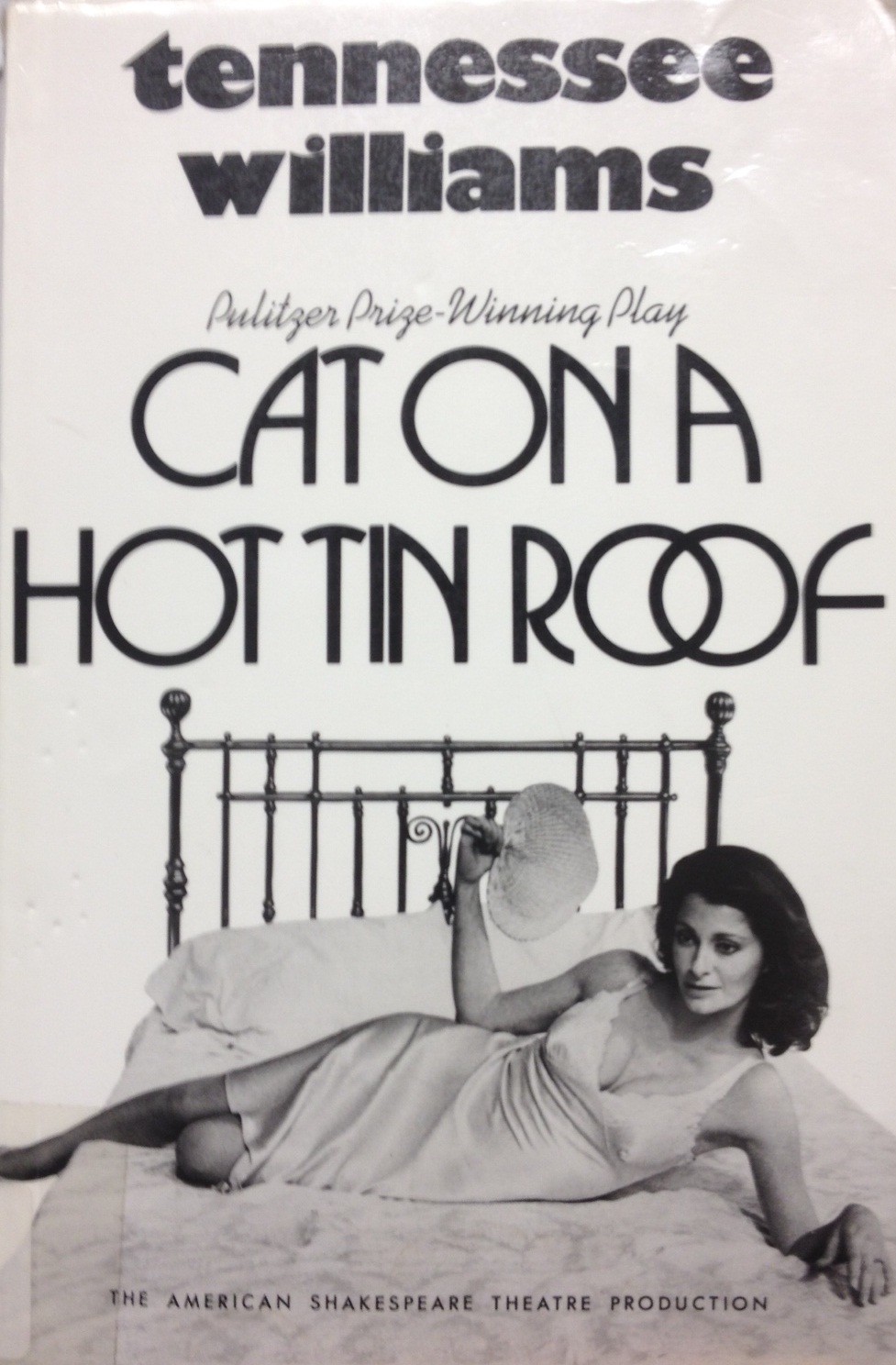
photo (2)Arguably Tennessee Williams’s best-known or best-regarded play, Cat on a Hot Tin Roof may be familiar to some of us for the 1958 film starring Elizabeth Taylor (shown on the cover of my copy from the local library) and Paul Newman. It won Williams the Pulitzer in 1955.

The action takes place in a few rooms and on the full-length upstairs gallery of a Mississippi Delta plantation home. In the opening scene, young wife Margaret is complaining to her husband, Brick, about his family: his brother Gooper (what a name!) and Gooper’s wife Mae are obnoxious people, with five children and a sixth on the way, bent on securing the plantation for themselves as inheritance, as Big Daddy is dying of cancer. Brick is no longer sleeping with Margaret, for reasons that go unexplained, at least by Brick himself. Margaret (and the rest of the family) are concerned with Brick’s drinking; and there is much innuendo directed towards his relationship with a now-dead friend named Skipper. The play, in three acts, with no break in time – so that the action of the play takes the same time as the playing of it – portrays discussions between various family members around these issues. Brick drinks too much; he doesn’t sleep with his wife; they’re expected to have a baby, at least one, to try and compete with Gooper and Mae’s outstanding performance in that department, despite which Brick is still the favored son. Big Daddy has been told he does not have cancer, but this is a lie to protect him, a lie that Brick exposes.

The nastiness of Mae is perhaps the least subtle element of this play – she is every inch a schemer – but overall it’s very well balanced in terms of what is said and what is left unsaid. The greatest victory Williams scores here, in my opinion, is atmosphere. It’s hot; there isn’t enough air flow, and the characters are mostly anxious to keep doors closed so that other family members don’t hear what is said. There are many secrets: the extent of Brick’s drinking; Margaret’s infidelity with Skipper (intended to prove his sexuality); the question of Brick’s sexuality; Big Daddy’s diagnosis of advanced and inoperable cancer. The secrets and the hot, still air are claustrophobic; and add to this “Maggie the Cat”‘s sensuality, her desire for her still-attractive husband, and her attempts to get him back into the marital bed, and we have a sultry, charged scene.

I observed about this play – but I think it’s true of all Williams’s work – that he writes quite lengthy and detailed and imaginative stage directions. There is almost a novel living within this play, so much does he put into his narratives about scenery and the manner the actors should take. It also occurred to me that some of his directions to the players were fanciful and difficult to act out; for example: “Big Mama has a dignity at this moment; she almost stops being fat.” How is Big Mama’s actor supposed to play that out?? On the other hand, Williams often releases his characters (more typically of a play script) into dialogue or monologue and lets them run. I think the characters we meet here are very well matched to help one another release truths, or hide them, or release untruths, as they will.

There’s no question that this is a beautiful piece of artwork, and another that I would very much like to see performed.

Themes include “mendacity,” as Brick continually refers to it: most overtly in regards to Big Daddy’s prognosis, but also relating to the inheritance that Gooper and Mae want so badly; Brick’s relationship with the late Skipper; and his relationship with his wife, and their likelihood of having children. A more understated theme, but one that shouldn’t be overlooked in the face of Williams’s own relationship with alcohol, is Brick’s alcoholism. This is something he doesn’t work particularly to keep hidden; the family is aware that he drinks a lot, but Big Daddy is surprised to hear about the “click” in Brick’s head that he needs before he can feel all right, and that can only be achieved by drink. I didn’t bother counting the drinks Brick takes before he feels the click, but it’s quite a few, and I believe was finally reached by three shots in quick succession. The poor guy. Adding to the claustrophobic, anxious, heated atmosphere I described above, Brick is on crutches, having twisted an ankle recreating his youthful athletic triumphs while drunk the night before; and instead of sitting and resting it, he’s jumpy, can’t stop moving. The people who want to communicate with him (Margaret, Big Daddy) try to take his crutch away to still him, but he continues to hobble. I think there is clearly some symbolism there. This wouldn’t be the same play if Brick weren’t crippled, or if he were to sit docilely and put his foot up on a pillow.

Another achievement for Tennessee Williams; and can someone produce this one locally for me, please?


Rating: 8 trips to Echo Spring.

from Liz: Sean Hemingway interview on alternative endings to A Farewell to Arms

She does it every time, you guys, because she a) knows me and my tastes quite well and b) scours the internet and the podcasts and whatnot constantly.

Liz sent me this: an interview with Ernest Hemingway’s nephew, Sean, on a radio show called “To the Best of Our Knowledge” (acronym TTBOOK, which is cute). It opens with a movie clip (from a movie I’ve never heard of, which is a reflection on me, not the movie) about Hemingway’s very well-regarded World War I novel, A Farewell to Arms: the movie’s protagonist is upset about the ending, as many of us have been and will be. Sean Hemingway has recently released a new edited version, A Farewell to Arms: The Hemingway Library Edition, which includes all the alternative endings that Hemingway wrote before settling on the one we know. There were 47 of them.

Click the above link to listen to, or read, the interview, which includes a few of the alternate endings. (I started by listening – which was good, for the movie clip, and for hearing Sean’s voice; but then I got impatient and read through the rest.) Um, this should be clear, but if you haven’t read the book, beware of spoilers in the interview!

I was intrigued because, as interviewer Steve Paulson says, these alternate endings give us a real window into Hemingway’s process and his difficulty, himself, with the ending. And as Sean points out, most of us have lost a loved one, and the difficulties Hemingway had working out how to end this book are analogous, at least, to the difficulties we have in letting go.

Do I want this new edition? Do I want to reread the novel, or just the 47 endings? I’m not sure; my appetite is certainly whetted by this interview, but I don’t think I’m up for a full reread. For one thing, although much-lauded, A Farewell to Arms is far from being among my favorite Hemingway works. I’d reread it before I reread Death in the Afternoon, but that’s about it. And I still haven’t read everything he wrote, either, so it would be hard to justify. I could run through those endings, though… we shall see.

Thanks, Liz, for another great reference. Go check out the interview – it’s short.

The Black Monk and Other Stories by Anton Chekhov (audio)

blackmonkI am tagging this as a did not finish, although I did, in fact, finish two short stories (and barely started a third). I DNF’d the story collection, though. Meaning, I don’t seem to be a Chekhov fan. It’s funny when things turn out that way: when I turn out not to like an author who is Classic, or in this case, revered as one of the best short story writers of all time (I can’t remember where I’ve heard this, but I have. More than once. sigh). But it does happen.

I listened to The Black Monk and Gooseberries. It was remarkable to me how much these stories reminded me of Tolstoy (who, if you recall, I also did not like). I don’t know if it’s Russian writers with shared characteristics, or that they both evoke the same world and that’s what bothers me. At any rate, the Russian society on the estate felt very much like the same background, transferred from Anna Karenina to Chekhov’s short stories.

In The Black Monk, our protagonist visits the estate where he was raised family-like by non-relations. The father figure encourages him to marry the daughter of the estate (so, the sister figure?), and he does. At a party somebody shares the legend of the black monk, who is imaginary but shows up… sometimes, some places. Our protagonist sees the black monk, talks with him, and uses their conversations as fodder for his own writing (oh yes, he is a writer by profession). He gets caught talking to himself (as it seems – he’s talking with his imaginary black monk) and “treated” for his “illness,” which frustrates him. He and the wife split up. The end. This is a story in which nothing much happens, and the black monk bits I found uninteresting. Is this minimalism as a stylistic statement, or something? Is it not what’s there, but what isn’t there? (Like action, personality, conflict?) This is a well-regarded piece of literature, but it passed me right by.

In Gooseberries, a few friends gather and sit around and tell a story: the brother of one of these men, having grown up in the country but found work as a bureaucrat in a city, dreams about retiring to the country. He will have a farm, or something like it; and he will have gooseberry bushes. In time he accomplishes this: he has a country estate, and gooseberry bushes. The brother (who is telling the story, to his friends) visits, and is served gooseberries. The country-aspiring brother praises them highly, but they are in fact bitter. I assume this is the grand symbolic conflict of the story that is meant to impress me, but again I found it banal. Oh, there is some social commentary on the fact that this bureaucrat-brother now professes to be a nobleman and high-handedly distributes buckets of vodka to the peasants on special occasions, pretending grandeur. But again, this is a story in which nothing happens, and I am bored. So I stopped listening.

In many literary cases, we praise the understated. I’m thinking of Cheever’s short story, The Swimmer, and Hemingway’s, Hills Like White Elephants. The under-context of these stories remains pretty well hidden, but they are praised as masterpieces. (I enjoyed both, for the record.) In Hemingway’s story, nothing really happens; but it is still thought-provoking and oh, so emotionally evocative. In Cheever’s, a little more happens; nothing is said about what Cheever really wants to say; but it still works. I wonder if there’s something hidden in The Black Monk that, if explained to me, would make it so much more enjoyable? I suspect not.

Funnily enough, this audiobook I picked up right after The Gunslinger is read by the same narrator, George Guidall. That was an interesting experiment in the different voices and moods a good narrator can evoke. When I thought to notice, I could tell – obviously – that the same man read the two books; but it never would have occurred to me mid-story, because he does a fine job of bringing to life two such different worlds. The fantastic, dramatic made-up world of King’s fantasy series couldn’t be more different than Chekhov’s staid, frustrated Russian society, and Guidall did well by each, so none of my criticism falls on him. I was annoyed by the characters Guidall read; but I think he read them as they were written.


Rating: 2 empty comments.