poems & booze

Randomly – or less randomly, following the subject of yesterday’s review – I have something to share with you on this Tuesday morning. At my very favorite bar, there is a poem scrawled in chalk on the wall behind the taps & bottles. This is a fairly literary bar – they have open mic poetry nights and, I believe, book talks as well. One of my favorite things about this bar is how easy it is to show up after work and sit at the bar alone with a very fine beer and a book, and not be bothered – as a woman, not a ubiquitous experience. The bartenders are friendly – or to be clearer, I consider them friends – and other than their occasional company I’m left alone. So today I’ll pass on to you the poem featured at Mongoose vs. Cobra: At The Quinte Hotel by Al Purdy. (I accessed it here, and would note that there are a few slightly different versions floating around out there.)

I am drinking
I am drinking beer with yellow flowers
in underground sunlight
and you can see that I am a sensitive man
and I notice that the bartender is a sensitive man
so I tell him about his beer
I tell him the beer he draws
is half fart and half horse piss
and all wonderful yellow flowers
But the bartender is not quite
so sensitive as I supposed he was
the way he looks at me now
and does not appreciate my exquisite analogy
Over in one corner two guys
are quietly making love
in the brief prelude to infinity
Opposite them a peculiar fight
enables the drinkers to lay aside
their comic books and watch with interest
as I watch with interest
a wiry little man slugs another guy
then tracks him bleeding into the toilet
and slugs him to the floor again
with ugly red flowers on the tile
three minutes later he roosters over
to the table where his drunk friend sits
with another friend and slugs both
of em ass-over-electric-kettle
so I have to walk around
on my way for a piss
Now I am a sensitive man
so I say to him mildly as hell
“You shouldn’ta knocked over that good beer
with them beautiful flowers in it”
So he says “Come on”
So I Come On
like a rabbit with weak kidneys I guess
like a yellow streak charging
on flower power I suppose
& knock the shit outa him & sit on him
(he is just a little guy)
and say reprovingly
“Violence will get you nowhere this time chum
Now you take me
I am a sensitive man
and would you believe I write poems?”
But I could see the doubt in his upside down face
in fact in all the faces
“What kind of poems?”
“Flower poems”
“So tell us a poem”
I got off the little guy reluctantly
for he was comfortable
and told them this poem
They crowded around me with tears
in their eyes and wrung my hands feelingly
for my pockets for
it was a heart-warming moment for Literature
and moved by the demonstrable effect
of great Art and the brotherhood of people I remarked
“-the poem oughta be worth some beer”
It was a mistake of terminology
for silence came
and it was brought home to me in the tavern
that poems will not really buy beer or flowers
or a goddam thing
and I was sad
for I am a sensitive man.

From his book “Poems For All The Annettes.”

The Trip to Echo Spring: On Writers and Drinking by Olivia Laing

Laing’s poetic ruminations on the alcoholism of six authors will charm readers of travel writing, biography and literary criticism.

echo spring
Olivia Laing’s The Trip to Echo Spring studies six authors whose lives meet at the juncture of creativity and alcoholism. While Laing (who walked along the river where Virginia Woolf killed herself for her previous book, To the River) acknowledges she had many alcoholic writers to choose from, the half dozen she selected justify and reward her nuanced attentions. Though F. Scott Fitzgerald, Ernest Hemingway and Tennessee Williams have been studied to the point of exhaustion, John Cheever, Raymond Carver and John Berryman have been less comprehensively examined.

Laing’s exploration of these extraordinary men’s lives has many facets. The Trip to Echo Spring, named for the bourbon favored by the maudlin Brick in Williams’ Cat on a Hot Tin Roof, is partly literary criticism–and no lightweight in that department, showing serious attention to her subjects’ works. Meanwhile, the level of biographical detail reveals Laing’s interest in their intersections with one another in life as well as literature. There are hints of travelogue as well, as Laing crisscrosses North America to visit the crucial locations in these writers’ lives, from Hemingway’s Key West to Fitzgerald and Berryman’s St. Paul, Minn., to Port Angeles, Wash., where Raymond Carver finished his life.

The common themes Laing finds in the cities and the bars where these men drank themselves into misery, death, and art include swimming, fluidity and the cleansing properties of sea and stream. She delves into the biology and psychology of of alcoholism, with several forays into Alcoholics Anonymous, and finally touches on her own upbringing as the child of alcoholics. While she focuses on the relationship between writing and drinking, another key part of her journey is personal–but her own history with drunks is only gradually revealed and never takes center stage.

These disparate elements come together elegantly in Laing’s quietly contemplative prose. She is sensitive to the struggles of these tortured men (among them several suicides) and deeply appreciative of their accomplishments, but also clear-headed about their shortcomings and their abusive treatment of others as well as themselves. A lovely piece of writing in its own right, The Trip to Echo Spring is a fine tribute to artists as well as a lament for their addiction.


This review originally ran in the November 20, 2013 issue of Shelf Awareness for the Book Trade. To subscribe, click here.


Rating: 8 bottles.

book beginnings on Friday: Snowblind by Christopher Golden

Thanks to Rose City Reader for hosting this meme. To participate, share the first line or two of the book you are currently reading and, if you feel so moved, let us know what your first impressions were based on that first line.

snowblind

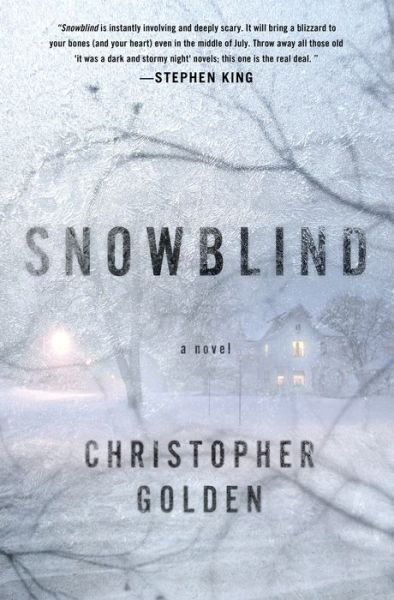
Snowblind is a thriller with a paranormal element, and I am finding it rather gripping. I’ll share the opening lines:

Ella Santos stood on the sidewalk with a cigarette in her hand, watching the snow fall and feeling more alone than she ever had in her life. The storm seemed to loom around her, holding its breath and waiting for her to go back inside.

Not ornate, but language is not the strength of this novel. The pacing and atmosphere will only ramp up from here.

This quotation comes from an uncorrected advance proof and is subject to change.

The Orchardist by Amanda Coplin (audio)

orchardistI read about this novel… somewhere… some time ago, and had it loaded on my iPod along with many others. And then Christine Byl (author of Dirt Work) praised it mightily on her facebook page, and it moved to the top of my list.

I will by sharing the plot outline as I vaguely understood it when I started this book: an old man manages an orchard in the hills, alone, as he has for many years, when a pregnant girl appears at the edge of a field and seems to need his help. He helps her.

That’s all I knew going in, and I’m a little tempted to leave it at that for you, too. I’ll tell you a little more, but I do want to leave a lot for you to discover on your own reading.

The old man, Talmadge, has indeed managed his expansive orchard property in Washington state for some 40 years, ever since he was 17 and his 16-year-old sister disappeared into the woods one day without warning. He has one friend from town, Caroline Middey, and a few friends among a group of Indian horse wranglers who seasonally stop by to help him pick his fruit; but he is mostly alone. And then the girls show up – two of them – and begin by stealing some apples from him on market day. He sets them out plates of food at his cabin and wanders off to let them eat; when he returns, they have cleaned the cabin of every scrap of food. They are both visibly pregnant, and look about 13 years old.

Talmadge does his best to care for these girls, who are consistently portrayed, early in the novel, with the imagery of wild animals. They stare, they watch him carefully and warily, they flinch away; they don’t talk. Their loyalty is towards each other; they have no more ability to trust Talmadge than a stray dog that’s been beaten. They are strongly identified with the wild. And somehow, in my early understanding of this book, I had thought that the story began and ended with the pregnant girl (or as it turned out, girls), but I was wrong. This novel spans a number of years – about 25 of them. Early on, it appears that the action is in essence Talmadge’s recovery of a family, lost when his mother died and his sister disappeared and now replaced by these young women and their children. But no, it’s not that simple. That does seem to be the momentum, the effort of at least some of the characters in question, but the world that Coplin portrays is too much the real world for anything to come out that easily, or for anyone’s dreams to be fulfilled so fully.

I enjoyed very much the simple depiction of central Washington state in the early 1900’s. Coplin, like her characters, doesn’t use flowery speech, but communicates nonetheless the gnarled beauty of a landscape of hills, canyons, and fruit trees, and the careful loving care Talmadge puts into the details of his orchard: it’s an art, really. Her writing evokes the feeling that this is another time, only a little related to our world today. It’s a beautifully written story, and beautifully read as well by Mark Bramhall.

The pace of this story is careful and measured. Talmadge is a contemplative man; seeing as how he’s past middle age and employed at growing trees, it should not surprise us that he takes his time in all things, which Coplin reflects in the rhythms of her writing. Bramhall follows suit in his reading, which is lovely and sedate. In the first, say, third of the book, the reader feels some tension about the two pregnant girls and their immediate fate: there are presumably labors and deliveries to come, at a schedule that cannot be denied, which gives the pace a little push. But in the middle third things slow considerably, and if one is going to get impatient with this book, this is when it will happen; I got a little impatient myself at the slower middle bit. Come to think of it, the story is sectioned off rather like a person’s life, which it resembles in several ways. In its youth, the plot leans forward into the future; in middle age it slows somewhat; and it regains a sense of urgency in its old age, when it feels its death coming – or the death of its characters. So, on pacing I have some mild criticisms, which can be alleviated by being a little patient because you enjoy the story so much, or by being a more patient reader than I am.

An overarching theme is clearly family, or relationship. The characters in this novel almost without exception lack family in the traditional sense of blood relatives; they make their own families outside those bonds – or fail to, and also relate strongly to the earth. There is a fine passage near the end about a young woman losing track of her physical self while doing physical work, feeling closer to the dirt than to her own body. In fact, women doing physical work is a thread throughout, which I also appreciated. (And now that I think of it, is another clear connection to Dirt Work.)

Overall, The Orchardist is a moving story, beautifully written, sad and exquisite and with some fine statements on human nature, and an underlying statement on our diminishing relationship with the land. Fine narration by Bramhall. Caveat for pacing, but that’s a matter of preference.


Rating: 7 Rhode Island Greenings.

A Little History of Literature by John Sutherland

An easily grasped primer on our finest wordsmiths, from Homer through the Bröntes, Proust and Kafka.

literature

John Sutherland (Lives of the Novelists) tackles an impressively broad subject in A Little History of Literature. Beginning with Homer and The Epic of Gilgamesh, Chaucer and Shakespeare, he hopes to instruct his reader in literature–what it is, where it’s been and where it might be headed.

Sutherland takes us from a childhood of “reading… under the blanket, with a torch, after lights out,” and the genesis of children’s literature, through the modern developments that brought us Fifty Shades of Grey and genre divisions. Even as he recounts the historical details behind Beowulf or the birth of the King James Bible, he skips forward to reference current trends, markets and buying habits, relating them to centuries-old forces. Major works from many centuries are joined by digressions into the history of printing, of copyright and of books themselves.

Sutherland presupposes a certain background among his readers: “much of what many of us know about science comes from reading science fiction,” for example, or his description of “many” or “most” children growing up reading at home. He also focuses, with few exceptions, on Western literature, although he does make a conscious effort to call attention to the role of women writers within that tradition. These issues aside, this slim book makes for a necessarily cursory review of literature’s greats–and the loving treatment by an expert, presented in easily understood terms, will please both novices and established readers looking to dip back into well-loved works.


This review originally ran in the November 19, 2013 issue of Shelf Awareness for Readers. To subscribe, click here, and you’ll receive two issues per week of book reviews and other bookish fun!


Rating: 6 historical trends.

Teaser Tuesdays: Careless People by Sarah Churchwell

Teaser Tuesdays is a weekly bookish meme, hosted by MizB of Should Be Reading.

carelesspeople

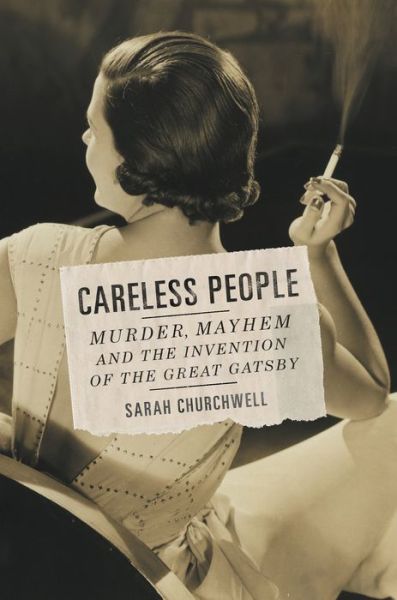
I am very excited about this book, which studies The Great Gatsby in terms of the world Fitzgerald inhabited when he wrote it, and in terms of the landmark year (literarily and otherwise) of 1922 in which he set this, his best-known work. I am trying not to say too much for now, but it is enjoyable. I’ll share a tidbit.

At the end of Chapter Six, Nick and Jay Gatsby walk out among the debris, a “desolate path” of fruit rinds and discarded party favors and crushed flowers, exposing the waste and decay. Gatsby admits that Daisy didn’t enjoy herself and Nick warns him against asking too much of her. “You can’t repeat the past,” he tells Gatsby. “Can’t repeat the past?” Gatsby cries incredulously. “Why of course you can!”

…which I think evokes the mood of The Great Gatsby quite well. Stay tuned.

This quotation comes from an uncorrected advance proof and is subject to change.

on staying home

Husband and I recently took a 4-day weekend off from work. Timing called for it: the rhythm of working hard and playing hard made it clear that we were due for a few days. Our original plan was to drive up to the Ouachita Forest in Arkansas to camp and ride mountain bikes on some cool trails that we’d raced on but never “just” ridden – the latter being a better way to have fun and see the scenery. But as the weekend approached, the weather forecasts turned against us, predicting cold (30’s at night, 50’s during the day) and rain (60% chance). These conditions don’t lend themselves to either camping or mountain biking. So we started examining other attractive options: Jamaica? Cozumel? West Texas?

However, in the final days leading up, as we considered options and I stressed out at work – I’d be leaving a big project and returning to a big project that I had just abandoned for several days! – I didn’t feel up to airport schedules or travel time. I just wanted to rest. We literally left it up to the last minute, and when we woke up on Thursday morning – without an alarm – we just… stayed.

Because Husband works for an airline, we get to do far more fun, exotic travel than our paychecks would indicate. It’s always an exciting ride! And I guess I’d gotten into the mindset that a vacation should involve going somewhere that would make our friends jealous or experiencing a different climate than the one we’d left behind. This year I’ve been all over Texas, twice each to Colorado, California, and Washington, and to Australia. And I felt a little sheepish at choosing to just stay home on this recent weekend.

But you know what? It was freakin’ amazing, and just what I needed. We did a bunch of great things: happy hour with our bike racing team; a walk in the park (midday on a weekday!) with the dogs; sushi; a bike ride on gravel and another on trails; camped out one night; visited with old friends; met some new family-friend twins for the first time; and cooked up a storm on Sunday. We also found a little dog that needed some help, and he spent a few days with us before going home to his family – but we’ll be seeing him again.

fancy new car-camping tent at one of my favorite spots

fancy new car-camping tent at one of my favorite spots


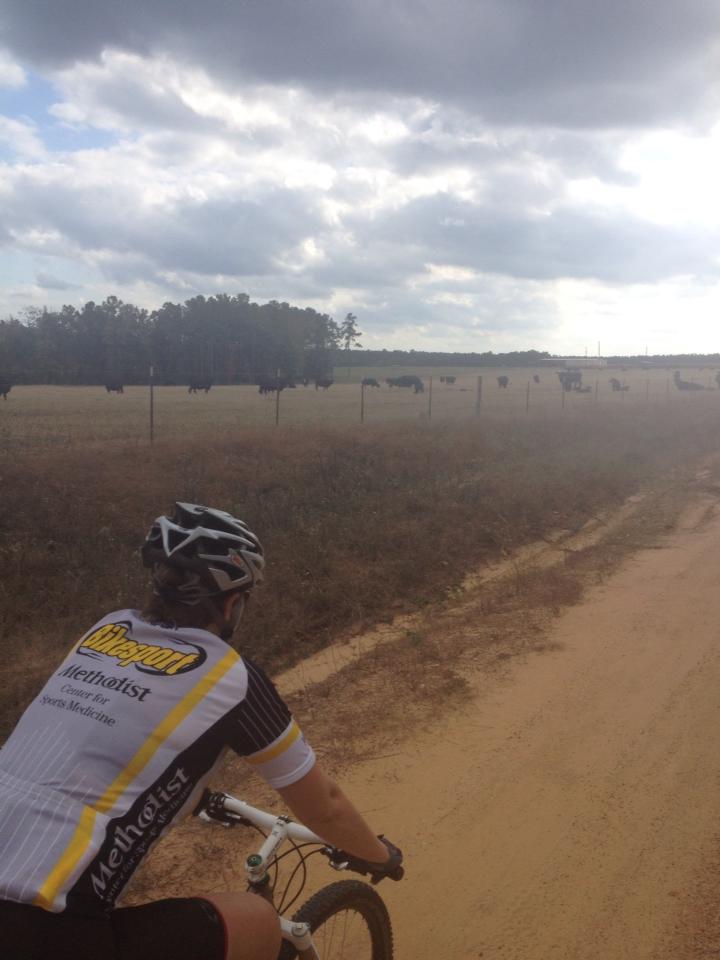
exploring some new-to-us unpaved roads

exploring some new-to-us unpaved roads


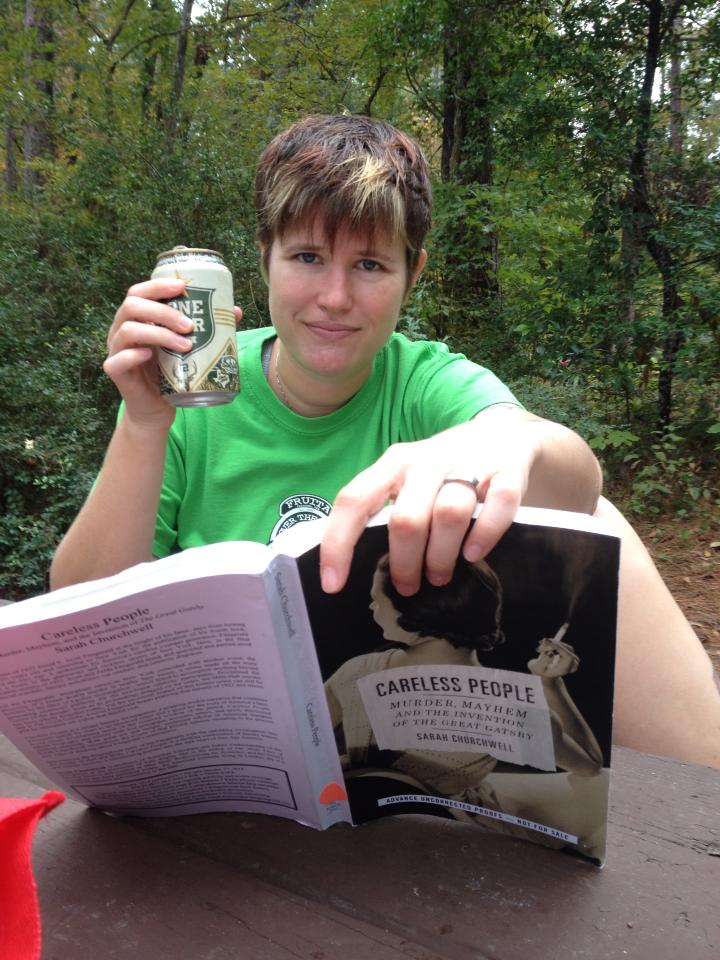
relaxing at the campground

relaxing at the campground


twins!

twins!


our visitor - we temporarily named him Ernesto (after guess who)

our visitor – we temporarily named him Ernesto (after guess who)

And the reading, you ask?? Well, naturally. I got a good ways into Careless People: Murder, Mayhem and the Invention of The Great Gatsby by Sarah Churchwell, about which I have been excited! and also began Snowblind by Christopher Golden, which grabbed me on the very first pages. And because we spent no time in my car, I took several days off from listening to Amanda Coplin’s The Orchardist, but was pleased to get back to it on Monday morning.

The weekend ended with a relatively calm – and therefore extremely rare – Sunday, and I got to do a few chores around the house and prep comfortably for the week to come. I learned a valuable lesson on this staycation: it’s not always necessary to go somewhere exciting or exotic to have a really pleasant, relaxing, fun, rejuvenating break from the daily grind. This will go down as one of the better vacations of the year. And now, I want to be careful to keep this lesson learned in my consciousness for future reference. Here’s to another day off – and staying home.

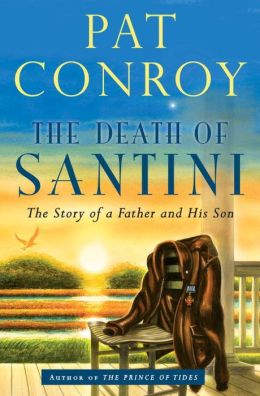
The Death of Santini by Pat Conroy

A remarkable ode to the real-life inspiration behind one of the most hated fathers of American literature and film.

deathsantini

With The Death of Santini, Pat Conroy returns to the autobiographical roots of one of his first successes, the 1976 novel The Great Santini. In this memoir, he recalls his father, a larger-than-life Marine hero who was an abusive monster to his family, from the perspective of decades passed. This is, he promises, the last story he’ll tell of his father–and of his mother, the beautiful false Southern belle.

Conroy’s style and ability to portray time and place are as mesmerizing and evocative as ever; the painful, neurotic (or, as he frequently says, “f-ed up”) family dynamics among the seven Conroy children and their mythically proportioned parents are peppered with humor. After his brother Tom’s suicide, for example, the family is at first shocked to realize that the funeral cards list the information for another brother, Tim, but then they razz him mercilessly. Another sibling notices the animosity their sister has for Conroy and reflects how hard it must be to hated so much. “No, I hate all you guys that much,” Tim says, to which brother Jim replies, “Shut up, Tim. You’re dead.”

As Conroy takes us through his convoluted relationship with a man he hated and feared, but eventually loved and felt close to (more or less), his gift for storytelling makes his story perfectly understandable and sympathetic. Don Conroy never ceased denying that he was falsely accused, but he softened over time and, it seems, in his dying years finally learned how to be a father.


This review originally ran in the November 5, 2013 issue of Shelf Awareness for Readers. To subscribe, click here, and you’ll receive two issues per week of book reviews and other bookish fun!


Rating: 8 poems.

The Drawing of the Three by Stephen King

drawing threeThis is book 2 in the Dark Tower series. I reviewed book 1, The Gunslinger, here (and a later installment, The Wind Through the Keyhole, here). And I have just ordered my copy of book 3.

At the end of The Gunslinger, Roland – the title character, the last gunslinger in his changing world – met up with the man in black (not Johnny Cash), and fell into a deep sleep; when he awoke, it seemed that a long time had passed, maybe years. This is the beginning of The Drawing of the Three; we’ve lost no time, except what Roland lost while he slept. As the man in black read in his tarot cards, the gunslinger will now encounter three individuals who will shape his future, and enable him – maybe – to reach the dark tower, his only goal.

He awakens on a beach with a strange creature approaching him – something like a giant lobster, with the ability to verbalize nonsensical questions, and with menacing claws. These figures he will call the lobstrosities (I love it), and they’ll be a constant threat. Roland does encounter the characters that the man in black predicted: the Prisoner, the Lady of Shadows, and Death (though Death will come under a different name). I’ll leave the plot alone at that.

This is a fantasy novel with all the captivating elements I mentioned when I reviewed The Gunslinger. It is perhaps less overtly a genre mashup; this struck me more as a whimsical mashup of worlds. Roland travels back and forth between his world, which shares characteristics with ours but is clearly other, and a New York City that the reader recognizes. This world-shifting fascinates me. I am reminded of a book I read as a kid called Eva, by Peter Dickinson. I was transfixed by the question of whether Eva lived before our time, or after our time; it could have gone either way. Similarly there was another “chapter book” called Enchantress from the Stars, by Sylvia Engdahl, around the same time that raised the same questions for me: is the enchantress from our planet? before or after our time? or another “star” altogether? Something along these same lines struck me with The Drawing of the Three.

What I think I’m trying to say here is that Stephen King, as always, excels at representing both realism, and fantasy or “other”, all at the same time. The backstory for each of the four characters in this book – Roland, the Prisoner, the Lady, and Death – is meticulous. King doesn’t give the Prisoner a life just as he relates to Roland, our star; he gives him a history, and it’s magnificent. As for plot tension, there’s nothing higher-stakes than the fate of the world, which is the epic conflict of this series.

If The Gunslinger was slightly less impressive than The Wind Through the Keyhole, this second in the series more than recovers. I am transfixed; I am riveted to Roland’s world, committed to his costars (I hope King doesn’t kill them off too quickly!), and even though I’ve read a few books since this one as I write this review, I can’t stop thinking about the Dark Tower series. I can’t get my hands on book 3, The Waste Lands, quickly enough. Stephen King continues his winning streak.


Rating: 7 lobstrosities.

The Hunted Whale by James McGuane

An evocative photographic study of historic whaling tools and techniques.

huntedwhale

“The hunt is one of man’s most ancient endeavors,” begins The Hunted Whale. James McGuane’s photographic exploration into the bygone practice of whaling transports the reader back in time, when whale oil lit the streetlights of the world’s major cities and lubricated the burgeoning textile industry. Whaling was a significant economy unto itself, employing countless young men who were convinced to ship out for years at a time by employment agents known as “land sharks.” It was a trade performed by hand, and McGuane examines its many aspects: hunt, ship, whaleboat, crew, whale, tools and more.

McGuane’s text is accompanied by more than 200 fine, detailed color photographs depicting whaling artifacts, including several examples of scrimshaw–the art of painted, engraved or carved whalebone or teeth. Photographs of twisted and mangled–but intact–harpoons give visceral evidence of the whale’s power to resist human efforts, and McGuane details the methods in practice. Also showcased are innovative technologies, such as toggled harpoons or “irons.”

Selections from Logbook for Grace, a diary kept by naturalist Robert Cushman Murphy aboard the whaleship Daisy in 1912, add a valuable firsthand perspective and bring McGuane’s subject to life. With all its salty flavor, The Hunted Whale is an obvious choice for fans of Moby-Dick, but history or naval buffs and fans of pre-mechanized times will be equally charmed by this detailed pictorial view of the ancient industry of whaling.


This review originally ran in the November 5, 2013 issue of Shelf Awareness for Readers. To subscribe, click here, and you’ll receive two issues per week of book reviews and other bookish fun!


Rating: 5 scrimshanders.