movie: Capote (2005)

I was so pleased when Husband expressed an interest in watching Capote with me the other night. It’s rare that we agree so easily! And I have some Capote readings coming up – The Early Stories of Truman Capote for a Shelf Awareness review, and Breakfast at Tiffany’s for a beer-drinking book club; and I do like a little immersion when I get to know a writer. I recall being deeply impressed by In Cold Blood, but I hardly remember Other Voices, Other Rooms at all, so there’s that.

capoteCapote‘s storyline is concerned with the writing of In Cold Blood, with no examination of Capote outside that timeline. Opportunities are missed there, of course, as the man had a fascinating life in general; but as a fan of In Cold Blood I can’t complain. Any work of art, literature, or film has to choose its scope. In this case we are glad to get to meet Nelle Harper Lee (played by Catherine Keener), as she assisted Capote with his research in Kansas: I read somewhere recently that she was an ideal helper there as her soft, Southern femaleness alarmed the Kansans a little less than Capote’s flamboyant New Yorkness (of Southern roots, yes, but still). The late Philip Seymour Hoffman stars as Capote and does as outstanding a job as I had heard (for which he won an Academy Award for Best Actor, among others).

The Clutter family has just been killed in rural Kansas. Capote reads about it in the New York Times, and immediately feels that this is a story he needs to write; he takes a train down to Kansas from New York with Nelle, his childhood friend. In their distinct styles – Capote pushier, Nelle more quietly sympathetic – they interview the locals and get the feel for things. Then two suspects are arrested, Dick Hickox and Perry Smith. When Capote first lays eyes on Perry, he changes his plans from an article to a full-length book. “There’s just something about him, he’s so lonely” (I paraphrase wildly). The film emphasizes the connection between Capote and Smith, which reads here, on screen, as somewhere between a strong psychological bond and infatuation. Husband struggled with Capote’s character as he transitions from apparently having a crush on Perry, and getting him a new lawyer to help him out in an appeal (and, as he later acknowledges, help himself out in terms of having a book to research)… to exploiting Perry for his story and being sorry that the man won’t die quickly enough. This makes Capote a less sympathetic character: absolutely true. But is it an accurate depiction of the man? I think quite possibly yes, so don’t hold it against the filmmakers. Finding the protagonist likable is not, I think, a requisite for art.

I was particularly intrigued by and suspicious of the implication that the epigraph for Capote’s final, unfinished work Answered Prayers was a comment on his experience with Perry Smith and In Cold Blood. It was a convenient epilogue to this film, certainly, but I think it’s a bit complex an idea to just throw out with the finishing credits. I’d enjoy exploring Capote’s life and work with this idea in mind, though. Whatever else you might say about him, I think we have to agree that he’s an intriguing guy. My favorite biographical subjects are always those that raise complicated reactions in us, and Capote fits that bill.

Capote is an arty, well-produced and interesting film that mostly follows the true and also interesting story of Truman Capote and In Cold Blood. Hoffman’s acting is very fine: his expression of Capote’s voice, mannerisms and prima donna behaviors are often a little grating but I think that was true of the original, and he does a good job with the character switching Capote used for different scenarios. I enjoyed Capote and Capote both very much.


Rating: 7 cigarettes.

on Rick Bragg

Sometimes it happens this way. I decide I need to read a book – not put it on the TBR shelf to grow musty for two to five years to never, but really read it – and (as in this case) I put myself on the local library’s hold list for it. It comes my turn, and I go to the library and pick it up off a special shelf where it’s been filed under my name. I take it home, and I go back to reading the books I’ve been assigned, for work, for a living. I read another 6, 8, 10 books; some of them are really good, and I get involved and distracted. I interview a few authors, which is often, not always, engrossing. I go online to renew this book that I haven’t made time for yet, and find that – of course – someone else is on the hold list, behind me in line. I have to turn it in in four days. If you have forgotten this about me, I am a librarian. I’m no longer employed as such, but that blood pumps through me still.

So I put down the book I had just begun reading, for work, with a deadline. That book, by the way, offered an epigraph by the author of this book. And I pick up All Over But the Shoutin’, by Rick Bragg.

Bragg blew my mind with My Southern Journey (which will publish in two weeks or so; look out for my review then), and although I’d heard his name before, I never knew that he would be a writer to reach into me in such a way, to pull on me and make me nostalgic for a place that is not my home: foreign language words like fernweh, sehnsucht, saudade seem to touch on it. Bragg’s travels capture me; how will I ever go back to that other book, let alone my life, when this is done?

The Last September by Nina de Gramont

As a literary novel of both suspense and emotion, this flashback-filled murder mystery has broad appeal.

last september

The Last September, by Nina de Gramont, portrays an immediately gripping world of secrets, trauma, and conflicting loyalties. Spanning mental illness, the meaning of family, and the lengths we go to for love, this novel begs to be read in a single sitting.

…Click here to read the full review.


This review was published on August 27, 2015 by ForeWord Reviews.

IMG_4538


My rating: 8 tiny scribbles.

Teaser Tuesdays: The Annihilation of Nature by Ceballos, Ehrlich and Ehrlich

Teaser Tuesdays is a weekly bookish meme, hosted by MizB of Should Be Reading.

Look out for a forthcoming Maximum Shelf issue on this beautiful coffee-table book about Earth’s sixth mass extinction event, which is human-caused and going on now.
annihilation of nature

The Tasmanian tiger, with its remarkable coloration and tiger-like stripes, was the largest predator marsupial. Females were unique in that their pouch opened to the rear and, interestingly, the males also had a pouch into which they could withdraw their scrotum. The last captive individual died in 1936.

If that is not fascinating stuff about this species, I don’t know what. And the tragedy of losing such singularities cannot be understated – and this book is full of it, I’m afraid.

This quotation comes from an uncorrected advance proof and is subject to change.

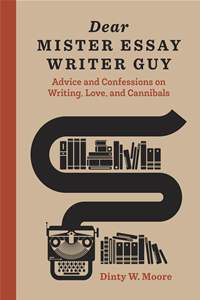
Dear Mister Essay Writer Guy: Advice and Confessions on Writing, Love, and Cannibals by Dinty W. Moore

Finely crafted short essays masquerading as self-effacing jokes about writers and writing, in q&a form.

dear mister essay writer guy

Dinty W. Moore (Between Panic and Desire), the editor of Brevity, solicited respected contemporary essayists for questions regarding the form, so he could answer them in Dear Mister Essay Writer Guy: Advice and Confessions on Writing, Love, and Cannibals. An essay riffing on the question at hand accompanies each q&a. The resulting collection of self-deprecating humor includes bits of writing advice as a bonus.

Cheryl Strayed has concerns about her predilection for the em dash: Moore assures her that “em dashes can replace commas, semicolons, colons, the large intestine, and parentheses.” Brenda Miller worries that Facebook “is like one big communal personal essay”; Moore answers with a selection of his status updates over a period of months, which are as sage and instructive as they are hilarious. Roxane Gay wonders about the value of writers writing about writing. Other seekers of wisdom include Judith Kitchen, Phillip Lopate, Brian Doyle and Lee Gutkind. Moore makes room to share a “found essay” left on his voicemail by Mike the Tree Guy, and to list the side effects of memoir, including “nausea, sleep problems, constipation, gas, and swelling of the navel.”

Moore is rarely serious and keeps his tongue in his cheek throughout, but the result is enlightening as well as entertaining. With fewer than 200 pages, Dear Mister Essay Writer Guy is a quick and enjoyable read, to be taken in pieces as small as the reader prefers. Its witty, modest tone belies the artistry of the essays contained, which are exemplars of the short form.


This review originally ran as a *starred review* in the August 28, 2015 issue of Shelf Awareness for Readers. To subscribe, click here, and you’ll receive two issues per week of book reviews and other bookish fun!


Rating: 7 polar bears, naturally.

book beginnings on Friday: One Out of Two by Daniel Sada, trans. by Katherine Silver

Thanks to Rose City Reader for hosting this meme. To participate, share the first line or two of the book you are currently reading and, if you feel so moved, let us know what your first impressions were based on that first line.

one out of two

This is a very slim (100-page) novel in translation from the Spanish, and I am excited and charmed by its first lines.

Now, how to say it? One out of two, or two in one, or what? The Gamal sisters were identical. To say, as people do, “They were like two peas in a pod,” the same age, the same height, and wearing, by choice, the same hairdo.

My ARC offers a blurb on the front cover from Robert Bolaño: “Of my generation I most admire Daniel Sada, whose writing project seems to me the most daring.” Sada died in 2011.

This quotation comes from an uncorrected advance proof and is subject to change.

Last Ragged Breath by Julia Keller

last ragged breathThis is the fourth novel in Julia Keller’s detective series starring Bell Elkins, a lawyer with a high-powered degree who has returned to small-town West Virginia to work as a prosecutor there. I tried to read (or actually, listen to) the first, A Killing in the Hills, and found the characters a bit flat. In a nutshell, Last Ragged Breath was very enjoyable, but did not entirely solve that problem.

The Buffalo Creek Flood of 1972 is a true historical event in West Virginia history, in which a coal mining company’s irresponsibility and disregard for human life led to more than 100 deaths. In this novel, a childhood survivor of that tragedy, Royce Dillard, is now a grown man, a recluse living alone in the woods with a number of rescue dogs. A tourism development company looking to build a resort in the nearby hills has been bothering him to sell a small parcel of land; when the chief botherer turns up murdered on Royce’s land, he is arrested for the crime. Although the forensic evidence is overwhelming, something about this case doesn’t sit right with prosecutor Bell Elkins. Meanwhile, she struggles with sideplots: her best friend the sheriff has just retired, and she’s not done being angry and grieved about it; she is learning to work with his replacement; and a potential love interest offers distractions.

Bell Elkins is noted as a well-developed character by many, inspiring complimentary blurbs from the likes of Michael Connelly. Sadly, I continued to feel that a few aspects of her personality felt predictable. The teenaged daughter who bothered me so much in the first novel is now mostly removed, although I recognized the same awkward dialog between the two of them when she reappeared. Other characters (like the new sheriff, and the owner of the resort-building company) also felt just a bit too typed from time to time, and scenes sometimes get a bit overwrought. This is my only complaint with the book, though, and it is a minor one (and perhaps my sense of it was heightened by that earlier experience). Overall, the story is compelling, and carries significant momentum: I was happy to spend a day and a half doing almost nothing other than finishing the book. Its comments on corporate responsibility and the complexities of coal mining’s regional legacy were well done. The people of Acker’s Gap mostly recognize that coal is dirty, and mining is dirty work; but they also need work, and see that there’s nothing to fill the hole it would leave. Nothing is simple.

An intricate plot, neatly paced suspense, and yes, likeable (if not perfectly realized) characters make for not only an enjoyable and entertaining read, but one accompanied by commentary on our real world. I’ve made my peace with the Bell Elkins series. And stay tuned for my upcoming interview with the very gracious Julia Keller.


Rating: 6 kibbles.

The Fish Ladder: A Journey Upstream by Katharine Norbury

A pensive, meandering memoir of searching–for the source of both a river and the author’s life.

fish ladder

In The Fish Ladder: A Journey Upstream, a memoir of two concurrent paths, Katharine Norbury aims to find a river’s source and to discover her own. She is mourning a recent miscarriage and the loss of her father, taking solace with her mother and her daughter, Evie. Norbury was adopted, and all she knows of the woman who abandoned her at a convent is a name. Neil M. Gunn’s novel The Well at the World’s End inspires her to walk a waterway from the sea to the source, as does Gunn’s protagonist. But Norbury’s journey is clearly also metaphorical, a search for herself and her roots.

The route she chooses is not specific: with Evie, she walks parts of several waterways, eventually setting more precise goals along the way, and reaching for Gunn’s work when her plans falter. Her expedition to find her biological family proves to be more challenging, intersecting her pathway upriver, from the location she has discovered is her birthplace.

Norbury’s seeking is set in Britain, and The Fish Ladder doubles as an amateur naturalist study of the country’s flora and fauna. She shares her insecurities and questions alongside Celtic folk tales about salmon traveling upriver to the places of their birth. Her story wanders, but in the end makes emotional and profound ventures into landscape, the importance of place and the very real connections between physical and interior voyages.


This review originally ran in the August 25, 2015 issue of Shelf Awareness for Readers. To subscribe, click here, and you’ll receive two issues per week of book reviews and other bookish fun!


Rating: 5 pieces of chocolate.

Teaser Tuesdays: The Living by Annie Dillard

Teaser Tuesdays is a weekly bookish meme, hosted by MizB of Should Be Reading.

the living

As is the new norm with audiobooks, I am working my way through Annie Dillard’s novel about my new place of residence very slowly. Set in the region including and surrounding what is now the town of Bellingham, The Living is about the early days of settlement. It is a large and sweeping tale that spans generations, which will give me some challenge when it is time to write about the whole, since I’m taking so long to listen to it. But no worries. It remains an engaging story, and it’s always stimulating to read about a place that you know. Today’s teaser involves a settler to Washington state traveling back east for a visit.

Minta considered the Rockies inferior to the Cascades and dull, for they lacked form, height, and glaciers. The volcanic cones she loved, Mount Baker and Mount Rainer, had enormous forests at their skirts, and waterfalls that drained the meadows above the forests, and precipitous snowfields and glaciers that rose above the clouds.

Indeed. As I am a new resident of Cascadia, this is something to think about in a country enamored of the Rockies.

Thanks for stopping by today. I’ll get around to reviewing this novel one of these days…

Creative Nonfiction, issue 56: Waiting (summer 2015)

You can read my review of the previous issue here.

waiting“True stories, well told.” In this issue, they are stories concerned with waiting, whatever that might mean to the writer. (A few craft-related essays are also included.) Unsurprisingly, I am very impressed with the stories CNF chose to publish.

There’s not much not to love here, beginning with Editor Lee Gutkind’s opening piece about all the waiting that goes on in his and my line of work; Dinty W. Moore’s ponderings on the genre name “creative nonfiction” (I am an unrepentant Moore fan); and the essay “Waiting and Wading through Story” by Maggie Messitt, about immersion research and storytelling and the lessons she’s learned from other writers. But I was really blown away by this issue’s winning essay: I agree wholeheartedly with their choice of Joe Fassler’s “Wait Times” as winner of the Best Essay Prize. If you read nothing else in this magazine, please go read this story. It is heartrending and thought-provoking and disturbing, and I’ve thought about it at least daily for more than a week since reading it. It’s about a medical emergency experienced by his wife.

I found Judith Kitchen’s “Any Given Day” harder to love, and I’m sorry to say that, because I’ve heard such wonderful things about her (and have her Half in Shade waiting on my TBR shelf), not least from Gutkind in his opening piece. She died last fall of cancer, and this piece is in part about that ending. But the form of it – loose, amorphous, wandering – didn’t quite work for me. Just a personal reaction; perhaps you’ll find it mindblowing, and I’d love to hear if you do. Certainly she is a fine artist. But this piece didn’t work for me quite so well.

“Lost and Found” by Josephine Fitzpatrick was more a straightforward narrative piece, and call me simple-minded but that struck me more forcefully. Fitzpatrick’s brother went missing in Vietnam when they were both teenagers, and this is the story of waiting for him to come home or for his story to be somehow resolved, for many decades. It is of course touching and thoughtful and, I think, potentially helpful for others suffering from “ambiguous loss” (see also Sonya Lea’s outstanding Wondering Who You Are). Mylène Dressler’s “End Over End”, about coming to surfing as a mature adult and finding the stoke, finds a good balance between cerebral wanderings and narrative.

Following essays and stories about waiting, Sangamithra Iyer’s “The Story Behind the Story,” about searching for her grandfather’s history as civil servant turned activist in Burma, is a touching and instructive piece, not least in its realization that “not getting the story was part of my story, too… the loss of memories, the erasure of our histories, is part of the narrative of many of us children of the diaspora.” I love this concept.

Rachel Beanland’s “Required Reading” was another revelation, about handling the loss of her father by reading numerous memoirs of others’ losses. This strategy was deemed strange or not shared by others but made sense to her, helped her, and this makes sense to me, too. Look, I just said something similar, above, about “Lost and Found” and Wondering Who You Are. This is a short but powerful essay and it contains lots of titles and snippet-quotations that I’m marking for later.

I always look forward with intrigued anticipation to “Pushing the Boundaries,” the section of each issue that includes an “experiment in nonfiction.” This time it is Nathan Elliot’s “An Honest Application,” a response to the part of an immigration application that asks him to justify and place a value on the marriage that hopes to qualify him for permanent Canadian residence. His actual written response is short and simple, but it is accompanied by lengthy footnotes that include all the emotion and indignation he couldn’t put in his application. It is genius – I loved it – and I love as well the story of love that he has to tell.

There were others, but these are my favorites. You can view these pieces and more, or buy the whole issue (do that!) here.