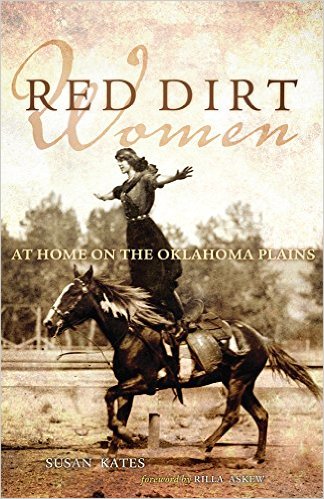
book beginnings on Friday: Red Dirt Women: At Home on the Oklahoma Plains by Susan Kates

Thanks to Rose City Reader for hosting this meme. To participate, share the first line or two of the book you are currently reading and, if you feel so moved, let us know what your first impressions were based on that first line.

red dirt women

My first review for Concho River Review is of this slim collection of stories about Oklahoma’s diverse and powerful women. It is a fine and auspicious beginning book, and in that spirit, today’s book beginning:

In her chronicle of life in Kenya – one of the great grasslands of the world – Isak Dinesen explains that it is impossible to live any place for a time and remain unaltered by one’s surroundings. “It does not even make much difference,” she says, “whether you have more good or bad things to say of it, it draws your mind to it, by a mental law of gravitation.”

You know I am a little obsessed by a sense of place, and that is very much at the heart of this collection, as this Ohio native comes to feel at home on Oklahoma’s dusty plains. Good stuff. I am glad to be able to recommend this book to you. Happy weekend, friends.

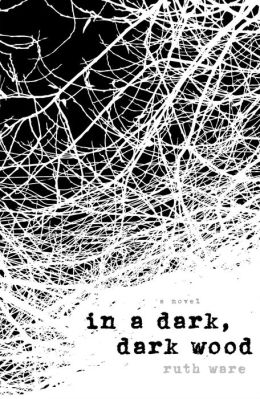
In a Dark, Dark Wood by Ruth Ware

An enchantingly unsettling thriller with mysterious characters and a classically spooky setting.

dark dark wood

Ruth Ware’s chilling, atmospheric thriller In a Dark, Dark Wood is her first novel and the inaugural title published by Simon & Schuster’s new imprint, Scout Press.

Nora is a writer of crime novels, a loner who buys her groceries online and appreciates her solitude. But when she gets an invitation to a hen party being thrown for a woman she hasn’t spoken to in 10 years, her carefully structured life is disrupted. Against her instincts, she agrees to attend, and the party’s setting serves as a disturbing beginning: an isolated castle of steel and glass set deep in the English woods, populated for the weekend by nervous guests, each apparently with secrets to keep.

In the novel’s disjointed timeline, Nora later wakes up in the hospital with fractured memories of being covered in blood, running through dark woods with a sense of urgency; the police are waiting outside her door. What happened to her? Or… what has she done? As the narrative switches between Nora’s confusion in her hospital bed and the events leading up to her hospitalization, she and the reader together begin to wonder: Can she really not remember, or does she not want to? Both timelines accelerate with building suspense toward the big reveal, and eventually Nora will have to go back and recall events from her past that she’d rather leave forgotten.

In a Dark, Dark Wood is peopled by mysterious characters set to a classically spooky backdrop and culminating in blood, broken glass and memory loss. Readers who appreciate being unnerved will be charmed.


This review originally ran in the August 14, 2015 issue of Shelf Awareness for Readers. To subscribe, click here, and you’ll receive two issues per week of book reviews and other bookish fun!
<hr /

Rating: 7 tequila shots.

A Clue to the Exit by Edward St. Aubyn

Edward St. Aubyn’s favorite of his own novels surveys characters from his other work, in a clever, sophisticated consideration of death and consciousness.

clue to the exit

Edward St. Aubyn (Mother’s Milk) calls A Clue to the Exit his favorite of his own novels. Originally published in 2000, it’s now being reissued by Picador.

Charlie is a hack screenwriter who’s just been told he has six months to live. (He takes issue with the idea that his doctor has “given” him six months, as if it were a gift he should be grateful for.) He starts driving more carefully, even as he considers suicide, experimenting with the proper response to this news. He contacts his ex-wife about seeing his daughter; he sells his house and takes half his riches to Monte Carlo to lose it as quickly as possible. And, suddenly inspired, he sets out to write a serious novel–much to his agent’s exasperation.

In Monte Carlo, he meets a beautiful stranger, who he imagines might help him with his burden of mortality. Angelique is a gambling addict, and in her company Charlie feels an equal craving for his own writing. They have a deal: she gambles away his fortune, and he writes in the casino as he watches her. His novel, On the Train, tackles the big question of consciousness, or nothing less than the meaning of life, and Charlie’s autobiographical protagonist is none other than Patrick Melrose, St. Aubyn’s most famous character, who is joined by others that St. Aubyn’s fans will recognize from previous work. The characters of the novel within the novel argue philosophy on a train stuck in Didcot, as Charlie finds himself stuck as well between games of chance and the need to map his own final months.

St. Aubyn’s craft is on full display with this inward-looking work of simultaneous parody and earnestness. Nearly every line is quotable, a small but shining victory of prose. On the Train visits with Proust and Buddha, while “a clue to the exit” references Henry James on “the human maze,” but alongside serious, even wearying considerations, Charlie’s story is often very funny and self-referential. A third-person narrative “is so much more personal than a first-person narrative, which reveals too flagrantly the imposture of the personality it depends on,” writes St. Aubyn in Charlie’s voice: A Clue to the Exit is told in first-person, while On the Train is in the third. This feedback loop is a central device. “Feeling too upset to write, I made the brave decision to write about feeling too upset.” A parade of absurd characters and dinner parties accompanies Charlie’s, and his character Patrick’s, contemplations of death. As Charlie’s six months run out, St. Aubyn continues to surprise his reader in the final pages.

A refined and stylish novel of cynicism and the question of death, A Clue to the Exit is a perfect sample of St. Aubyn’s craft.


This review originally ran in the August 13, 2015 issue of Shelf Awareness for the Book Trade. To subscribe, click here.


Rating: 6 chips.

Teaser Tuesdays: My Life on the Road by Gloria Steinem

Teaser Tuesdays is a weekly bookish meme, hosted by MizB of Should Be Reading.

my life on the road

I was intimidated to read this book by Steinem – my first of hers – because she is such an accomplished, impressive woman. But I shouldn’t have been. She is warm and approachable on the page. Her story is not only of interest and worth reading (which of course I knew going in), but also well and simply told.

The book is a series of stories, and for today’s teaser, I’ve chosen one very short one for you.

On another campus, some women tell me about men who leave their own underwear on the floor and don’t feel compelled to pick it up – or even notice what they’ve done. By now, the shouts and laughter have become quite rowdy, and I’ve begun to worry about a silent young Japanese woman in the front row. Perhaps we are offending her.

As if summoned by my thought, she stands and turns to face all five hundred or so women. “When my husband leaves his underwear on the floor,” she says quietly, “I find it useful to nail it to the floor.”

Amid laughter and cheers, this shy young woman seems surprised to find herself laughing, too. She tells the group this is the first time she has ever said anything in public.

This quotation comes from an uncorrected advance proof and is subject to change.

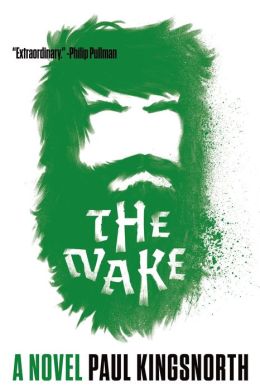
The Wake by Paul Kingsnorth

This compelling novel of resistance to the Norman Invasion, told in a hybrid of Old English, will satisfy motivated readers of history, ecology and the persistent pull of the old gods.

wake

The Wake is a singular debut novel by Paul Kingsnorth (One No, Many Yeses; Real England), set in England immediately following the Norman invasion of 1066. Its first-person narrator is a landowner named Buccmaster, who has lost everything to the attack: his family, his home, his land and his privilege. He takes to the fens and woods, with revenge in his heart and an intention to drive the French from his land and all of England. There he becomes one of the guerrilla fighters known as green men, whose chapter in history is little known.

What makes this powerful story distinctive is Kingsnorth’s decision to write the story in what he calls a “shadow tongue,” an Old English hybrid of the author’s invention, made slightly more understandable to the modern reader. This choice presents an undeniable challenge to the reader, and requires substantial extra effort to pursue the story. (Hint: try reading aloud, to hear cognates and the rhythm of the speech). But Kingsnorth defends his strategy: it evocatively renders Buccmaster’s voice, and brings to an already gripping saga a layer of new meaning, in that the reader has to participate in creating that meaning through interpreting unfamiliar words. A partial glossary deciphers some words, but many are left for the reader to define via context clues and, yes, guessing. Some readers will be turned away. But those who persist will find the language easier to follow after 20-40 pages, and will be rewarded by Buccmaster’s riveting narrative.

Buccmaster is a follower of the eald (old) gods, as was his grandfather, the gods of wilde places on the earth and its wihts (creatures). His father was not. “I will not spec of my father,” he says, but the story of his father is only one of the details that this unreliable narrator leaves out. As Buccmaster travels overland on foot, gathering companions who also wish to drive out the French, he journeys as well into the myths and traditions of his elders, and envisions a grand role for himself. The fate of his band of green men is as tenuous as that of England, as their leader struggles with reality.

The Wake is an ambitious novel in its themes and scope, in addition to its unusual linguistic decisions. As the English folc in his story become disconnected from their land, they lose their freedom: “if the frenc cums and tacs this land and gifs these treows [trees] sum frenc name they will not be the same treows no mor.” As an impassioned defense of the natural world and people’s responsibilities toward it, the novel acts as a metaphor for modern times. Buccmaster’s personal narrative is a lesson in pride and its dangers, a glimpse of another culture in its own language. Kingsnorth’s captivating first novel is thought provoking, multi-faceted and intriguingly rendered.


This review originally ran in the August 11, 2015 issue of Shelf Awareness for the Book Trade. To subscribe, click here.


Rating: 8 fugols.

book beginnings on Friday: We Were Brothers by Barry Moser

Thanks to Rose City Reader for hosting this meme. To participate, share the first line or two of the book you are currently reading and, if you feel so moved, let us know what your first impressions were based on that first line.

we were brothers

A thoughtful memoir with beautiful illustrations by the author begins with this paragraph.

I have a family photogrpah that was taken on a Christmas Eve sometime in the early 1960’s. We are in my aunt’s living room. Two generations pose in front of a fireplace that, as far as I know, never entertained an actual fire. Above the garlanded mantel hangs a portrait of my aunt’s late husband that I painted when I was in high school. The people in the picture are my mother’s people: her husband, sisters, and brother are there, as well as my brother and me. Most of us lived cheek to jowl on a short stretch of Chattanooga country road.

Idyllic? Don’t get too comfortable. This is the story of a troubled brotherhood; but it is told lovingly, if sadly. Stay tuned.

This quotation comes from an uncorrected advance proof and is subject to change.

the TBR shelves: a lifestyle

Friends, I am a full-time reader-writer these days, having moved cross-country and left my day job behind. I read & review books & do author interviews for a living, and pursue my own, creative writing where I can. Let me repeat: I read books for a living.

I’ve written about this before, but I say again, I read for lots of reasons. I read for work, obviously, and am happy that what I get to read for work is mostly stuff I’m really interested in. But I also want to read all the good creative nonfiction and memoir out there, to train myself on it; I want to read all the good writing about sense of place, and people’s relationship to place; I want to catch up on everything ever written by Hemingway, Abbey, Maclean, and Dillard; I want to read more Stegner and Snyder. For fun I’d definitely spend more time with King and Burke. I want to read all the books on this and other lists. There are always more classics on my wish list – Steinbeck, Fitzgerald, Nabokov. I’m sure I’m forgetting all sorts of things, too.

Unsurprisingly, then, I’ve also got a couple of shelves devoted to books I already own and hope to someday find time for. Sometimes I weed these. When we moved from Houston to Bellingham, I was pretty ruthless; but I still moved probably 50 or 60 “to-be-read” (or TBR) books. Where do they come from?? I was just wondering this, so here’s a blog post.

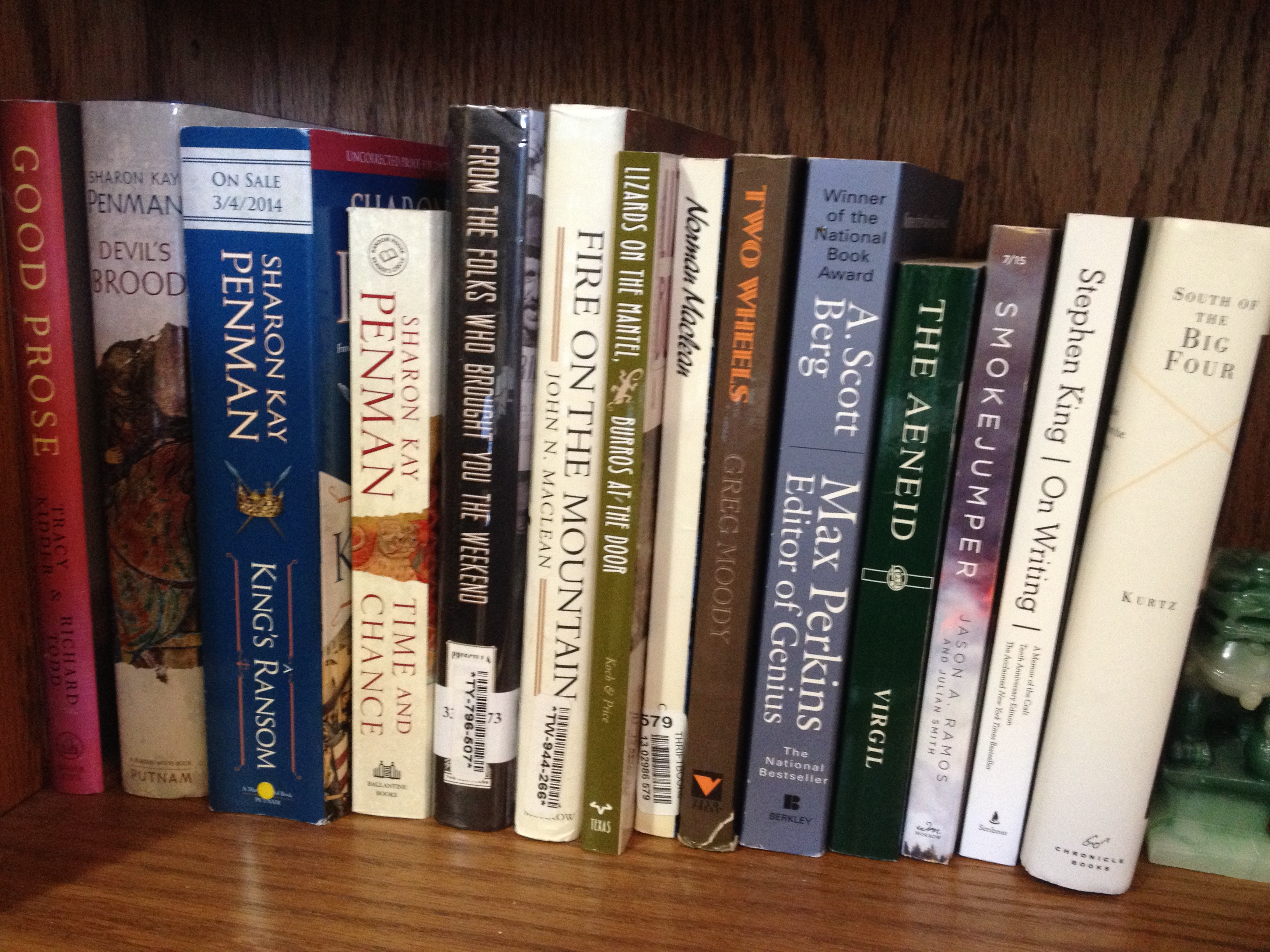
My TBR shelves, in pictures (click to enlarge):
IMG_6176
IMG_6177

IMG_6178

IMG_6179

IMG_6181
These are recommendations (and gifts – Fil) from friends, on cycling and nature and Texas and Mexico; biographies of Melvil Dewey, Howard Hughes, and Zelda Fitgerald (if there’s a theme there, it might be mental illness); nature writing, much of it recommended by other nature writers; a hefty pile of Sharon Kay Penman; and several galleys I missed the chance to review for Shelf Awareness, but still hope to read (a smokejumper’s memoir; a readalike for Gus Lee’s Honor and Duty). Books about writing, or books that showcase the kind of writing I aspire to. There’s a different edition of A Sand County Almanac, from my dad. They’ve come from the discards pile at libraries I’ve worked at, as gifts, as galleys from publishers, and more than I like to admit I’ve bought and paid for, and may never find time to read. I’ve read 80-something books this year, and 18 of them were purely my choice, unassigned. I already quit my day job. What gives?

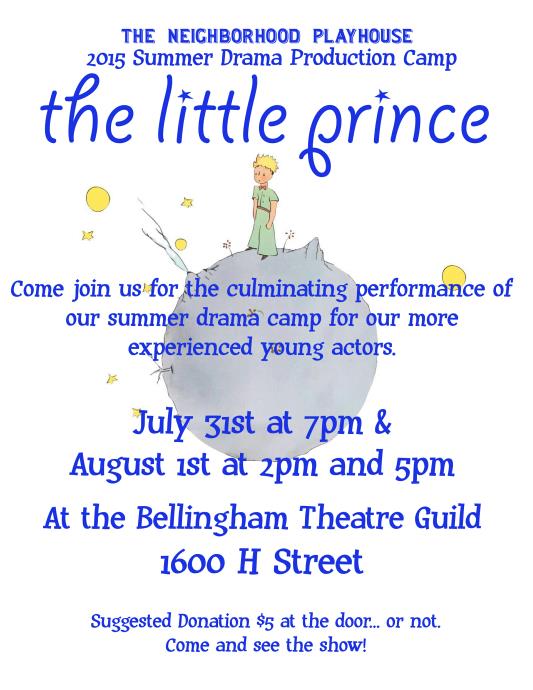
The Neighborhood Playhouse presents The Little Prince

little princeThe Little Prince is a magical tale, and I was immediately sold on the idea of a local production, performed by young people no less. The Neighborhood Playhouse Summer Drama Camp culminated in this production after less than two weeks; the ability of these teens to stand up with confidence and memorized lines after such brief prep is impressive enough, even if the play hadn’t been beautifully and feelingly done, which it was. Wow.

This was a musical production, and as I said about The Drowsy Chaperone, there were moments of less than perfect polish: these actors (whether youth or adult) are not professionals. But that’s okay! In fact, like when I go to watch college or adult-league sports, it’s part of the charm: I can see that these are “just” real people, like me, pursuing a passion. And I’m not criticizing. The level of performance here was very high – just not Broadway.

There were several very strong singers up there, especially the young lady who played the flower, but they all played their parts well. I felt the magic of St. Exupery’s original work, as these young actors communicated all the emotion of the pilot – his frustration, his regrets – and the prince, whose innocence is part of his appeal. I felt happy and lucky to be in the small audience. Thank you, Neighborhood Playhouse, and to the kids: bravo.


Rating: 7 snakebites.

Teaser Tuesdays: Mary McGrory: The First Queen of Journalism by John Norris

Teaser Tuesdays is a weekly bookish meme, hosted by MizB of Should Be Reading.

mary mcgrory

I am reading a delightful biography of a groundbreaking newspaperwoman, who wrote book reviews (ahem!) before her political coverage began; she would cover 12 political campaigns (and everything in between) in her lengthy and influential career. I am reminded somewhat of Newspaper Titan. But John Norris can tell it better than I can, of course.

In many ways, Mary was as much an anolmaly at the end of her career as she was at its beginning. When she broke through, during the Army-McCarthy hearings, she was the lone female reporter in the room. On the campaign trail, she was one woman surrounded by a hundred men. By the end of her career, she was working in an environment where there were more and more women, most female reporters were married, and employers like the Post provided maternity leave and benefits. To this new generation of women, Mary was a throwback: the woman who took on McCarthy and Nixon; the pioneer who was forced to decide between career and love; a beloved relic from an earlier era who drank with the Kennedys and crafted handwritten thank-you notes. Mary had gone an entire career without ever being the norm.

Stay tuned for my review of the book, followed by my interview with the author.

This quotation comes from an uncorrected advance proof and is subject to change.

Wondering Who You Are by Sonya Lea

A woman’s thoughtful account of life after her husband’s traumatic brain injury.

wondering

When Sonya Lea’s husband, Richard, had surgery to treat his rare appendiceal cancer, they knew there were risks. But they had not considered that Richard would wake up with no memory of his 23 years of marriage and two young adult children, or of his own personality and past. Sonya considers their shared history and difficult recovery in her memoir, Wondering Who You Are.

The details of Richard’s medical story are inarguably painful but often sweet. Sonya’s changed husband is empathetic, guileless and highly motivated to learn. Alternating chapters cover the trauma of his surgery and aftermath, and the story of their teenage romance and decades of marriage, until the timelines merge into one: Sonya’s quest for the husband she lost and her eventual acceptance of the one she’s found. This powerful, gut-wrenching narrative negotiates spirituality, hope and despair, sexual experimentation and a dedicated caregiver’s tireless research and advocacy. Sonya and Richard’s family story wanders geographically as well, from Kentucky to Ontario, Banff, Memphis, Seattle, California, France, India and more. Through assorted, arduous adventures, they learn again to rely on one another, to persist and to accept.

Sonya Lea is a fascinating narrator, by turns vulnerable and fierce, patient and maddened, always devoted. Her writing is contemplative and lovely, and contains just enough scientific detail. The result is a lyrical, intensely candid meditation on memory, identity and the stories we create for ourselves–and a love letter to both the new and old versions of Richard.


This review originally ran in the July 28, 2015 issue of Shelf Awareness for Readers. To subscribe, click here, and you’ll receive two issues per week of book reviews and other bookish fun!


Rating: 9 journal entries.