The Early Stories of Truman Capote

These previously unpublished stories written in Truman Capote’s youth are instantly recognizable.

early stories truman capote

The Early Stories of Truman Capote contains 14 stories, most previously unpublished, written in Capote’s teens and 20s, and only recently unearthed among his papers in the New York Public Library archives. Presented with a foreword by Hilton Als of the New Yorker, these are short pieces, studies of subjects Capote would continue to favor in the later works for which he is known: sensitive young children, fractious ladies, the poor and the disenfranchised. They are set in the Deep South, in New York City, in swamps and in small towns.

The talents of the author of In Cold Blood and Breakfast at Tiffany’s are evident in this early work. His descriptions are simple but strongly evocative: “curly, wig-like grey hair” and eyes “bright, like bubbles of blue glass.” His characters tend to be laconic but expressive, with interjections speaking as loudly as words. In “Swamp Terror,” a boy chases a convict into the woods and gets a bigger taste of adulthood than he bargained for. In “Louise,” a schoolgirl lets her petty jealousies do irreparable harm. “Traffic West” presents a remarkable collection of characters and events, in experimental form. In other stories, a young boy finds the dog of his dreams in a park, but the dog belongs to another child; and two wives muse on the hypothetical murder of their husbands.

These easy-reading, alternately amusing and haunting stories offer a fresh, new glimpse of Capote’s genius, and simultaneously feel intimately familiar.


This review originally ran in the November 6, 2015 issue of Shelf Awareness for Readers. To subscribe, click here, and you’ll receive two issues per week of book reviews and other bookish fun!


Rating: 7 deaths.

Things That Are by Amy Leach

Warning: raving follows. This is the best book.

THINGS THAT ARE by Amy Leach.Amy Leach’s Things That Are is a collection of essays that address creatures and natural phenomena, philosophy and the stars; they are as fanciful and wondrous and wondering as anything I’ve ever read, delightfully imaginative and fun to read, and illuminating. I learned facts and was made to consider concepts, and the package was unbelievably beautiful.

Amy Leach introduces her reader to beavers that “affably yield not”; music that sweeps you “juggled into its furious torrents, jostled into into its foamy jokes, assuming its sparklyblue or greenweedy or brownmuddy tinges”; peas that grow too tall to support themselves and must “grow madly wending tendrils, to sweep the air for lattices – just as teetery marionettes will grow marionette cords to sweep the air for marionetteers.” I marked many such quotations to share with you for their whimsy, their unique perspective, or their lingual tricks. Sometimes I failed and just noted that the whole essay should be studied and loved, as with “Talent” and “Warbler Delight” and “The Safari” and oh, the essay called “Pea Madness”…

Leach describes peas, which are self-contained until they grow tall enough that they must reach for external support. At this point she describes their tendrils, their reaching: your yearning, she writes, “can horse or unhorse you.” If you yearn for lattice and find one, you have won; if you reach not at all, you will lose; if you reach and find nothing, “your looking apparatus topples you over.” And some of us may have a lattice standing nearby, “installed with you in mind,” that we never find, although we come within an inch. The pathos! She writes that the yearning of peas is extrasensory: they do not know for what they reach; and

lattices are not the only things that are extrasensory. When you cast your small, questioning arms into the opaque universe, you may find a trellis to tether yourself to; or you may find a tree sticky with birdlime; or a snuffling piglet; or a trapeze artist swinging by who takes you for an aerialist and collects you – then alas, unless you have excellent timing and a leotard, you will be a lost cause.

This writing is funny and approaches our known world from a wholly unique angle; and its message is so powerful that I am nearly immobilized.

In “Silly Lilies,” Leach teaches us about gravitropic mutants, who send their shoots into the ground and their roots into the air, “like a demented boat that insists on sailing upside down, draggling underwater its silky sail.” (Yes, she wrote ‘draggling.’ Also ‘circumgallop,’ and ‘vasty,’ which she defines in her Glossary: “Has approximately the same meaning as ‘biggy,’ ‘hugey,’ and ‘giganticky.’ Do not let anyone tell you these words are not words; all words are words.” I think this is part of why she is compared to Lewis Carroll.) To describe lotuses in a windstorm, she evokes an image of slam-dancing hula girls. This is outrageous stuff. “Bluebirds defect, like bubbles and luck.” “Stars, like thoughts, are not inevitable.” I could go on. In “Twinkle Twinkle,” an essay from the section on “Things of Heaven,” she writes: “The incandescent cauliflower-ballerina is made of dust plus deep light; take away either ingredient and you have no celestial vegetables tripping the light fantastic in a laser tutu.” And I promise, in the context of the whole essay, this sentence makes perfect sense. It would take such a long quotation to illuminate to you that I would fear copyright violations; you should just go get a copy of this book yourself, and learn.

With all these playful poetics, I hope I haven’t given you the impression that Leach is only a whacky fun manipulator of language – because she is that, but she is much more than that. These essays examine and interrogate concepts larger than the ones we meet in everyday life. She forces her reader to question, and I have marked several of her passages to come back and continue to reflect upon.

I am smitten, you see. I found both the writing and the content perfectly formed and singular. Oh, and there are illustrations. I enjoyed the illustrator’s story of The Evolution of the Cover, and then, of course, this interview with Leach herself. And as my final bid to make you buy this book, listen to this lovely piece of work, in which Leach reads her essay “God” to a bluegrass accompaniment.

Best book of 2015, obviously.


Rating: 10 fireflakes.

“Where the Heart Was” at You Are Here Stories

Back to You Are Here Stories today for another short piece of my creative nonfiction writing. Thanks for checking it out! If you have comments, please consider leaving them there instead of (or in addition to) here. Many thanks.

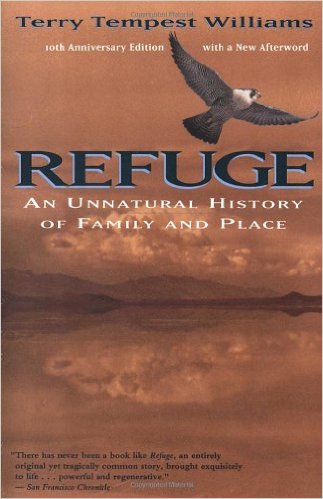
Teaser Tuesdays: Refuge by Terry Tempest Williams

Teaser Tuesdays is a weekly bookish meme, hosted by MizB of Should Be Reading.

I am pleased to have found the time, finally, to pick up more work by Terry Tempest Williams. Refuge is her well-regarded memoir of her mother’s life and death within the region of Great Salt Lake, in Utah.
refuge

Today I chose a few lines that not only tell succinctly what this book is about, but speak to me personally as I work through my own relationship to place.

Most of the women in my family are dead. Cancer. At thirty-four, I became the matriarch of my family. The losses I encountered at the Bear River Migratory Bird Refuge as Great Salt Lake was rising helped me to face the losses within my family. When most people had given up on the Refuge, saying the birds were gone, I was drawn further into its essence. In the same way that when someone is dying many retreat, I chose to stay.

I am, of course, very excited about this book, as Terry Tempest Williams consistently impresses me. I am also already planning to reread one I loved as a kid: Pieces of White Shell. So look out for that one to come.

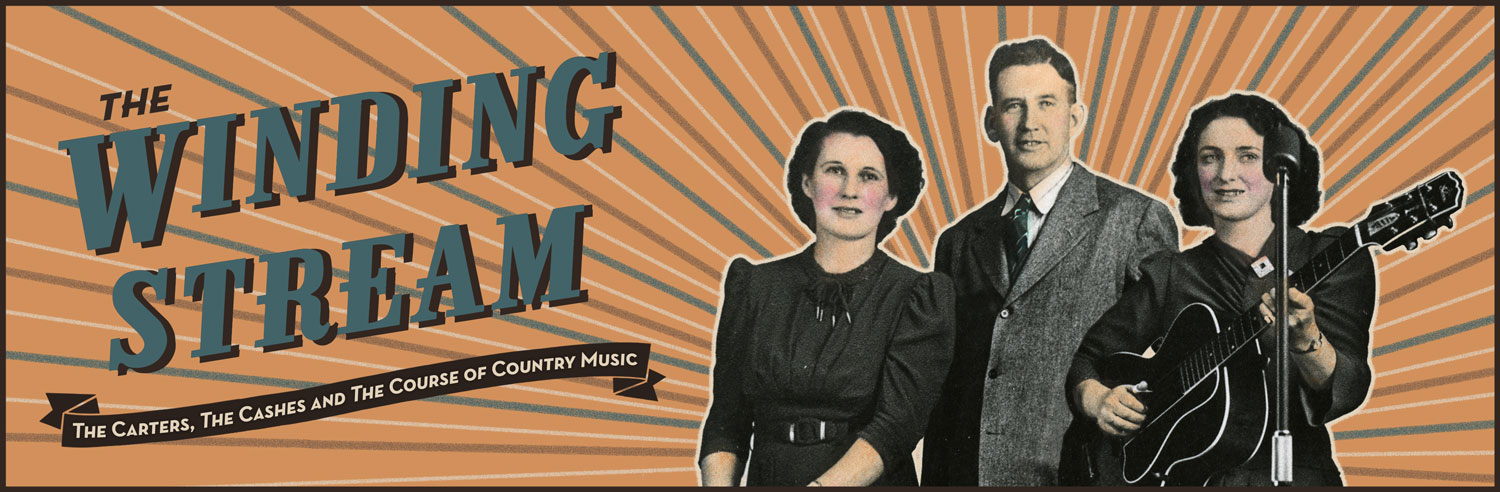
movie: The Winding Stream (2014)

The Winding Stream is a documentary about the contributions of the Carter Family (plus Johnny Cash) to music as we know it. I was deeply impressed, and learned a lot, and was reminded here and there of another excellent music-history documentary, Muscle Shoals.

source

source (click to enlarge)

The Carter Family began with the trio of A.P. Carter, his wife Sara, and Sara’s cousin Maybelle (also a Carter by marriage to A.P.’s brother), who began playing music together in the 1920’s. The scope of the story is astounding, how many of these Carters there were and are, how many songs they recorded – the original trio left 260 recordings behind as their legacy, if I remember correctly. A.P. was an early music ethnologist, who traveled throughout his region – the Appalachian mountains of Virginia – seeking out old songs, “mountain music” as they called it (there was no “country music” yet). He noted the lyrics and the tunes and took them home, where he and Sara and Maybelle arranged them, rebuilding them somewhat, and then recorded them for the Victor Talking Machine Company. Today it occurs to us to wonder about the ethical implications of all these songs ending up being Carter songs; but as the movie points out, back then there was no concept of music being “owned” by anyone in particular. And but for A.P.’s avid, even obsessed calling to save this old music (even at the cost of his family life), many of those songs would have been lost to history in the Appalachian hills.

The trio eventually became part of a radio empire in Mexico, just across the border from Del Rio, Texas: “border radio” sprang up to avoid U.S. regulations, and used a high-powered frequency to send their programs across the States. (Stranger than fiction: the founder of the Del Rio border radio station was a doctor famous for his goat gland transplant procedure that supposedly boosted men’s sexual function and who promoted female circumcision [to make women less frigid, he claimed].) This is how a young boy named Johnny Cash first heard the Carter Family singing their old-timey songs. The group by this time involved some of the next generation, including Maybelle’s three daughters who would eventually be the Carter Sisters; one of them was little June. As Johnny Cash grew in stature, he kept Mama Maybelle close: in footage from his late life, he calls her the biggest star he ever knew.

The story goes on from there. You’ve heard of Johnny’s daughter (June’s daughter-in-law), Roseanne Cash. Their only child together, John Carter Cash, appears in the movie with his wife, an avid student of the Carter Family history who inspired him to learn more about his own legacy. These contemporary Carters still play the old music. In fact, one of the impressive details is in how many Carters there have been, and how they all seem to have had that music running in their veins: it was just a part of their lives, it appears, and they all could play. For example, Janette Carter, A.P. and Sara’s daughter, appears throughout the documentary, recalling her parents and their career. Only late in the movie do we learn that A.P. asked her on his deathbed to continue the legacy – and so she opened a dance hall and picked up her guitar and played. All of these characters – so many Carters – are rich, colorful figures in a compelling history.

As with Muscle Shoals, this film inspired a purchase: we went out immediately and bought an album by the Carolina Chocolate Drops after discovering them onscreen. One of the points made throughout is that the Carters have influenced all the music we know today. Like the (better-known) Beatles, everything that came after had a note of Carter Family in it.

Not only an extraordinary story, The Winding Stream is a well-produced and visually pleasing documentary, rich with family, detail, and emotion. I will say that in the animation of old black-and-white photographs of the original trio performing their music, the moving, blinking eyes were entirely creepy. But this was a rare treat of a movie. I learned a lot, and the music was outstanding.


Rating: 9 songs saved from extinction by A.P. Carter.

book beginnings on Friday: Things That Are by Amy Leach

Thanks to Rose City Reader for hosting this meme. To participate, share the first line or two of the book you are currently reading and, if you feel so moved, let us know what your first impressions were based on that first line.

I am fairly certain that it was Hali Felt, author of the outstanding Soundings, that recommended this book. I’ve had it on my shelf for years, and am so glad now that I have finally gotten around to reading it.

THINGS THAT ARE by Amy Leach.Things That Are is already sort of blowing my mind, and feels right up my alley: fanciful, dreamy, but also very rooted in the real world; whimsically lovely writing. I’ve only just begun, so stay tuned for the review: we’ll see if it sticks. But for now, wow. It begins with a chapter called Donkey Derby:

Usually all we have to do when we go a-conquering is build a boat, find a benefactress, recruit a ribald crew, and wear radiant glinting helmets. With these four easy steps my kind has conquered far-away lands, and seas and moons and molecules.

And I have the impression she will mine all those fields, that is, far-away lands, seas, moons and molecules (and maybe some of the implications of going a-conquering, too). Let us hope.

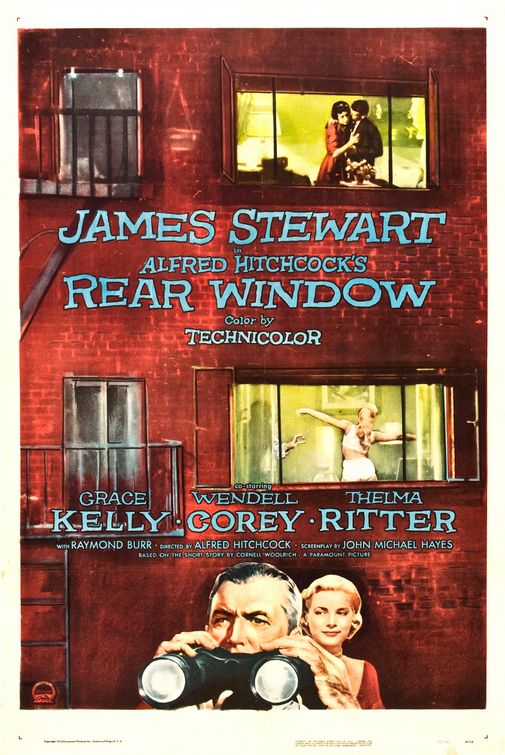
movie: Rear Window (1954)

Happily, after some disappointment with The Birds the other night, I moved directly into another Hitchcock film that pleased me far more. I found Rear Window entertaining, clever, funny, and visually pleasing. Jimmy Stewart and Grace Kelly don’t hurt, of course. But fundamentally, I think murder-mystery ages better than horror, and that is what Rear Window is: not horror, but a noir murder mystery, which is one of my favorite things.

rear windowJames Stewart is L.B. Jefferies (“Jeff”), successful photographer of the adventurous sort, known for action shots, combat and the like. He is laid up with a broken leg, in a wheelchair, in his apartment, which suits him poorly, of course. Also irksome is his girlfriend and would-be fiancé, the lovely Lisa (Grace Kelly), a wealthy socialite he feels can’t possibly accept his life on the edge. Bored and bothered, he takes to spying on his neighbors out the window. The entire movie takes place from this perspective: we only ever see the inside of Jeff’s apartment, and the view he sees out its window, into a courtyard and the windows that also look upon it. There’s a middle-aged couple with a little dog; a female sculptor; a young ballerina who entertains many men; a slightly older, lonely woman; a composer struggling with his latest work; and a salesman who appears to be entirely tired of caring for his invalid wife. Jeff is visited by Lisa as well as a nurse, and a police detective friend he calls on for help when he thinks he’s witnessed a murder.

I loved the visuals: both James Stewart and Grace Kelly (particularly in tandem), and the vignette-style views of courtyard and other apartments, almost a shadowbox effect. I loved the survey of lives and loves provided by Jeff’s perspective. The lives he peeks into represent a range of experiences of life, different levels of contentment. I thought the suspense was well-done in a classic, thunder-and-lightning, guns-and-beautiful-ladies style. Even the puzzle itself – the whodunit – was engaging, if imperfect. The business with the flashbulbs struck me as quite ridiculous, but I laughed good-naturedly, because the overall effect of the story, the sets and the cast was so enjoyable. My fourth Hitchcock film is definitely my favorite. Fans of Agatha Christie will be pleased.


Rating: 9 little red pills.

art museums: Intersections, The Infinity Machine, and the Surrealists

I made my first trip to Europe with my then-boyfriend, who had an art degree. We went to Brussels and therefore to the Musées Royaux des Beaux-Arts de Belgique. We spent 8 or 9 hours there, and I have felt an aversion to art museums ever since. (I will say that the Mauritshuis in den Haag is a nice, small art museum filled with classics, including Girl With a Pearl Earring, which is easy to get through fairly quickly and is worth the time.) Despite this aversion, on a recent visit back to Houston, I went with my mother and my “other parents” (old family friends) to a few art museums on a Friday afternoon.

We started with Intersections, by Anila Quayyum Agha, at the Rice University Art Gallery. The piece is a six-and-a-half-foot cube of laser-cut wooden cube, suspended, with a bright bulb inside, so that the pattern cut out of the cube is projected onto ceiling, floor and walls. That pattern is a complex tessellating geometric design, and a short and very worthwhile video explains that Anila Quayyum Agha was inspired by the Alhambra. As a Muslim woman in Pakistan, she was not allowed into mosques (men only) and had few experiences with their interiors, but was struck by the extraordinary beauty and creative power in the Alhambra (which she was permitted to enter as a tourist.) She also spoke of the construction of this beauty by Muslims, Christians and Jews working together, and called it a “gem” of both artistry and unity between peoples. This was the inspiration for Intersections, whose tessellations echo the tile designs at the Alhambra.

Intersections, Anila Quayyum Agha (with Karen, Susan and Bob)

Intersections, by Anila Quayyum Agha. (With Karen, Susan and Bob). Click to enlarge.

It is a work of light and shadow, geometry and projection. The images on the ceiling and floor (closer to the cube) are crisper than those on the walls (which are further away), so the effect is variable. The cube itself is a work of art (although watch out for that ~600-watt bulb within), and the shadow/light-show another layer of it. People entering the room participate, because the shadows are cast on them (us) too. It was striking and meditative, and free at the University. Good stuff.

Next, after lunch, we went to the Menil campus, and walked first over to the Byzantine Fresco Chapel to see The Infinity Machine, by Janet Cardiff and George Bures Miller. This was an excellent counterpoint to Intersections: another room-sized installation playing with light and, in this case, reflection. Many mirrors are suspended on wires and rotate – around as one large constellation, and also in some cases individually. The room is very dark; a docent escorted us in with a flashlight to seat us on a bench until our eyes adjusted. A few lights lit the solar system of mirrors, and we suspect those lights dimmed and brightened or shut off completely or changed colors. It is hard to say, because the effect is disorienting. I had the odd feeling that different mirrors were present upon each rotation: clearly this is not the case, but the view was ever-changing and, I felt, never repeating. It was kind of intense. A soundtrack played, of NASA recordings of solar wind. Perhaps because we had just lunched at the Hobbit Cafe (always a treat), I said it sounded like the Eye of Sauron. I also thought of calling it “dark noise”: like white noise, but darker, spooky. At one point I thought Sauron was coming to get us on a train, with that characteristic clack-clack and growing whoosh. Where Intersections was light, crisp, patterned, and explicitly called for unity, The Infinity Machine was a little foreboding, even threatening – although I was very happy to experience it, and don’t mean that as a criticism. It was fascinating.

We finished with the Menil Collection building, about which I was most ambivalent, but there was a Dalí exhibit! I was enchanted by some of the artifacts in the Arctic Art collection, including a tiny statue of a bust (of a man?) with toddler on its shoulders; it was less than the height of one of my (cut-short) fingernails, and a fraction the width. I quickly browsed the “frottages and rubbings” exhibit. And then surrealism: lots of Victor Brauner and Max Ernest, several Joseph Cornell boxes (an exhibit of whose work first took me to the Menil, in high school), a few Picassos, and oh, Rene Magritte. I love him – although I didn’t feel he fit perfectly in this collection. His images are so crisp and hyper-real, even if they do float in the wrong places. Dalí’s Eggs on a Plate Without the Plate centered this exhibit, which was entitled “The Secret of the Hanging Egg.” But my favorite piece was The Hunted Sky by Yves Tanguy, which transfixed me. I wish I had a full-size print of that in my home to continue to consider, because I feel like I need more time. (You can look it up online but those images do no justice.)

Still, overall and by comparison, I moved through the Menil Collection quickly; I think the room-sized installations are more generally my speed than rooms filled with paintings. But this was a remarkable experience all around. I normally make it into an art museum every year or so, or less often, and generally at my mother’s side (I try to be good-natured about it, she doesn’t drag me). Today’s visit was at least as rewarding as any I can recall. If you find yourself in the neighborhood of either of these big installations, definitely check them out. Everything we saw was free, too (great job, Houston!), so take advantage!


Rating: 9 reflected or projected tones of light.

Teaser Tuesdays: Uncontrolled Spin by Jerry Summers

Teaser Tuesdays is a weekly bookish meme, hosted by MizB of Should Be Reading.

I am meeting new characters today in the start of a new series, Uncontrolled Spin: The Power and Danger of Spin.

uncontrolled spin
My teaser comes off the first couple of pages:

He hears the door close, and when he turns around, he sees a stunning, jaw-dropping, gorgeous long-legged redhead. Her athletic frame is accentuated, yet only modestly revealed, by her simple black dress and high heels. She is adorned classically with fine but understated gold jewelry; her earrings are half-carat diamond posts.

I fear perfect people: they make less interesting characters than ambiguous, troubled ones. But it’s early yet. Stay tuned…

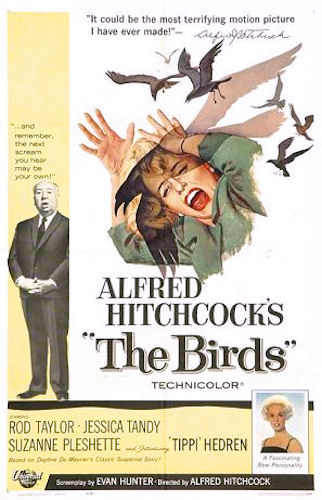
movie: The Birds (1963)

I am continuing my studies of Hitchcock with The Birds, after reading the short story just the other day. As I anticipated, it changed a great deal in adapting for the screen: in fact, only the concept of the birds attacking carried over; none of the characters or the setting were the same. (It was still set on a shore, but in California, not England.)

the birdsAnd I must admit, this was a sillier movie than Psycho. For one thing, The Birds necessitated special effects, and 1963 special effects do not play well in 2015. The attacking birds were a low point in the action, for their unrealism. (I suspect the sound effects of rioting birds were provided by screeching cats.) For that matter, the threat the birds posed read well on the page, but did not ring true onscreen: much flailing, of people and of birds, but not much evidence of real danger. As in Psycho, drivers persisted in getting into their cars via the passenger door. Also, they walk into one another’s homes – even strangers’ homes – right through the (unlocked) front door, sometimes without knocking. This I find most strange (and it happened in Psycho, too). Was this a 1960’s reality??

The early storyline begins in the bird shop and involves two people engaged in a bit of a feud; this quickly and strangely progresses into gift-giving and making out, which progression was not entirely transparent to me. I was interested in the friendship developing between Melanie and Annie, though. More so than in Psycho, I found a few of these characters to be fairly interesting people, and I liked that most of the key characters were women, Mitch being defined by relationships with mother, sister, ex-girlfriend and new girlfriend. But then our female lead, who had been a fairly strong woman, became a big heap of limp weakness, which was thoroughly disappointing. (Although perhaps unsurprising, considering 1963.) There was one visual, of a moonlit car on beach with birds, that I found striking. Other than that, this one gets a general ‘meh,’ and does not satisfy in the way that Psycho did. I’m happy to believe it did better than this in its own time, but it translates poorly to the modern one.

For me, not Hitchcock’s best.


Rating: 5 crows.