reread: She Got Up Off the Couch by Havel Kimmel

You’ll recall that I really loved this book when I read it in 2013. (First review here.) I reread it recently as part of my first semester reading list (see new tag here, many entries to come!). Students’ reading lists are individual, created by the student and faculty advisor together, so Katie Fallon and I came up with my list as a team.
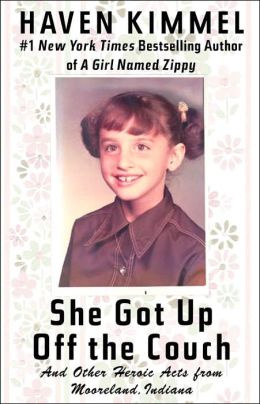
couchI loved this book again. Havel Kimmel’s mother is far from perfect; she struggles to hold herself together and care for her children and family in a way that her society deems correct; she appears ill-kempt. But in the course of this book, in Kimmel’s youth, she also learns how to drive a car (and buys herself one), enrolls in college and goes on to graduate school, gets a job as a teacher, and goes through a divorce. She struggles, but she keeps it together, accomplishes these large goals, and as this book’s existence shows, her youngest daughter loves her very much through it all. In other words, she’s our favorite kind of hero: challenged, imperfect, but eventually victorious against long odds.

So, a great story. But more than a great story, because Kimmel also presents it cleverly, with enormous humor (even when terrible things happen, like fifth-grade Kimmel’s double compound fracture with shattered bone extruding through the skin) and the kind of detail that makes the whole thing alive to her readers without ever feeling overloaded with descriptions. How does she do it? This is what I’m here to learn on this read. Because my stories are only as great as they are – I can’t control that part – but I can control how I tell them.

I’m still learning this kind of reading, how to read for the craft, to take it apart and see how it works. But here are some things I see:

  • Kimmel’s book is about her mother. The title and Preface make that clear. But many chapters hardly mention her, or don’t mention her at all. Much of Kimmel’s story characterizes mom Delonda without even touching on her. Who she married, what her children and family do when she’s not around, where she isn’t – all these things serve the development of Delonda, which I think is really cool.
  • Kimmel is hilarious. (Here, I don’t have much hope for myself; I’m afraid I’m missing that funny bone…) In the incident I mentioned above, the double compound fracture etc., she uses a totally hilarious doctor to add much of the humor in that scene. Was her doctor really that hilarious? I don’t know. Maybe she was gifted a comic doctor; or maybe she knew how to write his dialog to play that up.
  • Her POV rarely departs from that of the child she was in each scene. She stays in the past tense, but her conclusions, what she sees and what it means to her, stay in character. This often yields humor, because her audience knows more than her narrator does. It can yield poignancy in a way that is just honest without being precious. And it plays up the few moments when adult Kimmel comments on her past: these are rare enough that we pay extra attention.
  • A few chapters take unusual formats. There are lists; a transcript of an audio recording; rules of a game she plays with her friends. This kind of formal play (that is, playing with form) can be dangerous – it can distract, or call attention to itself, as in ‘look how clever I am’ – but I think it serves her well here. For one thing, it’s used sparingly. For another, the formats really do feel like they contribute to the narrative she wants to tell. I think a transcript of an audio recording is a great idea, because it’s in the moment. It’s real.
  • I spent some time focusing on the short chapter “Brother” that biographies her much older, and therefore mostly absent brother Dan. It’s a little bit of a departure from the rest of the book, in tone as well as subject, and I found it a charming encapsulated profile.

This is just the beginning of what I have to learn from Kimmel. Exciting, right? If you haven’t read her work yet, you obviously have my recommendation. I love everything she’s written, in fact, as you can see here.

Stay tuned for more reading-list musings to come.


Rating: still 9 lines to be close-read.

Safekeeping by Abigail Thomas

safekeepingThis book has been recommended to me several times, and now I can see why. It’s a memoir, covering most of Thomas’s life and emphasizing her three marriages and children, especially her second husband who died years after their divorce. But it’s a memoir in fragments. It doesn’t try to be comprehensive, which is a wise choice, since we can never tell all of a life, perhaps least of all our own (hmm). Instead, she gives us a number of crystalline scenes or anecdotes, which together paint a picture, necessarily incomplete but rich.

Thomas’s language is rich, too, lyrical and tangible in its sensory detail, but also rooted in the dirty and the everyday. These details can be sublime, but often aren’t the ones we’d think of when seeking the sublime: “Watermelon rind. Styrofoam. Broken clocks and chair legs.” Mattress shopping, table settings, sawdust on a rug. Chapters shift perspective, using first, second and third person POVs. In the second person, Thomas directly addresses her late second husband. I found it interesting to examine her choice of POV throughout the book and its effect: that second-person addressed to a specific person feels the most intimate, especially since the reader knows that that specific person is absent. Third person feels most remote, and she often uses it when (I interpret) she needs distance from her subject.

Safekeeping is a slim book, easy to read in one sense: you could flash right through it and walk away with a sense of Thomas’s personal history. There is plenty to sink into, though, too, and those may be the best kind.


Rating: 8 apple cakes.

Bonus: here’s a look at my semester’s reading, now that I have it all compiled. Hints of what’s to come!

click to enlarge

click to enlarge

Talking Back, Talking Black: Truths About America’s Lingua Franca by John McWhorter

A linguist argues for the legitimate and complicated contributions of the language he calls Black English.

talking-back

Linguistics professor John McWhorter (Words on the Move) has a message in Talking Back, Talking Black: Truths About America’s Lingua Franca: he exhorts his readers and the general public to recognize Black English (a term he prefers to African American Vernacular English or to Ebonics) as a language unto itself, not merely a mess of grammatical mistakes and slang: “a development that happens alongside the standard variety, not in opposition to it.”

McWhorter worries that academic linguists have relied too long on scholarly arguments in making this point. He does review some of those arguments–for example, Black English’s systematicity, meaning it has a grammar of its own–but then turns to global language patterns. Many cultures and language groups speak both a formal and a casual language in different settings, e.g., Standard Arabic and the local colloquial form (Egyptian Arabic, Syrian, etc.). While he acknowledges that racism partly underlies a general resistance to Black English as a legitimate language, he quickly moves on to what he sees as the larger problem: a misunderstanding of the value of diglossia, or speaking two languages. Along the way, McWhorter cites the relationship between modern Black English and the lingo of minstrel shows, makes the case for a recognizably black way of speaking (or “blaccent”) and examines usages such as “baby mama,” “who dat?” and what he perceives as two versions of the N-word.

Linguistics fans will be enthralled by McWhorter’s fascinating and logically presented study of two forms of English spoken in the United States.


This review originally ran in the January 24, 2017 issue of Shelf Awareness for Readers. To subscribe, click here, and you’ll receive two issues per week of book reviews and other bookish news.


Rating: 6 vowels.

new plan: twice weekly

Well, perhaps some of you are chuckling at me right now, because perhaps this was foreseeable. I have far too much to say to give you only one post per week, so let’s try two. [I am reading 20-25 books per semester for school and one per month for the Shelf.] Starting now, you’ll see posts on Wednesdays and Fridays. Hopefully this will not overwhelm.

For a little bonus today, check out this article about beavers a former writing classmate of mine recently had published. I saw this piece in an earlier and much different form; it is exciting to see him get it right like this, and encouraging for me to see him keep working on it til he found success. From there you may wish to go read this book review he wrote about a beaver book with a really great title.

Coming soon here at pagesofjulia: academic linguistics and race relations! Memoirs, sex, and Stephen King! Stay tuned.

Fever Dream by Samanta Schweblin, trans. by Megan McDowell

A woman and a boy sit in the dark, probing a shared story of love, danger and “the invisible thread that ties us together.”

fever-dream

Samanta Schweblin’s first novel, Fever Dream, is part contemplation, part living nightmare. Amanda lies in a dark hospital room, accompanied by a boy who is not her son. David walks her through the story of their meeting, as two very different mothers care for their two children in a dusty small town. Amanda worries over what she calls the “rescue distance”: “that’s what I’ve named the variable distance separating me from my daughter, and I spend half the day calculating it, though I always risk more than I should.” He presses her for details, because the two have an unnamed riddle to solve, but at the same time repeatedly chides her, “that’s not important.” This paradoxical sense of urgency combined with immobility evokes a classic bad dream. With relentless tension and steady pacing, the mystery of what has happened to Amanda, and to David, unfolds. This is a story about a parent’s need to protect her child; unnatural elements cannot obscure a cautionary tale about the pressures of parental love.

Fever Dream may be contagious: the reader should beware the compulsion to read it in a single sitting, pulled helplessly along by the power of the story. Though brief, its stream-of-consciousness style and absence of chapters emphasize a sense of inexorable forward momentum. Megan McDowell’s translation from the Spanish expertly delivers every atmospheric moment and line of near-panicked dialogue. A sense of foreboding hangs over this story that is at once a dark fairy tale and a realistic expression of everyday danger.


This review originally ran as a *starred review* in the January 20, 2017 issue of Shelf Awareness for Readers. To subscribe, click here, and you’ll receive two issues per week of book reviews and other bookish news.


Rating: 7 details that do not matter.

Cerulean Blues: A Personal Search for a Vanishing Songbird by Katie Fallon

Disclosure: Katie Fallon is my faculty advisor this semester, meaning we’ll be working closely together. I read this book just before meeting her.


Mid-April in our southern mountains is a gentle time; blooming forsythia lights up yards like bursts of yellow fireworks, magnolia trees sport gaudy white and pink blossoms, and median strips swell with lilacs and tulips.

cerulean-bluesCerulean Blues is a book about the cerulean warbler, a migratory songbird in danger but not listed as endangered (yet); it is also a book about the author’s becoming a fan and ally of the little bird, a year in her life.

It is organized by seasons: spring, summer and fall. In spring, Fallon discovers the bird and its possibilities for her, and the danger it’s in. This just happens to be as well the spring of 2007, and she is teaching at Virginia Tech when a school shooting takes place there that kills 33. The trauma of these events will shadow everything that follows for her. But she continues on through summer, when she travels to visit the cerulean in its northern habitats near her own Appalachian home, and fall, when she goes further afield to its migratory home in Colombia.

While Fallon is reflective and personal throughout, and the reader gets to know her husband and their rescue dog Mr. Bones as well as the narrator’s own insecurities and grief, this is very much a book about a bird species and its plight. While also showcasing some lovely language (see quotation above), she teaches us a great deal about cerulean warblers and the research (and personalities) that have taught her about them. It’s ultimately a work of science reporting by a non-scientist, as well as a memoir. I found her emotions and minor human flaws easily accessible, and the bird facts equally so. I felt that I got to know her by reading this–which turns out to be particularly applicable to my own studies, but will be rewarding for any reader. The Katie Fallon of these pages is an easy-to-like, easy-to-read instructor, and I think the cerulean warbler will gain more than a few more allies in its readers. (Quick hint: be sure to buy shade-grown and/or bird-friendly coffee!) Nice to meet you, Katie.


Rating: 7 colored bands.

Keep your eyes out for Katie’s next work of nonfiction, available in March of this year. I am especially looking forward to this one, titled Vulture: The Private Life of an Unloved Bird. Vultures are among my favorite birds, as they were Ed Abbey’s.

Take Me to Paris, Johnny by John Foster

This beautifully written memoir of a lover’s life and death will impress readers with its lyricism and emotion.

take-me-to-paris-johnny

Originally published in Australia in 1993, John Foster’s Take Me to Paris, Johnny recounts the life of his lover Juan Céspedes, who died of AIDS in 1987. This Text Classics edition–the first in the United States–includes an introduction by critic Peter Craven and an afterword by Foster’s close friend John Rickard. While these supplementary materials provide context and develop Foster’s character, the original work gleams abundantly without their help.

Juan was a Cuban refugee studying dance in New York City when he met Foster, an Australian history professor, in 1981. A one-night stand became a summer-long affair and then a long-term, long-distance relationship, to Foster’s surprise. As the couple wrangled with the Australian immigration authorities to gain Juan’s permanent residence there, his illness became undeniably serious. He died in a hospital in Melbourne with Foster by his side.

This sensitive, perceptive memoir keeps Juan at its center, outlining his boyhood and escape to the United States before focusing on the love affair and Juan’s death; the final event receives due gravity without defining his life or the book. In a mere 200 pages, Take Me to Paris, Johnny achieves a full emotional range, sketches Juan’s rare and changeable personality and imbues a tragedy with poetry. Foster’s writing is exquisite: thoughtful, lyrical and with an eye for detail. While this is undeniably a sad story, Foster resists wallowing, choosing instead to celebrate Juan and even to laugh at their troubles. Take Me to Paris, Johnny is incisive, wry, loving and deeply lovable.


This review originally ran in the January 10, 2017 issue of Shelf Awareness for Readers. To subscribe, click here, and you’ll receive two issues per week of book reviews and other bookish news.


Rating: 8 red gladiolas.

The Stand by Stephen King (audio)

the-standStephen King’s long, juicy novels often leave me a little tongue-tied when it comes time to write a review. There is so much to say. The Stand is a long one: this updated version (with King’s “Preface in Two Parts” and some 400 pages of added text left out of the original publication) runs around 1200 pages. Or, as iTunes informed me, 1.9 days of audiobook. Briefly I will say it was all worth it.

It is 1990, and a “superflu” has just wiped out the overwhelming majority of human life on the planet. This superflu was a biological weapon worked up by the United States military that, oops, wandered out of the lab. There are some weeks of totally creepy information control by the military & government, as they try and keep citizens from suspecting the reality that life as we know it is gone. Eventually we are left with a handful of people who stumble around an empty world and find each other. Put very simply, the good and virtuous people dream of a good woman–sort of a wise crone, feminine divine figure–and of a frightening dark man. The remaining people with basically good natures gather around Mother Abigail, and the remaining people with evil impulses gather around the bad man, who we recognize from other King novels by the name Randall Flagg. What follows is part good-vs-evil battle for the control of a near-empty world; but the far more compelling part is a story of human beings and their personalities, and personal struggles with the good and evil within all of us. Plus the practical difficulties of a high Colorado winter without piped-in heat.

This overly simple description doesn’t do it justice, of course. While there is an overarching good-vs-evil plot, that makes the story sound too pat and frankly boring: I wouldn’t read that. These characters are the masterpiece, as is so often true with King. The individuals and their nuances, and the challenges of the day-to-day, are creative, realistic, whimsical, hilarious, riddled with pathos and endlessly interesting. This is why I read Stephen King. Beyond that, this story makes for an intriguing sociological study (and he goes ahead and gives us a surviving sociology professor to help us along). Reading (listening to) this in 2016-17 calls to mind an obvious parallel to my favorite TV show, The Walking Dead. Both, for me, are studies in what the end of the world might look like for a few remaining survivors. Spoiler alert: we humans are the greatest threat, before and after.

I loved this reading by Grover Gardner; he did all the characters justice, which is no small feat. I loved the accents, especially on the character sometimes called “East Texas.”

For the serious King fan, there are the usual Easter eggs and references across novels. I’m not sure I qualify as a superfan yet–I’m only a small way into this man’s prodigious stack of published works–but I saw enough to tickle me.

What can I say? I’m adding nothing new to the world’s wisdom on Stephen King; I can only add my voice to a chorus: this man does some of the best world-building since Tolkien but is firmly rooted in our messy world, too. There are enough unexpected metaphors to please a poet, enough gimlet-eyed reality to please a realist, and enough fun to please the most loyal of genre readers. I can’t get enough.


Rating: 8 chocolate Payday bars.

in her honor: retirement of Marilyn Dahl

I needed to add this bonus post today to recognize the retirement of my editor at Shelf Awareness. Marilyn hired me as a reviewer in March of 2011, and she has been a pleasure to work with for these five years and eleven months, without a moment’s exception. I am of course a little devastated to lose her as a boss; but she deserves this, and she leaves some more than competent folks behind to take care of us. (In the last few years, Associate Editor Dave Wheeler has become a fine friend as well as a fine editor.) I’ve learned so much from Marilyn about how to read, how to write, how to read what I’ve written, how to play well with others, how to be a graceful human being. It’s been an honor.

I want to point you to Marilyn’s Reflections on Reading and Retirement column of Jan. 31, and as well to her Reading With… questionnaire. The good news is you will still see the occasional review with her byline on it. Maybe one mystery per month.

Love you, Marilyn. Thanks for everything.

Maximum Shelf author interview: Jennifer Ryan

Following last week’s review of The Chilbury Ladies’ Choir, here’s Jennifer Ryan: Original and Authentic.


Jennifer Ryan lives in the Washington, D.C., area with her husband and two children. She is originally from Kent and then London, and has worked as a nonfiction book editor. The Chilbury Ladies’ Choir (Crown) is her first novel.

photo credit: Nina Subin

photo credit: Nina Subin


How did you choose to use the epistolary form?

The letter form is one of my favorites. I really enjoy the way the voice exposes the inner feelings and personality of the character. The way she interacts with the off-stage recipient adds an extra tension–is some kind of pretense going on? It leaves some lovely space for an unreliable character to come through–someone who isn’t telling the recipient (or the reader) the truth, and will inevitably be uncovered by the end.

Is there one of these women you especially identify with?

Mrs. Tilling, the middle-aged widow whose only son goes to war. She was the first one I wanted to write about. Writing gives you the opportunity to dig into a situation or subject, put yourself in the middle of it as a character and experience what it must have been like. As a mother, I wanted to know how it felt to have your only child go to war, especially with the gruesomeness of the First World War fresh in your mind, all the young men mown down by bullets in the Somme. You’ve spent 18 years bringing up your son, caring for him, cooking for him, loving him, and this day–when he walks down the road with his kit bag over his shoulder–may be the last time you ever see him.

The differences in their voices is subtle, but distinct.

This was a wonderful part of writing Chilbury. Kitty steps away from traditional narrative style in her journal, jumping around from subject to subject by use of headings, and using her wonderful lists to cover subjects such as “People’s Colors,” and “What Happens to People When They Die.” Miss Paltry uses a lot of metaphors, and I had a hysterical time creating ones such as, “the day was as cold as a slap round the face with a fresh-caught cod.” She was a delight to create, and I always looked forward to writing her entries. Mrs. Tilling always longed to be writer and has a more literary style, which allowed me to be more expressive and use more sophisticated language and grammar. They are also defined by their accents. Mrs. Tilling has more of a middle-class vernacular, whereas Venetia and Kitty are more upper class, and Miss Paltry is more lower class.

Why this time period?

About 15 years ago I read about the London children being evacuated to the English countryside, and a new obsession was born. Since then, I’ve read personal accounts, memoirs, biographies, reference books and novels about the Second World War. When I was considering writing a novel, I’d been editing a book on the war in Afghanistan, and through that I recognized how cultural values change in a time of warfare. The population shifts and for a time things become more fluid, rules less rigid. Authority is challenged and the suppressed–in this case the women–have a chance to widen their horizons.

On a more personal note, when I was growing up, we had two grandmothers: one was Shakespeare Granny, who ruthlessly analyzed all the tragedies, and the other was Party Granny, who was full of hilarious and often scandalous stories about the war. I always had a burning ambition to write about her stories, especially the ones about her choir, which she swears got her through the war. Unlike the Chilbury ladies, though, Party Granny’s choir was reportedly dreadful, and there were plenty of stories about how they lost competitions and sang so out-of-tune that when they visited a choir member in hospital, the nurses took them to perform for every ward to “give everyone a good laugh.” They hammed it up, of course, “to jolly everyone along.”

How did your experience as an editor of nonfiction inform this work?

Narrative nonfiction works similarly to fiction. I created a structure whereby the main story arc of the choir contained and ran alongside the five story arcs of the main characters. Structure is the cornerstone of any good, well-functioning nonfiction, and I think the same is true of fiction.

The work of sentences is also crucial, and although they tend to move to a different end in nonfiction, a good understanding of sentence potential and variability is key to producing a fluid work. But because the characters themselves were writing the entries, I had to step back from writing complex sentences and grammar for all but Mrs. Tilling, who professes to yearning to be a writer.

Editing nonfiction has also given me the opportunity to dive in deep with other topics. A few years before I began writing Chilbury, I edited a book by a renowned cellist on how music affects our emotions, and some of the core ideas were used in the book. Having also sung in choirs, I wanted to bring that feeling of togetherness that they create, the magic of allegiance in song. It’s not an easy task to describe music in words, but I wanted to make sure it felt real to the readers, as if it was being performed in front of them.

How big a role did research play? How closely does this story mirror fact?

Research played a massive role. The day-to-day life of women during these times was incredibly hard. There were few labour-saving devices such as laundry machines and dryers, let alone central heating. All meals had to be made from scratch. The rationing and shortages made cooking even more time consuming. My grandmother had a dozen or so wartime recipes, like Lord Woolton Pie (a vegetable form of shepherd’s pie made specially for Lord Woolton by the head chef of the Savoy Hotel), mock banana (which was made from mashed parsnip mixed with sugar) and Pink Gin (my grandmother’s favorite cocktail, which was a lethal mix of straight gin with a splash of Angostura bitters.)

One of my favorite research tasks for Chilbury was interviewing people alive during the era. In an eye-opening way, most of the elderly women I interviewed remembered the war as one of the best times of their lives, recalling the new freedom and the work and responsibility, the feeling that you had to live for the day. One lady in her 90s decided that she simply had to demonstrate how to do that dance, “Knees Up, Mother Brown,” and I begged her not to as she struggled to her feet, clasped my arm, and began kicking her legs up one by one. Gripping hold of her as best I could, I had to laugh along with her. She couldn’t have been more delighted to relive the memories.

I was careful to make sure that everything that happens in the novel could actually have happened. Some of the plot threads came directly from my grandmother’s stories of the war, and one of the characters, Venetia, is based on her friend Letty, who was very beautiful and always playing the boys off each other.

The story of Silvie, the 10-year-old Jewish refugee from Prague, came from research about Sir Nicholas Winton, who set up a program to transport Jewish children from Prague to the U.K. in the wake of the war. In total he rescued 669 children, most of whom lost their parents in the Holocaust. They were taken in by British families, many of them remaining with those new families after the war. There are many horrific and sad accounts of the Nazi invasion of Czechoslovakia in 1938, and I tried to keep Silvie’s experiences true to the brutal reality of the situation.

It was important to me that the book was both an original work and authentic to the era. It certainly was an incredible time to live and write about, and I feel incredibly lucky to be able to plunge into this fascinating era and try my best to re-create some of the most exciting and frightening years of the war in Kent.


This interview originally ran on January 10, 2017 as a Shelf Awareness special issue. To subscribe, click here, and you’ll receive two issues per week of book reviews and other bookish fun!