






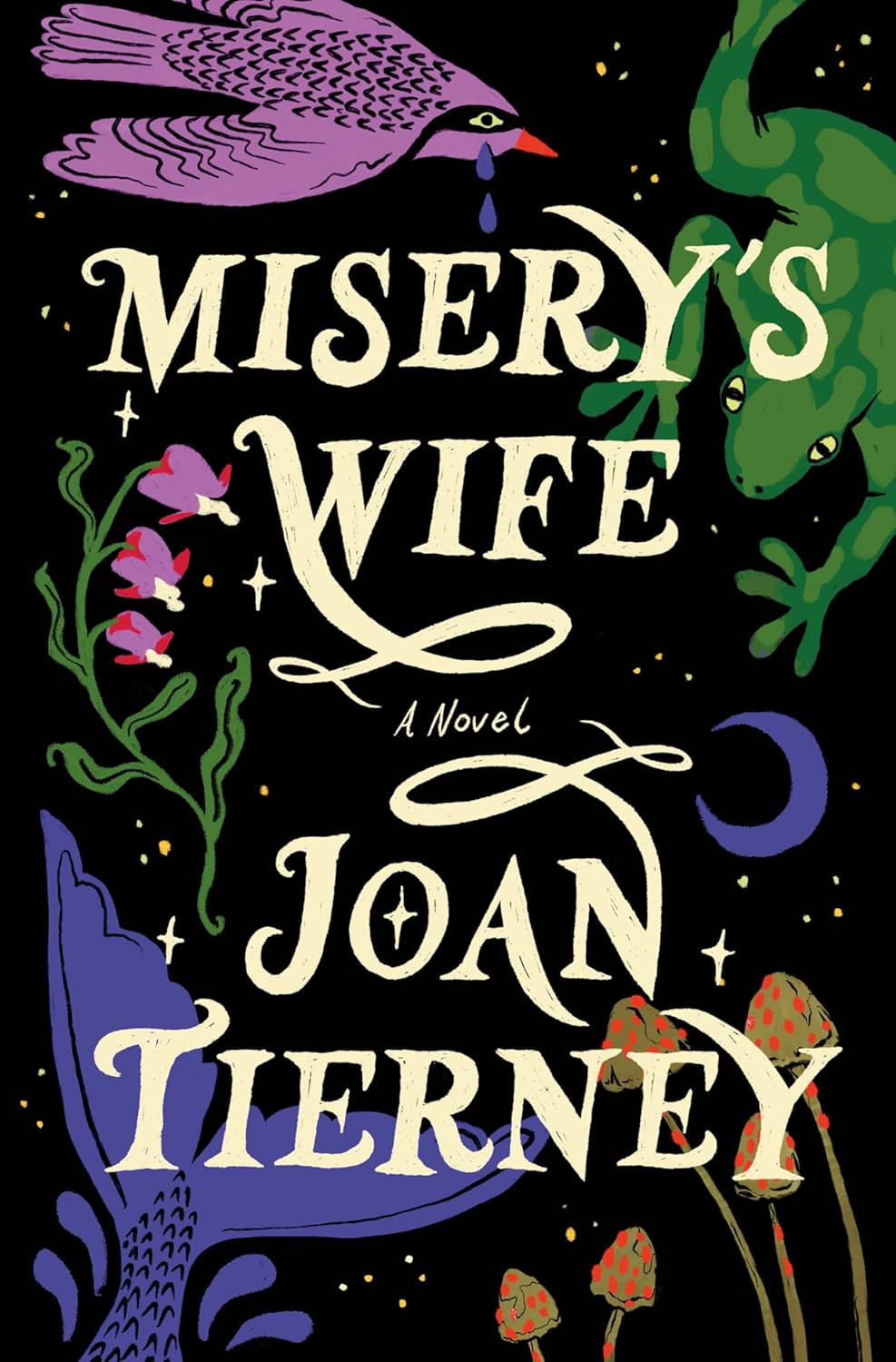
 Misery’s Wife is a lovely, off-kilter fable about family, sisterhood, love, transformation, and humans’ relationship with the rest of the world. It uses repetition and sets of threes in ways that feel familiar to a fairy tale tradition. I think I was expecting something referencing Persephone or Eurydice, but it turns out that Tierney here recasts a Portuguese folktale, with foods, names and language from that culture. I was unfamiliar but still found it all accessible and enjoyable.
We first meet the parents of three sisters. Agueda and Jaco have three girls, and during each pregnancy, Jaco goes on a mini-quest to ease his beloved wife’s discomforts, and each time, this results in the newborn daughter’s allegiance: Adelina is a child of the night and the sea; Borboleta is a child of the day and the sky; and Dores is a child of the wind and rain, “and Misery itself will bend to kiss her feet.” They grow respectively into a young woman who adores all things strange; one who admires and exudes beauty; and one who is mild-tempered and shy, given to daydreams. In a single day, Adelina elopes with the King of the Ocean. Borboleta runs away with the King of the Sky. And Dores declines the offer of the King of Misery, but he abducts her anyway.
Years pass. Agueda and Jaco mourn their three lost daughters. But lo (the book surprises us), there is a fourth, younger sister, a child of luck and fortune. “There was also the mistaken belief, in those early years, that Elixane was in fact a son rather than daughter… these things happen, and are remedied easily enough once the child themself can put voice to the truth.” As Elixane grows into a young woman, she receives three mysterious messages, one from sea, one from sky, and then a final message from the queen of Misery. “She asks that you find her and save her from her king.” As she prepares for this quest, Elixane meets Luck, who has (naturally) followed her all her life; he is accompanied by his sister, Jinx. Off and on, the pair will accompany her as she meets with each sister in turn, and endeavors to rescue Dores from Misery, as well as lifting a curse and generally improving circumstances in the kingdoms of sea and sky, and that of land and humans as well. Misery’s Wife is set in a future world badly damaged by anthropogenic climate change, which, like Elixane’s identity as a trans woman, is treated only glancingly.
I liked this story, although the stretches set in the kingdom of Misery were sometimes hard to read. I liked the representations of the love and devotion of family, of sisters and of friends, as well as the loving marriages (“When you marry someone, you marry their battles, too”), contrasted to Misery’s abuse (“Dores’s skin was pockmarked with bruises… The cat looked at the bruises and then looked at her eyes and said, ‘This is how it starts'”). I found the folk formula – repetitions in threes, quests and codes and riddles – soothing in its familiarity, which did not prevent plot twists. And I loved the decidedly happy ending. By that conclusion, I’d say that despite some comforting framing, Tierney has given us a surprising, thought-provoking fable that I will not soon forget.
Filed under: book reviews | Tagged: fairy tales, folk legends, gender, misc fiction |


Leave a comment