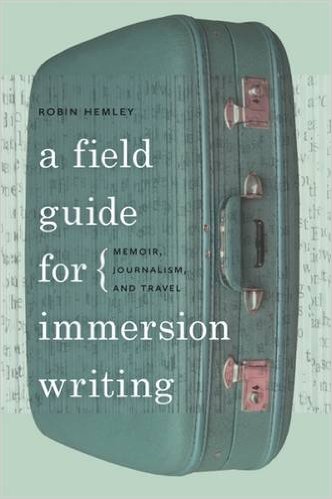
A Field Guide for Immersion Writing: Memoir, Journalism and Travel by Robin Hemley

field-guide-for-immersion-writingThis is the fourth “craft” book I’ve read this semester, and it’s one of the better ones. The Art of Subtext was an intriguing read, but so thoroughly geared toward fiction writing that it was less useful to me. The Situation and the Story felt a little wandering and indistinct. On Writing was of course wonderful – as an insight into King the man and the writer, as well as for his writing advice, which is largely on the sentence/language level and therefore applicable to nonfiction as well as the fiction that King specializes in.

By contrast, A Field Guide for Immersion Writing is specific in terms of the writing it addresses. I really appreciated Robin Hemley’s breaking down of immersion genres: first into travel, memoir, journalism, and then into quest, experiment, investigation, reenactment, and infiltration. (All of this makes sense in his thorough discussion. And there are examples.) I also really appreciate that he recognizes these as fluent: “The categories are meant to be useful, not binding.” He then works methodically through his categories and sub-categories of (nonfiction) immersion writing, addressing their fluid boundaries throughout, and offering advice about how to do both the immersion, the living and interviewing and learning, and the writing. He also speaks to the practical side of the writer’s life: how to pitch proposals, how to fund travel and research, that kind of thing.

Perhaps one of the most important things that made this book work for me was that I liked Hemley’s voice – which is to say first of all that he had a voice, that he let some feeling for his personality live in this book. (He was referring to immersive travel writing and not writing about craft, but see this line: “To me, it’s an act of generosity to introduce yourself, to say, This is who I am and why this story is important to me, and these are the people I met along the way.” [emphasis his] I hear this as an echo of something I’ve long believed: to not let oneself come into one’s writing is sort of dishonest. We know you’re there, so show yourself.) Hemley shows himself; and I liked, felt like I got along with, the person I met there. So I was primed to take advice from him. Also (as in the above parenthetical quotation) I found that we had some principles and opinions in common, again making me interested in following him. The point here I think is that our reactions as readers are subjective and personal (duh, right?), so if I vastly preferred Hemley’s craft book to Gornick’s, that doesn’t mean you’ll feel the same way.

That said, I do think that this “field guide” offers a wonder of practical advice, specifically geared towards a certain type of writer. Its specificity is definitely one of its greatest strengths (if you’re in that group of writers – see again The Art of Subtext), and it offers a huge number of examples of immersion writing that work in various ways. So, plenty of reading there.

More wisdom: Hemley writes, “Book projects are protean: you start out thinking you’re writing about one thing, but the book you write almost never turns out to be the book you set out to write.” This echoes something I’ve heard from a number of other students (and graduates, and faculty) in my MFA program, and it’s something I find intriguing, and both promising and scary.

I liked this book, and I liked the author enough that I intend to (someday) read his Nola: A Memoir of Faith, Art, and Madness, about his sister. That’s an endorsement.


Rating: 8 suitcases.

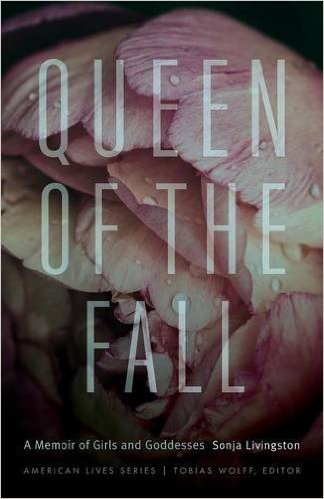
Queen of the Fall by Sonja Livingston

queen-of-the-fallThis is a memoir in the form of collected essays about girls, their experiences and generally a girl’s coming-of-age in New York state in the 1980s and ’90s. The whole book accumulates into something greater than its parts, which is a trick I love. Livingston’s writing is beautiful on the language level as well as in subjects and connections drawn. Her essays include lots of braided pieces, and a fairly heavy emphasis on having babies: avoiding having them too young and yearning for them later.

Livingston’s life is told not as a cohesive story, but in a series of observations and reflections – and anecdotes, but the autobiographical anecdotes feel in service to the reflections, not the other way around. The essays move well beyond Livingston’s autobiography, including studies of women distant to her own experiences: characters from Hollywood movies, television shows, history, the Bible. (Susan B. Anthony, the Virgin Mary, Ally McBeal.) There are also lots of girls and women she does know: her sisters, her mother, a niece; a bride from her childhood neighborhood, Judith Kitchen (briefly, Livingston’s writing instructor), girls she served as a school counselor, a woman she meets at a laundromat. As the subtitle points out, female characters are the unifying theme of this book. There are three sections, unnamed but with epigraphs at their start. They essays they include appear to be in chronological order, although this book in no way feels like a start-to-finish sort of narrative.

I’ve observed examples elsewhere (essays by Jessie Van Eerden and Rebecca McClanahan, Dorothy Allison’s Two or Three Things I Know for Sure) of an author using a single image, object, phrase (etc.), or a structure, to help apparently disconnected stories hold together and achieve a single effect. I’m particularly interested in this book for the way it holds together without quite such an easily identified unifier. To put it another way: Livingston does not quite promise (or deliver) a book “about” herself, her own life, her mother, or anything so straightforward. Instead she muses on “girls and goddesses,” and while I think this book is about herself and her mother and the women in her community, she has plenty of room to roam away from those topics; and the essays that roam still feel like they fit. This is the trick I want for myself: to write about more than just the one thing and still achieve a cohesive collection.

A lovely book to read simply for the experience; also thought-provoking; also plenty to think about from a craft perspective. Win-win-win.


Rating: 8 olive trees.

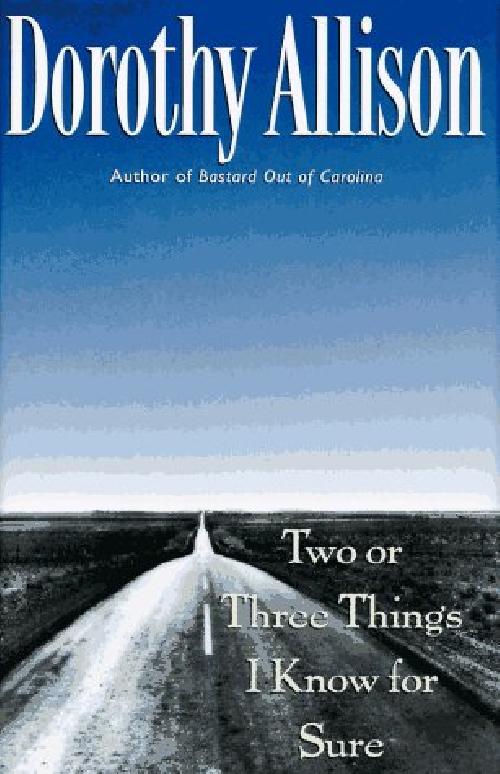
Two or Three Things I Know for Sure by Dorothy Allison

two-or-three-things-i-knowThis is a lovely, very brief but powerfully feeling memoir by the author of Bastard Out of Carolina, which I have not read.

It offers a look at the author’s life, and of the women in her extended family: chronological, but otherwise loosely attached to events, more musing and reflective than reportorial. Allison jumps in and out of time, so although events take place in chronological order, it’s not a straightforward start-to-finish narrative. She also includes family photos, and thus reminds me of Judith Kitchen’s Half in Shade. (This one came first.) Allison is concerned with the challenges these women have faced, and how they’ve handled them, with attention to place, culture, feminism and lesbianism; but family relationships are central. Her second-person address repeats “Let me tell you a story…” and weaves in the title line. This through-line provides another unifying tactic, like those I saw in essays by Van Eerden and McClanahan (here). Like Queen of the Fall (review coming up on Friday), Allison also offers some thoughts, and inspires some thinking, on women’s experiences and place in the world. Specifically in this book, that is the world of poverty-stricken Greenville, South Carolina.

At under 100 pages, this is a super-quick read; maybe too quick. I flashed through it in an evening and am left unsure of what I learned, although I enjoyed the experience. The good news is that a reread would be quick to do, too.


Rating: 7 quarter-miles.

The Pine Barrens by John McPhee

the-pine-barrensThe Pine Barrens came to my MFA reading list from my advisor Katie Fallon, and I can’t recall her justification, I just took it. It was a good tip. I’m a fan of McPhee now. I knew his name but don’t believe I’d read any of his work before.

I would call this a collection of related essays about the region of New Jersey called the Pine Barrens. I don’t known a ton about New Jersey, and had not heard of this place before. It’s a vast region in the southern part of the state that is thickly forested and very thinly populated; it is distinctive in climate, flora and fauna, and human culture, not very well known and subject to unfair stereotypes.* In these ways, it reminded me a little of the Driftless region I read about in this book, which is a less artful piece of literature than McPhee’s, but a similarly fascinating profile, I think. I am trying to say that peculiar places, especially when they come with peculiar peoples, are very interesting to me. (As much as I love nature, and nature writing, I admit to a weakness for people.) So, I enjoyed the subject of this book very much.

And also the writing. McPhee has certain qualities in common with Joseph Mitchell (see Up in the Old Hotel): neutral, journalistic, mostly absent from his own story. His descriptions are matter-of-fact and seemingly unadorned, although they are also often lovely images: they only seem straightforward. As a classmate of mine once said, easy-to-read writing that flows effortlessly is deceptively hard to write. He has an eye for just the right characterizing line of dialog:

“Horace’s mother and mine used to make their own yeast, too–out of potato water and hops. Modern women aren’t up to that.”

“They give you cold beans,” Horace Adams said.

Something about those cold beans really tickled me. Or this line:

He is about fifty, and he has a manner that suggests that he is not afraid to work and not afraid not to work.

The backwoods, simpler-times feel of the Pine Barrens and the pineys struck me somehow as… not bucolic, but pleasantly green and calm and quiet. McPhee felt for me like Mitchell but a little more foreign, because my personal experiences are a little closer to Mitchell’s urban setting than to this one. Both writers use language and sentences that feel simple rather than poetic or flowery, although both their language and their sentences are more complicated than they first appear. McPhee ties in research and outside sources with the immediate scenes he describes (visiting a piney cabin to ask for water, talking with its inhabitants) neatly; one flows into the other without much transition needed. It’s a smoothly flowing piece of narrative even though it covers a lot of ground.

I fear it is the work of some close reading indeed to figure out how to make such lovely work seem so effortless, but I’ll try.

In related news, thanks, Tassava, for sending me the link to this inteview with McPhee by The Paris Review. He sent it (unknowing) mere hours after I finished reading this, my first McPhee. It’s a great read – long, but juicy with gems, both funny lines and helpful thoughts for writers. What a joy.


Rating: 8 jugs.

*This book was first published in 1967, and my impression of the Pine Barrens is mostly based on this dated account. How remote and untouched is the region still today? I am not the one to say. Wikipedia calls it “largely undisturbed.” But there is also a website, www.njpinebarrens.com, which begs the question…

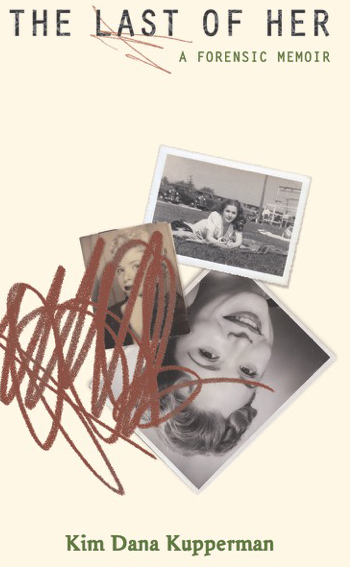
The Last of Her: A Forensic Memoir by Kim Dana Kupperman

Disclosure: Kim is a visiting faculty member in my MFA program, and one I’m looking forward to working with.


“Have a good life,” my mother wrote in March 1989, at the bottom of page four of her nineteen-page suicide letter.

This is a really good beginning, in that it certainly grabs my attention.

the-last-of-herThe Last of Her is Kim Dana Kupperman’s investigation into her mother: who she was, who she wasn’t, why she went.

This mother, Dolores, was a serial liar. She told many, many stories of her own personal history, leaving a real challenge for her only daughter in tracking that history. Kim was 29 when her mother killed herself, apparently to escape being busted for insurance fraud. It took some decades before she was ready to do the work that this book communicates: the research, the travel and the reconsidering of past crimes. Those are literal/legal crimes (Dolores was a junkie, a con artist, an identity thief, and apparently guilty though never convicted of assaulting a [pregnant] romantic rival with a hammer) as well as psychic ones, including mistreating and manipulating her daughter. The adult Kim eventually finds sympathy for this flawed and damaged woman, but it is quite an (understandable) journey to get there.

As a piece of creative nonfiction, The Last of Her is intriguing. The Preface deals heavily in birds, as Kim sketches the trauma of her mother’s suicide and then describes visiting the gravesites of family members she never knew. A few more birds season the rest of the story, although they do not end up playing as large a role as I expected. This lent a feeling, for me, of something larger and less knowable than human nature; not supernatural, but something of the mystery of the natural world, which is often absent (or mere scenery) in human stories.

This is also very much a memoir, not of Kim’s life or Dolores’s, or Kim’s memories of Dolores (although there is some of each), but of Kim’s study of her mother years after her death. In other words, this is the story of her research, including her reading of her father’s giant “Secret File” about Dolores and the custody battle she lost. I am drawn to this kind of story: the story of finding the story, that transparency. Kim’s tone keeps some distance, almost austerely observing the 20-something daughter to which this thing happened. It’s a remarkable piece of writing, on the sentence level (of course). I will also say that the chapter headings (quotations from a wide range of literature) quite baffle me; I need a guide to those.

This is a memoir about a sensational event that never approaches sensationalism, expertly crafted like a long poem, with precise emotional tone. A good study. Keep your eyes open as well for Kim’s (earlier) essay collection, I Just Lately Started Buying Wings, and the work of Welcome Table Press, where she is founding editor.


Rating: 7 phones hung up.

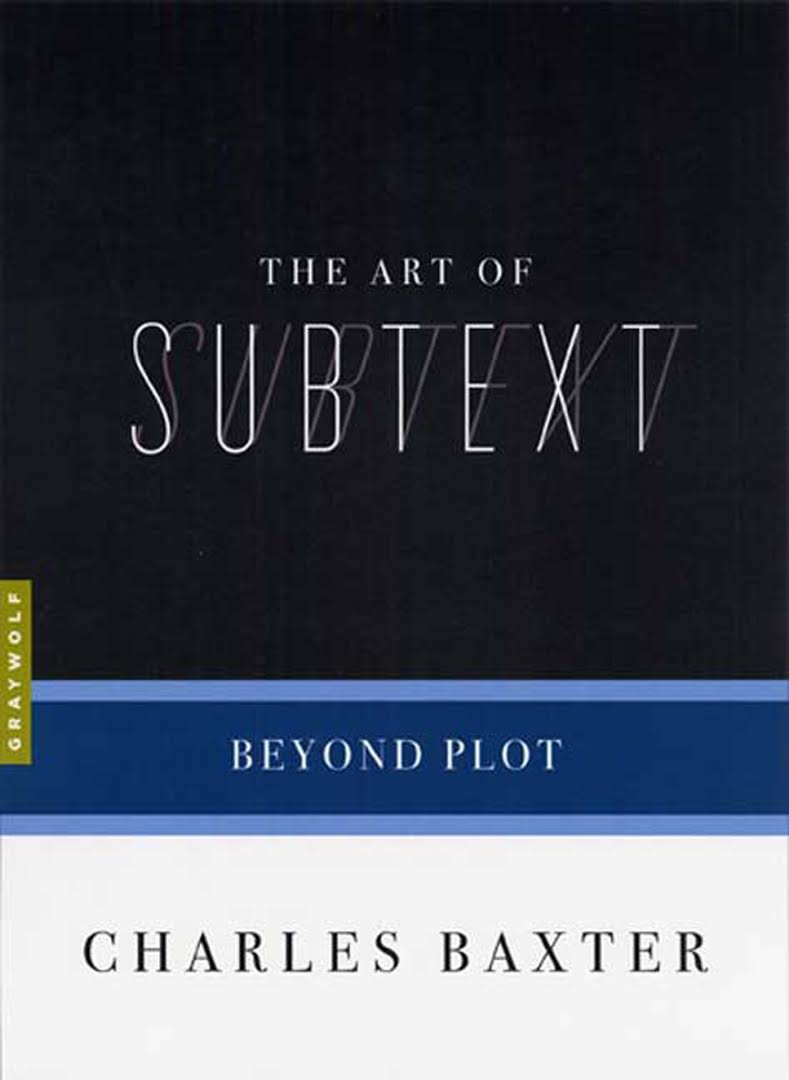
The Art of Subtext by Charles Baxter

the-art-of-subtextCharles Baxter is the editor of Graywolf Press’s The Art of series as well as the author of this installment. This is the second in the series that I’ve read (see The Art of History), and I’ll be reading two more this semester (Donald Revell’s The Art of Attention and Mary Karr’s The Art of Memoir).

The first thing to note about this book of writing craft advice is that it is strongly geared toward fiction. Where the others tend to cross genres (well, I suppose the Memoir one won’t), Baxter refers to fiction throughout, and takes his examples from the fiction of Dostoyevsky, Melville, Edward P. Jones and others. While this made for interesting reading, it did not suit my personal needs as a nonfiction writer very well. (I was disappointed, especially as excerpts from Baxter-edited The Business of Memory have appealed to me.) I was drawn to the topic of subtext because I aim for subtext, or subtle themes, in my own writing. Subtext means something a little different to Baxter in this book.

He calls it in his introduction “the unspoken soul-matter,” and divides his thoughts into 6 sections. “Staging” refers to dramatic placement of characters in scene (as in stage directions). “The subterranean” refers to the difference between what characters truly want, and what they say they want. This is an interesting concept to ponder for characters in nonfiction as well, although all of Baxter’s examples come from fiction. “Unheard melodies” inspects how fictional characters fail to pay attention: think about short attention spans and the way we “uh-huh” each other without really listening. This kind of ignored dialog, he argues, is a great place for subtext. “Inflections” and tonal shifts mark a movement from the literal to the suggestive; and he makes the point here that tone is sometimes everything. Example: the phrase “you’re really something” could be spoken in disgust or adulation. On the page, the reader needs tonal cues.

“Creating a scene” refers to the way that phrase is used in everyday life and not by writers: that is, not writing “a scene” (action taking place in time and space) but in the sense that arguing in public is called “making a scene.” Baxter asserts that fiction writers must have their characters make scenes in order to get their conflicts out into the open, or in other words, to pose the central conflict of their plot. Finally, he writes about “loss of face,” or the use (or choice not to use) characters’ literal faces to communicate through gesture or appearance. He makes a curious argument that the description of faces has fallen away in modern fiction writing, which is another interesting claim to investigate, although not one I’m particularly invested in at this time. (Please report back.)

My single favorite line of this book, and one I can easily take into my own work:

In truly wonderful writing, the author pays close attention to inattentiveness, in all its forms.

That one I will carry forward and ponder. Within it there may be an opportunity to ponder the differences (for craft purposes) between fiction and nonfiction in general.

In short, an involving little book of lit crit focusing on fiction, and thus not outside my interests; but not terribly useful for my own writing. Your mileage may vary.


Rating: 6 Chekhov stories.

MFA readings: a selection

Perhaps predictably, my rate of reading & writing for school threatens to outpace my work on this blog; and school is my priority, of course. Here I thought I’d just offer a quick rundown of what I’ve been reading lately and how it struck me. (Titles are bolded.) There may be more selection or digest-style posts to come.

My program director, Jessie Van Eerden (a most impressive woman & writer), put together a packet of portrait essays for a seminar she’s taught in the past, and shared this packet & her notes with me. I had a variety of reactions to these essays, which is totally okay: some will be more useful to my studies than others, and these reactions are all subjective.

I was most intrigued by

  • “Tracks and Ties” by Andre Dubus III;
  • “A Mickey Mantle Koan” by David James Duncan;
  • “Interstellar” by Rebecca McClanahan;
  • “The Passions of Lalla” by Michael Ondaatje; and
  • “A Good Day” by Jessie van Eerden,

and did some close readings especially of “A Good Day” and “Interstellar,” two profiles of the authors’ mother and sister respectively that include some autobiographical detail as well, and take certain organizing principles to help them tell the story of a whole person or a whole life in just a few pages: what a skill. I feel like maybe I’ve read “A Mickey Mantle Koan” before. It examines a beloved brother through a single object, one he never held in his hands, and integrates the language of both baseball and Buddhism, and lets the author do some more existential musing as well: ambitious, but executed. “Tracks and Ties” is another hyper-compressed profile, and “The Passions of Lalla” is especially interesting because it tells the life story of a person the author (apparently) never knew, through research, family mythologies and speculation. I hope to find time to go back to that one.

Of “Bessie Harvey’s Visions” by Will Woolfitt, Jessie writes, “Technically, this is a poem, but Woolfitt first wrote it as a lyric essay (same material sans line breaks).” I enjoyed reading it, and found the imagery and atmosphere involving, but I couldn’t see so clearly how to make this experience useful to my own writing.

Similarly, I was engaged by three longer profile essays –

  • “Present Waking Life: Becoming John Ashbery” by Larissa MacFarquhar;
  • “Notes on Pierre Bonnard and My Mother’s Ninetieth Birthday” by Mary Gordon; and
  • “Fuller” by Albert Goldbarth,

at least two of which have in common that they conflate or compare/contrast two very different subjects: Gordon swims between the art of Pierre Bonnard and her mother, as Goldbarth floats between Marie Curie and the dancer Loie Fuller. MacFarquhar more subtly lets her own character (herself) enter her examination of the poet John Ashbery. These again are worthy of study but didn’t feel right for my uses at this time.

By contrast, there were two essays in this packet that I just failed to enter at all. “The Shape of a Pocket” by John Berger and “Decreation: How Women Like Sappho, Marguerite Porete and Simone Weil Tell God” by Anne Carson felt too cerebral, too much work to wade through. This is not where I’m interested in going. In the latter case, the problem may be that I’m not drawn to the question of how these women “tell God”: and is Carson’s failure to bring me in despite my feelings about the subject matter her shortcoming, or a simple, blameless lack of connection? I may not be the right person to answer that last one.


up-in-the-old-hotelAs a separate project, I read essays from Joseph Mitchell’s Up in the Old Hotel, a big fat book I’ve had on my shelf for years. Saint Mazie and Joe Gould’s Teeth both refer to Mitchell’s work. He is famous for his decades of work for The New Yorker, and his portrait essays in particular.

I enjoyed every word I read–including the Mazie portrait, which I recognized from its reflection in Attenberg’s novel–but I settled on the title essay, “Up in the Old Hotel,” for my craft annotation. All of the essays I read showcased a seemingly neutral and nearly invisible narrator, and let the subjects portray themselves by use of dialog and speech, as well as physical descriptions, anecdotes and settings. The “Old Hotel” was remarkable because it told a lot more story than some of the straight portraits did; and its subject is not a person (although the central character Louie is very central) but a building, the old hotel. I focused in particular on the middle 12 pages of the piece, which offer a nearly uninterrupted monologue given by Louie, with minimal paragraph breaks and a wildly digressive style. Writers are warned against such techniques; but they work beautifully here. I think that’s because Louie’s voice is so strong and engaging; his style is so conversational that the reader buys into the delivery method completely; and because of Mitchell’s few but very strategic interruptions (Louie stops to make change, answer a customer’s question).

I recommend reading Mitchell if you get a chance.


the-situation-and-the-story
Finally, for craft, I read Vivian Gornick’s The Situation and the Story: The Art of Personal Narrative. This one didn’t work for me: in a word I’d say her succinct introduction and conclusion do the work her book wants to do, while the fatty middle part (two sections, on the essay and the memoir) read to me like wandering lit crit, and had little to offer me in thinking about my own work. Gornick has received plenty of positive response for this book, but my reaction was tepid. Her analysis of a number of essays and memoirs would have been more interesting to me if we had more reading in common, of course. But I am reminded of Christopher Bram’s The Art of History, which spent a lot of time giving negative or positive reviews that I did not always agree with, and which seemed so subjective that I was a little turned off. Yes, I see the irony as I give this negative, subjective review. But note that I am not here to sell you writing advice. By this point in the lifetime of pagesofjulia, I figure my readers know what we’re doing here together. (Thanks for sticking around.) If you loved The Situation and the Story or found it very useful for your writing, I’d love to hear your explanation of that experience. Not to argue, but to learn.

That’s my long post for today–now back to the program!

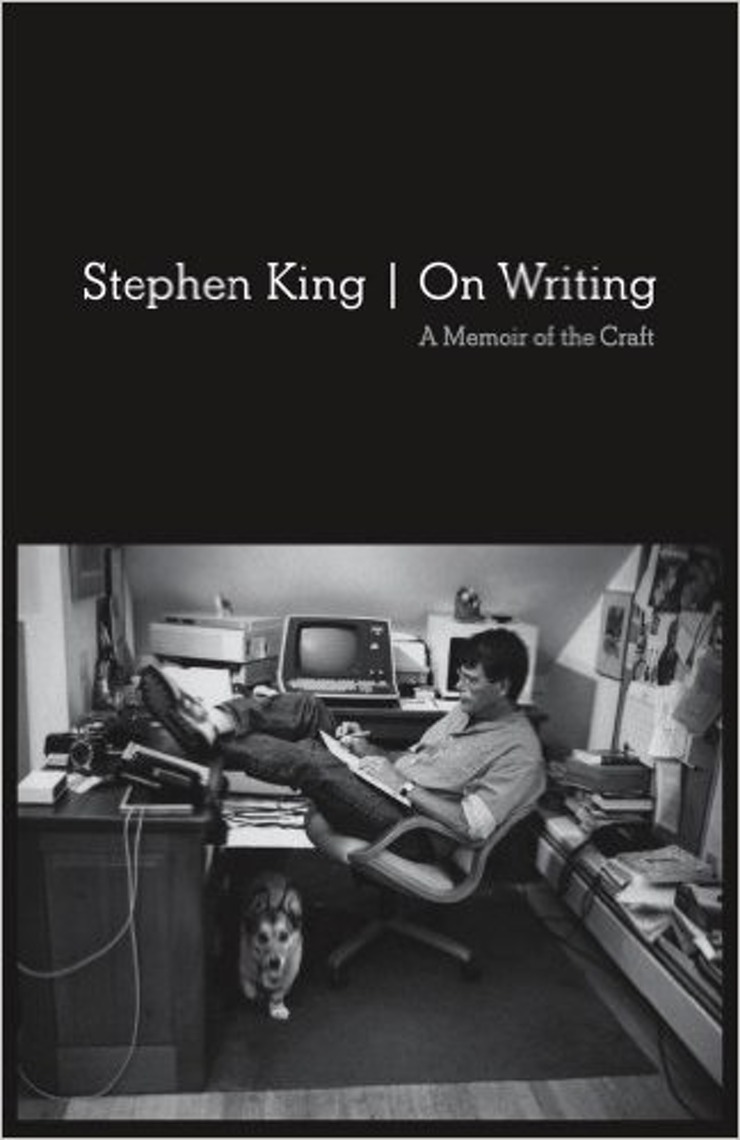
On Writing by Stephen King

on-writingThis book is required reading for all Stephen King fans, whether they aspire to be writers or no.

On Writing takes an interesting format. This is a “craft” book – instruction for writers – and the first of that category that I’m reading for the semester (though not the first I’ve read). But it’s not all craft; or at least not explicitly. Mine is a 2010 edition of a 2000 book, and it contains sections: first the First, Second, and Third Forewords; then a C.V., which is a sort of memoir but only about the writing or storytelling parts of King’s life. This spans some 80 pages and includes some writing advice along the way (including a little bit of marked-up early work). Next, “What Writing Is” (“telepathy, of course”) and “Toolbox” (as in, the writer’s, but with a nice metaphor referring to a real one). Now we get to the section called “On Writing,” which begins on page 141.

King’s rules are relatively simple: things like “read a lot, write a lot,” and some thoughts on how to separate writing from editing (get it all down on paper as quickly as possible, then leave it alone for a while til you can come back with an objective eye). He despises adverbs as much as the next wise reader/writer, especially when tied to speech tags. He touches on dialog and theme. Language is very important to King: this book is dedicated to Amy Tan, who told him it was okay to concentrate on that aspect of craft. (Some of us are thinking, duh.)

Even this writing-advice section is (perhaps necessarily) filled with details from King’s personal life, and his personal work style. This is why I say this book is an excellent read for anyone who loves King, whether they wish to write or not: it’s filled with the man, and the writer, himself, not to mention his characteristic storytelling style, even when giving advice. He writes characters, and the details of character and scene, so richly it’s almost multimedia; and yet we never realize we’re reading (yawn) exposition.

The next section of the book is “On Living: A Postscript,” and if you are indeed a King fan, you’ll notice that this book’s original pub date in 2000 immediately follows a certain 1999 event, when he was hit by a van while walking the back roads of Maine and nearly died. He relates this incident and his recovery in some detail here, and it makes a riveting story, of course, even though his reader knows the general outcome beforehand (the writer lives to write about it). The point here – though not belabored – is that living is an important part of writing. And, “Writing did not save my life–Dr. David Brown’s skill and my wife’s loving care did that–but it has continued to do what it always has done: it makes my life a brighter and more pleasant place.”

There are three “Furthermore” sections, to match the three forewords that started the book. These appendix-type bits are an example of a story before and after editing; a recommended reading list (totally unscientific, just what King has enjoyed reading), and a second reading list as addendum in this 2010 edition.

I haven’t even mentioned some of the writing advice I found most helpful here; for example, the concept of a piece of work as a found thing, a fossil, which then needs just excavation and polish, is especially applicable I think to nonfiction. (King admittedly concentrates on fiction – his genre – throughout, but that doesn’t mean there’s not plenty here for other writers.) And I loved his reverse of the gun rule:

There’s an old rule of theater that goes, “If there’s a gun on the mantel in Act I, it must go off in Act III.” The reverse is also true; if the main character’s lucky Hawaiian shirt plays a part at the end of a story, it must be introduced early. Otherwise it looks like a deus ex machina (which of course it is).

The best of Stephen King is here, and with some good writing advice to boot. Don’t miss this one.


Rating: 9 Very Important Books.

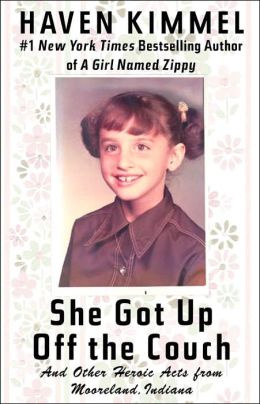
reread: She Got Up Off the Couch by Havel Kimmel

You’ll recall that I really loved this book when I read it in 2013. (First review here.) I reread it recently as part of my first semester reading list (see new tag here, many entries to come!). Students’ reading lists are individual, created by the student and faculty advisor together, so Katie Fallon and I came up with my list as a team.

couchI loved this book again. Havel Kimmel’s mother is far from perfect; she struggles to hold herself together and care for her children and family in a way that her society deems correct; she appears ill-kempt. But in the course of this book, in Kimmel’s youth, she also learns how to drive a car (and buys herself one), enrolls in college and goes on to graduate school, gets a job as a teacher, and goes through a divorce. She struggles, but she keeps it together, accomplishes these large goals, and as this book’s existence shows, her youngest daughter loves her very much through it all. In other words, she’s our favorite kind of hero: challenged, imperfect, but eventually victorious against long odds.

So, a great story. But more than a great story, because Kimmel also presents it cleverly, with enormous humor (even when terrible things happen, like fifth-grade Kimmel’s double compound fracture with shattered bone extruding through the skin) and the kind of detail that makes the whole thing alive to her readers without ever feeling overloaded with descriptions. How does she do it? This is what I’m here to learn on this read. Because my stories are only as great as they are – I can’t control that part – but I can control how I tell them.

I’m still learning this kind of reading, how to read for the craft, to take it apart and see how it works. But here are some things I see:

  • Kimmel’s book is about her mother. The title and Preface make that clear. But many chapters hardly mention her, or don’t mention her at all. Much of Kimmel’s story characterizes mom Delonda without even touching on her. Who she married, what her children and family do when she’s not around, where she isn’t – all these things serve the development of Delonda, which I think is really cool.
  • Kimmel is hilarious. (Here, I don’t have much hope for myself; I’m afraid I’m missing that funny bone…) In the incident I mentioned above, the double compound fracture etc., she uses a totally hilarious doctor to add much of the humor in that scene. Was her doctor really that hilarious? I don’t know. Maybe she was gifted a comic doctor; or maybe she knew how to write his dialog to play that up.
  • Her POV rarely departs from that of the child she was in each scene. She stays in the past tense, but her conclusions, what she sees and what it means to her, stay in character. This often yields humor, because her audience knows more than her narrator does. It can yield poignancy in a way that is just honest without being precious. And it plays up the few moments when adult Kimmel comments on her past: these are rare enough that we pay extra attention.
  • A few chapters take unusual formats. There are lists; a transcript of an audio recording; rules of a game she plays with her friends. This kind of formal play (that is, playing with form) can be dangerous – it can distract, or call attention to itself, as in ‘look how clever I am’ – but I think it serves her well here. For one thing, it’s used sparingly. For another, the formats really do feel like they contribute to the narrative she wants to tell. I think a transcript of an audio recording is a great idea, because it’s in the moment. It’s real.
  • I spent some time focusing on the short chapter “Brother” that biographies her much older, and therefore mostly absent brother Dan. It’s a little bit of a departure from the rest of the book, in tone as well as subject, and I found it a charming encapsulated profile.

This is just the beginning of what I have to learn from Kimmel. Exciting, right? If you haven’t read her work yet, you obviously have my recommendation. I love everything she’s written, in fact, as you can see here.

Stay tuned for more reading-list musings to come.


Rating: still 9 lines to be close-read.

Safekeeping by Abigail Thomas

safekeepingThis book has been recommended to me several times, and now I can see why. It’s a memoir, covering most of Thomas’s life and emphasizing her three marriages and children, especially her second husband who died years after their divorce. But it’s a memoir in fragments. It doesn’t try to be comprehensive, which is a wise choice, since we can never tell all of a life, perhaps least of all our own (hmm). Instead, she gives us a number of crystalline scenes or anecdotes, which together paint a picture, necessarily incomplete but rich.

Thomas’s language is rich, too, lyrical and tangible in its sensory detail, but also rooted in the dirty and the everyday. These details can be sublime, but often aren’t the ones we’d think of when seeking the sublime: “Watermelon rind. Styrofoam. Broken clocks and chair legs.” Mattress shopping, table settings, sawdust on a rug. Chapters shift perspective, using first, second and third person POVs. In the second person, Thomas directly addresses her late second husband. I found it interesting to examine her choice of POV throughout the book and its effect: that second-person addressed to a specific person feels the most intimate, especially since the reader knows that that specific person is absent. Third person feels most remote, and she often uses it when (I interpret) she needs distance from her subject.

Safekeeping is a slim book, easy to read in one sense: you could flash right through it and walk away with a sense of Thomas’s personal history. There is plenty to sink into, though, too, and those may be the best kind.


Rating: 8 apple cakes.

Bonus: here’s a look at my semester’s reading, now that I have it all compiled. Hints of what’s to come!

click to enlarge

click to enlarge