The Way to Rainy Mountain by N. Scott Momaday, illus. by Al Momaday

I was first told these stories by my father when I was a child. I do not know how long they had existed before I heard them. They seem to proceed from a place of origin as old as the earth.
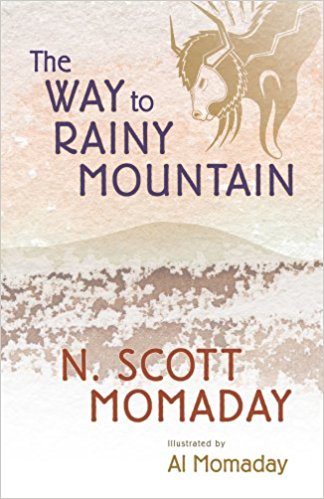
A short book, recommended to me by Kim Dana Kupperman as a way of considering an oral tradition. N. Scott Momaday is a Kiowa Indian, born in Oklahoma but raised on reservations in the southwest. He travels home to Rainy Mountain in Oklahoma to visit his grandmother’s grave, and this book reflects his journey as well as the original one the Kiowas made, from Yellowstone through the Black Hills, and south to the Wichita Mountains. This book is a record of the legends, the orally passed-down traditional narrative of a tribe and a culture now passed on. It is told in three voices. The first is the ancestral voice of the oral tradition (“the voice of my father,” Al Momaday, who also illustrates the book); the second, a historical commentary; and the third, Momaday’s own voice “of personal reminiscence.” Each short section separates these voices from each other visually:

It is a spare, slim book, under 100 pages and with lots of white space as in the spread above, and with illustrations to space things out further. It is therefore just a sketching (no pun intended) of a history, and somehow this feels right, since as Momaday points out, “the golden age of the Kiowas had been short-lived, ninety or a hundred years, say, from about 1740. The culture would persist for a while in decline, until about 1875, but then it would be gone…” His ability to piece these stories together is a rare one, and the record is necessarily scanty. But the scraps that we do have here are wise and hold a certain dignity.

They also hold a sense of place. I loved lines like, “Houses are like sentinels in the plain, old keepers of the weather watch.” It somehow makes sense to me that Momaday would have so much to say about a place he feels tied to without actually inhabiting; that it’s an ancestral belonging.

Once in his life a man ought to concentrate his mind upon the remembered earth, I believe. He ought to give himself up to a particular landscape in his experience, to look at it from as many angles as he can, to wonder about it, to dwell upon it. He ought to imagine that he touches it with his hands at every season and listens to the sounds that are made upon it. He ought to imagine the creatures there and all the faintest motions of the wind. He ought to recollect the glare of noon and all the colors of the dawn and dusk.

In terms of the oral tradition, I noticed that the storytelling style in those parts was simple, and often involved shifts that we are unaccustomed to in the written stories; but when read aloud, they sound more like the way we still tell stories today. “Bad women are thrown away. Once there was a handsome young man…”

Simply told, easy to read, but thoughtful and thought-provoking, and a way into stories that we don’t have much access to. As Momaday writes himself in the preface to this edition, twenty-five years after the first: “One should not be surprised, I suppose, that it has remained vital, and immediate, for that is the nature of story. And this is particularly true of the oral tradition, which exists in a dimension of timelessness.”


Rating: 7 black-eared horses.

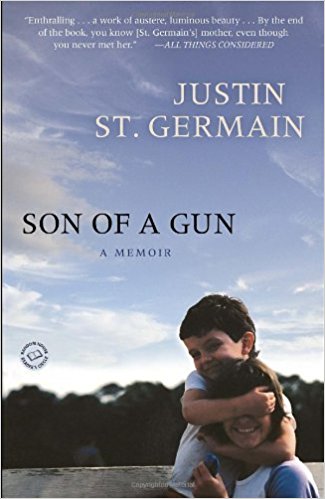
Son of a Gun by Justin St. Germain

Justin St. Germain’s Son of a Gun is a compelling, heart-breaking piece of personal narrative, and it is told beautifully, with restraint and with artistry and structure. The first observation is one any reader might make; the second is the more subtle observation of a reader looking for writing tricks. This is a book that works beautifully on both levels.

The narrator was raised by a complicated woman named Debbie. She was a soldier, a strong woman who made impulsive decisions and charged ahead, took care of herself and her two sons through all kinds of hardship; she had poor judgment in choosing romantic partners, was married five times with many relationships in between, for which she was harshly judged in turn. When Justin was 20, she was murdered by her most recent husband, Ray, a former cop with the requisite mustache and mirrored sunglasses. Until then, Justin had thought Ray the most harmless one of the bunch.

This memoir is the story of Justin’s mother’s death: his shock and grief, his anger, the violent end of Debbie and, later, of Ray. It ranges between these individual instances of gun violence and others, personal and societal, as Justin visits with Debbie’s former partners, goes shopping at a gun show, and cycles back over and over again to Tombstone. Oh, did I leave that part out? Justin and his brother Josh were raised in Tombstone, Arizona, a town whose very existence depends on the legends of Wild West shoot-outs.

I appreciate St. Germain’s title, because it reinvents an old and meaningless saying in a fresh new way: making the point that he is indeed a son of a gun, of a gun culture that engineered his mother’s demise. I also appreciate the way he handled his own character, the narrator, in a spare way that acknowledges (for example) the problematic way in which the 20-year-old reacts to his mother’s murder. He does not always behave well, but who would?

It’s a hell of a sad story, one that recalls my recent read Love and Death in the Sunshine State by Cutter Wood (review to come), and A Woman on the Edge of Time. It’s a hell of a story, in the first place, and at the same time, tragically, nothing out of the ordinary: a 2017 CDC report concluded that nearly half of female homicide victims are killed by a current or former intimate partner. St. Germain does deal with this larger context, although his primary concern (understandably) remains personal.

A hell of a story, but also artfully told. I often think that creative writing, the kind I’m studying, has two parts: an interesting story, and the artful telling of it. A book can become successful, can please or entertain and sell, with either one or the other of those elements, but the best books have both a good story and a good telling. One of the key features of this book, I think, is the narrative restraint. Anytime a writer handles a story this close to home and this fraught–emotional, violent, graphic–it’s difficult to keep a calm perspective, and yet not be cold and distant. St. Germain walks that line. Another strength is the weaving in of the external, if you will, theme material: the history of Wyatt Earp and the shootout at the O.K. Corral (which St. Germain informs us actually took place “in a vacant lot to the north, between a back alley and what is now the highway. But try putting that on a T-shirt”). This is a classic gift to the writer from the universe: that he was brought up in Tombstone, that Tombstone and Wyatt Earp and the O.K. offer such a backdrop for his story and his reflections on it. This braided-in information is almost too perfect for his story; but this is why we say fact is stranger than fiction. It allows a very neat context for the narrator to think about not only his personal tragedy, but the larger cultural implications.

I was riveted as I read this book, all the way through in a day, because this story has momentum, suspense and crafted pacing. I was heartbroken for the characters, and struck by St. Germain’s gestures at the larger world. It’s a very fine book.


Rating: 8 arcane alphanumerics.

Draft No. 4: On the Writing Process by John McPhee

Strong words, but I’m going to say it: I think this is the most enjoyable craft book I have read. Strunk & White and Stephen King are very good but McPhee wins it.

Eight essays about writing, previously published in The New Yorker and only one of them previously collected (“but to a far greater extent [it] belongs here”). McPhee is funny, self-deprecating, practical, and wise. He tells stories! I love the anecdotes, such as the one that begins “Frame of Reference,” and makes the point that a reference must always be chosen with an audience in mind. (Greta Garbo will not be meaningful to kids born after 2000; Britney Spears will not be meaningful to my grandmother.) He gives good, down-to-earth writing advice, unsurprising, as this skill has been honed by decades of teaching experience. McPhee’s students populate these essays, too, some of them bumbling and some of them accomplished, and all of them treated gently. He relates tales of interviews that went easily (Woody Allen) and less easily (Jackie Gleason). The tone, McPhee’s writing voice, is exceptionable. I find him just quintessentially likeable. He is funny, humble, and instantly recognizable.

“Progression” is about linkages, and fits nicely with the following essay, “Structure,” on that topic. “Editors & Publisher” is something of a series of profiles of those McPhee has worked with, with some advice and wisdom about how the work works. “Elicitation” is about interviews (those great stories), both anecdote and how-to. “Frame of Reference,” with all its details from life and history and McPhee’s writing and reading, was one of the most enjoyable essays for me. “Checkpoints” is about fact-checkers, again with such an engaging proportion of fascinating story and practicality. “Draft No. 4” is about the writing process and the writing life: how drafting works, and how to hopefully retain sanity. “Omission” is about brevity, and cutting, and allows McPhee to finish both this essay and the book with a humorous line spoken by General Eisenhower: this is a writer who knows how to pick a quotation and let it stand.

McPhee gave me some things to ponder: his astonishing method of finding a structure first and them a subject to fit it; his method of note-taking and outlining; his drafting. And I will cherish forever one-liners like, “If you kill a widow, you pick up a whole line” (not about homicide at all, but about “greening,” a topic after my own heart). I will keep this book handy for both its solid advice and its entertainment value. I’ll be recommending it to everyone I know; and I can’t wait to read more McPhee.


Rating: 9 mustaches.

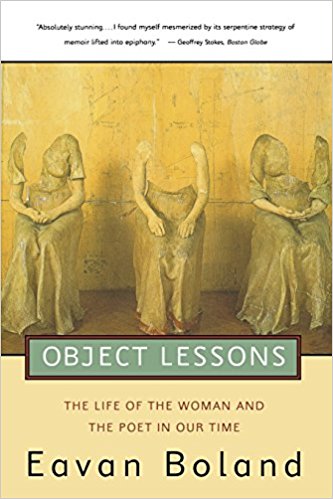
Object Lessons by Eavan Boland

I recall studying a poem in high school by Eavan Boland titled “The Black Lace Fan My Mother Gave Me.” As I approached this semester’s critical essay, one of the talented faculty in my program, Diane Gilliam, recommended this work of prose, for my topic on objects. Diane’s words, to the best of my memory, were, “Every woman artist needs to read this book.” I’m so glad I did; especially when I got to page 231, where “The Black Lace Fan My Mother Gave Me” makes an appearance, as the only poem of her own that Boland chooses to feature. Synchronicity.

Object Lessons is an examination of the conflict Boland has experienced between her self as poet and her self as woman, with the overlay of Irishness on it all. She leaves Ireland at age five, to a London that largely rejects her kind, to return to her home country in her teens and to study poetry at Trinity in Dublin, a charged literary atmosphere. It takes some time for this young person, still discovering herself as a woman, a sexual creature, and a person of a nation, not to mention as a poet, to see the holes in the legacy she has inherited: there is no place for her in this history. “It was not exactly or even chiefly that the recurrences of my world–a child’s face, the dial of a washing machine–were absent from the tradition [of the poet’s life], although they were. It was not even so much that I was a woman. It was that being a woman, I had entered into a life for which poetry has no name.” Names are important. “Every art is inscribed with them. Every life depends on them.” Further, about the poet-versus-woman tension: “For anyone who is drawn into either of these lives, the pressure is there to betray the other: to disown or simplify, to resolve an inherent tension by making a false design from the ethical capabilities of one life or the visionary possibilities of the other.”

Over the course of this book, she lays out the problems she found and her own best efforts at solving them, a job she acknowledges is unfinished. But she hopes that a book like this helps future women poets, by giving them a starting point, something else to point to. Heartbreakingly, by contrast, she relates that the first woman poet she knew of as a young woman was Sylvia Plath, and that name she knew first as a suicide, not a poet at all.

I was also very interested in the way this memoir started: with the missing, imagined, scantily sketched biography of her grandmother. The narrator explores the history, the meager records of the woman; she imagines; and she travels to view a grave and a hospital. It’s a lovely study, the story of someone absent, and a consideration of what we get from an ancestor we can’t really know.

Boland has plenty of good thoughts about place, sense of place, and nation as aspect of our selves and our writing selves. She makes much of the Irish poetic tradition to conflate the feminine and the national. Her musings can get pretty cerebral and abstract, so this memoir took some slow, thoughtful reading; but I think it’s worth the time. Also, I am very interested in Boland’s assertion that she structured the book like a poem: “in turnings and returnings.” I have more thinking to do.


Rating: 7 high heels tipped with steel.

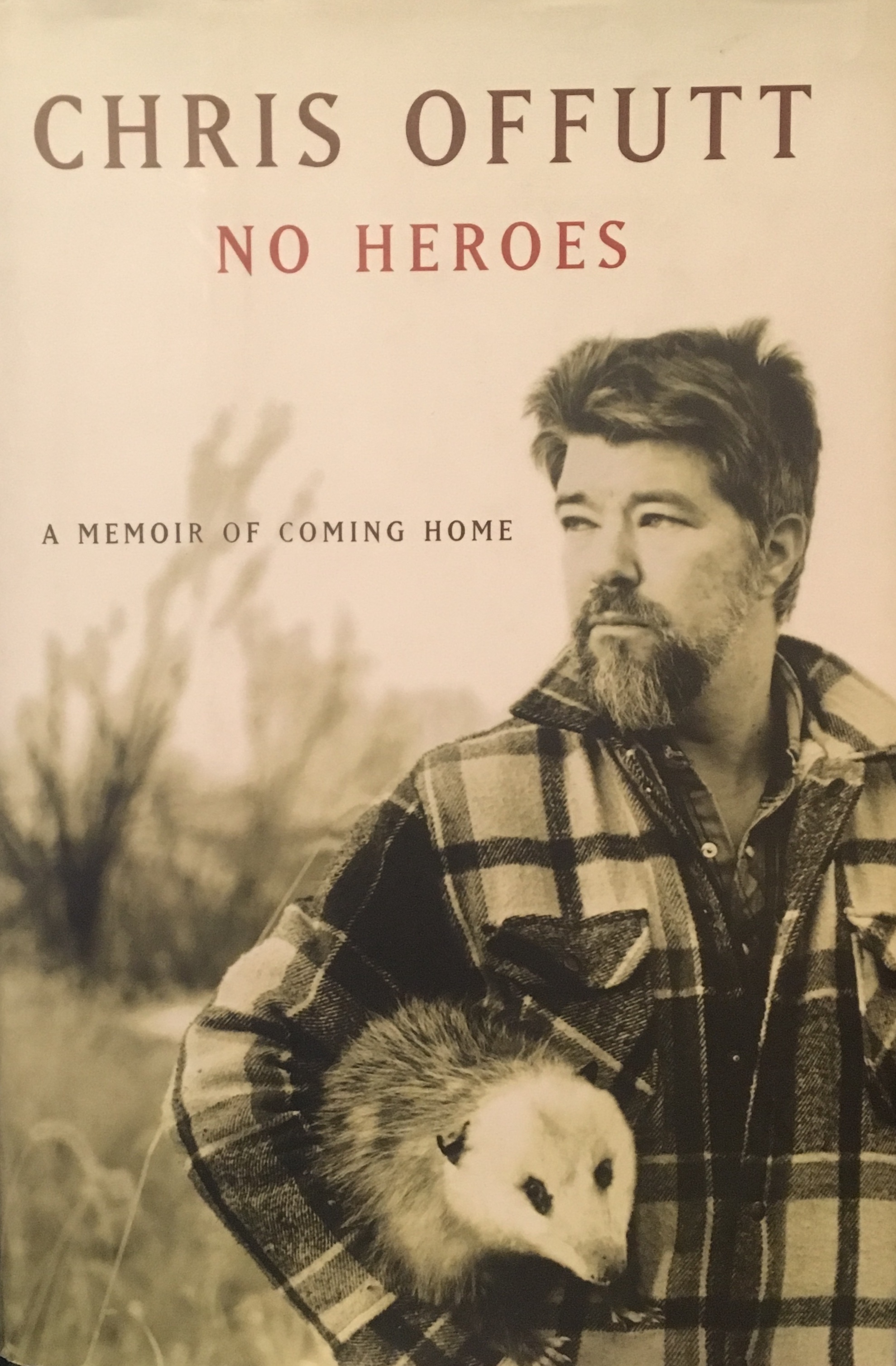
No Heroes by Chris Offutt

No matter how you leave the hills–the army, prison, marriage, a job–when you move back after twenty years, the whole county is carefully watching. They want to see the changes that the outside world put on you. They are curious to know if you’ve lost your laughter. They are worried that perhaps you’ve gotten above your raisings.

This is beginning of No Heroes. Only the prologue retains this second-person perspective, which I think would have gotten difficult for the length of the book, but it’s a perfect intro: it brings immediacy, in that you are the one facing these challenges; and it offers a dreamy, literary take on Chris Offutt’s rough-edged subject and setting. This prologue takes the form of an instruction manual (“to do this, do this”): how to return home, if home is this specific place. It concludes:

You are no longer from somewhere. Here is where you are. This is home. This dirt is yours.

It’s a perfect beginning.

This book is a close cousin to Jeremy Jones’s Bearwallow, which comes as no surprise because Jeremy recommended it to me.

It’s a fine book. In blurbs on the back, Offutt’s style is compared to that of Hemingway and Raymond Carver: strong words, but I can see the comparison. Offutt tends toward short, declarative sentences, except when he doesn’t (like Hemingway, a man perfectly comfortable with long, convoluted sentences and full-blooming metaphor when he feels like it, despite a reputation to the contrary). That is, the prose is mostly simply put together, undemonstrative, but he also knows how to turn a surprising or beautiful phrase at the moment we least expect it; the rarity of such lines adds to their impact.

Offutt’s story, like Jones’s, is of going away and coming back. Both men are from Appalachia. Offutt is from the hills of northeast Kentucky, where he went to elementary school, high school and college within ten miles, and only realized later how unusual this was. As a troubled twenty-year-old, he’d left the hills. He returns as a forty-year-old, having collected an education, written books, married and had two boys, lived and experienced lots of places. He’s back to teach at his alma mater, a humble school where he had worked maintenance while a student, a paradoxical foot-in-two-worlds experience that his cohorts on both ends–work and school–had struggled to accept. “It was more of a high school with ashtrays than a genuine college,” Offutt writes, but that criticism sounds less nuanced in isolation than it does on the page, in the midst of his obviously tortured love for this place.

In the course of No Heroes, he navigates his return to this place, whose dirt and leaves and birds he passionately loves. His parents still live here, but his love for them is less easy. His wife, Rita, and their two sons have some trouble adjusting to a place that is not theirs. Offutt came home hoping to be a hero to students like the one he was: talented but without role models, ready to slip into crime more easily than into art. The title foreshadows the end of that plot line, of course.

But there is another plot line! And it’s a doozy, complicating the story of the homesick Appalachian who has made good and therefore alienated himself. Offutt’s in-laws are finally ready to let him tell their stories. Both are Polish Jews and survivors of a string of Hitler’s concentration camps. You think you’re homesick? The narratives of Arthur and Irene humble us all. The flashback parts are different from the whole of the book: Arthur and Irene’s chapters are told in their own voices (Offutt recorded their interviews), and his own chapters told in his own voice; occasional scenes give dialog representing the interviews themselves. While a bit jarring at times (watch those chapter titles and they will guide you; I have trouble focusing on titles, for no good reason), even this effect–the jarring in and out of a painful past–suits the subject matter. It is Arthur’s admonishment about telling the complicated story, that even victims have flaws, that titles the book: “Remember, Sonny, no heroes.”

I really enjoyed this book. It’s very rooted in a beloved place, and contains two stories equally well-told. For parents, for Appalachians, for anyone facing the tension of succeeding out of the bounds of their upbringing, for the homesick, this is an engaging memoir.


Rating: 8 “crimson maple leaves with green veins that pulsed in mourning for the branch they’d left.”

Transfer of Qualities by Martha Ronk

What an extraordinary, slim little book. Many thanks to my classmate Andrew, who I think was the one to recommend it for my critical essay topic about objects.

Martha Ronk is a poet, so insert my usual hesitation about making intelligent commentary on a genre I’m not terribly comfortable with. This book is organized in three parts: Objects, People, and Transferred Stories (in the table of contents) or Transferred Fictions (within the text). That last discrepancy, I assume, is an editing error; but I kind of enjoy having the two options to choose from. On the other hand, my copy transposes a number of pages in the middle of the book: clearly an error, and a very annoying one, and I keep getting books with missing pages or transposed pages or whole sections replaced by duplicate sections; what gives? Anyway–I did have all the pages, and thank goodness, because they are good pages.

The section “Objects” is further subdivided into “Various Objects,” “The Book,” “Photograms,” and “Collecting,” and the first subsection is all prose poems, a breed of poetry I feel more at home with: just one or two paragraphs of lyric observations, and right up my alley, topically. I loved “A Glass Bowl” and “A Lost Thing” especially. As the book continues, prose poems give way to short essays, but there remains a dreamy note of not-quite-reality, and an attention to lyricism, rhythm, and sound. These words deserve to be read aloud.

Can I get away with sharing one of these prose poems here? If I choose a very short one? This is “The Cup,” the very first item of the book.

The cup on the shelf above eyelevel, the reach to get it for the first morning glass of water, the running of the water now clear after the silty water yesterday, the large dragonfly drowning in the cup, now in the bottom of the sink, and the sudden understanding of the whirr that edged the room last night, the unlocatable whirr that stops and starts and finally falls still as the lights are put out and what is left is the neighborhood barking, unidentified sounds pushed to the edge of consciousness, the sudden storm in the middle somewhere, and the knowledge that there must be a reason for what is now silence, a reason lodged in the absent muted clatter, as in the sudden morning appearance of venational wings, each the size of a thumb, folded inside the cup from the top shelf.

Go ahead, read it aloud.

Ronk quotes heavily from other writers, most especially Henry James (blurbs call James the “patron saint” or the “major genie” of this work). She studies various objects that move her, and a number of these are works of art–sculptures, paintings–making this partly a work of ekphrasis, recalling Doty (again and again). She has a piece called “An Obsession with Objects”–yes, I see you seeing me. She slips in Lolita and Posada (I look up at the Posada print on my wall), as well as her mother’s death and her own study of kung fu and fear of mortality; but it is the objects, always, at the center. The title concept is the transfer of qualities between objects, people, and places, an evocative thing to consider, especially for a person with my obsessions. She has a special care for bowls, and for blank space, for the air contained in bowls and other voids. I love it.

I found lots to love, to quote, and to save for future work, both critical and creative. At just seventy-nine pages, this book came as a small but powerful gift to me, not unlike (again) Still Life With Oysters and Lemon (also by a poet–hm). If you share my interest in “stuff,” by all means, make this a point.


Rating: 9 frames.

part two of two-part review: Earth Works by Scott Russell Sanders

Following up on part one.


Thanks for bearing with my lengthy review. I’m picking back up with a brief (!) list of a few of my favorite essays, in order of appearance in this collection.

  • “Doing Time in the Thirteenth Chair,” about being an alternate juror in a small-time drug-dealing case starring a confidential informer
  • “The Inheritance of Tools,” previously mentioned, about his late father’s legacy in the form of tools, literal and figurative
  • “Staying Put,” about attaching oneself to place, weathering the storm
  • “Letter to a Reader,” a life history, as man and as writer
  • “Buckeye,” my longtime favorite of his, more father’s legacy in objects
  • “The Common Life,” about what is basic and good in life, like making bread with loved ones
  • “Mountain Music,” about a fight with his teenage son that opens his eyes to a mistake he’s made (and inspires an essay collection)
  • “Silence,” an interesting one to appeal to me because it references faith and religion, topics that usually make me twitchy; about the Quakers’ silent worship
  • “A Private History of Awe,” about the things he finds moving in the world
  • “Buffalo Eddy,” a visit to a sacred place that inspires related musings, in a structure I appreciate: linking of concepts reminiscent of Eula Biss
  • “Mind in the Forest,” similar contemplation based in place.

There were other essays that gave me trouble, too. “The Uses of Muscle” makes some efforts (“I have a much greater appreciation now for the bodily strength of women”) but ultimately returns repeatedly to ideas of men using their muscles, or not, and the societal concerns with each possibility: “Fortunately for the peace of society, many boys play sports…” “How might boys and young men–or, for that matter, men of any age–use their muscles for something besides recreation or mischief?” You know this made me grumble. “Honoring the Ordinary” responded to certain critiques of the memoir genre in a manner I found a little broad and simplistic, but I should forgive this because Sanders’s audience for such writing was presumably a mainstream less tuned in than I am to this topic. But then the notes say that it was composed for a conference on the art of the memoir, so, hm. (On the other hand, both the early “The Singular First Person” and the later “Letter to a Reader” do a better job with this subject, in my opinion.)

If I nitpick, it is only because this essay collection engaged me so. The overall impression is excellent; if there are essays here I need to interrogate, it’s only because the whole is so impressive that I hold Sanders to a high standard. From another writer, “The Men We Carry In Our Minds” would have turned me away entirely, and I wouldn’t have finished the book.

Do I still have your attention? May I share a few favorite lines, for final good measure?

From “The Inheritance of Tools”:

I look at my claw hammer, the distillation of a hundred generations of carpenters, and consider that it holds up well beside those other classics–Greek vases, Gregorian chants, Don Quixote, barbed fish hooks, candles, spoons.

I ardently love a list, and Sanders is good at them. He chooses his items for alliteration, juxtaposition, sounds, and themes, with both poetry and meaning-making in few syllables. This concept of classics is one of the finest lists in this collection.

From “Staying Put”:

How can you value other places if you do not have one of your own? If you are not yourself placed, then you wander the world like a sightseer, a collector of sensations, with no gauge for measuring what you see. Local knowledge is the grounding for global knowledge.

From “Wayland”:

There is more to be seen at any crossroads than one can see in a lifetime of looking.

This for me recalls Annie Dillard, or Terry Tempest Williams, down on hands and knees, really looking into the grass where a casual looker would say there was nothing.

My encounters in Wayland shaped me first as I lived through them, then again as I recalled them during my visit, and now as I write them down.

In “Honoring the Ordinary,” I was struck by a concept which matches one from Still Life With Oysters and Lemon. Referencing his own earlier book, A Private History of Awe, Sanders writes,

I wished to honor ordinary experience, not by making it seem exotic, but by peeling away the rind of familiarity that keeps us from seeing the true power and beauty and wonder and terror of it.

Doty writes:

These [still life] paintings reside in domestic, physical, fleshly space… it is so startling… that everything in this up-close, bodily space is delineated with such clarity. We’re accustomed to not seeing what is so near to us; we do not need to look at things that are at hand, because they are at hand every day. That is what makes home so safe and so appealing, that we do not need to look at it. Novelty recedes, in the face of the daily, and we’re free to relax, to drift, to focus inward. But in still life the familiar is limned with an almost hallucinatory clarity, nothing glanced over or elided, nothing subordinate to the impression of the whole.

(Bold emphasis is mine, italics are his.) When I come across the corresponding line in Sanders, then, I’m struck not only by the sentiment, such a neat parallel to Doty’s, but also by the turn of phrase, the rind of familiarity, so evocative of Doty’s beloved lemons and their luxuriant, sensual peels.

From “Buffalo Eddy”:

We cannot know what moved those vanished artists to carve their language into stone, but I imagine it is akin to the impulse that will move Bill to write a poem about our visit to Buffalo Eddy and will prompt me to write this essay. Such writing is like breathing, an exhaling that follows inhaling, as natural as that.

That is as lovely and natural an ending as any for my thoughts here. Forgive my quibbles. Sanders is on the whole an essayist to admire and emulate. I appreciate his subject matter and the frank, humble, wondering nature of his prose: a man after E.B. White, even, with perhaps more gravity and less humorous witticism. I’m a fan.


Rating: 7 crows.

part one of two-part review: Earth Works by Scott Russell Sanders

For other Sanders work, see Pops’s review of Staying Put and my review of Writing From the Center.


At this point in my semester, I’m beginning to work on a first draft of the third semester project in my MFA program: a critical essay, or longform investigation of the strategies of writers I admire that might inform my own work. (For more about the critical essay, you can take a look at pages 42-44 of the student handbook here, and follow this tag.) My essay topic is the use of stuff, things, or material objects (new tag!) as a way in to a subject or a character. With this topic in mind, I approached this most recent (2012) collection of Scott Russell Sanders’s work especially interested in a few essays in particular. I’d intended to only sample from the rest; but I couldn’t put it down.


Earth Works is a must-have collection for the Sanders fan. He carefully selected the 30 essays here, including nine that have never before been collected. I’ve read some of these before, but remained mesmerized by both content and style regardless of my familiarity. Sort of like with that Beard essay I so revere, “Buckeye” remains a feat to appreciate on every reading, even six or eight readings in.

A brief preface places these essays in some context in Sanders’s life and aims, and then they unfurl, in mostly chronological order by date of composition (some exceptions for the sake of juxtaposing topics), and with few revisions to their original published form (“for better or worse”). I really appreciate that the first essay, composed in 1987, is “The Singular First Person”: it lays out Sanders’s perspective about the personal essay, its form and purposes. It’s a smart way to start, because it offers some idea of what he thinks he’s up to, and therefore some promise of what is to come. A humble man speculates on what he finds in the world, in the hopes of asking big questions: “Who am I? What sense can I make of this inner tumult? How should I live? Does the universe have a purpose? Do we? What finally and deeply matters? What is true, and how can we know?” (From a later essay, “Letter to a Reader.”) Sanders is concerned with nature and the natural world, but resists the term “nature writer” (as did Edward Abbey), because he is most concerned with interconnectedness: human beings with one another, with the natural world of which we are mere part. He wonders about spirituality, about our place in the cosmos, about the sadness of consumerism and war, the destruction of the Earth; but he has a great love for the world, too, and allows that to shine through.

This reading, my deepest exploration of his work, confirms for me that Sanders is one of my favorite essayists. He marries content that is meaningful and sympathetic to me with style that is both lovely to read, and nearly invisible. As I’ve said before, the best writing often doesn’t even feel crafted, but that’s when you know it was hardest to craft. These essays are good examples of that idea.

I came for three essays in particular, as I said. “The Inheritance of Tools” uses stuff or things to get at a character: Sanders recalls his father through the tools that father passed on to him, along with the knowledge of how to use them; this essay is a way of processing his grief on his father’s death. “Under the Influence” is about the same father, but in this essay, the father is an alcoholic, who causes his family great pain. The two fit interestingly together because they’re about the same man from two very different perspectives. Finally, “Buckeye” continues the grieving for the beloved father, through a series of objects, beginning with the title buckeyes but traveling through other material things. Because all three attempt to profile a parent, and deal with the relationship between writer and parent, and because two of them do so through objects, they offer a number of things to me. For the purpose of the critical essay, I’ve also got my hands on a talk Sanders gave in 1990 at the University of Iowa, about the crafting of “The Inheritance of Tools” and “Under the Influence.”

As I said, these were not the only standout essays for me, and I kept reading for the pleasure of it beyond the three essays I’d intended to study. It wasn’t all good times, either, though. An early (1984) essay, “The Men We Carry In Our Minds,” made me angry. Sanders means well, and he is good to the women in his life (wife and daughter) in many ways. He considers himself a feminist. This essay means well, too, but it makes some major blunders, when he concludes that his own upbringing in relatively impoverished, working-class conditions make the challenges he’s faced the same as those faced by women. I am taken back to an excellent article I read years ago, titled “Explaining White Privilege to a Broke White Person.” The idea here is that you can be really poor and still enjoy privilege as a white person, because at least your race isn’t contributing to the limitations or constraints you face. The same principle could be applied to Sanders’s arguments. You might have been poor, you might have been limited, but you didn’t face the glass ceiling, the sexual harassment, the wage gap, the rape culture, or the insidious, invisible assumptions of incompetence that women did and do face. Concluding that you thoroughly understand the predicament of women when you don’t is arguably more problematic than not attempting to understand in the first place; congratulating oneself and turning away is troubling, because it makes you something of a false ally. His blindness to this problem gave me a lot of trouble. The HuffPost article was published in 2014, and Sanders’s essay, again, in 1984. But since he’s reprinted it in 2012 without feeling a need for further comment, I think he still needs to go read the HuffPost piece.

I won’t forget the blind spots exposed in this essay. But it’s to the great credit of the rest of this book that I still love it. Because there is indeed much to love here, not least the previously uncollected work near the end–I really enjoyed seeing Sanders articulate his appreciation for Emerson, Thoreau, and Wendell Berry, among others. I had already sent a copy of this book to my father before I got to these essays, but they made me glad again that I’d sent it to him.

Come back to me next Wednesday and I’ll do more raving, and slightly more quibbling, with this long and rich book.

reread: Still Life With Oysters and Lemon by Mark Doty

This is one of a few rereads and re-reviews, as I work my way into this semester’s project: my critical essay about the use of material things in Mark Doty’s Still Life with Oysters and Lemons, Terry Tempest Williams’s Pieces of White Shell, and a handful of Scott Russell Sanders’s essays. Original review here.


I annotated this book last semester for its use of objects. This time around, I’m interested in contrasting its strategy for using things with Terry Tempest Williams’s in Pieces of White Shell.

Where PoWS is a collection of essays or stories, SLWOL is a single essay, just seventy pages. Williams offers a collection of objects and devoted a chapter to each, where each object (or grouping of objects) allows her a way in to discuss the topics she needs to discuss. Doty’s work is initially ekphrastic: he is engaged in a lengthy, unhurried meditation on a single painting, and along the way meanders through a wide variety of places, buildings, objects, and other paintings. Doty refers to the habitual attendees of auctions, a tribe in which he includes himself, as “curators of objects, some of which would outlast us” (33); Williams is employed as museum curator during the narrative present of her book. Both books are concerned with material things, and use those things as a way in to larger topics, or allow them to stand in for less concrete concepts. But they do it both in very different ways and to very different effects, in part because the two writers are pursuing very different subjects.

Williams explores a body of knowledge and mythology that is outside herself (Navajo culture and myth, and a scientific approach–geography, biology–to a specific place) in order to better understand her world, including her Mormon background and her relationship with people and nature; she works to put forward a philosophy gleaned and developed from these sources. Doty wants to develop a worldview as well, of the dualities that engage his curiosity: intimacy versus independence, home versus travel. (He writes in The Art of Description about the usefulness of polarity: “the pull of forces in opposition to one another makes writing feel alive, because it feels more like life to us than any singular focus does; reality, we understand, is a field in which more than one attraction, more than one strong tug, is always at work.”) He does this by examining the objects that draw his attention, and the nature of that attention. Thus, he’s not studying a still life painting so much as studying its effect on him, although a study of the painting is involved in a study of its effects.

In this way, Williams and Doty’s use of objects necessarily differs. Williams chooses the objects that head her chapters for their associative value. The Storyteller is a useful object because it opens the door to discuss storytellers she’s known, and the cultural value of storytelling. (The reader takes her word for it that these are also the objects actually on her desk, but whether chosen for the desk or for the book, still chosen.) Doty doesn’t choose objects so much as they choose him. He’s not using the painting, or the blue-and-white platter with antlered deer on it, or the peppermints, because of what they let him talk about. He is rather driven to use those objects because they have acted upon him, and it’s that acting-upon that he writes about in this book.

He also writes at several points about the narrative contained in objects: “I loved best the [auctions] that took place at people’s houses, for then the narrative of a life was most available” (31). The things he’s purchased “are informed for me, permanently, by the narrative of the auction, an experience of participation” (33). Obviously a nonfiction writer interested in composing a larger story through objects, perks up her ears at these mentions of narrative. However, I think perhaps Doty is even more interested in that “experience of participation.” Williams’s approach is more like narrative-through-representative-object (objects for their associative powers), where Doty’s is more the experience of interacting with objects, as the central narrative.

If there were a thesis question at the heart of this book, it might be, “Why do these things make me feel what they make me feel?” The title painting leads him into a lengthy discussion, revisited throughout the book, of how lemons represent intimacy. I’m not sure I would ever have gotten, myself, to a conclusion that lemons represent intimacy; but I’m deeply involved in Doty’s thought process. In the end, this book is not centrally about Doty’s life, any more than PoWS is about Williams’s. Rather, this book is about how Doty looks at (literal, material) things, and by extension how we all look at things.


Rating: upgraded to 9 quinces on this go-round.

reread: Pieces of White Shell by Terry Tempest Williams

This is one of a few rereads and re-reviews, as I work my way into this semester’s project: my critical essay about the use of material things in Mark Doty’s Still Life with Oysters and Lemons, Terry Tempest Williams’s Pieces of White Shell, and a handful of Scott Russell Sanders’s essays. Original review here.


The importance of this book to me can hardly be overstated, as I’ve read it many times since my childhood. It offers many possible annotation subjects: the dreamy quality of the stories Williams tells; the line between fact and fiction; the liberal use of other writers’ words to compile her own impressions; the interplay between Mormon and Navajo traditions; her study of storytelling as communication and education across generations. But here I am most interested in her use of objects as an organizing principle.

Williams’s chapters are organized by the items she keeps in a leather pouch on her desk at the Utah Museum of Natural History, where she works as museum curator. The prologue opens: “Out of my pouch falls a sprig of sage.” This prologue is different from the rest of the book in that it is set in Williams’s family home and tradition, while the rest of the book stays with the Navajo and her work life. Sage backgrounds her home. Chapter one, “Curator,” presents the pouch. Its first two paragraphs read,

I am a collector. On my desk sits a small leather pouch, weatherbeaten, full of mementos of the desert. I have carried it with me everywhere in Navajoland. It is my link with the Diné, as they call themselves. I am shy. The people are shy. The objects inside give us courage to speak.

I shake the objects out of their pouch and spread them across my desk. What stories they tell: a sprig of sage; rocks, sand, and seeds; turquoise, obsidian, coral; pieces of white shell; yucca; a bouquet of feathers bound by yarn; coyote fur; a bone from Black Mountain; deerskin; wool; a potshard and some corn pollen. Wait–something is missing. I shake the pouch four more times and from the bottom of the bag rolls out the Storyteller, a clay figurine from Jemez.

This list of objects forms the rest of the chapter titles. The prologue is subtitled “A Sprig of Sage,” and the rest following chapter 1, “Curator,” proceed: “Rocks, Sand, and Seeds,” “Turquoise, Obsidian, and Coral,” etc. down the list. “Storyteller” is followed by “Home,” and then an epilogue, acknowledgements, notes, and bibliography. With just a few exceptions, the pouch’s contents neatly form the table of contents. As a writer who has always struggled with titles, this neatness appeals to me.

Within each chapter, the object or objects offer entry into stories, folklore, natural history, and personal musings. The connections between object and story are often tenuous: they make sense to Williams, and she is content to leave them sketched. My first impression is that she follows her mind where it wanders without much explicit mapping of those wanderings for her reader. Let me look closer at how each chapter title describes its contents.

The sprig of sage is the Utah landscape that Williams and her family and her Mormon culture belong to; it leads her to family stories. The rocks, sand, and seeds are the geography of Navajoland (the Colorado Plateau), and this chapter lets her tell the story of that land both through the science of geography and through Navajo mythology. Turquoise, obsidian, and coral are colors: of the desert, and of Navajo mythology again. Pieces of white shell are vestiges of the ocean that once covered Navajoland, and this leads her to an old world and old traditions, again accessed in part through myth. Yucca is soap, tradition, and the traditional ceremony surrounding a Navajo woman’s first menses.

A bouquet of feathers bound by yarn is classic Terry Tempest Williams: her obsession with birds, and their place in the myth and culture and ecology of the region. Here she tells stories of communing with a great horned owl, and of attending a powwow. Coyote fur is also obvious, allowing a way in to Coyote/Trickster stories. A bone from Black Mountain is a storytelling opportunity: Williams picks up a bone and dreams, imagines herself shrinking to Flea and listening in on the storytelling of the animals on the mountain. The chapter ends with a lesson about the nature of storytelling.

Deerskin begins the reentry of Williams’s own family, as her father’s and brothers’ hunting traditions meet the Navajo Deerhunting Way. Wool is a connection to the Navajos’ sheepherding tradition. A potshard and some corn pollen lets Williams imagine her way into the ancient world of the Anasazi, the Navajos’ precursors in the region. The Storyteller reminds her of two women in particular that she’s known; the reader recognizes that Williams is herself a storyteller, as well, with all the ritual and roles associated. The outlier final chapter, “Home,” re-grounds Williams back in the present, in her office at the Utah Museum of Natural History.

I can see now that these objects each lead Williams into history, myth, place, and culture, associatively. In fact, it’s a more consistent, standard strategy than it immediately appeared to me–almost a formula, but with a feeling more intuitive and natural than that implies.

Within chapters there is an organization to admire, too. Many chapters both start and end with an image, or with the object itself, circular. This keeps the reader grounded in the objects and the images and associations they call up. It is part of what makes my overall impression of this book as both simple and profound: the pattern brings the reader back around, always, so that she remembers the objects that brought us here. Williams deals in concepts that ask her reader to stop and think, but she grounds them in easily grasped things. The chapter titled “A Bouquet of Feathers Bound by Yarn” begins with the word “birds” and ends with “birds burst into song”; the title phrase occurs in both the next-to-first and next-to-last sentences.

As a writer intimidated by both titles and the conclusion and tying-up of essays, this structure appeals to me very much as a strategy to make my own work easier to organize. I appreciate that the effect on me as reader was not of a formula but of an artful form. I think there may be a shortcut here for me. In my critical essay, there are several aspects of Pieces of White Shell that I hope to mine for my own work: overall organization of a collection, the theming of individual chapters or essays, and things standing in for stories or concepts, as ways in.


Rating: 9 coyotes return.