A White Heron by Sarah Orne Jewett

I found this story online, for free, here. Thanks to the Open Library project.


thanks to the Boston Public Library for sharing

thanks to the Boston Public Library for sharing

I finally got around to this one, and I’m so glad I did. I’ve seen it referenced before, but it was in Iodine that I saw the allusion that finally got me. And it was pretty easy to find online in full-text form, so no excuses.

It is a simple story. A girl named Sylvia (Sylvy) lives with her grandmother in the woods; she is fortunate to have been the one of a “houseful of children” to be chosen for this life, because she was very unhappy with people and in the city, and now she blossoms. The birds and trees are her friends. She meets a hunter, a pleasant enough young man, who initially scares Sylvy (because he is people) but who she comes to like and esteem. He is seeking a rare bird, a white heron, who does not usually roost in these parts but who Sylvy has seen and knows. In her admiration for the hunter, Sylvy climbs a very tall tree before dawn – a feat of great proportions – to locate the heron’s nest. Perhaps you can see where the central conflict comes from.

This is a very fine example of the art of the short story. It is a brief tale, and simple, but layered and allegorical and very moving. There are only three human characters, of whom the hunter remains unnamed and the grandmother is usually referred to simply as “the grandmother”; only Sylvy consistently gets a name. This adds to the simplistic, and the symbolic, effect. On the other hand, the natural world is well characterized. I love the cow:

…though she wore a loud bell she had made the discovery that if one stood perfectly still it would not ring.

Or the tree Sylvy climbs:

…it must truly have been amazed that morning through all its ponderous frame as it felt this determined spark of human spirit wending its way from higher branch to branch… The old pine must have loved his new dependent.

We can see here the important role that nature plays. Indeed, Sylvy herself is part bird:

…her bare feet and fingers… pinched and held like bird’s claws to the monstrous ladder [of the tree] reaching up, up, almost to the sky itself.

Her tree-climbing adventure seems to me to clearly be an epic journey of a rather religious nature; but I am inexpert in religious texts & symbolism, so I’m not sure I can articulate that for you.

Part of what I love about this story is the deceptive ease with which we sympathize with the bird over the hunter. I read this story in the car, and Husband expressed an interest, so I summarized it for him (which was a pleasure in itself), and he took it for granted that we want the bird, as it were, to win. Well, that’s an easy conclusion to come to; we’re animal lovers, he rescues baby birds that fall out of nests (I call him St. Francis), we like the woods. And this hunter, after all, is a sporting sort, interested in bagging a rare species, rather than feeding his family. But I don’t think the same sympathies would have occurred, let alone been obvious, to Jewett’s original audience (in 1886); they certainly aren’t obvious to the hunter and the grandmother in the story. In other words, Husband and I had very clear-cut sympathies, but I think we read this story differently than it would have read in 1886. The fact that it is moving to us today as it presumably was then, but in a different way, is remarkable to me, and thought-provoking.

This is a lovely little short story in the style of realism, in praise of nature over human industry, allegorical and sweet and very powerful. I have left quite a bit unsaid – like, the ending – because I want you to read it. The link’s at the top of this post, and it won’t take long. Go.


Rating: 9 breaths of fresh air.

The Prisoners by Guy de Maupassant

demaupassantPerhaps the best and the worst of The Prisoners is that it is like the other de Maupassant short stories I have read. This is to say that it is finely crafted with great attention to detail and wonderful expressiveness in very few words; it is also to say that it covers more of the same ground as I have seen in other of his work. That is, it is about the Prussian invasion and occupation of France in the Franco-Prussian War, and it highlights the honor and resourcefulness – and occasional corruptness and idiocy – of the French.

In this story, a young woman who is “daughter and wife of a forester” is home alone with her mother. The daughter’s wife is serving in the French army; the father is in town drilling with the local militia. This young woman is strong and unafraid. When half a dozen Germans show up demanding to be fed dinner, she tricks them into her cellar – once, apparently, an underground prison cell – until the local militia can come to take them into custody. The young woman is represented as a fine example of patriotism, courage, and quick wits; the French should be proud of her (and her father certainly is, although it is implied that the leader of the militia is happy to take credit for the capture). The militiamen, however, don’t get an uncritical treatment. I will leave this part spoiler-free, but an unfortunate and avoidable incident highlights that they are less competent than our daughter-and-wife.

This is yet another brief, effective short story from de Maupassant, who likes to both praise and expose his countrymen and -women for their behaviors during the Franco-Prussian War. He’s one of the very finest short story writers I’ve read, for his incisive use of language and imagery. Another winner.


Rating: 7 pumps.

Two Friends and The Lancer’s Wife, by Guy de Maupassant

photo credit

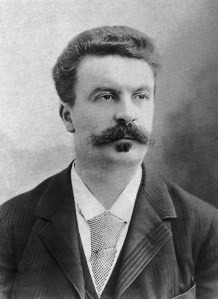
Guy de Maupassant (photo credit)

I recently read my very first Maupassant, Boule de Suif, and found it stellarly crafted. Recently I had a few more loose reading moments – the perfect chance to dip back into his short story collection briefly. The next two stories of his that I’ve encountered continue very much in the same subject area. The French are being occupied by the hated Prussians, and the French citizens are more or less commonly outraged, but they all react differently. As in Boule de Suif, the incisive portrayals of human character are the strength of these stories, along with character sketches and images of occupied wartime.

The Lancer’s Wife sees a small band of French soldiers, after a French defeat, living under Swiss protection. Their captain is furious at being removed from the action, and takes a handful of his men, including our narrator, secretly back into France to fight guerrilla-style. This tiny group, joined by the captain’s loyal and martial wife, encounters a tiny Prussian group of fighters, which includes the Prussian lancer’s wife as well. Without spoilers, I shall say that the two wives come face to face, and the issue is one of honor. If the qualities and moral of this story are a little idealistic, I am happy to be forgiving, because it’s well done and a joy to read.

In Two Friends, two Frenchmen who have enjoyed fishing together in the past, but who are now living under Prussian occupation, endeavor to go fishing once again, and are captured by the enemy. Again there is a question of honor. Again high standards are met, and I am left, after these two stories, with a feeling of nostalgia for the fine men and women of a time gone by. These are lofty emotions to be evoked by stories about war; but Maupassant renders the setting so beautifully that, again, I can only marvel at the craft.

I believe Boule de Suif is more or less accepted as his finest story, and it’s true that these, while impressive, were shorter and less impactful. However, they were easy to lose myself in. This man is a master of the short story.


Rating: 7 chins held high.

Boule de Suif by Guy de Maupassant

I found a few unaccounted-for minutes the other night, and picked up a short read I’d been meaning to get to: the short stories of Guy de Maupassant. [Recommended by Hemingway.]


This review contains spoilers.

Set in the Franco-Prussian war, this story sees a group of ten citizens of Rouen fleeing Prussian occupation in a stagecoach for Le Havre. They are a mixed group representing a neat cross-section of French society: a merchant couple; a bourgeoisie couple; a count & countess; a Democratic revolutionary; a courtesan; and two nuns. They settle into polite chatting in the stagecoach along social lines, with all turning their noses up at the courtesan. But as the journey goes longer than expected and they are unable to find an inn to serve them lunch or dinner, the courtesan produces a large basket filled with delicacies, and everyone thaws. They make nice with her, and eat her food. The title Boule de Suif is generally translated as “Dumpling” or “Butterball” or the like (I believe, more literally, it is “ball of fat”) and refers to the courtesan:

Short and round, fat as a pig, with puffy fingers constricted at the joints, looking like rows of shorts sausages; with a shiny, tightly-stretched skin and an enormous bust filling out the bodice of her dress, she was yet attractive and much sought after, owing to her fresh and pleasing appearance.

But upon arrival at their overnight lodging, they are held up: the Prussian soldier in charge forbids they continue on their journey until the courtesan will provide her services to him. She refuses, being a patriotic and proud Frenchwoman. And the group seethes: their travels are being held up and, as they point out, this is her business anyway, isn’t it? Why shouldn’t a whore be a whore with a Prussian as well as any other man? They wheedle, exhort, and command – even the nuns – until she is broken down and does the deed and they continue on their way. In the final scene, the socially elevated ladies turn their shoulder away from her again. And everyone has remembered to pack a lunch except Boule de Suif, and no one offers to share with her.

This is a masterfully executed short story, and I can see why Hemingway admired it. The human element is heartbreaking. It is painful to see the defeat of Boule de Suif’s pride and principles; it is maddening to see the disgraceful behavior of the socially superior characters. It is also a neatly devised statement on social class: the merchant and bourgeoisie couples are greedy and grabbing, clearly willing to place their allegiance with whomever will leave them to their profits; the count and countess are weak and craven; the nuns are unchristian in their failure to share food with a hungry courtesan; and the revolutionary is a lecherous drunk. The courtesan is the most patriotic, brave, and principled of the group.

The writing style is enjoyable, too, and again I can see where Hemingway was influenced. Just look at this first sentence:

For several days in succession fragments of a defeated army had passed through the town.

and tell me you don’t see Hemingway there. The meter or rhythm alone reminds me of him; obviously the subject matter as well.

I am rusty in my close-reading skills. I recall a poem I read in high school, for English class, that we picked apart line by line and word by word, finding three and four layers of meaning therein. It was The Black Lace Fan by Eavan Boland, and I really enjoyed the lesson. I think this short story would bear the same sort of close scrutiny. Or, it can be enjoyed as a quick read.

Highly recommended, and I hope I find time for the rest of the stories in this volume soon.


Rating: 9 pretenses.

great beer quotations in literature: Boule de Suif by Guy de Maupassant

Friends, I proudly come from a family of beer lovers, and have my eyes peeled not only for bicycle quotations in the books I read, but for those concerned with beer as well. I dipped into my very first de Maupassant the other day, and he satisfied.

He had his own fashion of uncorking the bottle and making the beer foam, gazing at it as he inclined his glass and then raised it to a position between the lamp and his eye that he might judge of its color. When he drank, his great beard, which matched the color of his favorite beverage, seemed to tremble with affection; his eyes positively squinted in the endeavor not to lose sight of the beloved glass, and he looked for all the world as if he were fulfilling the only function for which he was born. He seemed to have established in his mind an affinity between the two great passions of his life–pale ale and revolution–and assuredly he could not taste the one without dreaming of the other.

This evocation of trembling beer appreciation captivated me entirely. I am easily charmed.

It’s a great short story, too. Review to come.

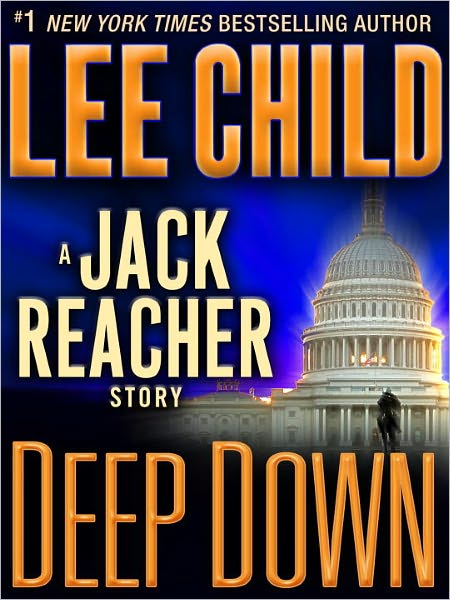
Deep Down by Lee Child

Jack Reacher is back. In this e-book-only short story, he’s back in the army, in his 20’s, making it chronologically one of the very early Reacher tales. He’s been called in from Frankfurt to Washington, D.C., where he’s put undercover as a sniper sitting in on a pre-committee… I know, bear with me… of politicos discussing a possible requisition for sniper rifles. Apparently the prior two meetings of these subcommittee politicos with military representatives have resulted in sensitive weapons information being leaked overseas, and Reacher is to find the leak. His handler in this operation is sure the leak is one of four women, and encourages Reacher to use his woman-wrangling skills as he sees fit. As we watch Reacher getting briefed and prepped in a slightly-too-small suit, we simultaneously see one of the women jogging into work. And the action begins. I’ll leave it at that in case you want to read it yourself.

Reacher fans will be able to predict how things play out. There are a few obligatory features: Reacher seems to read minds; he makes observations the average bear would not, and draws correct conclusions. There is flirtation. There is violence. He gets things right in the end. In these ways, it fits within the other Reacher stories we know and love.

What’s different here, though, is the format – and I don’t mean the e-book part, although I’m still not excited about that aspect either. No, I think I’m coming to the conclusion that short stories do not best showcase Reacher’s abilities. This is the second I’ve read, and The Second Son was interesting for the light it shed on Reacher’s past, brother Joe’s personality, and their relationship. I felt that Deep Down had some shortcomings. A lot of what I love in a full-length Reacher novel is development, the careful playing out of string, the stinginess with which we learn details, the way we get to know our characters better, often the development of a steamy relationship to boot: all things we need a full-length novel to do. While this story had all the elements Reacher needs (as observed), it didn’t give them the space they needed to grow. It didn’t do it for me. Instead, Deep Down read to me like what I fear it is: a hastily-produced holdover for Lee Child’s fans to satisfy themselves with while we await his new novel (A Wanted Man comes out in September). It was fun, and Reacher did kick butt, and it only took me 30 minutes to read – but that’s part of the problem. Only so much plot can come to fruition in a 30-minute read.

That last statement makes me wonder – is this really a problem inherent to the short story? And I don’t think it is. I’ve certainly read some very impressive, moving short stories by my favorite master of that genre, Hemingway. But you know, I don’t read a lot of short stories; I do find it a difficult genre, and I think I’m dissatisfied more often with short stories than I am with novels. New question, then: am I a poor reader of short stories, difficult to please? Or is this a difficult genre to do well in? I suspect the latter (although I’ll allow the former): with less space in which to develop characters and plot, an author has to be very precise and economical. This would help explain why Hemingway was so good at them, precision and economy being his hallmarks. And that author may need to take on less, plot-wise, so that he has time to flesh it out.

I have managed to make a rambling mess of this review. Perhaps I am not so strong on precision and economy, myself? At any rate, I found this a fine but decidedly below-average Reacher story; I am anxious for the next full-length book. Many thanks again to my mother for her loan of the e-reader so I could knock this one out on a lunch break!


Rating: 4 tough guys.

The Curious Case of Benjamin Button by F. Scott Fitzgerald

I was vaguely aware that the movie of several years ago was based on a book by F. Scott Fitzgerald. A new copy (the movie tie-in one, of course) crossed my desk at the library and I cracked it open. It’s a short story, as it turns out, just a little thing that they presumably built upon a great deal for the movie. I did not see the movie (I see very few movies), but I got the impression that it was more of a love story. This is not so of Fitzgerald’s original.

In the year 1860, Roger Button is dismayed, horrified and disgusted that his wife gives birth not to a screaming, red-faced infant but an old man, with the appearance of a 70-year-old. (And thus ends the role of Mrs. Roger Button in this story, strangely.) The little old manbaby is mildly disappointed, as well, with the strange reactions of his parents and, indeed, the world at large. Mr. Button tries to make Benjamin play with toys and other little boys, but neither man is pleased with the results. Benjamin is driven out of kindergarten by the disapproval of the teacher, but eventually finds a happy place at his grandfather’s side, smoking cigars and discussing what is wrong with the world today.

As the years pass, Benjamin grows younger. Roger sends him off to college at Yale, where he passes the examination but is turned away for his appearance: he looks like a man of fifty, despite being just 18. This works out fine, however, because he and his father get along swimmingly and find that they have much in common. Benjamin goes to work in the family business and makes a great success. He meets an attractive young woman at a dance and miraculously, she is attracted to 50-year-old men! (I can’t help but observe that male authors like to write this fantasy) and they marry. But as the years pass, he finds her unattractive as she ages, and she is exasperated by his appearing younger and younger. She seems to take this personally. He becomes a real man about town, going out, charming the young ladies, partying, and eventually neglecting his business concerns. He goes off to the Spanish American War, and earns a rank of lieutenant-colonel. Upon his return, he is feeling so young and spry that he gives college another whirl, this time at Harvard. In his freshman year he is a big hit, mature for his age, the star of the football team; but by his senior year, he finds the classes hard and he can no longer play football because his peers are bigger and stronger.

When he returns home, his wife has taken off, so Benjamin moves in with his son. The years pass, and a grandchild is born, and Benjamin becomes young enough to play with his grandson as peers. They attend kindergarten together, until the grandson moves on to first grade and Benjamin remains in kindergarten… until, in his third year, this becomes too challenging for him and he retires to be cared for by a nursemaid. He ends his life as an infant in a cradle, unaware of his surroundings.

It is a strange tale, imaginative, and well told; Fitzgerald knows his way around a phrase. There is a wryly funny tone to the early parts, with Roger Button trying to make an infant and a little boy out of an old man. Later, sadness becomes the dominant sentiment. There is an episode when the Army calls Benjamin back in for service, as a general; but when he shows up as a 13-year-old (or thereabouts) boy in a general’s uniform, he is laughed at and turned away in tears. Towards the end, as Benjamin begins to lose hold of his memories of the good times (newlywed happiness, military glory, playing football at Harvard), I thought of Flowers for Algernon.

This is a short, easy, very worthwhile story by a fine storyteller, and I recommend it. I do not feel especially interested in the movie which I fear is different, not as good, likely to disappoint – and maybe I’m wrong, but that’s my pro-book prejudice, and probably explains why I don’t watch more movies. Anybody have a movie review for me? Anybody both read and watched, and can make a comparison?


Rating: 5 buttons.

Tales from Watership Down by Richard Adams

in lieu of a cover shot, since mine is a plain hardback missing its dust jacket, I give you one of the fine illustrations from within.

As I noted in my book beginning post last week, I am taking this one out of order, since I have not yet read Watership Down. That original is a well-regarded fable or heroic tale about a group of rabbits overcoming odds to start a new life; these Tales are a late sequel (published more than 20 years after the original), and come in the form of a collection of short stories. They include the fables that the rabbits of Watership Down live with (their own cultural mythology, if you will) as well as stories involving the rabbits of the present day. They are sweet and curious; Adams includes a lapine glossary and gives these anthropomorphized bunnies their own societal norms and shared history. Some of these tales resembled some of the other great heroic myths in our own culture’s tradition; I thought of the ancient Greeks, for instance, because there is some question of god’s (or gods’) interference in the lives of mortals (rabbits). The stories were interesting, somewhat familiar in themes but engrossing. In a nutshell, I enjoyed them very much; they made for a quick, easy, entertaining, evocative session. The emotions that the rabbits feel – courage, fear, love, concern, friendship, curiousity – were very real, and I cared about the characters. Oh, and they have such lovely names! That said, I definitely felt the hole left by my failure to read Watership Down first, and think that that would have enriched the experience. Big events are referred to and not explained; I feel confident that’s what the first book did. So, recommended, but probably not until you’ve read the original, which I shall look forward to doing.


Rating: 5 bunny ears (probably more if I had read the first book first).

book beginnings on Friday: Tales from Watership Down by Richard Adams

Thanks to Rose City Reader for hosting this meme. To participate, share the first line or two of the book you are currently reading and, if you feel so moved, let us know what your first impressions were based on that first line.

in lieu of a cover shot, since mine is a plain hardback missing its dust jacket, I give you one of the fine illustrations from within.

I’m doing it backwards again, since I’ve not read Watership Down, sigh. I look forward to getting my hands on a copy! The first story in this follow-up volume of Tales, entitled “The Sense of Smell,” begins:

“Tell us a story, Dandelion!”

It was a fine May evening of the spring following the defeat of General Woundwort and the Efrafans on Watership Down.

And so we start with several clues as to the history of those gathered around to hear a story; and who amongst us readers doesn’t enjoy storytime? I think it’s an auspicious beginning.

What are you reading this weekend?

The Dorothy Parker Audio Collection

Dorothy Parker is a flippin’ hoot. She is hilarious. This was a great way to enjoy her work, too: I enjoyed the variety of narrators, with Cynthia Nixon (yes, of Sex and the City) and Alfre Woodard being my favorites. But they were all great.

This is a collection of Parker’s short stories, mostly, with a few reviews and journalism pieces thrown in. The narrators bring different tones to each piece, which was a great touch. Parker has a distinctive sense of humor: wry, dry, tongue-in-cheek, a little bit dirty here and there, decidedly satirical. She pokes fun at the women of her era (mid-twentieth century) and their ambitions and affectations; her own sex comes under by far the harshest criticism in this collection, at least overtly. But I think, too, that there is a more subtle criticism of society in general hidden in there.

I struggle a little bit when reviewing collections; I don’t want to get into plot summaries of all the component parts, but here are a few for you… The opening story, Big Blonde is both funny and full of pathos; Dusk Before Fireworks excoriates a jealous girlfriend (although her ladies’ man boyfriend doesn’t come out smelling too nicely either). But the One on the Right tickled me to no end – I only regret that it was so short! Pathos, I suppose, is a theme here, because Horsie was almost painful. Just a Little One is an amusing story set in a speakeasy; Cousin Larry and The Game both deal with infidelity again. The Bolt Behind the Blue examines a hypocritical and poisonous “friendship” between two women of different social standings. And these are but a few of the included pieces.

You must experience Dorothy Parker for yourself. This is a great selection, and I hope to get my hands on more. Sad, but oh so funny, too.


Rating: 7 giggles.