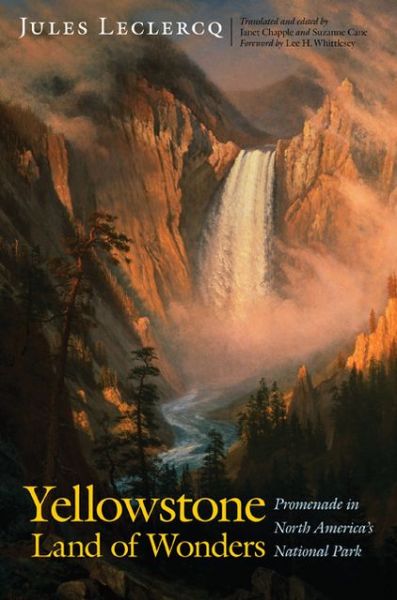
Yellowstone, Land of Wonders: Promenade in North America’s National Park by Jules Leclercq

An unprecedented English translation of a travel narrative from the early years of Yellowstone National Park.

yellowstone
In 1883, a well-traveled French lawyer, writer and judge named Jules Leclercq explored the newly designated Yellowstone National Park on horseback. Three years later, he published a book praising the area’s strange and wondrous marvels–but the book is not simply a lovely appreciation of natural scenery. Leclercq also researched the history of the region and its people in order to write a scholarly study, a snapshot of a place in time. And yet there has never been a complete English-language translation of his original text until Janet Chapple and Suzanne Cane’s Yellowstone, Land of Wonders.

Leclercq is most fascinated by Yellowstone’s geysers: “The mind is so occupied with the extraordinary geological phenomena bursting upon one at every step,” he writes, “that one views the scenery only abstractedly.” He does, however, turn his pen to Yellowstone Lake and Falls; he considers the latter far superior to Niagara. He also includes a chapter on the park’s wildlife, and warns that whole species will be exterminated if hunting continues unchecked.

Leclercq’s narrative is imperfect. He sometimes quotes without attribution from contemporary sources and gets geological details wrong. But Chapple and Cane meticulously keep readers informed on such points. Their translation and editing–with copious notes–is thorough in confirming and expanding Leclercq’s points, offering commentary not just on Yellowstone but on the author and his era. The result has more than just historical value; as Leclercq concludes (and as is still true today), “All this grandeur inspires grave and religious thoughts.”


This review originally ran in the May 10, 2013 issue of Shelf Awareness for Readers. To subscribe, click here, and you’ll receive two issues per week of book reviews and other bookish fun!


Rating: 6 geysers.

In the City of Bikes by Pete Jordan

A history of Amsterdam’s love affair with the bicycle contained within an American cyclist’s memoir.

cityofbikes
After the close of his first memoir, Dishwasher, Pete Jordan moved to Amsterdam for a semester to study urban planning, with a focus on his passion: bicycles. He never left.

Jordan’s decision to move was rather capricious–he knew almost nothing about Amsterdam–but he found a city packed with bicycles and rich with cycling history. In the City of Bikes is the story of his journey from itinerant dishwasher to settled family man, as well as a thoroughly researched history of the bicycle in Amsterdam. Beginning with the early bikes of the 1800s and cycling’s golden age in the 1890s, when the safety bicycle hit the streets, Jordan moves on to the tire shortages and (in this case, bicycle-related) atrocities of the city’s Nazi occupation before concluding with his own place in modern cycle-crazy Amsterdam.

Joining Jordan are his new wife, Amy Joy, and their son, Ferris, a passenger and later pilot of Amsterdam bicycles since his conception. When Amy Joy becomes proprietor of a local bike shop, the Jordans have truly found their home in the Dutch capital. Considering his reason for going in the first place, Jordan is especially well suited and qualified to tell this story, and he lives up to expectations with a meticulous detailing of Amsterdam’s bikes. Full of personal anecdote, self-deprecating humor, local lore and a history of cycling that positively bursts with enthusiasm, In the City of Bikes is both a memoir and an ode to bicycles.


This review originally ran in the May 3, 2013 issue of Shelf Awareness for Readers. To subscribe, click here, and you’ll receive two issues per week of book reviews and other bookish fun!


Rating: 7 tire-powered light generators.

526395_4403542975615_1825014471_n

Bonus photo I couldn’t resist, of me in the early 2000’s, cycling in Bruges – but it may as well be Amsterdam, and I did ride there too – on a Dutch-style bike. (Hoping this gives me extra reviewer-cred!)

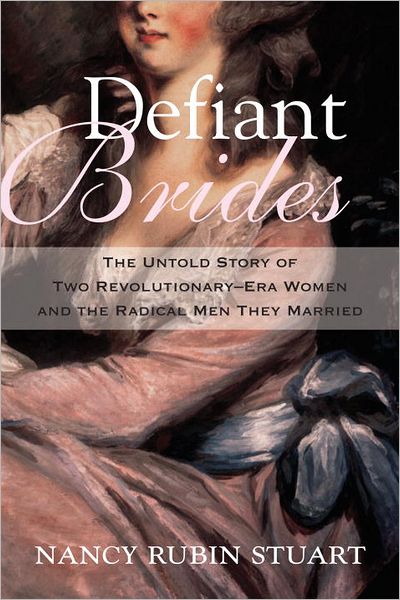
Defiant Brides: The Untold Story of Two Revolutionary-Era Women and the Radical Men They Married by Nancy Rubin Stuart

Parallel profiles of two wives on opposite sides of the American Revolution.

defiant

Margaret “Peggy” Shippen Arnold and Lucy Flucker Knox have traditionally been treated as historical footnotes in relation to their more famous husbands, Benedict Arnold and Henry Knox. Nancy Rubin Stuart (The Muse of the Revolution) remedies this neglect in Defiant Brides, a double biography that examines these two women as individuals as well as influential players in the American Revolution.

Peggy was a beautiful blonde belle of Philadelphia society, from a family that favored the British. Lucy was from a well-to-do, firmly Loyalist Boston family. The Shippens reluctantly admitted the political expediency of Peggy’s marriage to military hero Benedict Arnold; the Fluckers disowned Lucy for the sin of matrimony with patriot Henry Knox. Lucy supported her husband’s military and political careers in relative poverty and socialized with George and Martha Washington, even as she fretted over Knox’s long absences and missed the opulence of her youth. Peggy staunchly championed her husband through his treason and banishment and their subsequent financial difficulties in England and Canada; her part in Arnold’s betrayal at West Point, and her own possible role as a spy, remain controversial.

Stuart’s thoughtful research and consideration brings each woman forward into her own spotlight, reflecting on the flaws and strengths that Peggy and Lucy brought to their marriages and to the events of their time. Defiant Brides is an effortless read and a fresh perspective on the American Revolution, featuring two women who defied their parents to marry into a conflict that shaped a nation.


This review originally ran as a *starred review* in the April 23, 2013 issue of Shelf Awareness for Readers. To subscribe, click here, and you’ll receive two issues per week of book reviews and other bookish fun!


Rating: 7 degrees of loyalty.

Harley Loco: A Memoir of Hard Living, Hair, and Post-Punk from the Middle East to the Lower East Side by Rayya Elias

A visceral exploration of sex and drugs in 1980s New York City.

harley

Rayya Elias was born in Syria in 1960 but fled with her family to Detroit at age seven. Too young to appreciate her family’s culture fully, she doesn’t fit into her new environment, either, and suffers a rocky youth in Detroit before escaping to New York City with her newfound passions: rock ‘n’ roll, hairstyling and drugs. The Lower East Side in the early 1980s was a sparkling playground for a young woman trying to find herself, and Elias becomes sought after both as a hairdresser and as a new wave musician.

It will take her years to identify as a lesbian, but the affairs with women that began back in Detroit blossom into full passion (and dysfunction) in New York–and, for a short time, in a shared London apartment with a married woman and her husband. Her drug abuse also blossoms into an addiction to cocaine and heroin, a problem that will take countless stints in rehab and detox facilities–and jail–to conquer. By the end of her story, Elias is clean, back in New York and pursuing healthy musical creativity.

Far from being just another story of addition and redemption, Harley Loco (a nickname the author earned in jail) is unusual in its rawness and feeling. Elias perfectly evokes New York City in the 1980s and ’90s, complete with sour odors and pain. Her personality–hard-edged and unrepentant, yet tender and vulnerable–is thoroughly bared and, in the end, irresistibly likable.


This review originally ran in the April 19, 2013 issue of Shelf Awareness for Readers. To subscribe, click here, and you’ll receive two issues per week of book reviews and other bookish fun!


Rating: 7 second chances.

Maximum Shelf author interview: Josh Hanagarne

Following yesterday’s review of Josh Hanagarne’s new book, The World’s Strongest Librarian, here’s my interview with the man himself.


Josh Hanagarne: The World’s Strongest Librarian Writes

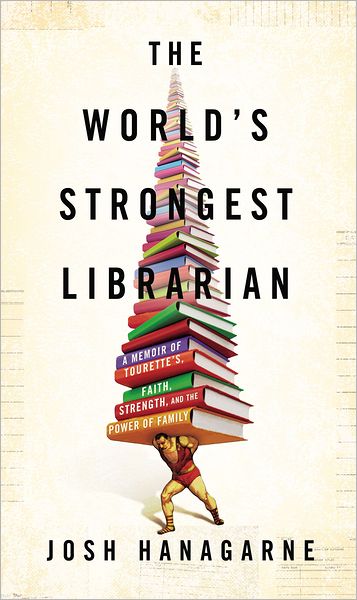
Josh Hanagarne is from Moab, Utah, and lives with his wife, Janette, and son, Max, in Salt Lake City, where he works at the beautiful main branch of the SLC Public Library. His memoir, The World’s Strongest Librarian, touches on the bizarrely various pieces of his life: his struggles with Tourette Syndrome; his journey to becoming a husband and a father; his love affair with books and libraries that would eventually lead to a career; an obsession with the gym that became a penchant for tearing phone books and full decks of cards; and a less-than-smooth lifelong relationship with the Mormon Church, where he still finds family and friends but less faith than he once held.

worldsstrongest

Your book includes a lot of personal and painful history that belongs not only to you but to your wife and family as well. What was the process for sharing those personal details?

It was hard. During the first draft I didn’t think too much about how people were going to react. When I started going through on the second draft, I started showing things to Janette or to my mom and asking, is this accurate? Is this something you’re okay with having in here? Sometimes it was, sometimes it wasn’t. Whenever anybody was mildly uncomfortable with something, I just took it out–nothing of real consequence. I guess when you write a memoir, you choose which periods of your life you’re going to represent, and then you choose which episodes best represent those periods. If you’re a normal person, sometimes that means you’ll look good and sometimes it means you’ll look bad. So that wasn’t fun, but it was honest, I think, without being tedious and self-flagellating.

I’ve always used humor kind of in self-defense, because I knew if I could make people laugh I could make them focus on something other than my tics. I think this book is kind of sad, and I think a lot of humor is rooted in something sad. I believe Kurt Vonnegut and Mark Twain both talked towards the ends of their lives about having various forms of irony fatigue, because humor was mainly a self-defensive tool for them. I think in any book where you get to pick and choose what you put in, the sadder stuff’s going to get sadder, and the funny stuff’s probably going to get funnier.

You’ve included Dewey classification numbers under each chapter heading. Do you think this resonates with the general population, or mostly just librarians?

I don’t know. I think most people, even if they don’t get it, will probably be intrigued. Some people have pointed out that they don’t all work out exactly the way capital-“L” Librarians think they should, to which I will just say, the numbers do exactly what I want them to do. I think it’s eye-catching. I didn’t necessarily think of it as being gimmicky, because it really does tie in thematically with each chapter. What I really like about it is that you can kind of see what’s coming and yet sometimes not have any clue how one thing will lead to the next.

Tell us about the process of writing this book: When did you write? Were you still working at the library?

This is probably going to disappoint a lot of aspiring writers who put off writing until they have hours of free time every day, but I don’t think I ever sat down and wrote for more than 15 minutes at a time. I just can’t; the tics won’t let me. I wrote whenever I could. I’d guess I rarely wrote more than half an hour total in a day. I do write really fast. I found out that, at least now, I’m the sort of writer who has to make a gigantic mess and then clean it up, because if I start trying to anticipate all the editorial questions on the fly, I just freeze up and I don’t get anything done. So I wrote a lot more to get to this book than I probably could have, if I were another writer. I wrote the first draft totally on my own and then I sent it to my editor, and things had just been going so well that I kind of assumed, yeah, my first draft is surely anyone else’s fourth or fifth. Then my editor sent it back and said, you’ve got to get rid of 120 pages. We can’t even talk yet. Fix this. Which was a great lesson to learn, and not an easy one. But editing was really kind of fun, because Megan [Newman] is really the right editor for me. I think it took three total drafts between us, but about eight on my part. I learned that it takes a hideous amount of work to appear spontaneous. But it was a lot of fun. The shortest way to answer your question is: I wrote every day, I only wrote for a few minutes at a time, and I just kept going. A big part of it is being willing to show up.

Was the writing process cathartic for you?

If this book hadn’t come about, I think I’d probably still be going through the motions in church, trying not to make waves. The ideas I’ve gotten from church have everything to do with my relationship to my body, and the explanations I thought I owed for my life. In writing the book, I realized, I’m actually going to have to deal with this. So I got into the sticky situation of writing a book about how much I love my family and yet gently distancing myself from the church, knowing that that would be painful for my family. That was the biggest catharsis: realizing that I was going to have to deal with that shift in faith. Spending so much time thinking about that, and trying to word it correctly, is what taught me what I actually do think about it all.

Would you say that you had a message or even a cause to communicate with this book, related to Tourette’s, or libraries, or anything else?

I’m not much of a crusader. But when I go speak to groups of people with disabilities, or their parents, or special educators, the reaction I get is so humbling and overwhelming. If people I speak to are actually getting out of this story what they tell me they are, I knew I really needed to do this book as well as I can. So that it can go be me in all the places I can’t be. There’s definitely no downside to spreading the word about Tourette’s. This story seems to inspire some people without me ever needing to claim I can inspire anyone. As far as libraries, obviously this whole book is my love letter to books and libraries. That’s not necessarily what I intended, but for me to write about myself honestly, that’s the only thing that could have happened.

What do you most want people to know about you that’s not in your book?

To entertain my son occasionally in the morning when I put my pants on, I will hold them up at about waist height and I will try to jump into my pants. So I jump all the way up in the air and tuck my knees in and if I do it right, my feet come through the pants and I’m dressed. And if it goes wrong it goes really badly wrong. And about one of every 10 times I can put my pants on this way. Once in a while. You know, one out of 10 might be optimistic.


This interview originally ran on April 9, 2013 as a Shelf Awareness special issue. To subscribe, click here, and you’ll receive two issues per week of book reviews and other bookish fun!

Maximum Shelf: The World’s Strongest Librarian by Josh Hanagarne

Maximum Shelf is the weekly Shelf Awareness feature focusing on an upcoming title we love and believe will be a great handselling opportunity for booksellers everywhere. The features are written by our editors and reviewers and the publisher has helped support the issue.

My editor recently asked me if I’d like to put together my first Maximum Shelf for them, and said she had just the book in mind for me: The World’s Strongest Librarian: A Memoir of Tourette’s, Faith, Strength, and the Power of Family, by Josh Hanagarne. (My father found this a hilarious expression of what my editor thinks of me. I’ll let you work that one out. I haven’t.) I was thrilled; and I loved the book. Because this would make for an extra long blog post, I’ve split the Max Shelf issue into two posts for you, so please enjoy my review today and my interview with the gracious & funny Josh tomorrow.


worldsstrongest

Josh Hanagarne, blogger at The World’s Strongest Librarian, “might be the only person whose first three-hundred-pound bench press was accompanied by the Recorded Books production of Don Quixote.” This is just one of his remarkable singularities. A gentle giant who tears phone books for fun, at 6’7″ he tends to catch the eye at the Salt Lake City Public Library, even when his Tourette Syndrome is not acting up. His memoir explores these contradictions and oddities, and his remarkable journey from idyllic childhood to painfully jerky young adulthood to a contented family and work life.

Hanagarne had a happy childhood, beloved by his mother, an incorrigible prankster and devout Mormon, and his devoted, irreverent bear of a father. He grew up in libraries, a passionate bookworm disturbed only by the tics that began in first grade but would go undiagnosed until high school (although his father suspected Tourette’s from the beginning). By young adulthood, they were not only embarrassing but violent and debilitating. He would eventually suffer a hernia from the force of his involuntary shouting tics, and his larger movements resulted in injury to himself and chaos in his immediate surroundings. After high school he spent years trying numerous cures, in and out of college, working various jobs and struggling with depression. Lifting weights at the gym stilled the tics somewhat, and for a while he got regular Botox injections in his vocal cords to quiet the shouts and whoops. During that time he met and married a lovely Mormon folklorist named Janette. For the first eight months of marriage, he couldn’t speak to her above a whisper.

Although deeply in love, the atmosphere of Josh and Janette’s story early in their marriage remains clouded. For years they try to get pregnant. Janette suffers two miscarriages and they are harshly rejected by the Mormon Church as adoptive parents. Josh continues to tussle with Tourette’s. For a short time, he finds a position as assistant special educator quite satisfying, not least because his tics become unremarkable in a room full of special needs. But he soon leaves that job, because he seeks challenge: crucially, he aspires to overcome Tourette’s, to beat his tics into submission. Pondering what might present the greatest challenge to a man who can’t keep quiet, Josh is drawn to the quietest place he knows, a place that has always offered succor and delight. He gets a job as a clerk in the library and begins a master’s program in library science. And a key piece of marital bliss is finally achieved when Janette delivers a healthy baby boy named Max.

Josh continues to battle Tourette’s in the gym, discovers kettlebell lifting along the way, and makes a new friend in Adam Glass, a former Air Force tech sergeant and strongman: he bends wrenches and horseshoes and tears decks of cards and phone books. Josh’s story takes an inspiring turn as the twitchy librarian and the foul-mouthed strongman gradually develop a friendship; as Adam helps Josh build strength, together they also begin to understand and subdue the tics. He finds Adam a little strange, and the explanation for his social awkwardness is also what makes him the perfect mentor for overcoming Tourette’s: Adam is autistic.

The adult Josh Hanagarne who relates his story is content and stable, happily married, thrilled to be a father to four-year-old Max, and working full-time at the Salt Lake City Public Library. As he relates his stranger-than-fiction story, he intersperses present-day anecdotes from a workplace that he wryly notes is rife with strange and occasionally smelly patrons and events. He muses eloquently and powerfully about the role of libraries in society, and their future possibilities. Throughout his life and this book, Josh struggles with his Mormon faith, as he sets off on the expected mission and faces myriad challenges in school, work, marriage and parenthood. In telling a story about family, church and Tourette Syndrome, he always circles back to libraries and to books, in many charming literary references. And always central to Josh’s story is his love of family. From his loving parents and exceptionally close siblings through the clear delight Josh finds in marriage and fatherhood, he stresses the inestimable gift of a loving family.

Josh’s memoir is thoughtful, heartfelt, often hilarious– and unsparingly honest. He is not proud of every moment in his own past, but he shares nonetheless. The image of the man today who wrote this book and who works in a large branch of a public library in a large city is that of a serious yet funny, mature, loving family man, and this image is only partly at odds with the earlier, less secure young man we come to know in these pages. The younger Josh was unsure and unstable, and the author is more comfortable in his own skin. But both have tics, and stories to tell.


This review originally ran on April 9, 2013 as a Shelf Awareness special issue. To subscribe, click here, and you’ll receive two issues per week of book reviews and other bookish fun!


Rating: 9 minutes of calm.

Tomorrow: I interview The World’s Strongest Librarian.

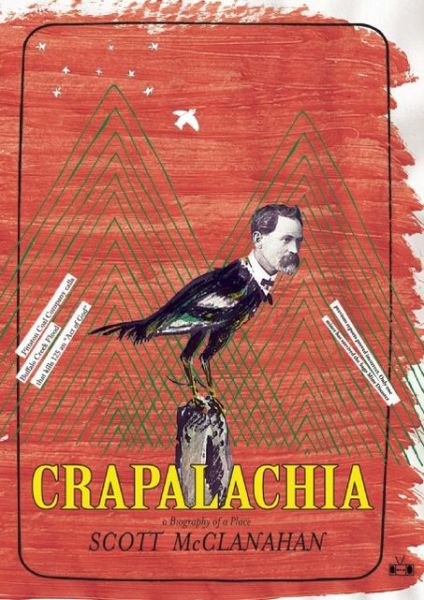
Crapalachia: A Biography of a Place by Scott McClanahan

The author of Stories and its followups, Stories II and Stories V!, shares a memoir of Appalachian boyhood filled with the requisite hardships but ultimately redemptive.

crapalachia

Scott McClanahan centers Crapalachia on two characters of his West Virginia youth who rule over much of the narrative–his Grandma Ruby, an ornery, fantastical mother of 13 (or so) children who also photographed dead people, and his uncle Nathan, who had cerebral palsy and enjoyed listening to the radio preacher and having six-packs of beer poured down his feeding tube. We also meet his schoolboy friends, like Little Bill, an eventual roommate with obsessive-compulsive disorder and a destructive crush on a girl down the street.

Crapalachia is an unusual story told in an unusual fashion, peppered with second-person references, advice to the reader on how to live, how to remember and forget. The attentive reader will also appreciate McClanahan’s “Appendix and Notes” for its revelation of where he’s twisted the truth (as he remembers it) to suit the story he wanted to tell. Like many memoirists, McClanahan is concerned with the nature of memory, its credibility and value. He sometimes gets mired in the unpleasant, cringeworthy details of life, then pans out for grand, loving, hopeful statements. This is a gritty look at life–in Appalachia, yes, but also in a universal sense. Historical detail turns what looked to be a memoir of childhood into the subtitle’s promised “biography of a place.” In the end, despite various tragedies, this poetic, rambling series of remembrances is surprisingly optimistic.


This review originally ran in the March 26, 2013 issue of Shelf Awareness for Readers. To subscribe, click here, and you’ll receive two issues per week of book reviews and other bookish fun!


Rating: 6 gallstones.

Ramblers: Loyola Chicago 1963: The Team that Changed the Color of College Basketball by Michael Lenehan

A dynamic, emotional study of one college basketball team’s role in the civil rights movement.

ramblers
Michael Lenehan’s Ramblers chooses one college basketball team, and one season, to illustrate a sea change in the sport–and in the United States. The Loyola Chicago team of 1963 was not the first to send black and white players out on the court together, but Lenehan makes an excellent case for the significance of this particular team’s actions at a key moment in the national struggle for civil rights. He examines their competition over the course of the season, focusing on two teams in particular: Mississippi State, whose players had to sneak out of state due to a ban on playing teams with nonwhite members, and Cincinnati, which was also an integrated team, but one with an increasingly antiquated playing style.

Relying on primary sources and interviews to study a handful of individual players, coaches and administrators, Ramblers passionately evokes the beauty of a great game in a time of great change, and works as a metaphor for changes taking place across the nation as well. Lenehan handles the game with an ease and comfort that indicate his expertise, and Ramblers combines his passion for basketball with an intimately detailed history–including a deeply moving digression into the 1962 riots at Oxford, Miss. Lenehan eventually follows each of his subjects through to the present (or the ends of their lives), giving Ramblers a feeling of completeness. Throughout, he maintains a sense of fun appropriate to a book that’s ultimately about the antics of college kids.


This review originally ran as a *starred review* in the March 19, 2013 issue of Shelf Awareness for Readers. To subscribe, click here, and you’ll receive two issues per week of book reviews and other bookish fun!


Rating: 7 fast breaks.

The Girls of Atomic City by Denise Kiernan

An evocative view of the Manhattan Project through the eyes of the women who worked and lived in the secret city of Oak Ridge, Tenn.

atomic

Oak Ridge, Tennessee was born in the fall of 1942, but would remain unknown until August 6, 1945, when the United States dropped the atomic bomb on Hiroshima. Oak Ridge, or “Site X,” housed factories for the enrichment of uranium. The workers at those factories at their peak numbered some 75,000, living in a secret city and working on they knew not what.

Diverse young women traveled from around the country fill the jobs needed to help win a war. Denise Kiernan’s The Girls of Atomic City is a unique glimpse into their strange experience of working on a project whose nature was kept from them. Most expected to leave Oak Ridge as soon as the war was won, but many stayed on for decades. Due to the fine supply of handsome young men in uniform, a number of Kiernan’s subjects would make families and homes there.

Based on interviews with their now-elderly subjects, the stories of Jane the statistician, Virginia the chemist, Kattie the janitor and many more are vivid and human in Kiernan’s telling. The focus of the book briefly zooms out for the dropping of the bomb, visiting Truman’s White House during the decision-making process, but then plunges back into Oak Ridge, where women who tested for leaks in pipes and kept tanks clean were rocked by the revelation of what they’d contributed to. Kiernan melds hard science and history with the moving stories of women caught in events bigger than themselves, whose experiences and whose work changed the world irrevocably. The result is a compelling and unusual new perspective on the Manhattan Project and World War II.


This review originally ran in the March 5, 2013 issue of Shelf Awareness for Readers. To subscribe, click here, and you’ll receive two issues per week of book reviews and other bookish fun!


While I am always constrained by the limited space available for reviews in Shelf Awareness (you know I can get wordy!), this book was especially difficult to boil down, touching as it does on women’s issues, history, science, working conditions, civil rights, war and ethics… It could be compared to Soundings or The Immortal Life of Henrietta Lacks in its intersection of hard science with the creative, feeling portrayal of women’s lives. Additionally, Kiernan’s use of primary sources – interviews with survivors of the era – made me pause to think of my grandfather, a WWII veteran who’s over 90 years old now, whose memories will someday be lost to us. This is a fine book on an interesting subject and I just had to say a few more words to that effect.


Rating: 8 acronyms.

Vera Gran: The Accused by Agata Tuszyńska, trans. by Charles Ruas

The unanswered questions surrounding the life of a lounge singer in the ghettos of Warsaw, as seen through the gauze of memory.

veragran

Vera Gran was a wildly popular Jewish lounge singer in the Warsaw Ghetto during World War II. In 2007, she died in an apartment in Paris–filthy, claustrophobic, paranoid and hateful. For decades, despite being found innocent by several tribunals, she had faced accusations of collaboration with the Gestapo.

Agata Tuszyńska was 19 when her mother, also a survivor of the Warsaw Ghetto, first told her she was Jewish. In her approach to a profoundly sad and traumatized old woman, Tuszyńska seeks the truth but realizes it cannot be pinned down. Vera Gran: The Accused is not a biography, but a shifting portrait of Gran, the Ghetto and survivors’ guilt; it is a contemplation of what we will do (and should do) to survive. Readers unfamiliar with Vera Gran may be more familiar with Wladyslaw Szpilman, the subject of Roman Polanski’s award-winning film The Pianist: Szpilman was Gran’s piano accompanist, but he cut her out of his memoir–later becoming one of her most vocal accusers. The nature of memory and memoir, the power of the stories we tell when those stories outlast memory of the events themselves, becomes a central theme in Tuszyńska’s book.

Charles Ruas’s translation from the French is subtly poetic and adds to the quiet tones of Tuszyńska’s musing as well as Gran’s anger. It is this atmosphere, along with the unknowable questions surrounding Gran, that makes Vera Gran: The Accused a remarkable and memorable contemplation.


This review originally ran in the March 1, 2013 issue of Shelf Awareness for Readers. To subscribe, click here, and you’ll receive two issues per week of book reviews and other bookish fun!


Rating: 6 changed stories.