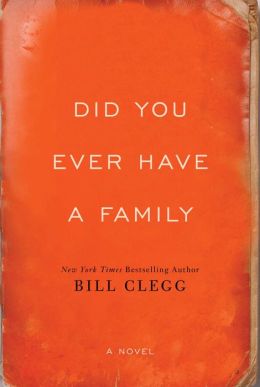
Maximum Shelf: Did You Ever Have A Family by Bill Clegg

Maximum Shelf is the weekly Shelf Awareness feature focusing on an upcoming title we love and believe will be a great handselling opportunity for booksellers everywhere. The features are written by our editors and reviewers and the publisher has helped support the issue.

This review was published by Shelf Awareness on June 10, 2015.


did you everAcclaimed memoirist Bill Clegg (Portrait of an Addict as a Young Man; Ninety Days) offers a profound jolt with his first novel, Did You Ever Have a Family, the impetus for the creation of Gallery Books’ new literary imprint, Scout Press.

June Reid’s world is splintered and lost in an instant. In the early morning of her daughter’s wedding day, her farmhouse explodes and burns, killing June’s ex-husband; her current boyfriend, Luke; her daughter, Lolly; and Lolly’s fiancé, Will. Did You Ever Have a Family maps the circumstances of the blaze and follows the aftermath of this tragedy as it affects June and other members of the families and communities of the victims.

In Clegg’s unusual composition, each chapter belongs to a different person, with the reader left to configure their connections. Some of their stories are told in first person, some in third, and almost all in flashbacks. This ever-shifting perspective highlights mistakes and misunderstandings, including June’s; other characters provide small revelations, thereby contributing to larger questions. The relatives and acquaintances of the deceased are joined by others with less clear ties, who appear to the reader in ever-widening concentric circles. Thus Clegg slowly and skillfully reveals the night of the fire and the nuances of the surrounding community in deft disclosures, through different points of view and with deep feelings.

June’s farmhouse is located in the small Connecticut town of Wells, where the locals are employed, somewhat resentfully, in serving weekend people from New York City. June had first been a weekender, and later moved in full-time. She ruffled some feathers when she began dating Luke, a handsome young man some 20 years her junior with a complicated history, about whom everyone in town had an opinion. June’s own family is not uncomplicated: following her divorce, she struggled to get along with her daughter, Lolly, a dreamy girl who apparently blamed her mother for the fracturing of the household. But June had worked to get to know Lolly’s fiancé, Will. She was counting on a future. In a moment of unguarded exasperation, she rhetorically asked Will’s sister: “Did you ever have a family?” After losing hers in such a spectacular, gruesome fashion, June eventually departs Wells carrying no identification, with only her car keys and a bank card left in the jacket she was wearing when she ran out of her house.

Early chapters focus on native Wells residents: friends, neighbors, the florist contracted for the wedding, the caterer who never got paid. But as characters gradually expand and diversify, the geography of Did You Ever Have a Family also spreads as the narrative unfolds, until its focus ranges from the east to the west coast of the United States. The lives of many are altered by the loss of June’s family; their simply expressed, easily understood emotions belie the gut-wrenchingly awful stories they tell. And each is ultimately working to build or define family, with varying degrees of success.

Lydia is Wells’s town outcast, busty and socially awkward, who gave birth years ago to a baby whose father had to have been African-American, although Lydia’s husband was red-haired and pale. That baby would grow up to be an intelligent, athletic, convicted felon–June’s boyfriend, Luke. When readers meet her, Lydia is chafing under the opinions of small, mean minds and loud voices. Town gossip holds Luke responsible for the tragedy, and thereby confirms Lydia’s low social status. Following an estrangement of several years between mother and son, June had orchestrated a tentative reconciliation. But when June leaves town following the funerals of everyone she loved, Lydia loses not only her son but her only friend. After June deserts Wells, gossip gains strength, and may yet destroy what the fire didn’t.

Supporting characters include a teenage neighbor who helped fix up the yard for the wedding and who carries his bong with him everywhere, and the family of June’s never-to-be son-in-law, Will, who return home to Washington State to mourn him. At a small seaside motel on the West Coast, a couple who have fled their own tragedy in Seattle worry over their new guest, a ghostlike woman who rents by the month and never leaves her room. And with yet another perspective, the reader learns the identity of Luke’s father, although Luke himself never did. These characters and vignettes are not disconnected, although their relationships become clear only over the course of Clegg’s masterfully woven story.

June and Lydia inhabit the center of this wondrous, grave and glorious story, but each voice that speaks up in Did You Ever Have a Family is gripping and invokes the reader’s sympathies. Every character and every small tragedy is a sensitively portrayed, complex, and compelling study on its own. What first appears to be a tale of grief in the face of unspeakable loss grows with its own momentum, until finally its scope is much wider than initially suspected. The expansive and surprising result eventually portrays the building of community and the possibility of recovery, even forgiveness. Did You Ever Have a Family is an elegant first novel, carefully composed and beautifully, hauntingly written.


Rating: 8 daisies.

Come back tomorrow for my interview with Clegg.

Saint Mazie by Jami Attenberg

The fictional portrait of a real-life, rough-edged, hard-drinking “Mother Teresa” on New York City’s tough streets in the early 20th century.

saint mazie

Saint Mazie by Jami Attenberg (The Middlesteins) brings to life a true historical figure–movie theater proprietress Mazie Phillips–as a fully realized, full-color, unlikely hero.

They called her Queen of the Bowery. She was bottle-blonde, busty, husky-voiced and crude; she was a self-described good-time girl with a gruff manner, partial to men and drink. But she was also a humanitarian, though she would never have admitted it. Attenberg’s inspired story takes the form of a historian’s fictional collection of material: entries from Mazie’s diary, excerpts from a draft of her unpublished autobiography and interviews with descendants, acquaintances and local experts on New York City’s past.

Mazie begins her diary on her 10th birthday, in 1907. She is new to New York City; her older sister, Rosie, has rescued her and the youngest, Jeanie, from domestic violence in Boston. The three sisters form an odd but lasting household with Rosie’s husband, Louis, beloved of all three. From this day forward, Mazie remains in the city, drinking through Prohibition, assisting the wounded at the Wall Street bombing in 1920, and pinching pennies to help her neighbors through the aftermath of the 1929 crash.

Saint Mazie‘s structure establishes an evocative tone of both ancient history and immediacy. Mazie’s love affairs and friendships are wrought with sensitivity and nuance; Nadine, the barely-named researcher behind the story, surfaces with rare, delightful hints to her own personality and motivations. Mazie’s life is compelling, heartrending and irresistibly paced, but it is Attenberg’s subtle storytelling decisions that make this novel unforgettable.


This review originally ran in the June 2, 2015 issue of Shelf Awareness for Readers. To subscribe, click here, and you’ll receive two issues per week of book reviews and other bookish fun!


Rating: 7 postcards.

Old Heart by Peter Ferry

A sweet, tender story of a decades-old, dreamed-of romance and the less elegant realities of aging.

old heart

Peter Ferry (Travel Writing) crafts a wise and delicate novel of aging, love and autonomy in Old Heart.

Tom Johnson is an old man. He has been widowed, and thereby freed from a troubled marriage, for a number of years. His adult children have begun pressuring him to sell the house in Illinois and move into a home. The motives of his son the gambling addict are suspicious; his daughter’s are likely pure. His eldest child, who had Down syndrome, was Tom’s best friend, but his death has given Tom the opportunity to pursue an old mystery. And so Tom plots to run away, leaving no clues behind save a note for his family: “I am not coming back.” He then travels to the Netherlands to track down a Dutch woman he knew during World War II, with whom he had “invented love.” He knows the chances of finding Sarah alive are poor, but he is driven nonetheless. “This is my life, whatever is left of it,” he writes in the note to his children.

The half-hidden narrator of Old Heart is Tom’s granddaughter Nora, a graduate student who had just begun recording the story of Tom’s return from the war and the beginning of his long-lived but unhappy marriage. When Tom makes his escape, Nora is the only one he takes into his confidence, and she relates parts of his story from her perspective. In other chapters, he chronicles his personal history–the parts where he meets and loves Sarah–in long letters to Nora. Throughout, the question of Tom’s mental competence looms over his narrative.

Of course, upon his arrival in the town where he knew Sarah, Tom does not find what he hoped he would; what he finds instead is far more complicated. In the winding path he travels–from Illinois to Eindhoven, and from dream to reality–Tom instead learns a lot about what he wants, what he has the right to expect from his life and where he’s come from. And despite his age, he continues to grow, and finds a chance to love.

Old Heart is earnest and, yes, occasionally sentimental, but also pensive and eventually enlightened. It is at once a romance, a meditation on the complications of end-of-life independence and the responsibilities of family, and a lovely personal history. In a slim, unassuming read, Ferry opens intriguing questions and introduces his reader to complex and deeply likable characters. The result is delightfully warm and universally appealing.


This review originally ran in the June 4, 2015 issue of Shelf Awareness for the Book Trade. To subscribe, click here.


Rating: 8 decisions.

Girl in the Moonlight by Charles Dubow

A lifetime of love and lust, with a backdrop of fine art, vast wealth and high society.

moonlight

In Girl in the Moonlight by Charles Dubow (Indiscretion), Wylie Rose has known the Bonet siblings since he was 10, when he fell out of a tree and broke his arm at a party on their massive estate. He studies painting with the elder son, who becomes a dear friend; he admires the younger twins and the rest of the family, who are all brilliant, luminous, talented, beautiful and tremendously rich. But it is Cesca, two years older than Wylie, who hypnotizes him, and ruins him for any other woman or any other life than self-destructive devotion to her.

From a distance of decades, adult Wylie reflects on that life–always coming when Cesca called, from their first sexual encounter when he was a teen through her unpredictable comings and goings over the years, and the apparently mature and healthy relationships he throws aside for her in Manhattan, Paris and Barcelona. She seemingly can’t help her flirtations, manipulations and self-destructive behaviors. Wylie feels for her like “an exile misses his homeland or an old man misses his youth.”

Dubow’s writing is a bit uneven, but often inspired in its phrasing, evoking a mystical atmosphere around Cesca’s mesmerizing power and the rarefied world she travels in: extraordinary wealth, titles and estates around the world, artistic success and broken hearts. Wylie and Cesca see tempestuous years pass in struggling to define the magnetism they feel for one another, and readers will be spellbound by the process.


This review originally ran in the May 26, 2015 issue of Shelf Awareness for Readers. To subscribe, click here, and you’ll receive two issues per week of book reviews and other bookish fun!


Rating: 5 martinis.

Hyacinth Girls by Lauren Frankel

A tricky, smart riddle in novel form about bullying and family secrets.

hyacinth girls

Lauren Frankel’s debut novel, Hyacinth Girls, opens when Rebecca puts Callie’s face, along with a provocative question, on a billboard near the high school. A lengthy flashback explains why, in a gradual uncovering of the past. Callie is not Rebecca’s daughter but the daughter of her late best friend, Joyce. The happenings and drama of Callie’s middle and high school years are more troubling than the average teen experience, and have led to some terrible events that call for a billboard. But what exactly happened, and who is the perpetrator and who the victim, and why? These are questions that take the whole book to unravel, with roles reversing throughout. Rebecca’s voice alternates with Callie’s, but not until late in the book, when the reader’s impressions are already formed. The mixing up of clues and the struggle to sort out loyalties results in an unreliable narrator or two.

The story of Callie and her social circle eventually becomes entangled with that of Joyce and Rebecca, when they were childhood best friends. New and old traumas slowly, coyly come out: bullying, suicide, simple mistakes and basic meanness. Betrayals and lies populate the experiences of both generations. In revealing a complex web of family and community secrets, schoolyard bullies and the nature of trust, Frankel nudges her reader to ask questions like the one Rebecca puts on the billboard: Do you know your children?

Hyacinth Girls is a compelling and powerfully evocative novel of friendship and love, deceit and duplicity, and the rough terrain of being a teenage girl.


This review originally ran in the May 26, 2015 issue of Shelf Awareness for Readers. To subscribe, click here, and you’ll receive two issues per week of book reviews and other bookish fun!


Rating: 6 tattoos.

Still Life With Insects by Brian Kiteley

The subtle, sublime life of an amateur entomologist, in tiny glimpses.

insects

Leah Hager Cohen (No Book but the World) selected Brian Kiteley’s first novel, Still Life with Insects (originally published in 1989), for reprinting by Pharos Editions. In her introduction, Cohen gracefully outlines the strengths of this slim, quietly powerful book.

Elwyn Farmer is an amateur entomologist, forever wandering off to peer under dry leaves or dig in riverbanks. Still Life with Insects consists of his journal entries, spanning 40 years: from 1945, when his 43rd birthday has just been celebrated, to 1985, when his vision begins to fade. The entries record his quiet rejoicing in the ephemeral glory of the natural world, the beetles he collects and, through and around them, the details of his fragile life. Following several nervous breakdowns, he tells stories in which grandchildren and tragic death figure at an equal level with the Burying Beetle (Nicrophorus marginatus), or the Asian Stink Bug his family encounters in a Hungarian resort.

Although a bug collector’s field notes may not sound like an imaginative or exhilarating backdrop, Brian Kiteley’s distinctive style plays well to such a challenge. His greatest accomplishment is understatement. In a mere 103 pages, a sensitive, complex man becomes a brittle old man, fully experiencing the passing of time and life. The stories that fill these journal entries, sparse and widely spaced over decades, are necessarily mere vignettes, bare sketches. Still Life with Insects is a deceptively simple story, characterized by restraint, but with many layers of allegory available to the close reader.


This review originally ran as a *starred review* in the May 19, 2015 issue of Shelf Awareness for Readers. To subscribe, click here, and you’ll receive two issues per week of book reviews and other bookish fun!


Rating: 8 boxes.

The Mountain Can Wait by Sarah Leipciger

A hit-and-run fatality overshadows the life of a family and a community in the bush of British Columbia.

mountain

Sarah Leipciger’s debut novel, The Mountain Can Wait, centers on a family’s shared and separate struggles in the wilds of British Columbia. Tom’s wife left him when the kids were small. He hopes he can put in one last good year at work, sell his forest restoration company and provide for his children in his retirement. His son, Curtis, lives a few towns over, a young man on his own. Daughter Erin has begun to pull into herself, in typical teenage fashion. Around this nucleus are colorful characters like Tom’s mother-in-law, angry and estranged, living off the land in a tiny island village; Tom’s new girlfriend, a poet with an independent streak; and the tree planters and other employees of his company. Between hunting and foraging, idle drug use and countless cigarettes, this motley crew sharply evokes their environment in Leipciger’s spare but feeling prose.

The biggest crisis of all is out of sight for much of the story, but bookends everything else that transpires: a hit-and-run that kills a teenaged girl and haunts the driver, who is slow to seek redemption. “She was an instant, the sulfuric flare of a match…. And there was a dull slap.” This overarching tragedy shadows the rest of the action, as characters go on making their plans, unaware of how it will affect their lives.

In language that highlights natural beauty and the challenges of living in the bush, Leipciger explores what a sense of responsibility really entails, the finer points of family dynamics and the strong hold a place can have on a person, from Whistler to the tiny isles around Vancouver Island. Curtis struggles with the family tradition of hunting for their meat; he has trouble killing, even collecting tadpoles. But he will wreak havoc in just trying to survive, let alone impress his father. Tom is still troubled by the sordid details of his wife’s demise, some years after she left. He loves his children, but despairs at knowing them at all.

The Mountain Can Wait concentrates on the difficulties of properly caring for loved ones, and the meaning of community. Set within British Columbia’s stunning and intimidating back country, a mountain goat killed in one shot and a bear only wounded come to the forefront, too. As the title reflects, even the calamities Tom and his clan experience fade against such a backdrop.


This review originally ran in the May 14, 2015 issue of Shelf Awareness for the Book Trade. To subscribe, click here.


Rating: 7 cherries.

Going Driftless: Life Lessons from the Heartland for Unraveling Times by Stephen J. Lyons

An admiring profile of the successful, low-impact communities in a little-known region of the Midwest.

driftless

Stephen J. Lyons (A View from the Inland Northwest) muses on a remarkable region of the U.S. in Going Driftless: Life Lessons from the Heartland for Unraveling Times. “The Driftless” spans a small area of southwest Wisconsin, northwest Illinois, northeast Iowa and southeast Minnesota. A distinctly unglaciated history defines certain geographic parts, and a network of streams provides variant topography. In these pages, Lyons explores that landscape and the cultural experimentation born there.

The remote hills and valleys of the Driftless are uncharacteristic of the Midwest, and these steeper slopes have sheltered alternative lifestyles for decades, from the back-to-the-landers who arrived in the 1970s to naturalists, traditional and organic farmers, artists, musicians and other singular souls living there today. Over several years, Lyons visits various Driftless communities, chatting with their leaders as well as others encountered by chance. He surveys farming and dairy cooperatives, families living off the grid, small business owners, food co-ops, a Zen monastery and successful planned communities. For example, Lyons outlines the history of Seed Savers Exchange, located near Decorah, Iowa, which curates a collection of more than 20,000 seed varietals from around the world in the public domain. The region attracts those interested in getting back to basics, hoping to build communities.

Going Driftless comprises a series of sketches of people, places and organizations, and steers clear of judgment or conclusion in favor of quiet contemplation. Lyons gently suggests near the book’s end that these unobtrusive lifestyles have something to offer in unstable times.


This review originally ran in the May 12, 2015 issue of Shelf Awareness for Readers. To subscribe, click here, and you’ll receive two issues per week of book reviews and other bookish fun!


Rating: 7 apples.

Mislaid by Nell Zink

A Southern comedy of errors starring a broken family stretched across social classes.

mislaid

At the start of Nell Zink’s delightfully odd first novel, Mislaid, Peggy is a lesbian teenager in 1960s Virginia heading off to Stillwater College, a remote women’s school, where she plans to sow her oats with all those other young ladies and become a famous playwright. Instead, she begins a strangely lusty affair with one of the few male faculty members, Lee Fleming, a famous poet hidden away at Stillwater by his wealthy and proper Virginia family because he is gay. Their misguided, mismatched affair quickly results in a pregnancy and marriage. After 10 years, Peggy finds herself miserable, acting as servant to Lee’s obnoxiously pretentious literary house guests while he engages in infidelities and general disrespect. She runs away, taking their three-year-old daughter and leaving their nine-year-old son, Byrdie.

Because Lee has also threatened to have her committed, Peggy goes into hiding. She conveniently acquires a birth certificate from a recently deceased African American child to rechristen her white-blonde daughter as Karen Brown, herself as Meg. They squat in a condemned house in abject poverty, making a new life, but the oddest part is that “Karen and Meg Brown” on their paperwork are black. “Maybe you have to be from the South to get your head around blond black people,” writes Zink, but Meg and Karen, white as they are, do pass.

A decade later, when Karen enters the University of Virginia on a minority scholarship as a freshman, Byrdie is a senior there and the two finally meet. The ensuing drama of confused identities drips of both tragedy and hilarity, as family dynamics and literary ambitions propel a broad cast of quirky, complex, lovable characters into odd scenarios. Meg has mixed herself up in some illegal dealings in her years as a single mom and met some interesting folks. Karen’s boyfriend and his family are equally zany and winning. Zink pulls no punches in portraying Virginia’s mores and peculiarities. Mislaid‘s pathos is charmingly funny, and a sentimental streak softens the sarcasm.

With its distinctively Southern setting and bizarre range of sincere men and women making their way in a weird world, Zink’s novel captivates from the very first page. Readers may be tempted to blaze through this slim book in a single sitting. Comic, sympathetic, heartbreaking and outrageous, Mislaid is a wonderful, raucous book with everything of life in it.


This review originally ran in the May 12, 2015 issue of Shelf Awareness for the Book Trade. To subscribe, click here.


Rating: 9 BLT’s.

Paris Red by Maureen Gibbon

The model for a famous Manet nude is exquisitely fictionalized as a young woman voracious for experience.

paris red

“That day I am seventeen and I am wearing the boots of a whore.” So begins Maureen Gibbon’s Paris Red, a novel of art, love, sex and survival in 1860s Paris. Victorine, the red-haired narrator, is not a whore herself; the boots were a gift. She works instead as a brunisseuse–silver burnisher–along with her best friend and roommate, Nise. The two sometimes pick up men, though, and this new one, Eugène, is different from the others: he wants them both. Unlike Nise, Victorine pursues experience headlong, wanting to feel it all, and it is she who wins Eugène’s devotion. In the process she puts ambition above friendship, losing Nise, choosing instead a position as Eugène’s model and muse. She purchases oils and pastels for him, poses for sketches and paintings, and luxuriates in the role of his lover.

Paris Red is a sensual, luscious novel, filled with tastes, smells and sounds, as well as colors. Eugène is actually Édouard Manet, strolling the streets under a false name, but Gibbon’s focus here is Victorine, the real historical model for Manet’s Olympia. She finds a home for her passion for color in his studio, and plays model-actor in Eugène’s world, while also learning about–and never losing–herself.

In powerful, vivid prose, Gibbon (Thief) pulls her reader into a sensory Paris that cuts across class lines, painting a strikingly intense and intelligent young woman in Victorine. The overall effect is erotic, but also clever and perceptive, a remarkable glimpse into a moment of art and time. Readers will never view Olympia the same way again.


This review originally ran in the May 8, 2015 issue of Shelf Awareness for Readers. To subscribe, click here, and you’ll receive two issues per week of book reviews and other bookish fun!


Rating: 8 apple fritters.