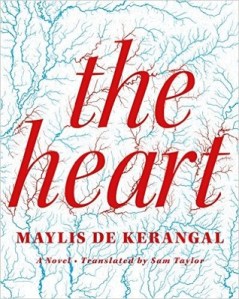
The Heart by Maylis de Kerangal, trans. by Sam Taylor

The story of a heart transplant, from life to death to final outcome, is viewed through the varied perspectives of some of the people involved.

heart

Maylis de Kerangal’s The Heart, translated from the French by Sam Taylor, spans just 24 hours but covers some of the most profound material imaginable. Simon and his two friends leave the beach after a pre-dawn surfing session and crash off the road. In the hours that follow, Simon’s parents are asked to make decisions about the removal of his organs. A woman with three sons waits for the heart transplant that will, hopefully, prolong her life. De Kerangal follows these and other players–doctors, nurses, family and friends–as the drama unfolds: of Simon’s heart, life and death and definitions, the meaning of generosity and what we love.

The Heart delves deeply into its subjects: the transplant operations are described in precise detail. The anguish of parents losing a child is explored at some length in its various incarnations–aggression, confusion–and compared to that of shipwreck survivors, or of a man who has just been in a fight with “some guy who was asking for it.” Characters are complex–the nurse who met with a lover last night, “sober and ravishing”; the soccer-obsessed surgeon with the violent girlfriend; the man from the Coordinating Committee for Organ and Tissue Removal, whose job it is to convince the parents to approve the transplant and who is passionate about music and his Algerian goldfinch. Through these and other points of view, an extraordinary and shocking story is revealed. Taylor’s expressive translation renders a sensitive, stark and entirely engrossing novel.


This review originally ran in the January 19, 2016 issue of Shelf Awareness for Readers. To subscribe, click here, and you’ll receive two issues per week of book reviews and other bookish news.


Rating: 7 minutes.

Arcadian Nights: The Greek Myths Reimagined by John Spurling

Classic Greek myths starring Herakles, Theseus and more are reborn in vivid, funny, fresh forms.

arcadian

From his home in a hillside Peloponnesian village, John Spurling (The Ten Thousand Things) charmingly retells some of Western literature’s best-known stories. He balances careful attention to the originals with his own humorous voice, honoring well-loved classics with a fresh eye.

Each section focuses on a hero: Perseus, Herakles, Apollo, Theseus and the ill-fated Agamemnon. Chapters begin and end with Spurling’s own Arcadian vista, on the Gulf of Argos, which inspires his imagination. Through these lenses, Arcadian Nights (re)familiarizes readers with the curse on the House of Atreus, the Twelve Labors and the complexly intertwining genealogies of mortals and immortals in a storied era somewhere between history and myth. Spurling notes commonalities with other cultures’ and religions’ fables, and infuses the established legends with added detail: imagined dialogue lends well-known characters extra personality, and Herakles gets a perfectly apt new piece of apparel. The occasional modernization enlivens the tales, as when the newly dead line up to cross the River Styx into Hades–it “was a little like going through security in an airport today”–but this is no clumsy 21st-century resetting of Aeschylus. Rather, Spurling’s gentle, clever wit complements the originals’ themes of heroism and romance, and their reminders of the importance of hospitality, humility and memory.

Spurling’s passion and enthusiasm and the best of Greek myth shine through this new version, equally appropriate to introduce new readers or reinvigorate the appetite of those who already honor such names as Zeus, Achilles, Athena, Poseidon and more.


This review originally ran in the February 16, 2016 issue of Shelf Awareness for Readers. To subscribe, click here, and you’ll receive two issues per week of book reviews and other bookish news.


Rating: 7 golden apples.

The Vegetarian by Han Kang, trans. by Deborah Smith

A South Korean woman’s decision to become a vegetarian has surprising and memorable consequences.

vegetarian

Yeong-hye was an ordinary woman–a trait her husband appreciated–until she made the shocking decision to become a vegetarian. In South Korea, this is unusual and socially scandalous; her family reacts by railing and trying to force her to eat meat. “I had a dream,” is all she says in explanation. Han Kang’s novel The Vegetarian recounts Yeong-hye’s choice and its consequences.

Three sections tell the story from different perspectives: Yeong-hye’s disgusted and frustrated husband; her brother-in-law, a video artist whose work and every thought become fixated on Yeong-hye and her “vegetal” nature; and finally, her older sister, in the late stages of the extreme situation brought about by a seemingly simple decision. Their different relationships to the protagonist reveal more of her personality, but they cannot understand her. Vegetarianism is only one stage in Yeong-hye’s extreme plan for metamorphosis, as it turns out. As her story unfolds, this single decision brings increasing disgrace, violence and subversion, and her limited control over her own life diminishes.

This is a dreamy story with depth and mystery, translated from the Korean by Deborah Smith with nuance and a tone of growing wonderment. Yeong-hye is a confounding and almost mystical character, never seen through her own point of view. In the end, The Vegetarian asks questions about mental illness and the significance of personal choice. Yeong-hye’s story is disquieting, thought-provoking and precisely formed.


This review originally ran in the February 12, 2016 issue of Shelf Awareness for Readers. To subscribe, click here, and you’ll receive two issues per week of book reviews and other bookish news.


Rating: 7 trees.

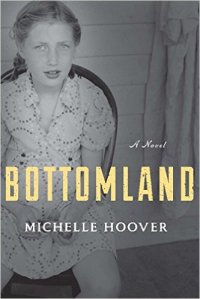
Bottomland by Michelle Hoover

Following World War I, a German American family in the Iowa plains faces the usual deprivations of farm life compounded by wartime prejudice and the mysterious disappearance of two children.

bottomland

In Bottomland, Michelle Hoover (The Quickening) tells the story of an immigrant family’s experience in the Midwestern plains with empathy, understanding and an eye for detail.

Julius and Margrit Hess arrived in Iowa in the 1890s, determined to make their bottomland there support a family. Four daughters, two sons and years later, the story opens with Nan, the eldest child, straining to hold her household together following Margrit’s death. The two youngest girls, Esther and Myrle, have disappeared in the night, from behind locked doors, leaving no note or sign of struggle. In the anti-German frenzy of World War I, the neighbors and townspeople began to harass the Hesses, and good relations have never been established since. Nan and her siblings fear that this local animosity has finally culminated in the fate of the two girls. How does a family negotiate such a loss? “Deaths are commonplace. But a disappearance–it has the scent of murder in it.” The Hesses are now only Nan; her bitter and gnarled brother Ray and his wife, Patricia; brother Lee, well-meaning but easily confused; quietly supportive sister Agnes; and near-silent Father, who ceased his full participation in life when Mother died. They search for Esther and Myrle across the countryside and even as far as Chicago, the city that “sounded like spitting.”

Bottomland is told in alternating first-person perspectives. Nan has sacrificed to keep the Hess family fed and in one piece. Julius brought his wife to a dusty claim, with a dugout to sleep in, to start a family. Lee, the younger and larger of the two boys, was always a little slow, but his injury in the war did him further harm. And finally there are the perspectives of Esther, the unruly child, and then the baby, Myrle. These are the personalities most revealed in the novel, and each of the Hesses is developed expertly, each dealing differently with the rock-hard and dirt-poor life they lead, with the prejudices of their neighbors, and of course with the missing girls, empty seats at the table and the question of food for the winter: “Hope, it was a terrible expense. We couldn’t let anything go to waste. And we couldn’t risk the extra we might set side only to spoil” if the girls did not return.

Hoover offers a lovely feat of exposition, bringing to life the immigrant experience, the hard work of homesteading, the deprivations and bigotries of the war years, and the workings of family, how its members cope and hold onto one another. Bottomland covers a large terrain, with characters who feel warm and close. Readers will be drawn in, and moved.


This review originally ran in the February 12, 2016 issue of Shelf Awareness for the Book Trade. To subscribe, click here.


Rating: 7 accidents.

Maximum Shelf author interview: Molly Prentiss

Following yesterday’s review of Tuesday Nights in 1980, here’s Molly Prentiss: Painting a World.


Molly Prentiss was born and raised in Santa Cruz, Calif. She has been a Writer in Residence at Workspace at the Lower Manhattan Cultural Council, at the Vermont Studio Center and at the Blue Mountain Center, and she was chosen as an Emerging Writer Fellow by the Aspen Writers Foundation. She holds an MFA in creative writing from the California College of the Arts, and currently lives, writes and walks around in Brooklyn, N.Y. Tuesday Nights in 1980 (Scout Press) is her first novel.

photo: Elizabeth Leitzell

photo: Elizabeth Leitzell


Do you have experience within the New York art scene?

It was mostly done by research. Most of my friends are artists or writers, but not in 1980. I went to graduate school at an art school, so I have been around a lot of visual artists, and my fiancé is a visual artist. Conversations with them often influenced the projects and pieces I referenced throughout my book. I go to a lot of gallery openings in the Lower East Side and SoHo with those friends. But I wouldn’t say I’m an expert of any kind. A lot of it was googling and reading books at the Strand and some trips to the New York Public Library.

What about synesthesia? You portray James’s sensations so vividly.

I don’t have synesthesia, and I don’t know anyone very well who has it. But I do think there are elements of synesthesia that exist within a lot of creative people’s brains. I feel I have really strong associations: with days of the week having a certain color, for example, although I don’t actually see those colors. Words pop into my head when I think of a certain smell or color. I often used my own associations to create James’s. I was enthralled by the idea of synesthesia and I did tons of research on it. I read a particularly great book called Wednesday Is Indigo Blue. It includes charts made by people that have synesthesia, where they describe the exact color of every letter in the alphabet, or they talk about every date on the calendar and what it smells like. They see sparks or flashes before their eyes. They talk about it as if it’s a screen in front of their eyes. They know it’s their synesthesia at work, they know it’s not “real” to the outside world. It was a really fascinating thing to look into, and I especially loved working with language surrounding James’s synesthesia. It’s my favorite way to write, to link one thing to another sort of haphazardly, but also in a way that feels organic.

Your choices of subject and setting are exact and evocative. What brought you to this intersection?

You know, the novel has taken many forms throughout the last seven years. Many of them included much longer time periods, and more characters. An original draft had a very different central character, but then I started writing about his mother, and then I started writing about his mother’s brother, who became Raul Engales, and a lot of that character’s action ended up happening to Raul. But that shifted the timeline backwards a bit, to the late ’70s, early ’80s. And I realized that when I struck on that time period, something started happening. I found I was really interested in lingering there. And the same thing happened with the place setting. In previous drafts, large sections took place in Argentina, and eventually my agent (who I worked closely with to edit the book) and I talked about centralizing it in New York. That was the place where the book really came alive, where the action was really happening, and I could render it the most clearly, because I live here and have had such New York experiences and can speak to that the best. So both of those things happened organically. And the location and the time period ended up becoming central pillars of the book, but I didn’t set off with starting to write a book in the ’80s, specifically. I rooted the book in the characters first and the specific position in time and in place came later.

There was a ton of evolution. James in particular was always a thorn in the side of the book. He used to be a side character. In the beginning he didn’t have synesthesia, and in another version he was going blind. I had to learn how to plot the book, move it forward and give it narrative drive, and I used James for that purpose a lot. He became a central character around which the book really revolves. So there’ve been many shifts in dynamics throughout the book, and ways that the plot and the characters have morphed in order to give the story more heft, or more direction, and those are things that I had to teach myself along the way, how to make the story link up and tighten up and push forward.

In a cast of such weird and interesting people, do you have a favorite, or one you most identify with?

It’s hard. I really like Arlene, who is a side character, but she makes me laugh, just thinking about her. I like her relationship with Raul, which is simultaneously motherly and in some way romantic. I think she’s sort of romantically interested in him. She’s also sort of his mentor, and I like that relationship a lot. I ended up loving James, but he was so hard to write that at some points I really hated him. But in the end he wound up softer, more relatable and kinder than in the beginning.

What were the best and worst parts of those seven years spent writing your first novel?

There were many changes, probably just as many ups as downs, and many exciting parts within the actual writing. There are times when you’re inside of a novel when something clicks, and you can feel it just working, bringing everything into place, and those moments are so thrilling. That’s why you do the rest of the hard work. In terms of pitching the book to agents and selling it and all that, there were some crazy ups and downs. I queried my agent something like two years before I signed with her, and we finally signed and then worked together for three more years, so that was a super-long and arduous process. She was so great, and so helpful, but I would often leave her office in tears because she would have me reworking whole sections, and replotting, and there was a lot of grunt work and overhauls that were really difficult. But on the whole it was really great, to learn how to write the book.

What’s next?

Well, I’m working on my second novel. I’m just in the beginning stages of brainstorming and conceptualizing. The full story is to be determined, but it’s rooted in the way that I grew up, in Northern California in the 1970s, in a community living situation. It will have elements of that, totally fictional of course.


This interview originally ran on February 10, 2016 as a Shelf Awareness special issue. To subscribe, click here, and you’ll receive two issues per week of book reviews and other bookish fun!

Maximum Shelf: Tuesday Nights in 1980 by Molly Prentiss

Maximum Shelf is the weekly Shelf Awareness feature focusing on an upcoming title we love and believe will be a great handselling opportunity for booksellers everywhere. The features are written by our editors and reviewers and the publisher has helped support the issue.

This review was published by Shelf Awareness on February 10, 2016.


tuesday nights
It is New Year’s Eve, 1979. In Buenos Aires, a woman named Franca is raising her son alone. The country is in the midst of the turmoil called the Dirty War; kidnappings are on the rise, and Franca is frightened: she has been baking cakes for an underground group that records the names of the “disappeared.” In New York, a man named James Bennett has had a harder time than most finding his way in life: his synesthesia always made him exceptionally strange, as he refers to colors, sounds and smells no one else sensed. But he’s finally made it, as an art critic for the New York Times. Also in the city, Raul Engales works night and day at his art, painting in poached studio space at New York University, a school he does not attend. He knows his work is better than any of what’s being sold in the big galleries. If he could only get someone important to look at it.

Molly Prentiss’s striking first novel, Tuesday Nights in 1980, covers one year, from December 31, 1979, through the final days of 1980. Says an art dealer with more influence than she perhaps deserves: “I’ve always found Tuesdays so charming, haven’t you? I do everything on Tuesdays.” The action tends to take place on Tuesdays, which sounds like a cumbersome and effortful device, but in fact flows smoothly and almost invisibly, following the lives of a few individuals in a city and an art scene big enough to swallow them. Tuesday Nights in 1980 is a sweepingly large and profound story about art, love and actualization, cleanly and beautifully composed.

The lives of Engales and James form the two main threads of story, with their fortunes rising and falling as precipitously as anything in 1980s’ New York. James’s success is born of the impressions other people’s work makes on him: de Goya and Picasso’s blue period both sound a bold, steady drumbeat; Bill Rice gives him a “nocturnal mood” and a headache; the paintings of Louise Fishman smell strongly of shampoo. “He felt gushes of wind and crawling ants, tasted burnt sugar and gazed at skies’ worth of stars.” Marc Chagall’s work gives him a hard-on. Writing these impressions for a public audience gives him immense satisfaction and a little money, and helps him to accumulate a legendary and sought-after collection of “the pieces that made him hear beautiful music.” Meanwhile, Engales sees the glimmering beginnings of the attention his work deserves. He finds a community: the grouchy woman at his art studio, the fellow creatives at “the squat” where he spends his free time and finally, crucially, a muse. Lucy is an innocent from Idaho who believes in omens, who steps out of a taxicab into a world of promise and finds what she thinks she is looking for in the artist. Then James and Engales each suffer a drastic, shattering loss that changes their respective abilities to create. And a small boy from Argentina appears in their lives, offering new varieties of pain, love and responsibility.

Tuesday Nights in 1980 portrays the arts scene as inspired and genius, and fraught with tension between creativity and the question of “selling out.” James’s weird and enchanting perceptions allow Prentiss to paint the visual arts colorfully, as well as fragrantly, noisily, brilliantly, tenderly and roughly. A central theme is the beauty of damage. “Wounds and deformities and cracks and boils and stomachs: this was the stuff that moved Engales… He could hear his father saying: The scratches are what makes a life.” This is not a concept invented by Prentiss, but her characters struggle with and embody it in moving, new ways.

While always told from a third-person perspective, the focus changes from chapter to chapter among Prentiss’s diverse cast: primarily James, Engales and Lucy, but supported by a number of equally fascinating and colorful associates. James’s wife, Marge, is a woman who presents to him as a deep and glorious red, whose own creative career has been sacrificed to enable his. Arlene is a curmudgeonly painter friend to Engales, given to unconventional sartorial choices: a “long fish skirt and a coat that was somehow both puffy and flowy” or “a flowy dress with an outrageous pattern on it… eccentric cowboy boots and a trench coat of sorts, with many, many pockets.” Prentiss’s talent for characterization is prodigious, and matched by her delightful turns of phrase. The art collector who loves Tuesdays has “the kind of hair that was popular that year, a curtain revealing only the first act of her face: a queenly nose, confusingly colored eyes (were they violet?), cheekbones for days” and “a voice as simultaneously regal and flighty as her hair.” She laughs “like a pretty horse.”

A plot with multiple storylines involving so many characters is easily followed, because the people and events who form them are so memorable–but not to the point of caricature. No, James Bennett and Raul Engales and the rest are only as bizarre as their time and place, which Prentiss evokes perfectly: SoHo on the brink of devastating gentrification; artistic genius on the brink of commercialization or self-destruction, or both; and the insane, everyday choices made by regular people seeking love, identity and community but fearing to make the wrong move. Tuesday Nights in 1980 is a beautiful, poetic novel of ambitiously profound considerations, a large-scale drama in a series of small, perfectly rendered moments.


Rating: 8 shades of astonished gray.

Come back tomorrow for my interview with Prentiss.

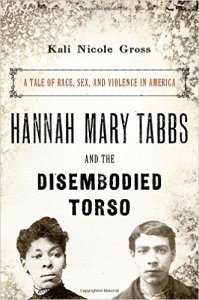
Hannah Mary Tabbs and the Disembodied Torso: A Tale of Race, Sex, and Violence in America by Kali Nicole Gross

In this shrewd historical study, a salacious murder trial in 1887 Philadelphia offers insights on criminal justice, violence, race and gender.

hannah mary tabbs

When Kali Nicole Gross (Colored Amazons) came across the case of an unusual 1887 Philadelphia murder, she found a story with many layers. In Hannah Mary Tabbs and the Disembodied Torso: A Tale of Race, Sex, and Violence in America, she explores the intricacies of that case and its implications on criminal justice, a culture of violence and conceptions of race and gender.

Hannah Mary Tabbs was an unusual post-Reconstruction black woman–she unabashedly pursued sex outside of marriage and used violence and physical threats to make a reputation for herself in her black community in Philadelphia’s Seventh Ward. In the white community, meanwhile, she upheld the idea of womanly virtue and subservience to her white employers. Gross argues that this manipulative, variable representation of herself allowed Tabbs to almost get away with a serious crime. Tabbs had a lover whose headless, limbless torso turned up on the edge of a pond outside of town. The man convicted for that murder was, Gross contends, a patsy. The skin tones of the various players in this love triangle appear to have played as large a role as their guilt or innocence.

In prose that demonstrates careful research and offers a realistic reconstruction of the crime, Gross comments on social standards for morality and relationships between races and genders. The case of the disembodied torso is not only a sensational piece of true crime, but an opportunity to reflect on these continuing complexities.


This review originally ran in the February 9, 2016 issue of Shelf Awareness for Readers. To subscribe, click here, and you’ll receive two issues per week of book reviews and other bookish news.


Rating: 6 assumptions.

Ostend: Stefan Zweig, Joseph Roth, and the Summer Before the Dark by Volker Weidermann, trans. by Carol Brown Janeway

This poetic contemplation in translation illuminates an uneasy creative community of artists and writers gathered one summer as fascism and Nazism are growing in Europe.

ostend

Volker Weidermann’s Ostend: Stefan Zweig, Joseph Roth, and the Summer Before the Dark is a glimmering work of language and an insightful tribute to literary friendship in a singular historical moment.

Stefan Zweig was a successful and popular Austrian writer; Joseph Roth was less successful but also gifted, a tortured, heavy-drinking writer whom Zweig called his “literary conscience.” When war loomed in the summer of 1936, Zweig returned to the Belgian seaside town of Ostend, where he had spent the summer of 1914. His work no longer welcome in Germany, his home in Salzburg defiled by police and his marriage collapsed, he nonetheless joyfully embarked on new work and new love with his secretary, Lotte Altmann. And he brought along Roth, supporting him financially and in his work (support that would strain their complex, fraternal relationship throughout). The troubled Roth, too, found new and rejuvenating love with a German writer, Irmgard Keun, one of the few non-Jews in their small émigré community.

Aside from brief background and epilogue, Weidermann stays within the boundaries of the summer of 1936–the summer before the dark, in which Zweig, Roth and an assortment of “detractors… fighters… cynics… drinkers… blowhards… silent onlookers” manage for a single season to love, laugh and exercise creative genius in a world rapidly falling into war and fascism. Translated from the German into lyrical, meditative prose by Carol Brown Janeway, Ostend is a brief but scintillating portrayal of this season, its spirit and a set of remarkable characters.


This review originally ran in the February 5, 2016 issue of Shelf Awareness for Readers. To subscribe, click here, and you’ll receive two issues per week of book reviews and other bookish news.


Rating: 8 little schnapps glasses.

The Cowshed: Memories of the Chinese Cultural Revolution by Ji Xianlin, trans. by Chenxing Jiang

This memoir by a survivor of the Chinese Cultural Revolution poignantly sheds light on an under-examined period in history.

cowshed

Ji Xianlin was one of many Chinese intellectuals held in makeshift prisons, called cowsheds, on university campuses during China’s Cultural Revolution, which began in 1966 and lasted for 10 years. He was mocked, humiliated, beaten and starved. He wrote about these experiences only reluctantly, observing late in life that none of his fellows had done so and that younger Chinese need to know their history in order to learn from it. In 1998, he released his memoir, now translated into English for the first time as The Cowshed: Memories of the Chinese Cultural Revolution.

Ji narrates his years of torment compellingly, in remarkably fair-minded fashion. He claims that his work is not literary, but it is adorned with lovely metaphors: he compares his torture to Indian and Chinese concepts of hell, “a veritable pagoda of horrors,” and makes reference to the steep path to Mount Tai, one of five Taoist sacred mountains.

Ji’s story is painfully moving and beautifully related, elevated by his preface and journalist Zha Jianying’s introduction, and his appendix, an abbreviated memoir of Ji’s whole life that puts the bulk of The Cowshed into perspective. He ponders the question of human nature as basically good or bad, and illuminates Chinese culture with sensitivity and humor; for example, “We Chinese intellectuals are descended from a tradition of scholars who would rather be killed than humiliated.” Until his death in Beijing in 2009, the wise older man who wrote this book remained a patriot who wanted the best for China and who appreciated that he saw the Cultural Revolution so intimately, if only so that he could bear witness.


This review originally ran in the February 5, 2016 issue of Shelf Awareness for Readers. To subscribe, click here, and you’ll receive two issues per week of book reviews and other bookish news.


Rating: 7 cornmeal cakes.

Every Last Tie: The Story of the Unabomber and His Family by David Kaczynski

David Kaczynski’s contemplation of his brother’s life and crimes is sensitive and skillfully composed, with broad appeal.

every last tie

David Kaczynski is a poet, a former English teacher, an impassioned opponent of the death penalty and the younger brother of Ted Kaczynski, better known to the world as the Unabomber. In Every Last Tie, he contemplates “loving memories and painful outcomes,” hoping to illuminate his brother’s and his own experiences.

Some of David’s message involves correcting misconceptions. For example, he says it was not his heroism but his wife Linda’s compassionate and principled actions that identified the Unabomber. He relates the process of recognizing Ted’s voice in the Unabomber’s manifesto: Linda’s concern, David’s denial, the careful considerations they conducted together and the final decision–betrayal of his brother or betrayal of yet more innocent lives. David often contemplates such difficult questions as how to explain Ted Kaczynski’s illness and actions, coming from a family that David portrays as caring, close and committed to education and integrity. He characterizes Ted as a loving older brother increasingly withdrawn from society, a tortured genius and, finally, a mentally ill man David no longer understands. The decision to identify his brother still prickles. “Ted’s cruelty stigmatizes my good name; but my reputation for goodness comes at his expense. Like all contrived opposites, we reinforce one another.”

Every Last Tie is beautifully written, searingly honest, in no way the sensational tell-all it might have been, but a careful exercise–sometimes emotional, sometimes intellectual–in self-examination. David clearly wants to pile praise on his beloved parents, but chooses to consider their complexities, seeking truth over comfort. The result contains a certain amount of psychological analysis (especially in a thorough afterword by James L. Knoll IV, a forensic psychiatrist who has both studied Ted Kaczynski’s case and come to know David well), but the book is also a meditation on notions of family, “the premise that a brother shows you who you are–and who you are not.” David struggles to reconcile the brother he loved and the serial killer he turned in, but does not belabor the point, choosing instead to remember and share what he knows, and acknowledge the mystery. Knoll’s afterword makes a more pointed criticism of the United States’ “nonsystem” of mental health care.

This slim, intriguing book is the story of a family whose two sons lead different lives. David Kaczynski’s voice is quietly thoughtful, and his writing is lovely; he ranges from family anecdote to psychological puzzle to philosophical musing while retaining an even tone. Every Last Tie is both a straightforward story and a complex consideration of an extremely difficult one.


This review originally ran in the January 26, 2016 issue of Shelf Awareness for the Book Trade. To subscribe, click here.


Rating: 8 letters.