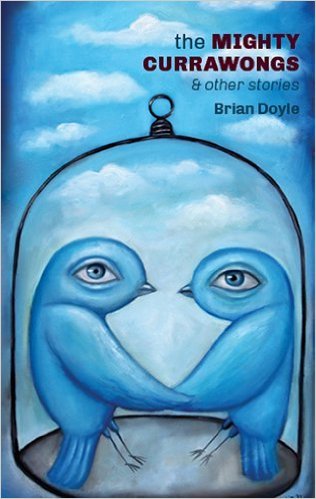
The Mighty Currawongs by Brian Doyle

With Brian Doyle’s reliable good humor, this collection reveres human efforts and love in situations both moving and laughable.

mighty currawongs

The Mighty Currawongs and Other Stories by Brian Doyle (Martin Marten) roams broadly in subject matter, but always offers joyful, whimsical wordplay and an abiding love for life’s absurd and profound moments. These short stories–almost all under 10 pages–deal specifically with human experiences and relationships, rather than embracing the wider natural world of Doyle’s novels, but the same voice and fanciful tone appear clearly.

A Boston basketball league plays through hilarity and scuffles, and finds a player who deepens the game. A likable archbishop loses his faith; a grandfather teaches his grandson to play chess; a tailor offers a young newspaperman sartorial and other advice. Through these everyday incidents, Doyle’s approach to the world is poignant (as in a veteran’s memories of the Vietnam War) but steadfastly hopeful. Indeed, the only criticism of his work might be for his unrelenting optimism, expressed by consistently likable, essentially good characters. But with his mastery of language and eye for detail, Doyle’s characters always feel authentic, and their ups and downs are realistically proportioned. His gift for finding the sublime in even the small and dirty details is alive and gleaming in this short story collection.


This review originally ran as a *starred review* in the September 30, 2016 issue of Shelf Awareness for Readers. To subscribe, click here, and you’ll receive two issues per week of book reviews and other bookish news.


Rating: 8 halves of the door.

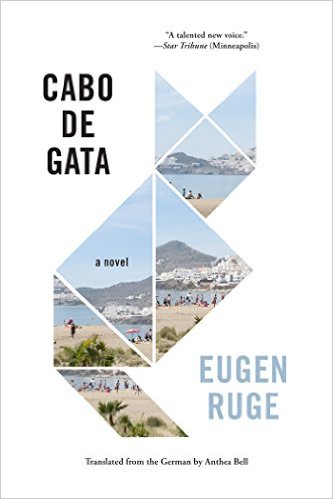
Cabo de Gata by Eugen Ruge, trans. by Anthea Bell

This clever, stylish novel in translation follows a German man’s quietly tortured self-exploration in an austere Spanish village.

cabo de gata

In this slim, unassuming novel, Eugen Ruge (In Times of Fading Light) experiments with form and style, setting a plot of quietly tortured self-exploration in an austere Spanish village. Cabo de Gata is almost minimalist in its events, but expert detail fills out a story larger than its circumstances. In Anthea Bell’s translation from the German, the unnamed narrator’s voice suits him perfectly.

In Berlin in the years just after the Wall came down, Ruge’s narrator feels stuck. He has a good-enough if meaningless job; his ex-girlfriend calls only to ask him to help care for her daughter; he suspects the punks in the ground-floor apartment stole his bicycle. He sees the rest of his life rolling out in front of him in mind-numbing routine, doomed “like the undead” to empty repetition. And so he leaves.

Indecision about where to travel pleases rather than alarms him: he seeks the unknown, “for the sake of experiment,” because he is also an aspiring novelist. He chiefly wants someplace quiet and warm, and so flees to Cabo de Gata, a town in Andalusia promised by the travel guides to offer “a breath of Africa.” The nearly abandoned fishing village turns out surprisingly to be terribly cold, the inhabitants gruff and standoffish; his writing comes out bitter. He is a curious, contradictory character, perhaps not entirely reliable: he is not superstitious, he announces, and then proceeds to find signs in hermit crabs and his dead mother in a stray cat. Intermittently obsessive, he fills his days as much with invented tasks and rules as he does with writing the intended novel.

It may sound absurdist, but Ruge’s quietly affecting story is more understated than it is bizarre. The narrator has his quirks, such as a fondness for humming “The Star-Spangled Banner” (“Jimi Hendrix taught it to me in his famous appearance at Woodstock”). But he is essentially involved in a search both existential and humdrum: where to go from here.

The narrator tells his story from a distance, from a much later time in which he hints that he has been very successful, and he pointedly chooses not to consult notes or check his facts (“I could Google it,” he writes, but he doesn’t). This meta-view offers another layer for the discerning reader to dissect. On the surface the odd story of a troubled man haunting a Spanish ghost town, Cabo de Gata also poses questions about life’s directions and perspectives.


This review originally ran in the September 30, 2016 issue of Shelf Awareness for the Book Trade. To subscribe, click here.


Rating: 7 candles.

A Woman on the Edge of Time: A Son Investigates His Trailblazing Mother’s Young Suicide by Jeremy Gavron

The legacy of a mother and her suicide reveals the story of both a woman and a social movement.

woman on the edge

Jeremy Gavron grew up with the faintest of impressions of his mother, who died when he was four years old, in 1965. He didn’t know that her death was a suicide until he was 16, and only decades later did he embark upon an exploration of her life and reasons for ending it. A Woman on the Edge of Time is a record of his examination and tentative conclusions.

Gavron’s mother, Hannah, is a tantalizing character. A talented, magnetic youth, she excelled in acting, equestrian sports and poetry; had an affair with the headmaster of her boarding school; married at 18; earned a doctorate in sociology while raising two young sons; and wrote a feminist text that would be published shortly after her death. In an echo of Sylvia Plath’s suicide two years earlier, she gassed herself in a flat just one street over from Plath’s. And, like Ted Hughes, Gavron’s father all but erased her presence from the lives of her two children.

In chasing this shadowy figure, Gavron corresponds and visits with Hannah’s friends, colleagues and family, and studies letters, diaries and photographs left behind. Along the way, the reader is exposed to English cultural history, particularly in Gavron’s investigations of Hannah’s book The Captive Wife, a qualitative study of young homebound mothers. As he concludes, there can be no thorough comprehension of a suicide or of a mother he doesn’t remember. A Woman on the Edge of Time ends with Gavron’s attempted “narrative verdict,” which though incomplete does offer him some closure.


This review originally ran in the September 23, 2016 issue of Shelf Awareness for Readers. To subscribe, click here, and you’ll receive two issues per week of book reviews and other bookish news.


Rating: 7 gurns.

The Black Panthers: Portraits from an Unfinished Revolution by Bryan Shih and Yohuru Williams

Photos, essays and interviews with rank-and-file Black Panthers “complicate the Panther story in a good way.”

black panthers

With The Black Panthers: Portraits from an Unfinished Revolution, photojournalist Bryan Shih and historian Yohuru Williams seek to tell a nuanced story of the Black Panther Party, one different from the popular conception of gun-wielding “thugs,” chiefly male, in black leather jackets and Afros with the leadership–Huey Newton, Bobby Seale and Eldridge Cleaver–centered in Oakland, Calif.

In pursuit of the rank-and-file perspective, Shih photographs and interviews Panthers or former Panthers, male and female, whose narratives express pride, humility, trauma, frustration and hope. Accompanied by essays solicited from scholars, this collection tells a more complex and sympathetic story. While not uncritical, the authors do champion an interpretation that emphasizes love and service over violence, featuring, for example, party programs like Breakfast for Schoolchildren (in more cities than just Oakland), free busing and ambulance services, free health care clinics and more. Shih’s photographs are striking and expressive, capturing the “humanizing details” he sought.

The Black Panthers is not the complete story: for instance, the “deep misogyny and sexism within the rank and file and leadership” is mentioned but not really addressed. Perhaps there is no complete story–as proven here, the party was made up of diverse members, with varied goals and motivations. Shih and Williams’s objective to expose this multiplicity, and inspire a second look at an energetic but ill-fated cause, is achieved with this intelligent, unapologetic book.


This review originally ran in the September 16, 2016 issue of Shelf Awareness for Readers. To subscribe, click here, and you’ll receive two issues per week of book reviews and other bookish news.


Rating: 8 humanizing details.

The Penalty Area by Alain Gillot, trans. by Howard Curtis

When a grumpy soccer coach takes in his 13-year-old nephew, they’re both forced to grow, on and off the field.

penalty area

Quirky and heartwarming, Alain Gillot’s The Penalty Area introduces an eccentric soccer coach who finds unexpected happiness in the oddest places. Vincent Barteau retired from playing professionally after an injury, settling instead for coaching as a way to stay in the game. Coaching children was never the plan, but this job pays well enough. He is a loner, frustrated with the mediocre talent he has to work with. When his estranged sister shows up to deposit her 13-year-old son with him, Vincent is understandably annoyed–until he puts his nephew Léonard on the field and everything changes.

Léonard is a chess prodigy and all-around odd boy. He dislikes soccer for being “too simplistic.” It is only in deciphering plays, percentages and tactics that his exceptional intellect is engaged. Caring for Léonard exposes Vincent to new people and scenarios; the man dislikes change as much as the boy does, but in the new world that opens before them, possibilities abound. Léonard discovers soccer. Vincent discovers family and hope.

The Penalty Area handles material that could easily overindulge in sentiment, but Vincent’s awkward, exasperated approach to life and human flaws admits no foolishness. Howard Curtis translates from the French in occasionally stiff prose, which nonetheless suits the equally stiff narrator. Vincent’s voice offers the novel a disarming vulnerability; Léonard and Vincent’s exploration of new challenges feels fresh and endearing, even humorous. No love of sport is required to feel the genuine emotion pulsing from this story about making connections.


This review originally ran in the September 13, 2016 issue of Shelf Awareness for Readers. To subscribe, click here, and you’ll receive two issues per week of book reviews and other bookish news.


Rating: 7 shots on goal.

The World in Flames: A Black Boyhood in a White Supremacist Doomsday Cult by Jerald Walker

This vivid, immersive memoir describes an innocent childhood in a terrifying religion.

world in flames

The Worldwide Church of God taught that the Great Tribulation would begin in 1972 and end three years later in a river of fire from which only the Chosen Ones would be saved. Jerald Walker grew up with these teachings looming over his head. In 1975, at the predicted end of the world, he would be 11 years old. In The World in Flames, Walker relates his unusual upbringing in Chicago as the sixth child of blind African American parents, in the black wing of a church that preached segregation as well as fire and brimstone.

Except for a brief prologue and epilogue offering a glimpse of the adult Walker, the whole of this fantastical true story is told from a child’s disarming perspective. Jerry is six when his memoir opens in 1970, and his days are filled with fear. Preoccupied with the coming events and concern for a friend who is not Chosen, he struggles to navigate family secrets, severe corporal punishment and a religion based on threats. As narrator, Jerry is matter-of-fact and innocent about the improbability of his home life. This narrative voice renders an incredible story accessible. Perhaps the most heartbreaking detail is Jerry’s guileless devotion to his church.

Walker (Street Shadows) recounts his growth from wide-eyed child to hapless teen, and finally to skeptic, with immediacy and feeling and without offering judgments. His personal history verges on the absurd, but his telling of it is earnest and unadorned, never sensational. The World in Flames is a difficult story simply and gracefully told.


This review originally ran in the September 9, 2016 issue of Shelf Awareness for Readers. To subscribe, click here, and you’ll receive two issues per week of book reviews and other bookish news.


Rating: 7 lines of scripture recited.

Maximum Shelf author interview: Jade Chang

Following yesterday’s review of The Wangs vs. the World, here’s Jade Chang: Method Writer.


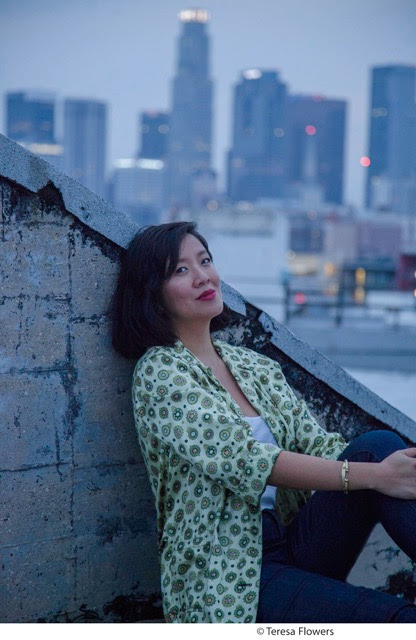
Jade Chang has covered arts and culture as a journalist and editor. She is the recipient of a Sundance Fellowship for Arts Journalism, the AIGA/Winterhouse Award for Design Criticism, and the James D. Houston Memorial scholarship from the Squaw Valley Community of Writers. She lives in Los Angeles. The Wangs vs. the World is her debut novel.
photo credit: Teresa Flowers

photo credit: Teresa Flowers


Your journalistic background covered some of the topics in the Wangs’ lives, but still: How different was writing a novel? And how hard?

I never got an MFA, but my college did have a good creative writing program, so I went through writing workshops there. And in workshop, we were always writing short stories. I guess I liked it okay, and when I graduated I continued trying to write short stories, but sometimes a thing is just not your form. And short stories were kind of hard for me. Simultaneously, I was working as a journalist. And I enjoyed writing articles–hated writing on deadline, but enjoyed writing articles. But once I started writing a novel it felt like, ahh!–this makes more sense. Having all this space, all this room, all this time, having a much broader canvas felt more exciting to me. I don’t know that being a journalist affected my experience enormously, except that I think it’s really good training because you learn to not be too precious about your words. I got used to being edited, to rewriting and all that stuff. And that’s good training for any writer.

Did the Wangs come to you fully formed, or did you have to work to build them? Are they based on anyone you know?

There’s definitely no character-by-character corollary for them in real life. I would say that Charles Wang, the father, came to me kind of fully formed. His bluster, his exuberance, his excitement about life, but also his kind-of-asshole side, all of those things felt like–well, like a view of America to me. And then also he just really felt like a lot of fun to do. The other characters definitely felt from the very beginning like real people to me. But I do a lot of character work–I ask myself questions about a character, and a lot of that stuff doesn’t go into the book at all, but it gives me a more well-rounded sense of who someone is and how they will react in a situation that does end up in the book.

Your characters are so rich, and span genders, ages, lifestyles and stages of life.

I knew I wanted to look at contemporary life from several different viewpoints. Growing up kind of between Gen X and Gen Y, I always found that definition of generations really interesting. So I really wanted to have siblings who were in different generations, who looked at the world in different ways. There are roughly 10 years in age between the sisters Saina and Grace, and that’s a huge difference in experience.

Then you have a father who is an immigrant, children born here, and a stepmother who comes from a world that’s actually very different from the father’s, even though to someone who knows nothing about them, you might think that they are from the exact same world. I wanted to show a lot of different viewpoints. And I was interested in getting into a lot of worlds in this book. So you have the father who thinks of himself as a consummate entrepreneur or businessman, who makes a fortune in makeup. And then you have the oldest daughter who is an artist, and so you get to go into the art world. And then you have the middle son who’s a standup comedian and the youngest daughter who is an aspiring style blogger. I really wanted to look at worlds where you have a balance between artifice and reality. It’s all tied to the outset of the financial collapse in 2008, and that particular financial collapse, as most of them are I think, was based on essentially a lie, or the big con–mortgages we couldn’t really afford, and all that. The financial world at that time was falling apart based on a beautiful lie. It made me very interested in other worlds that are based on that as well. I think makeup is definitely that. And then the art world–you know, I love it so much in many ways, but a piece can be worth nothing or millions of dollars, based on who says it is. That is so fascinating to me. I love the overlaps between these worlds, in how we ascribe values to things.

I really enjoyed your shifting perspectives–even the car gets a voice. Was that hard to write?

It was a challenge, and it was a really fun challenge. I definitely knew I wanted to do that. I was joking with a friend that, just like a method actor, I’m a method writer. I just really need to completely be in someone’s head and looking through their eyes in order to fully embody a character. And I liked the challenge of it, honestly. I wanted to see if I could write from five or six viewpoints.

You chose to leave some untranslated Chinese dialogue for the (non-Chinese-reading) reader to decipher from context clues. Why?

A lot of the books that we read in America today are from the point of view of white people in America. Or they’re written for what has been the majority audience, which is white people in America. And I feel like on the one hand obviously this book is for everybody, as every book is, but I wanted a different world of people to get to be the insiders. So people who speak Chinese and can understand the Chinese, they get to be the insiders in this book. But I didn’t want to write it in Chinese characters, because I wanted any reader to be able to kind of sound it out and get that experience of what it feels like to eavesdrop in a language that you don’t understand.

But you’re not actually missing out on anything. There might be something a little bit jokey, or a colloquialism that’s in the Chinese that doesn’t come out in the English, but essentially, it’s all there.

Do you have a favorite character?

I feel a lot of sympathy for Andrew. He is the middle brother, he is really trying hard to find his way in the world, he’s so good-hearted, he really just wants the best for everybody. But he’s also a young guy, and so he makes a lot of dumb missteps. And I just love stand-up comedy. I think it’s so fascinating and so fun. You have to be so smart to do it well, and also so emotionally reckless. I feel a lot of sympathy for stand-up comics in general, and so writing him and writing those scenes where he gets up and does stand-up sets, that really made me love him a lot.

But whichever character I was working on emotionally, working on their emotional arc, I felt a lot of love for that character at that point.

What are you working on next?

I am working on another novel. We’ll see what happens.


This interview originally ran on September 7, 2016 as a Shelf Awareness special issue. To subscribe, click here, and you’ll receive two issues per week of book reviews and other bookish fun!

Maximum Shelf: The Wangs vs. the World by Jade Chang

Maximum Shelf is the weekly Shelf Awareness feature focusing on an upcoming title we love and believe will be a great handselling opportunity for booksellers everywhere. The features are written by our editors and reviewers and the publisher has helped support the issue.

This review was published by Shelf Awareness on September 7, 2016.


wangs vs the world

Jade Chang’s first novel, The Wangs vs. the World, is an accomplishment: sparkling characters, family dynamics, humor and despair set against global historic and economic forces, rendering the title entirely apt.

Charles Wang is a proud patriarch. He has three beautiful, talented children (though his son hasn’t slept with quite so many women yet as he should have, and his older daughter lives too far away), and has built a major financial empire in makeup manufacturing. He has the house in Bel-Air, the factories, the cars; his second wife has all the designer clothing, jewelry and handbags she ever wanted. He has a “sexy little cigarette speedboat painted with twenty-seven gallons of Suicide Blonde, his best-selling nail polish color–a perfect blue-toned red that set off the mahogany trim and bright white leather seats.”

Until he doesn’t.

In 2008, the Wang fortune evaporates, like so many others, due nearly as much to Charles’s hubris as to the economic climate of the time. In the face of this calamity (frequently referred to in his inner monologue as “the Failure”), Charles turns to an old legend: his family’s land in China, stolen by the Communists. This fable of luxury and excess was his birthright, and with the U.S.-based version collapsed, he determines to take his family back to the old country and reclaim what is rightfully theirs. And so a road trip ensues, with the patched-together family forming and reforming in various configurations cross-country.

Charles and his second wife, Barbra, depart the California home they no longer own in a powder-blue Mercedes station wagon nearly 30 years old, which luckily had been transferred into the nanny’s name, so it wasn’t repossessed with the other cars. They pick up stunned younger daughter Grace from her boarding school in Santa Barbara, then son Andrew from Phoenix, Ariz., where he’d been enrolled in college (working harder on his stand-up comedy routine than on his studies). The Wangs aim for the home of elder daughter Saina in the Catskills, where she struggles to regroup from her own personal trauma–and from there, for China. But on a southern detour, Andrew leaves the group for an older woman he meets at a New Orleans wedding.

The hilarity of filial antics on this road trip, “a troupe of Chinese Okies fleeing a New Age Dust Bowl,” forms a central part of this story. But the larger narrative involves Charles’s perception of the injustices done to the Wangs by history: Japan’s invasion of China, immigration through Taiwan, investment patterns in the U.S. The next generation of Wangs has taken an artistic turn: Saina is a fallen darling of the New York art world; Andrew aspires to be a comic, but relies perhaps too heavily on Asian jokes; and Grace surprises her elders with her fashion sense (and a promising blog on the topic). The Wangs vs. the World is about generational and cultural challenges, and not just that of the Chinese immigrant to the United States. It is more about family than money.

This is a stylish novel, fun to read. The Wangs sometime speak in a mashup of English and Chinese that Chang leaves untranslated, though adequately understandable in context. Charles has his own prejudices, including a bias against “the tropical joke of Taiwan” and “the poor, illiterate, ball-scratching half men from Canton and Fujian.” Each chapter shifts perspective, beginning with Charles the patriarch and cycling through outsider stepmother Barbra (whose further crime is to be not even Chinese, but Taiwanese), the three privileged but loving children, even the 1980 Mercedes.

Chang crafts her characters expertly, with nuance and precise details. In Charles’s mind, makeup “was artifice, and it was honesty. It was science and it was psychology and it was fashion; but more than that, it was about feeling wealthy. Not money–wealth. The brilliant Aegean blues and slick wet reds and luscious blacks, the weighty packaging, with its satisfying smooth hinges and sound closures.” In packing to leave his dorm, Andrew prioritizes “his top five pairs of sneakers–original issue Infrared Air Max 90s, Maison Martin Margiela Replica 22s, Common Projects Achilles Mid, beat-up checkboard Vans, and a pair of never worn Air Jordan 4 Undefeateds.” Saina’s social life in the Catskills is populated by few but absorbing characters–including an old artist boyfriend and a new one who’s a farmer–who are among Chang’s finest sketches. Andrew’s economics professor offers an impassioned in-class explanation for the crash: “Every one of you ought to be furious because you are the unfortunate generation who will be graduating and trying to obtain jobs in a busted economy that we might well pack up and sell to the Chinese.” These details, and perfectly formed dialogue, make an already engrossing story positively glitter.

As a novel with momentum and magnetism, reaching across generations from China and Taiwan to high-society California and New York to New Orleans and the Catskills, with stops along the way, The Wangs vs. the World undertakes an ambitious range of material. Chang manages both this sweeping plot and backdrop, as well as the finer points of characterization and relationships, with ease. The result is hilarious and heartfelt, witty and wise, and a prodigious achievement for a first-time novelist.


Rating: 8 of dad’s old paisley Hermès bow ties from the eighties.

Come back tomorrow for my interview with Chang.

Love from Boy: Roald Dahl’s Letters to His Mother ed. by Donald Sturrock

Forty years of letters from a beloved children’s author to his mother offer an intriguing, entertaining perspective on both the man and the world.

love from boy

Roald Dahl, renowned for both children’s classics and eerie adult short stories, wrote his first letter home from boarding school in 1925, when he was nine years old; Donald Sturrock (Storyteller: The Authorized Biography of Roald Dahl) edits this collection of previously unpublished letters from Dahl to his mother. In Love from Boy, Sturrock’s minimal narrative appears alongside the epistolary bulk of the text, accompanied by a small selection of Dahl’s photographs and drawings.

Organized in seven chapters by phases of Dahl’s life, the correspondence tracks the growth of a beloved imagination and literary career. Over 40 years, Dahl evolves from funny prankster to crafty storyteller to a more serious and cynical mind, particularly following World War II. Dahl had a thoroughly interesting life even before he began writing in earnest: from English boarding schools to travel and corporate work in colonial Africa, hours logged as a Royal Air Force pilot, diplomatic work in the United States and collaboration with Walt Disney in Hollywood. But Love from Boy also provides a personal perspective on his eye for detail and the absurd, his predilection for pranks, his knack for characterization–“He’s a short man with a face like a field elderberry, and a moustache which closely resembles the African jungle. A voice like a frog…”–and his quirky preoccupation with personal hygiene, especially dental care. Love from Boy is both an endearing glimpse of a much-loved author and a sober view of mid-20th-century world events.


This review originally ran in the September 6, 2016 issue of Shelf Awareness for Readers. To subscribe, click here, and you’ll receive two issues per week of book reviews and other bookish news.


Rating: 7 tubes of Euthymol.

The Motion of Puppets by Keith Donohue

This reworking of the myth of Eurydice features a woman locked in a world of sentient puppets.

the motion of puppets

With The Motion of Puppets, Keith Donohue (The Boy Who Drew Monsters) evokes a bizarre underworld with an array of mythological references in a story of lovers seeking reunion. Newlyweds Kay and Theo Harper have come to Quebec for the summer, where she works as an acrobat in a cirque and he wrestles with a work in translation between semesters teaching French literature in New York City. The first line of the novel reads: “She fell in love with a puppet.” And this is where the trouble begins.

A puppet shop in Quebec’s Old City draws Kay’s attention daily, but the door is always locked, the lights off. One night, when returning from a party after midnight, she fears she is being followed and, finding the door unlocked for once, slips inside. Theo contacts the police when she does not return home, but no trace can be found of her. The rest of The Motion of Puppets alternates between their two experiences. Theo searches Quebec all summer for his wife, then returns to New York City and his work, distracted and mourning. Meanwhile, Kay adjusts to new circumstances: she has become a puppet. Along with the other puppets shut away in the shop she once admired, she is able to speak and move on her own only between midnight and dawn–once she learns how to move again in her new body. Eventually, she takes pleasure in performing (with the help of a puppeteer) for audiences, as she had in the cirque. And she makes new friends, especially with the one puppet who also remembers and yearns for her human form.

This dreamy, sinister novel alludes widely to history, literature and legend. Theo’s translation project is a biography of the photographer Eadweard Muybridge, whose work involved scientific knowledge of human and animal locomotion. Muybridge shot and killed his much younger wife’s lover, a story that preoccupies Theo, also an ardent–if not clingy–older husband. One of Theo’s colleagues is a professor of antiquities who is equally eager to find relationships between past and present. Most pointedly, however, Kay’s predicament is a reference to the myth of Orpheus and Eurydice, in which Orpheus misses his wife so terribly that Hades agrees to let her leave the underworld and return to life with him, under one diabolical condition. In Donohue’s novel, Theo’s ability to save Kay from her incarnation as a puppet relies on his ability to trust her. But first, she must make him recognize her in her new form.

An engrossing novel of love, fancy and enchantment, The Motion of Puppets offers a perfectly wrought moodiness, detailed settings and an unsettling plot. Kay and Theo are underdeveloped as characters, but serve the mythic proportions of the story well. Smart, eerie and moving, this puppet show holds the potential to transport its reader to another world.


This review originally ran in the August 30, 2016 issue of Shelf Awareness for the Book Trade. To subscribe, click here.


Rating: 7 hinges.