The Mighty Franks by Michael Frank

This memoir of family wounds and favoritism charts dark territory as the author searches for understanding.

the-mighty-franks

“‘My feeling for Mike is something out of the ordinary,’ I overhear my aunt say to my mother one day when I am eight years old… ‘I wish he were mine.'”

Michael Frank comes from an especially close-knit family: his mother’s brother married his father’s sister. He is devoted to his doubly related Aunt Hankie and Uncle Irving. The elder couple is childless, and so they “share” the younger couple’s three sons, of whom Mike is the eldest. The two households are neighbors in Laurel Canyon, in the Hollywood Hills. Both grandmothers live together at the foot of the canyon. It is all very cozy: Aunt Hankie calls them “the larky sevensome,” or “the Mighty Franks.”

And Mike is the luckiest, larkiest one of all, because he is Aunt Hank’s pet. They spend their free time together. She takes him antiquing, and sets out to teach him everything she knows. Hank (a nickname for Harriet) and Irving are successful Hollywood screenwriters, and they have the finest taste in architecture, art, literature, movies, music (nothing after Brahms) and manners. Hank has an overwhelming personality and strong opinions, and when she says that Mike has the eye, the artistic eye for the creative pursuits she prizes above all, he is naturally proud–and motivated.

The Mighty Franks is Michael Frank’s memoir of the relationship he shared with his forceful aunt. While he is favored, his two younger brothers are mostly ignored (Hank sniffs that one has the makings of a scientist, the other, an athlete). He is the modelling clay she plays with, until he begins to awaken to a world larger than Aunt Hank, and forms his own opinions and tastes. She sees this as rebellion, ingratitude or worse. As Mike grows up, Hank seems to break down and the Mighty Franks begin to fissure.

Frank moves between the child’s perspective of events as they unfold and a place of reflection. In writing this story, he seeks a better understanding of his aunt, the imperfect workings of his extended family and his own relationships within and outside it. Hank is firm about hierarchies: the Renaissance over the Middle Ages, Faulkner over Hemingway, Fred over Ginger, early Fellini over late. Similarly: Hank over her younger brother, both of them over their spouses, Mike over his brothers. And always Hank first.

The Mighty Franks is an immediate, gut-wrenching account of events that are often painful for young Mike. While not an easy story to take in, Frank’s ruminations offer some necessary distance. His tone is serious and his prose occasionally verbose, but the saga of this flawed family is deeply involving. Any hint of sensationalism is more than balanced by the psychological insights Frank eventually achieves.


This review originally ran in the April 11, 2017 issue of Shelf Awareness for the Book Trade. To subscribe, click here.


Rating: 6 period pieces.

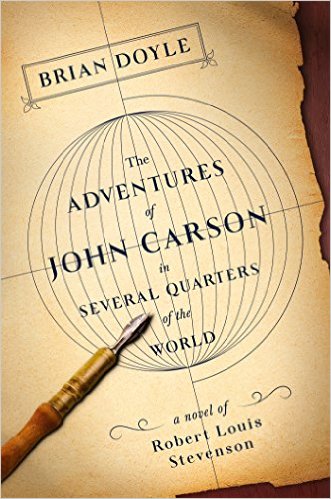
The Adventures of John Carson in Several Quarters of the World: A Novel of Robert Louis Stevenson by Brian Doyle

With enthusiasm and verve, in the style his fans love, Brian Doyle re-creates a novel Robert Louis Stevenson intended to write.

john-carson

In a novel with layers of authors, Brian Doyle (The Mighty Currawongs; Martin Marten) honors the art of storytelling. The Adventures of John Carson in Several Quarters of the World is firmly based in fact: Robert Louis Stevenson boarded for some months at the home of Mrs. Carson in San Francisco while waiting to marry his love, Fanny. He conceived of a novel based on the tales of his landlady’s husband, but never wrote it. Doyle imagines what stories Mr. Carson might have told, and the style in which Stevenson might have written them. Doyle calls upon other published accounts of Carson’s and Stevenson’s acquaintances, including Mark Twain and scientist Alfred Russel Wallace.

In Doyle’s imagination, Stevenson sits by the fire with Mr. Carson as the latter recounts his voyages around the world as a seaman and his experience as a Union solider in the Civil War. This talented storyteller takes Stevenson (and Doyle’s reader) through the jungles of Borneo, over the rocky hills of Irish islands, from coast to coast of Canada in winter, to Australia’s Sydney Harbor and to the battlefield at Gettysburg. Mrs. Carson turns out to be as fine a narrator as her husband, and both have a knack for ending on a cliffhanger just as dinner is ready. As he recounts the Carsons’ feats, Stevenson also explores the sights, smells and steep hills of 1880 San Francisco, and touches on his romance with Fanny Osbourne, herself a worthy, headstrong character.

Doyle’s characteristic prose style is effusive, wry, highly descriptive and always passionate about his subjects. Throughout this story of stories runs a thread of commentary on the value and nuances of the storytelling art. Stevenson constantly refers to his ambition and makes notes for future works: “Hyde would be a lovely name for a character,” he muses, and imagines a novel in which a “sudden shocking kidnapping would set the prose to sprinting.” In several passages, Doyle-as-Stevenson extols the power of storytelling, the universal need for tales of adventure, the urgency of getting them out–he even worries what the “disconsolate reviewers” might say. Readers hungry for more stories-upon-stories will delight in Doyle’s “Afterword” and “Thanks & Notes,” which are filled with recommendations for further reading (what he calls “homework”).

Stevenson’s rollicking zest for adventure blends happily and seamlessly with Doyle’s unrestrained love of words and life. Adventures offers daring exploits, romance and emotional highs and lows, but perhaps most of all, a celebration of stories. Doyle’s signature style expresses this joyousness perfectly.


This review originally ran in the March 2, 2017 issue of Shelf Awareness for the Book Trade. To subscribe, click here.


Rating: 8 stories, of course.

Eggshells by Caitriona Lally

A narrator who belongs in a fairy tale becomes lost among the indifferent streets of Dublin in this quirky, imaginative debut novel.

eggshells

Caitriona Lally’s first novel, Eggshells, portrays an unbalanced but charming narrator stuck in an overwhelmingly complex Dublin, searching clumsily for home. In the opening pages, Vivian settles into the house she’s recently inherited from her great-aunt Maud, who “kept chairs the way some people keep cats.” This dusty, cluttered house suits the eccentric inheritor, who avoids mirrors and hygiene, preferring to cultivate her own “earthy tang.” Vivian believes that she is a changeling, fallen out of a world of fairies and elves and into this one by accident. Her daily chore is to find a magical door through which to reenter her rightful place in that other world.

Unsurprisingly, Vivian’s obsessions and whimsies make modern Dublin’s other residents uneasy. She has few contacts: her nosy neighbors, given to shaking their heads; a flummoxed social worker; and an impatient older sister: “her world is full of children and doings and action verbs, but I’m uncomfortable with verbs; they expect too much.” The sisters share the same name, Vivian, although sharing is not the right word: the older sister comfortably inhabits the name, while Lally’s protagonist is forever displaced, lacking an identity of her own.

Vivian walks the city and takes buses and cabs, exploring streets with promising names (Poppintree, Lockkeeper’s Walk, Ferrymans Crossing, All Hallows Lane) and performing tricks and charms–circling a particular pole three times, whispering to herself, and otherwise alarming passersby. She maps these routes and analyzes the shapes she’s walked, looking for meaning. She advertises her search for a friend named Penelope (“Pennies Need Not Apply”). Vivian is, in her awkward way, a giver: she leaves cryptic but (she believes) encouraging notes in books that she donates to charity shops, and €5 notes in the pockets of cardigans on sale in thrift stores. She makes lists in her notebook–names of birds, favorite sweets, museum artifacts–anywhere she might find weird words and possible anagrams. Vivian’s fascination with wordplay echoes Lally’s knack for language, and this emphasis is one of the great charms of Eggshells, a sweetly off-kilter novel about loneliness, communication and finding one’s place in the world.

Vivian stumbles, and may never find the portal to the place she yearns for. But she makes shaky progress: acquiring a pet goldfish, throwing a dinner party of sorts, finding a new friend with traumas and eccentricities of her own. Eggshells is ultimately a funny, occasionally grim story centering on a sympathetic character who is either disturbed or a changeling from a fanciful world: it is for the reader to decide.


This review originally ran in the February 16, 2017 issue of Shelf Awareness for the Book Trade. To subscribe, click here.


Rating: 7 goldfish.

The Signal Flame by Andrew Krivák

This novel of love, grief and the cycles of life veils its profundity in deceptively simple everyday events.
the-signal-flame

Andrew Krivák (The Sojourn) paints indelibly rich scenes and relationships with The Signal Flame, an astonishing novel set in a small town in northeastern Pennsylvania’s Endless Mountains. A strong tie to that setting is one of the elements that binds together a community and a family struggling with loss and continued life.

The people in Dardan mourn patriarch Jozef Vinich. He is survived by his daughter, Hannah, and her son Bo; these three generations have been touched by war. Jozef lost fingers in World War I; Hannah’s husband survived World War II but returned in ignominy, a deserter later killed in a hunting accident; and Bo’s younger brother, Sam, has been missing in action in Vietnam for some months. As they grieve for Jozef and Sam, Hannah and Bo must also navigate a lingering feud with another local family, the management of a business and a farm, a natural disaster and a legacy Sam has left behind.

The town of Dardan and its inhabitants are eloquently portrayed, both in the everyday and exceptional. Krivák’s writing is beautiful, luscious but never overwrought; he recalls Norman Maclean in the understated loveliness and clarity of both language and meaning. He imbues his story with methodical pacing, a strong sense of place and a perfectly expressed sense of the quotidian: The Signal Flame takes place between Easter and Christmas of 1972, but encompasses a world of human experience. This is an extraordinary novel to be savored.


This review originally ran in the February 10, 2017 issue of Shelf Awareness for Readers. To subscribe, click here, and you’ll receive two issues per week of book reviews and other bookish news.


Rating: 9 letters.

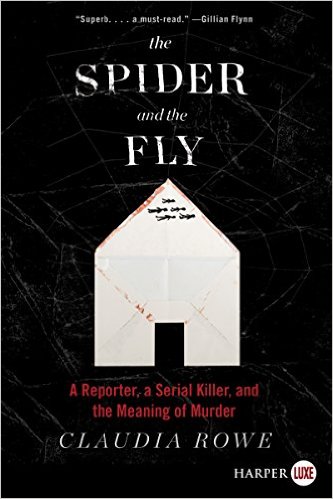
The Spider and the Fly: A Reporter, a Serial Killer, and the Meaning of Murder by Claudia Rowe

A journalist with trauma of her own exchanges a torrent of letters with a serial killer in this absorbing, suspenseful memoir.

the-spider-and-the-fly

Claudia Rowe is a careworn reporter in Poughkeepsie, N.Y., when a local man confesses to the rape and murder of a series of missing women. The case has journalistic potential, but there is more to the story. As Rowe and killer Kendall Francois communicate in letters and phone calls and during prison visits, the journalist’s life goes into a tailspin. Her boyfriend leaves, taking their dog; she moves to the woods and lives in a barn like a hermit. As her obsession with Francois grows, Rowe delves into her own past, a troubled childhood and damaged relationships leading to what she sees as a lifelong fascination with brutality.

Chasing violence and fear has led her to a serial killer who can seem like a big teddy bear as well as a disturbed predator. Rowe yearns to understand where a man like this comes from, how a murderer is made, and the intricacies of race and class in Poughkeepsie and beyond. She puzzles over Francois’s family home, so stuffed with rot and detritus and denial that decomposing bodies went unnoticed. What she learns is that Francois may not be a riddle she can solve.

The Spider and the Fly is a work of personal exploration, as much about Rowe’s growth as an individual as it is about Francois’s crimes. The reflective tone and dogged probing into the ugliest of human behaviors enrich this blend of true crime, memoir and suspense. Looking into darkness, Rowe gains some understanding and some release.


This review originally ran in the February 7, 2017 issue of Shelf Awareness for Readers. To subscribe, click here, and you’ll receive two issues per week of book reviews and other bookish news.


Rating: 7 cans of grapefruit juice.

Human Acts by Han Kang, trans. by Deborah Smith

South Koreans struggle to comprehend a 1980 uprising and the violence that follows.

human-acts

Human Acts is the second novel by Han Kang (The Vegetarian) to be translated into English. An introduction by translator Deborah Smith provides valuable context for this meandering book, which uses a dreamy atmosphere to explore the violence of a 1980 student uprising in South Korea.

Kang approaches the horrifying events of the Gwangju uprising obliquely. She doesn’t shy away from the shocking details–indeed, the novel opens with a young boy taking a brief respite from his work cleaning and caring for an overflow of unidentified dead bodies in a converted government office. But instead of spotlighting this violence, Kang focuses on the lives of individuals, beginning with Dong-ho, the boy caring for the dead, and then rotating through the views of those around him. First-, second- and third-person perspectives reinforce the feeling of circling the center of this event. After Dong-ho, the reader meets his best friend, shot dead in the streets; the two young women he works with; and his grieving mother. In a state of massive unrest, violence and terror, these characters appear dazed. Others look back over the decades that follow, including an editor wearily battling censorship and former prisoners struggling with old trauma. This range of voices, their sense of shock and unreality, along with the title, explore the possibilities of humanity: human acts can be variously brave, selfish, gentle and cruel.

Human Acts is a remarkable novel, at once lyrical, dreamlike and horrific. Smith’s succinct introduction is an excellent aid in understanding both Kang’s message and her artistry.


This review originally ran in the February 3, 2017 issue of Shelf Awareness for Readers. To subscribe, click here, and you’ll receive two issues per week of book reviews and other bookish news.


Rating: 7 bodies.

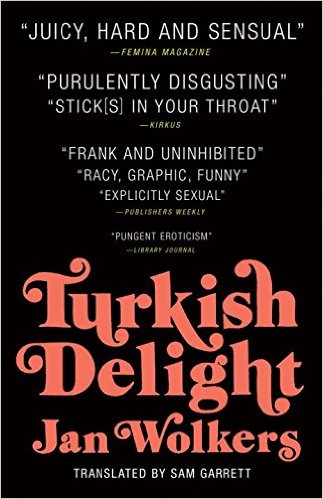
Turkish Delight by Jan Wolkers, trans. by Sam Garrett

This Dutch novel of 1969 still titillates with its sexual content, but deserves serious consideration for style and themes, too.

turkish delight

Jan Wolkers’s 1969 novel Turks Fruit was translated from the Dutch into many languages and adapted into a highly regarded 1973 film. Sam Garrett’s English translation is not the first of this work, but reflects its continuing appeal.

Turkish Delight opens with the unnamed narrator, a sculptor, lamenting and railing against his lost love. He describes in great detail a surfeit of sexual affairs undertaken after she departed, then flashes back to describe their first encounter: Olga picked him up as a hitchhiker, then pulled over the car for the first of their sexual enthusiasms. Olga is the heart and life of this novel and of the narrator’s existence: he obsessively recites and reviews her body, her sex, her red hair, her love for animals, her jokes and delights. The lengthy flashback sees their relationship and, later, marriage run its course (his evil mother-in-law plays a heavy role), and returns again to the sculptor’s tortured single life. His love for Olga does not flag, even as she degrades herself (in his eyes) with subsequent marriages and physical decline. The novel ends at Olga’s deathbed, where the former lover feeds her the soft candy Turkish delight, as her teeth fail her.

Not for the faint of heart, Turkish Delight was immediately notorious upon its original publication for its graphic sexual content, and decades later remains a frank, granular portrayal of sex, bodily fluids and coarse language. It has much to offer beyond shock effect, however. The narrator’s tone is unapologetic, and if he is fixated on Olga’s body and its pleasures (and equally detailed in describing his later lovers), his message is as much romantic as it is sexual. On the one hand, he worships Olga as a romantic ideal, and on the other, speaks in a recognizable, colloquial, even familiar voice. It is easy to see how shocking, even revolutionary Wolkers’s writing appeared in 1969, and it holds the power to provoke today. But it is also an honest view of a sticky love affair, one made of sweets, devotion and passion, as well as cruelty and obsession. Fittingly, Olga and the sculptor welcomed a menagerie of animals into their home together, and in a way their relationship ends as violently as a pet destroyed with an accidental crunch, “as though the little bird was built around a wooden frame.”

Garrett’s translation of Wolkers’s prose is often lyrical and always heartfelt; the juxtaposition of poetry with crude language echoes the narrator’s passionate love and enormous lust. Turkish Delight is a serious and artistic literary work, but only appropriate for readers fully tolerant of graphic sex.


This review originally ran in the January 30, 2017 issue of Shelf Awareness for the Book Trade. To subscribe, click here.


Rating: 7 positions.

Talking Back, Talking Black: Truths About America’s Lingua Franca by John McWhorter

A linguist argues for the legitimate and complicated contributions of the language he calls Black English.

talking-back

Linguistics professor John McWhorter (Words on the Move) has a message in Talking Back, Talking Black: Truths About America’s Lingua Franca: he exhorts his readers and the general public to recognize Black English (a term he prefers to African American Vernacular English or to Ebonics) as a language unto itself, not merely a mess of grammatical mistakes and slang: “a development that happens alongside the standard variety, not in opposition to it.”

McWhorter worries that academic linguists have relied too long on scholarly arguments in making this point. He does review some of those arguments–for example, Black English’s systematicity, meaning it has a grammar of its own–but then turns to global language patterns. Many cultures and language groups speak both a formal and a casual language in different settings, e.g., Standard Arabic and the local colloquial form (Egyptian Arabic, Syrian, etc.). While he acknowledges that racism partly underlies a general resistance to Black English as a legitimate language, he quickly moves on to what he sees as the larger problem: a misunderstanding of the value of diglossia, or speaking two languages. Along the way, McWhorter cites the relationship between modern Black English and the lingo of minstrel shows, makes the case for a recognizably black way of speaking (or “blaccent”) and examines usages such as “baby mama,” “who dat?” and what he perceives as two versions of the N-word.

Linguistics fans will be enthralled by McWhorter’s fascinating and logically presented study of two forms of English spoken in the United States.


This review originally ran in the January 24, 2017 issue of Shelf Awareness for Readers. To subscribe, click here, and you’ll receive two issues per week of book reviews and other bookish news.


Rating: 6 vowels.

Fever Dream by Samanta Schweblin, trans. by Megan McDowell

A woman and a boy sit in the dark, probing a shared story of love, danger and “the invisible thread that ties us together.”

fever-dream

Samanta Schweblin’s first novel, Fever Dream, is part contemplation, part living nightmare. Amanda lies in a dark hospital room, accompanied by a boy who is not her son. David walks her through the story of their meeting, as two very different mothers care for their two children in a dusty small town. Amanda worries over what she calls the “rescue distance”: “that’s what I’ve named the variable distance separating me from my daughter, and I spend half the day calculating it, though I always risk more than I should.” He presses her for details, because the two have an unnamed riddle to solve, but at the same time repeatedly chides her, “that’s not important.” This paradoxical sense of urgency combined with immobility evokes a classic bad dream. With relentless tension and steady pacing, the mystery of what has happened to Amanda, and to David, unfolds. This is a story about a parent’s need to protect her child; unnatural elements cannot obscure a cautionary tale about the pressures of parental love.

Fever Dream may be contagious: the reader should beware the compulsion to read it in a single sitting, pulled helplessly along by the power of the story. Though brief, its stream-of-consciousness style and absence of chapters emphasize a sense of inexorable forward momentum. Megan McDowell’s translation from the Spanish expertly delivers every atmospheric moment and line of near-panicked dialogue. A sense of foreboding hangs over this story that is at once a dark fairy tale and a realistic expression of everyday danger.


This review originally ran as a *starred review* in the January 20, 2017 issue of Shelf Awareness for Readers. To subscribe, click here, and you’ll receive two issues per week of book reviews and other bookish news.


Rating: 7 details that do not matter.

Take Me to Paris, Johnny by John Foster

This beautifully written memoir of a lover’s life and death will impress readers with its lyricism and emotion.

take-me-to-paris-johnny

Originally published in Australia in 1993, John Foster’s Take Me to Paris, Johnny recounts the life of his lover Juan Céspedes, who died of AIDS in 1987. This Text Classics edition–the first in the United States–includes an introduction by critic Peter Craven and an afterword by Foster’s close friend John Rickard. While these supplementary materials provide context and develop Foster’s character, the original work gleams abundantly without their help.

Juan was a Cuban refugee studying dance in New York City when he met Foster, an Australian history professor, in 1981. A one-night stand became a summer-long affair and then a long-term, long-distance relationship, to Foster’s surprise. As the couple wrangled with the Australian immigration authorities to gain Juan’s permanent residence there, his illness became undeniably serious. He died in a hospital in Melbourne with Foster by his side.

This sensitive, perceptive memoir keeps Juan at its center, outlining his boyhood and escape to the United States before focusing on the love affair and Juan’s death; the final event receives due gravity without defining his life or the book. In a mere 200 pages, Take Me to Paris, Johnny achieves a full emotional range, sketches Juan’s rare and changeable personality and imbues a tragedy with poetry. Foster’s writing is exquisite: thoughtful, lyrical and with an eye for detail. While this is undeniably a sad story, Foster resists wallowing, choosing instead to celebrate Juan and even to laugh at their troubles. Take Me to Paris, Johnny is incisive, wry, loving and deeply lovable.


This review originally ran in the January 10, 2017 issue of Shelf Awareness for Readers. To subscribe, click here, and you’ll receive two issues per week of book reviews and other bookish news.


Rating: 8 red gladiolas.