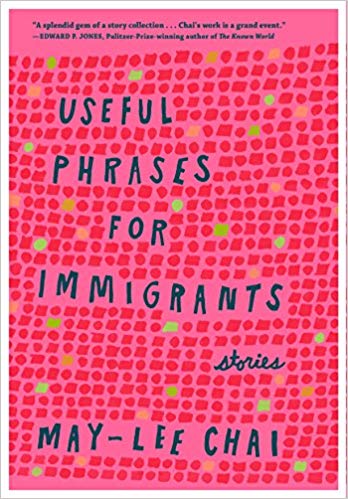
Useful Phrases for Immigrants by May-lee Chai

These stories about Chinese immigrant families range widely in their specifics, but offer a universal attention to love, hope and striving.

In Useful Phrases for Immigrants, May-lee Chai (Hapa Girl; Tiger Girl) illuminates a range of characters with experiences in common. This story collection is aptly titled: these are tales of Chinese immigrants to North America and, sometimes, within China. They are stories of family and community dynamics.

They encompass an adventure with a dying mother, an ice cream cake that potently stands in for a critical memory of childhood tragedy and the distinctive trials of a Chinese-American traveling to Beijing. A young boy new to the big city quickly learns to play rougher games there. While not linked by specific characters, these stories share certain things: the names and numbers of siblings vary, but details, like a treasured cloisonné bowl, reappear. Such commonalities, rather than contributing to a feeling of homogeneity, lend a feeling of continuity. In other words, families may diverge in their particulars, but face similar challenges concerning culture and relationships.

Literary form varies: one story examines an unfortunate event in public view–a body discovered at a construction site–from the perspectives of five characters, none of whom knew the deceased. Their somewhat clinical approaches leave room for the reader’s compassion to move in. The titular story begins with a simple shopping excursion and gets complicated by the protagonist’s English, which she is still learning. She relies on those useful phrases: “I would like to speak to your manager,” “I know my rights,” “rain check.” The shopping problem turns out to be a stand-in for a larger issue of filial relationships. In the final story, poignantly titled “Shouting Means I Love You,” an aging father makes a pilgrimage to honor his family’s hero; his daughter grumbles before realizing a profound truth.

Chai’s stories carry themes about borders–national, cultural and psychic–and traditions old, new and invented. As the world becomes increasingly global, this material proves ever-relevant. Chai’s prose is often unadorned, but occasionally startlingly lovely: “summer days stretched taffy slow from one Good Humor truck to the next.” Even unnamed characters prove memorable long after their brief appearances.

These evocative stories are variously funny, surprising, gloomy and heartening, ultimately about a universal human experience, of immigration and beyond.


This review originally ran in the September 25, 2018 issue of Shelf Awareness for the Book Trade. To subscribe, click here.


Rating: 6 training bras.

The Twenty-Seventh Letter of the Alphabet by Kim Adrian

A remarkable memoir, organized as a glossary of terms, that is part detective story, investigating a mother’s mental illness.


The Twenty-Seventh Letter of the Alphabet is a memoir with an unusual structure to match its ever-shifting reality. “I’ve wanted to tell this story for as long as I can remember wanting anything at all,” writes Kim Adrian (Sock): the story of her mentally ill mother, how she got this way and what Adrian can or should do about it.

Linda, Adrian’s mother, has been diagnosed with a long list of ailments: borderline and narcissistic personality disorders, bipolar, psychosis, paranoia and more. Adrian’s father is an alcoholic; his memories, his assertions that Linda wasn’t always this crazy, “not like she is now,” can’t be trusted, because “he’d been drunk the whole time.” Adrian’s sister has few memories from their childhood. In constructing this narrative, then, she relies entirely on her own memory. But the trouble with remembering the truth of what happened is that Linda’s lies, manipulations and her own troubles with reality created a wildly shifting experience for her oldest daughter. If Linda retold a story, the very truth of it changed for Adrian. Reconstructing the past now is therefore a fraught undertaking.

This troubled and troubling attempt to reorganize a life is organized alphabetically, beginning with an anecdote titled “Abecedarian” about an unexplained event in grade school, and ending not with “Zigzag” (Linda weaving down a city sidewalk), but with the entries under “&.” “Until the mid-nineteenth century, the ampersand was considered the twenty-seventh letter of the alphabet,” and for Adrian it offers inclusivity, “a verbal umbrella” under which she is both mother and daughter, both happy and sad.

This structure, the glossary, would feel contrived or awkward in less capable hands. The narrative of Adrian’s childhood through her own motherhood and healthy, loving family life is told more-or-less chronologically, but in fragments, whose alphabetized titles emphasize the narrator’s reliance on words, on the power of storytelling to restructure her experiences, perhaps to fix something. The glossary’s entries are anecdotes, descriptions of family photographs or simple definitions. “Domesticity: A kind of faith, in my experience.” Deceptively simple fragments add up to more than the sum of their parts.

Adrian’s story is often horrifying. Both of her parents were violent; her mother’s emotional and verbal abuse is ongoing and perhaps more shocking still. The older woman’s circumstances, bouts of homelessness and hospitalization, and the younger woman’s inability to extricate herself from the cycle of abuse, can be difficult to read. But, see “Hope: The ‘only way of knowing a person,’ said Walter Benjamin, is to love them without it.”

The Twenty-Seventh Letter of the Alphabet is a feat on many levels. Adrian tells a harrowing story, surprisingly redeemed by her own sweet family, but in many ways also continuing. She gives it meaning without having answers to all the questions she still asks herself. Her work as glossator is astonishing and inventive. Her glossary is strangely gripping, with a momentum pulling the reader in and through. The result is whimsical, even darkly funny at times, brimming with compassion, terribly sad and deeply loving. Memoir readers should not miss this singular offering.


This review originally ran in the September 7, 2018 issue of Shelf Awareness for the Book Trade. To subscribe, click here.


Rating: 8 nutcrackers.

The Silence of the Girls by Pat Barker

This retelling of the Trojan War by one of the women on the side of defeat is essential, and essentially human.

The Iliad is the story of the Trojan War told by the victors, and by men. At long last, another perspective is offered, in Booker Prize-winner Pat Barker’s The Silence of the Girls. Briseis was queen of a city near Troy and, after it fell to the Greeks, she was given as prize of honor to Achilles. After Apollo compelled him to forfeit a concubine, Agamemnon took Briseis for his own. This indignity inspires Achilles’s famous sulk, which begins the Iliad.

In the tradition of Margaret Atwood’s Penelopiad, The Silence of the Girls is a much-needed retelling. Where men sing of honor and glory, women experience a different war. They are controlled by men: by their fathers and husbands, and then by their captors. Briseis is beautiful and royal; she hates her new status as concubine, but sees the far worse treatment of the “common women” who sleep under the Greeks’ huts, with their dogs, and are used by any man who pleases. She is clever and gives nuanced portraits of many characters in the Greek encampment below Troy’s walls. She is proud, angered by the indignities of slavery. One of the book’s themes is the question of authorship: she knows that it is Achilles’s story that the world will hear, but she searches for her own within narratives of men and war.

Strong, beautiful Achilles is cold, but stops short of cruelty. Gentle Patroclus eventually befriends Briseis. Ajax, Agamemnon, Odysseus and Nestor are profiled; but equally important are the other slave women. Briseis has friends, allies and antagonists among them, but always considers their struggles. For example, Ajax’s concubine is one of several women who recommend pregnancy above all other strategies. Briseis does not love her captors. But one of her revelations involves how the Trojans will survive, in the end: the sons of the Greeks will remember the Trojan lullabies their captive mothers sang to them.

The Silence of the Girls, like the classic it’s modeled on, is an epic. Briseis’s uncertain situation brings tension and momentum. At just 300 pages, this novel feels much bigger than it is, but is never heavy. Even with the atrocities, violence and loss it portrays, the protagonist’s thoughtful, compassionate point of view emphasizes humanity. It would be too much to say she weighs both sides of an issue evenly; she is loyal to her family and angry with her captors, but she also sees the tragedy in ranks of young Greek boys killed.

This mature, reflective narrative manages the cataloging of Homer’s telling (how many tripods offered, how many bowls of wine mixed), but with a grace and an interest in individual people that is fresh and novel. Barker uses metaphor and animal imagery deftly. Her prose flows easily, like storytelling between friends. It’s an absolute pleasure to read for any devoted fan of the Iliad, but equally accessible to those new to the Trojan story; indeed, The Silence of the Girls might make the perfect entry.


This review originally ran in the August 9, 2018 issue of Shelf Awareness for the Book Trade. To subscribe, click here.


Rating: 8 waves.

The Third Hotel by Laura van den Berg

Laura van den Berg (Find Me) opens her second novel, The Third Hotel, in an atmospheric Havana. Clare has traveled from her home in upstate New York to attend the annual Festival of New Latin American Cinema. She is a sales rep in elevator technologies, but her husband was a film critic, specializing in horror. Clare has come alone on this trip intended for the two of them, and it is here, in this jumbled city of many faces, that she sees her husband again, navigating Havana with ease, “like he had not been struck by a car and killed in the United States of America some five weeks ago.”

The Third Hotel is part ghost story, part realistic portrayal of grief, part psychological thriller. What exactly Clare sees and experiences is up for debate. Her character appears on the outside to be ultra-normal: a boring salesperson with a suitcase packed neatly with toiletries for her work-related travels, and a content if distant marriage. But as the story develops, we see the fractures and skews in perspective. In the opening scene, Clare is removed from a conference reception for licking a mural. She shows a passion for both travel and silence, especially when they can be combined: “In a hotel room her favorite thing in all the world was to switch off every light and everything that made a sound–TV, phone, air conditioner, faucets–and sit naked on the polyester comforter and count the breaths as they left her body.”

This slightly tilted version of reality is told in perfectly realistic fashion, tempting the reader to simply accept each new development as it comes. While the novel’s action takes place in Cuba, flashbacks reveal details of Clare’s marriage and life in New York, her travels in the Midwest (she has a special love for Nebraska) and her upbringing in Florida: her parents were hotelkeepers, which puts her interest in travel into a new light. Further revelations hint at explanations for what is off-kilter in this story–chiefly, her husband’s impossible return from the dead–but in the end, The Third Hotel leaves much to the reader’s imagination or interpretation.

Van den Berg’s clean, descriptive prose brings full images and sensory detail to life without drawing attention to the writing. The shapeshifting city of Havana is a riveting character in itself, and contributes greatly to the atmosphere. The Third Hotel explores the oddities of travel and relationships; silence and noise; and the effects of past trauma. Like Clare, it is an engrossing, thought-provoking enigma.


This review originally ran in the July 9, 2018 issue of Shelf Awareness for the Book Trade. To subscribe, click here.


Rating: 7 breaths.

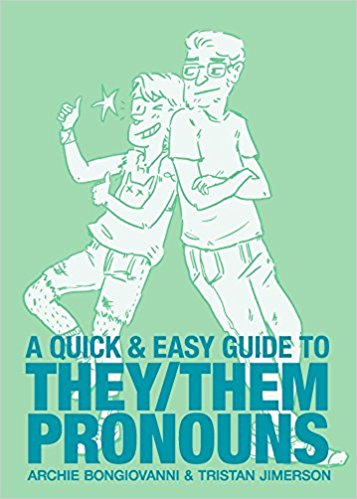
A Quick and Easy Guide to They/Them Pronouns by Archie Bongiovanni and Tristan Jimerson

A concise, friendly, illustrated guide to gender-neutral pronouns written by a likable pair of friends.

The coauthors of A Quick & Easy Guide to They/Them Pronouns are friends. Archie Bongiovanni identifies as nonbinary and uses they/them pronouns; Tristan Jimerson (he/him) knew them before they came out as nonbinary, so Bongiovanni asked him to help communicate with a mainstream population who might have trouble with the concept. Bongiovanni and Jimerson make a jolly, jokey team in this graphic how-to manual, with Bongiovanni’s illustrations, but despite their often playful tone, they take this topic seriously. They agree that being told one’s pronouns don’t matter is “basically telling you that you don’t matter.”

A Quick & Easy Guide addresses what a pronoun is; why people might want to use gender-neutral pronouns; how to ask for and give one’s pronouns; how to change one’s language and how to handle mistakes; and how to integrate these lessons into professional and retail settings. It’s written both for a general readership that may be confused by they/them pronouns, and (in a special section by Bongiovanni) for nonbinary folks. It even includes sample scripts and signs to post in places of business.

This is a short, easy-to-read, affordable guide, because the authors hope it will be widely distributed and handed out on the street. It meets its goals neatly: just the facts, but in a friendly, approachable tone, enhanced by the true friendship of its authors. A Quick & Easy Guide is for everyone, because as Bongiovanni and Jimerson point out, we encounter nonbinary folks every day, whether we know it or not.


This review originally ran in the July 10, 2018 issue of Shelf Awareness for Readers. To subscribe, click here, and you’ll receive two issues per week of book reviews and other bookish news.


Rating: 7 arrows of good intent.

The Shades by Evgenia Citkowitz


Note: I am away for my residency period at school for two weeks or so. This is a previously scheduled post. I will respond to comments, but not as quickly as usual. Thanks for your patience, and thanks as always for stopping by.


In this atmospheric story, a grieving family splits, each suffering more or less alone, until a stranger comes to visit their mysterious old house and throws them off-balance even more.

Evgenia Citkowitz’s first novel (following a short story debut, Ether) is a captivating, mysterious story of family, love and grief. The Shades centers on Catherine and Michael, a year after their teenaged daughter, Rachel, died in a car wreck. Their son, Rowan, insisted on going away to boarding school immediately after losing his sister.

Catherine has withdrawn to the country, to the apartment in a subdivided manor where she and Michael had hoped to retire. She lets the mail pile up, doesn’t answer the phone and neglects her previously successful London art gallery. Meanwhile, Michael continues to work and live in the city, where he fails to find comfort in architecture–his passion–and tries to reconcile himself to his troubled marriage: “their lives ran parallel but never together or intersecting.”

The estate where Catherine has retreated is a focal point–this historic house whose design elements enchant her husband, but whose empty rooms, with both children gone, haunt her. When a young woman shows up at the door saying she used to live there, Catherine grasps at her like a drowning woman. In this potential for new friendship, she clearly sees a lifeline. But this visitor, whom Catherine calls simply “the girl,” may not be what she seems.

Catherine’s career as a tastemaker in the fine arts, and Michael’s in architecture and real estate, provide just a few of the many threads that combine for this story’s rich tapestry. The history of Catherine’s family (her father’s art, her mother’s instability); Rachel’s burgeoning romance, revealed only after her death; Michael’s courtship of the ever-aloof Catherine; Rowan’s attempts to carve out an identity for himself apart from his family: these are significant supports to Citkowitz’s plot. Strangely, that plot, involving the mystery girl and a flash-forward opening to the book that is not resolved until the final pages, is less sharply executed, less beguiling than the details that render this family so realistically. The meticulous portrayal of characters, the flaws and struggles in their relationships and a gloomy, atmospheric tone are the greatest accomplishments of The Shades.

A subtle plot element involves the myth of Orpheus and Eurydice, in which Orpheus tries to bring his beloved wife back across the River Styx following her death, but fails because he does not follow Hades’ instructions. Foreshadowed briefly by an opera at which Michael and Catherine’s romance began to bloom, this myth offers a lens for interpreting their grief, and the damage it will wreak on their family. Readers with a careful eye or a familiarity with mythology will recognize this thread; the rest will be none the poorer for having missed it in a novel rich with pathos and agony, but also simple humanity: love, loss, grief, hope and deceit.


This review originally ran in the June 8, 2018 issue of Shelf Awareness for the Book Trade. To subscribe, click here.


Rating: 7 lilting rhomboids.

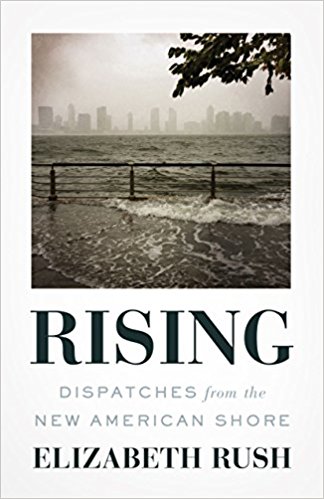
Rising: Dispatches from the New American Shore by Elizabeth Rush

This study of rising sea levels puts both science and poetry to work in honoring human and non-human coastal communities across the United States.

Journalist Elizabeth Rush’s Rising: Dispatches from the New American Shore is science, poetry and personal witness, concerned with human and more-than-human communities. It is a reckoning with the ugly reality of climate change, with numbers and predictions becoming grimmer each year. It is a poetic meditation on the nature of change, on how people can make peace with a changing world and our agency in it. And it is an impassioned consideration of the injustices humans perpetrate on one another, and on the non-human world.

Rush saw firsthand the reality of rising sea levels in inland Bangladesh, when a boy named Faharul showed her his dying mustard greens, their veins filling with salt. It took her years to follow that story to the U.S. communities she visited in researching and writing this book. In Rhode Island, Louisiana, Maine, Florida, New York, Oregon and California, Rush interviews local residents, observes local flora and fauna and questions scientists. She studies climate change and the rise of sea levels globally, but particularly in wetland ecosystems.

Rush’s concerns begin with plants and animals: salt marsh harvest mouse, roseate spoonbill, Caspian tern, rufous hummingbird, red knot, black tupelo. But she quickly extrapolates them to tell a human story, too, about the people threatened alongside greater egret and cypress, and about her own struggle to navigate hope and action within despair. “I have a hard time separating excavation from elegy.” The loss of islands on Louisiana’s coast means the loss of Native communities there, and to understand that loss, one must recognize that those communities were formed by relocated tribes of Chitimacha, Biloxi, Choctaw and Acadian people pushed out of their original homes all over the continent. This is but one example of the vulnerable populations most at risk and least assisted by social supports.

Appealingly, Rush puts her research and writing to work alongside the perspectives of coastal residents: interwoven chapters are told in other voices. She makes allusions to the story of Noah and his ark, and to Leslie Jamison’s The Empathy Exams, seeking the right reference point. Striking black-and-white photographs from Rush’s travels add another gorgeous, elegiac layer to the narrative she helps to construct. Finally, an alliterative organizational structure stemming from wetland botanical structures makes this a book to be admired on many levels.

Rising is in some ways a difficult read. Its subjects are sobering and saddening, and survivors of flood events may be re-traumatized by some descriptions. The human-on-human crimes Rush documents include both discriminatory lending practices and sexual assault. These are important subjects to consider, regardless of the pain they may cause, but Rising has more to offer: pulsing, gleaming prose and a stubborn search for, if not hope, then peace in the face of disaster.


This review originally ran in the May 24, 2018 issue of Shelf Awareness for the Book Trade. To subscribe, click here.


Rating: 10 rampikes.

(Yes, that good, even though it made me terribly depressed too.)

Convenience Store Woman by Sayaka Murata, trans. by Ginny Tapley Takemori

A quirky novel about a convenience-store clerk who seems to be the ideal employee.

In the opening pages of Convenience Store Woman, Keiko Furukura is in her element, at work in the Hiiromachi Station Smile Mart. She knows what the displays need, how properly to promote the day’s featured item, when the cold drinks need replenishing; she reads her customers expertly: “Instantly I deduce that he will use electronic money.” She is a valued employee and good at her job. The mingled beeps, dings, rustles and clacks of the convenience store form a “sound that ceaselessly caresses [her] eardrums.”

Few situations in Keiko’s life have been so easy. In primary school, she often responded to the world in ways others thought wrong: offering to cook and eat a dead bird on the playground, applying a shovel to the skull of a classmate in order to break up a fight. She wasn’t a violent child; these just seemed like practical strategies. She couldn’t understand why the teachers at school got upset. Life presented a series of puzzles she could not decipher, until the day she went to work at the Smile Mart. The convenience store offers Keiko a uniform, a series of set lines to be spoken to customers and a manual for staff behavior. She copies her coworkers’ choices in clothing and cosmetics, mimics their speech patterns and facial movements, and learns to play the part. She’s never felt so successful: no one notices that she’s different anymore. “Here in the convenience store we’re not men and women. We’re all store workers.” And so she has been a store worker for 18 years.

Convenience Store Woman, Sayaka Murata’s English-language debut, is a compelling novel about conformity in society, and the baffling rules applied in work and life. Murata’s protagonist is likable, if a bit baffling herself. Ginny Tapley Takemori’s translation feels just right for the slightly off-kilter reality of this thought-provoking story: Keiko’s first-person narrative is earnest, if continually challenged, in attempting to decode the world around her.

Keiko is attuned to the ways people act, speak and move; she suspects they are all imitating each other, just as she is imitating them. She studies these behaviors to lower her own profile, but remains honestly unclear why careers, marriage and children are desirable goals. When a new employee comes along who also has trouble fitting in–but who hasn’t mastered the act as much as Keiko has–she is intrigued. Tired of everyone questioning her lack of a husband or a “real job,” Keiko takes a risk. But it may cost her the carefully constructed mask she’s learned to wear.

This brief, brisk novel is an engrossing adventure into an unusual mind. Is it a subversive, satiric criticism of societal norms? Is it a surrealist take on extreme workplace culture? Or simply the perspective of a woman wired a little bit differently? Murata holds the reader rapt, wondering what Keiko will do next. Convenience Store Woman is for all kinds of readers, for anyone who’s ever questioned the status quo.


This review originally ran in the May 21, 2018 issue of Shelf Awareness for the Book Trade. To subscribe, click here.


Rating: 7 rice balls.

West by Carys Davies

A mule breeder heads west to search out a mythic beast while his daughter struggles quietly at home in this tale of fantasy, hope and risk.

In the newspaper, Cy Bellman reads of bones pulled from the Kentucky mud–enormous, ancient bones, belonging to some mythic creature taller than the tallest trees. Grieving his lost wife, he is now transported: he all but stops eating and sleeping, too disturbed to give his full attention to his work as a breeder of mules, or to his 10-year-old daughter, Bess. He can’t help but go in search of the beasts that have so captured his imagination, and leaves Bess and their small farm in rural Pennsylvania in the care of his hard-edged sister, Julie, with the occasional help of an odd neighbor, Elmer. With some weapons, trinkets for trade and a new stovepipe hat, Bellman travels west, toward the wild frontier.

West is Carys Davies’s first novel (though she’s published two short story collections, The Redemption of Galen Pike and Some New Ambush), and it is an epic tale of early 19th-century adventure in a small package. With fewer than 200 pages, its scale is nonetheless mighty, conjuring both history and fable. Davies’s simple, conversational prose stays out of the way of her gripping plot.

Julie and the town’s citizens think Bellman a fool at best. Bess, however, adores her father, and is heartbroken to be left alone with no books or pleasures, only a motley bunch of mules; her dead mother’s gold ring is hidden away by her unloving aunt. In her father’s absence, she makes up charms for his good luck: “if she made it from the pump to the house without slopping a drop of water over the lip of the bucket, it meant he was in good health.” She takes long walks with her favorite mule, until Elmer’s awkward attentions to the deserted household become too alarming, and she shuts herself up inside.

Meanwhile, Bellman wanders the wild countryside, farther and farther south and west, first alone and then with an unlucky Shawnee boy named Old Woman from a Distance for his guide. Bellman’s dreams of the enormous creatures grow vivid, and then less so, as his distance and time away from home increase. He promised Bess he would be gone two years at the most, but as her 12th birthday approaches, his grip on both his promise and his quest look doubtful.

West is a novel about family commitments, small-town agitations and the irresistible, fanatic pull of the unknown. Bellman is either enchanted or suffering a good old-fashioned midlife crisis. Davies writes of small fates: hopeful young Bess, bitter Julie, the enigma of slovenly Elmer, and Old Woman from a Distance, with a troubled past of his own.

This quick, compelling read will please lovers of historical fiction, legendary quests and stories of humble familial devotion. It may prove as hard for Bellman to find happiness at home as to find the monstrous “animal incognitum” he seeks. Readers, however, are the richer for his efforts.


This review originally ran in the April 3, 2018 issue of Shelf Awareness for the Book Trade. To subscribe, click here.


Rating: 7 incognita.

Love and Death in the Sunshine State by Cutter Wood

In Florida, a stolen car, a missing woman and a conflagration draw a writer from out of town to ruminate on the darker side of human relationships in this thoughtful melding of true crime, memoir and speculation.

As Love and Death in the Sunshine State opens, Cutter Wood has just graduated from college and is on a family vacation to the island of Anna Maria, near Tampa Bay, Fla. Afterward, he returns home to wait tables, expecting never to think of the place again–until he finds out about a fire at his Anna Maria motel.

A woman named Sabine Musil-Buehler, co-owner of the motel, has been missing for several weeks. Her car is recovered, with blood on its seats and a stranger behind the wheel. Police name three persons of interest: Sabine’s husband, her boyfriend and the man who stole the car.

Wood is fascinated. He is drawn back to Anna Maria. As he enters graduate school and begins a romantic relationship, which stales and sours, he pulls apart the relationship that might have killed Sabine. Love and Death in the Sunshine State, Wood’s debut, is a memoir of post-college ennui; an investigation into a likely murder; an exploration of the light and dark sides of human connection; and an imaginative account of what might have happened to Sabine. Wood blurs genre boundaries, eventually offering a hybrid form that best suits his mind’s wanderings.

He visits with the principal characters and neighbors, and the man most people think killed Sabine. Her boyfriend Bill is in prison on a parole violation; he corresponds with Wood, as he once courted Sabine through the mail and on weekly furloughs. About that courtship, Wood writes, “There is something holy in a friendship born like this in letters.” His own correspondence is less satisfying. “I knew that Bill had lied to me, but I knew, too, that even if he’d told me everything he remembered, it would hardly answer all the questions I had.” This approaches the heart of the book: the question of truth versus fact, of what is unknowable.

Along the way, Wood profiles a handful of characters. Sabine is a German immigrant seeking sunny days and a hospitality career. Bill is an ex-con seeking support and comfort. These protagonists are joined by Sabine’s husband, her coworkers at the hotel, Wood’s girlfriend and others. And the narrator: a young man seeking art and love, frustrated by the “vanishingly small increments” through which love can turn to “if not cruelty, some precursor of that emotion.”

Wood deserves credit for a narrative voice that prizes honesty over flattery, or self-flattery. His book is essentially an examination, not only of Sabine and of her murderer’s emotions and motivations, but of the narrator himself, of universal human flaws. It is an often lovely evocation of place and culture: the gritty, small-town life of Anna Maria, its beautiful backdrop and trivial treacheries. His writing style starts out a little overblown, but soon settles into a meditative tone appropriate to his subject. In the end, Love and Death is a memorable, thought-provoking work of true crime and imagination.


This review originally ran in the March 27, 2018 issue of Shelf Awareness for the Book Trade. To subscribe, click here.


Rating: 7 shoes.