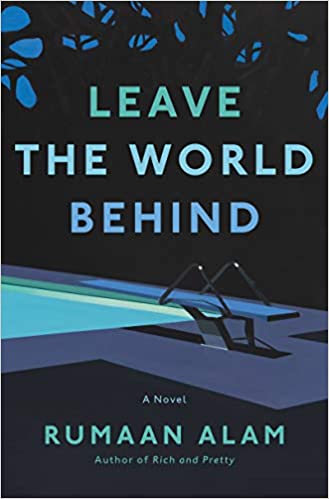
Leave the World Behind by Rumaan Alam

Ominous events throw two families together and off-balance in this captivating, thought-provoking novel.

Rumaan Alam (Rich and Pretty; That Kind of Mother) thrills and unsettles with Leave the World Behind, a novel about family and other relationships, getting what’s desired and reactions in the face of crisis.

The story begins mid-road trip, a white family of four on their way from the city to their vacation rental. Amanda is an account director in advertising, Clay an English professor; Archie is 15, Rose 13. They have an apartment in Brooklyn (“really Cobble Hill”) and a mid-range sedan somewhere between luxurious and bohemian. “The life they had was perfect,” Amanda frequently reflects, and yet they are jealous of their well-appointed Airbnb, its idealized decor and the imagined lives of its owners. The four of them enjoy the house, the pool, the beach. Their vacation is perfect if a little boring, like the family. Alam’s narrative and descriptions are gorgeously detailed and impeccably paced, so that this is a story for readers to sink into, effortless and comfortable, even sumptuous. Until a knock comes at the door.

Ruth and G.H. are the owners of the vacation home, and the arrival of the older couple in the middle of the night is disturbing enough, but their story is stranger: a blackout in New York City, fear driving them out into the country, invading the family’s perfect getaway. Amanda is suspicious. Unexpectedly, Ruth and G.H. are Black. Amanda wonders if it wouldn’t make more sense for them to clean this beautiful house, rather than own it.

The almost entirely undefined external situation–the reported blackout, loss of cell and Internet services, televisions reduced to blank blue screens–forces the four adults and two teenagers together and holds them there, a delicious narrative device that leaves them simmering. The resulting tension touches on generational differences, gender dynamics, class and race–Clay and Amanda are self-conscious of their faux-benign racism, and the story serves subtly as a criticism of social norms. There is a note of the locked-room mystery and heaps of foreboding. Readers gets meticulous details of Amanda’s grocery shopping and the vacation home’s furnishings, but the extent and nature of the outside threat is delivered in mere hints. “Some people got sick, because that was their constitution. Others listened and realized how little they understood about the world.”

Leave the World Behind is pitch-perfect in atmosphere, easy to read and deceptive in the high polish of its setting. Alam has crafted a deeply bewitching and disquieting masterpiece.


This review originally ran in the September 4, 2020 issue of Shelf Awareness for the Book Trade. To subscribe, click here.


Rating: 9 green porcelain lamps.

Nature Matrix: New and Selected Essays by Robert Michael Pyle

Collected essays arguing for nature as a unified matrix serve as an excellent introduction to the work of this veteran writer, or a continuing pleasure for readers in the know.

After decades of writing and naturalist study, Robert Michael Pyle (Wintergreen; Where Bigfoot Walks) thoughtfully collects essays on a theme in Nature Matrix: New and Selected Essays. He conceives of a single, interconnected whole, not a binary of natural and non-natural worlds, but an organism of which humans are an inextricable (if often unaware) part. He explores the “extinction of experience” that threatens our future, defines his religion as “Alltheism” (with nods to Darwin, Muir and Kurt Cobain) and envisions wilderness as a continuum, with some version of the wild existing in every vacant lot and on every street corner. The introduction, “Pyrex, Postcards, and Panzers,” makes the point nicely: it took both pretty pictures and tanks to teach the author about the interrelatedness of the natural world–which is to say, simply, the world.

With 24 books to his credit and having studied, written, lived and taught all over the world, Pyle has a broad and rich body of work to draw on for this collection, first conceived of (by this title) in the late 1960s. Nature Matrix as published in 2020 may contain different essays than 1970’s would have, but the principle remains faithful. These 15 essays (ranging back to 1969, five of them previously unpublished) cover classic Pyle territory: butterflies, conservation, quiet appreciation of the outdoors.

Also included are a profile of John Jacob Astor I and arguments for reading hardcopy books rather than screens and for Bright Lights, Big City as an “elegant ethology of one species of upright hominoid ape under the influence of one species of plant in the contemporary canyonlands.” Nabokov is a recurring character (for his literary and visual arts and his lepidoptery), alongside “the High Line Canal, an irrigation ditch coursing the altitudinal contours across the landscapes of Greater Denver, carrying Platte River water from its mouth at the edge of the Rockies out onto the plains near the present Denver International Airport,” where the author as a child first learned to observe and love the details of the natural world.

Pyle’s voice varies from cantankerous to droll, awe-filled to academic; his characters and fascinations are equally wide-ranging. After all this, “In some ways am I right back where I started: fascinated by a stump on the corner.” It is the persistent note of wonder as much as his impressive depth of knowledge and passion that makes Nature Matrix a remarkable addition to Pyle’s life’s work.


This review originally ran in the August 27, 2020 issue of Shelf Awareness for the Book Trade. To subscribe, click here.


Rating: 7 twitchers.

World of Wonders: In Praise of Fireflies, Whale Sharks, and Other Astonishments by Aimee Nezhukumatathil, illustrated by Fumi Nakamura

World of Wonders is a lovely, thoughtful series of meditations, charmingly illustrated, with love and awe on every page but never shying away from the prickliness of life.

Poet Aimee Nezhukumatathil (Oceanic) stuns with her nonfiction debut, World of Wonders: In Praise of Fireflies, Whale Sharks, and Other Astonishments, delightfully illustrated by Fumi Nakamura. These essays explore the natural world and the human experience, finding parallels, meaning and beauty in the intersections.

“A catalpa can give two brown girls in western Kansas a green umbrella from the sun,” Nezhukumatathil begins. This is an apt and representative line: place-specific, beautifully phrased, with reference to some of the identities these essays will explore. They are mostly titled for the plants and creatures they center–peacock, comb jelly, narwhal, dancing frog–with a few exceptions, such as the expressively named “Questions While Searching for Birds with My Half-White Sons, Aged Six and Nine, National Audubon Bird Count Day in Oxford, MS.” The red-spotted newt and dragon fruit that title their respective essays receive Nezhukumatathil’s attentive study and yes, wonder, but the author’s own experience is always a second thread. She brings a poet’s ear for language and an eye for commonality and metaphor, both reverent of the natural world and specific in her personal story.

Fireflies, touch-me-nots and flamingoes offer her a way to talk about being a brown girl in a white man’s world, growing up in the era of Stranger Danger and feeling disjointed between continents. A young Aimee is asked to draw an animal for a class assignment in Phoenix, Ariz. She responds with a resplendent peacock, India’s national bird, but is chastised and asked for an American bird. Her bald eagle wins a prize but causes her shame. Fumi Nakamura’s accompanying illustrations are whimsical and warm–who doesn’t love an axolotl’s smile?–and sweetly complement Nezhukumatathil’s prose.

World of Wonders offers a series of brief naturalist lessons, but is perhaps at its best in drawing connections, as between the axolotl’s smile and what to do “if a white girl tries to tell you what your brown skin can and cannot wear for makeup.” When it goes boom, “the cassowary is still trying to tell us something.” “And just like the potoo, who is rewarded for her stillness by having her lunch practically fly right to her mouth–perhaps you could try a little tranquility, find a little tenderness in your quiet. Who knows what feathered gifts await?” Wisdom, wonder and beauty make this slim collection one to treasure.


This review originally ran in the August 11, 2020 issue of Shelf Awareness for the Book Trade. To subscribe, click here.


Rating: 9 pale berries growing in spite of the dark.

author interview: Isabel Wilkerson

Following my review of Caste: The Origins of Our Discontents, here’s Isabel Wilkerson: A Portal to Understanding.


Isabel Wilkerson won the Pulitzer Prize for Feature Writing in 1994 for her work as Chicago bureau chief for the New York Times, and was awarded the National Humanities Medal in 2016. Her first book, The Warmth of Other Suns: The Epic Story of America’s Great Migration, won the National Book Critics Circle Award for Nonfiction, among many other awards. She has taught at Princeton, Emory and Boston Universities and has lectured widely. Caste: The Origins of Our Discontents was published by Random House on August 11.

You very naturally and quickly inserted material related to the pandemic in this book. How do you handle that kind of lightness on your toes?

photo: Joe Henson

This book is so far-ranging: three continents, three cultures, the manifestations of the artificial hierarchies that caused so much tragedy in all three. The breadth and the scope of the research was just overwhelming. To build this story meant going into so many different aspects of life, to show how it affects all of us to one degree or another as we find ourselves entrapped in a caste system that we did not ask to be in. I was constantly adding, down to the wire. And then Covid-19 became an ever-present reality in the lives of Americans, and I had to figure out where it could go. It’s been an extraordinary experience, just from a publishing standpoint, to have everyone working on this book spread out all over, trying to put together something this complicated, in addition to all the other projects that anyone who was working on this book was doing. It’s a miracle. That it could come together at all is a testament to what can happen when people are dedicated and committed.

What’s interesting is that it was already in there, because the book opens with a pathogen, and that was just a prescient–almost a premonition. There’s something about how the mind works and intuition acts. A thesis of the book is that caste is so ever-present, an invisible powerful force in society and in all of our lives, that anything that happens somehow has a connection to caste.

This book involves such rich use of metaphor, in a serious piece of heavily researched nonfiction.

I think in metaphor. I’m primarily a narrative writer; narrative nonfiction is where I’m happiest, is the natural expression of my ideas. I find that I’m most at home in telling a story, and a metaphor is a story. It’s making that connection, it’s a way of reaching a reader through the most natural means that I know. I don’t know of any other way.

American caste is both a novel concept and an instantly recognizable one. How does this book tread new ground?

The Warmth of Other Suns is the story of six million African Americans fleeing the Jim Crow South for the north and west over the course of much of the 20th century. Some would describe that as the story of a response to what many people would call racism. However, that word does not appear in Warmth, not in the text. It might be in the title of an article that I refer to–that book has 100 pages of notes–but that’s not a term I use, because I don’t think that it’s sufficient to describe the phenomenon that undergirds interactions and structures of power in the United States. That doesn’t mean racism does not exist, but I did not feel that it was the most applicable or accurate way to describe what people were fleeing, or what they met in the places that they fled to.

This book is a continuation of the perspective I took with Warmth. I think that using the word caste requires us as Americans to think differently. It automatically expands our sense of what we think we know. It’s an uncommon word to apply to ourselves, so it gets you thinking in a way that words we’re accustomed to using can blur. Because it’s not a word that we’re accustomed to using, it’s not judgmental, doesn’t feel as if it’s an accusation, doesn’t automatically incite shame or blame or guilt. Not only is it accurate, but it is a portal to understanding. That’s how I connect with the word as a writer.

Historically speaking, caste has on occasion been applied to the United States. Charles Sumner had used the word; Martin Luther King had used the word. Where people have looked deeply at the structures that we have inherited throughout American history, they have often come back to this word. But there’s been nothing that dives deeply into what that actually means. This was an attempt to do that, and to go to the original caste system that would come to mind most readily, which would be India, and that of the short-lived, terrifying Third Reich, and the interconnectedness of those two and that of our own country.

Then there are the pillars, which I came to as a result of going deeply into the topic: what had been written before; the Laws of Manu, which is the code for the Indian caste system; the Nuremburg Laws; and, of course, the aspect of all this that I knew best, the Jim Crow laws in our own country. I researched them ever more deeply in order to emerge with what I have described as the eight pillars of caste.

I read scores of books from multiple cultures. I collated and pulled together the histories and the ways of enforcing these caste systems into a more easily digestible rendering in one place.

At what point did you see the book take shape?

This has been simmering within me for a long time. Warmth was a precursor. It’s about the Great Migration, but it’s really about freedom and how far people are willing to go to achieve it, and the caste system that they were forced to flee. That’s one reason why Warmth has remained so constant a presence in all the ups and downs we’ve seen since it came out. There’s still been a hunger for it that defies the presumed topics, because the topic is so much bigger than the Migration itself.

I heard a side note on the news about anthrax emerging from the permafrost in Siberia in July of 2016. I didn’t know what I might do, but I knew it was something. That was the beginning of this book. Who knew that by the time I would complete it, we would be in a global pandemic that would shut down humanity in its tracks. I didn’t know at that moment I would write a book about caste, but that was the beginning of an understanding that this was big. The planet was in peril, humanity was in peril, and this was a seemingly small example that didn’t get a lot of attention at the time, but it spoke to me strongly. Every passing month, every passing year after that, it became more urgent. It was a progression toward this book.

First the pandemic, and then the responses to George Floyd’s murder, mark this book’s entry to the world. It feels very timely, but also timeless.

Whenever I write, I seek to be timeless, and focus on the history. We keep seeing the repeat of the history that we’re not paying attention to or don’t know well enough. These events are shocking, but not surprising if you know the country’s history. I go back to one of the many metaphors in the book, the old house: I’m essentially coming in as the inspector of the building and saying, these are the weak points that need attention. If you know your house, then you know what is wrong with it and you will seek to fix those things. If you don’t know, you can’t fix them. If you have no interest in knowing, you absolutely are not going to be able to fix those things.

Without transcending the artificial boundaries between us, without seeing the humanity in one another, we will continue to hurt each other. What we’ve seen recently has been brewing and simmering for 400 years. It rises and it falls, accelerates and slows, but it always comes back, because we’re not dealing with the essential structures that have created the system we live in. Until those systems are addressed, it will continue.


This review originally ran in the August 4, 2020 issue of Shelf Awareness for the Book Trade. To subscribe, click here, and you’ll receive two issues per week of book reviews and other bookish news.

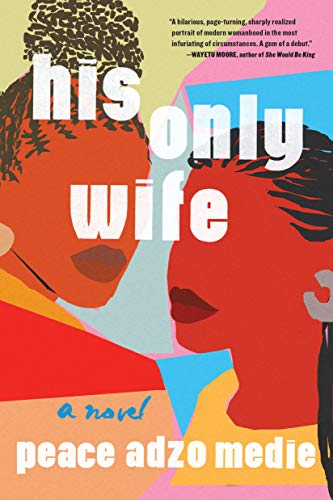
His Only Wife by Peace Adzo Medie

In this winning debut, an arranged marriage exposes a young woman to unimagined riches and a tantalizing taste of freedom, with unexpected consequences.

Afi lives in a humble home in the Ghanaian city of Ho with her mother. Since Afi’s father died, they are beholden to local businesswoman “Aunty” Ganyo for their jobs, their home and basic necessities like flour. So when Afi’s marriage is arranged to Aunty’s son Eli, she knows it is an honor, although she feels some trepidation at marrying a man she does not really know. “Elikem married me in absentia; he did not come to our wedding.” And so her new life begins inauspiciously in Peace Adzo Medie’s arresting first novel, His Only Wife.

Afi’s task, according to the powerful Ganyo family, is to win her new husband away from “the woman” with whom he’s already had a child, who is perceived to have stolen him away from his family. Afi resents being a pawn, but for her own reasons wishes to build a life of true love and commitment with Eli, whom she finds handsome and kind. She is out of her comfort zone, however, when she is installed in a luxury apartment in Accra, surrounded by food, clothing and modern conveniences she’s never known–with Eli still absent.

The young woman’s story unfolds in the first person, as Afi deals with an unfamiliar world and competing bids for her loyalty. Her mother and her new mother-in-law Aunty pressure her to appease and obey Eli. She makes a new friend, mistress to Eli’s brother, who recommends greater independence. While His Only Wife is on its surface the story of Afi and Eli’s marriage, at another level it’s more concerned with Afi’s development as an individual. Over time, in the big city and with more financial freedom, she will grow and learn more not only about her chosen career in fashion but about herself.

Medie gives Afi a voice that winningly combines insecurity, wisdom and dignity. Fashion and food contribute to a cultural backdrop. Accra is a cosmopolitan city, while Afi’s life in Ho was marked by privation and the importance of social and filial hierarchies. The dramas of Afi’s marriage and various family conflicts offer an entertaining plot rich with humor, but it is the story of the strong woman in a challenging and changing world that will capture readers’ hearts. His Only Wife is a memorable novel of personal growth and choosing one’s own destiny.


This review originally ran in the August 6, 2020 issue of Shelf Awareness for the Book Trade. To subscribe, click here.


Rating: 6 bowls of akple.

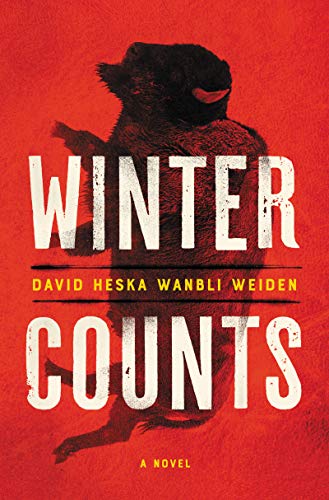
Winter Counts by David Heska Wanbli Weiden

On South Dakota’s Rosebud Indian Reservation, local enforcer Virgil Wounded Horse is faced with a challenging and personal case.


David Heska Wanbli Weiden’s first novel, Winter Counts, is a gripping story of crime investigation set on the Lakota Rosebud Reservation in South Dakota. Virgil Wounded Horse is cynical. He can’t imagine not living on the rez, but he’s more than skeptical of Indian spirituality and ritual, and doesn’t feel very connected to his people; his memories of being bullied in school are too fresh. Now that both his parents and his sister are dead, he doesn’t have much family to feel loyal to–but he is devoted to his orphaned nephew, Nathan, now a teenager who shares his home.

Virgil makes his living as a private enforcer. Tribal police have very limited powers, and the feds don’t bother with much on the reservation short of murder, so the Lakota often resort to hiring someone like Virgil to deliver vigilante justice. Now he gets to beat up his former bullies, and earn a few bucks doing so. It’s not necessarily work to take pride in, though, especially in the eyes of his ex-girlfriend’s politically powerful family. So Virgil is surprised when her father, a tribal council member, asks for his help. And he’s even more surprised when the case brings Marie back into his life.

It seems a local small-time pot dealer might be moving up into dealing heroin on the reservation. And when Nathan accidentally overdoses, it all becomes very real, with high stakes. Virgil will end up traveling all over the rez and down to Denver to try to track this latest crime wave. The scope of the case quickly grows beyond this private enforcer’s comfort zone, and he has a renewed romance to manage, while trying to keep Nathan safe at the same time. Out-of-town gangs, heavy hitters and hard drugs challenge Virgil’s skills. To keep all these threads together, he may need to reconnect with his Native roots, after all.

While Weiden’s prose is serviceable, his sympathetic characters and gripping plot keep readers engaged. Action and suspense are special strengths, and Weiden, himself a member of the Lakota nation, brings valuable perspective to the lives and experiences of his characters. The setting of Winter Counts offers an important and overlooked glimpse at the particular challenges faced by Native Americans, especially concerning crime and justice. But make no mistake: at the heart of this crime novel is a fight for the future of Rosebud Reservation and the lives of Virgil, Nathan, Marie and many more for whom this place is home. Tightly paced, compelling, realistic and deeply felt, Winter Counts offers a fresh take on the crime thriller.


This review originally ran in the July 30, 2020 issue of Shelf Awareness for the Book Trade. To subscribe, click here.


Rating: 6 glasses of Shasta.

author interview: Natasha Trethewey

Following my review of Memorial Drive: A Daughter’s Memoir, here’s Natasha Trethewey: The Lens of That Burning Question.


Natasha Trethewey is a former two-term United States Poet Laureate and the author of five collections of poetry. She is currently the Board of Trustees Professor of English at Northwestern University. In 2007, she won the Pulitzer Prize in Poetry for her collection Native Guard. Memorial Drive is her second book of creative nonfiction.

Is this the book you thought you were writing when you began the project?
photo: Nancy Crampton

Not at all. When I first said that I needed to do it, it was after I had begun to get a lot of press about me as a writer, after the Pulitzer and after being named U.S. Poet Laureate. Because of that, there were many newspaper stories or profiles in which my mother was mentioned as sort of an afterthought, the backstory. She was basically summed up in a line as this victim to whom this terrible thing had happened, and it really bothered me. I decided that if that tragedy was going to be part of the backstory that was recorded again and again, then I wanted to be the person to write her story, so she would not be simply reduced to a murdered woman. What I wanted to do was to show how important she was, her life, my time with her, her death, and my becoming who I am and becoming a writer. I thought one of the ways to do that was to tell the story of who she was, and I imagined it as more like a sort of biography of her. I would have researched her the way I have researched historical figures I wrote about in poems.

It didn’t work out that way. Instead, I think probably the moment that I looked at Shakespeare’s Sonnet 3, those lines I used–“Thou art thy mother’s glass, and she in thee/ Calls back the lovely April of her prime”–I knew that I was the biography, in many ways. That what she was able to make in me was one of the best records of who she was, and how remarkable and resilient she was.

How did you choose this title? Not person, action, relationship, but place–with obvious allusion to memory/memorializing.

You hit the nail on the head. As a writer I think one of my enduring projects is the drive toward memory and memorialization, and contending with the contentions and overlaps between personal memory and cultural or historical memory, what gets recorded and what gets left out of the record. So I knew that that was my project, because that’s what I was trying to do in Native Guard, that’s what I was trying to do in Domestic Work, is record part of my community, where I grew up in Mississippi, that was disappearing. These old people were dying, and it took me a long time to make that connection, that my mother had literally died on Memorial Drive in the shadow of the largest monument to the Confederacy. And that symbolically had something to do with my drive to memory and memorialization, and insisting that things that often get left out and forgotten are remembered.

It must have been painful in some ways to reenter this trauma. Was it worth it?

Oh, yeah. I mean, it was really difficult, and even now I find that having to talk about her and the book in this way keeps the grief that usually is farther away right up on the surface. So I’m living with it differently now than I usually do. But one of the things that I will never forget is when I first met Dan Halpern, who is my editor, and he had read just a few paragraphs of a scene that I had written when I was proposing the book, and he said to me that he fell in love with her just from that. And I thought, if that’s what can happen then, yeah, it’s worth it. She’ll be remembered. She’ll be known by people. And at least they’ll know what she meant to me. That’s a way of knowing her, too.

When you write a book like this, or in general: Do you write with an audience in mind, or for yourself first?

That’s an interesting question that I hadn’t thought about as related to this book. I think I might answer differently if I were thinking about poetry. Or maybe not. Because I was writing in response to what I told you about at the beginning, the newspaper articles that just recorded her as victim or murdered woman, I really was always having an audience in mind. Someone that I had to say oh, no, no, no–this is who she was, too. But at the same time, I think I must have been writing to myself, because of the things that I learned in the process. I knew many different things by the time I got to the end than when I started. I began to understand more things that I had willfully erased, things that were driving me internally on a subconscious level but that I hadn’t allowed myself to think about consciously. And so in that way, I was revealing myself to myself. Which is of course why for me that other epigraph comes in: “All journeys have secret destinations of which the traveler is unaware.” I didn’t know where I was headed.

And maybe that’s the problem in the question, because how could you ever not be writing for yourself?

Right, but it’s a good question, because it makes you think about the not competing, but the multitude of motivations for writing a book project like this.

How different is the writing of prose versus poetry?

On the most basic level, the silly level, it has always been harder for me to write more. I’ve always been better at writing less. Give me an assignment in a class to write a seven-page paper–somehow I’m not going to be able to get to that. Poems are so much smaller and more compressed; that just seems my natural inclination. But I think that I write prose like that. I imagine there was so much more that could have been in this book and part of this story, but it sort of crystallizes around one or two threads. For me it felt like a very long extended poem that had to do some of the things that I want a poem to do, as it moves, as it turns to certain motifs, certain images, certain words.

Turning to poetry–does a book like Native Guard begin as a project, where there’s a book idea and then it is filled with poems? Or do you write poems and then realize you have a book?

I almost always begin with a problem, some historical question that I want to ask myself, I want to ask the nation. I want to examine and explore from many different angles. When I am focused on something like that, it’s as if I could look at anything and it will somehow be filtered through the lens of that burning question that I’ve been asking myself.

When my students are worried about what they’re going to write about or whether the poems that they’re writing will somehow hold together, I talk to them about their obsessions, the things that we can’t get away from, that have an impact on how we see the world and the things in it. If you trust that, that’s what will come through in your poems, and your poems will hang together more than simply because you’re the person that wrote them. You’re the vision behind them.

What are you working on next?

This book took a lot out of me, and so I’m in a place of trying to fill back up. There are things that I’m interested in, so I’m reading. It has a lot to do with my home state, and cross-mapping memory and memorialization, with Confederate monuments, sites of lynchings, which sort of engrave white supremacy on the landscape. I know that’s what I’m thinking about, so I know that I won’t be able to look at a tree without thinking about it.


This review originally ran in the July 28, 2020 issue of Shelf Awareness for Readers. To subscribe, click here, and you’ll receive two issues per week of book reviews and other bookish news.

The Happily Ever After: A Memoir of an Unlikely Romance Novelist by Avi Steinberg

A romantically challenged writer treats the romance novel as career aspiration and life coach, with endearing and revealing results.

Following a divorce, Avi Steinberg (Running the Books; The Lost Book of Mormon) enters the realm of the romance novel, hoping to learn how to write a few commercially successful books and, perhaps more importantly, to solve his own real-life romantic challenges. In his quest, Steinberg hangs out with readers, authors, publishers and cover model CJ Hollenbach (so much more than “Ohio’s Response to Fabio”), attends conferences, joins a writing group and eventually lands a multibook contract under the pen name Dana Becker. These adventures he documents in The Happily Ever After: A Memoir of an Unlikely Romance Novelist.

Part personal memoir, part travelogue and part social and literary criticism, The Happily Ever After questions the societal tendency to look down on romance novels (and to apologize for reading them), examines romance’s domination of the commercial book market, reconsiders classics and the author’s own life through a romance lens, and explores the numerous subgenres of this much-loved and much-reviled field. Steinberg makes observations about gender roles and identities not only within romance novels but throughout American society. “The sentimental tropes of romance are so deeply embedded in our culture, we take them for granted,” making his comments relevant for everyone.

Entering as a romance newbie, Steinberg learns (and outlines for readers) the rules of the genre, including the necessity for “an emotionally satisfying and optimistic ending,” or Happily Ever After (HEA, in Romancelandia parlance). He concludes that “romance is America’s national literature: not because it is universally read or admired but because it is universally obsessed over,” and that Scheherazade was a romance author–bound to the whims of her audience, delivering rapidly and on demand.

Appropriately, Steinberg’s memoir has a generally upbeat cast, even during low points and through the narrator’s struggles with sincere emotions (“you go for a laugh when you could say something real,” one of his writing groupmates tells him; he calls himself “a depressed person who is an optimist at heart”). Also appropriately, the book concludes with the author’s own romance and bona fide HEA.

By no means is this memoir just for fans of the romance genre, although those readers will of course be tickled by his appreciative study. Steinberg’s personal story will suit any reader curious about the book industry, or who simply appreciates quirky personalities. Aspiring writers may find tips and tricks of special interest, but this is no how-to; rather, it’s an endearingly candid exploration of books, subculture and love itself.


This review originally ran in the July 24, 2020 issue of Shelf Awareness for the Book Trade. To subscribe, click here.


Rating: 7 aliases.

The Boy in the Field by Margot Livesey

A single discovery touches three siblings’ lives in surprising ways in this poignant, gleaming story.

The Boy in the Field is a stunning novel of tenderness, interconnectedness, cause and effect by Margot Livesey (The Flight of Gemma Hardy; Mercury). Matthew, Zoe and Duncan are walking home from school one day when they find him, in a field with cows, swallows, bluebottles: a beautiful young man, really just a boy, bloodied and unconscious. He speaks one word: “Cowrie,” Zoe reports to the police. “Cowslip,” says Duncan. “Coward,” says Matthew. With their discovery, they save his life.

The teenaged siblings are close, loving and very different from one another. Matthew, the eldest, is thoughtful. He hopes to become a detective one day, and becomes obsessed with solving the mystery of who hurt the boy in the field, and why. He puzzles over motivations. Zoe has “a gift for finding things: birds’ nests, their mother’s calculator, a missing book, a secret.” She worries over her parents’ relationship and explores her own first sexual experiences; she is drawn to the ways in which people come together and apart. Duncan, the youngest, is observant, almost preternaturally sensitive and a gifted painter. Finding the boy will start him toward a discovery about his own life that might be destructive.

The novel unfolds through alternating chapters from the perspectives of Matthew, Zoe and Duncan. Their parents, Betsy and Hal, are compelling characters as well, less known than the children but multi-faceted, imperfect and endearing. Livesey’s deceptively simple prose renders each sibling as both sweet and complicated. Their shared experience, finding the injured young man, begins for each of them a different kind of acceleration: into adulthood, out of innocence, into reconfigured connections. Matthew gets to know the police detective assigned to the case; his relationships with his girlfriend and his best friends irrevocably change; he notices for the first time that he’s drawing away from his younger siblings. Zoe has out-of-body experiences, breaks up with her boyfriend and meets a young philosopher, and it is Zoe who discovers the chink in their parents’ marriage. Duncan sinks into the paintings of Morandi, gets a new dog and launches an investigation of his own. By book’s end, the three will grow both closer and apart through this shared experience.

The Boy in the Field is a coming-of-age story, a mystery, a sharp-eyed examination of individual lives and relationships. Despite the violent crime related to its title and the insecurities that arise for various characters along the way, this brilliant novel offers a sense of beauty and safety in its quiet ruminations.


This review originally ran in the July 21, 2020 issue of Shelf Awareness for the Book Trade. To subscribe, click here.


Rating: 8 brushstrokes.

Luster by Raven Leilani

Race, sex, shifting social rules, art, inspiration and digestive troubles plague the compelling protagonist of this debut novel.

Raven Leilani’s first novel, Luster, is a rocket-paced, sensual fever dream of sex, trauma, relationships and conflicting perceptions.

Edie is in her 20s and struggling, with her crappy shared Bushwick apartment, her low-level position in children’s publishing, her uninspired sexual choices and her irritable bowel syndrome. Her parents are dead, but the psychic wounds they inflicted are not. Her painting is not going well, and she is a Black woman in New York City. “Racism is often so mundane it leaves your head spinning, the hand of the ordinary in your slow, psychic death so sly and absurd you begin to distrust your own eyes.” Early on, her affair with Eric seems different, refreshing, in spite of, or because of, the 23-year age gap. Then Edie gets fired and evicted, and she spirals, landing, weirdly, in the middle of someone else’s marriage. She knew from the start that Eric was in an open marriage–his wife set a lot of rules for his relationship with Edie. But suddenly she finds herself taken in, literally, by Rebecca, living in their guest room in New Jersey, asked to mentor this white couple’s adopted Black daughter, Akila. Surreality seems to be Edie’s default, but now the funhouse mirror tilts again.

Edie’s first-person narration is nearly stream-of-consciousness, long sentences overflowing with imaginative visual impressions and self-deprecation: “as the car is pulling away he is standing there on the porch in a floral silk robe that is clearly his wife’s, looking like he has not so much had an orgasm as experienced an arduous exorcism, and a cat is sitting at his feet, utterly bemused by the white clapboard and verdant lawn, which makes me hate this cat as the city rises around me in a bouquet of dust, industrial soot, and overripe squash, insisting upon its own enormity like some big-dick postmodernist fiction and still beautiful despite its knowledge of itself, even as the last merciless days of July leave large swaths of the city wilted and blank.” Edie’s particular blend of despair, panic and self-destruction is spellbinding. As she hesitatingly helps Akila with her hair and accompanies Rebecca to work (conducting autopsies at the VA) and to a midnight mosh pit, Edie begins to paint again. She is inspired by the minutiae of this family home: lightbulb, dinner plate, Rebecca’s body.

Luster is intoxicating and surprising, never letting readers settle into recognizable patterns. Leilani has crafted an unforgettable novel about a young woman making her own way.


This review originally ran in the July 20, 2020 issue of Shelf Awareness for the Book Trade. To subscribe, click here.


Rating: 7 Captain Planet mugs.