A Sense of Place by Wallace Stegner (audio)

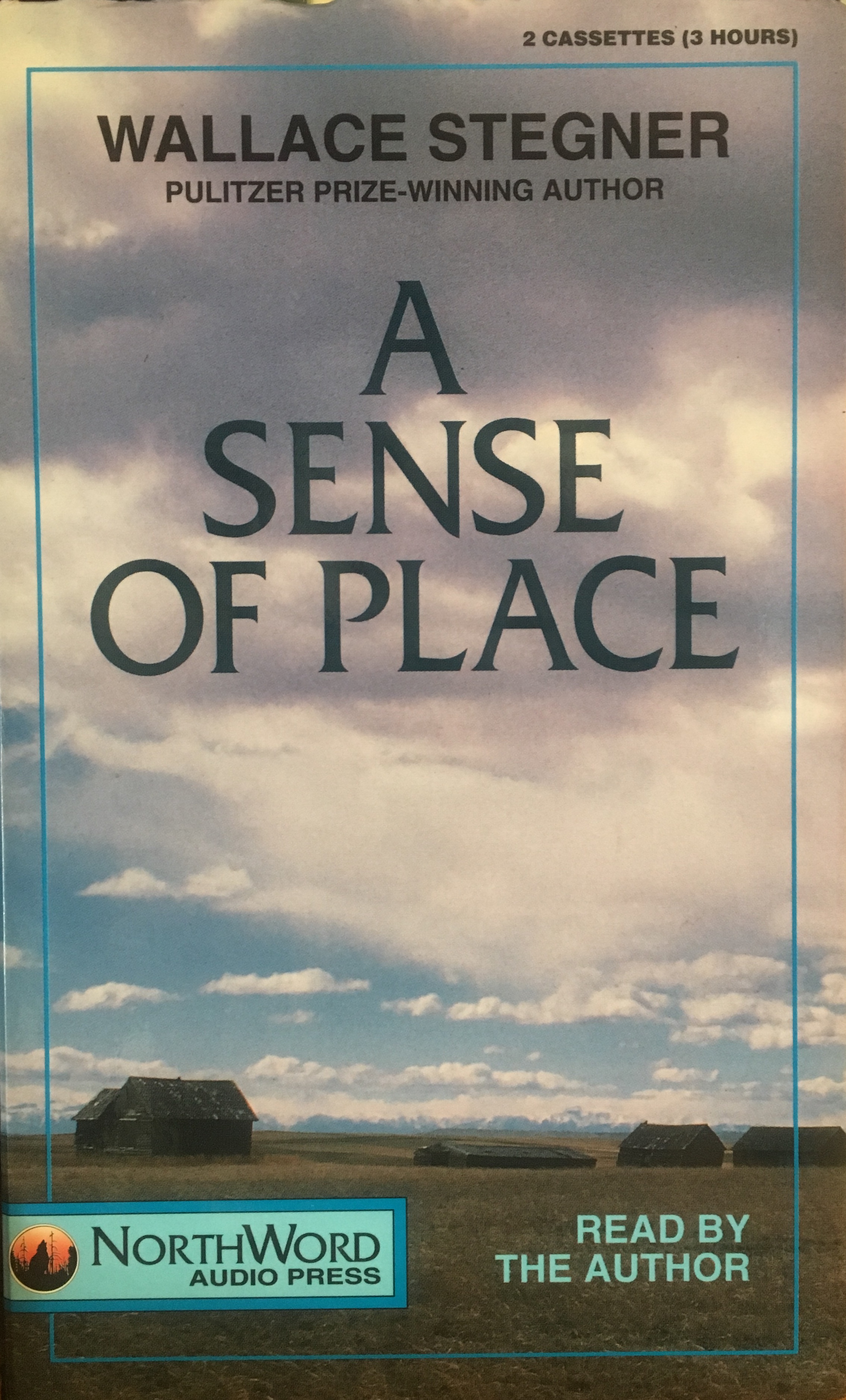
To write about this essay collection, I must first tell you about the format.

From my research, it looks to me like the collection exists only on audio, and only on audiocassette. I bought the set of two cassette tapes some years ago, and have had them all this time, waiting for a way to listen to them. The only cassette player I could locate in my friends-and-family circle was a desktop item my father dug out of the attic for me; but its volume only goes so high, and Stegner came out of the machine so low that I could only hear him if I pressed my ear against the tape player, which I quickly tired of. (Thanks anyway, though, Pops.)

Then finally a friend bought me this outstanding gift: a cassette-to-MP3 converter! Who knew! Thank you so much, Margaret; it was a shame to use it for just the two tapes, but hopefully the guy I passed it on to gets some use out of it with his old rock tapes. Anyway, I was finally, after years of ownership, ready to listen to my Stegner as I drove north across west Texas.

And it is Stegner himself reading, which I think is a nice bonus, although he does have a bit of a somnolent monotone. The essays are not titled; he simply rolls from one into another, so that I was rarely clear on when one ended and another began, although changes of subject serve as loose guides. It’s an intriguing problem, the format of these essays and their absence from the world otherwise. I am a bit interested in transcribing them myself for posterity, if I could find the appropriate person to work with on that project. Hmm.

Now on to the essays, yes? I enjoyed listening. Stegner has a lot to offer: he has known several corners of this country very well at several times in particular, and he specializes in detail and color (literally and figuratively, as in “local color”). He can be relied upon for commentary about conservation issues, and although his positions sound a little obvious in 2019, coming from 1989. His storytelling style is soothing, especially read aloud in that drowsy voice of his. I do wish I had these on paper to read and look at; as it was, I had to let the stories and reflections wash over me, which was pleasurable, but leaves me with less to say for this review.

I made a few short recordings of lines that appealed to me. I have no idea what essays they are from.

The Wasatch in Utah… taught me the feel of safety… A man can tuck back in against mountains, the way Hemingway used to tuck back into the corner stool at Sloppy Joe’s, his back covered and all danger in front of him.

(Guess why I like that one. That would be Sloppy Joe’s in Key West; I’ve been there.)

We manage to breed saints, brutes, barbarians, and mudheads in all sorts of topographies and climates, but what country does to our way of seeing is another matter, at least for me. By and larger I do not know what I like, I like what I know.

I wish I had the line that came just before, too: his point was that topographies and climates don’t make people who are smart or stupid, moral or evil. It’s a point that’s important to me. People judged for their geographies is becoming a pet peeve of mine. And that last line: “I do not know what I like but I like what I know.” It makes sense somehow.

Every night in season [the frogs] conducted love concerts that could drown out conversation even inside the house. Stamp on the patio bricks and they fell silent so suddenly from such a crescendo of noise that the silence rang like quinine in the ears, the sort of silence I’ve heard nowhere else except in the middle of the Amazon jungle.

Silence rang like quinine! What an unexpected simile; and I’m not sure exactly what it means, not knowing what quinine sounds like in one’s ears; this is a line that I think would get picked apart by certain creative writing professors I’ve known, but I appreciate it. I don’t know what quinine rings like, but the surprise pleases me, and I’m willing to take it on faith that that was some silence, whew. Now, the Amazon jungle as a place of silence I trust a little less: I imagine a jungle being rather a noisy place, what with all the life going on there, the peeps and rustles and dripping that surely must be going on. But perhaps Stegner has been to the Amazon. I have not.

There were other startling lines, and worthwhile observations. I wish I could share the text of these essays with you. Barring that, take my word for it, unless you have a tape deck and $16.48 (which will buy you the tapes right now on that other Amazon; more from AbeBooks).

Even with all the hassles it took me to listen to A Sense of Place: worth it.


Rating: 7 names.

I’ll Gather My Geese by Hallie Crawford Stillwell

It has been a long while since I read a book given me by Fil (three years!), but I remain grateful. I’ve been recently traveling in the Big Bend region (and you can check out my travels here), and so I packed this one along.

Hallie Stillwell was born in Waco, but when she was a year old the family moved to West Texas, and (aside from three years in New Mexico) she would live the rest of her life there. The towns she knows best and describes here – Alpine, Marathon, San Angelo, Ozona – are familiar to me from my visits to the region, and there is always a warm fuzzy feeling when I recognize the places I encounter in books.

Hallie moved to Presidio in 1916 at age 18 to teach school, leaving at 20 to marry a rancher, Roy, in the borderlands. She would be by his side until his death in 1948. She was born in 1897 and died in 1997, just shy of her 100th birthday: that fact alone would make her memoir significant – just think of all the changes she’d seen. As Hallie briefly catalogs in her preface, she lived through Pancho Villa’s revolution; the Spanish influenza epidemic; the 1929 crash and the Depression; two world wars; and countless technological advances. This is her memoir.

The title is explained: her father thought, when she headed to bordertown Presidio (where I ate lunch just the other day) as a teenager to work, that she was chasing wild geese. She told him that she’d gather them then. This is a phrase that recurs, and shows the early strength of character that would mark her life. This book has a style I recognize: the writing is uncomplicated, straightforward, not a work of fine art but of reportage. I did note some fun colloquialisms: “not worth a tinker’s dam,” “so upset that I could have fought a circle of saws.” But the point is the stories, not the writing.

I also noted Hallie’s habit to sum up her feelings. Often sections of text end with a remark about how contended and happy her family was; or, conversely, about how frustrating Roy could be, with his taciturn nature and resistance to change. However Roy irritates her, though, or however often she bemoans her own inexperience and ignorance of ranching operations, she always returns to the refrain: “I remember thinking… ‘I hope our lives will always be this way.'” “I felt that my life was complete… I often wondered what more I could want.” The overall effect is of a woman pleased with her lot, through the unbelievably hard times and Roy’s often obnoxious (though often funny) behavior. This kind of refrain could get tiresome, as Pollyanna as it is. But it felt authentic here. Perhaps Hallie is trying to convince herself as much as she is us, in looking back at a life that was hard but worthwhile. It feels real. It also feels in line with the untutored, amateur, honest memoir style.

I was a bit disappointed to see this book end with Roy’s death, as she lived almost another 50 years after that point. The “In Memoriam” epilogue to my memorial printing says, “Roy’s death in 1948 at the beginning of the longest drought of the century impelled Hallie to diversify. Having already mastered the roles of teacher, rancher, marksman, and mother, she became a justice of the peace, barber, journalist, author, storekeeper, RV innkeeper, and celebrity.” (Markswoman, please!) But none of these stories are told in this volume. I think that’s a loss.

But what is here is fine reading, and I do recommend it.


Rating: 7 head of cattle.

The Prairie in Her Eyes by Ann Daum

This is an extraordinary book, one of the most enjoyable reads of the year so far. I took it slowly, out of pure pleasure. Thanks once more to Jessie.

Ann Daum is from a farm-and-ranch in South Dakota’s White River Valley. She left to go to college, but returned every harvest season, and came back after college. She grew up as a ranch hand; her father was the farmer, but her sister and she were ‘cattlemen’ and handlers of horses. As her parents age, and circumstances work against cattle ranching, that part of the family business shrinks and crumbles; they sell off much of their four thousand acres. But Ann’s horse breeding operation does well, and she continues on the family property.

Against this backdrop, The Prairie in Her Eyes is an essay collection and something of a memoir-in-essays. It begins with Ann listening to sandhill cranes passing over her family’s homeplace, in an essay titled “The Habit of Return,” and ends with “The Last Crane,” in which she watches the last sandhill of the season worry itself along. In between, essays consider the history of South Dakota and its farming and ranching cultures; the region’s wildlife; “Silence and Spaces” and “Predators and Prey,” and more. I admire Daum’s titles, which often cue me to follow her subtle braid, as in the essay “Fences,” which deals with boundaries of different sorts, and the variety of effects of literal fences in her region of South Dakota, for good and for ill, and the evolution within her own life of how she sees fences, which is a matter of both her own growth and of changes in the place itself.

Some of this content is hard to take. An account of a difficult foaling had me in tears; the animals (not people!) who hurt and died wrenched me. There is human trauma, as well, that can be difficult to read; interestingly, the human trauma is written about with some distance, less graphically, while the animals’ is more viscerally portrayed. But it’s shown with so much love and grace, and beautiful prose. I’d recommend this book 1,000 times.

These lines open “Silence and Spaces”:

Rain never falls in the South Dakota of my childhood. Wind blows down the valley with the force of locomotives, clouds pile on the horizon, thunder growls from the west. Once, sometimes twice, a summer, lightning sparks prairie fires that crackle and spit, swallow brown summer grasses without tasting. The flames cough embers up like glowing stars and the smoke hangs in cloud. But there is no rain.

This paragraph is about the weather. Fairly dramatic weather, sure. It’s about a lack: no rain. Weather, and an absence. It does not sound like a good recipe for gripping prose. But the fires swallow brown grasses without tasting? Amazing.

Obviously the themes and subject matter of this book spoke to me. It’s about home, what it means to be attached to a place, and how complicated, multifaceted, and imperfect our connections are. I love how deeply the flora, fauna, and history (natural and otherwise) of her region have contributed to making Daum who she is. At the pinnacle of this concept is the essay “Why We Return – The Prairie in Her Eyes,” in which an old woman comes to visit the Daum family property. This woman had never lived there; she’d never seen it before; but her parents had homesteaded there, and an older sibling had been born there. Just like the cranes in “The Habit of Return” (and, obviously, Daum herself), she felt the pull of the place, even though she’d never set foot. “Gertie grew up missing a place she never knew.”

I’m enchanted. I’ll be referring back to this one.


Readalikes: Gretel Ehrlich’s The Solace of Open Spaces and Evelyn Funda’s Weeds: A Farm Daughter’s Lament.


Rating: 9 fading trails.

A Field Guide to Getting Lost by Rebecca Solnit

Another book that came to me at just the right time thanks to Jessie van Eerden. I know of Rebecca Solnit, of course, but I think this is the first of her writing that I’ve read. I really enjoyed it in several aspects: its subject matter is very much in line with that of my thesis (that I’m currently writing); its structure is of interest and also has something to offer my own; the writing is lovely; the content it approaches is wide-ranging, and (as Jessie said early in this semester as we did a manuscript review), “I like to learn stuff.”

That said, it’s not an easy book to sum up. These collected essays are connected, but far from telling a narrative. Solnit is exploring the idea of getting lost and what it has to offer us; and that is ‘getting lost’ in several senses, geographic (I got off the trail and I was lost) and metaphoric (after my mother died I was lost, or I lost several years). Also the sense in which we lose both things and people: lose your keys, lose your mother (to death), lose a boyfriend (when you break up). She sees value in getting lost – sometimes it’s how we find ourselves – and notes that we don’t get lost much anymore. Late in the book, she looks at old maps with their ‘Terra Incognita,’ and observes that we don’t have terra incognita on our maps anymore. We know it all! Right? (Of course, we’ve thought we knew it all before, and been proven wrong.)

I’m using the sense of place tag here although it’s not quite right, which is perhaps a design flaw in my tag. By ‘sense of place,’ I have tended to mean a strong attachment to a certain place; so Jesse Donaldson’s writing about Kentucky, James Lee Burke’s New Iberia, Michael Connelly’s Los Angeles, or Mary Karr’s southeast Texas. That is not what I found with Solnit, so much as a strong feeling about the importance of wandering, losing and finding oneself, in place and in other senses. Place plays an important role here. This book feels like it fits that tag, even though it doesn’t fit the tag as I originally conceived it. (This blog will be eight years old next month. Expect some scope creep.)

Structure-wise: there is a chapter-title refrain, with the heading The Blue of Distance (italicized, where the others aren’t) taking every other place between differently-titled essays. These are not the same essay over and over, but they all meditate on blue and its role in our observation of distance, beginning with the literal meaning (that is, that the sky and deep water both look blue for scientifically observable reasons) and moving through less-literal ones. Distance, it seems, is an inextricable part of one’s ability to get lost. My 600-square-foot house would be much harder to get lost in (tell that to my geriatric dog) than a 20-something room mansion would be. I really appreciated this design, the repeated title for very different essays; it was a succinct cue to the way in which they’re linked.

Another item I found interesting to note was Solnit’s references, the other thinkers she turns to. Some were perhaps unsurprising, as writers cite other writers: Fitzgerald, Nabokov, Katherine Anne Porter, Virginia Woolf, Joseph Conrad. These are joined by Johnny Cash, Patsy Cline, Bobbie Gentry, Yves Klein, Plato, Álvar Núñez Cabeza de Vaca, and Alfred Hitchcock (among many others). A huge number of minds contributed to Solnit’s own thought processes here – which are of course her own – and I was fascinated by the twists and turns. Again (and again), this is something I need in my own writing and that appeals to me. I can’t wait to tell Jessie how right-on she was with assigning me this book.

Obviously this Field Guide‘s usefulness to me is just beginning. You will like it, too, if you like far-ranging considerations of the human condition and where each of us as an individual might be or should be headed, if we’re thinking about it. I found it an engaging and curiously winding path, and I recommend it.


Rating: 8 shades of blue.

On Homesickness: A Plea by Jesse Donaldson

Our temples are made of logs in Kentucky so be careful with the flame.

This is a book very much after my own heart, even though its narrator doesn’t care much for the city that has my heart; we both share a love for home, even though our homes are different.

On Homesickness is a collection of fragments, none longer than one page, and that’s an important design feature, because each spread follows a pattern. The left-hand page names a Kentucky country, its date of establishment, and a small representation of its shape on a map. The right-hand page offers a fragment, sometimes expressly referring to the corresponding county but more often not. It’s possible that fragments and counties match up better than I know, and a Kentuckian might know better, but I’m not really all that concerned. These super-short pieces of prose make a neatly paced, lyric form for what is essentially a wandering wanting. Donaldson yearns for his home and can’t figure out how to get there. Meanwhile we learn as well that he and his beloved partner have a pretty good life in Oregon, a place he finds beautiful but not quite home. His partner is uninclined to pick up and move to Kentucky. Donaldson flubs a job interview that might have moved his family home; his wife gets pregnant, and in a lovely piece near the end, “…I realize that for our daughter, this place will be home. And I want her to love it like I did mine.”

That is the narrative arc, such as it is (and it ends beautifully), but the narrative bones of this book are spare. Along the way, Donaldson also mines Kentucky history, myth, and cultural references (that Colonel’s sour mash), creating as much mood as story. Again, yearning is absolutely the dominant feeling, coming across loud and clear. Also very present is the unnamed partner, the wife in Oregon. This is a love story as much for a woman as for a place. “A place can’t love me. Not like you.”

I find this book interesting for its form, its bravery in sparsity and what it communicates so succinctly. Its themes are so much my own that it aches a little, and I recognized almost every line as I read. Even the references felt uncannily personal (Janus, Cleanth Brooks, Houston). Is that because I’m so truly the right reader for this book? Or because it’s designed to appeal to every reader in this personal way? Probably a little of both. Either way, a good study in minimalist, lyric prose; mood over plot; and a decent way to learn about Kentucky, not from an academic historian but from a lover. I liked it very much.


Rating: 8 love stumps.

Bonus material/synchronicity: I was originally sent this book in galley form for a Shelf Awareness review, but I didn’t get around to it. I kept the book, though, because I thought I might be interested someday. When I worked with Jeremy Jones last semester, I learned that his “In Place” series from WVU‘s Vandalia Press had debuted with this book as its first release. Meant to be. Part of me wishes I’d gotten to it sooner (and written that review for the Shelf!), but part of me thinks I found it at the right time.

Cutty, One Rock: Low Characters and Strange Places, Gently Explained by August Kleinzahler

I bought this book nearly two years ago, on the recommendation of my friend Doug.

Cutty, One Rock has four parts in this edition (three in the original). Generally, the book deals with Kleinzahler’s background–family, hometown and neighborhood–in a Mob-rough New Jersey; it deals with place, relationships with people, and eventually with art. His parents live a middle-to-upper-middle class life, concerned somewhat with appearances; his mother is devoted to Shakespeare. The back of the book calls them “both cultivated and deranged,” which I think is apt. Early in the book, these parents figure as central influences, central characters in the child’s upbringing, but stay tuned for another important family member to come later in the book.

The adult Kleinzahler is an expatriate Jerseyite living in California’s Bay Area, and the differences between these two places, the baggage he carries between them, is another central feature. Here he is describing the “swagger, a bluff air of menace that many of the males wear”:

Once, after leaving a restaurant in North Beach, here in San Francisco, I gave a panhandler a dollar, a middle-aged black guy with some amusing riff or other.

“Thanks, Jersey,” he said, to the great amusement of my companions.

“How did you know I was from Jersey?” I asked.

“Are you kidding?” he said.

The narrator does substantial traveling beyond these two points, east and west, and these other locations and the nature of travel itself offer another recurring thread. The essay “East/West Variations” opens:

There’s a window, thirty-six hours or so, not even, when traveling by air between places, places where you’ve lived for a long time. After you’ve landed and into the next day, perhaps the evening–then you begin to lose it. It goes very quickly, decaying like a tone in the air. But for a while, inside that window, you’re hyperawake.

He goes on to describe this “window,” which I couldn’t help but conflate with the window you look out of when traveling by air–which I was doing, as it happens, while reading this book. He concludes on the next page that “places are conditions of mind.” By the end of this wide-ranging essay (which catalogs several romantic interests and his hard-nosed mother’s reactions to these women), we deal directly with a parent’s mortality. It’s a hell of an undertaking, and I’m not sure I followed him everywhere he tried to take me, but I appreciate the ambitious handling of place and people, and their intersection.

Part three tackles the subject of poetry, and poets. Kleinzahler is a poet; but he’s a rough-and-tumble Jersey poet, with no patience for poetry readings or academia. He writes a particularly scathing send-up of Garrison Keillor’s Good Poems; a profile of Allen Ginsberg (reminding me, not for the first time, of Joseph Mitchell); and a lovely elegy of Thom Gunn. The Keillor criticism, “No Antonin Artaud with the Flapjacks, Please,” is clever, and the Ginsberg profile is incisive; but I love Kleinzahler’s voice best when he writes with love, as he does of Gunn.

Kleinzahler is derisive toward intellectuals,

particularly university intellectuals, [who] indulge in pissing contests over how much they’ve read, quoting at length by heart and so on. No wonder they have no friend off-campus. Thom could more than hold his own if sucked into one or another of these contests, but it wasn’t his sport.

And it’s not Kleinzahler’s sport, either, but I do want to point out that he had me noting (and in some cases looking up) terms like diabase, tibouchina, carillon, cloaca, tatterdemalion (great fun, that one), superannuated, and–very happily–sprezzatura, which I remember from John McPhee’s Draft No. 4, in which McPhee expresses a sense of total consternation at this untranslatable and mysterious term. So there, Kleinzahler.

While there are many fine essays here–like “The Bus,” about public transportation, class in cities, and the invisible weirdness of strip centers–this book held two exceptional highlights for me. One was the essay, in part two, “The Zam Zam Room.” It offers a profile of a bar, a dark and smoky bar with a characterful bartender/owner who professionally throws people out.

When David Letterman came to town to do a week of shows, his advance people phoned Bruno to see if he would throw Letterman out of the bar on the show. “No, I’m sorry, thank you,” Bruno said over the phone. “Who’s David Letterman?” he asked us. “I don’t know this person. Why do these people bother me? He must be some New York person.”

Perfect descriptions of place, local culture, and especially a singular personality, make for an essay I love–but if it’s also set in a bar, I’m really sold.

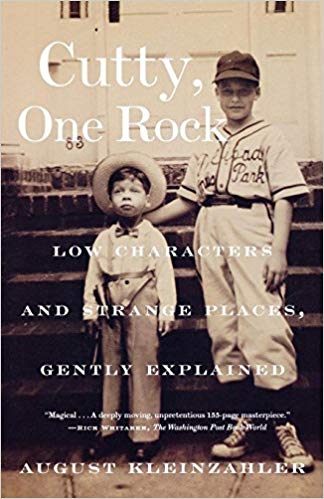
The finest thing in these pages, though, is part four. Where the first three parts contain three to four essays apiece, this is a single essay, which shares the book’s title, “Cutty, One Rock.” That’s what Kleinzahler’s older brother always ordered when he went out, which he did, just about all night and every night until he died young and tragic. I heard echoes and rhymes of Norman Maclean’s “A River Runs Through It” loud and clear throughout. This deeply loving study of a loved brother, its close attention and reluctant acknowledgement of flaws, its worship–because the narrator was the much younger brother, always looking up–is so good it hurts. That’s them on the front cover.

This book is worth reading from cover to cover, but that final section really blew me apart. Booze; sense of place; difficult families and unbeautiful homes. Also, memoirs by poets. Good stuff. Thanks, Doug.


Rating: 8 dry martinis.

guest review: The Solace of Open Spaces by Gretel Ehrlich, from Pops

Pops has been making his way through my backlist. See, while we’re at it, his comments on Dream Team. Here, he’s sent a full discussion of The Solace of Open Spaces, which I reviewed here (see his comments there, too). Thanks as always for weighing in, Pops!

Thanks for yet another good recommendation, although belatedly honored.

Ehrlich’s work is as special as you describe, although you commended it with one more cowboy than I might have, likely accounted for by personal taste and happenstance, that nebulous coincidence of reading the right book at the right time (or not).

Two other, little things I noticed. One is her occasional unabashed use of urban references in metaphors or similes describing wild and natural (albeit inhabited) places. This is not so typical in literary works about the wild, but it works well here supporting her personal story as a ‘straddler,’ as she once refers to herself, shifting between places.

The other is a brief mention in her chapter “To Live in Two Worlds,” a title with meaning for her book’s personal backstory, but also for the chapter’s subject describing the parallel Wyoming culture of native Indian tribes. She attends two tribal events; one is the annual Crow Fair, where an Indian friend remarks on tribal mythology about a ‘berdache’ (p.123), a French word which she parenthetically defines as transvestite.

I have read that the American Indian or First Nation usage of a French word derives from French voyageurs, the French trappers in early North American history who were the first European contacts with many native tribes, who then adopted many French terms in their learning of English. The voyageurs encountered the cultural fact of native gender ambiguity, and recognizing a common social reference, contributed their word to an emerging hybrid language of native, English and French words.

From multiple references I have read, Wiktionary seems to get it right: berdache is “a person who identifies with any of a variety of gender identities which are not exclusively those of their biological sex.” An added comment there goes beyond what I have seen elsewhere: “Considered offensive by many Native American communities because of its pejorative and non-American etymology, berdache began to fall out of use in the 1990s; two-spirit and various tribe-specific terms are now used instead.” The latter is wonderfully explicated here by a gay blogger in Montana.

Nevertheless, I find the history fascinating, including that last reference with very helpful context: the contemporaneous accounts, from both Indians and early explorers, suggest both surprising awareness and a more tolerant acceptance of a cultural and social issue that US culture still wrestles with today.

In reading northwest history I have seen berdache, as a word and cultural phenomenon, repeated in things I’ve read lately. Notable are two excellent works of creative non-fiction history, Jack Nisbet’s Sources of the River and Peter Stark’s Astoria. The narrative lines of the two books briefly but importantly overlap, and a berdache is, remarkably, at the center of that historical confluence.

Nisbet’s work references contemporaneous journals of Scot-Canadian David Thompson, who led (and amazingly, accurately mapped) the first European expedition from Columbia River headwaters in Canada to its mouth near Portland, Oregon, in 1811 immediately after Lewis & Clark journeyed overland to the mouth. In his journeys through true wilderness, meeting some tribal parties who have never seen a white person, Thomson first hears tales of a berdache, then meets the person named Qánqon – twice! First is early in the trip, near the headwaters; second is later, at the mouth.

Astoria describes a complicated American expedition of the same period (they and Thompson were vaguely mutually aware), which involved two groups, overland and by sea, converging on the mouth of the river. All three parties converge in the summer of 1811 at the Astorian camp near present-day Portland – and, defying odds, the mysterious Qánqon also arrives, with a companion, to make it four. This motley combination clashes to provide a bit of historical human drama and political intrigue. And it all makes for wonderful reading.

So that’s what I know about berdache. And thanks to Ehrlich for providing yet another reference to an interesting historical thread.

What a turn this review took! I did not remember the term berdache at all, so there you have it. (Also, that was five years and how many hundreds of books ago? Probably nearing a thousand?) Also, although we all know I do not have time for more titles added to my list, I love a review that comes with additional reading recommendations. Thanks as always for weighing in, Pops!

The Way to Rainy Mountain by N. Scott Momaday, illus. by Al Momaday

I was first told these stories by my father when I was a child. I do not know how long they had existed before I heard them. They seem to proceed from a place of origin as old as the earth.

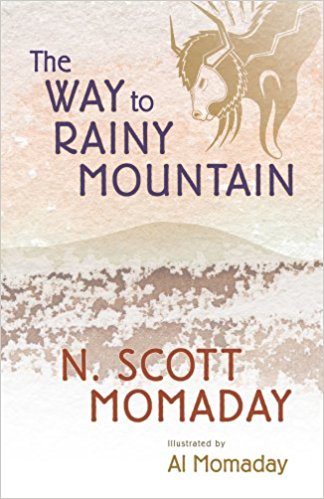
A short book, recommended to me by Kim Dana Kupperman as a way of considering an oral tradition. N. Scott Momaday is a Kiowa Indian, born in Oklahoma but raised on reservations in the southwest. He travels home to Rainy Mountain in Oklahoma to visit his grandmother’s grave, and this book reflects his journey as well as the original one the Kiowas made, from Yellowstone through the Black Hills, and south to the Wichita Mountains. This book is a record of the legends, the orally passed-down traditional narrative of a tribe and a culture now passed on. It is told in three voices. The first is the ancestral voice of the oral tradition (“the voice of my father,” Al Momaday, who also illustrates the book); the second, a historical commentary; and the third, Momaday’s own voice “of personal reminiscence.” Each short section separates these voices from each other visually:

It is a spare, slim book, under 100 pages and with lots of white space as in the spread above, and with illustrations to space things out further. It is therefore just a sketching (no pun intended) of a history, and somehow this feels right, since as Momaday points out, “the golden age of the Kiowas had been short-lived, ninety or a hundred years, say, from about 1740. The culture would persist for a while in decline, until about 1875, but then it would be gone…” His ability to piece these stories together is a rare one, and the record is necessarily scanty. But the scraps that we do have here are wise and hold a certain dignity.

They also hold a sense of place. I loved lines like, “Houses are like sentinels in the plain, old keepers of the weather watch.” It somehow makes sense to me that Momaday would have so much to say about a place he feels tied to without actually inhabiting; that it’s an ancestral belonging.

Once in his life a man ought to concentrate his mind upon the remembered earth, I believe. He ought to give himself up to a particular landscape in his experience, to look at it from as many angles as he can, to wonder about it, to dwell upon it. He ought to imagine that he touches it with his hands at every season and listens to the sounds that are made upon it. He ought to imagine the creatures there and all the faintest motions of the wind. He ought to recollect the glare of noon and all the colors of the dawn and dusk.

In terms of the oral tradition, I noticed that the storytelling style in those parts was simple, and often involved shifts that we are unaccustomed to in the written stories; but when read aloud, they sound more like the way we still tell stories today. “Bad women are thrown away. Once there was a handsome young man…”

Simply told, easy to read, but thoughtful and thought-provoking, and a way into stories that we don’t have much access to. As Momaday writes himself in the preface to this edition, twenty-five years after the first: “One should not be surprised, I suppose, that it has remained vital, and immediate, for that is the nature of story. And this is particularly true of the oral tradition, which exists in a dimension of timelessness.”


Rating: 7 black-eared horses.

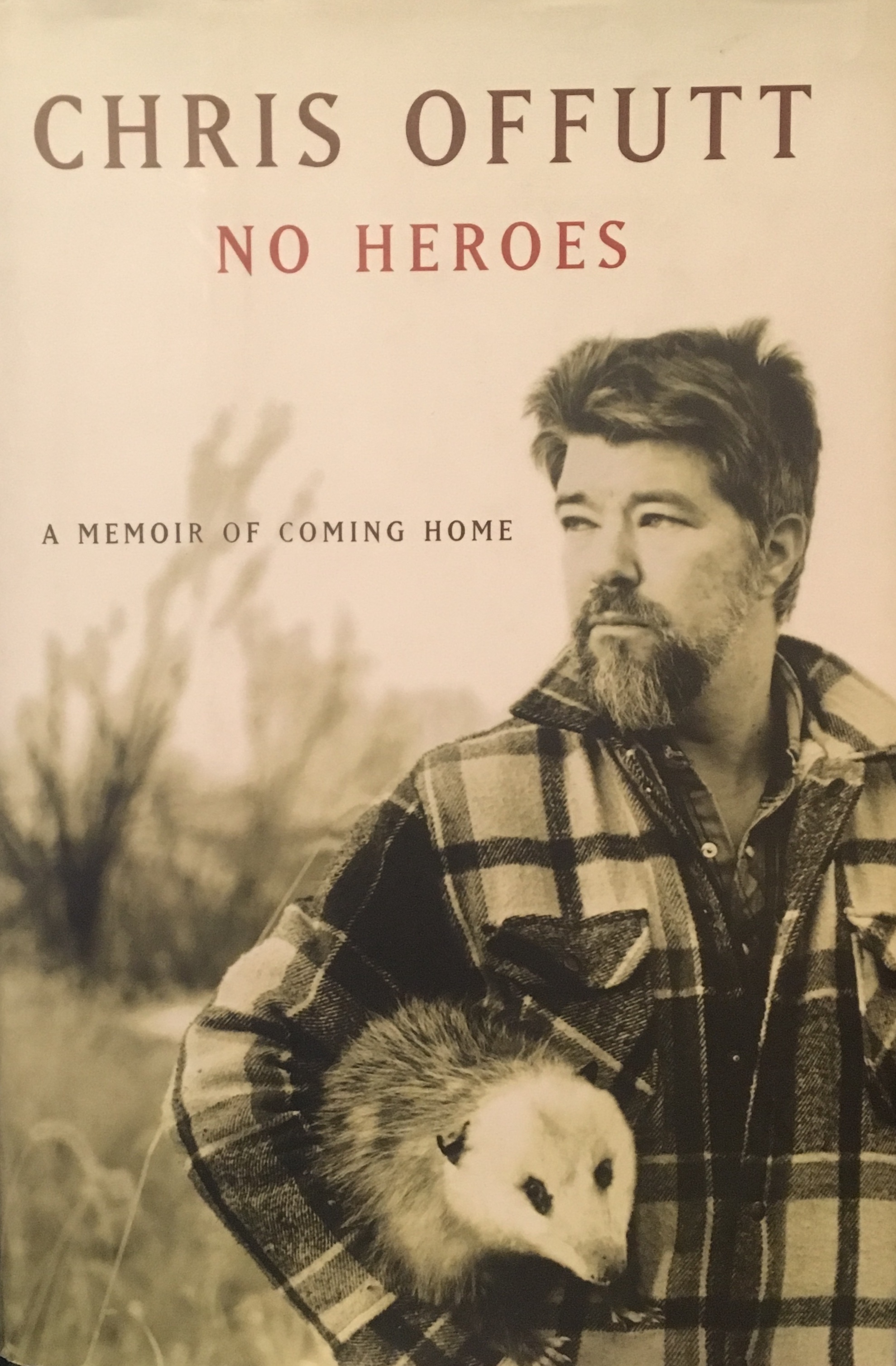
No Heroes by Chris Offutt

No matter how you leave the hills–the army, prison, marriage, a job–when you move back after twenty years, the whole county is carefully watching. They want to see the changes that the outside world put on you. They are curious to know if you’ve lost your laughter. They are worried that perhaps you’ve gotten above your raisings.

This is beginning of No Heroes. Only the prologue retains this second-person perspective, which I think would have gotten difficult for the length of the book, but it’s a perfect intro: it brings immediacy, in that you are the one facing these challenges; and it offers a dreamy, literary take on Chris Offutt’s rough-edged subject and setting. This prologue takes the form of an instruction manual (“to do this, do this”): how to return home, if home is this specific place. It concludes:

You are no longer from somewhere. Here is where you are. This is home. This dirt is yours.

It’s a perfect beginning.

This book is a close cousin to Jeremy Jones’s Bearwallow, which comes as no surprise because Jeremy recommended it to me.

It’s a fine book. In blurbs on the back, Offutt’s style is compared to that of Hemingway and Raymond Carver: strong words, but I can see the comparison. Offutt tends toward short, declarative sentences, except when he doesn’t (like Hemingway, a man perfectly comfortable with long, convoluted sentences and full-blooming metaphor when he feels like it, despite a reputation to the contrary). That is, the prose is mostly simply put together, undemonstrative, but he also knows how to turn a surprising or beautiful phrase at the moment we least expect it; the rarity of such lines adds to their impact.

Offutt’s story, like Jones’s, is of going away and coming back. Both men are from Appalachia. Offutt is from the hills of northeast Kentucky, where he went to elementary school, high school and college within ten miles, and only realized later how unusual this was. As a troubled twenty-year-old, he’d left the hills. He returns as a forty-year-old, having collected an education, written books, married and had two boys, lived and experienced lots of places. He’s back to teach at his alma mater, a humble school where he had worked maintenance while a student, a paradoxical foot-in-two-worlds experience that his cohorts on both ends–work and school–had struggled to accept. “It was more of a high school with ashtrays than a genuine college,” Offutt writes, but that criticism sounds less nuanced in isolation than it does on the page, in the midst of his obviously tortured love for this place.

In the course of No Heroes, he navigates his return to this place, whose dirt and leaves and birds he passionately loves. His parents still live here, but his love for them is less easy. His wife, Rita, and their two sons have some trouble adjusting to a place that is not theirs. Offutt came home hoping to be a hero to students like the one he was: talented but without role models, ready to slip into crime more easily than into art. The title foreshadows the end of that plot line, of course.

But there is another plot line! And it’s a doozy, complicating the story of the homesick Appalachian who has made good and therefore alienated himself. Offutt’s in-laws are finally ready to let him tell their stories. Both are Polish Jews and survivors of a string of Hitler’s concentration camps. You think you’re homesick? The narratives of Arthur and Irene humble us all. The flashback parts are different from the whole of the book: Arthur and Irene’s chapters are told in their own voices (Offutt recorded their interviews), and his own chapters told in his own voice; occasional scenes give dialog representing the interviews themselves. While a bit jarring at times (watch those chapter titles and they will guide you; I have trouble focusing on titles, for no good reason), even this effect–the jarring in and out of a painful past–suits the subject matter. It is Arthur’s admonishment about telling the complicated story, that even victims have flaws, that titles the book: “Remember, Sonny, no heroes.”

I really enjoyed this book. It’s very rooted in a beloved place, and contains two stories equally well-told. For parents, for Appalachians, for anyone facing the tension of succeeding out of the bounds of their upbringing, for the homesick, this is an engaging memoir.


Rating: 8 “crimson maple leaves with green veins that pulsed in mourning for the branch they’d left.”

The Wrong Side of Goodbye by Michael Connelly

My mistake is also my good fortune. Travel to West Virginia was supposed to go smoothly from the San Antonio airport, through Dulles, to Rochester; but of course I ended up delayed, rerouted through O’Hare, with a half-day to kill at the airport before ever leaving Texas. I had packed more books in my checked bag, but ended up running out of available-at-hand reading material in Chicago. So I bought a book at an airport newsstand. Bad news: long travel day. Bad news: so many books at home (and in that checked bag) that I wanted or needed to read. Good news: a delicious, un-looked-for chance to read a new-ish Harry Bosch mystery.

Remember when I got to read genre mysteries for fun? Whew, it’s been a while (a little over three years). The Wrong Side of Goodbye finds LAPD’s Detective Harry Bosch retired from the force–forced into retirement, in fact, under a dark cloud (which will surprise no one who knows his genre-typical troubles with authority, despite also being an authority). He’s got a PI license, and has been moonlighting–unpaid–with the small-town San Fernando police force, in an “island city” in the middle of LA. His job with the SFPD is to examine cold cases, which is right up his alley. In the opening pages, Bosch has just received a pair of assignments. A multi-billionaire octogenarian hires him, with the utmost secrecy and confidence, to track down an heir who may or may not exist. And San Fernando is plagued by a serial rapist who appears to be escalating. With the help of Mickey Haller (whose fame began with Connelly’s The Lincoln Lawyer), Bosch tracks both cases. The first will take him into his own memories and traumas of the Vietnam War, and the second will take him into grave danger. But Bosch hasn’t lost his touch, no matter what the LAPD may think.

Classic, and good for the fans. Bosch’s daughter Maddie has grown up and is attending college. Bosch and Haller have a solid working relationship and more. Bosch retains his old skills. This was a nostalgia read for me. I found the same old, good old hero I remember. As I reflect, I’m not sure he shows the evolution of age that perhaps he should at this point in the series. Maddie has grown up, but Bosch feels the same. His professional status has changed, but I don’t detect much of a nod to aging, physically or in terms of his outlook on the world. This may be an element of unrealism in a mostly realistic series. But this is escapist reading for me, too, so I’m unbothered. If I find Bosch just as I left him, that’s okay with me. This is the Bosch I missed.

The mystery part of the book is as good as ever. I love this stuff, and I’m so grateful to Michael Connelly and to that newsstand at O’Hare for bringing me this joy. It was a rare pleasure. And now back to my studies.


Rating: 7 pre-rolled joints.