Teaser Tuesdays: The Hour of Land by Terry Tempest Williams

Teaser Tuesdays is a weekly bookish meme, hosted by MizB of Should Be Reading.

Terry Tempest Williams is as wonderful as ever. As I explore her work, I keep returning to her lesser-known Pieces of White Shell as my personal preference, but The Hour of Land is a new favorite.
hour of land
In these essays, she applies her wise, poetic eye to place, history, ecology, the future, and how we relate to one another, resulting of course in phenomenal writing. Naturally I turn to her chapter on Big Bend for today’s teaser, a single line I loved.

Ocotillo is a green withheld in winter.

Keep your eyes open for this treasure to come in June.


This quotation comes from an uncorrected advance proof and is subject to change.

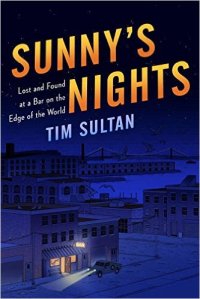
Sunny’s Nights: Lost and Found at a Bar on the Edge of the World by Tim Sultan

A vividly portrayed Brooklyn bar serves as vehicle in a young man’s ode to his friend.

sunnys nights

Tim Sultan wandered by accident through the door beneath the sign that read simply “Bar,” in the derelict neighborhood of mid-1990s Red Hook in Brooklyn, N.Y. Charmed by the proprietor, Antonio Raffaele “Sunny” Balzano, Sultan become a bar regular, then a bartender, and eventually left his Manhattan high-rise job to devote himself to the bar–or, more accurately, to Sunny himself. Sunny’s Nights: Lost and Found at a Bar on the Edge of the World is an appreciation of that man.

Sunny’s bar is “on the edge of the world” because Red Hook is both a point on what Sunny calls the Mississippi-Hudson River (because of the Hudson’s role in his youth, which he recalls in parallel to the adventures of Tom Sawyer and Huck Finn), and an outlier in the consciousness of greater Brooklyn. Sultan explores the history of the neighborhood as well as of Sunny and his bar, a family affair for generations. The result is both memoir and biography, alternating between the protagonists’ years of friendship and their separate pasts: Sultan grew up in West Africa and Germany while Sunny’s childhood was confined to Red Hook. Also an artist in diverse media, Sunny is wildly charismatic, with endless stories that unfailingly hold his audience spellbound; this is the real story of the bar. As Sunny and Sultan share histories, escapades (including a near-drowning in the Mississippi-Hudson) and hospital visits, old Red Hook wise guys (some still bending an elbow at Sunny’s), poets, lovers, musicians and artists make for a colorful, eclectic and winning tale–like Sunny himself.


This review originally ran in the March 1, 2016 issue of Shelf Awareness for Readers. To subscribe, click here, and you’ll receive two issues per week of book reviews and other bookish news.


Rating: 7 Bathtubs.

The Family Tree: A Lynching in Georgia, a Legacy of Secrets, and My Search for the Truth by Karen Branan

A journalist’s research uncovers her own family history and connections to a horrifying hate crime.

family tree

In researching her family history in the little town of Hamilton, Ga., investigative journalist Karen Branan was surprised to find connections to a 1912 lynching. A nephew of her great-grandfather, the sheriff, was murdered. Days later, a local mob killed three black men and a black woman. Branan digs deeper, expecting to find her forebears innocent of violence. The evidence is far more complex in The Family Tree: A Lynching in Georgia, a Legacy of Secrets, and My Search for the Truth.

In a town where nearly everyone has been related by blood or marriage for generations, Branan’s family variously turned a blind eye to the murders, or directly participated. She finds herself related not only to the white mob, but to at least one of the black victims as well. Every new piece of information complicates the story and startles her further, until she has to address her most basic understanding of the world. “I began this journey believing myself to be an unflinching investigative reporter and a nonracist,” Branan writes, but must confront a bias in favor of her own family. Admirably, she examines herself and the preconceptions she brings, even to the pursuit of racial justice.

The Family Tree offers an in-depth study of the history of Southern race relations, particularly in Georgia. The narrative of the lynching is told thrillingly, the background more dryly, but it is Branan’s personal perspective and soul-searching that makes this history insightful, relevant and memorable.


This review originally ran in the January 19, 2016 issue of Shelf Awareness for Readers. To subscribe, click here, and you’ll receive two issues per week of book reviews and other bookish news.


Rating: 6 liaisons.

Lizards on the Mantel, Burros at the Door: A Big Bend Memoir by Etta Koch with June Cooper Price

lizards burrosThanks to Fil for another hit. (Still don’t give me any more books, though, I tell you I’m swamped.) Reading this memoir about a place I love was engaging, amusing and comforting.

Etta Lindeman was born in Ohio in 1904. She was an active youngster but sickly in her young adulthood, when she married Peter Koch. One recommendation to help her breathing troubles was to move to a warm, dry climate. This, combined with Peter’s professional ambitions, took them on a trip cross-country that was to wind up in Arizona, where they would settle and continue to raise their three daughters. Peter was a newspaper photographer who wanted to make nature films and travel the country giving accompanying lectures; the National Parks Service helped by engaging him to promote several parks, including the Great Smoky Mountains National Park and eventually… Big Bend. The Kochs drove their 23-foot trailer (“Porky the Road Hog”) from Ohio to the Smokies, through Louisiana, where Peter filmed the wetlands’ water birds, and into Big Bend through Marathon, Texas. As Etta relates in this journal-like memoir, her family’s adjustment to the West Texas desert near the Mexican border was not without challenges. She was initially leery: “Texas had always been for me a movie set… A place of flimsy barrooms people by six-footers with six-shooters.” But eventually it wins their hearts and they settle permanently. The three Koch daughters have remained in Texas. The eldest, June, is co-author here, having done her own research, pulled together her mother’s papers and a first draft and seen them through to publication.

Etta’s voice is charming. She is not a professional writer, and her prose is perhaps not artful; I think of the term “outsider art” – but surprisingly lovely in moments, too. I liked her evocative descriptions, and these lines:

Nearby is a weeping juniper that is so strange. At first I thought the tree was wilting and perhaps ready to die but was told it is a dejected tree by nature.

Her style is mostly reportorial, but with a brisk, conversational tone. The chapters generally cover episodes or events: the surprise birthday party Pete throws her; a trip to Hot Springs; Pete’s trip down the Santa Elena canyon in a homemade boat. She has a sense of humor, too, a sense of fun (despite describing herself as the scaredy-cat of this active family). My favorite part must have been the final chapter, “Kaufman’s Draw,” which describes an adventure driving across the desert: it reminded me of Abbey’s “Disorder and Early Sorrow,” that story in The Journey Home that I loved so much.

I found the Big Bend I know and love in this book, although earlier, cleaner. When Etta writes,

I didn’t know the sky was so big… so blue… but as we traveled west I discovered that although the earth grew whiter and vegetation sparser, the sky grew more intense, more brilliantly blue.

I recognize this precisely. I have yet to find the scientific explanation for it, but the light out there is different: sharper, brighter.

Lizards on the Mantel, Burros at the Door is also a fine primary source on the work of community building, which is part of what it means to pioneer or homestead: as the Park Service’s settlement (in the Basin of the Chisos Mountains) grows in population, Etta – who had home-schooled her children since arriving in Big Bend – teamed up with other wives and mothers to provide schooling and cultural activities. The community puts on dances, has potluck dinners and cooperates in living and raising kids in such a remote spot.

Simply told but with unmistakable personality, this first-person account of roughing it in far West Texas won my heart. It will get extra points with readers who love the place, like I do, but there is certainly something here for everyone who likes history, memoir, and the romance of simple living.


Rating: 7 murals.

The Tender Bar by J.R. Moehringer

tender barI loved this one.

The Tender Bar is a memoir of one man’s life in a bar. JR was a little boy surrounded by women and girls: he lived with his mother, grandmother, aunt and four girl cousins (and a grandfather, uncle and a boy cousin, but still). He felt drawn to men: in his hindsight telling, he felt the lack of a father, and sought male attentions and teachings, and a model for becoming a man. He found this in his uncle, but even more so, in the hallowed space just 142 steps away, where his uncle tended bar.

This is both a bildungsroman and the story of a bar. By some extension, it is thirdly the story of a place: Manhasset, Long Island, a town historically fixated on drinking and comfortable, sociable places to do it in. We see JR’s childhood – deeply chaotic and troubled in his home life, but bolstered by a beloved and mostly stable (if chaotic in their own way) group of men from the bar. We see him grow up, learn about himself and the world, and experiment with concepts of what he owes to his world and what he’ll do with himself. There is always the bar, at the center of these concepts. Eventually, JR becomes an adult, and the bar ages alongside him. Losses come with age, culminating in the losses of September 11, 2001, which were widespread for a town that commuted into the City and into the World Trade Centers.

I loved many things about this book. I loved the format, which begins with some (presumably research-based) backstory about Manhasset, and with some musings on bars and life. (See my book beginning.) I loved Moehringer’s tone: of immense and frequent humor, often self-deprecating, but also of sober reckoning. He made me laugh out loud until I had to put the book down and hold my belly. I liked the perspective he took, the places where his adult’s wisdom did and did not inform his telling of the child’s experience. I felt drawn to the family, the bar community, and JR’s difficulties with differences in class (when he goes off, of all places, to Yale) and geography (moving at one point to Arizona, where his accent stands out). Despite being totally foreign to me, the Manhasset setting made sense, came alive in this telling. (And not for the first time: Manhasset is the model for the setting of The Great Gatsby.) And of course as much as anything I loved this bar: I loved his love for the bar, and sympathized with it, and I loved the place itself. I recognize and feel affection for a place with playfully rude, unhurried service, a divey atmosphere but with professional cocktail construction. It is a literary place, named Dickens in Moehring’s youth and later changed to Publicans but keeping its nod to culture, song and theatre, and especially words. JR tried for years to write about the place while in the place – the concept that the reader knows would eventually become The Tender Bar.

In this place he meets men (and some women) from all walks of life, professors and police officers and bookies and poets and more. He compares the bar to the Iliad (sure to either win my heart or offend me; here, the former):

In fact the bar and the poem complemented each other, like companion pieces. Each smacked of ageless verities about men.

And he goes on to identify the Ajax, the Hector, the Achilles he finds in Publicans.

I’m sure I give the impression that this is a book seeped in testosterone, and that’s not untrue, but it’s more nuanced than that. For years, JR looked for men to teach him what it meant to be a man. It was something of an obsession for this mostly-fatherless boy (although one wonders how much of that is inserted in hindsight). There are women in the story, too, of course: a girl cousin, a girlfriend, female friends, but centrally his mother, from whom he learns a lot. In the end, he acknowledges that she did a better job of many of the virtues he looked to men for, than did the men he found.

He offers nuggets about writing. As attributed to a priest he meets in the bar car of the train from the City back to Manhasset:

Do you know why God invented writers? Because He loves a good story. And He doesn’t give a damn about words. Words are the curtain we’ve hung between Him and our true selves. Try not to think about the words. Don’t strain for the perfect sentence. There’s no such thing. Writing is guesswork. Every sentence is an educated guess, the reader’s as much as yours. Think about that the next time you curl a piece of paper into your typewriter.

I could spend all day on this quotation alone, some of which I’d take issue with – I think words are very important, and I think the perfect sentence is to be sought – but there’s a lot to ponder and a lot of wisdom there.

I feel like I’ve gotten to know JR Moehringer by reading his story, and I like him. I acknowledge his flaws but would be his friend. That’s a fine outcome for a memoir, I think. This was an excellent book, in its stories, its characters, its format, the details of its writing, and its emotional tone. It’s a little like The Liars’ Club in its best parts: funny, self-deprecating, sad, beautiful, brave, honorable, ironic. I raise my glass.


Rating: 9 pet mice.

book beginnings on Friday: The Tender Bar by J.R. Moehringer

Thanks to Rose City Reader for hosting this meme. To participate, share the first line or two of the book you are currently reading and, if you feel so moved, let us know what your first impressions were based on that first line.

It felt like a great and happy luxury to take time out of my professional reading to read this book just for me. (Actually it is referenced as a standard by a book I was hired to read, and you will see that one come up later. But I already had this one on my desk. So it counts.) I was struck immediately by the opening lines: how perfect.

tender bar

We went there for everything we needed. We went there when we were thirsty, of course, and when hungry, and when dead tired. We went there when happy, to celebrate, and when sad, to sulk. We went there after weddings and funerals, for something to settle our nerves, and always for a shot of courage just before. We went there when we didn’t know what we needed, hoping someone might tell us. We went there when looking for love, or sex, or trouble, or for someone who had gone missing, because sooner or later everyone turned up there. Most of all we went there when we needed to be found.

There is, of course, a certain special bar that I think of, where I have gone when happy and when sad. Miss y’all.

Just a few paragraphs later, another piece of profundity:

While I fear that we’re drawn to what abandons us, and to what seems most likely to abandon us, in the end I believe we’re defined by what embraces us.

I think this will be a good one, friends.

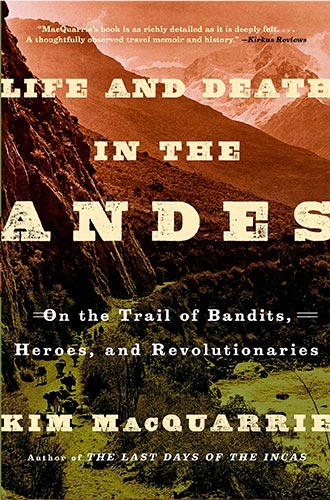
Life and Death in the Andes: On the Trail of Bandits, Heroes, and Revolutionaries by Kim MacQuarrie

This mesmerizing history of the Andes Mountains smoothly brings colorful characters and outrageous stories to general readers.

andes

Kim MacQuarrie (Last Days of the Incas) has long been fascinated by the vast region defined by the Andes Mountains. Having traveled and studied the length of these mountains, 4,500 miles of South America, he shares their stories in Life and Death in the Andes: On the Trail of Bandits, Heroes, and Revolutionaries.

Protagonists range over centuries and national borders, and include Pablo Escobar, the modern Colombian drug lord; Charles Darwin as an amateur naturalist in Ecuador’s Galápagos Islands; the 1980s Shining Path guerrilla movement in Peru; a teenaged girl sacrificed by the Incas in the 1400s; Che Guevara, making his final stand in Bolivia; and Butch Cassidy and the Sundance Kid, whose lives likewise end in Bolivia. MacQuarrie explores cultural conflicts with sensitivity, as in examining Hiram Bingham, the “discoverer” of the Machu Picchu ruins in Peru, who conveniently ignored earlier local knowledge of the site. Finally, MacQuarrie introduces the Yámana people of the southernmost points of Chile and Argentina, and meets with the last speaker of the Yámana language.

Life and Death in the Andes is captivating, its fascinating tales told with enthusiasm as well as careful research when dealing with relatively straightforward facts or with the story of “Juanita”–a young woman who lived in the 15th century–told as “an imaginative reconstruction based upon historical, ethnographic, forensic, and archaeological evidence.” This engaging history of dramatic stories and arresting characters is entertaining as well as informative, and its readability serves to recommend it widely.


This review originally ran in the December 22, 2015 issue of Shelf Awareness for Readers. To subscribe, click here, and you’ll receive two issues per week of book reviews and other bookish fun!


Rating: 8 coca leaves.

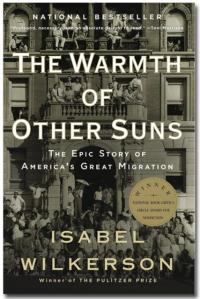
guest review: The Warmth of Other Suns by Isabel Wilkerson, from Pops

More than three years ago, I listened to the audio version of this book, and reviewed it here. At that time, Pops commented:

You make a most important point – that this is essential American history, of which most white Americans are sadly unaware. Jim Crow discouraged personal initiative and disrupted families & communities – a loss for the South. The challenge for black Americans to recreate their lives in “foreign” parts of the country, and the consequences for those regions, is an important part of our collective & continuing history.

He has now gotten around to reading The Warmth of Other Suns himself, and posted a longer comment to that original review. I thought it deserved its own post here so that more readers would have a chance at his thoughts.

warmth

I finally picked this one up, overcame the weighty intimidation of 600 pages and fully appreciated what Wilkerson created. I will simply add to your good observations.

Like you, I enjoyed her written voice and how she allows herself to be part of the story. Her own family story, and its part in her motivation for writing, is important and contributes to the warmth of her people stories. She writes with open sympathy, if not empathy, for the migrants, and full appreciation for the courage & fortitude revealed in their experiences; and I found that appropriate. Just one example, from her earliest pages describing the magnitude of the migrants’ decisions: “it was the first big step the nation’s servant class ever took without asking.”

I am struck by the breadth of her story, much attributable to how she weaves in anecdote & nuance in the course of her narrative. Whole books can be written of the wide ranging cultural contributions in literature, music, sports (maybe even “root doctors” in medicine?) – from the early stages of slavery forward, but released in a torrent once the migration began escaping Jim Crow. She mentions this in passing, but we learn more as she accumulates anecdotes & chapter heading quotes.

The racism implicit in mainstream history & sociology accounts is due full treatment elsewhere, but she obliquely makes the point well with examples of contemporary “professional” accounts, including some that are uncomfortably recent.

And I’m glad she also observes the way the migrants changed the cities, not just the reverse; this is not a Black History Month episode – it’s an essential part of American history that has been ignored and misunderstood at our loss. Her treatment of the Jim Crow regime is a good example, as she describes the deliberate way it was constructed, one little ordinance or ambiguous social convention at a time, enforced by law but often also arbitrarily, in the shadows, hidden under literal cloaks as well as cloaks of darkness. The not-knowing was part of the terror; her analogy to the spread of Nazism is worthy. She describes the terrible impact on individuals, both physical & mental; but also the deep & insidious cultural impacts, including the scars on a white culture so pitifully dependent on the master/slave mentality.

Hers is a wonderful contribution to our history, and will no doubt guide my further reading as it has yours.

Thoughtful as ever. Thanks, Pops. For those that missed it, this is an exhortation to go get Wilkerson’s excellent book today! (My final editorial addition: I really do recommend the audio version.)

Merry Christmas, y’all.

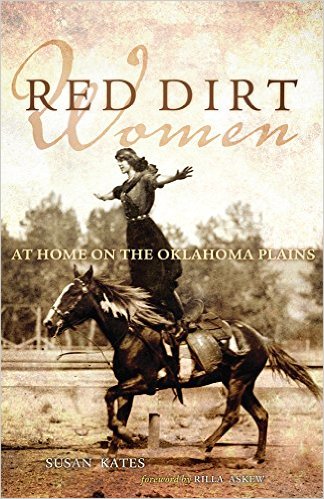
Red Dirt Women: At Home on the Oklahoma Plains by Susan Kates

The reasons so many pioneer women did not desert Oklahoma’s Dust Bowl days are the same reasons Kates was able to find an unlikely peace there, and cannot be succinctly rationalized or explained–except perhaps in this collection of sensitive, thoughtful, grounded musings.

red dirt women

Red Dirt Women is a collection of essays examining the Oklahoma plains and its people, particularly its women, by a transplant who has found home there. Susan Kates is an Ohio native, and professor at the University of Oklahoma. As she relates in these stories, her transition to a dusty otherworld was not always smooth, but over time the Oklahoma landscape and population opened up to her. One message of her collection as a whole is that this place and people are richer than the stereotypes of bonnets and cowboy hats suggest. Kates’s essays vary slightly in their form, but run toward profiles of people and culture. The women she describes include barrel racers, a Vietnamese jeweler, a hippie preschool teacher, gamblers, a birdwatcher, and roller derby players. A brief foreword by Rilla Askew recommends the journey Kates portrays within.

This is just a stub: my full review of Red Dirt Women was published in the fall issue of Concho River Review. You can subscribe or purchase a single issue by clicking that link. Or, don’t hesitate to run out to find a copy of the book itself: I recommend it.


Rating: 8 Queens.

Dispatches from Pluto: Lost and Found in the Mississippi Delta by Richard Grant

An occasionally bumbling Brit moves into the Mississippi Delta and delivers a romping survey of the surroundings.

dispatches from pluto

Richard Grant (Crazy River) is “a misfit Englishman with a U.S. passport and a taste for remote places,” a writer and professional peripatetic when he encounters an old plantation home in the Mississippi Delta. Later he will ask, “What sort of idiot goes on a picnic and ends up buying a house?” He then explains.

In Dispatches from Pluto: Lost and Found in the Mississippi Delta, Richard moves, with his girlfriend, from New York City to a spot even the locals find remote. They struggle with home improvements, an enormous vegetable garden and the moral problem they encounter in hunting for their meat. After some hilarious hiccups along the way, they take pleasure in living in large part off the land. Perhaps more challenging are questions of culture: the liberal newcomers are sensitive to their conservative religious neighbors, who are surely suspicious in turn. But from the beginning they manage to bond like family.

Grant narrates the next year with reflection and humor, from electoral politics and absurd local news to learning how to hunt and party like a Deltan. The myriad forms and intensities of racism and racial tension develop into a theme, as Grant pursues diverse friends and acquaintances. But he finds beauty as well as complexity, and concludes, “I had done the thing that modern life conspires against. I had fully inhabited the present without distraction.” Dispatches from Pluto offers a lovely, appreciative and entertaining tour of the strange and rich Mississippi Delta.


This review originally ran as a *starred review* in the October 27, 2015 issue of Shelf Awareness for Readers. To subscribe, click here, and you’ll receive two issues per week of book reviews and other bookish fun!


Rating: 7 armadillos.