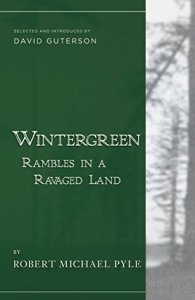
Wintergreen: Rambles in a Ravaged Land by Robert Michael Pyle

wintergreenAs I mentioned last week, I read Wintergreen in preparation for a class I am taking this very weekend from the author, Robert Michael Pyle. It was an intriguing read, and I’m looking forward to learning from the man himself.

The copy I read, borrowed from Pops, is a Pharos Edition, meaning that “one of today’s most exciting authors” hand-picked and introduced it in a reprint. Wintergreen was originally published in 1986 by Scribner; this 2015 edition is being called a 30-year anniversary, and David Guterson (The Other, Snow Falling on Cedars) brought it to Pharos.

In a word, Wintergreen is a book in defense of the ravaged land of the subtitle. That land is the Willapa Hills of southwest Washington (near where the Oregon line meets the coast), where Pyle settled after growing up in Colorado and studying in Seattle and at Yale, and some other stops along the way including Great Britain. This land is ravaged, of course, by logging; but Pyle argues that it is still beautiful, still deeply rich in natural wonders, and worth saving. Pyle is a biologist and a writer, and his style is both reverent and carefully descriptive and detailed. His tone can be occasionally irreverent and jokey; he is conversational, humble, and disarming, absolutely likable. I intend to like him, when I meet him.

In his own words,

This is the plan of the book: to describe the Willapa Hills and the wildlife they support, both native and alien; to examine the impact of intensive forestry upon the land and its life; and finally, to assay the ability of organisms (including ourselves) to survive in the aftermath of massive resource extraction. Throughout, questions of biogeography, ecology, and evolution in the wet, wintergreen world find their way into the text.

And four sections of four essays each do this work, as promised. It is kept from being overly square, in that structure, by Guterson’s intro, a Prologue, and an updated Afterword written for this 2015 edition.

I felt a great affinity for the sense of place that is so central to this work, especially because the place Pyle loves is an underdog, a humble and much-derided place. He writes,

In attending to these neglected hills I try to appreciate them for what they still are, without holding against them what they once were.

He takes his reader leisurely through what this place once was – the hugest of the huge old-growth Douglas firs et al, the ones whose stumps were repurposed as roomy homes for families – and what it is now – second-, third- and fourth-growth, and stump fields that however hold their own beauty, and remarkably biodiversity. He writes beautifully. There is undeniable poetry in the line,

The backs of old barns break and ancient boats and Studebakers deliquesce into the fundament.

Or, when introduced (and little-loved) nutria are quirkily described:

Wombatlike but generally black, they add a definite presence to an already-altered ecosystem, and they are somewhat more interesting than cows.

His audience is understood to be somewhat sympathetic to his feelings and beliefs: that the natural world deserves our protecting even while that is a rather arrogant concept; that old growth forests are special; that green is good. He takes some background knowledge for granted (first approaching the question, “what is old growth?” on page 198), but this is not much of a risk. He is right about the background his readers come to him with.

As he acknowledges in the newly-added Afterword, some of the specific details of politics, policy, and specific local conditions in the 1986 edition are a little dated now. But none are incorrect; and he brings us up to date in this Afterword. The questions I noted during my reading were well answered. Any period-specific feeling to the whole is enriching, if slightly distracting: it makes this text feel grounded in time as well as literal ground.

The pace of these 369 pages is not rushed, but indeed rambling. Patient readers, however, who love a certain level of detail and a good, rain-soaked, mature story, will be well rewarded.


Rating: 8 individually loved stumps.

book beginnings on Friday: Wintergreen: Rambles in a Ravaged Land by Robert Michael Pyle

Thanks to Rose City Reader for hosting this meme. To participate, share the first line or two of the book you are currently reading and, if you feel so moved, let us know what your first impressions were based on that first line.

wintergreen

I am reading this in preparation for the upcoming Chuckanut Writers Conference and a class I will be taking from Robert Michael Pyle himself. An introduction from David Guterson is intriguing, as is the Pharos Edition (same folks who brought Still Life With Insects back into print). It begins:

At any time of the year and in any weather, my bedroom window frames a green and pleasant country scene. Halfway open, it makes a Kodachrome slide of the bucolic valley below, bordered by white sashes and molding.

Lovely. And this setting is just a few hours south of where I live.

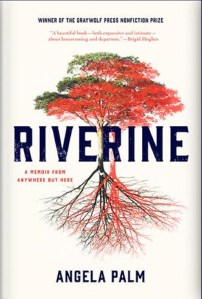
Teaser Tuesdays: Riverine: A Memoir from Anywhere but Here by Angela Palm

Teaser Tuesdays is a weekly bookish meme, hosted by MizB of Books and a Beat.

Teaser

riverine

I am observing a real trend in my reading, and in the reading I’m enjoying most, toward Graywolf Press and their Nonfiction Prize. That is only one of the promising aspects of this book.

I usually handpick teasers for you, but for this one I decided to open the book randomly to a page I haven’t yet read. And I am not disappointed.

The fields that surrounded my new home were laden with a history that I could not yet unpack. They were neither romantic nor scary.

But, it is implied, they became so? This one does tease.

This quotation comes from an uncorrected advance proof and is subject to change.

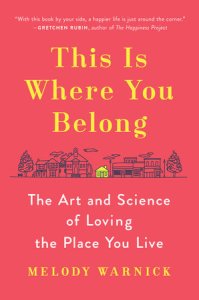
Teaser Tuesdays: This Is Where You Belong by Melody Warnick

Teaser Tuesdays is a weekly bookish meme, hosted by MizB of Books and a Beat.

Teaser

You might have noticed my interest in writing with a strong sense of place, or place-based writing. You might have also noticed that my family moved ~2,500 miles about 18 months ago. And so books like this one always catch my eye. Melody Warnick is a quirky, likeable narrator who makes a quite serious quantity of research easily manageable in her study of the “art and science” of place attachment.

this is where you belong
Here’s a meta-meta teaser to blow your mind today.

“Edmund Wilson once wrote that no two people ever read the same book, and I’ve come to believe that no two people ever live in the same city,” notes the writer Emily St. John Mandel. Our experience of the place where we live depends entirely on who we are, how we interact with it, and how we interpret what’s happening around us. We create our places every day by the way we choose to view them.

You will recall how I’ve enjoyed Emily St. John Mandel (here, here). This is Warnick quoting Mandel quoting (the critic) Wilson: whoa. And what a perfect sentiment. I’m all about this theory of infinite relativity, myself: that all our experiences are always relative, individual, and subjective. So no one who loves a place is ever “wrong”, and a person who hates a place is only “wrong” in that they’ve failed to leave room for someone else’s love.

Lots more place-relative wisdom on offer in This Is Where You Belong. Stay tuned.

This quotation comes from an uncorrected advance proof and is subject to change.

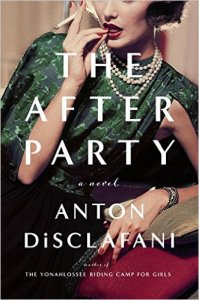
The After Party by Anton DiSclafani

The particular culture of 1950s Houston high society is the setting for this disturbing story of friendship and secrets.

after party

Anton DiSclafani’s The After Party opens in the 1950s in Texas in the world of the oil-rich. Narrator Cece has a loving marriage and a baby boy. Her best friend, Joan Fortier, lives the night life, although at 25 she is nearing the end of her prime in this glittering culture of money, power and conformity. In flashbacks, Cece reveals the way the Fortiers took her into their home and–almost–their hearts, and Joan’s mysterious vanishing acts.

Cece has always been deeply committed to serving the needs of Joan. She may rankle at being called a handmaiden, but she can’t help it: Joan has that effect on her. The girls have been best friends since kindergarten, and when Cece is left parentless as a teen, she moves into the Fortier estate, in the closed community of opulent River Oaks, an exclusive neighborhood in Houston.

Cece is obsessively devoted; Joan is carelessly, selfishly wild; and River Oaks is chilling in its regimentation: “We all served the same pimiento sandwiches, from the same recipe, at luncheons.” DiSclafani’s (The Yonahlossee Riding Camp for Girls) depictions are impeccable. Readers familiar with Houston will recognize landmarks like the legendary Shamrock Hotel, and note DiSclafani’s pitch-perfect rendering of River Oaks. The After Party is a puzzle with carefully modulated tension; Joan’s disappearances and carefree disdain for luxury perplex Cece, and the reader, until the final pages. Characterization, strong sense of place and the painful riddle of friendship form a novel that is vibrant, sensitive and suspenseful.


This review originally ran in the May 24, 2016 issue of Shelf Awareness for Readers. To subscribe, click here, and you’ll receive two issues per week of book reviews and other bookish news.


Rating: 7 high dives.

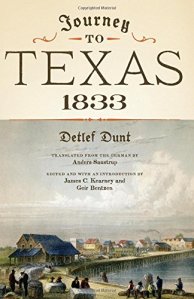
Journey to Texas, 1833 by Detlef Dunt, trans. by Anders Saustrup, ed. by James C. Kearney & Geir Bentzen

Detlef Thomas Friedrich Jordt was born in the Holstein region of Germany in 1793, and in 1833 immigrated to Texas. He was motivated by a letter from an earlier immigrant, Friedrich Ernst. Although the two were not acquainted, the letter had circulated widely in the region, with an explicit message: that others should join Ernst in a land of promise and opportunity. Jordt’s own experience led him to publish in 1834 a book titled Reise nach Texas, under the pseudonym Detlef Dunt. The first English translation of this travelogue/travel guide was published in 2015 as Journey to Texas, 1833.

This is a varied and informative compilation, including not only Jordt’s original text but significant supplementary material. A translation of Reise nach Texas was found among the papers of the late Anders Saustrup, a recognized scholar of German immigration to Texas. James C. Kearney and Geir Bentzen then took on the project. Their introduction covers Jordt’s family history; the social, political and economic circumstances in Germany that pushed so many to emigrate; the significance of the Ernst letter; and commentary on Jordt’s writing. The translation of Reise nach Texas makes up a little more than half of the volume…

This is just a stub: my full review of Journey to Texas was published in the Spring 2016 issue of Concho River Review. You can subscribe or purchase a single issue by clicking that link.

I’d just like to add that this was an extra fun read for me personally, because I know quite well the area that’s covered in these pages. For many years my parents owned a ranch just a few miles from where Dunt/Jordt is believed to be buried. It felt a little like coming home.


Rating: 6 small towns I used to ride my bike through.

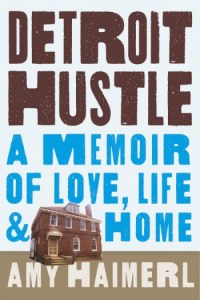
Detroit Hustle: A Memoir of Life, Love, and Home by Amy Haimerl

This memoir of home renovation in Detroit delves into much more, including the importance of place, the meaning of urban revival and the building of lives and loves.

detroit hustle

Journalist Amy Haimerl and her husband, Karl, loved their Red Hook neighborhood in Brooklyn, N.Y., but were facing rising costs and considering relocating. Friends and family were surprised by their choice of famously struggling Detroit, Mich., but they fell in love with a 1914 Georgian Revival (lacking heat, electricity, plumbing, windows and much more), and took the plunge. The house they named Matilda cost them $35,000 to purchase–and exponentially more in renovations.

Detroit Hustle is Haimerl’s memoir of rebuilding Matilda and building her marriage to Karl in parallel. But it is also a musing on what it means for a girl from a working-class family in rural Colorado to move through Mississippi and New York to arrive in the gritty and disparaged city of Detroit. Five weeks after they buy, Detroit declares bankruptcy. Amy covers the court proceedings for Crain’s Detroit Business while researching her new city and its history. Her study of the city yields complexities and contradictions, a portrait of proud residents and the difficulties of gentrification.

Haimerl is thoughtful and reflective about her relationship to place and to the intricacies of Detroit’s past and future; quirky, funny and loving about her marriage; and by turns vexed and inspired by the process of home renovation. Her vivid personality pairs well with the rich, colorful, troubled city she loves. Detroit Hustle is a remarkable memoir spanning home repair, political and culture geographies, and the choices we make for the people, places and things we love.


This review originally ran in the May 6, 2016 issue of Shelf Awareness for Readers. To subscribe, click here, and you’ll receive two issues per week of book reviews and other bookish news.


Rating: 8 dentils.

Notes from No Man’s Land by Eula Biss

notes from no man's landI am terribly grateful that I got to read this book with a class to help me along. That is, the same class that read Bernard Cooper’s wonderful Maps to Anywhere, about which likewise. I was once in a book club, not for very long, which I wished would go much more deeply and intellectually into very serious books. My father said back then, “it sounds like what you really want is a graduate school classroom.” I see now that he was right. This is “just” an undergraduate class, but a good one.

Notes from No Man’s Land is an essay collection that I think is most obviously about race in the United States, but it is about much more than that, too. The writer is a white woman (albeit one from a remarkably diverse family, not at all a white family), and in writing about race she takes on the voice of “the other,” always a nearly impossible thing to do sensitively, smartly and with authority, but she does it.

Like Maps to Anywhere, this is also a masterpiece of organization; we could pick apart the ordering and titling of Biss’s essays in several ways and still not be through with all she’s done here. The first and last (or next-to-last, depending on interpretation) essays are fragmented contemplations of apparently disparate subjects, that wrap this collection up intelligently. If I had to choose one word to characterize Biss, the writer, as I’ve come to know her on these pages, I would choose “smart.”

The language is poetry, too. Every word choice was considered and weighed. The connecting images are so many and complex that I can hardly begin to see how many levels this book might be read upon. Oh, and she works heavily with a sense of place: what else could I ask for? I will share a few lines, several pages apart:

I fell asleep to the distant sound of drums, which I was not always entirely sure was the distant sound of drums. Rain, blood in the body, explosions in the quarry, and frogs are all drums.

I know now that I left home and I left the drums but I didn’t leave home and I didn’t leave the drums. Sewer plates, jackhammers, subway trains, cars on the bridge, and basketballs are all drums.

And just as a sample (not to bore you), I’ll share a little of the analysis I wrote for class of Biss’s opening essay, “Time and Distance Overcome.”

I appreciated both the braided form, and all the white space.

There are three sections separated by a centered line. The longest single paragraph is about half a page long (wraps pages 5-6, about the sabotage against telephone poles that took place in Sioux Falls, SD and Oshkosh, WI). Mostly the paragraphs are just a few sentences long; five contain just one sentence each. These short, punctuated passages feel almost staccato, almost list-like. This works well for the subject matter, which begins benignly but quickly turns dark.

Biss begins with Bell’s invention of the telephone, and the reader has one expectation for the meaning of “time and distance overcome,” the title which tops this first page, where the telephone is introduced. The first section of the essay moves smoothly from telephones to telephone poles, and the resistance early telephone poles encountered. After that first break, though, the lynchings begin coming fast and thick, in short sentences that echo the choppy effect of Biss’s short, double-returned paragraphs. The first lines of this second section read:

“In 1898, in Lake Cormorant, Mississippi, a black man was hanged from a telephone pole. And in Weir City, Kansas. And in Brookhaven, Mississippi. And in Tulsa, Oklahoma, where the hanged man was riddled with bullets. In Danville, Illinois…”

This jarring delivery emphasizes the nasty jolt of the sentences’ content. Likewise, the direct leap into the new subject – no transition – increases the reader’s shock. Lynchings are shocking: this is appropriate. The short sentences and feeling of litany continues, from lynchings through race riots and from the South to the North, making clear a general rather than geographically specific trend.

The final, shortest section, at just half a page, mirrors the work of Notes from No Man’s Land as a whole. That is, it turns back around to an earlier time, Biss’s childhood, family history, and innocent view of telephone poles; there are no lynchings in this section, but there is reference: “Nothing is innocent.” Then there are the telephone poles in Nebraska that, after a heavy rain, grew small leafy branches. This image prefaces “All Apologies,” the concluding essay of the book which echoes this one in form, and concerns itself with regret, apology, the duality of responsibility/guilt, and what is owed. There is a small measure of hope in those green branches.

The most obvious thread or theme that holds this essay together is the telephone pole; the reader is prompted by the cover image. But the less obvious, more sinister themes are those that hold the book together: race relations, the complexities of varied perspectives. “The world was not waiting for the telephone.” “Even now it is an impossible idea, that we are all connected, all of us.” “But nothing, I would like to think, remains unrepentant.”

I think Biss’s opening essay shapes in miniature the work of her entire book; presages the final essay, which so nicely wraps up by recalling the opening; and uses form to emphasize subject matter. It’s an extraordinary essay in these layers of function, and I’m so glad to have her “Notes” to shed some light into her process.

I am impressed throughout with what Biss is confident enough to leave out, or point obliquely towards. I think it must take a lot of courage and self-trust (or is it trust in her reader?) to leave such subtlety on the page and not direct my gaze. “You can get it or not, all the same to me,” she seems to be saying.

This is the kind of work I very much want to study, forever.


Rating: 10 circles.

birth/place project launch at Defining Place

A few weeks ago I asked for your help with a project. That project has now gone live: I’m calling it birth/place, and you can visit it here. I want to thank those of you who have offered to contribute, and I invite the rest of you to do so. Also, of course, you are invited to follow birth/place at that link. New images go up every Tuesday morning, so you’ll get just one ping a week (unlike the five-day schedule I keep here).

defining place
I’m having a fabulous time exploring place, and I just hope some others out there find it as fascinating a conceptual journey as I do. Thanks as always for reading, friends.

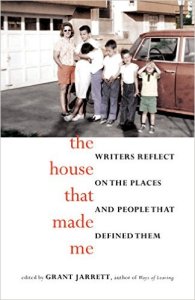
The House That Made Me: Writers Reflect on the Places and People that Defined Them edited by Grant Jarrett

Carefully curated essays take on the concept of home from varied points of view.

house made me

The House That Made Me collects essays by 19 writers reflecting on their childhood homes (or whichever home each writer has found most influential). Editor Grant Jarrett developed the idea for this anthology while contemplating his own first address via Google Earth, and he directs the contributors to that software. While the majority of essays hew close to Jarrett’s initial notion, some also riff on the concept: Roy Kesey considers those who view our homes from above, including birds, spies, angels, gods, astronauts and children climbing on roofs, as he once did.

The resulting assembly of voices offers a range of approaches and backgrounds: Kris Radish’s nostalgia for an idyllic rural community; Patricia Jabbeh Wesley’s attempts at home-building in Liberia just before civil war erupted; and the juxtaposition of Pamela Erens’s privileged upbringing on the lake in Chicago and Jeffery Renard Allen’s difficult one in that same city’s Southside. Justine Musk writes of the possibility that “a person has two homes: the place where you were born (literally, not metaphorically), and the place that fits your soul.” As she works to leave her small Canadian hometown for Los Angeles: “It’s that sense of not-belonging that can become, slowly and over time, its own kind of belonging.” While each essay is a worthy and thought-provoking piece of craft, the true achievement is in the sum of these parts, a chorus of diverse experiences that work together to define “home” in all of its possibilities.


This review originally ran in the April 22, 2016 issue of Shelf Awareness for Readers. To subscribe, click here, and you’ll receive two issues per week of book reviews and other bookish news.


Rating: 8 parachutes, for its matching my personal obsessions, these days.