book beginnings on Friday: The Signal Flame by Andrew Krivák

Thanks to Rose City Reader for hosting this meme. Participants share the first line or two of the book we are currently reading and comment on any first impressions inspired by that first line.

A new novel for the weekend.

the-signal-flame

A fire in the great stone fireplace was as constant in the house as the lengthening days when Easter was early and spring was late. But on the morning after his grandfather died, Bo Konar took the logs and the log rack in the living room out to the barn, swept the bricks clean of ash, and dusted the andirons so that they looked like thin faceless centaurs of black.

These are good, if not simple, opening sentences. I lingered over the first one, its concept of the constancy of lengthening days when… there’s a lot to take in there. The second is much simpler, concrete and physical: logs, log rack, barn, bricks, ash, andirons–and then that fine simile, the faceless centaurs of black, which seem so appropriate to the grief we are witnessing. In just these two sentences, I felt like I was in the hands of a skilled writer with a story I would care about. So far, this is so.

This quotation comes from an uncorrected advance proof and is subject to change.

Monsters in Appalachia: Stories by Sheryl Monks

Short stories defined by their location offer a complex Appalachia filled with both light and dark.

monsters-in-appalachia

Monsters in Appalachia presents the short stories of Sheryl Monks in a collection that ranges over a region but offers a cohesive vision. United by their sense of place, these stories are compassionate and impassioned, often disturbing and filled with energy.

The dangers of coal mining strike the young and the experienced alike. A 14-year-old girl is encouraged by her mother and aunt to pursue men, but resists. A man searches for a dog he believes holds the key to better luck. An exchange at a small-town grocery drives home class inequalities and double standards. Factory workers consider devising on-the-job accidents to collect disability. And in the final, titular story, an old man hunts and captures monsters while his wife prays for punishment for the couple’s sins.

The monsters are in fact many and various, figurative and surreally literal. Monks’s characters are plagued by poverty, abuse, limited education and a shortage of resources and options–upholding some of the stereotypes of Appalachia–but in their choices, they prove more than their typecasts. Dialect and place-specific details establish settings like the mountains of West Virginia, where a panicked mother “can’t spot a single star for the heavy swag of tree branches that flank the road as it winds itself around the mountain.” A stern, moody atmosphere is one of Monks’s strengths, although there are points of light in this dark collection. Monsters in Appalachia is often painful but always authentic, both muscular and sensitive.


This review originally ran in the November 15, 2016 issue of Shelf Awareness for Readers. To subscribe, click here, and you’ll receive two issues per week of book reviews and other bookish news.


Rating: 7 serpents.

Speaking American: How Y’all, Youse, and You Guys Talk: An Illustrated Guide by Josh Katz

Regional linguistic patterns in the U.S. are explained with intelligence, whimsy and visual aids.

speaking american

In December 2013, the New York Times published an online dialect quiz that became the paper’s most-viewed page. Times graphics editor Josh Katz expands that quiz’s contents and the powerful response it elicited with Speaking American: How Y’all, Youse, and You Guys Talk: An Illustrated Guide.

This large-format book organizes United States dialect patterns by subject matter: how we live, what we eat, where we go and more. Two-page color-shaded maps visually communicate regional usages, like the predilection for “rummage sale” in southeastern Wisconsin, over “garage sale” and “yard sale.” Maps and text zoom in for unusual local outliers, like Pittsburgh’s distinctive use of “yins” for the plural “you.” Katz notes the rare case where gender is predictive of usage (women are more likely than men to say “bless you,” or anything at all, when someone sneezes) as well as the “linguistic fault line running from Texas up through Arkansas, then tracking the Ohio River… toward the Mason-Dixon line,” credited to white settlers’ expansion patterns. Besides seriously investigating the questions of sneaker vs. tennis shoe, doodle bug vs. roly-poly, semi vs. 18-wheeler and more, Katz clearly enjoys his subject: especially amusing are the “How to Pretend You’re From…” sections. For Nebraska, you might pick up some “pickles” at the store–not pickled cucumbers, but a form of legal gambling.

Offering some new material since the famous quiz and elucidating the original, Speaking American is a fascinating survey of U.S. dialects as well as a fun, humorous exploration of a nation.


This review originally ran in the November 4, 2016 issue of Shelf Awareness for Readers. To subscribe, click here, and you’ll receive two issues per week of book reviews and other bookish news.


Rating: 8 potato bugs.

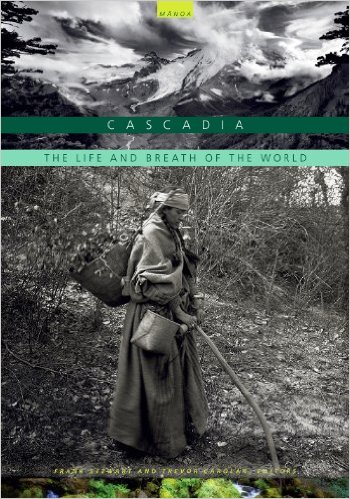
selections from Cascadia: The Life and Breath of the World ed. by Frank Stewart & Trevor Carolan

cascadiaI just read a few pieces from this collection, so I won’t finish with a final rating, but I think it’s recommendable overall for readers interested in a sense of place in this place in particular; nature & ecology; First Nations peoples; or Emily Carr.

The table of contents is organized by category: essays, oratory, poetry, memoir. Unusually, the order of the table of contents is not the same as the order in the book itself. I picked out a few things I wanted to read: essays “In the Shadow of Red Cedar” by Wade Davis, “Reinhabitation” by Gary Snyder, and “Nature’s Apprentice” by Rex Weyler; Barry Lopez’s fiction “In the Great Bend of the Souris River”; and all three pieces of memoir, “The Laughing One: Word Sketches from Klee Wyck” by Emily Carr, “The Sasquatch at Home” by Eden Robinson, and “Lew Welch: An Appreciation” by Maxine Hong Kingston. Emily Carr’s sketches appear throughout, illustrating not only her own writing but all of Cascadia.

The work of Barry Lopez and Maxine Hong Kingston were among my favorites; Eden Robinson’s story about her mother and Elvis was curious and enjoyable. But by far the standout for me was Emily Carr, a woman I know best from a work of fiction: Susan Vreeland’s The Forest Lover. I marveled here at her skill with words as well as pencil and paintbrush. She recounts experiences as a teen visiting a mission school and other native communities, and the wisdom and humor as well as observations she expresses are impressive. I marked several startling phrases.

The house was of wood, unpainted. There were no blinds or curtains. It looked, as we paddled up to it, as it if were stuffed with black.

It must have hurt the Indians dreadfully to have the things they had always believed trampled on and torn from their hugging. Down deep we all hug something. The great forest hugs its silence. The sea and the air hug the spilled cries of sea-birds. The forest hugs only silence; its birds and even its beasts are mute.

The old man sawed as if aeons of time were before him, and as if all the years behind him had been leisurely and all the years in front of him would be equally so. There was strength still in his back and limbs but his teeth were all worn to the gums. The shock of hair that fell to his shoulders was grizzled. Life had sweetened the old man. He was luscious with time like the end berries of the strawberry season.

Luscious with time like a strawberry. I tell you. And this woman is famous for her paintings! (Etc.)

From Barry Lopez’s story, in which the narrator pours his passion into working with wood, reading wood, and using that work to read his world, comes a metaphor:

Nothing solid, I learned, can ever be built without shims.

I’ve just taken a quick overview of what this book has to offer; but I can see that it addresses the politics, history, cultures and ecology of the region of Cascadia (“a great arc from Southeast Alaska to Cape Mendocino, California”) through a variety of lenses and voices. And with some lovely words in between.

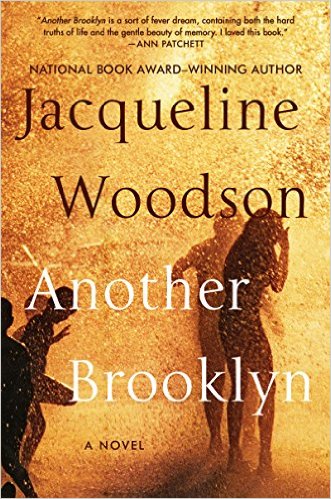
Another Brooklyn by Jacqueline Woodson

A vibrant, emotive coming-of-age novel explores friendship and its pitfalls in a changing world.

another brooklyn

Another Brooklyn is Jacqueline Woodson’s (Brown Girl Dreaming) first adult novel in 20 years. Powerfully moving and lyrical, it demonstrates her expertise beyond the children’s and young adult literature for which she is known.

“For a long time, my mother wasn’t dead yet.” This first line presents the powerful narrative voice of August, an adult reminiscing about her Brooklyn upbringing. Chapter 2 flashes back to the summer of 1973, when she was eight years old, and the novel follows chronologically from there. August and her little brother, recently relocated from Tennessee following a murky family tragedy, adjust slowly to city life. August watches a group of three girlfriends from her painted-shut, third-floor apartment window; she longs to be with them and eventually integrates herself, building an intensely close foursome. The girls share the mysteries, miseries and conquests of puberty–though their fate is hinted at by the opening chapter.

Another Brooklyn visits iconic moments in culture and history: damaged Vietnam veterans, white residents fleeing Brooklyn, the influence of the Nation of Islam in the neighborhood and in August’s single-parent household, the city-wide blackout of 1977. The city offers hope to four beautiful, talented, intelligent girls, and threatens them with men in dark alleys and the limiting judgments of others. Afros, cornrows and hijabs mark fashions in time. But despite these vibrant, evocative framing elements, this is essentially a coming-of-age story in which a child comes to face the hard edges of reality, both particular and universal. Woodson’s eye for detail and ear for poetry result in a novel both brief and profound.


This review originally ran in the August 12, 2016 issue of Shelf Awareness for Readers. To subscribe, click here, and you’ll receive two issues per week of book reviews and other bookish news.


Rating: 7 pickled pig’s feet.

Mississippi Noir ed. by Tom Franklin

Collected noir stories firmly grounded in Mississippi atmosphere offer a concise view of the genre’s possibilities.

mississippi noir

Akashic Books’ noir series travels to Mississippi, with Tom Franklin editing this collection of short stories by both established and newly published authors. Mississippi Noir includes 16 tales, symmetrically organized in four sections of four: “Conquest & Revenge,” “Wayward Youth,” “Bloodlines” and “Skipping Town.” The thematic groupings are loose, and the contents work equally well in any order, picked up and put down as the reader chooses.

These chilling stories vary in length, from 20-some pages down to just a few, and though they cover a range of subjects and settings in time, they consistently embody the ideal of noir writing with a strong sense of place. Bullets, blood, abuse and longing appear frequently, with some sex scenes thrown in as well. Ace Atkins writes of desperate teens running out of options; Megan Abbott, in a scintillating contribution, views from both sides a romance gone tragically wrong; Chris Offutt’s understated story stars a waitress drifting from town to town; and Dominiqua Dickey’s first published story involves an interracial romance in 1936. Within all of the pieces, the authors pay special attention to local details: natural beauty, economic depression, college culture, the longing to escape a small town or the yearning for a wider world.

These stories are dark by definition, and marked by unhappiness: as one narrator sighs, “I wanted sleep to pass without actually having to sleep. I wanted the future.” But an appreciation for the surroundings is always evident; these pages drip with Mississippi humidity. Fans of classic noir will be pleased and rooted in this redolent setting.


This review originally ran in the August 9, 2016 issue of Shelf Awareness for Readers. To subscribe, click here, and you’ll receive two issues per week of book reviews and other bookish news.


Rating: 7 bullets.

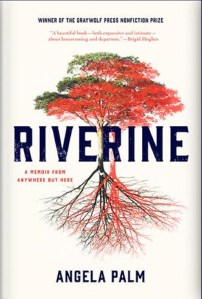
Riverine: A Memoir from Anywhere but Here by Angela Palm

This memoir of a difficult upbringing in the heartland deals also with broader questions of place and free will.

riverine

Vermont editor Angela Palm grew up in a struggling rural Indiana community on the banks of the Kankakee. The river had been straightened to yield farmland, but it frequently flooded back to its original shape, turning each house into an island. Palm’s greatest happiness lay in her love for the boy next door; she fell asleep each night watching him through their bedroom windows. She dreamt of escaping her troubled home life, even without a clear idea of what escape might mean. And then the boy next door was sentenced to life in prison for a horrible crime.

Riverine: A Memoir from Anywhere but Here is Palm’s exploration of her roots and her journey away from them. By a complicated and sometimes messy route, she escaped rural Indiana, but the separation remains incomplete. Even with a family and creative life of her own, far from her hometown, she is pulled back, perhaps most of all by that boy next door, Corey.

Three parts form Riverine: Water, Fields and Mountains. In a blend of storytelling chapters and braided essays, Palm takes the reader chronologically through those environments of her life. Without clear plans, she nevertheless strives for a future free of obligation to her past, while also looking back, trying to understand its causes and effects. As a criminal justice student, for example, she contemplates theories for explaining criminal actions: behavioral, psychological, economic and policing theories, the broken windows theory and the biological theory of deviance. These she experimentally applies to Corey’s crime. Along the way, she repeatedly asks herself “how I loved a person who could do this and why I didn’t see it coming… why I still feel the loss of you in my life.”

Palm’s memoir is not only the story of her life and the divergent parallel life Corey has led, but also an examination of how place forms a person. “The need to look at other landscapes for clues about what already lies within us is real.” Much of her figurative journey away from the gritty setting of her youth has taken place through literal travel and relocation. Tellingly, Riverine begins with a child studying a map. Palm recognizes in herself “a fascination with selvage, run-down places and meaningful interactions with strangers… scarred lands and depressed buildings.” She seeks out abandoned spaces, looking for insight in damage.

Her writing is easy to read, compelling and draws the reader in with its momentum. Riverine is about self-determination, the origin of deviance, and places, particularly the liminal ones. “Fringe investigation was the science of my neighborhood and of my art.” Palm’s story is yet unfinished, but her memoir has an admirable structure and art of its own.


This review originally ran in the July 21, 2016 issue of Shelf Awareness for the Book Trade. To subscribe, click here.


Rating: 8 broken windows.

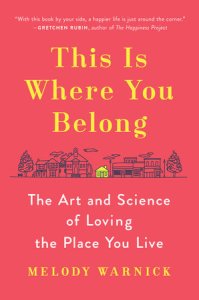
This Is Where You Belong: The Art and Science of Loving the Place You Live by Melody Warnick

A chronic mover seeks to settle down, and offers practical, accessible steps for readers to follow.

this is where you belong

When Melody Warnick, her husband and their two children moved for the sixth time in 13 years, from Austin, Tex. to Blacksburg, Va., she started to wonder if this new town would be a panacea, or if perhaps she was chasing an impossible dream. Had her family’s search for happiness via mobility been a form of magical thinking? So began the work of This Is Where You Belong: The Art and Science of Loving the Place You Live.

Warnick approaches the goal of settling, or of loving where she lives, enthusiastically and broadmindedly. Research is a major component of her work, but it never feels that way. Warnick consults social sciences studies and conducts myriad interviews, and distills what she learns into conversational musings that make the reader feel a part of the process. In the opening chapter, she identifies 10 “place attachment behaviors,” which form the chapters that follow. These include walking more, volunteering, exploring nature and creating something new. For each behavior, she sets a goal and records her progress; each chapter ends with a “love your city checklist” of suggested actions. This Is Where You Belong is a carefully documented experiment, explicitly designed for readers to replicate in their own lives.

By the end, Warnick has established herself as a fallible, likable everywoman, and her struggle to love Blacksburg comes to represent a universal concern. Her journey to feeling attached to where she lives is scientific and packed with research, but also feels like an old friend’s casual banter. This practical exercise in intentional place-based happiness is for the homesick and the optimistic alike.


This review originally ran in the June 24, 2016 issue of Shelf Awareness for Readers. To subscribe, click here, and you’ll receive two issues per week of book reviews and other bookish news.


Rating: 8 ticks on a list.

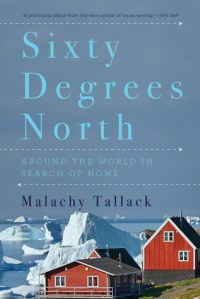
Sixty Degrees North: Around the World in Search of Home by Malachy Tallack

This broadly appealing travelogue combines carefully crafted writing with immersion in Northern lands and contemplation of the idea of home.

Print

Malachy Tallack comes to identify the northern Scottish archipelago of Shetland as home only after a long and troubled journey away and back again. In Sixty Degrees North: Around the World in Search of Home, Tallack grapples with the concept of belonging to a place, while traveling around the world on a single parallel. “For just as we inhabit the landscape, the landscape inhabits us, in thought, in myth and in memory.” He opens with the evocatively titled chapter “Homegoing,” and wraps up, naturally, with “Homecoming.” The chapters in between might be characterized as home-seeking.

These titles serve as shorthand for a considerably more complicated story. Tallack was not born in Shetland, but a loss he suffered in his teens left him there, feeling stranded. Ever since, he has vacillated with the attraction of other places, of movement, and the comforting appeal of an idea of home. Sixty Degrees North describes his travels through Greenland, Canada, Alaska, Russia and Scandinavia, which occupy the space of a year and thus document the North’s extreme seasons. This voyage is literally perambulatory, as Tallack compulsively walks, learning towns and cities by foot. In recalling an earlier time spent in Siberia, he studies his attraction to this place from a greater distance. He pursues home, even as he revolves around it.

While largely concerned with interior musings, Tallack makes a remarkable survey of cultures, climates and histories along the way. Ongoing themes include ties to nature and to community; the tension between isolation and engagement; stasis, movement and exile. His topics range over colonialism and native cultures, and the significance of peat, salmon and reindeer to indigenous peoples. He examines Scandinavia’s social and political systems, particularly in the Åland Islands, which belong officially to Finland but are politically independent and have a majority Swedish population. He touches on the science of climate change, the relative definition of “north” and the question of “denordification… as though by changing, by developing, by warming, the north can actually become less like itself.”

An introverted, quietly likable but troubled narrator, Tallack experiences no momentous events in the course of his travels, and even few conversations. His writing is thoughtfully composed, beautiful and often surprising, such as when he observes, “Loss shapes us like a sculptor, carving out our form, and we feel each nick of its blade.” Sixty Degrees North is not a book of action, but rather an extended meditation, on longing and belonging, on personal ties to place and on the particular nature of a certain band of earth and sea.


This review originally ran in the June 14, 2016 issue of Shelf Awareness for the Book Trade. To subscribe, click here.


Rating: 8 degrees (in two senses).

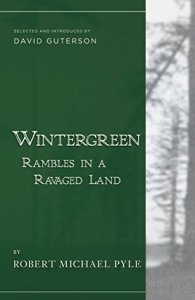
Wintergreen: Rambles in a Ravaged Land by Robert Michael Pyle

wintergreenAs I mentioned last week, I read Wintergreen in preparation for a class I am taking this very weekend from the author, Robert Michael Pyle. It was an intriguing read, and I’m looking forward to learning from the man himself.

The copy I read, borrowed from Pops, is a Pharos Edition, meaning that “one of today’s most exciting authors” hand-picked and introduced it in a reprint. Wintergreen was originally published in 1986 by Scribner; this 2015 edition is being called a 30-year anniversary, and David Guterson (The Other, Snow Falling on Cedars) brought it to Pharos.

In a word, Wintergreen is a book in defense of the ravaged land of the subtitle. That land is the Willapa Hills of southwest Washington (near where the Oregon line meets the coast), where Pyle settled after growing up in Colorado and studying in Seattle and at Yale, and some other stops along the way including Great Britain. This land is ravaged, of course, by logging; but Pyle argues that it is still beautiful, still deeply rich in natural wonders, and worth saving. Pyle is a biologist and a writer, and his style is both reverent and carefully descriptive and detailed. His tone can be occasionally irreverent and jokey; he is conversational, humble, and disarming, absolutely likable. I intend to like him, when I meet him.

In his own words,

This is the plan of the book: to describe the Willapa Hills and the wildlife they support, both native and alien; to examine the impact of intensive forestry upon the land and its life; and finally, to assay the ability of organisms (including ourselves) to survive in the aftermath of massive resource extraction. Throughout, questions of biogeography, ecology, and evolution in the wet, wintergreen world find their way into the text.

And four sections of four essays each do this work, as promised. It is kept from being overly square, in that structure, by Guterson’s intro, a Prologue, and an updated Afterword written for this 2015 edition.

I felt a great affinity for the sense of place that is so central to this work, especially because the place Pyle loves is an underdog, a humble and much-derided place. He writes,

In attending to these neglected hills I try to appreciate them for what they still are, without holding against them what they once were.

He takes his reader leisurely through what this place once was – the hugest of the huge old-growth Douglas firs et al, the ones whose stumps were repurposed as roomy homes for families – and what it is now – second-, third- and fourth-growth, and stump fields that however hold their own beauty, and remarkably biodiversity. He writes beautifully. There is undeniable poetry in the line,

The backs of old barns break and ancient boats and Studebakers deliquesce into the fundament.

Or, when introduced (and little-loved) nutria are quirkily described:

Wombatlike but generally black, they add a definite presence to an already-altered ecosystem, and they are somewhat more interesting than cows.

His audience is understood to be somewhat sympathetic to his feelings and beliefs: that the natural world deserves our protecting even while that is a rather arrogant concept; that old growth forests are special; that green is good. He takes some background knowledge for granted (first approaching the question, “what is old growth?” on page 198), but this is not much of a risk. He is right about the background his readers come to him with.

As he acknowledges in the newly-added Afterword, some of the specific details of politics, policy, and specific local conditions in the 1986 edition are a little dated now. But none are incorrect; and he brings us up to date in this Afterword. The questions I noted during my reading were well answered. Any period-specific feeling to the whole is enriching, if slightly distracting: it makes this text feel grounded in time as well as literal ground.

The pace of these 369 pages is not rushed, but indeed rambling. Patient readers, however, who love a certain level of detail and a good, rain-soaked, mature story, will be well rewarded.


Rating: 8 individually loved stumps.