shorts by C. L. Polk: “St. Valentine, St. Abigail, St. Brigid”; Ivy, Angelica, Bay; The Music of the Siphorophenes

I have been missing Polk’s Kingston Cycle (starting with Witchmark), and was pleased to find a few shorts (for free!) on their website. Here are one short story and two novelettes. (The last is offered with two spellings! Apologies if I’ve used the ‘wrong’ one here.)

“St. Valentine, St. Abigail, St. Brigid” is a short story with some sweetness in its protagonist’s devotion, and in the honey produced by her mother’s bees, but also darkness, in the prices we pay and the love that is not returned. Theresa’s mother is a powerful magician, a mistress of the bees. Theresa was the price she exacted from a client. She is protected and privileged, but not loved. She will make her own deals for the sake of her own affections. As I recognize from other Polk works, this story combines a dreamy, weighted atmosphere and deep feeling in a delicious blend, with a mythic tone and a character I care deeply about in just a short span of time.

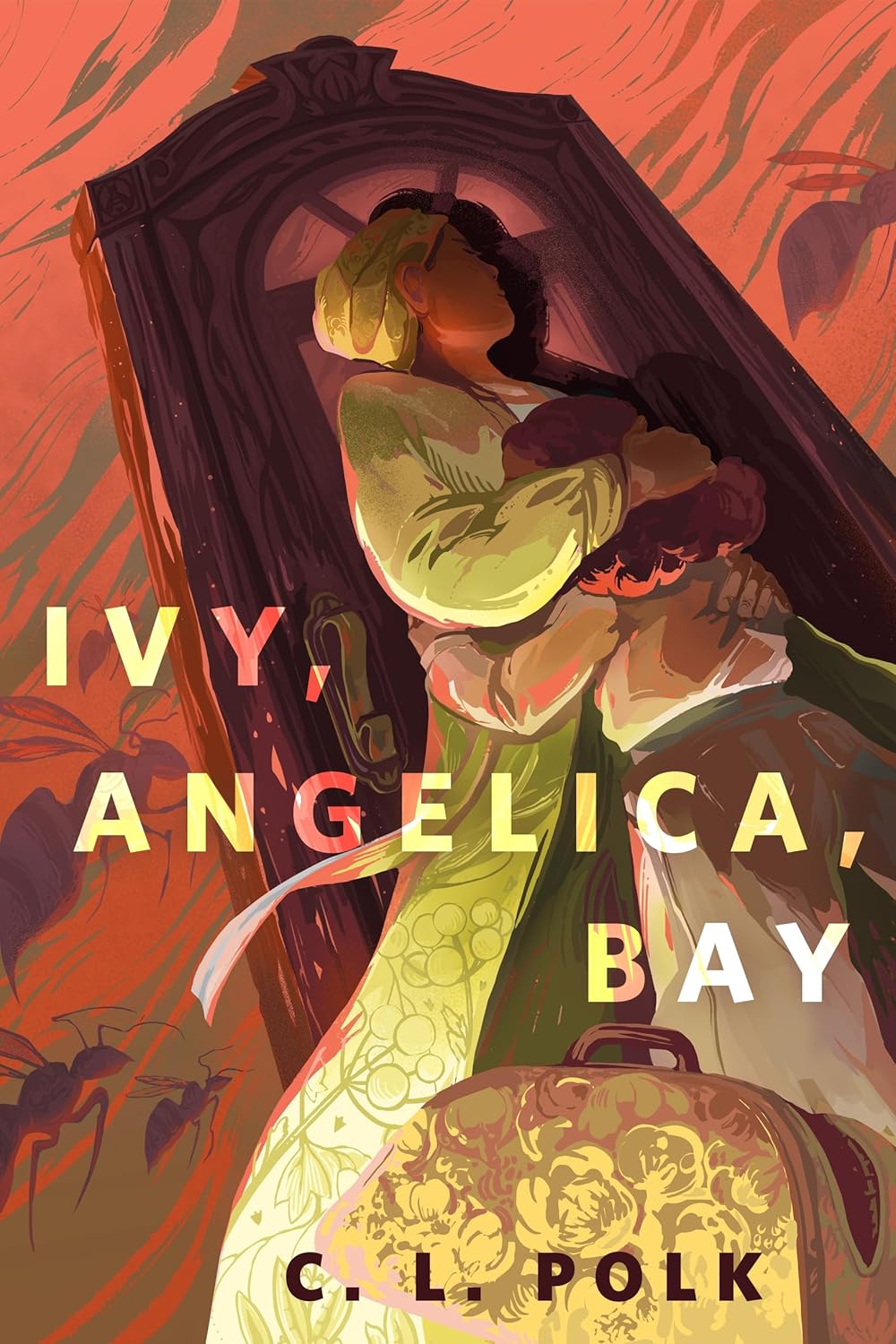
I was even better pleased to find Theresa again, grown up, in Ivy, Angelica, Bay. The heartbreak hits a bit harder here, perhaps because we are growing up. But she’s coming into her powers, as well. The ending offers a twist I love, with opportunities; I wonder if we might hope for more fiction, perhaps at novel-length, in this world: Theresa and the other mistresses of the bees who come before and after, and the world of good people but also darkness in which they move.

The Music of the Siphorophones or Siphorophenes (no cover image I could find) comes from a slightly differently imagined world. Where the bees wield their power in a world that looks a lot like ours, this novelette reminds me a bit of The Expanse: space pilots in a future universe in which ‘spacers’ (who live on ships and stations and planets far from human origins) have developed very differently from ‘grounders’ (mostly-Earthbound people), and there are galaxies’ worth of threats to consider in interspace travel, from pirates to intrigue in politics and entertainment, and good old-fashioned human trauma. But also the Sirens, who offer (reputedly) something like a religious experience to those lucky enough to encounter them. There will be big moral questions on offer for our small cast of characters here, and again, opportunity for this world to grow into more writings for Polk, if they desire it. I hope they do.

This continues to be a talent I’d like to hear more from.


Rating: 7 bulbs of water.

reread: the Murderbot series by Martha Wells

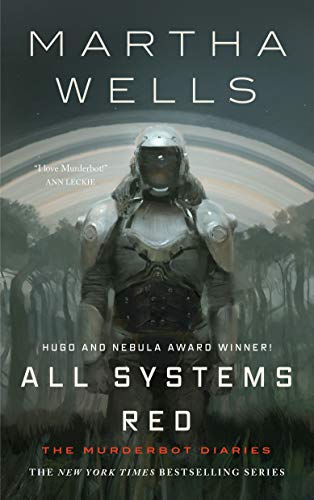
After my recent reread of All Systems Red, the first book in the series, I screamed through books 2-7 in less than two weeks. (Yes, that means I read System Collapse twice in under a month.) I’m not going to review them individually because I scarcely experienced them as such on this go. Also: not so much plot summary as praise.

I enjoyed these books the first time around, but found exponentially more pleasure in them this time around. First, having some background with the series allowed me to sink in more quickly and spend less time getting my footing. And second, I read books 2-7 back to back (with a few titles between 1 and 2), so they became a single narrative. As I mentioned just recently in re-reviewing All Systems Red, I am less a natural or ‘native’ reader of sci fi, and needed a little more time to adjust than some readers (Liz?) might. And Martha Wells has a tendency to begin her stories “in scene,” which is often advice writers get – begin already amid the action – and I think it can work very well, and does for Wells, but there is a risk or a cost in that it requires your reader to get on board rapidly. It’s only in this reread that I realize what a poor job this reader did of it the first time. Familiarity has been of great benefit to me here.

I also had the chance to see that Wells is very good at reminding her series readers of what’s happened before (or, less ideally, introducing a reader who’s begun mid-series to what is happening). This is very tricky: over-explain and you’ve taken the reader out of the book; under-explain and they’re lost. I think she has a deft hand at the quick aside that does that job neatly. (It helps that these books are billed as Murderbot’s diaries, so that it can address the reader directly and say things like “remember when this happened before?” pretty naturally.) I found on this read that each book builds really nicely on what’s come before, not just in plot elements and characters but in terms of worldbuilding. I don’t think I appreciated that the first time. I’m certain I missed a lot. I also just found it that much more pleasurable to immerse myself in Murderbot’s narrative voice, which is the greatest strength, I think, of the series: wry, deeply sarcastic, self-critical, wise, tortured, hilarious.

This revisiting was incredibly rewarding and delicious. I absolutely see why Liz keeps cycling through. I think I will do the same. I wonder how much more depth I’ll see on a third round.

These books are wise and insightful about social concepts and relationships. They are pathos-ridden and also very funny. Murderbot is a unique, odd, and surprisingly human creation; I could live in its head for much longer than these seven books, very happily. I strongly recommend the series to anybody who likes a good story and marvels at the weirdness of human behaviors. And if it doesn’t gel perfectly the first time, it might be worth a second attempt. If you love it the first time, it gets even better. Amazing.


Rating: 9 channels.

The Lost Girl by Sangu Mandanna

I am a creature, a girl, life stitched from nothing. I am eerie and frightful. And I’m stronger than all of them. I can’t allow any hunter, or Weaver, or betrayal to defeat me. Believing that is all I have. It’s all that might save me.

I have been a fan of Mandanna’s witchy book and this YA trilogy. I’m jumping back in time here to her debut novel, a YA sci fi with some romance elements, naturally enough a coming-of-age story, with some pretty neat philosophical questions. It’s quite good, but she’s gotten better since.

Eva is an echo, as opposed to a human: she was not born but made to order by the Weavers for a family who requested her. Echoes are sort of spares: Eva is based on her ‘other,’ or her original, a girl named Amarra who lives in Bangalore. Eva lives in a small English village where she is heavily guarded and tutored and trained in how to be Amarra. She reads what Amarra reads, consumes the same music and movies and foods, wears the same clothes. As far as possible from Bangalore to the English countryside, she is supposed to mimic Amarra, to be prepared to be Amarra if something should happen to the valued human girl. But something has gone awry with Eva: she has a personality of her own. She is not as agreeable as Amarra seems to be. She is strong-willed and stubborn, has interests that different from those of her other. She asks too many questions. Even to have taken a name of her own is a serious crime. [Can I just say how remarkable I find it that she’s taken the same name as in Peter Dickinson’s YA novel that I loved so much?!] And then, of course–this would be necessary for the story’s sake–Amarra dies. And Eva is up for the role of a lifetime, that for which she has been designed.

With obvious parallels to The New One, and a classic we’ll discuss shortly, The Lost Girl examines concepts that humanity has considered before; but that’s certainly not a criticism, nor am I alleging unoriginality. (This book predates The New One, for the record.) Rather, I guess I’m observing that the questions Mandanna is playing with here are of perennial interest. What power do we have to design the people or have the babies we want? Is it appropriate or moral to play with technology that would do so? (There are some efforts at work too in pursuit of immortality, that other perennial human preoccupation.) Eva literalizes the idea of a young person coming of age under the constraints of society or family’s expectations; but on some level every young person wrestles with similar bounds, and necessarily rebels against them. Is Amarra a better girl, or just a different one? Does Eva have a right to self-determination? Many people in their world see Eva as less-than, an abomination. What makes someone human, or a person, or deserving of respect? How do we combat prejudice that’s based on ignorance? How are we to navigate grief? (Hint: maybe not by having a copy of our beloved daughter made to spec, and then demanding she live up to impossible ideals.)

Eva is in a difficult spot. She has to be someone she’s not, both for the sake of her literal survival (echoes are destroyed if they can’t do their jobs) and because she genuinely wishes to comfort Amarra’s bereaved family, who seem like decent people. But she isn’t Amarra. And even dead, the ‘other’ looms large. “Maybe that’s what the dead do. They stay. They linger. Benign and sweet and painful. They don’t need us. They echo all by themselves.”

Mandanna, and the system of echoes, and Eva, are all clear on the reference to Frankenstein here. Echoes are firmly forbidden access to the book, which Eva rightly senses is because there’s something there. Who is the monster–the scientist or his creation? What if you let the Creature set his own path?

Eva’s first-person voice is spot on, the rules of this world are well established for most of the novel, the questions it asks are compelling and thoughtfully explored. The characters are complex and sympathetic, the stakes are high, the whole thing is absorbing. There is a romantic subplot, with tension between Amarra’s boyfriend and Eva’s potential (and obviously highly forbidden) love interest. It’s all really well done, and this novel was headed for a higher rating, but it gets a bit out of control towards the end. The action is a bit unwieldy and the rules of the world collapse a bit, for me, in terms of believability. A certain promise is asked to carry an awful lot of weight in the plot denouement, as if promises are more binding than we know them to be in our world, at least, and indeed it seems to come down to a villain keeping their word, which feels doubtful at best. In an invented world like this, Mandanna could have made a rule of some sort about how promises work–they could have been literally binding–but she didn’t, and the importance of the promise didn’t work for me. I suspect I’m seeing Mandanna’s evolution as an author here, and I’m not mad about it and will still be seeking out her work. My rating of 7 is still solid! But it looked even stronger for a while. I think this author has grown a great deal since her debut.

Great premise, and well done through most of the book; fell off a bit at the end. I am still a fan.


Rating: 7 scones.

reread: All Systems Red by Martha Wells

I cannot believe I rated this a mere 7 on first go-round. That’s madness. It’s a brilliant book! I guess this is evidence of how slow I was to enter Murderbot’s world. Now that I’ve read seven Murderbot books, this one was far more accessible for me, and the rating has increased considerably. Liz listens to the audiobook version of this on repeat, and I get that now absolutely (although I’ve still never listened to the audio version).

This time I was all in from minute one, with a background understanding of the rules of Murderbot’s world, the constraints of being a construct, the confusions about what exactly it is, its lovably grumpy attitude toward humans and its preference for entertainment media. I think it’s a fairly unusual portrait of… this kind of life form… that an individual could be sort of lackadaisical, may I say even lazy, toward its *work* and genuinely want to be left alone to watch what you and I would call TV shows. In this first book, Murderbot is for the first time living and working with a group of humans who are open to its (if you will) humanity, and Murderbot does not know what to do with that. Some of the humans more than once call it “shy,” but that’s not entirely it; Murderbot is uncomfortable with being treated like a person that deserves respect and autonomy, because that’s a new experience. And this is compounded by its need to pretend its not such a person, because for its own safety it needs for no one to realize that it’s hacked its governor module and is operating according to its own wishes. So. “Yes, talk to Murderbot about its feelings. The idea was so painful I dropped to 97 percent efficiency. I’d rather climb back into Hostile One’s mouth.” (That voice is hysterically funny.)

I can’t get enough and am now in danger of ripping through the whole series all over again. I’m sure some readers (Liz?) accessed this much more easily on the first read, but boy, is this second one an improvement for this reader.


Rating: 9 little hoppers.

System Collapse by Martha Wells

Book 7 is, again, the most recent Murderbot book to date, but there are more on the way, we’re told, and thank goodness. This tip from Liz has been (yet again) a big winner. I took a big break between books 6 and 7 – pretty precisely three years, whew! but it wasn’t too bad to jump back in. I won’t say I recalled all the fine points of where we were and who the humans were, but I was close enough to follow along; I think I’m already a little liable, with sci fi in particular, to let some of the details of tech and even plot wash over me as I go with the general atmosphere, themes, and cleverness. The Murderbot Diaries are absolutely character-driven, with style (that is, chiefly, Murderbot’s unique, sarcastic voice and secretly-a-teddy-bear personality) carrying a good portion of the load as well. I’m way more here for Murderbot itself – its inner dialog, its anxieties and values and reluctant but absolute loyalties, its decision making and love for entertainment media – than anything that happens to it. Those events are only here to let Murderbot react and act and be its loveable self.

Murderbot is full of dryly funny observations about how inexplicable humans are. “Humans are great at imagining stuff. That’s why their media is so good.” “Not even humans know why humans do things.” It coins ‘argucussion’ for the argument/discussions its humans have. Upon conflict, one human says to Murderbot, “We should talk about this later,” and its internal narrative responds, “We probably should but we absolutely are not going to, not if I can help it.” Because Murderbot is as avoidant of its own emotions and trauma as any repressed, long-ignored, forced-to-be-self-reliant human. It is a very human SecUnit.

This edition, it is fair, may start a bit more mid-scene than usual even for Martha Wells (and this is a thing she does), and it’s been a while since I last knew where we were. Murderbot and its growing crew of beloved humans (it is reluctant to admit to this, of course, but we know it is true) and ART the sentient spaceship are in a tricky negotiation situation involving mistreated and rightfully suspicious colonists, evil corporation lackeys, and dangerous ancient aliens. There is action and fighting, and mysteriousness. Murderbot spends a fair amount of time pretending to be human, which is at least better than pretending to be a SecUnit that has not hacked its governor module (there’s a little bit of that as well). It has the opportunity to free other SecUnits, too, and that possibility and the other SecUnits’ reactions are promising for future books. I smell a sequel and I can’t wait.


Rating: 8 fictionalized documentaries!

A War of Swallowed Stars by Sangu Mandanna

This review contains spoilers for books that precede it in the series, but is spoiler-free for this book.


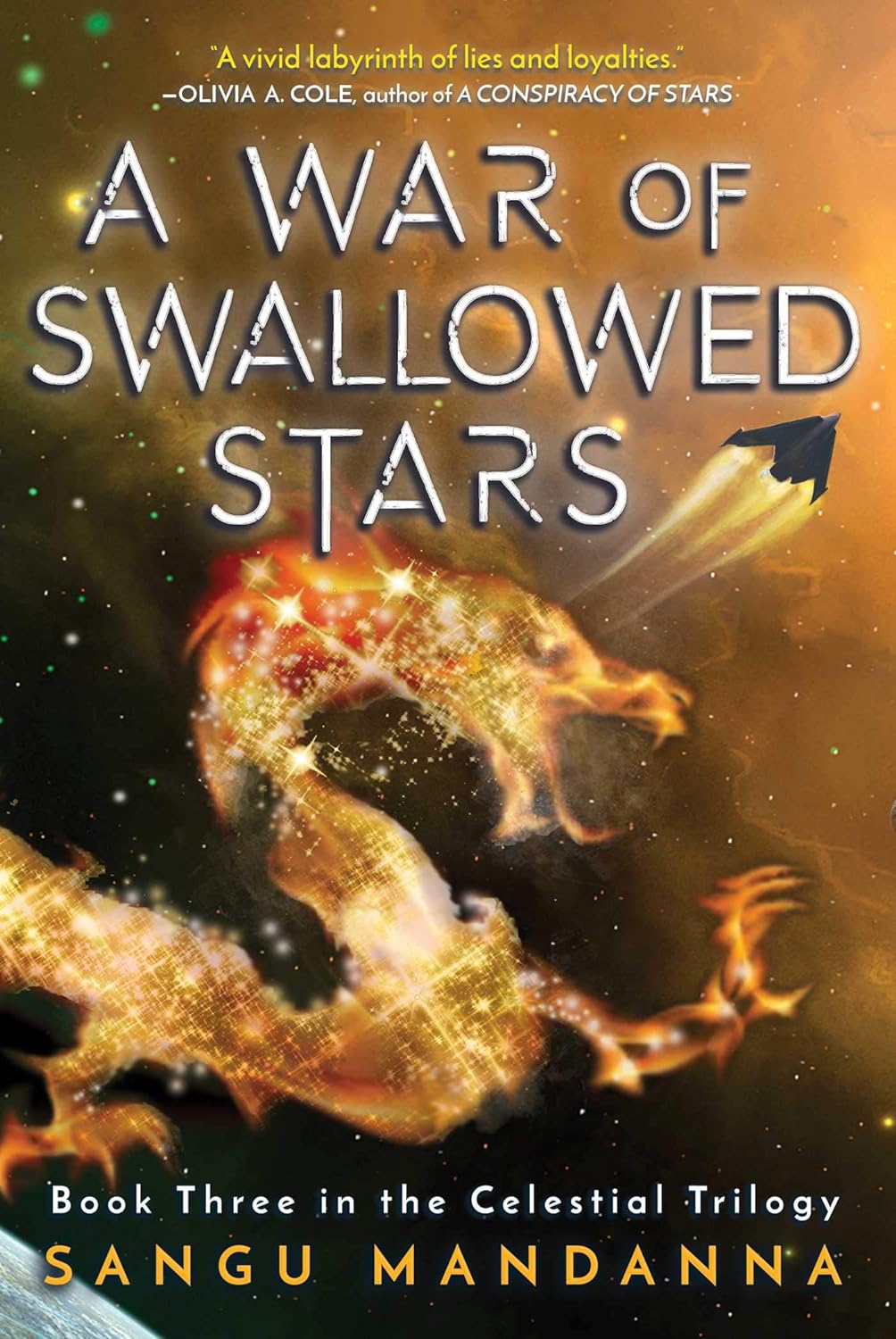
This is the third in a trilogy, following A Spark of White Fire and A House of Rage and Sorrow. And it had me pretty rapt, y’all. I was on the edge of my seat throughout, and I cried at the end, but in a good way, which makes me feel glad for the newly-12-year-old I’ve just gifted it to for her birthday. (I teased her that she had to wait because these books are labeled 12 and up!) The world we have come to care about over three books is in great peril, as are the relationships we’ve invested so much in. And it’s not that nobody we love is lost in this book; but it all ends in a way that feels right.

The Celestial Trilogy has featured magical weapons, gods and monsters, murderous family members, and friends where we’d least expect them. Esmae has experienced great and intense trauma, and weathered some very real depression. “I don’t know how to make my way through to the other side of it… I can’t see anything but the dark. I feel like I’ve fallen down a cold, dark hole and I’ll never get out.” Whew. But she has good friends. And she has good on her side. Hang in there, readers.

Mandanna took us through a lot in this series, but the emotional roller coaster has been well-earned, and it pays off in a big way. I can’t wait to hear what my young friend thinks. And you all.


Rating: 8 moments of eye contact.

A House of Rage and Sorrow by Sangu Mandanna

As I’ve decided will be my regular procedure around here, this review contains spoilers for books that precede it in the series, but is spoiler-free for this book.


Following A Spark of White Fire is A House of Rage and Sorrow, book 2 in the Celestial Trilogy by the author of The Very Secret Society of Irregular Witches. I love it.

Esmae is still reeling from the loss of her best friend at the end of book one. Also quite painful is the fact that Rama was killed by her twin brother in a duel, as he thought he was fighting Esmae herself: not only did Rama die, but her brother meant to kill her. Esmae’s anger is beyond description. She wants to burn it all down. She is also carefully avoiding a burgeoning romance, because (I judge) she is as angry with herself as with anyone, and doesn’t think she deserves it.

She is also, however, making friends. Surly Sybilla has cracked open and become as loyal to Esmae as to Max; beloved Rama’s sister Radha has appeared on the scene and begins making her way into the group, not without hiccups. There is a small, new, perhaps fragile, but very real family of friends forming around the girl who has always mourned not having a family.

Then again, the political intrigues and betrayals surrounding her flesh and blood keep multiplying, and the revelations and bad news keep coming. Just how much can one teenaged girl go through? A House of Rage and Sorrow ends on a cliffhanger, not unlike book one; but unlike that finish, this time I had the next installment at hand. Stay tuned for book three in this trilogy.

I love that romance keeps developing (and not just for Esmae!) alongside anguish and intrigue, and a very real and believable coming-of-age arc in which Esmae tries (at least a little) to balance her rage against her better wishes for her loved ones and her wider world. I can’t wait to see where we’ll go next.


Rating: 7 lions.

A Spark of White Fire by Sangu Mandanna

A very fun sci fi novel and first in a trilogy. Aimed at younger readers, it still has plenty of plot and character to engage us kids-at-heart.

I’d call this ‘light’ sci fi in that the science isn’t ‘hard’ and doesn’t contribute crucially to any plot points. You might call it speculative fiction instead: political and familiar intrigues, with coming-of-age issues and romance, set in a world that is not quite like our own. Esmae has grown up in the spaceship kingdom of Wychstar, but she belongs on Kali. By winning an archery contest, and therefore winning a gods-blessed undefeatable warship, she is able to return to the home she’s never known; but reuniting her fractured family and putting the rightful heir back on the throne may be a bigger job than she’s realized.

Esmae is a teenager who’s lived most of her life appearing as an unremarkable orphan, although she also enjoys the close friendship of Wychstar’s youngest prince Rama. He’s a true and lovely friend. Secretly, she has also enjoyed training under a famous warrior named Rickard, who is bound to teach no one but the offspring of Kali’s late king. Rickard and the gods are the only ones who know Esmae’s true identity at the novel’s start.

So, like I said: speculative fiction, at the juncture of fantasy and sci fi, with political intrigue and the challenges of coming of age. Esmae’s troubles winning a kingdom may be outside the experiences of most young readers, but exploring the larger world and finding one’s place in it, struggling to find one’s truest identity, making friends and feeling attraction and navigating conflicting loyalties – all these are absolutely universal. I think it’s a very accessible story for young readers.

I read this book for my own pleasure, absolutely, but also because I was hoping to pass it on to my favorite almost-12-year-old, and for that reason I paid more attention than usual to anything that might cause concern for the younger set. There’s some very mild bloodshed, and some intro-to-sexual content: basically a quick but passionate kiss, and some reference to wanting hands on one’s body and feelings of warmth. By my standards, this is plenty appropriate for a middle schooler. I pointed these passages out to my friend’s parent, and we agreed that she’d be fine. (You know I’m not inclined to censorship, and I was reading far spicier stuff at a younger age. And sometimes confused by it! I also appreciate that this kid is doing other reading about bodies, and doing a fair amount of reading with her parents. All solid.)

Fully invested in books two and three. I’ll read more by this author, too.


Rating: 7 birds of feathers and buttons.

The Golden Enclaves by Naomi Novik

**Spoiler-Free!**

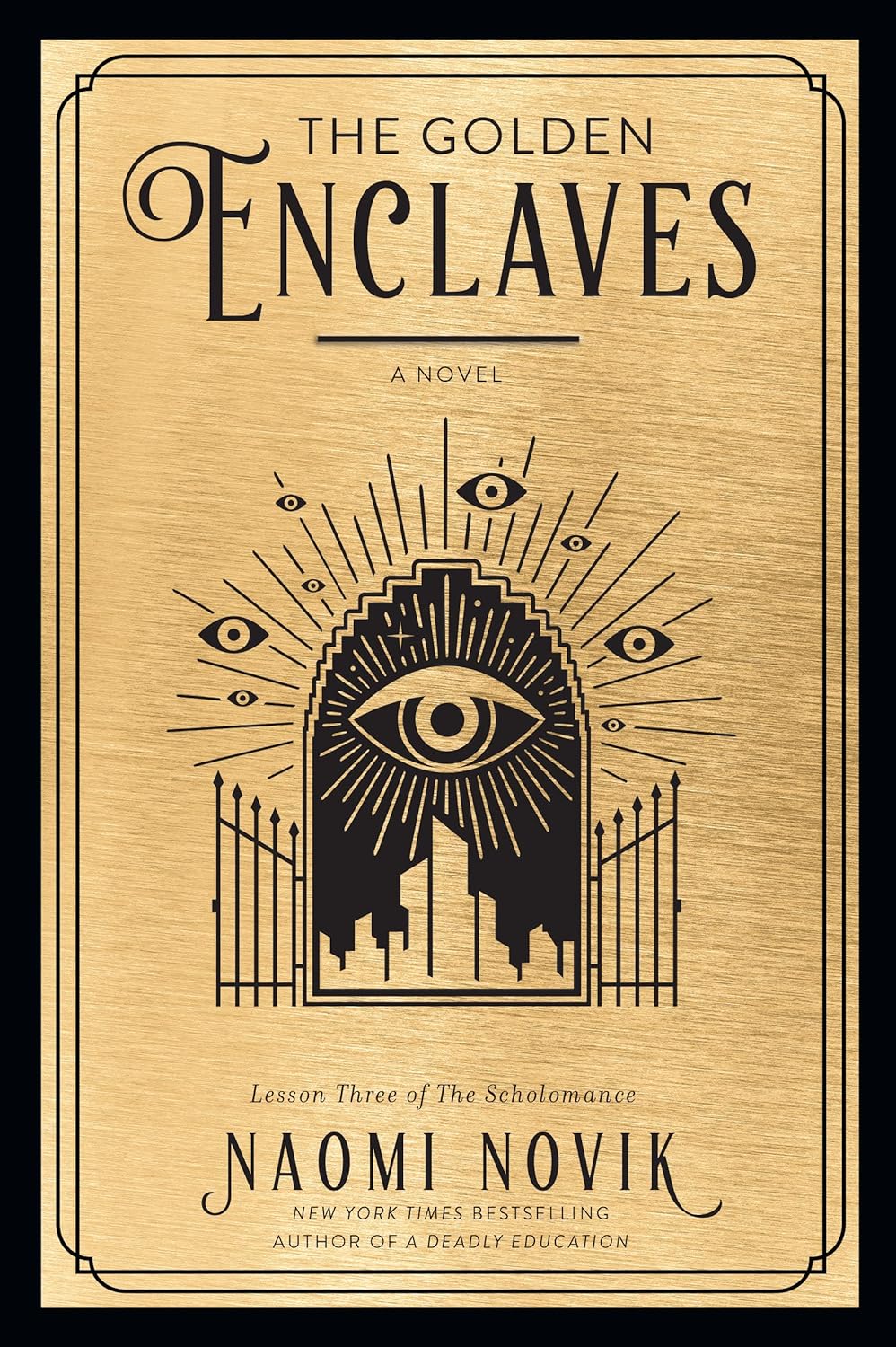
Following A Deadly Education and The Last Graduate, The Golden Enclaves wraps up the Scholomance series. I am very pleased with this conclusion and the whole series. For spoilers’ sake, this review includes practically no plot summary.

As a series finale, The Golden Enclaves takes on a lot, and involves a ton of action, ranging very widely in the ‘true’ geographic world as well as in the void and the magical spaces that populate Novik’s imagined world. A number of characters take great steps; this is indeed a coming-of-age for El, who has graduated from the Scholomance and achieved some real victories, but only to step out into a larger world where the monsters are decided not all neatly taken care of. She’s suffering some losses, not least in realizing the limits of her powers: she is one of the most powerful wizards ever, but there are still limits. We see her take less advantage of the friendships and alliances we’ve seen her form up til now, but also find news ones and/or revive some that have lain dormant.

I love about this whole series that it offers commentary on class divisions and the ethics of who gets to be safe and cared for in the world. Those themes are strengthened here, and complicated. There is a very pointed conflict of interests that she calls a trolley problem, of the highest order; El must face that she cannot (so to speak) save them all, that every choice has a cost. In the face of this frustration, she wavers, considers giving up. We have learned that El is incredibly strong and strong-willed; she doesn’t give up easily. But we have also never seen her tested like this.

I love the characters, including one or two who are still ‘rising’, coming to center stage. I love El herself so dearly; she struggles so hard with this book, even after having accepted help and friendship, and her struggles often yield some good snarky humor and fun amid the pathos. Novik has enormous world-building power, which was evidenced at the series’ start but is still at play here, because our understanding of the world (and El’s understanding of it!) must expand considerably in this book. I’d recommend her to anyone.


Rating: 8 bricks.

How Long ’til Black Future Month? by N.K. Jemisin

This book took me on such journeys and brought me so much joy and enjoyment and laughter and more difficult but also rewarding feelings; I have long felt that Jemisin is a rare master, but this may be the pinnacle. I love this book. I was once mildly disappointed with novella-length versions of her world; but here she clearly perfected the short story. And I was so pleased with the wide variety of worlds we got to dip into. Every story is unmistakably Jemisin, but each is also so different. They range in the impressions they give of settings in time and in space, from recognizably referring to our world to being fairly far afield; some are set in the worlds of her novels, some stand alone, and a few closely answer another author’s work (more on that in a minute). Some, similarly, seem to fit into a timeline of our own world, while others stand apart. But they all have the flavor. I went back to immediately reread one story in particular as soon as I finished the book, and that’s a rare move.

How Long opens with an author’s introduction in which she shares her coming-of-age as a writer, her growth as a short story writer, and the struggle of being a Black woman in fantasy and science fiction, among other things. “The stories contained in this volume are more than just tales in themselves; they are also a chronicle of my development as a writer and as an activist.” For this reader, at least, it felt right to come to this collection after having read all the novels (I haven’t read all her work as published in various places, but I’ve read all the books); I felt familiar with the writer now offering a look back across those years. Such a treat. Also, I hope she lives to write many books for a long, long time more.

The first story in the collection is “The Ones Who Stay and Fight,” which is quite explicitly a response to Ursula Le Guin’s “The Ones Who Walk Away From Omelas.” This was, again, a real treat for me; I’ve read “Omelas” for a couple of classes in which I was a student and also taught it for several years, so I’ve looked pretty closely at its concepts as well as its sentences, and that was an excellent preparation to appreciate Jemisin’s strong response in both its concepts and its sentences. To match the voice and style of another writer is not ‘mere’ imitation but a serious accomplishment in itself, and this story does that well. Jemisin has a fiery answer to Le Guin’s troubled false utopia; her Um-Helat is not “that barbaric America” nor “Omelas, a tick of a city, fat and happy with its head buried in a tortured child.” She’s got a different idea, and exhorts the reader to come along, “get to work.” (The direct address comes from Le Guin, but Jemisin grasps it firmly.) I was so delighted with this opening story, I could hardly stand it.

Other favorites include “Red Dirt Witch,” “L’Alchimista,” “The Effluent Engine,” “The Evaluators,” “Henosis,” and “The Elevator Dancer” – is Orwell just this much in our society, or in my head (recently Julia), or is this an explicit play on 1984? To emphasize the range of these stories, I will attempt a few one-line description/summaries:

  • “Red Dirt Witch”: The White Lady threatens Emmaline’s family, but she knows the red dirt of Alabama, and the magic it holds, too well to go down easily.
  • “L’Alchimista”: As a professional chef, Franca has fallen far, but she can’t resist a challenge; when a mysterious stranger shows up at her little kitchen in Milan, she will discover her art holds even greater power than she knew.
  • “The Effluent Engine”: In historical New Orleans, a Haitian spy looks for technological advantage and finds also love. (Jemisin’s website calls it “a swashbuckling adventure-romance set in 1800s New Orleans with secret societies, derringers, and bustles.” Love!)
  • “The Evaluators”: Human contact with alien species is highly regulated; why is this one trade contract being rushed? Danger! (Strong hints of Octavia Butler’s Lilith’s Brood series.)
  • “Henosis”: In out-of-order chapters, a famous author is kidnapped by his biggest fan.
  • “The Elevator Dancer”: Security guard secretly, shamefully, watches a subversive act of dance.

Bonus: many of these stories are available elsewhere, linked from Jemisin’s site, if you’d care to go hunting that way.

This book has left my mind changed, and I’ve stepped away and back to it. Strongly recommend.


Rating: 10 frava roots.