rerun: The Solace of Leaving Early by Haven Kimmel

From early in my career with Havel Kimmel: please enjoy this review from April of 2013.

Langston Braverman has recently returned to her hometown of Haddington, Indiana. Very close to receiving her PhD she walked out of her oral exams. She is a strange, exceptionally erudite but socially fragile and problematic young woman. She has a dog named Germane: “named not after Germaine Greer, but as in: Germane to this conversation.” (I love that.)

Amos Townsend is Haddington’s pastor, of only a year or two now. He is tormented by the death of a local named Alice; he feels that he should have been able to stop her death, and he is struggling with his faith, which is actually nothing new.

Alice’s two children are left in limbo; their crazy aunt Gail has turned out to be unfit, and their grandmother Beulah is clearly too near death herself to wrangle with two traumatized little girls. Upon Alice’s death, they dispose of their original names, Madeline and Eloise, and state that they are now called Immaculata and Epiphany. They wear costumes from a Renaissance drama from school, that their mother made, all the time. Complete with hats: the tall cone-shaped kind with ribbons streaming off the tops.

Langston’s mother AnnaLee picks up some of the slack, and then insists that Langston step up: she is not in school, not working, and these children need her. Of course, Amos plays a role as well, so that this village will truly raise a child.

Langston and Amos are the stars of this story (along with the striking Immaculata and Epiphany, of course). When they meet, they repel one another like magnets. Despite sharing tastes and interests in reading, philosophy, theology, and (I can’t stress this enough) their particular brands of weird, they repel. And, as is clearly a theme in Kimmel’s work, the cerebral content, the philosophies and theologies that shape this part of the story are complex and thoroughly explored. I think I said this in my last Kimmel review, but: her many references partly pique me to go off and study, and partly exhaust me, making me so glad I don’t have to read Whitehead and Tillich and Frithjof Schuon. It makes me sit back and… wonder… that all these strange, complex, learned thoughts that Langston has are thoughts that Kimmel had to have first, had to conceive to put them in her heroine’s mouth; think of that.

Immaculata and Epiphany see Mary (the Mother of God) in the dogwood tree in their grandmother Beulah’s backyard. Naturally, because that is the kind of world this is. It is very strange and is a kind of beautiful, and again I observe that Kimmel’s gift is to create a midwestern small-town world that is both hopelessly humdrum and depressing and everyday, and also strange and exalted and worthy of examination.

What happens to our exquisitely odd cast of characters should definitely remain a surprise to you, reader. It’s pretty great, though.

I love this author SO MUCH that I am struggling to write reviews; but I will keep reading her. Next up is The Used World, and I am, of course, working to get my hands on her best-known bestselling memoir, A Girl Named Zippy.

I’ll close, as I tend to with Kimmel, with a few lines from the book that particularly caught my eye. Where these have, in the past, been lovely examples of her use of language, these are more concepts that I really liked. There is a book theme here. And the language is great – observe the curry comb, is that an image or what – but it’s the concepts that I like most here:

Amos knew as well as anyone what went into writing a book, having written a master’s thesis, and he considered the process to be akin to having one’s nerves stripped with a curry comb.

Maybe he knows what goes into writing a book as well as anyone… who hasn’t written a book?

The most intractable aspect of his bachelorhood was that Amos was uncomfortable eating without reading; he felt as if he were wasting both time and food.

Me too, Amos. I’m right there with you.

Amos tapped his fingers on his bony knees. “Why do you have a book and I don’t?”

“Because I’m a woman, Amos.”

“Yes, but why do you have a book and I never do in a situation like this?”

AnnaLee put the book down. “I carry a bag. I also have safety pins and emergency money, and a package of those little wet towelettes. We live in Indiana. I could get stopped by a train, I could get bored. I always carry a book.” She went back to reading.

How perfect is that. “We live in Indiana, Amos!” Perhaps it goes without saying that I, too, try to keep a book with me at all times? I fail on safety pins and wet towelettes, though.

I’m sure I’ve failed to do this book justice. But it’s divine.

Rating: 9 ribbons on a hat.
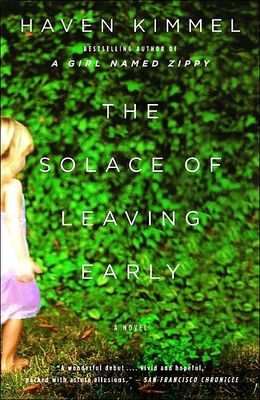
Lovely. I should reread her sometime.

rerun: Soundings: The Story of the Remarkable Woman Who Mapped the Ocean Floor by Hali Felt

Please enjoy this time capsule from August of 2012.

I’m so glad I picked this book up (and bought it for the library where I work). It sounded like just the sort of thing I appreciate: a biography of a little-known historical figure who made an important contribution to the world as we know it but was herself forgotten. In this case, the “remarkable woman” of the subtitle is Marie Tharp, whose meticulous study and cartography of the ocean floor established the concept of plate tectonics that science now recognizes as fact, but was at best a blasphemous and ridiculous notion before Tharp came along. Her achievements, however, were minimized by a scientific culture in which women did not belong. This biography is additionally appealing to me for its mood: author Hali Felt takes a whimsical, dreamy, almost fanciful tone at times. She describes her own attraction to Tharp’s story (born in part of Felt’s mother’s, and her own, fascination with maps) and the relationship she felt to her subject. She dreams of Tharp coming to her to explain the mysterious and unspoken parts of her life. This book is nonfiction, but it’s honest, personally related, and warm.

There is also an enigmatic love story of sorts hiding within Soundings: Tharp’s career and life were both tied to a man named Bruce Heezen. Heezen was her coworker, then her technical superior; but they shared a partnership in work, in science, in discovery, and apparently in all things. It is known that they were a couple, although they never married and the details of this side of their relationship are very few.

Felt follows Tharp from her childhood with a science-minded father she adored, through her education in English, music, geology, and mathematics, and to her first job in the oil & gas industry (oh, how familiar to this Texas girl). But she was held back: this was the 1940’s, and women in science were mostly expected to make copies, compute numbers, and brew coffee. Eventually Tharp found her way to New York, to Columbia University and the Lamont Geological Observatory. This is where she would meet and work with Heezen and quietly make history.

The science in this book is very friendly and accessible to a general reading public; the story that Felt set out to tell is more that of a woman’s life and accomplishments despite the limitations of her society, than that of tectonic plates per se. For that matter, Felt shows that it was Marie’s combined backgrounds in art as well as science that made her perfectly suited to play the role she did in history. Her meticulous re-checkings of data and attention to detail were indispensable – but so was her interest in visually representing the data available in a way that would show the general public (not just academics) what she’d discovered. So her achievement was artistic as well as scientific. Soundings does make the science side clear, but doesn’t dwell, and is never dry. Rather, Marie Tharp comes to life: she is a precocious child; an ambitious, able, frustrated student; a dedicated scientist; a life partner; an eccentric aging woman caught up in her own past, campaigning to honor and preserve the legacy of her other half.

Hali Felt was honest about the role she plays in the story she relates. She begins in her Introduction by briefly describing her own attraction to maps, and then follows a chronological format, beginning with Tharp’s childhood and following her life, and eventually her death. And then Felt returns to the story: her discovery of Marie Tharp’s existence, her interest, her decision to follow that interest, her research, her relationships with the living descendents of Tharp and Heezen’s world (the “Tharpophiles”), and in the Acknowledgements at the end, she even hints at the process by which she came to write and publish this book. I found all of these Felt-related details interesting too.

In a word, this is a lovely biography, and the style and tone of it may be my favorite part.


Rating: 9 double-checkings of data.

I remember it fondly.

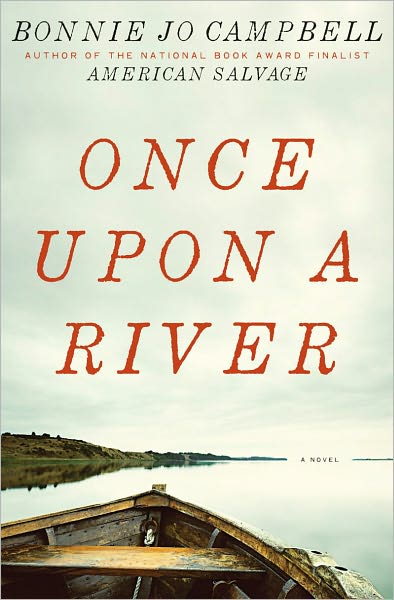
rerun: Once Upon a River by Bonnie Jo Campbell

Pulled from the depths of October 2011, please enjoy this rerun review.

Once Upon a River is a beautiful book. The story is not joyful, let me say that right off. But it’s beautifully wrought, and in fact, when I finished it and stepped back and viewed it as a whole, I decided that the story has a certain beauty, too. A sad beauty, but a beauty that’s true to life.

This is the story of Margo. She grows up in a little town on the Stark River in Michigan, hunting, fishing, and living and breathing the river. She is close to her grandfather, and lives in the outdoors; school and social situations are difficult for her. She’s a very skilled outdoorswoman, and an especially good shot; Annie Oakley is her hero. Bad things happen. Margo’s mother leaves, and as her situation further deteriorates, she takes off upstream in the boat her grandfather gave her to look for her mother. Margo lives off the land and the river, mostly. She makes a few alliances but they all fall apart. People and relationships are not as reliable as the river and the outdoor world in which she feels safe and comfortable. More bad things happen. She grows up some, learns about people, and learns more about the natural world. She moves upstream and downstream, learns how to survive with her hands, a few tools, and her skills, along the lines again of Annie Oakley (she will eventually own two biographies, among her few prized possessions).

This story is painful in more than a few spots. Plenty of bad things happen, including several rapes and quite a bit of death. There’s no shortage of young people having sex, to which your reactions may vary. (Consensual? In itself a “bad thing”?) You will cringe. But like many books that are both sad and realistic, the cringing might be worth it. Margo’s story actually looks skyward, hopefully, at the end. She finds and makes some good things, too.

Campbell has full grasp of metaphor. The river flows on, and Margo learns its rhythms, and how to assert herself while following its current. She finds the river to be a more constant (if not predictable) force than human nature. Campbell has full grasp of language, too; she writes beautifully, lyrically, symbolically. In the end it’s a gorgeous book and I recommend it wholeheartedly. So, to recap: bad things happen, but beautifully. It’s a book about life.

I shan’t attempt a retrospective rating at this distance of more than eleven years, but I still remember this one fondly.

rerun: The Song of Achilles by Madeline Miller

Fun fact: I interviewed Miller for the podcast Critical Wit, and that interview posted on the same day (May 31, 2012) that she won the Orange Prize for this novel, which was a fun piece of synchronicity for all of us, I think. That interview can be heard here.

This review originally posted on May 17, 2012.

I read this book in a day, rapt and tearful and awed. Madeline Miller, I love you. Write more, please.

I expect that most people are at least vaguely familiar with the story of the Trojan War, even if you never read the Iliad, yes? The Greeks sail to Troy in pursuit of Helen, “the face that launched a thousand ships” (that’s these ships!), the most beautiful woman in the world, stolen from her king-husband Menelaus by the Trojan prince Paris. They fight at the gates of Troy for ten years before Odysseus’s characteristically clever notion of the big wooden horse (the Trojan horse of idiom) wins the war for the Greeks. Achilles is a hero of the war, on the Greeks’ side. He had been sitting the war out in protest against an offense to his pride when his close friend (and, most scholars agree, lover) Patroclus goes into battle and is killed. In the opening scene of the Iliad, Achilles is mad with grief and rage, about to rush into battle, kill Hector, and be killed by Paris.

That’s the background. Miller, a scholar of ancient languages (including Greek) and theatre has written a novel from Patroclus’s point of view. This gave her quite a bit of leeway, since Patroclus is not given much coverage in Homer or in ancient myth generally; she got to do what she wanted with him. Here, we see him grow up from a boy: he was a disappointment to his father, then was exiled in dishonor and sent away to be fostered in another kingdom, where Achilles is the prince and heir. The two boys form a decidedly unlikely friendship, with Patroclus the dishonored and weak following in the footsteps of Achilles, whose future is prophesied to be something enormous: he will be Aristos Achaion, the greatest of the Greeks.

Patroclus joins Achilles in his studies and their bond grows closer until they become lovers. They are not eager to join the Greeks and sail to Troy to fight for another king’s wife, but circumstances (and Odysseus, the crafty one) conspire to see them off. From there, you can revisit my synopsis of the Iliad, above – except that we keep Patroclus’s perspective, which actually made the Trojan War that I thought I knew so well spring fresh from the page.

And that is one of the several strengths of this book: that an ancient myth that is familiar to many readers, like me, becomes so real, new, crisp and juicy in Miller’s hands. It definitely made me want to go back and reread the Iliad, as well as other cited works. (Check out the Character Glossary, whether you think you need it or not, for background as well as mentions of other books you’ll want to go find.) The myth of the Trojan War comes alive with Patroclus as it hasn’t before.

Another great strength is the emotional impact Miller achieves. This book is moving, sweet, heartfelt, powerful, in its tragedies as in its loving moments – and the tragedies are plentiful. There is visceral wrath in Achilles’s mother Thetis and her hatred of all mortals and Patroclus in particular; that emotion comes through just as strongly as the love that makes Patroclus put aside jealousy and envy, makes him put Achilles’s needs before his own. I noticed that the first-person voice of Patroclus rarely uses the name Achilles, but just refers to his lover as “he” – thus emphasizing the extent to which Achilles is the center of his world.

As I said at the start of this review, I want more of this! It’s so well done. If you’re taking requests, Ms. Miller, I would like to read a book about what happened to the happy family of Odysseus, Penelope and Telemachus following the conclusion of the Odyssey: how does Odysseus manage to gracefully step down from power and transfer to Telemachus without sacrificing any of his machismo? Reading The Song of Achilles raised this question for me – how a king could step down and preserve his dignity and quality of life. I wonder, too, whether Penelope ever gets grumpy about all the philandering Odysseus did along his homeward journey, while she was standing strong against the suitors.

In a nutshell, this retelling of the Trojan War and the relationship between Achilles and Patroclus is lovely, loving, sweet and deeply emotional; it preserves the grand, sweeping scale and feeling of humanity and drama in the original, but brings it freshly alive in an appealingly different format. The Song of Achilles made me sigh and think and cry, and I wanted more when it was all gone. This may very well be the best book I’ve read in 2012.


Rating: a rare 10 loving caresses.

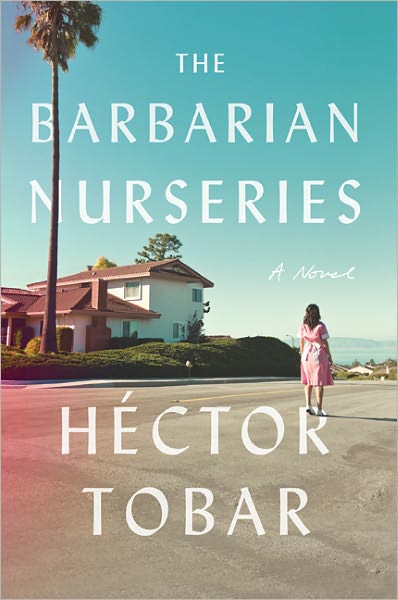
rerun: The Barbarian Nurseries by Héctor Tobar

A deceptively quiet story, with swift currents running deep beneath its surface, considers the fate of an unprepared Mexican housekeeper in Orange County left to care for her employers’ young children.

Pulitzer Prize-winning journalist Héctor Tobar’s second novel tackles the ambitious goal of characterizing Southern California’s multicultural schizophrenia and achieves it admirably.

Araceli is quietly comfortable in her role as housemaid to the Torres-Thompson household in Orange County, one of three Mexican domestics; but when the gardener and nanny are suddenly dismissed, she is puzzled to find herself expected to care of three children she considers strangers. Worse, she wakes up one morning to find both her employers gone with their baby–-leaving her alone in the house with two young boys. In desperation, she sets off with them on a daunting trek through diverse and unfamiliar Los Angeles to try to find their estranged paternal grandfather.

Tobar creates an intriguing juxtaposition of cultures, as the Torres-Thompson children are thrust into a huge, unfamiliar, multiethnic city. Most observations are from Araceli’s perplexed, amused, lyrically bilingual perspective. At other times, we look through the boys’ eyes, with all the wonder of the new, including evidence of poverty they’ve never before encountered. The older boy (age 11), in particular, has a unique way of clinically interpreting new experiences through books he’s read, imbuing the world with fantasy. The adventure with the boys is a comedy of errors–-Araceli becomes suddenly famous as a symbol of racial politics, and her fate depends upon forces outside her control.

The Barbarian Nurseries is a beautifully written, contemplative and thought-provoking view into Southern California’s diversity and contradictions, as well as a fascinating and well-presented story.


This review originally ran in the September 23, 2011 issue of Shelf Awareness for Readers. To subscribe, click here, and you’ll receive two issues per week of book reviews and other bookish news.


I decided to skip the post-dated rating on this one, as it’s been a while and I’m genuinely curious as to how it’s aged. I did call it one of the best books of the year. Anybody have a more recent reading to report?

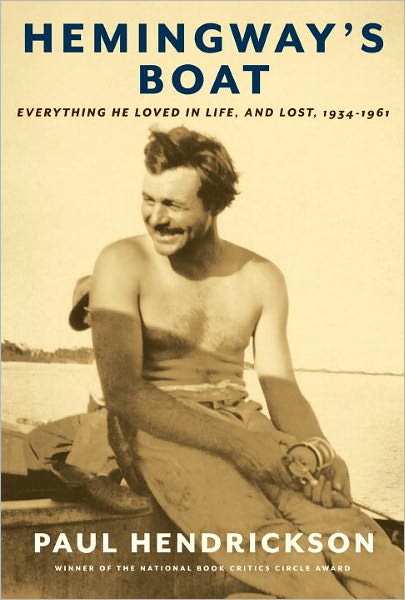
rerun: Hemingway’s Boat: Everything He Loved in Life, and Lost, 1934-1961 by Paul Hendrickson

A lyrical, textured, and meticulously researched meditation on Hemingway from a fresh new angle.

Paul Hendrickson, NBCC award-winning nonfiction author for Sons of Mississippi, pulls off the remarkable feat of finding a fresh, new angle from which to approach Ernest Hemingway: his boat Pilar. Purchased in 1934 with an advance from his longtime publisher Scribner, she saw him through three wives, great achievements and critical failures in his writing career, big fish and little ones, and the beginnings and the endings of many relationships. Hendrickson suggests that Pilar may have been the love of Hemingway’s life.

This is not a biography but a careful and compassionate rumination on the man through the lens of the boat. Hendrickson has brought to his readers a Hemingway who is neither object of worship nor monster, but a full and complex human who made serious mistakes in his relationships and fought pitched battles against his own demons, and finally lost.

The Hemingway fan will be enthralled with new details of his life, and the study of figures previously treated as minor but now revealing new facets of the man. The less familiar reader will be fascinated by this comprehensive account of the master and his complex spiderweb of varied effects on so many lives, large and small. Hendrickson presents his unusual and noteworthy story with beautifully quiet intensity and contemplation. Hemingway’s Boat achieves a terrific feat in reworking Hemingway’s story.


This review originally ran in the September 23, 2011 issue of Shelf Awareness for Readers. To subscribe, click here, and you’ll receive two issues per week of book reviews and other bookish news.


Further notes… Hendrickson treats Hemingway sort of gently, but doesn’t spare the man in his moments of monstrosity. Hendrickson comes from several different angles, interviewing different people who knew Hem more or less well, unearthing some new details. Hemingway’s Boat approaches the subject with the relatively unique concept that he was just a man – a great artist, but also human, with flaws and moments of everyday beauty. This book was noteworthy in all my reading about Hemingway and the surrounding literature. It made me laugh and cry. I wholeheartedly recommend this book for fans of Hemingway, or of literary biography, or of well-written nonfiction, or for those looking for vignettes in Key West or Havana history.


rerun/reread: Have You Seen Marie? by Sandra Cisneros, illus. by Ester Hernández

I’ll call this one in part a rerun post, since it started that way. But I did reread the book as well, and in a different format. We’ll start with the original review, which ran in 2014.

What a lovely, lovely book. Fans of Sandra Cisneros, don’t be put off by the sometimes-classification of this short fable as a children’s book. Cisneros says in an afterword that she certainly never thought of it that way; she intended it for adults, and I can confirm that it works that way, very well.

This is a short, dreamy, poetic tale of a woman, the narrator, who has just lost her mother; a visiting friend (“I was the only person Rosalind knew in all of Texas”) has lost her cat, Marie. Together, the two women go walking the streets of San Antonio, distributing fliers and asking folks the title question: Have you seen Marie?

The voice and rhythms and lyrical style that I remember from The House on Mango Street are vibrantly present here. The women ask dogs, cats and squirrels as well as people about the missing Marie, and their reactions are noted, and charmingly represented as being every bit as important as the people’s. On the surface, this is the story of searching for Marie; but it is also the story of Cisneros losing her beloved mother, feeling like an orphan in her own middle age, and gradually coming to understand that “love does not die.”

As I mentioned, Cisneros is careful to point out that this was not meant to be a story for children, but rather one for adults, with the idea of helping others like herself deal with experiences like hers: losing a parent, or a loved one. I am very (very) glad and relieved that I don’t seem to facing this experience now, or soon; but I imagine that this book would indeed help. I appreciate its soothing musical tone and gently loving, inspired advice and creative understanding of death, what it means, the grieving process. It is a tender tale. Cisneros is inventive and calming and this is a beautiful, moving story about family and friendship. I highly recommend it, for anyone.

This audio version is read by the author, and so beautifully; I love her lilt; it’s perfect. I want to very much recommend this version (in both English and Spanish in one edition – one cd of each). But then, the print copy is illustrated by Ester Hernández, and Cisneros is clearly very pleased with that aspect. Hearing her speak about their collaborative efforts on the illustrations (Hernandez came to visit & tour Cisneros’s San Antonio; she calls it documentary-style) made me regret missing the print. So there you are. Both, perhaps?? I think I will go out and get myself a copy of the book, too.


Rating: 10 trees along the San Antonio River.

I did indeed buy the print book, and what I had in mind, in part, was to have it on hand when a friend needed it. That’s taken some years, but I turned to it just recently here with a friend in mind who’d lost a parent, and whose children had therefore lost a grandparent. I picked it up to check it for age-appropriateness for those kids. My conclusion is that it is “safe” for young kids – nothing harrowing about the grief, in fact only gentle reminders that the narrator (the Cisneros character) has lost her mom. It behaves like a children’s picture book: the illustrations are as lovely as I’d imagined, and it relies on refrains and simple language. My only hesitation for kids would be that it’s longer than a typical bedtime story. I did pass it on to my friend with that caution. Maybe it takes a couple of nights to read; maybe it’s for the elder child and not the younger. I also hope my friend will try it on his own first, if only for his own, personal benefit.

It’s also true that I’ve lost somebody close to me recently, too, and I was touched and moved all over again by Cisneros’s small, apparently simple book. Especially the author’s note caught me this time, because it offers a way of thinking about grief that I find charming and, I think, useful. I was also pleased by the cultural flavor of Cisneros’s San Antonio neighborhood. I love that taste of home. And since my original review, I’ve lived near San Antonio, and become a little familiar with its neighborhoods. This was an added bonus. There are a few Spanish-language words sprinkled in, but even with no knowledge of the language, I think any reader will be fine to follow along using context clues.

I am still recommending this book highly, for adults, and with some caution for children as well. I’m sticking with my original rating, and I’m glad I got such a timely chance to revisit.

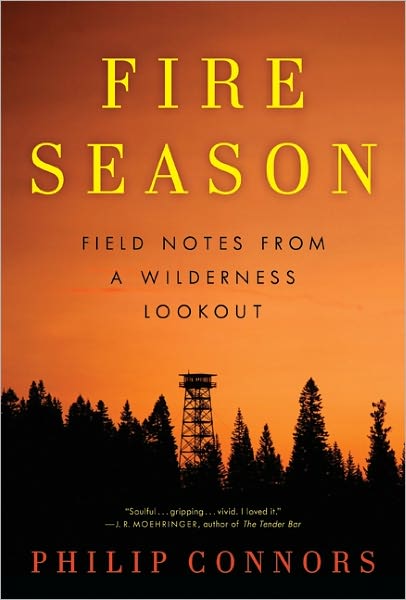
rerun: Fire Season: Field Notes from a Wilderness Lookout by Philip Connors

Trying something new here, friendly readers. Without getting too far into it all, the last weeks have been a stressful time for me, for both personal and work-related reasons. I’ve been a bit overwhelmed, and I’m in danger of getting behind here at the blog. Of the irons in my fire, this is not one I really want adding to the stress. So, an experiment. On occasional blog-post-days, I’m going to rerun old content. We are nearly 12 years old here at pagesofjulia! My hope is that some newer readers may be exposed to reviews they’ve not seen before, and I get another chance to expose you to (or remind you of) some of my favorite books. If this is old news, obviously, skip it, as you please. (Bonus: I had fun going way back to look for reviews to rerun.) I’ll try to keep the editing of my original reviews to a minimum.

Naturally we’re beginning with one of my all-time favorites, Phil Connors’ brilliant first book, Fire Season. I first reviewed this book in May of 2011. You can also read my father’s review, and friend Tassava’s, of same.

Please enjoy.


This is an amazing book. The first sentences immediately grabbed me. Connors works summers in a teeny, tiny tower room way up in the sky in the Gila National Forest in New Mexico, as a fire lookout. His job is to spot smoke and call it in for control or “management” of the fires. But his “field notes” tell so much more than the story of his career as a lookout. This is the story of his time alone in the Gila, and of the visitors he receives and the visits he pays back to town; it’s the story of his and his dog Alice’s interactions with nature. It’s the story of fire and smoke and the Forest Service’s management of fire. It’s a history of fire, of the Forest Service, of the Gila, of so very many aspects of our nation’s history, and the natural history of the southwest. Connors discusses the varied reactions the government has had to fire: the policy of fire suppression, consistently and in every case, versus the concept of “controlled” or “prescribed” burns, and the ongoing debates. He contemplates society, its benefits and our occasional desire to escape it. He discusses his unique model of marriage, in which he spends some five months a year living alone and mostly out of touch. He also relates ecological issues like fire as a natural control mechanism, erosion, and the preferences of flora and fauna. And more.

I found Fire Season astounding and important. There’s a zen-like balance in it. Connors is a rather balanced man, in that he still craves human contact; he’s not an entirely back-to-the-wild isolationist, nor does he fail to appreciate cold beer and a variety of media. But he achieves a special and rare state of commune with nature, too. His writing, for me, parallels this balance. He can wax philosophical, crafting lyrical, beautiful odes and hymns of reverence to nature, fire, and life; but he never gets overly wordy, tempering the poetry with (still beautifully written) narrative history.

Connors tells so many little stories I would love to pull out of this book and share as vignettes. For example, the story of Apache Chief Victorio’s last stand (that lasted over a year) in the vicinity of the lookout tower where Connors is stationed:

That September day in 1879, on the headwaters of Ghost Creek, marks a peculiar moment in America’s westward march: black soldiers, most of them former slaves or the sons of slaves, commanded by white officers, guided by Navajo scouts, hunting down Apaches to make the region safe for Anglo and Hispanic miners and ranchers. The melting pot set to boil.

Or the history of the smokejumpers, which I didn’t know before – the parachuting firefighters who pre-date paratroopers and taught them their trade. Or the tale of the Electric Cowboy. Or the story of the little fawn. I cried, mostly because I empathized. Really, it could be read as a series of anecdotes; but the whole is greater than the sum of its parts. The larger story is important, too. I even glimpsed traces of the training I’ve received in trail-building and (more broadly) land management.

The history, the lore, the anecdotes, the author’s relationship with nature, his relationship with his wife, the landscape of the Gila, the details about local species of bird, fish, and game… there are so many gems in this thoughtful, loving, lovely book. I am not doing it justice. It’s a very special book and I strongly recommend this to everyone, no matter who you are. But I especially recommend it if you are… a nature lover, a hiker, a dog lover, a government bureaucrat, a pyromaniac, an environmentalist, a city dweller, a romantic, a firefighter, a skydiver, a cribbage player, a whiskey drinker, a writer, a loner, a philosopher, a historian, a student, or a teacher.

This review originally ran before I instituted a rating system, but obviously –


Rating: 10 phobias.