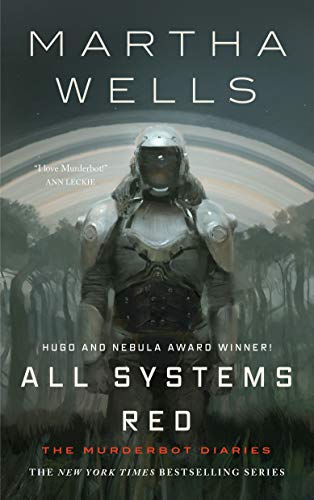
reread: the Murderbot series by Martha Wells

After my recent reread of All Systems Red, the first book in the series, I screamed through books 2-7 in less than two weeks. (Yes, that means I read System Collapse twice in under a month.) I’m not going to review them individually because I scarcely experienced them as such on this go. Also: not so much plot summary as praise.

I enjoyed these books the first time around, but found exponentially more pleasure in them this time around. First, having some background with the series allowed me to sink in more quickly and spend less time getting my footing. And second, I read books 2-7 back to back (with a few titles between 1 and 2), so they became a single narrative. As I mentioned just recently in re-reviewing All Systems Red, I am less a natural or ‘native’ reader of sci fi, and needed a little more time to adjust than some readers (Liz?) might. And Martha Wells has a tendency to begin her stories “in scene,” which is often advice writers get – begin already amid the action – and I think it can work very well, and does for Wells, but there is a risk or a cost in that it requires your reader to get on board rapidly. It’s only in this reread that I realize what a poor job this reader did of it the first time. Familiarity has been of great benefit to me here.

I also had the chance to see that Wells is very good at reminding her series readers of what’s happened before (or, less ideally, introducing a reader who’s begun mid-series to what is happening). This is very tricky: over-explain and you’ve taken the reader out of the book; under-explain and they’re lost. I think she has a deft hand at the quick aside that does that job neatly. (It helps that these books are billed as Murderbot’s diaries, so that it can address the reader directly and say things like “remember when this happened before?” pretty naturally.) I found on this read that each book builds really nicely on what’s come before, not just in plot elements and characters but in terms of worldbuilding. I don’t think I appreciated that the first time. I’m certain I missed a lot. I also just found it that much more pleasurable to immerse myself in Murderbot’s narrative voice, which is the greatest strength, I think, of the series: wry, deeply sarcastic, self-critical, wise, tortured, hilarious.

This revisiting was incredibly rewarding and delicious. I absolutely see why Liz keeps cycling through. I think I will do the same. I wonder how much more depth I’ll see on a third round.

These books are wise and insightful about social concepts and relationships. They are pathos-ridden and also very funny. Murderbot is a unique, odd, and surprisingly human creation; I could live in its head for much longer than these seven books, very happily. I strongly recommend the series to anybody who likes a good story and marvels at the weirdness of human behaviors. And if it doesn’t gel perfectly the first time, it might be worth a second attempt. If you love it the first time, it gets even better. Amazing.


Rating: 9 channels.

reread: All Systems Red by Martha Wells

I cannot believe I rated this a mere 7 on first go-round. That’s madness. It’s a brilliant book! I guess this is evidence of how slow I was to enter Murderbot’s world. Now that I’ve read seven Murderbot books, this one was far more accessible for me, and the rating has increased considerably. Liz listens to the audiobook version of this on repeat, and I get that now absolutely (although I’ve still never listened to the audio version).

This time I was all in from minute one, with a background understanding of the rules of Murderbot’s world, the constraints of being a construct, the confusions about what exactly it is, its lovably grumpy attitude toward humans and its preference for entertainment media. I think it’s a fairly unusual portrait of… this kind of life form… that an individual could be sort of lackadaisical, may I say even lazy, toward its *work* and genuinely want to be left alone to watch what you and I would call TV shows. In this first book, Murderbot is for the first time living and working with a group of humans who are open to its (if you will) humanity, and Murderbot does not know what to do with that. Some of the humans more than once call it “shy,” but that’s not entirely it; Murderbot is uncomfortable with being treated like a person that deserves respect and autonomy, because that’s a new experience. And this is compounded by its need to pretend its not such a person, because for its own safety it needs for no one to realize that it’s hacked its governor module and is operating according to its own wishes. So. “Yes, talk to Murderbot about its feelings. The idea was so painful I dropped to 97 percent efficiency. I’d rather climb back into Hostile One’s mouth.” (That voice is hysterically funny.)

I can’t get enough and am now in danger of ripping through the whole series all over again. I’m sure some readers (Liz?) accessed this much more easily on the first read, but boy, is this second one an improvement for this reader.


Rating: 9 little hoppers.

rerun/reread: Have You Seen Marie? by Sandra Cisneros, illus. by Ester Hernández

I’ll call this one in part a rerun post, since it started that way. But I did reread the book as well, and in a different format. We’ll start with the original review, which ran in 2014.

What a lovely, lovely book. Fans of Sandra Cisneros, don’t be put off by the sometimes-classification of this short fable as a children’s book. Cisneros says in an afterword that she certainly never thought of it that way; she intended it for adults, and I can confirm that it works that way, very well.

This is a short, dreamy, poetic tale of a woman, the narrator, who has just lost her mother; a visiting friend (“I was the only person Rosalind knew in all of Texas”) has lost her cat, Marie. Together, the two women go walking the streets of San Antonio, distributing fliers and asking folks the title question: Have you seen Marie?

The voice and rhythms and lyrical style that I remember from The House on Mango Street are vibrantly present here. The women ask dogs, cats and squirrels as well as people about the missing Marie, and their reactions are noted, and charmingly represented as being every bit as important as the people’s. On the surface, this is the story of searching for Marie; but it is also the story of Cisneros losing her beloved mother, feeling like an orphan in her own middle age, and gradually coming to understand that “love does not die.”

As I mentioned, Cisneros is careful to point out that this was not meant to be a story for children, but rather one for adults, with the idea of helping others like herself deal with experiences like hers: losing a parent, or a loved one. I am very (very) glad and relieved that I don’t seem to facing this experience now, or soon; but I imagine that this book would indeed help. I appreciate its soothing musical tone and gently loving, inspired advice and creative understanding of death, what it means, the grieving process. It is a tender tale. Cisneros is inventive and calming and this is a beautiful, moving story about family and friendship. I highly recommend it, for anyone.

This audio version is read by the author, and so beautifully; I love her lilt; it’s perfect. I want to very much recommend this version (in both English and Spanish in one edition – one cd of each). But then, the print copy is illustrated by Ester Hernández, and Cisneros is clearly very pleased with that aspect. Hearing her speak about their collaborative efforts on the illustrations (Hernandez came to visit & tour Cisneros’s San Antonio; she calls it documentary-style) made me regret missing the print. So there you are. Both, perhaps?? I think I will go out and get myself a copy of the book, too.


Rating: 10 trees along the San Antonio River.

I did indeed buy the print book, and what I had in mind, in part, was to have it on hand when a friend needed it. That’s taken some years, but I turned to it just recently here with a friend in mind who’d lost a parent, and whose children had therefore lost a grandparent. I picked it up to check it for age-appropriateness for those kids. My conclusion is that it is “safe” for young kids – nothing harrowing about the grief, in fact only gentle reminders that the narrator (the Cisneros character) has lost her mom. It behaves like a children’s picture book: the illustrations are as lovely as I’d imagined, and it relies on refrains and simple language. My only hesitation for kids would be that it’s longer than a typical bedtime story. I did pass it on to my friend with that caution. Maybe it takes a couple of nights to read; maybe it’s for the elder child and not the younger. I also hope my friend will try it on his own first, if only for his own, personal benefit.

It’s also true that I’ve lost somebody close to me recently, too, and I was touched and moved all over again by Cisneros’s small, apparently simple book. Especially the author’s note caught me this time, because it offers a way of thinking about grief that I find charming and, I think, useful. I was also pleased by the cultural flavor of Cisneros’s San Antonio neighborhood. I love that taste of home. And since my original review, I’ve lived near San Antonio, and become a little familiar with its neighborhoods. This was an added bonus. There are a few Spanish-language words sprinkled in, but even with no knowledge of the language, I think any reader will be fine to follow along using context clues.

I am still recommending this book highly, for adults, and with some caution for children as well. I’m sticking with my original rating, and I’m glad I got such a timely chance to revisit.

In the Woods by Tana French (audio)

Loading up on audiobooks for the big drive to Texas and back, I made an unusual call: I chose to reread a book, or rather to listen to one I’d read years before. Life is mostly too short for rereads, but: 1, I love Tana French and have read everything of hers already. 2, I found this one on a best-of list of some sort, I think specifically referring to the audiobook (or else it’s just that I discovered late that she is especially good on audio, because of the Irish accents). 3, I am that lucky mystery fan who forgets plots and can therefore enjoy them again and anyway 4, I read this one of hers first and (mostly importantly) before I had this blog. So, off on the big drive with this excellent book…

…which it turns out I had forgotten wholly, because the plot scarcely felt familiar at all past the introductory scenes. First, a prologue flashback: in 1984, in a Dublin suburb, three 12-year-old best friends don’t come home when called for tea. Two of them, a boy and a girl, will never be seen again. The third, Adam, is found with his broken fingernails dug into a tree’s bark, with blood in his shoes but unharmed. He is catatonic and unable to help the police with their investigations. He goes away to boarding school; his family moves away; and then the reader discovers that he is the novel’s narrator, now a grown murder detective who goes by the name Rob Ryan (having taken his middle name to avoid his rocky past). Hilariously, Rob believes that his career choice has nothing to do with his lost childhood best friends.

In the present, some twenty years later, the body of a murdered child turns up in the very same suburb, in the same woods (now much abbreviated by development, and under controversy as a freeway expansion runs up against an archeological dig). Ryan and his partner and best friend, Cassie Maddox, pull the case, despite being rather the young misfits of the department. Unbelievably, the murder squad does not know that Rob Ryan was once Adam Ryan, the very famous found boy of that old–and possibly connected–crime. Cassie is the only one, beside Rob’s parents (whom he feels he barely knows), who knows his identity.

In the Woods is an atmospheric, contemplatively-paced mystery novel in two timelines. As Ryan works on the present-day murder, he also probes at his own lost memories of that childhood trauma. It is also the story of relationships: Rob and Cassie share a very special bond, a very special friendship, which both resists and succumbs to stereotypes. I think it’s worth remarking that I do not actually like Rob Ryan, our narrator, protagonist, and therefore one might expect our hero. He isn’t that. Cassie is a compelling and likeable character, but since she is only seen through Ryan’s eyes (we get the story from him), I fear she never quite becomes fully known–not only in the way that none of us ever really knows anyone, but also because for all his adoration and attempts to understand her, she is finally a cipher for Ryan’s own issues. Perhaps what disappoints me most about him is that even after all his complexities and soul-searching, Ryan winds up predictable after all. I do not like him in the end.

The plot is however not predictable, even to this rereader. In fact, as I think about other Tana French books, it’s not actually the whodunit solution that I remember, but the atmosphere, the experience of being in the story as it unfolds. There were times when the pacing felt a bit off, when I felt we spent too much time wallowing, and that feels perhaps familiar from other T. French novels as well, but that’s a fairly minor quibble when I think about how real these characters felt. Also, the accents are completely wonderful on audio, which I think is the best way to do Tana French.

As I write this review, I’ve let too much time pass (because vacation), and already the denouement’s details are fading for me, but the relationships – between Ryan and Maddox, and other ones – still feel very near to me, the personalities and the conflicts. And I’ll always be back for more French.


Rating: 8 home-cooked meals.

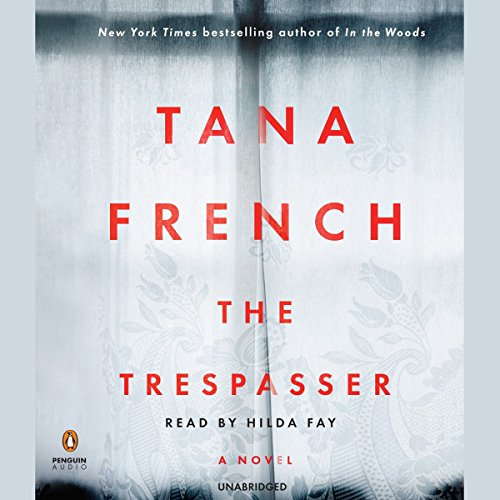
The Trespasser by Tana French (audio)

The Trespasser is the sixth book in Tana French’s ‘Dublin Murder Squad’ series, starring Antoinette Conway and her partner Steve Moran. Conway is chafing at her mistreatment by the rest of the murder squad, the good old boys’ club that hates her (she interprets) for being a woman, for having brown skin, for not playing their games. Moran’s all right, a good partner, and more or less loyal – she brought him into the squad, after all – but she has trouble trusting him entirely. It’s just a part of her personality, and/or, a result of the continuing abuse and harassment she experiences.

They work the night shift, and keep getting assigned low-level domestics and bar fights. Until Aislinn Murray: a Dream Date Barbie-type in a magazine-perfect flat, with a shadowy past. The squad pushes Conway and Moran to settle this one quickly, by charging the obvious suspect: a new boyfriend who had a date with Aislinn the night she died. But the two young detectives have some more complicated theories in mind. The Trespasser is part “straight” murder mystery, as they race to solve Aislinn’s murder, but it’s also part murder-squad intrigue, and a hefty part psychological drama: Conway has some formidable strengths, but it seems one of her greatest weaknesses is a certain suspicion, not to say paranoia, that makes it hard for her to trust Moran or anyone. In Tana French’s signature style, much of the turmoil of the story takes place not in exterior action but inside Conway’s head, as she argues with herself about what she can believe in.

In the middle, this one got a bit slow for me, and like The Witch Elm could have used some acceleration; but by the end, it zipped along as cracklingly as the best of French’s work. I still hold The Likeness to be her finest, but this one is solid.

And then, holy smokes, talk about amnesia. I just searched this blog for previous Tana French reviews and found that I’d read this one shortly before its 2016 publication. I can’t believe it – not for a moment did it feel familiar. I’m losing my mind. Previous review here, and I’m keeping the rating. This reading seems a bit different from that first experience in that I detected a slow-down in the middle; also, reading vs. listening makes a big difference with French’s atmospheric, heavily Irish stories. I love hearing them done aloud with the accents and the musical lilt and pacing, and wouldn’t want to consider reading them if I had the audio version available!

I can’t believe I forgot this book.


Rating: 8 schemes.

reread: The Stand by Stephen King

My copy of The Stand runs 1,153 pages, and I have a lot to stay. Sorry for the long review.
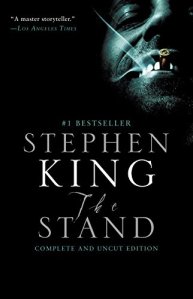

I loved this book before, and all over again, although not without qualifications. It took me nearly two weeks to read these ~1,200 pages, but only because I was reading other books at the same time (and teaching three classes) – it was really a handful of nights reading 300+ pages at a go. I loved this book all over again.

The very obvious impetus was the current pandemic, and my curiosity about how well The Stand tells a story that we are now (in some ways) living. The answer is, pretty well, actually. In the real world we don’t have a supernatural evil force in the form of a shapeshifting man with a cadre of more and less intelligent evil-minded followers; but there is plenty of metaphorical material there for those so inclined. I’ll leave that work to each of you. The superflu aka Captain Trip’s infection itself is different from Covid most importantly in the speed and rate of transmission, the death rate, and the speed with which it does its deadly work. It is infectious massively more of the time, and nearly always deadly. Covid is wildly infectious and pretty deadly by real-world standards; Captain Trip’s takes this to a logical extreme, which is often what fiction does, but the parallel is striking and instructive. That it is also wildly fast-acting is an interesting point. In some ways, the slowness with which Covid makes itself known (meaning, we can be infected for days or weeks before we get sick – and we can be infected and not get sick, therefore acting as invisible vectors)… has helped its spread, because we humans have a hard time taking seriously something that we can’t immediately see happening. Captain Trip’s, on the other hand, looks more like this: guy coughs near you; 20 minutes later, you are coughing. You might both be dead in a day or two. This is much easier for people to grasp as a concept; they feel fear and wish to take precautions much more, and much sooner, than we have with Covid. The flip side is that it’s much harder to fight against (especially because if you cough, you die). At least to this lay reader, this difference between reality and fiction feels like a simple difference between two types of virus. To my (again, layperson’s) knowledge, a virus could act as quickly at this one does; we just didn’t happen to get one of those. There would be pros and cons.

Captain Trip’s was also manufactured in a lab as a form of biological warfare which then accidentally escaped. This is not the case with Covid.

Because of the massive death rate of Captain Trip’s, the post-pandemic world looks very different than the one we will be living in the real world. Roughly, let’s flip the numbers of living and dead: the United States in The Stand is populated by some tens of thousands of people. That means their challenges in rebuilding, and in thinking about designing a new world, are very different from the ones we’ll face. Well, I’m trying to write a book review and not entirely a social commentary; but let me say briefly, I think the Covid crisis is highlighting the inequities and injustices we’ve always lived under, and we have a rather special opportunity to do something to fix our systems, with this new (to many of us) vision we’ve been granted. The survivors in this novel, on the other hand, have been left with the “toys” (Glen Bateman’s term) of a previous world, but limited knowledge of how to use them, and the power (etc.) has been turned off. Ideally, they’ll choose what to pick back up (book learnin’, heat in the winter, animal husbandry) and what to leave lying (nuclear weapons). But Glen Bateman is not terribly optimistic. (I must confess, neither am I.)

On to the book review proper. This remains a thoroughly compelling, expertly paced, engrossing story. Characters are delightfully wrought, various and complicated. The sympathy drawn out of us for the Harold Lauders of the world is disturbing as hell; he’s a villain but he’s very human. (The Walkin’ Dude is just evil, and not human.) While there are “types” in Glen Bateman, Larry Underwood, and Stu Redman, they’re convincing human beings at the same time that they’re types. Let’s face it, there are types in the real world, too; that’s where they come from. The momentum with which this plot moves could perhaps not be better executed; Stephen King is a master, and as I said above, I can easily take in 300+ pages in a single sitting (and stay up until 3am, I’m sorry to say), because it’s just all so juicy and absorbing.

That said, I did have a few concerns on this reread that I didn’t have just three years ago. Partly I suspect this is because in reading a print copy, I was able to pay closer attention to certain details. The audio experience I had in 2017 was entertaining, and I certainly followed the story and many of its finer points, but I do feel like I can watch a story more closely when I read it. I can speed up and slow down at my own pace, reread a line if necessary. And I think seeing a word printed imprints it on my mind more thoroughly than a word heard. I don’t know if that’s because I have a certain kind of brain or if it’s relatively universal.

On the other hand, I also think I’ve become more attuned to certain issues and injustices in the world in the last few years. So, on this go-round I noticed a problem in particular with race and ethnicity. King’s characters are almost all white, which doesn’t seem statistically plausible in this country, although I’ll allow that in 1978 (when this novel was originally published) the country probably looked a lot whiter than it looks now – it probably was a little whiter, but it also would have looked a lot whiter, in terms of where society (and therefore Stephen King) directed its gaze. And the few characters of color? Well, we have the “magical Negro” trope, which Stephen King gravitates toward in many of his works. (There’s a decent write-up of the concept in King’s work available here thanks to the Internet Archive’s Wayback Machine.) “Although from a certain perspective the character may seem to be showing blacks in a positive light, the character is still ultimately subordinate to whites. He or she is also regarded as an exception” (source). Mother Abigail is delightful, and she does get her own backstory, but her function in terms of plot seems to fit squarely into “magical Negro” territory. It could be said she also serves as a token. Headline: Black woman character as hero! There are very few other non-white characters, and they’re all problematic: the abominable Rat Man, the heroin addict in the “second epidemic” section, the “black junta” early in the pandemic (they wear loincloths. This is disgusting, SK). But the ending really got me, and take note, writers of all stripes: the end of your book is the taste that is left in your reader’s mouth. At the end of The Stand we get the evil force sometimes known as Randall Flagg reawakening in an unknown place where he is surrounded by brown-skinned men with spears who don’t speak English but worship him. Not cool.

King’s women are sort of up-and-down with me; I rather love Frannie Goldsmith, the pregnant college student who is part scatter-brained and part moral compass, but I’m also getting weary of the pert young thing who lusts after the middle-aged man. And Tom Cullen, the mentally challenged man with occasional rare wisdom who is able to tune into a higher frequency than his peers-of-normal-intelligence – well, he feels a little like the mentally challenged version of the “magical Negro.”

These concerns dismayed me on my second reading, and while I want to be clear that I really enjoyed rereading this book and still find it to be a masterpiece, it is a flawed masterpiece. And I wonder what King would see fit to correct, if he were to edit this novel for a reprint in 2020. He’s still problematic now, as we know, but I think we should ask of our heroes (literary and otherwise) not that they be perfect, but that they be always learning, progressing, and always willing to learn. I’m certainly still learning: for example, it took a second reading for me to track some of the concerning elements of this book.

I still recommend The Stand. In some aspects it nears perfection. In others, cause for concern and fodder for discussion.

I am letting my original rating stand (ha), because I have new observations in both the positive and the negative columns.


Rating: 8 chocolate Payday bars.

National Theatre Live at Home presents Treasure Island (2015), and the other stuff I’m watching online

This week’s edition of NT Live at Home is another repeat for me, but one I was glad to be able to revisit. Treasure Island can be viewed here until Thursday, when we’ll get access to Twelfth Night. I’m looking forward to it!

This was the first NT Live show I ever saw, with my father, in Bellingham, WA at their outstanding Pickford Theatre. It’s as delightful as I remember. The talented Patsy Ferran plays Jim, who’s a girl in this version – I love a little gender-twist to a classic, and the empowerment that comes with it in a case like this. While it’s not such a big deal as to steal the show, she gets in a few lines about how girls can have adventures too. (Likewise, a few female crew members and pirates draw the odd remark – acknowledged, but not earth-shaking.) Ferran’s Jim is expressive and fun. Arthur Darvill’s Long John Silver is perfect: charming, and terrifying. I love the scene where his one-leggedness is revealed. And I like how they managed the one-leggedness onstage. I see in my original review that I was bothered by certain aspects of the adaptation from Robert Louis Stevenson’s novel; I am unbothered on this go-round, by more distance from reading the novel, for one thing, but also by appreciation for the theatre. Still impressed by the modular set! This is a great show.

Otherwise, this weekend I’ve been catching up on some of NPR’s excellent Tiny Desk Concerts: Bob Weir and Wolf Bros., Chika, Megan Thee Stallion, Rising Appalachia, Los Lobos, Sheryl Crow, Café Tacvba… and the odd Tiny Desk (Home) Concert, like one from Tank (from Tank and the Bangas). There are so many great ones to dig into.

I am also reading my way right through nearly 1,200 pages of The Stand and grading hundreds of pages of student essays.

Put NT Live on your schedule, if you haven’t already!

National Theatre Live at Home presents Jane Eyre (2015), and other online events

Week two of NT Live at Home! This was a repeat viewing for me – I saw Jane Eyre when it was a new production, and loved it. I was perfectly happy and grateful to see it again. And again, to remind you: this production is viewable for free but for a limited time, until the next show goes up on Thursday, so do go see it here asap. This week’s release will be Treasure Island, another outstanding production. Put it on your calendar!

So, Jane Eyre as repeat: still outstanding. I think I loved it even more this time around, although I see I originally rated it a 10, so I can’t do better than that! I am impressed all over again with the set – so simple, and yet used to convey so much movement and so many different sets; the movement of people, including the lovely, clever form of travel in a carriage left to the imagination but fully communicated by the actors; the use of actors as set (as a doorknob, for example) and (I still love this) the actor who plays a dog. And the bird. Each actor, excepting Jane herself, plays multiple roles, with few but meaningful costume changes, and yet they’re not a bit hard to keep straight. Minimalism is the thing all around: set, costuming, cast (in numbers only) are spare. But the acting is superb.

I had forgotten the musical numbers entirely! And while they contribute something (and are stunningly performed), they are not the most important element. What I remembered best about this play – minimalism and extraordinarily great acting – are still the best parts. I didn’t remember it being so passionate – I don’t remember Jane being so passionate, even when she was a child. As my mother would say, this character has an overdeveloped sense of justice. (I won’t say whom my mother has said that about!) That’s interesting, because in my interview with author Erin Blakemore, I recall she and I agreeing that Wuthering Heights is the novel of passion where Jane Eyre is the novel of reason – but this is surely a story of passion! at least in the stage version. Another new observation: on this go-round I badly want to reread the novel, which I haven’t read since high school. Maybe I can straighten all that out.

I was really stunned and deeply impressed with this re-viewing. Don’t miss it. My previous rating, 10 fires burning brightly, stands.

In other news, and continuing my feeling of overwhelm at all the lovely art & culture available online these days, I’ve seen some additional great stuff the last few days, including a Drive-By Truckers concert (from Pickathon 2017), a Jason Isbell & Amanda Shires jam session and fireside chat, and an author reading by Paul Lisicky and Carter Sickels at the Blue Stoop in Philly. (This was an event I’d originally planned to see in person – I had a dogsitter lined up and everything. But instead I got to attend with a whiskey in hand and dog in lap.)

This was the third time I’ve gotten to hear Paul’s voice in recent months. I interviewed him about his recent Later (that interview will be here on Friday), and I attended (online) another recent reading. He’s made me cry all three times; I don’t know what to tell you about that, but it’s a moving book and I’m a fan. Actually, Carter’s reading made me cry as well; they were both lovely, beautiful readings as well as beautiful books. (I haven’t read Carter’s, but I’ve since preordered it through Taylor Books.) There was some question of how new releases are reading, now, in the pandemic – because the books that are being released now of course date from before COVID ruled our lives. And while some have not profited by the change, sounding frivolous or tone-deaf in the new landscape, both of these books have aged well, if you will. Both are about sickness, which of course is creepy in its own way, but both have intelligent things to say about contagion, isolation, and how illness and death are in some ways confirmations of life.

having a whiskey with Paul Lisicky

Just last night I reveled in this Tank and the Bangas concert. There are concerts and plays coming out fast and thick – and I’m also reading three books at once and teaching a couple of college courses! Whatever else may be true in social isolation, bored I am not. I’ll say it again: the pandemic is a terrible thing. But there are some bright points of light in this darkness: art.

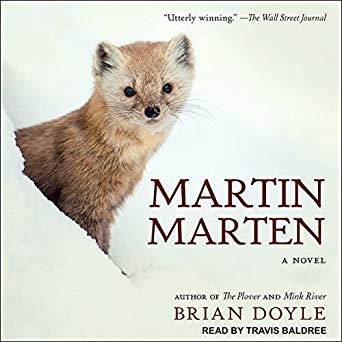
reread: Martin Marten by Brian Doyle (audio)

By coincidence, this book review was next in line when today’s date came up. But it feels perfectly appropriate for this gift-giving holiday, because Brian Doyle is a gift, and I think this novel is my favorite of his.

I have returned to my very first Brian Doyle experience with Martin Marten (originally reviewed here), because I miss him and love his work. Having enjoyed a few other audiobooks of his, I thought I’d try Travis Baldree’s narration.

It’s very good; I enjoyed the different voices for each character, from Maria to Dave to each of Dave’s parents, to Moon and Emma Jackson and Miss Moss and Mr. Douglas the trapper. I thought he preserved the sense of wonder and boundlessness that characterizes Doyle’s work. I found myself not thinking of the narration much, actually, and just living in the world of Martin Marten, and I think the disappearance of an art form’s container is often the highest compliment.

And the book is everything I remembered. As is said early in The Princess Bride, this book has everything it. “Fencing, fighting, torture, revenge, giants, monsters, chases, escapes, true love, miracles…” Well, there’s no fencing here, but there is death and birth and love and fighting and beginnings and endings and the easy connection of the two, and an un-wedding, and blizzards and springtimes and basketball and running and maps and trees and all the animals and plants and beings… Brian Doyle inspires lists like these; he writes in lists like these. He is all-encompassing, in the best and least pretentious way. For example, here is a paragraph that caught my eye this time around.

And deep mysteries too, things that no one could ever explain and in most cases no one ever knew or apprehended or discovered–a new species of snow flea mutating in a dark crevasse on Joel Palmer’s glacier; a blue bear born to two black ones but alive only for a day; a place where trees and bushes and ferns decided to intertwine and make a small green cottage complete with walls and a roof and a door; a cave with the bones of a creature eight feet tall inside; a pencil lost by Joel Palmer at nine thousand feet of elevation on the south side of the mountain, long ago encased in ice and now some twenty feet beneath the surface, waiting to be found in the year 2109 by a young woman named Yvon, who would be amazed that the pencil never wore out no matter how much she used it, as if it had patiently stored up words for two centuries; and much else, more than we could account even if this book never ended and its pages and pulses went on forever, and it was the longest book in the history of the world. Even then, it couldn’t catch more than scraps and shards of the uncountable stories on the mountain, of bird and beast, tree and thicket, fish and flea, biome and zygote. And this is not even to consider the ancient slow stories of the rocks and their long argument with the lava inside the mountain and the seething and roiling miles beneath the mountain, all the way to the innermost core of the sphere, which might be a story of metallic heat so intense that to perceive it would be your final act in this form; another mystery.

A dear friend of mine, nearing the end of her MFA study, read this book on my recommendation and sent me a message that said simply, “my prose is lifeless.” Well, it’s not, but I know what she meant: Doyle’s just jangles with life. I know he is not for everyone. The above paragraph includes a single sentence fragment that is 198 words long. He gushes. But for those of us it works for, I think it works very well.

I wish I could go to live in one of Brian Doyle’s fictional towns. Although it does snow a lot there.

If you love the natural world and are charmed by the idea of not privileging any one species (ahem, humans) over all the rest; if you are excited by the many possibilities for joy in the world, big and small; if you love life, words, all kinds of critters, and even humans; if knowledge for its own sake thrills you; if you are prone to being pleased by lists and wonder–do give the novels of Brian Doyle a try. He has made this world a far better place.


Rating: there is no reason to amend my original 10 tomatoes.

reread: Mink River by Brian Doyle (audio)

My father was right to recommend this reread (re-listen) after finishing The Plover. I didn’t even necessarily remember Declan, hero of the latter novel, from Mink River. And while he was definitely present here, and a colorful character, and recognizable from his later role, I was struck by the knowledge that there were many such colorful characters, whose lives might have been pursued in a sequel. And I was struck with grief all over again that we have lost the brilliant, generous, loving, exuberant voice of Brian Doyle too soon from this world. I wanted him to write so many more books.

He was still living when I read (listened to) this book the first time. This time, I felt saddened at many turns, ironically, in appreciating the delightful high spirits and joy and wisdom in his every line. Gosh, but I’m devastated at this loss, all over again and over and over.

But the book itself: still a wonder and a joy to experience. I fell in again with the inhabitants of Neawanaka, particularly the families of Worried Man and Maplehead and Cedar, No Horses and Owen and Daniel; Declan and Grace, of course; and others: Nicholas, Michael and Sarah, and the budding romance (as I see it) between Stella and the doctor. I ached for Moses the crow and the nun, his rescuer and dear friend. I remember listening to this novel for the first time, working out at the YMCA in Bellingham, Washington. It’s funny how memory can transport us into the past. People talk about smell being such a powerful mnemonic, but for me it’s never been as strong as songs and stories, the listened-to. Hearing Worried Man and Cedar share a beer at lunch again took me back to the abductor and adductor machines and sweat, just like that.

As for writing about the book itself, I think I did a pretty good job the first time around, and will let that stand. I will say, about the audio version, it was outstanding a second time; but I wish I had the words in front of me to consult and quote from. So I’ll be finding myself a print copy as well. Consider that the highest of praise.

We miss you, Brian.


Rating: still those 8 bottles.