Ring Shout by P. Djèlí Clark

Ring Shout is a most interesting, slim, swashbuckling adventure story about hunting and fighting the monsters of the Ku Klux Klan. Here, those monsters are literal: ‘regular’ (human) Klan members are called simply Klans by our narrator Maryse, while those who have ‘turned’ are Ku Kluxes, horrifying beasts who love dog meat and wear human skins but are visible to those – like Maryse and her friends – with ‘the sight.’ What we learn alongside Maryse in the course of this story is that Ku Kluxes are not the only, nor even the worst, monsters in this world.

Ring Shout is set in 1922 and begins on the Fourth of July in Macon, Georgia, where Maryse, Sadie and Chef have set up a trap for the demonstrating Klan: a stinking dog carcass laced with explosives. We begin mid-scene and then slowly get to know our heroines. Sadie is an ace with her Winnie (Winchester 1895), and Chef carries a German trench knife, taken off the enemy when she fought in World War I; but she’s earned her nickname through her expertise with bombs. Maryse Boudreaux is from just outside Memphis, where she experienced a trauma as a young girl that has set her on the path she walks now: she hunts monsters. Maryse, Sadie and Chef are backed up by other talented and badass women at a cabin in the woods outside Macon: Nana Jean is an old Gullah woman with powers of prophecy and root magic; Molly is a Choctaw scientist experimenting on the body parts of Ku Kluxes that the hunters bring her; the German widow Emma Krauss is a folklorist and ardent socialist. It is a motley and formidable crew, backed up by a few male allies who mostly serve as helpers and sexual partners but lack the sight. (This novel attacks racism head-on, while its feminism is inarguable but resides in the background. I love it.)

My editor & buddy Dave didn’t love this book, reporting, “It felt like much more of the action-packed, wise-cracking, zombie-slaying kind of horror story than I’d hoped for. I like my menace to be a bit more subtle.” And I think his description is accurate, but it worked for me. Subtlety is not the language of Maryse or her friends; they are in-your-face angry, foul-mouthed, and unapologetic about their rage, passions, and needs.

Chapters are often preceded by ‘notations’ referring to the Shouts that give the book its title. (“A shout or ring shout is an ecstatic, transcendent religious ritual, first practiced by African slaves in the West Indies and the United States, in which worshipers move in a circle while shuffling and stomping their feet and clapping their hands,” says Wikipedia.) These notations are credited as transliterated by Emma Kraus – differently spelled but the same name as the character in the book. I was fascinated, when I looked up the author P. Djèlí Clark, to find that “Phenderson Djèlí Clark or P. Djèlí Clark is the nom de plume of American science fiction writer and historian Dexter Gabriel; he chose to publish his fiction and his nonfiction under separate names so that readers of one would not be disappointed or confused by the other.” (That’s Wiki again.) This leaves me moderately confident that Kraus and her notations are historical truths, but I can’t confirm that with anything I’ve found between the pages of this book.

Clark’s Acknowledgements paint an intriguing picture of his influences for this story, citing

The 1930s ex-slave narratives of the WPA. Gullah-Geechee culture. Folktales of haints and root magic. A few Beyoncé videos. Some Toni Morrison. Juke (Jook) joints. Childhood memories of reading Madeline L’Engle under the shade of a cypress. Juneteenth picnics. New Orleans Bounce. A little DJ Screw. H-town that raised me…

and more. (Yes, the Screw and H-Town shout-outs please me immensely.) I added one book and one album to my list, and went looking for a book I remember from childhood that plays a role in this story. In other words, Ring Shout ranges widely. It is indeed a rollicking mad adventure story, and in that sense easy to read – under 200 pages and action-packed. Entertaining and horrifying. It is a tale of the memory of slavery and of the Klan and violence. It is quietly feminist. (It is also being made into a television series.) I think I’ll be looking for more by this author.


Rating: 7 juleps.

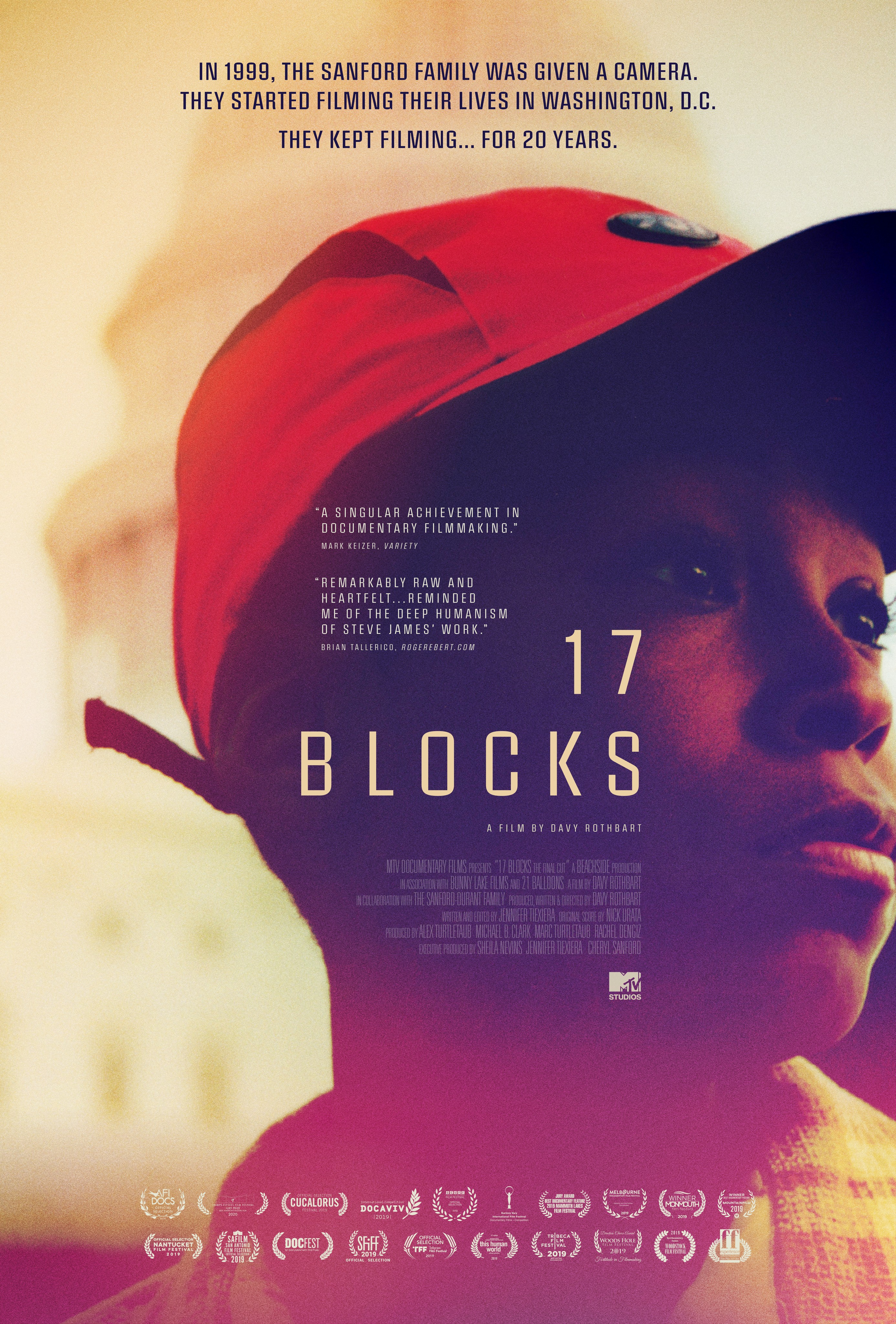
movie: 17 Blocks (2019)

A filmmaker meets two brothers – Emmanuel, 9, and Smurf, 15 – at a pickup basketball game in southeast Washington, D.C. They strike up a friendship. Film footage from the following twenty years, shot by both filmmaker and the family members themselves, eventually yields this documentary: 17 Blocks, in reference to the distance between the Sanford family home (at the film’s opening) and the nation’s capitol building. Count that as a not-completely-subtle cue to consider certain contrasts.

The Sanfords and Durants are poor and Black and plagued by social ills including addiction, gun violence, and incarceration. They live through terrible tragedy. Their lives are presented here seemingly unmediated: they speak directly to the camera; raw footage is edited together. (All narratives are mediated, of course. And it’s worth nodding to the feat of culling 1,000 hours of footage to create such an intelligent narrative in 90-something minutes.) There is plenty of opportunity to think through larger issues, beginning with the commentary implied by the title. What is most horrifying about this movie is the pain in the lives of the Sanfords; what is perhaps even more horrifying is that they are representative of so many lives, that their pain is so common.

There’s a quite good review over at Rogerebert.com (although it gets the Sanford kids’ birth order wrong), to which I’ll refer you for a deeper look; reviewer Matt Zoller Seitz makes some good points that I agree with about why the film is excellent, as well as a few mild criticisms. I appreciate his point that the film “probably doesn’t push hard enough against reactionary, Puritan, possibly racist readings of the Sanford family’s misery as it should have.” He also warns viewers of how hard 17 Blocks is to watch, and he’s right: it’s awful, discomfiting stuff, and the discomfort one feels watching it is only appropriate and reasonable. There’s another layer for me, though, too. The first half or so felt awfully close to ‘poverty porn’ (a term I may have first learned when I first started to get to know Appalachia). The problem is that in order to recognize problems in communities, in systems, we have to look at people’s suffering. But there’s something inherently problematic about the looking at – something voyeuristic – that’s discomfiting in a different way. I haven’t quite sorted my feelings about this. Possibly, if we are to make a movie of the Sanfords’ lives and look at it like this, we have a responsibility to work harder to do the work Seitz mentions, the pushing back, “in order to guard it more righteously against bad faith interpretations.” I’m not sure. This is not properly a criticism I’m offering, but a question. Also, it is very relevant that Sanford matriarch Cheryl was an active part of the production and promotion of the movie; the family is on board and involved, which we should keep in mind in considering the complicated situation with this (white) filmmaker and any potential question of exploitation.

I don’t know. But I do know that the film is artful, wrenching, visually intriguing and deeply affecting, and I’ll be thinking about it for some time. If you check it out, please let me know what you think.


Rating: 7 t-shirts.

Bluebird, Bluebird by Attica Locke (audio)

I reviewed Heaven, My Home, which comes second in this series. My father reviewed the highly-regarded first novel Bluebird, Bluebird, and now I’m finally catching up.

Pops did a good job with the high points of this one, and I remember Heaven very fondly (I rated it 8 fingers). There’s no question in my mind that Locke is at her best in handling the complex, nuanced, contradictory nature of Texas history and relationships (particularly in regards to race, but of course there’s more there too). The social justice questions, with no easy resolutions, are Locke’s greatest strength. I found the murder mystery part of this novel less compelling. And I should acknowledge that this audiobook took me way too long to finish, so maybe I didn’t give it the fairest shot in terms of my slow reading (listening) pace. It did get a little draggy for me in the middle; I think the contemplative interiority of Ranger Mathews’ thought processes and turmoil was a mite slow for my personal tastes. Which is related to my bigger concern with the book: I had trouble believing in Mathews (as a fictional character who ‘rings true’), and I had trouble caring deeply about his problems, because he exasperated me.

I had trouble with some of his unprofessional behaviors. Not morally, but in terms of believability: does he really get away with it? The drinking on the job, and the blurred boundaries with the murder victim’s widow, and with Geneva, a powerful matriarch in the small town where he’s investigating a couple of murders. It often felt to me like he was amateur at his job – I expected him to have it together more, or at least be better about hiding his boozing. He sure does rush off half-cocked. And while the widow’s character also made me a little impatient, I bought that this is who she would be. Everyone else feels believable; it’s just Mathews. I’m familiar with the self-destructive, loner, problems-with-authority police detective in fiction – it’s a type, and one I rather specialize in. But this one feels like he’s not very high-functioning in his self-destruction, if that makes sense, and it just rang less true for me.

I do not require that I like a character in order to care what happens in a plot. But there has to be some stakes that I can engage in, and I struggled with that here. My problems with Mathews were distracting.

More compelling was the conflict Mathews feels about the law, nicely encapsulated in his two role models, twin uncles who respectively work(ed) as a lawyer and a Texas Ranger. He’s been drawn in both directions, and still feels the pull of the law, although most of all in the pressures applied by others.

It made him sad, the degree to which this kind of credit hogging mattered to Greg, that three years behind a desk had made him so desperate for the climb that a double homicide was seen as an opportunity first and a crime against nature second. But wasn’t Darren a little guilty of this, too?

…Maybe justice was messier than Darren realized when he’d first pinned a badge to his chest; it was no better or worse than a sieve, a cheap net, a catch-as-catch-can system that gave the illusion of righteousness when really the need for tidy resolution trumped sloppy uncertainty any day.

And,

He got it confused sometimes, on which side of the law he belonged, couldn’t always remember when it was safe for a black man to follow the rules.

Point very well taken. Although, Mathews can occasionally feel like a mouthpiece for these musings, rather than a fully human character.

I did really enjoy the local culture of Lark, Texas, the blues and the home cooking at Geneva’s. And the complex relationships, which Pops refers to in his review, were well drawn (and feel very real).

Narrator J. D. Jackson has a nice voice but sometimes plays this one with a hair more drama than I needed – again, a little distracting.

Some good stuff here, but a lot that bothered me, too. If I’d started here I wouldn’t have read Heaven, My Home, which I think is a superior book. It’ll be interesting to see what comes next for Ranger Darren Mathews.


Rating: 6 plates to go.

Copperhead by Alexi Zentner (audio)

I was quite entranced by Touch and so I jumped into Copperhead with nothing but the author to go on. It’s quite a different book, ambitious, and good, but flawed. This novel takes on the timely – not to say trendy – topic of race and racism in contemporary America. I don’t question Zentner’s earnest commitment to the topic, but it’s a tricky thing to execute seriously in fiction without getting a little overwrought.

Our protagonist is 17-year-old Jessup, a high school senior in Cortaca, New York (a thinly disguised Ithaca, with Cortaca University obviously Cornell). He’s a talented football player and excellent student, but still wrong-side-of-the-tracks because of his family’s hand-to-mouth existence, the trailer they live in, and the fact that his brother and step-father are serving prison sentences for the deaths of two Black college students in what was either self defense or a hate crime, depending on who’s telling the story. Jessup’s mother and sister still attend the Blessed Church of the White America. Jessup would tell you he’s not a racist; his girlfriend is Black. He resents that people judge him for his family history and their association with the white supremacist church.

This is all background information; the novel’s action takes place over four days, Friday night’s football game through Monday night’s protests, but it is action-packed. What might be called a series of unfortunate events explodes into increasing posturing, grandstanding, violence. Jessup is pressured to choose sides. Zentner’s greatest accomplishment is the empathy his reader feels for this kid. We don’t like to spend much of our compassion on white supremacists, but this novel ticks boxes for two intellectual puzzles I’ve long been interested in: 1, the concept that bigots are made or taught, not born, and there’s somebody there, at some early-enough point, that I do feel for. And 2, the question of when we begin to hold a person responsible for his own crimes – the abused child we feel for, but when he grows up to be an abuser we don’t; at what age or stage is the cut-off? I feel like Jessup’s character begs both these questions. He is in some ways a good kid. And while he’s far more fair-minded than some of his family and church, he’s also a white supremacist, by default rather than by hate. The puzzle of Jessup himself I think is well-expressed; we stay with his close third-person perspective throughout the novel, and I find it easy to like and sympathize with him, even though he’s problematic too. I find it realistic that (especially) a 17-year-old boy with such a troubled past would have the kinds of blind spots that Jessup has. That doesn’t mean I think it’s all okay, but I think it’s realistic.

The events that kick off (no pun intended) the weekend’s action are a bit contrived, in terms of narrative: a perfect-storm sequence. Sometimes life really does work in such strange ways, but it is also clearly a novelistic device to get the issues moving that Zentner needs to address. That’s more or less okay with me, but the mechanics of plot here are showing a bit more than some might like. Characters other than Jessup are less well developed than he is (also understandable; a lot has been put into this protagonist, and there’s less left over for everybody else). Things get a little ham-fisted with the stepfather, David John, who is just such a great guy aside from the white supremacist business… and this allows Jessup to wonder how it’s possible for a racist to be such a deeply decent dude? (The answer, staggeringly obvious to everyone but Jessup, is that he’s deeply decent to white people. But honestly, I do buy Jessup’s blindness on this account – again, as one of those believable blind spots. Seventeen years old!) Where the novel goes most wrong is in the final events and epilogue: wrapping up this complicated and fraught story is a challenge, and Zentner was maybe a little overcommitted to a redemption narrative. Only in the final pages (minutes, in my audiobook) does the novel, which excels in drawing out my sympathies, descend into morality tale. It gets a little graceless. Again, Zenter’s earnest good intentions are not in question, and it’s a pretty good morality tale, one that will yield good discussions in classrooms and book clubs. But as a novel, the last bit is a bit cringey.

There are some beautiful, moving, thoughtful moments, and absolutely memorable images, and I think Jessup’s character is all win. The complexities of family, legacy, and the taught-and-learned nature of hate are well illustrated. Copperhead took on an ambitious mission, and as a novel, doesn’t quite stand up to that tall order, but it gives us plenty to think about. I think its greatest accomplishment was in how much I empathized with Jessup, and how uncomfortable I felt with my own empathy – not always a pleasurable experience, but an instructive one. I was certainly engaged throughout, and I do recommend this read, with a few caveats. I respect Zentner’s work here, and I’ll look for more from him.


Rating: 7 text messages.

Stamped: Racism, Antiracism, and You by Ibram X. Kendi and Jason Reynolds

Liz recommended this book to me (in the audio format) as an excellent, succinct, accessible history of racism (including its purposeful invention) and antiracism, and she was (as usual) right. This is an outstanding introduction to, or review of, the concepts of race and racism in this country, in the context of world history. It’s truly for everyone: those new to such a history will find it manageable, and those not new will learn something new or at least have that larger picture – race in America within world history – clarified in useful ways. The audiobook is just four hours long, and every minute of it is engrossing. I wholeheartedly second Liz’s recommendation.

Stamped: Racism, Antiracism, and You is a “remix” of Ibrim X. Kendi’s highly-regarded Stamped From the Beginning: The Definitive History of Racist Ideas in America. It’s approximately half the length (300 vs. 600 pages). I have not read the latter, fuller version, but my father should be finishing it anytime, and he’s appreciative; perhaps he’ll give us a review to partner with this one. Tables of contents show that the content of each books lines up neatly; they do appear to be two versions of the same material, and I think it’s a real service to give both versions to the world. For this remix, Kendi is joined by young adult novelist Jason Reynolds, who also narrates the audio version (excepting the introduction, delivered by Kendi). It’s my impression that Reynolds does the remixing of Kendi’s original work, bringing his facility with younger readers. The book is labeled for ages 12 and up, but to characterize this as a book for younger readers is too limiting; it’s great for adults, too.

The opening chapter begins,

This is not a history book. I repeat, this is not a history book. At least not like the ones you’re used to reading in school. The ones that feel more like a list of dates (there will be some), with an occasional war here and there, a declaration (definitely gotta mention that), a constitution (that too), a court case or two, and, of course, the paragraph that’s read during Black History Month (Harriet! Rosa! Martin!). This isn’t that. This isn’t a history book. Or, at least, it’s not that kind of history book. Instead, what this is, is a book that contains history. A history directly connected to our lives as we live them right this minute. This is a present book.

And I want to start there because I’m interested in that characterization of what makes a history book. Between you and me, I would like to assert that this is a history book, but I get what the authors are up to here: for those younger readers (or for all of us!), they’re trying to distance themselves from the dry and boring history book, the traditional history book, that separates “history” from what matters in the here-and-now. I think this is a history book, in all the best ways – one for history books to emulate.

Having gotten that out of the way: five sections organize the broad scope of this history. They are organized by years. “Section 1: 1415-1728” opens with “The Story of the World’s First Racist.” (In Stamped From the Beginning [SFtB], Part I is titled “Cotton Mather.” He is not the world’s first racist – that title goes to Gomes Eanes de Zurara.) “Section 2: 1743-1826” corresponds to SFtB‘s “Thomas Jefferson.” “Section 3: 1826-1879” corresponds to William Lloyd Garrison; “Section 4: 1868-1963” is W.E.B. Du Bois, and “Section 5: 1963-Today” is Angela Davis. Those section headings from SFtB appeal to me. Obviously the date ranges handle more than the lives of each individual, but I appreciate the choice of an individual for each section of history, and of the progress of racism in America. Methodically, then, Kendi & Reynolds move through history from the 1400s, and Zurara’s invention of racism (in Europe), to the present day. They hit the highlights in terms of events, personalities, laws, cultural shifts, and theories of race and racism and antiracism, the intellectual arguments offered for why some people should be kept under the boots of other people. I love that they note the markers in media and art for racist thinking, too, commenting on the timing and context of Uncle Tom’s Cabin, To Kill a Mockingbird, Birth of a Nation, Tarzan, and Planet of the Apes. I’m a big fan of spotting the connections across (what we think of as) disparate threads of history and study: movies, literature, history. I think it deepens our understanding of each to see how they fit together.

I found Reynolds’s audio narration completely lovely, and would listen to anything else he reads.

I understand that SFtB is an excellent, deep, rich, dense study. I know I have a lot to learn from it, and I hope to get to it sooner than later. The work of a book like that is important. But I’m so grateful that Stamped exists, too. It’s a truly masterful achievement to make such a swath of history so accessible in just 300 pages, and there are some pretty involved theories and concepts expressed here in a package that I think anyone can grasp (again, it’s labeled for ages 12 and up). I think this book is likely to reach even more people than SFtB. As Liz suggested, I can realistically recommend this one to my first-year college students. This is a book for anyone and everyone. It proves, through history and observations and stories, that we are not living in a post-racial world; racism (and a caste system based upon race) is alive and well in this country and culture, even if it’s learned to disguise itself – that just makes it more important that we learn how to recognize it in its trickier forms. Stamped is the book to help us begin that work. Recommended for everyone.


Rating: 9 privileges.

Buried in the Bitter Waters: The Hidden History of Racial Cleansing in America by Elliot Jaspin

I came to this book from the podcast series “Seeing White,” where Elliot Jaspin spoke briefly about one of the cases handled in his book. I made a note of the title and got it through the college where I teach, via interlibrary loan. I love interlibrary loan. The subject of Buried in the Bitter Water is the instances in American history where a community has run its Black residents out of town. This is a very specific kind of occurrence, as Jaspin lays out in his fascinating introduction. I think it’s worth telling that story, of how this project began.

In the late 1990s, Jaspin visits a small town in northwest Arkansas. He observes that, despite a history of Black residents, he doesn’t see any in the present time. He asks and is told that “the Klan keeps them out.” Using census data over the last century, he goes looking for counties where the Black population shows a sudden drop – the standard he uses is a drop of fifty percent in a decade. He begins with Southern states but expands his search to include “thirty-one states in the South, Midwest, and Mid-Atlantic where I thought I would be most likely to find racial cleansings.” (I wonder what he missed in the remaining nineteen states!) Census data, at least at the time of his research, was only available by county, so that’s the unit of measurement he uses, while speculating that he’s probably missing instances involving smaller communities – towns, villages. Having identified counties with suspicious numbers, he cross-checks contemporary newspaper records, and indeed he finds stories like those in Berryville, Arkansas (where he’s visiting at the start of this story) and Corbin, Kentucky (which was the story featured on “Seeing White”).

A word on language: Jaspin writes that the term ‘ethnic cleansings’ was coined in the early 1990s by Croatians fleeing Serb-dominated Yugoslavia. He acknowledges that it is problematic in its assumption that a place is ‘cleaner’ without an out-of-favor ethnic group, but concludes that it’s okay because it was coined by its victims. I’m not terribly comfortable with that, myself, but I appreciate that he at least considers the question. I feel like it at least needs “scare quotes” (if not a better term, please?), and I’ll use them in this review, as in: Elliot Jaspin has done some important original research on “racial cleansings” in American history.

And he has. For the book, he identifies a dozen of the “very worst” cases, and tells those stories in twelve chapters. In many cases he’s interviewed local residents, descendants of those residents who were run out of town, or even survivors. It’s part of the book’s thesis that these histories have never before been told, and based on Jaspin’s research I believe that to be true. So his work is important – this is primary research beginning to tell a story of American history that we absolutely need to get on the record. The case studies are predictably horrifying.

But they’re hard to read for another reason, too. Back to those problems of language. Buried in the Bitter Waters was published in 2007, but it feels older than that because Jaspin frequently makes errors in sensitivity. This is important research, but it’s important how we write it up, too. For one thing, he uses ‘black’ as a noun throughout, for people: the blacks lived here, the blacks did this and that. I’m pretty sure it’s been a part of social justice training since before 2007 that we should refer to people as people: Black employees of the mine, Black students in the school, Black people, as opposed to simply ‘blacks,’ which reduces them to perceived race and nothing else. This usage is all over every page of the book, and it grated at me, and affected my ability to concentrate on the stories Jaspin was telling. Now, 2007 was a long time ago in wokeness terms, and I’m trying to be patient with Jaspin, but I found this hard to take. He also makes a common error in naming the race of Black people, while other characters in the history might just be men, women, people. (We are left to assume that they’re white. It’s not always clear.)

It gets worse: a county is noted to have “lynched their own black seven years earlier,” a line which makes me shudder. And “if young Charles Stinnett had not decided to rob the spinster Emma Lovett, there might still be a black community in Boone County, Arkansas.” I am positive we knew what victim blaming looked like in 2007, and this is an excellent example of it. What made the white residents of Boone County run their Black neighbors out of town was not the alleged crime of an individual Black man. It was the white residents’ racism. Later, the six-day trial, conviction, and sentencing to death of Charles Stinnett is referred to (by Jaspin) as “speedy justice.” In reference to events in the early 2000s he writes that “a century earlier, segregation, disenfranchisement, and racial cleansings had established a white man’s country.” I would like to point out that this country was established as a white man’s country well before the early 1900s – in fact, before it was a country, the earliest white settlers were working to establish it as such, more than four centuries ago.

I’m not trying to pick on Jaspin, who I think is well-meaning, and earnest in his search for truth and justice. But I think it’s an important feature of this book that he doesn’t address all the baggage he brings up, including his own. We’re all on our own paths of discovery, hopefully all moving toward ever better awareness of social justice, and that process is never finished. I don’t know it all or get it all right, certainly. We have to keep learning; thinking we’re done with it is the easiest way to stop learning. I’m not here to crucify Jaspin for what he got wrong in 2007, but it’s part of my review of this book that he got a lot wrong, in how he writes about Black people and how he assesses the results of his research. His work is a contribution to research in this field, and future historians will consult it and add to it – and I hope rewrite it in better and clearer terms, soon. It’s only been thirteen years, but it’s time.

Jaspin details his twelve chosen case studies of ‘racial cleansings’ in eight states. They are hard to read, both for the right reasons (because this history is shameful and disturbing) and because I often cringed at Jaspin’s terms. He makes some astute points about the factors at play here, obviously including racism but also including, for example, economic factors, and capitalism’s successful pitting of poor white workers against poor Black ones. He finishes with a lengthy conclusion that felt a bit out of place for me: he tells the story of how this material was intended for the newspaper chain he worked for, but it got edited to death and/or left unused, because the chain included the Atlanta paper that badly mishandled its coverage of Klan activity in north Georgia in the 1980s, which is part of the continuing story of the ‘racial cleansing’ that took place there. (Whew.) This detailed story of a failure of journalistic integrity struck me as a little off-topic, and a little personal for the author, in ways that didn’t necessarily serve the broader goals of the book. (The related point is that we’re still not doing the self-examination of history that we need to do, which is valid. But it gets a bit wide of the mark, in my reading.)

Final assessment? This was a complicated one for me. I appreciate Jaspin’s introduction, in which he details his discovery of this phenomenon, and his research methods. (Note the limited capabilities of internet research in the late 1990s and early 2000s.) I think his primary research into under- or unexamined ‘racial cleansings’ is deeply important to the field of American history. The scholarship in this book is significant, and will bear further study. I’m glad for Jaspin’s contributions. But I’m also bothered by the shortcomings in his language, and his occasional failure to question the given narrative. I think the next scholar to take up this work can and should do better.


Rating: 5 times words matter.

guest review: Bluebird, Bluebird by Attica Locke, from Pops

I reviewed the second book in the Ranger Darren Mathews series, Heaven, My Home. Pops is taking us back to the highly-decorated first in that series, Bluebird, Bluebird. He tells me it ends in a classic cliff-hanger.

This is a great, compelling mystery; by a Black author; about a Black Texas Ranger; about mostly Black characters; set in familiar East Texas locations; interwoven with Blues music (songs on Geneva’s jukebox are our playlist, including “Bluebird” by John Lee Hooker, about a man seeking a lost love ‘down south’, alluding to our plot); and with an epigraph from a Lightin’ Hopkins song, “Tom Moore Blues.”

And besides all that, she discreetly includes insightful social commentary about Black roots in the South, White privilege and racism, and the fraught legacy of biracial offspring from conflicted Black-White intimacy. E.g Ranger Darren Mathews’ family is rooted generations-deep in East Texas soil, stolid landowners now become proud and successful patriarchs of a clan determined not to be moved:

It was an arrogance born of genuine fortitude and a streak of hardheadedness six generations deep, a Homeric shield against the petty jealousies and lethal injustices that so occupied white folks’ free time, their oppressive and intrusive gaze into every aspect of black life – from what you eat to who you marry to the clothes you wear to the music you play to the way you wear your hair to how you address them on the street. The Mathews family recognized it for what it was: a fevered obsession that didn’t really have anything to do with them, a preoccupation that weakened a man looking anywhere but at himself.

And: Darren contemplating how to explain to Randie, wife of murder victim Michael Wright, his desire to return home from Chicago.

[Randie:] ‘Michael always wanted to make excuses for these racists down here, had some kind of twisted nostalgia about growing up in the country that made him blind to all the rest of the bullshit down here.’ [Darren:] ‘It’s not making excuses. It’s knowing that I’m here, too. I’m Texas, too. They don’t get to decide what place this is. This is my home, too.’ …this thin slice of the state that had built both of them, Darren and Michael. The red dirt of East Texas ran in both their veins. Darren knew the power of home, knew what it meant to stand on the land where your forefathers had forged your future out of dirt, knew the power of what could be loved up by hand, how a harvest could change a fate. He knew what it felt like to stand on the back porch of his family homestead in Camilla and feel the breath of his ancestors in the trees, feel the power of gratitude in every stray breeze.

And: that troubled sexual intimacy, and even love, amidst entrenched racist culture.

Michael’s and Missy’s murders were race crimes, yes, but that was mainly because of the ways race defined so much about Lark, Texas, especially in terms of love, unexpected, and the family ties it created. [Darren] had forgotten that the most elemental instinct in human nature is not hate but love, the former inextricably linked to the latter. …[These white men’s] lives revolved around the black folks they claimed to hate but couldn’t leave alone.


Rating: 9 blues songs.

I’m not the least bit surprised that this sounds like an incisive novel, with complicated social issues in its heart. What I remember about book two is that the mystery plot is also worthwhile. I’d love to find time for more Attica Locke! Thanks, Pops.

podcast: the “Seeing White” series from Scene on Radio

“Seeing White” is a 2017 series on the podcast Scene on Radio, from the Center for Documentary Studies at Duke University (in a very podcast-rich part of the country, it seems to me). Host John Biewen (a white guy) is upset by racial injustice in the United States, and curious about the invisible forces that go beyond simple, mean, interpersonal racism and account for the systemic, institutional forms that do still more damage and are less easily identified. Noting that our discussions about race tend to manifest as discussions of people or communities of color, he wants to “turn the lens” back on whiteness. What the heck is that?

My father recommended this podcast series to me, pretty forcefully, and my first reaction was to say, 2017? His recommendation came in the height of this summer, the summer of George Floyd and Breonna Taylor and a new energy behind BLM protests, and it felt a little weird to look back three years for an angle on these events. Three years is kind of a short time, but also rather a long time, in the evolution of our (national-level) thinking on race. Well, I was wrong about the timeliness concern. While the most recent event markers have changed – Charlottesville being the landmark event when this podcast was released – the conversations we need have not. I’m adding my voice to my dad’s: this podcast presents ideas, facts, and history to help along that conversation, one that I found thought-provoking and useful, and that I absolutely still think is useful – nay, imperative – in 2020.

John Biewen and Chenjerai Kumanyika

Biewen examines whiteness via conversations with experts and scholars, including historians, researchers, and educators. On each episode (save one, I think), he then consults and reviews his new content with Dr. Chenjerai Kumanyika, professor of critical cultural media studies, cultural industries, “and things like that” at Clemson University and then Rutgers. Kumanyika (a Black man) serves as a sounding board and a gut-check for Biewen, there to offer both a personal and an expert perspective and make sure Biewen doesn’t head off in any funky directions; he’s the Black friend, which is a concept that should give us some pause. (I hope he got paid for his role here.) But the two are friends in the real world, and Kumanyika signs on for this project eyes-open. The two do share a joke about his role: “You’re not asking me to speak for all people of color, are you?” “Yes! of course!” “Well good. Because that’s what I do…”

Big, complicated topics here; writing this review/response is intimidating, but here’s my best effort.

I thank my parents and my upbringing for the fact that I’m not new to concerns about race and racism. But it’s clear to me, too, that nobody (and most particularly no white person) can sit back contented, thinking that she’s got it all worked out. To be a good anti-racist means being constantly ready to keep learning and finding out where I’ve been wrong. One of the greatest offerings of “Seeing White,” for me, was its help in wrestling with a certain concept. 1) I see and understand that race is a social construct in our society, rather than a biological fact; that makes sense to me. 2) And yet race is also a reality in our society and culture: it affects people’s experiences in education, law enforcement, finance, real estate, health care, and so much more; we have a (wildly imperfect) system of identifying people by race just by looking at them. So 3) How can race be both made up and a reality at the same time? …I don’t think I would have articulated this philosophical puzzle before listening to the podcast, but it’s definitely been a puzzle for me for some time. After listening, I feel like I have a better handle on it. Race is indeed both a reality within our culture, and something we made up. We’ve manifested it. Suzanne Plihcik of the Racial Equity Institute, episode 2:

We know, for example, since the human genome project, that we are 99.9% genetically the same. There is more genetic variation in a flock of penguins than there is in the human race. There is more genetic variation within groups that have come to be called races than there is across groups that have come to be called races.

However, after more than 400 years of entrenched racism, discrimination, and enforced segregation on this continent, we have built in differences that weren’t there. Health disparities are not a result of racial difference, but a result of different treatment over lifetimes and generations.

From episode 8, Dorothy Roberts, professor of law, Africana Studies and sociology at the University of Pennsylvania and leading scholar on racial science:

The sickle cell example is the resort of people who know that there’s a mountain of evidence showing that race is an invented category, and so they grasp at sickle cell all the time… Peoples who live in areas where there’s malaria have developed this mutation, or have a higher prevalence of this mutation, because it protects against malaria. But it’s not confined to Africa, it’s not present in all of Africa, and so it simply is not a ‘Black’ disease. It just says nothing about race whatsoever. It’s linked to groups that developed in areas where there’s a lot of malaria, that’s all.

This was a lightbulb moment for me: sickle cell has nothing to do with race! It’s about where the mosquitoes are!

So yes, 1) race is a social construct and simultaneously 2) race is a reality in our culture because 3) we have made it one, over centuries of social construction. Which means that 4) we have to consciously, purposefully, effortfully, and over years, decades, possibly more centuries, deconstruct it. Race and racism will not go away because we wish them to, and they certainly won’t go away because we turn our gazes in another direction and claim to not see color. We made this, and it’s now on us to unmake it, at personal and collective cost.

There is much to be gained and learned here, no matter how openminded you think you are.

I think perhaps the best single episode to catch might be the penultimate, episode 13: “White Affirmative Action.” This episode spells out in hard facts and figures and a thorough study of history how white people have gotten ahead, methodically, throughout American history, how we’ve been given advantages at the expense of other groups. It offers some good answers to those who would say “How could I owe reparations? I was born in 19–. My people didn’t even own slaves. My people only came over in (whatever year).” Etc. Answer: if you’ve been white in this country for more than a few minutes, you’ve benefitted from institutional racism, period. Even if you’re well meaning. Even if you didn’t want to. Even if you’re not, personally, racist. Even if you grew up poor! (I’ve linked to it before, but still good: “Explaining White Privilege to a Broke White Person.”) To become better versed in explaining this concept, I highly recommend episode 13. (For the record, I am absolutely in favor of paying reparations to Black Americans.)

I’m barely scratching the surface of what’s available in these 14 podcast episodes, of course. I am not particularly qualified to teach this content to you, but what I can do is offer my review: this is deep and rich and complicated content, excellently explained and articulated and discussed, in fairly manageable chunks. Spend some time with it. Improve yourself and try and improve the world.

Good tip, Pops. Thanks.


Rating: 9 questions to sit with.

Saint Monkey by Jacinda Townsend

Disclosure: Jacinda is a friend and I love her.


Saint Monkey is a rich novel full of detail, color, sound, and texture. In the 1950s, two girls, Audrey and Caroline, grow up as neighbors and (mostly) friends on the “colored” side of the small community of Mt. Sterling, Kentucky. For all that happens to both of them as they grow into womanhood, it is the rocky relationship between them that’s the heart of this book. Audrey is bookish and quiet (Caroline, in her head, calls her Poindexter), while Caroline is a bit more out in the world; the latter dreams of making it to Hollywood, but it is passive Audrey who gets out. Each girl loses a parent in childhood, and halfway loses the other as well: Audrey’s father is killed fighting in Korea, her mother then descending into the bottle; Caroline’s father brutally murders her mother and is then incarcerated (although not for long). These tragedies do not serve to bring them together. Often halfheartedly, but with enormous talent, Audrey plays the piano, and it is this that gets her spotted by a talent scout and packed onto a train for New York City. There she plays in the house band at the Apollo and gets romanced by a man the reader recognizes at once is not worth it. Meanwhile, back home, Caroline samples the young men in town and chooses not to respond to Audrey’s letters.

The novel alternates between the first-person perspectives of the two girls, so that we get Audrey’s close observations of her beloved friend, her earnest hopes and fears, her tentativeness, then Caroline’s brash, prickly, brave face and the vulnerability underneath. Their voices are distinct, and Caroline’s humor and vernacular is one of the highlights of the book, for me. From both angles, this is a world fine-grained and full of sensory details – rich, lush, dense with them – such that I had to slow down to take it all in. Saint Monkey‘s pace is unhurried; we’re here to look around and think and feel, not rush through lives that are hard enough in the first place. There is plenty of hardship: poverty, various forms of abuse, and the persistent low hum of abuse that is being both Black and female.

Audrey loves her grandfather. She loves living in Harlem and playing at the Apollo, loves the scene and even the music, for all that she approached it lackadaisically at first; she loves the man who becomes her husband, although I don’t. But she loves Caroline most of all. Caroline in turn relates to everything and everyone with a simmering rage, including her childhood friend, Poindexter; but the preoccupation is mutual. For all that this book is wide-ranging and handles well so many subjects – segregation, local culture, settings, music, families, frustration, and Caroline’s exquisite voice – I think it’s most about that intersection between two women who can neither come together nor separate. It’s fairly rare that a book insists that I slow down the way this one did. (I think the last was Giovanni’s Room, which is referenced in this one, of course.) I look forward to reading more like this: vibrant voices and the true emotions of human relationships. Look out for Townsend’s second novel to come from Graywolf in 2022.


Rating: 8 cases of cosmetics.

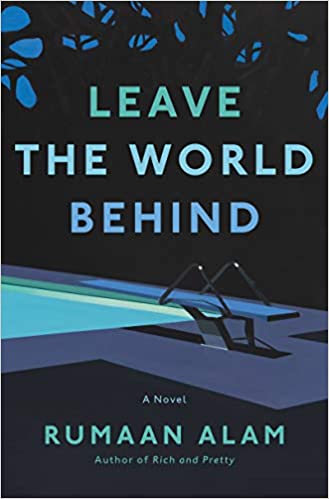
Leave the World Behind by Rumaan Alam

Ominous events throw two families together and off-balance in this captivating, thought-provoking novel.

Rumaan Alam (Rich and Pretty; That Kind of Mother) thrills and unsettles with Leave the World Behind, a novel about family and other relationships, getting what’s desired and reactions in the face of crisis.

The story begins mid-road trip, a white family of four on their way from the city to their vacation rental. Amanda is an account director in advertising, Clay an English professor; Archie is 15, Rose 13. They have an apartment in Brooklyn (“really Cobble Hill”) and a mid-range sedan somewhere between luxurious and bohemian. “The life they had was perfect,” Amanda frequently reflects, and yet they are jealous of their well-appointed Airbnb, its idealized decor and the imagined lives of its owners. The four of them enjoy the house, the pool, the beach. Their vacation is perfect if a little boring, like the family. Alam’s narrative and descriptions are gorgeously detailed and impeccably paced, so that this is a story for readers to sink into, effortless and comfortable, even sumptuous. Until a knock comes at the door.

Ruth and G.H. are the owners of the vacation home, and the arrival of the older couple in the middle of the night is disturbing enough, but their story is stranger: a blackout in New York City, fear driving them out into the country, invading the family’s perfect getaway. Amanda is suspicious. Unexpectedly, Ruth and G.H. are Black. Amanda wonders if it wouldn’t make more sense for them to clean this beautiful house, rather than own it.

The almost entirely undefined external situation–the reported blackout, loss of cell and Internet services, televisions reduced to blank blue screens–forces the four adults and two teenagers together and holds them there, a delicious narrative device that leaves them simmering. The resulting tension touches on generational differences, gender dynamics, class and race–Clay and Amanda are self-conscious of their faux-benign racism, and the story serves subtly as a criticism of social norms. There is a note of the locked-room mystery and heaps of foreboding. Readers gets meticulous details of Amanda’s grocery shopping and the vacation home’s furnishings, but the extent and nature of the outside threat is delivered in mere hints. “Some people got sick, because that was their constitution. Others listened and realized how little they understood about the world.”

Leave the World Behind is pitch-perfect in atmosphere, easy to read and deceptive in the high polish of its setting. Alam has crafted a deeply bewitching and disquieting masterpiece.


This review originally ran in the September 4, 2020 issue of Shelf Awareness for the Book Trade. To subscribe, click here.


Rating: 9 green porcelain lamps.